Knife poised at the CBC’s throat, here’s what Canadian conservatives have to say about it

August 21, 2024

Abacus has a new public opinion poll asking again about defunding the CBC.

But this time the pollster has a new angle on Canada’s biggest culture war issue. It’s measured the intensity of “defunding” opinions by plotting data on how close “defund the CBC” is to a “third rail” issue, a provocative policy in danger of backfiring on the political party promising action.

The poll results show that a campaign promise to defund the CBC is a ballot box winner with 22 per cent of voters and a dead loser with 30%. According to Abacus, a promise to kill the CBC brings it very close to that electrified third rail and, in an observation brimming with irony, puts it in the same territory as reviving the death penalty.

An important point from the survey not underlined by the pollster is that nearly half of respondents either didn’t have an opinion or indicated they “might” vote for a party pushing the defund CBC agenda. We should keep in mind that federal voter turnout in 2021 was only 59%: not all poll respondents vote and there may be a correlation between “I don’t know” on a poll and “I don’t vote” on election day.


Nevertheless, the existence of those “maybe” defunders is good enough for Pierre Poilievre and the Conservatives to stay the course. It also keeps the fundraising spigot open. Here’s a typical social media message from the Tory shadow Minister for Heritage, Rachel Thomas:

Without a doubt, defunding the CBC has long been a great fundraising hook for the Conservatives. The question the rest of us ask is whether they mean it quite so literally. 

Despite the firehose of CPC social media messaging, the Party’s latest publication of soberly-worded policy resolutions from its September 2023 convention is far more restrained on CBC bashing and even less emphatic than Erin O’Toole’s 2021 election platform (now scrubbed from the CPC website) which unambiguously promised to defund CBC English language television.

Says the new Conservative Party policy document:

The CBC/SRC is an important part of the broadcasting system in Canada. It must be a true public service broadcaster, relevant to Canadians. We will accordingly ensure the CBC/SRC:

  • rationalizes any programming that overlaps or competes with private sector equivalents
  • reduces its reliance upon government funding and subsidy
  • reflects regional and demographic diversity of Canada in its role as a public broadcaster; 
  • responds and is accountable to its audience; 
  • supplies balanced and non-partisan programming. 

…We believe that control and operations of the CBC/SRC could be best accomplished through establishing distinct budgets for the operations of the internet, TV, and radio broadcast functions.

(Emphasis added)

Reading that, it sounds more like the CBC might be overdue for a regular dental check-up.

Still, Poilievre and Thomas are so personally committed in their messaging that it’s hard to see them backing down without sacrificing a great deal of political capital (in fact Thomas is so hot on the issue she refused to endorse her leader’s continuation of funding for French-language Radio-Canada).

What applies here is the expression ‘when people keep telling you who they are, believe them.’

It’s interesting to consider what small “c” conservatives think of all this. With the 2025 federal election looming, they may be expected to fall in line. 

Globe & Mail columnist Andrew Coyne and Editorial Page Editor Pat Brethour don’t need any encouragement and have already called for defunding the CBC. Coyne would of course have to find a new side-gig to replace his regular appearances on CBC’s At Issue. Brethour has suggested the $1.4 billion budget savings be turned over to Canadian content creators in the guise of subsidies.

Sean Speer’s The Hub appears to have turned from grudging supporter of public broadcasting to pronouncing time’s up on the CBC’s last chance to appease conservative critics.

The last straw was a CBC human interest story concerning a transgendered man who gave birth to a child. While many might regard such a news item as a man-bites-dog story for the modern age, for Speer it’s the provocation worthy of the CBC’s coup de grâce:

Whatever one thinks about the story it’s hard to argue that it reflects broad public interest journalism. The article itself indicates that the individual’s chance of conceiving a child was 1.8 percent. The nature of their experience—particularly in St. John’s—is even more atypical. It’s highly niche content that is neither representative of the broad-based local experience nor informative of major national or international developments for a local audience.

It didn’t have to be this way.

…The decline in local news isn’t a new issue. It’s been a slowing-moving crisis. The CBC had plenty of time to reorient itself as a key part of the government’s response to these developments. But it has chosen not to.

In a parallel universe, the public broadcaster could have reconfigured its staff and other resources beyond the 40 or so communities (which mostly comprise provincial capitals and key population centres) in which it’s currently present.

There may be a role for public policy to support local journalism. That’s the subject of a worthy policy debate. But however one comes down on the question the CBC isn’t the answer. The CBC doesn’t do public interest local journalism anymore. It does identity politics. And that will ultimately be its downfall.

On the other hand, Rewrite blogger Peter Menzies is more interested in a mission re-boot for a public broadcaster that tacks further to the centre, stops competing with private news organizations for advertising revenue, and focuses on underserved audiences and markets. Here are some of his comments from an interview with Canadian Affairs, worth reading at full length:

FD: Poilievre has indicated he would cut $1 billion in federal subsidies from the CBC, while maintaining French and Indigenous programming. What do you make of this plan?

PM: I think [the plan] needs a lot of work. It depends how they want to define “defunding.” Right now, the CBC operates with a little under $2 billion in total revenue [and] $1.4 billion of that comes from the federal government. If you cut $1 billion [in federal funding], that leaves about $400 million. Currently, it costs about $500 million to run the French programming. So the math doesn’t work. You can’t cut a billion dollars and have much left over for French or English. 

You could [however] trim down its operations. So instead of having two radio networks in each language, you would just have one. You could get rid of what’s left of Radio Canada International, which is essentially an ethnic radio station. You could get rid of sports, etc. But [the Conservatives] need a far more precise plan. 

FD: In your opinion, what are the services that the CBC should be providing? And which of its current functions should be pared down?

PM: The CBC has the country’s most popular news-carrying website. So it’s doing that well. 

CBC Radio One is a market leader — often in first place and no worse than second — in every major population centre in the country from Halifax to Vancouver.  I think other [functions] like ICI Musique and its English equivalent are unnecessary. Private sector players like Apple Music and Spotify are already serving people with music.

You could take a good long look at merging CBC News Network and CBC over-the-air. 

But leave the French services alone, because the French market is entirely different from the English market. The [French] content is quite popular in Quebec. 

That still leaves about $400 million in television entertainment programming to discuss.

In the event you have concluded that MediaPolicy.ca endorses any of this budget cutting, I most emphatically do not. What is exciting from a policy point of view is the opportunity to reconsider what public broadcasting means to us, what we want to pay for, and whether we in fact might pay more not less.

I am not holding my breath that such a discussion will happen in an organized way prior to the next election. The government’s blue-ribbon committee is already charged with reporting to the Heritage Minister “regularly” and at some point perhaps we will know what they are telling her. In January, Pascale St-Onge said “I really want to achieve that before the next election, to make sure that our public broadcaster is (as) well-positioned as possible for the future.”

But unless the Liberal government deliberately chooses an expansive policy rethink over returning Conservative fire with its own wedge politics, the potential for thoughtful discussion will be overtaken by the rhetoric of election campaigns.

***

If you would like regular notifications of future posts from MediaPolicy.ca you can follow this site by signing up under the Follow button in the bottom right corner of the home page; 

or e-mail howard.law@bell.net to be added to the weekly update; 

or follow @howardalaw on X or Howard Law on LinkedIn.

How the Brits are going to do Canada one better on Bill C-18

August 17, 2024

Whenever MediaPolicy posts about mandatory digital news licensing payments —my description of the Online News Act Bill C-18 — I situate the Canadian narrative in the story of Google and Meta resisting similar regulatory schemes around the globe. 

Canada was not the first to hang a price tag on Big Tech exploiting its market power over news publishers. Featherweight Australia (population 26 million) did it in 2021 and recently news organizations renewed their agreements with Google. The European Union (450 million) broke ground a few years earlier with a scheme of mandatory copyright payments. A Senate bill modelled on Australia’s code failed in US Congress in 2022 (340M), but the Californian (40M) state legislature is considering a version of our C-18 right now.

What about in the United Kingdom (70M)?

In June the British parliament passed the Digital Markets, Competition and Consumer Act (DMCC). The bill is designed to give the Competition and Markets Authority (CMA) better police powers over Big Tech.

The CMA’s priority issues in digital are those you frequently hear about from the American and European jurisdictions: the phone app environment, digital advertising and most recently the Google monopoly in Search.

However the CMA now says it is going to get around to mandatory news licensing payments in due course. An analysis of the potential CMA approach to that issue was released July 31st by the British media consulting firm Enders and appears to speak in the voice of the public regulator.

Alas the Report is paywalled, so I offer some of its observations.

The backstory of the Australian and Canadian regulatory efforts is described much in the terms that MediaPolicy has told it previously

“Google undoubtedly gets value out of publisher content, but quantifying this is very difficult, as so much is indirect (with news queries not monetised). Regimes in Australia and Canada have in practice avoided direct quantification of a ‘fair’ value exchange even though that was their original intention. In Canada, Google ended up agreeing to a set payment amount annually.” 

In fact the report has nice things to say about how Canada handled the news licensing problem. It comments that “the ‘exception’ route of Canada involves some uncoupling of payments from a direct value exchange [pricing of news] —this seems like a fudge but in fact is more sensible in practice and principle, given the challenges of that direct calculation.”

I think that’s a good description of how initially both Australia and Canada designed “market correction” legislation for news payments, using binding arbitration as an enforcement backstop, with unpredictable pricing outcomes. But in the end Google and Meta just cut a deal with Australian news organizations and Google came to terms with the Canadian government at a fixed price they could live with. The lower, the better.

And then Meta walked away from news. First in Canada, probably soon in Australia. Since 2018, Meta has been degrading and down ranking news on its platforms and their news consumption in all countries has plummeted. So it looks like regulating them hastened the inevitable. 

Enders thinks the UK can do a better job regulating news licensing payments.

The availability and prominence of news on platforms is the prime directive of any public policy, says the report, “even if it isn’t directly legislated for.” That phrasing ought to tip you off.

Enders then lionizes Google’s various donations and collaborations with the news industry, geared towards staving off regulation, and concludes “any regime should incentivize —and must not disincentivize— such effective collaboration….The Act does not directly set out a news publisher bargaining regime [like Australia or Canada] and the UK may not end up with a dedicated news bargaining code at all if the CMA decides that existing [voluntary] deals [between platforms and publishers] and its own other interventions are sufficient.”

As for Meta, the Enders report appears to write off Facebook and Instagram.

The underlying assumption in the report is that it’s too hard to make Big Tech play nice if government is making the prescriptive rules on how they must pay for news. You have to find a “participative approach” they like better, at a price they are willing to pay. 

Now that might strike you as defeatist, but Enders (and British Parliament) would see it as pragmatic.

Here’s a chart Enders prepared which does a pro and con summary of the Australian, Canadian and EU regulatory efforts:

The bottom line in the report is its suggestion of a made-in-Britain approach with these features:

  • News licensing payments aren’t the top CMA priority under the DMCC, so while the regulatory body concentrates on digital advertising and mobile applications this gives Google and news publishers a window to come to terms that everyone can live with. It also leaves time to observe what kind of impact AI large language models are making on search engines and the news content that feeds them.
  • If that voluntary approach doesn’t work then the CMA may move. The DMCC already includes binding arbitration as the toughest measure on Google, but there would be alternatives.
  • Those alternative funding mechanisms —both are familiar to Canadians— might include a digital levy on Big Tech that is distributed directly to news organizations, or perhaps a direct government subsidy from a treasury increased by taxing Big Tech
  • Another potential policy move is to regulate news prominence on Big Tech platforms, although Enders flinches at the idea of a “must carry” rule for news on the platforms.

Throughout the report, its clear Enders believes that any price Big Tech pays for news must be fixed, not driven one arbitration outcome at a time, and (although Enders avoids saying so) low enough for Big Tech.

How the news journalism industry in the UK, Canada and around the world sorts this out will be the key to its financial sustainability. As this graphic in the Enders Report demonstrates, the digital news audience is declining not only on legacy platforms but on direct visits to owned and operated digital news sites, while rising on links through social media and search:

***

MediaPolicy wrote last month about the stunning Rogers scoop of high-margin programming licensed in Canada by Warner Brothers Discovery to Bell and Corus when those deals expire at the end of 2024.

Bell filed in Ontario court for an injunction against Rogers and WBD on the grounds of a two-year post-termination non-compete clause in the Bell-WBD licensing agreement. 

Rogers has filed its response and claims ignorance of the Bell-WBD non-compete, holding the US studio responsible and liable for any damages to Rogers. 

The drama has many more acts (I haven’t seen the WBD filing as yet). But if Bell is right about its non-compete protection, you have to wonder about the due diligence process just completed by Skydance Studios in its purchase of WBD. 

***

The recommended podcast experience for the week is cravenly self serving. Broadcast Dialogue has a 27-minute interview with the author of Canada vs California: How Ottawa took on Netflix and the streaming giants.

An amazingly urbane and sensible commentary on the continuing saga of the Online Streaming Act,  if I may so say so.

***

If you would like regular notifications of future posts from MediaPolicy.ca you can follow this site by signing up under the Follow button in the bottom right corner of the home page; 

or e-mail howard.law@bell.net to be added to the weekly update; 

or follow @howardalaw on X or Howard Law on LinkedIn.

The leaky Meta news ban is roiling Canadian journalism

From the McGill Report on Meta news engagement

August 11, 2024

The beginning of August marked the first anniversary of Meta’s 2023 ban on Canadian news content, its response to mandatory licensing payments required by the Online News Act, Bill C-18.

McGill University researchers released a report taking stock of the ban’s impact on the distribution and consumption of news on social media platforms including Meta’s Facebook and Instagram but also Twitter, YouTube and TikTok.

The Report’s headline finding is that engagement with Canadian news on Meta’s platforms is down 85% from before last year’s ban, to the tune of eleven million views daily. It’s not an airtight 100% disengagement, according to the Report, because Meta is not weeding out the user uploaded workarounds, screen shots of news items and modified hyperlinks to online news.

The Facebook/Instagram presence on social media is so dominant that an 85% reduction in Meta news engagement results in a 43% decline in total social media distribution of news. TikTok was up 24%, but Google’s YouTube was down 22%. Twitter held its ground. (See the right-side graphic above).

It’s unclear what role is played by the known increase in “news avoidance” by consumers. The Canadian breakout of the global Reuters survey of digital news noted that news engagement on Facebook had been declining long before its news ban came into effect: from 46% to 29% of Canadians seeking news at least weekly on Facebook in the seven years preceding Meta’s news ban. The downdraft of news engagement on the ban-free YouTube also suggests there is more going on than the Meta news block.

Nevertheless, the loss of news engagement on Meta platforms has a major (and alarming) impact on news consumption by “incidental” consumers who graze for news about current affairs on social media instead of conventional print, broadcast and digital news platforms. According to the McGill Report:

Some highly-motivated Canadians seek news outside of social media platforms through other means, either via news subscriptions, digital news websites, or television and radio, and are likely not severely impacted by the ban. However, active news seekers are the minority. The average Canadian does not frequently consume news, particularly about politics (in fact, 40% actively avoid it) and will likely only become aware of current events by being incidentally exposed to content about it online. Much of this incidental exposure to news is facilitated by social media, such as through friends and family discussing politics online or algorithmic feeds pushing trending content whenever a major event happens. This news exposure has been dramatically reduced due to the Meta news ban.

The McGill Report’s dismal findings about post-ban news consumption on Meta platforms, expected as they were, reignited public criticism of both the government’s decision to legislate in the first place or, on the other hand, Meta’s response.

One of the fuse lighters was Chuck Lapointe, publisher of Narcity.com, a chain of local news and lifestyle websites. Like many other small or local publishers, Lapointe describes the loss of Meta platforms as a disaster for his content distribution.

The first anniversary of the Meta ban coincided with Lapointe’s Narcity losing its appeal of eligibility for the federal Qualified Canadian Journalism Organization (QCJO) program that subsidizes the salary of each employed journalist provided the news site is “engaged” in publishing “original news.” 

According to Lapointe, his publications were declared ineligible for being insufficiently “engaged” in producing original news; that’s legalese for not publishing first-hand reporting frequently enough. Lapointe says that his site posted original news —-as opposed to aggregated or re-written content—- once or twice weekly. 

There is no bright red line in federal QCJO guidelines on how frequently a news site must publish original news to be eligible for QCJO. The only useful benchmark in the guidelines is that once a news outlet is determined to publish original news on a frequent basis, the news outlet is remunerated up to $30,000 for the annual salary of each journalist who works at least 75% of their working hours “engaged in the production of original written news content.”

As you can see, the QCJO funding rules for “per journalist” payroll subsidies are not the same as Online News Act licensing payments that instead are tied to the publication of “news content” that is “made available” by a “Digital News Intermediary” platform, i.e. Facebook or Google. The “news content” does not have to be original reporting and there is no requirement for the frequency of “availability.”

On the heels of that QCJO ruling, Lapointe announced that his site has been welcomed back on Facebook and Instagram because, as he said in a LinkedIn post, Meta has accepted his argument that Narcity’s ineligibility for QCJO means the publication is no longer a “news outlet” that Meta bans so that it can avoid financial liability for “making news available” under Bill C-18. 

Lapointe characterized Meta replatforming his editorial content as Narcity “opting out” of the Online News Act itself, encouraging other news outlets to forgoing QCJO payments in exchange for regaining distribution on Facebook:

All news publications — who are QCJO designated — even if you want no part in Bill C-18, are LOCKED-IN. The Online News Act automatically includes you if you are designated as QCJO… 

You have no way to opt-out and no way to get your Meta distribution back.

I hope that the news of our Re-instatement on Meta will trigger a re-evaluation of the Online News Act and allow the option for people to opt-out if they don’t see the business benefits of participating.

We should’ve done this earlier. What a f*cking trip. Anywho, we’re back on Meta, see you there.

Meta has always maintained a portal inviting outlets such as Narcity to declare themselves not to be “news outlets” as defined by the Online News Act (which is not quite the same as being disqualifying from the QCJO program which requires frequent original news reporting). Says the Meta attestation: 

Furthermore, you acknowledge that this submission constitutes a legally binding statement acknowledging that you are not a news outlet or business producing news content within the meaning of the Canadian Online News Act.”

No doubt Meta’s lawyers have thought about this, but a news site’s ineligibility for QCJO payments is not dispositive of whether a media website is a “news outlet” publishing “news content” under the Online News Act Bill C-18 (for example, digital news published by television companies is ineligible for the QCJO program but they are clearly C-18 “news outlets” whose “news content” is being blocked by Meta). 

Just as an illustration of this strange state of affairs, it didn’t take me long yesterday to locate on Facebook an organic posting of my own linked news content (published by Monitormag.ca) posted last January in the thick of the news ban:

The question then arises, how much of the 15% of remaining news engagement on Meta platforms is not screen grabs or modified links but rather organic posts of “news content” cleared for flight by Meta? Could Meta be ghosting into “making news available,” the legal trigger for licensing payments under the Online News Act?

Heritage Minister Pascale St.-Onge, whose government certainly did not appreciate being punked by Meta last August, publicly expressed her concerns but acknowledged that Meta’s status as a Digital News Intermediary (DNI) under Bill C-18 is something for the CRTC to determine.

For its part, the CRTC’s response to a Canadian Press reporter was an audible diving beneath a desk. A Commission spokesperson confirmed that section 7 of the legislation requires a company like Meta to self identify as a DNI. Section 7 is oddly silent on the consequence of a DNI failing to notify the Commission of DNI status, although there exist general provisions for the CRTC assessing fines for non-compliance under the Act.

“Some reports have claimed that Meta continues to make news available; however, the CRTC would require further evidence to take further action,” the Commission stated.

Where does that leave us? If Meta is making news content available on its platforms, whether posted by users or media “opt-outs,” then any one of several hundred news outlets that have lost access to Facebook and Instagram might take it badly.

The “undue preference” rules in section 51 of C-18 could come into play as news outlets might ask the CRTC to get out from beneath the desk and consider whether Meta is favouring some media outlets and discriminating against others in the operation of its leaky news ban.

The context for all of this remains Meta’s global strategy to resist mandatory news licensing payments wherever it can. 

Although the European Union’s scheme of licensing payments for news appears cemented, Meta has announced its refusal to renew compensation agreements in Australia, with a preemptive threat of another news ban, while the Australian government is considering its legislative response “imminently.”

Within the walls of Big Tech’s Alamo, that is to say in California, the state legislature is proceeding with a version of Canada’s Bill C-18 that has cleared legislative committee votes by large voting margins.

***

In commenting on the Big Tech issues above, I may have buried the lede.

Last week a US federal judge ruled that Google is operating an illegal monopoly in its Search Engine business. The case turned on the judge’s finding that Google’s multi-billion dollar deals with Apple to become the default search engine on iPhone browsers was an abuse of market power. Matt Stoller has an excellent summary here.

I can’t help but observe that Google’s Search monopoly was the policy starting point for Ottawa legislating the Online News Act.

Google also chose the first of August to pass along corporate tax liabilities to its customers in Canada, Italy, Turkey and Spain in response to national Digital Services Taxes activated in each of those countries. MediaPolicy published an analysis of the Canadian DST and the retaliatory Google increase to Canadian advertising rates here.

***

If you would like regular notifications of future posts from MediaPolicy.ca you can follow this site by signing up under the Follow button in the bottom right corner of the home page; 

or e-mail howard.law@bell.net to be added to the weekly update; 

or follow @howardalaw on X or Howard Law on LinkedIn.

Google raises prices for Canadian advertisers in rebuke to Digital Services Tax

August 7, 2024

The controversial federal Digital Services Tax is back in the news after Google raised prices charged to its Canadian advertisers by 2.5 per cent last week.

The August 1 price hike stoked demands from some Canadian commentators that Finance Minister Chrystia Freeland unilaterally withdraw Ottawa’s three per cent DST on a range of digital services offered in Canada by the largest Big Tech companies including Google, Meta, and Uber. One estimate puts the new tax revenue at $1 billion flowing annually into federal coffers.

Freeland’s DST came into effect on July 1, 2024 (and retroactive to January 1, 2022) but payment of the tax bill is not due until July 2025.

At the same time, Google raised prices in response to other national DSTs in Turkey, Spain, and Italy. Operator of the world’s dominant search engine, Google pulled the same trigger in 2021 in India and France and before that in 2020 in the United Kingdom and Austria. To get the point across, a well-designed web page on Google’s site allows you to toggle between price increases tied to each nation’s DST legislation. There is an “other” tab (for other countries contemplating a DST).

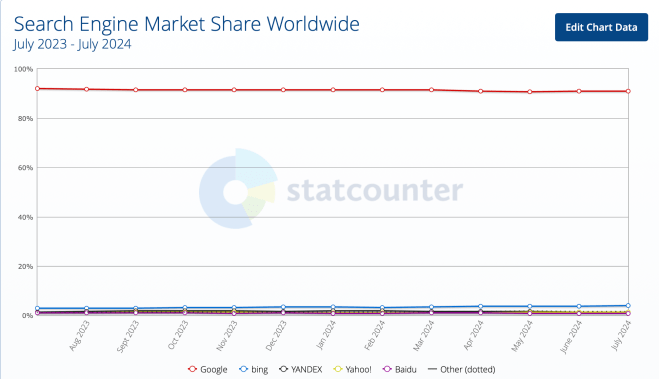
Google Search global market share

In addition to the Canadian Chamber of Commerce calling upon Ottawa to rescind the DST, Ontario Finance Minister Pete Bethlenfalvy made the same request, fearing trade retaliation by the United States. 

The debate revives traumatic political memories of the “split run magazine” dispute between Canada and the US in the late 1990s. The United States was successful in getting Ottawa to climb down from a law designed to prevent the US magazine industry from trade dumping into the Canadian magazine market. The US threatened retaliatory trade sanctions against Canadian plastics, wood and steel products manufactured in the electoral ridings of federal ministers. 

Why a DST?

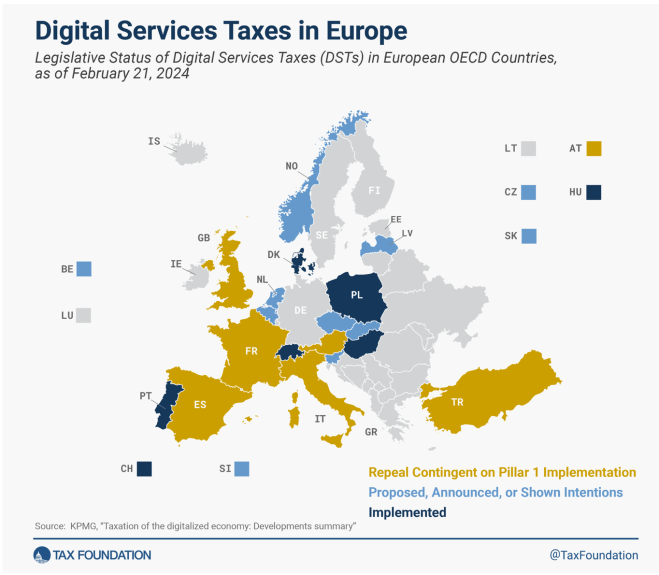
Several member nations of the Organisation for Economic Cooperation and Development (OECD) have implemented a national tax on digital services at rates varying from 2 to 7.5 per cent of revenues as a proxy for a higher percentage tax on profits. 

Source: Federal budget document, April 2024

The ambit of digital services taxed depends on the national jurisdiction, but most focus on digital advertising and the monetization of customer data.

As illustrated below, European OECD nations are further ahead than Canada in introducing a DST:

The 38-nation OECD maintains a strong position against tax avoidance and jurisdiction shopping by global companies. It cast its eye on American Big Tech as early as 2013. 

The delicately phrased “tax base erosion and profit shifting” problem is most acute in global digital services which represent significant economic activity in host nations and confer a competitive tax advantage over domestic media companies. In short, it’s another iteration of the GAFAM/FAANG problem. 

However, throughout the term of the Trump administration the US remained unmoved. Readers may recall that Trump  threatened tariffs on wine, handbags and cosmetics if France went forward with its proposed digital services tax. 

Perhaps because Trump lost the November 2020 election, OECD nations resumed legislating their own digital services taxes, first the United Kingdom (2%) and shortly thereafter France (3%). 

In 2021 incoming President Joe Biden’s administration continued the threats of tariff retaliation while engaging in negotiations with OECD nations. In October, Biden unveiled a tentative agreement with OECD nations that included the “Pillar One” substitute for DSTs, a 25% tax levied on a one-quarter share of excess corporate profits (rather than revenues):

For companies with global revenues of more than US $26.4 billion and profitability above 10 percent, 25 percent of profits above 10 percent would be taxed according to a new formula based on where a company’s customers are located.

OECD Pillar One – Tax Glossary

The Pillar One deal was scheduled to come into effect no later than December 31, 2023. Once the agreement was ratified by national legislatures, nations with existing DSTs would repeal them by the deadline. 

As for Canada, the federal Liberals had previously announced in November 2020 their plan to legislate a DST in the spring 2021 federal budget and had followed through in April 2021. The Canadian DST was set be triggered on January 1, 2024 if the Biden deal was not ratified by US Congress.

US Congress “couldn’t name a post office”

The Pillar One deadline passed uneventfully in Washington and, as of August 2024, Biden has yet to get his deal through either chamber of US Congress. 

The Democrats do not have the two-thirds majority in the Senate to ratify the tax convention. Up until January 2022 the Democrats enjoyed only a slim majority in the House of Representatives before Republicans took over in the 2022 mid-terms.

A recent internal Congressional report estimates that under Pillar One the US loss of corporate taxes collected from Big Tech will exceed one billion dollars annually.

This March, the Republican chair of the all-important House Tax Committee hit his rhetorical stride, declaring the “proposal will not equalize the playing field, this tax burden will fall disproportionately on American companies, which are nearly half of the largest and most profitable in the world,” said Mike Kelly (R-PA)

“Let’s state the facts here. Two-thirds majority is required in the Senate for enactment of Pillar One. In today’s political environment, it is hard to believe that we get that much support on naming a post office, let alone an international tax treaty.”

It appears that Biden’s deal is dead in the water unless Kamala Harris becomes President and Democrats take full control over both houses of Congress, a partisan triple crown that was last achieved by Republicans in 2017 and by Democrats in 2008.

A more dignified solution?

The elephant in the room is always American trade retaliation.

But ignoring the elephant for the moment, DSTs do enjoy expert support. Writing last year in Forbes magazine, American tax commentator Robert Goulder characterized DSTs as a clunky policy instrument but a no-brainer for tax jurisdictions getting the short end of the stick from Big Tech:

It’s tempting to take the above statistic (13 of 18 firms paid more DST [in Britain] than [corporate] income tax) as evidence that [revenue rather than profit] taxation can indeed function as a safeguard against profit shifting. Would I prefer to get there by means of a more dignified solution? You bet I would, but that’s not on offer. DST is what’s on offer. At this point, a country is foolish not to have one — if for no other reason than it adds leverage for Pillar one. 

In a similar vein, Canadian tax expert Allison Christians is quoted in the recent Globe and Mail story on the DST suggesting it is an effective tax tool for Canada, adding:

It’s surprising to me when people rush to bash any tax on a foreign company that comes to Canada, takes out our advertising industry completely, and all the advertising dollars are going to U.S. firms, like Facebook or Google.

Getting back to the elephant, Big Tech’s lobby group describes the Canadian DST as a “contagion” and a bad precedent for the US given that Canada is its biggest trade partner, notwithstanding the British and European DSTs currently in place.

The Canadian DST might find itself making a guest appearance at the bargaining table of any number of bilateral trade disputes or else at the scheduled 2026 review of the Canada-United States-Mexico Trade Agreement (CUSMA). It is not unusual for the trade partners to load up on grievances in anticipation of talks. US Congress already has a wish list that includes the Online Streaming Act Bill C-11 and the Online News Act Bill C-18.

The concern as always is that the US might ignore mandatory trade dispute resolution and instead act unilaterally and preemptively with retaliatory tariffs, especially in the event of a second Trump administration. Trump memorably repudiated the Trans Pacific Partnership trade deal on his third day in office in 2017 and later hit Canada with illegal steel and aluminum tariffs as a bargaining ploy during the 2018 renewal negotiations of CUSMA.

It’s not clear if the Trudeau government can count on Opposition support for the DST, or if Pierre Poilievre forms the next government whether he will defend it. The Conservatives campaigned in 2021 in favour of a DST, but the Conservatives also abandoned campaign promises on both the Online Streaming Act and a bill that the Liberal government eventually introduced as the Online News Act.

***

If you would like regular notifications of future posts from MediaPolicy.ca you can follow this site by signing up under the Follow button in the bottom right corner of the home page; 

or e-mail howard.law@bell.net to be added to the weekly update; 

or follow @howardalaw on X or Howard Law on LinkedIn.

Pollara Poll on trust in media is full of news nuggets

August 5, 2024

The Reuters Digital News report on journalism was released in June and MediaPolicy posted observations about both the global results and the Canadian outcomes.

Another month and another report, the July survey results from Pollara titled “trust in [Canadian] media” are available:

The new poll asks some good questions and gets some intriguing results. Here are a few that I found insightful:

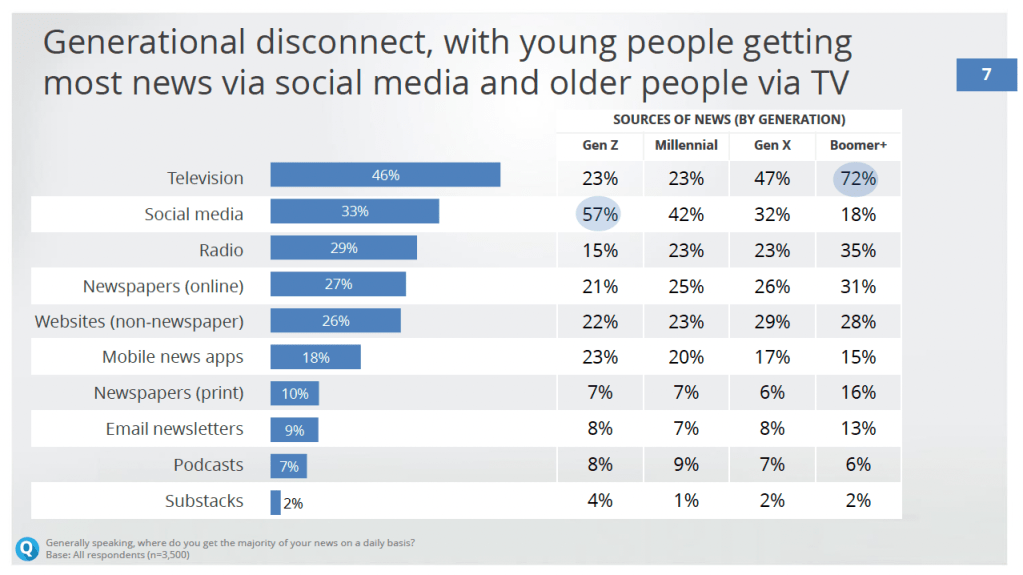
  • With nine out of fifteen million Canadian homes subscribing to cable with a CRTC-capped price on local stations, “legacy” television remains the dominant news provider. Together radio and television broadcasting are heavily favoured by boomers (born before 1965) but clearly not by Gen Z or millennials (born after 1980) who are committed in large numbers to getting their news from organic posts or through hyperlinks on social media platforms. That generation gap is Pollara’s headline observation. But the same data reveals a narrow generation gap in consuming text journalism offered online by newspapers and other media providers. That’s encouraging:

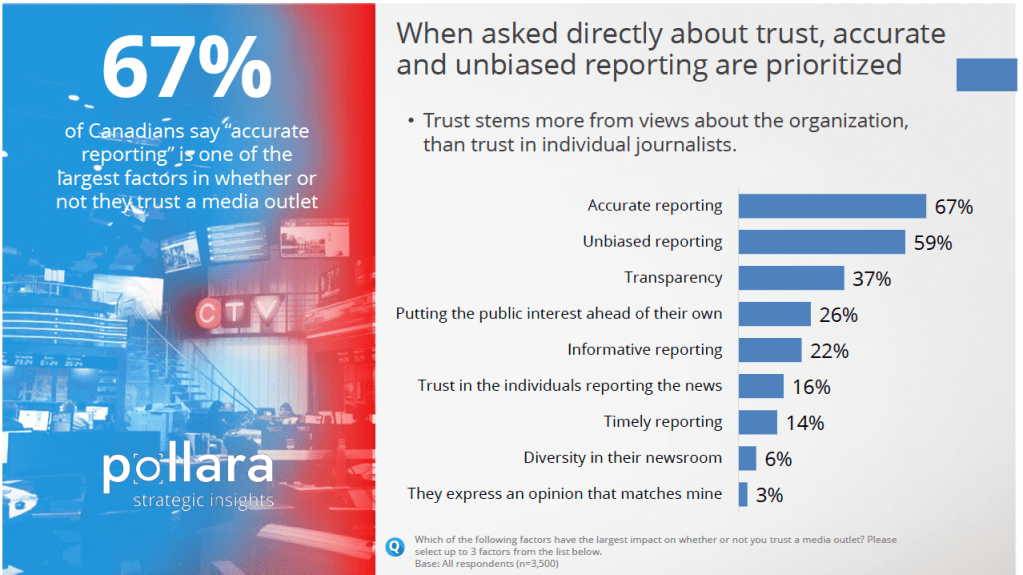
  • In general, public opinion on “trust” in media often presents as a riddle: individual news consumers appear to equate “trust” of a news outlet with their own loyalty to a news outlet. This poll asked respondents for their top criteria of what they mean by “trust” and pollsters got this result when respondents were asked to pick up to three answer statements:

The respondents’ top ranking of accurate reporting (67%) and unbiased reporting (59%) is a “good” answer, as is the ultra low ranking of “express an opinion that matches mine.” (3% of respondents)

That public altruism is difficult to square with the same question in the Reuters survey which included the answer statements “represent people like me fairly” (65%) and “similar values to me” (56%).

The Pollara poll got similar results to Reuters by finding a gap between news consumers’ trust in their preferred news outlet, versus the ones they dislike or don’t follow (see slide 15).

For a little fun as the long weekend ebbs, try this little exercise: mark each of the top ten Canadian news sites on this slide as “conservative,” “centrist,” or “progressive”:

Again just for fun, you can check your answers against this slide on popularity of news outlets measured by “voter intention:”

To conclude, consider whether there is a correlation between your results and Conservative leader Pierre Poilievre’s positions on news journalists, news outlets, and defunding the CBC.

And have a good week.

***

If you would like regular notifications of future posts from MediaPolicy.ca you can follow this site by signing up under the Follow button in the bottom right corner of the home page; 

or e-mail howard.law@bell.net to be added to the weekly update; 

or follow @howardalaw on X or Howard Law on LinkedIn.

Catching Up on MediaPolicy – local television subsidies – Google re-ups in Australia – Music labels angry at CRTC levy – NBA rights go to Amazon – How to fix the CBC

July 27, 2024

This week MediaPolicy posted again about local television news.

The occasion is that the CRTC is kicking off a new proceeding to reconsider the Independent Local News Fund. The gist of the post is to observe that it’s a very difficult task and asks the disruptive question: who needs news journalism subsidies more than others?

***

There is a report out of Australia that Google has renewed its three-year licensing deals with news outlets, keeping the platform from being regulated by the News Media Bargaining Code, the equivalent of Canada’s Online News Act. It’s five year deals don’t expire until 2026. The recent renewals are for recurring one-year terms, inviting some reading of tea-leaves as to Google’s long term intentions. 

The value of the deals are not being released, consistent with Google’s strategy of keeping the public, governments, and news outlets in other countries guessing about the value of compensation.

***

The CRTC’s June 4th ruling on audio streamer contributions to Canadian media funds was pegged at an unexpectedly high 5% (reduced to 4.65% if you deduct the portion that can be withheld by streamers to spend directly on Canadian music). 

If you listened to Michael Geist’ recent podcast interview of ex-Spotify chief economist Will Page (I recommended it last weekend) you know that the streamer industry believes the 5% contribution is outrageous and could provoke global music streamers to at best raise subscription prices or at worst exit the Canadian market. 

This week the global music labels chimed in: here is a statement from Music Canada’s Patrick Rogers making the same prediction. 

My own view is that the 5% is too high, although I haven’t written at length about that (another day). But note that the streamers and labels are not offering to match lower contributions to any special efforts to make Canadian music discoverable. That’s how Canadian radio does it.

As for the audio streamers’ ability to absorb the 5% hit, obviously the Tech conglomerates YouTube, Apple TV and Amazon are able to fight for market share with no expense spared. On the other hand, the industry leading Spotify does not enjoy that advantage. Instead, Spotify has been raising prices and laying off staff. Its most recent quarterly disclosure announces a 29% profit margin.

***

The National Basketball Association has refused to renew its television deal with TNT Sports (owned by Warner Brothers Discovery).

TNT has held the rights for 40 years and was coming off a nine-year deal that included a right-to-match any better offers. Warner said it matched the new offer from Amazon, Disney and Comcast’s NBC Universal. The league said it didn’t. They’re off to court.

Major league sports programming is the biggest and most reliably monetized content in television. So much so, that sports-only streamers like DAZN have driven the value of rights steadily upwards. The Big Tech streamers are also in the rights bidding picture, nibbling away. This is a big bite. If Amazon wins this fight, look to other streamers to up their game.

***

The great CBC rethink is picking up steam among policy commentators. There’s an intelligent piece from David Skinner here. It touches on too many important ideas to summarize, but it’s well worth the five minute read. 

***

Errors, omissions, and corrections: three of them in one week (but only one is my fault!).

  • In a post last week MediaPolicy analyzed an opinion poll conducted by Public Square on behalf of The Hub. My post noted the nefarious fact that only six of the 24 questions —-the Hub article said there were 24 in all— were published. After publication, the good folks at The Hub clarified that the “24 questions” included multiple choice questions. The Hub sent me the full results and indeed no questions or answers had gone unpublished. 
  • In previous posts I estimated that the $200 million figure provided by the CRTC as the total amount of annual streamer contributions to Canadian media funds was likely divided $150 million for video and $50 million for audio. My estimate was an extrapolation from 2022 data available on the CRTC website. When I asked the CRTC to confirm or clarify the $150 and $50 million figures, its spokesperson declined to comment. However in the Commission’s recent Notice of Consultation concerning the Independent Local News Fund, it specifies that the 1.5% tranche from the video streamers’ overall 5% contribution is worth $42 million. Doing a little math, that means the overall video streamer contribution is $140 million, not $150 million. While I am on the subject, I should remind readers that the CRTC’s ruling allow streamers to hold back a portion of the levy to spend directly on their own Canadian content: 1.5% of 5% for video and 0.35% for audio. Accordingly, the contribution figures of $140 million and $60 million will be lower. 
  • I made a howler of a typographical error in my Friday post, it will amuse you. Here’s the corrected sentence, the bold text was missing in the original: “Finally, a third very taboo question is not asked: what’s an “underserved market” after Pierre Poilievre’s Conservatives follow through on their promise to close English-language television CBC stations?”

***

If you would like regular notifications of future posts from MediaPolicy.ca you can follow this site by signing up under the Follow button in the bottom right corner of the home page; 

or e-mail howard.law@bell.net to be added to the weekly update; 

or follow @howardalaw on X or Howard Law on LinkedIn.



Can the CRTC solve the riddle of local TV news?

July 26, 2024

The CRTC has launched its long-delayed proceeding to sort out what to do with the Independent Local News Fund.

The ILNF is an $18 million per year subsidy for broadcasts of original local news. It supports 19 independently owned television stations in 13 markets located in small cities (but also Hamilton and St.John’s). Here’s the latest distribution report from the Canadian Association of Broadcasters:

The $18 million comes from a CRTC “local expression” tithe on Canadian cable company revenue, precisely 0.3%. A recent regulatory filing by those stations acknowledged that the subsidy underwrites a staggering 70% of news production costs.

The CRTC created the $20 million ILNF in 2016: until then a smaller $10 million per year fund had been available only to small market broadcasters, regardless of corporate ownership.

Alas the CRTC’s approval of the Rogers-Shaw merger in March 2022 upset the ILNF apple cart. In selling to Rogers, Brad Shaw cut loose his family’s debt-laden Corus Entertainment property, including its 15-city Global News chain. That meant Global lost the annual $13 million in special news funding owed by its former parent cable company.

On the other hand, as a newly “independent” broadcaster, Global had a slam-dunk claim to a share of the $18 million ILNF fund. But based on its size, Global would be entitled to at least half the fund, beggaring the other 19 stations.

Faced with that regulatory conundrum, then CRTC Chair Ian Scott shrugged and said, in so many words, we’ll get around to that later, thanks.

Two years later and here we are. At least two important things have changed. First, Corus and Global stand on the brink of insolvency or else some Houdini-style refinancing. Second, the CRTC has just ordered online streamers to pony up 1.5% of annual revenues for the ILNF, approximately $42 million annually. In theory, the ILNF is now flush.

At least two important things have not changed.

The first is that television remains the top distribution platform for Canadian news journalism.

The second is the economics of local news broadcasting. Canadian conventional television (i.e. local stations that belong to either major networks or independent owners) has been unprofitable since 2012 and more recently in 2023 operated $423 million in the red (a thirty per cent loss margin). Meanwhile, stations spend $379 million on news production. According to a data tabulation prepared by Statistics Canada for Communications Management Inc., 84% of stations lose money, regardless of ownership. These are the inconvenient facts.

The Commission plans a big rethink of local news funding some time in 2025 but in the meantime, they are going to figure out the ILNF. It seems to be avoiding the simple solution which would presumably be thus: subsidize Global stations in the same manner as the other 19 stations. The injection of cash from the online streamers permits that.

Instead, the Commission is ruminating big changes to the distribution of the news production subsidy.

The first question is whether online news broadcasters —those without a CRTC license governing over-the-air television signals— could become eligible for the ILNF. The possibility of admitting registered Internet broadcasters suggests a proliferation of applicants to the ILNF, even American-owned in theory. It also raises the brain-teasing question of whether the video-heavy news websites run by licensed broadcasters are eligible too.

The second question posed by the Commission is whether ILNF dollars should be prioritized for French language news and for “rural, remote and underserved communities.” Up until now, ILNF funds have been dispersed on the basis of independent ownership status. Out of curiosity about the potential definition of “rural, remote and underserved communities,” I put together the spreadsheet below (ILNF recipients in red). Feel free to respond to me with corrections:

Finally, a third very taboo question is not asked: what’s an “underserved market” after Pierre Poilievre’s Conservatives follow through on their promise to close English-language CBC television stations?

The riddle of news production subsidies will not be easily solved by the Commission, especially in the context of this new proceeding for the ILNF. 

Television news is part of a larger news ecosystem, including online, print, and radio. Support for news journalism consists of several overlapping federal and provincial government programs, public broadcasting, Google’s licensing payments and CRTC levies. As well, the eligibility criteria is not uniform: for example television news websites are ineligible for federal dollars. 

The Commissioners have their work cut out for them.

***

If you would like regular notifications of future posts from MediaPolicy.ca you can follow this site by signing up under the Follow button in the bottom right corner of the home page; 

or e-mail howard.law@bell.net to be added to the weekly update; 

or follow @howardalaw on X or Howard Law on LinkedIn.
Catching up on MediaPolicy – The Globe’s plan to deregulate broadcasting – Corus to the debt wall – Page on music streaming

July 20, 2024

It’s possible that readers of this space have figured out that I start my day with the Globe and Mail. The print edition home delivered, thank you very much.

That’s for many reasons, including the beat reporters who do such a good job covering media policy (a shout out for Marie Woolf and prior to her Alexandra Posadzki and James Bradshaw). It amazes me they can get a handle on complex regulatory issues as adroitly as they do. Journalists, like lawyers, are quick studies (but paid so much less).

The Globe’s Editorial Board, now that’s a different story.

In response to the CRTC’s $200 million Canadian content levy on foreign streamers last month, the Globe advocated for the full deregulation of Canadian broadcasting. Instead, financial aid for Canadian drama programming, musician development and local news currently tithed from major Canadian broadcasters and US streamers would be replaced by federal subsidies created by…. defunding English language CBC television. 

As you can see, it’s a meaty editorial. And well salted. The beneficiaries of Canadian content tithes are snidely identified by the billionaire-backed Globe and Mail as “assorted worthy groups.” Yes, those would be independent Canadian television producers, Canadian bands, small market radio stations, and independent television stations broadcasting in small and mid-sized cities. 

Then there are the factual errors: “Netflix already spends substantial sums on Canadian content,” says the Globe. They do? Name a figure. Name some Canadian originals Netflix made. Somebody’s been reading off of the Hollywood Motion Picture Association’s lobby notes. 

More cogently, the editorial argues that broadcasters’ and streamers’ ability-to-pay the regulatory cross-subsidies of key cultural and news content identified in the Broadcasting Act is not what it once was and that burden ought to be shifted from media companies and their customers to governments and their taxpayers.

The editorial reads very much like an opinion column or six you might have read under the byline of Andrew Coyne, the Globe’s libertarian-in-residence. I’m tempted to rebut further in the interest of perspective and context, but I already did.

By coincidence, this week MediaPolicy published two posts which bear upon the issues raised in the Globe editorial. The first is my argument that the Online Streaming Act, which updates the Broadcasting Act for the Internet era, rests on consensus liberal values shared by most Canadians. So perhaps we can stop carrying on like it’s a winner-take-all culture war to be fought between ideological hostiles. 

The second post offers some thoughts on a recent opinion poll on news funding, commissioned by the conservative opinion website The Hub. My conclusion is the same: there is more we agree upon than disagree on Canada’s media policy. Let’s take the heated debate down a notch. 

***

It’s a grim summer at Corus Entertainment. Six weeks from now the banks can invoke loan conditions that would seem to require immediate debt pay downs. The company is planning hundreds of new layoffs, including staff at its 15-city Global News television network. 

The new co-CEO Troy Reeb is trying to buck up shareholder and employee morale by saying that Corus can replace the profitable lifestyle television programming it just lost to Rogers with new US shows and that Corus still has a vibrant schedule of Canadian shows for Canadian audiences. 

Unifor National President Lana Payne, a former journalist, issued a statement in which she said “the media sector is under extreme threat, and we are at a critical juncture where we need life-saving intervention, including a plan from every single political party in Canada, to save local news. We would expect this necessary plan to receive all party support so that media workers can see this country supports fact-based journalism and democracy.”

Unifor represents Global TV employees across the country.

***

Last week MediaPolicy updated you on Paramount’s sale to Skydance Media.

There’s more activity in Hollywood this week. Netflix issued a positive quarterly report, solidifying its position as the runaway industry leader.

Elsewhere, debt-burdened Warner Brothers Discovery is reported to be considering splitting the company in half, but not into its pre-merger constituent parts. Instead, the reshuffle would cut loose studio production and the Max streaming platform, debt-free from the struggling cable business.

The folks at Corus may recognize the strategy.

***

If you have a taste for digging deeper into music streaming and CRTC regulation, there’s a Michael Geist podcast with guest Will Page you should listen to. MediaPolicy has posted before about Page, Spotify’s former chief economist and current proxy spokesperson. He’s got some definite opinions, specifically he is opposed to any and all regulation of music streaming and he wants to tell you why.


***

If you would like regular notifications of future posts from MediaPolicy.ca you can follow this site by signing up under the Follow button in the bottom right corner of the home page; 

or e-mail howard.law@bell.net to be added to the weekly update; 

or follow @howardalaw on X or Howard Law on LinkedIn.
We all agree: news journalism subsidies are necessary.

July 17, 2024

Last week the conservative opinion website The Hub collaborated with the pollster Public Square to publish a public opinion survey in support of three public policy recommendations, posed as an alternative to the Liberal government’s program to address market failure in Canadians news.

The article and poll summary is titled “DeepDive: New polling shows government funding of the news industry is eroding Canadians’ trust in the media.” 

Despite the gloomy headline it’s a refreshing dialogue, more constructive than the position taken by The Hub’s preferred candidate for Prime Minister, Pierre Poilievre. If elected, Poilievre plans to “defund the CBC,” repeal the 2019 federal aid to written news journalism, “kill Bill C-11” (which authorizes mandatory subsidies to broadcasting news), and kill Bill C-63, the Online Harms legislation. So much killing. 

Less bloody minded, The Hub proposes to replace Ottawa’s $35 million per year Journalism Labour Tax Credit by greatly expanding its companion Reader Subscription Tax Credit. The Hub also recommends making for-profit news organizations eligible for charitable donations and converting the CBC into a national wire service for local news. 

The first two recommendations are built on the Public Square survey, of which six of the 24 questions and answers have been published while the other eighteen have been withheld. [Note: Public Square has clarified that the “24 questions” include sub-field responses to the six questions in total.]

The poll identifies a lack of trust in subsidized media, the jump off point for The Hub recommending a larger role for private choice in allocating subsidies. In a nutshell, the polling results suggest a low level of public awareness of the existing Labour Tax credits that subsidize journalist salaries but, at least hypothetically, a real public concern about the risks of government funding of news journalism. 

This leads The Hub to recommend that policy makers prioritize subscription rebates and charitable donation write-offs as better public subsidies than the federal Labour Tax Credit’s that currently reimburses news outlets for 35% of journalist salaries.

Because The Hub anchored its recommendations in the Public Square poll, the survey deserves a closer look. Where I am going with this is to suggest that regardless of the merits of the recommendations, building them on the foundation of a poll on public trust in media neither advances nor undermines them. Declining trust in media and other civic institutions is a decades-old trend, an intractable problem that has very little to do with news journalism. 

The Public Square survey is thankfully not one of those polls torqued with loaded questions about the federal government’s media strategy (I could point to a few others).

But it’s the nature of the polling beast that questions drive answers. When it comes to detailed policy issues, it’s difficult for a pollster to phrase a question for a broad and relatively underinformed public audience that isn’t interpreted by respondents in very different ways.

trust in news outlets

When respondents were asked by Public Square to choose a general statement that comes closest to “your views of the news in Canada,” the available answers included “most of the news is biased,” “I don’t get the truth from mainstream news,” or conversely “I know I’m getting the truth from mainstream news.”

Putting aside the fact there is no statement querying public trust in “non-mainstream news,” the trouble with the question is that it’s like sticking a thermometer in the ocean and declaring the results to be a weather report. Does anyone really expect to get “the truth” from all news stories and all news outlets all of the time? 

By contrast, when Reuters polled on “trust in media” it carefully asked if respondents “think you can trust most news, most of the time.” The results, while far from encouraging, ran about 20% higher than the Public Square findings. 

Another vexing topic probed in the Public Square survey is public attitudes towards government funding of news journalism (despite important funding details and newsroom practices enforcing editorial independence not being well known).

On that point, Public Square asked respondents to choose from among a number of key statements such as “government paying journalist salaries” and “I trust the government to decide which specific news media qualifies for funding.” (Emphasis added).

I’m betting 99% of Canadians have no idea that the gatekeeper of subsidies under the federal Qualified Canadian Journalism Organization program—including The Hub’s favoured Reader Subscription Tax Credit— is not a “government” official but in fact an independent advisory board of journalism professors and retired journalists. That independent board has successfully avoided controversy since the program began in 2019. Its denial of QCJO status to Rebel News is the exception that proves the rule of its independent gatekeeping.

But putting aside my nitpicking, the most important thing I can say is that the decline in trust in media is as about as relevant as whether teenagers respect their parents. Declining trust is decades old, world-wide, applies to all civic institutions and is far worse in the United States which sports no public subsidies to news journalism at the federal level with only a handful of state programs. 

To hammer that nail, consider that the Canadian decline in trust in media began well before the Trudeau Liberals’ first foray into news subsidies in 2019. No, the decline in trust problem is better understood as a rise in civic alienation problem, and a deeply concerning one.

But let’s get back to the recommendations.

in us we trust

In recommending news media subsidies channeled through readers and donors, I believe that The Hub grasps that the task of any successful program of publicly supported news journalism is to engage the 85% of Canadians who say they won’t pay for news. Yes, that includes some news junkies who perversely insist on free content. But the cohort we must be most concerned about is the vast majority of Canadians: casual news consumers who will never pay but must remain engaged in our liberal democracy.

That’s why The Hub’s recommendation of juicing the Liberals’ Reader Tax Credit is appealing. The idea is to put government dollars in reader pockets so that individual Canadians choose which news outlets get subsidized while getting their own content for free. 

The current version of the federal Reader Tax Credit is anemic: it’s non-refundable at 15% of paid subscription dollars, capped at $500 in subscriptions (i.e. reducing income taxes owed by $75). The Hub would enhance it and make it refundable like political contributions. In this way, casual news consumers, presumably heavily represented among low-income earners, would be incented to take out a subscription.

It’s an appealing public policy tool with its emphasis on private choice. There are some design challenges that come with it. Will Canadians in this target audience be patient enough to wait up to 18 months for their rebate? What about Canadians that don’t earn enough to bother filing income tax returns? It would help if Revenue Canada would publish a demographic analysis of who has been claiming the current subsidy for the last five years.

There’s one other thing we should be clear-eyed about when advocating for reader tax credits. While reader subsidies are likely to reward editorial excellence, they will also reward partisan reporting of the news. Reader subsidies will weaponize the existing practice of newsroom editors chasing and retaining readers by publishing content that appeals to their prejudices, not necessarily their eagerness to reconsider them.

donating to journalism

Aside from rejuvenating the Reader Tax Credit, The Hub also recommends exploiting the Liberals’ 2019 changes to the tax code that made donations to non-profit news organizations eligible for income tax deductions. The recommendation is to extend this charitable status to for-profit news organizations. This is currently the practice in the United States.

Pursuing more donor dollars is worth considering. La Presse has had great success with it, soliciting small donors while keeping subscriptions free. 

But as many of the Public Square survey respondents would undoubtedly point out, donations are a significant funding source that might influence the independence of news reporting. Beware the angry philanthropist donor! Again, maybe that’s just a design challenge: like political contributions, charitable funding of news journalism could be capped at modest donations.

At the end of the day there is some public policy experimentation that can be usefully carried out over the next few years for funding news journalism, searching for the right mix of subsidies that limit the dominant influence of any one source.

On that note, allow me to put in a good word for the existing Journalism Labour Tax credits, the direct salary subsidy claimed by news organizations that have been vetted by the QCJO adjudicators as engaging in professional journalism covering original news. 

The headcount subsidy is a reliable policy tool in an industry that has always hired journalists on merit in a competitive labour market; jealously guarded newsroom independence from publishers and advertisers; and given great respect to the autonomy of the journalist within the newsroom hierarchy. And I agree with those who believe in rigorous newsroom standards, including binding commitments of news organizations to professional standards.

a CBC news wire

Then there’s The Hub’s third recommendation: don’t defund the CBC. Rather, re-cast its mission critical into a mandate to cover local news as a publicly owned news wire service. That’s a riff on a similar proposal made last year by Peter Menzies and Konrad von Finckenstein. My only hesitancy about this proposal (as a full-throated fan of public broadcasting) is what does that mean for the rest of the CBC’s news and entertainment programming?

One of the things that The Hub’s proposal doesn’t address is television and radio news, especially local TV news. Television remains the number one choice for Canadian news consumers.

Up until its recent tithing of US streamers to support broadcast news, the CRTC’s approach has been to mandate Canadian TV networks to produce news, at a mounting and considerable loss, while requiring cable companies (and now streamers) to subsidize non-network television stations. Television companies are also not eligible for federal QCJO payments, even for their news websites. Given the leading role that broadcasters play in our news ecosystem, The Hub might have weighed in on this as well.

What’s positive about The Hub’s venture into the policy debate about market failure and subsidies in news journalism is that we are now debating the “how” rather than the “if” of a public policy response. I hope that means we are getting past the fantasy that there’s a full-fledged market solution hiding behind the nearest bush, if only we could stop public policy makers from propping up newsroom “grant farmers” and force them to innovate or die. 

All of The Hub’s proposals are subsidies and I congratulate them on their policy courage. As for role of market solutions, some of the most successful innovators in the Canadian news scene —the Globe and MailLa Presse and Village Media come to mind— are in receipt of subsidies. This hasn’t stopped them from innovating en route to achieving financial sustainability.

As a final word, let’s not forget about our festering “trust in news” problem. As I suggested, the root of the problem is rising social alienation and is beyond the ability of newsrooms to solve on their own.

If we want to get at declining trust in media in a direct way, we would do well to expend public resources on educating young people on how news journalism is made and how to view it with a critical eye. 

***

If you would like regular notifications of future posts from MediaPolicy.ca you can follow this site by signing up under the Follow button in the bottom right corner of the home page; 

or e-mail howard.law@bell.net to be added to the weekly update; 

or follow @howardalaw on X or Howard Law on LinkedIn.
Hail Bill C-11: our Canadian common ground

The Peaceable Kingdom” (Painting by Edward Hicks, c.1832) – cover art from Will Klymicka’s book Multinational Citizenship

July 15, 2024

The goals of Canada’s Broadcasting Act, updated by the Online Streaming Act Bill C-11, tell us a lot about who we are.

The bill has a long list of policy justifications for involving the state in cultural creation and discovery, beginning with the mission “to serve to safeguard, enrich and strengthen the cultural, political, social and economic fabric of Canada.”

In other words, we regulate media for the betterment of Canada, not solely to satisfy the individual appetites of Canadian consumers.

What are we, Canada?  Answer: a liberal democracy engaged in a never ending conversation about a society based on the individual rights and freedoms entrenched in our 1982 Charter and, on the other hand, the rights of provinces, language communities, and Indigenous peoples inscribed in the 1867 act of confederation, treaties, territorial claims and the Charter.

The dialogue about who we are takes place as much in Tim Horton’s as it does in the House of Commons. The artistic rendering of who we are takes place in mass media, as does the political debate. The Broadcasting Act regulates some of that mass media: video and audio news, sports and entertainment programming.

Lately, the legislation has been hotly debated, questioned, misrepresented, doggedly defended or just plain misunderstood. In my book on Bill C-11, Canada vs California, I wrote about the mechanics of broadcasting regulation, but also I offered thoughts on why both supporters and critics are drawn to debating it. I posted an earlier version of that chapter, “Telling Canadian Stories,” on MediaPolicy.ca.

There’s yet another angle on explaining our riveted attention to media regulation and, believe it or not, it’s liberal rights theory. 

Yup, liberal rights theory and media regulation. You roll your eyes.

Stay with me for a moment. 

The reason why the connection between liberal philosophy and the Broadcasting Act is more relevant than might first meet the eye is that Bill C-11 has become a flashpoint for a culture war between the governing Liberals and the Opposition Conservatives.

The bill didn’t start out that way. In fact the Conservatives initially supported the bill when it was tabled in the House of Commons in 2020 by the governing Liberals as C-10. Conservative MPs said the bill was long overdue and that the Liberals’ attempt at updating the Broadcasting Act might be too cautious. At the time, Conservatives supported regulating YouTube and other big content sharing platforms. 

It wasn’t surprising that at first Liberals and Conservatives were on the same page about the bill: they had shared more common ground than they had disagreement on the Broadcasting Act, dating back to 1968. 

That changed very suddenly in 2021, as I map out in my book. Soon enough Pierre Poilievre swore to “kill the bill”. As a consequence, some version of deregulating Canadian broadcasting is sure to find its way into the next Conservative Party election platform. The Conservative messaging in its opposition to C-11 is currently so libertarian, so hostile to any state regulation of media, that it appears to endorse a wide open global market for cultural content without any special rules to foster Canadian content.

How liberal rights theory fits into all of this is that the cultural mission operationalized by the Broadcasting Act —-which is resisting the market power of American programming by subsidizing and promoting Canadian content—- is in fact an act of small “l” liberalism. And dare I say, in the end as Canadians we are all liberals. Fundamentally we agree upon this: that all Canadians are equal to each other as human beings. That is the taproot of liberal rights.

If so, as liberals we ought to be able to agree on many shared values in cultural legislation, even if we disagree on many points of their application through regulatory activity. 

Now what I know or can explain about liberal rights theory, especially as it applies in the real world to cultural legislation, could fill a thimble.

But the writings of renowned Canadian political theorist Will Klymicka are a guide to how to do this.

During the 1990s, Klymicka published a robust theory of liberal rights, as distinguished from the minimalist version offered by students of the great 19th century philosopher Jon Stuart Mill. He was writing at a time of great uncertainty, including genocidal violence, between national majorities and minorities in Yugoslavia and Rwanda. And of course, in the same time frame Québec came within a referendum whisker of leaving Canada.

Klymicka’s project was to explain a theory of minority cultural rights within the framework of a liberal society, a creed that he believed already existed but was poorly articulated.

The starting point of any liberal society will always be the familiar set of personal liberties but, Klymicka wrote, it has to move on from there to build political institutions that mitigate the inevitable cultural domination of the majority “nation” over minority nationalities, ethnic communities and equity-seeking groups. That’s important, he wrote, because the liberal conception of human freedom is about choice, including the freedom of individual members of minority groups to consume culture that is especially meaningful to their pursuit of a good life. The hard-line liberals, such as J.S.Mill, demanded that minority groups assimilate into the majority and, to make that a credible demand, fell back on disparaging minority culture as parochial, illiberal or backward looking.

You may have guessed that Klymicka never considered the application of his writing to Canada’s cultural legislation which stresses the importance of minority culture on two levels.

The first is making breathing room for the culture of English-Canadians as a minority within an American dominated continental market for cultural goods.

The second is creating the same space for the culture of French-speaking Canadians, Indigenous peoples, anglophone minorities, and other domestic minority groups hoping to protect their mass media culture from domination by English-speaking and other majoritarian cultural content.

When you describe the goals of the Broadcasting Act as the pursuit of those public policies, I believe that most Canadians, and most Canadian political parties, see it the same way. The devil is in the details of applying the principles. I speculate, with a careless disregard for taboos, that what roils the debate is the single-minded devotion (and success) of the Québec political class in using the Broadcasting Act for one of the things it was designed to do: strengthen the ability of Québec to protect its French language culture. 

Not everyone will read Klymicka’s manifesto, Multicultural Citizenship (Clarendon Press, 1995). It’s dense stuff with a $100 cover price (and not easily available from public libraries). As the next best thing, I recommend Andy Lamey’s The Canadian Mind, an engrossing anthology of essays that includes a chapter on his mentor, Klymicka.

***

If you would like regular notifications of future posts from MediaPolicy.ca you can follow this site by signing up under the Follow button in the bottom right corner of the home page; 

or e-mail howard.law@bell.net to be added to the weekly update; 

or follow @howardalaw on X or Howard Law on LinkedIn.