When Pierre Poilievre was still thinking about the Conservative leadership, he put in a guest shift at the Commons Heritage Committee as part of the CPC’s filibuster of Bill C-10, the first iteration of the Liberals’ “Netflix bill.”
Poilievre claimed the bill was an elaborate Grit scheme to turn private Canadian broadcasting into government propaganda:
Before us is a bill that would allow government bureaucrats torig technological algorithms in order to favour certain kinds ofpro-government content online while discouraging content thatgovernment does not want us to see, in some cases taking thatcontent off the Internet altogether.
He promised to “Kill Bill C-10.”
Almost two years later, Senator Paula Simons appeared on Michael Geist’s podcast and, after publicly championing the efforts of Canadian YouTubers to escape the gravitational force of regulation, she denounced the disinformation campaign against the bill, particularly the false accusations of “censorship.”
Soon the CRTC will hand down its ruling on a list of regulatory issues triggered by the Online Streaming Act, C-11.
When it comes, you may wish to refer to my forthcoming book, “Canada vs California: How Ottawa took on Netflix and the Streaming Giants.” It’s set for publication by Lorimer Books on May 1st.
The book looks backwards and forwards. It begins with the Mulroney Conservatives’ reboot of the Broadcasting Act for new distribution technologies, anticipating the Internet. Then it turns the page to tell the story of how the CRTC exempted online broadcasting for 20 years; how Netflix and the foreign streamers surged unregulated into the Canadian market; and how political parties of all stripes were content to let sleeping dogs lay.
Then the Liberals changed their minds and in November 2020 we got the Online Streaming Act, a memorable two-year Parliamentary scrap, and a culture war.
Now it’s law and, looking forward, the book lays out the big issues to expect in the months and years ahead.
It’s a good politics story, worth telling with enough policy context to help Canadians understand what all the fuss is about.
You can pre-order in print or e-book from the Lorimer website or go directly to Indigo (it’s Canadian!), Apple, Amazon, or the “Shop Local” listing of Canadian bookstores.
***
Last week I posted about the unregulated status of “Connected TV.” That’s a reference to the expanding distribution technology of programming menus embedded in Smart TVs and plug-in sticks.
I got feedback from the post. One reader asked for a more fulsome explanation of why critics were objecting to the lack of regulation.
Anecdotally, the home page on Amazon Firestick is now my first portal to video programming (the link to Bell Fibe is a pain so I still switch to the cable set-top box for conventional television).
There are no Canadian apps on Firestick’s home page. You have to add them. Needless to say, Amazon initially picks the top five streaming apps and there are no Canadian apps. The prime real estate on the home page is reserved for the latest Amazon Prime feature or series. You can’t opt out of that.
There’s no question that programming menus on conventional aggregation websites, like Corus StackTV or Roku, will be regulated by the CRTC. How much, we will see in time.
But the new Online Streaming Act specifically contemplates the fair access and prominence of Canadian channels to the platforms of online distributors.
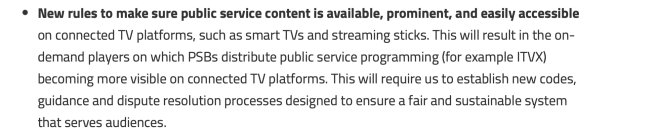
As another reader commented, the CRTC’s dismissal of Connected TV as “hardware” seems to pre-judge a significant regulatory issue without a hearing. The same reader pointed out that the British regulator Ofcom, now carrying out its own version of Bill C-11, includes Connected TV within its regulatory review:
***
The hate speech provisions of the federal Online Harms Bill C-63 are a continuous talking point on social media.
The Centre for Media, Technology and Democracy recently offered commentary from a panel of experts. They delve deeper into the pros and cons of amending the Criminal Code and the federal Human Rights Act.
If you have more time to invest, listen to Althea Raj’s excellent podcast on C-63. The first 45 minutes is a curation of critics’ commentary on the Bill. The last 25 minutes is the Justice Minister’s rebuttal.
***
Still on the Paramount Global sweepstakes watch, the US media conglomerate may be bought by Skydance. That’s the film distribution company run by David Ellison, son of Larry Ellison (owner of Oracle Corporation, the Hawaiian island of Lanai and second richest person in America). Ellison the son would be buying from Shari Redstone, daughter of media titan the late Sumner Redstone.
There may be a TV series in this story, but perhaps it was already done.
***
If you would like regular notifications of future posts from MediaPolicy.ca you can follow this site by signing up under the Follow button in the bottom right corner of the home page;
or e-mail howard.law@bell.net to be added to the weekly update;
In the case of Bill C-63, the attention-getters are the hate speech provisions, covered here, here and here in this blog. I’ve included again a cheat-sheet to help you follow the precise criminal and human rights code amendments.
University of Calgary law professor Emily Laidlaw has posted a summary of C-63 and last week she joined Taylor Owen of the Centre for Media, Technology and Democracy to chair an expert panel, available now on YouTube.
Before giving you the experts’ headline observations, be reminded that the bill’s hate speech provisions build upon pre-existing criminal code provisions on the one hand, and on the other hand reinstate a human rights law repealed by a 2013 free vote in Parliament.
The criminal code amendments didn’t get a ringing endorsement from the panel. York University law school professor Kenneth Grad suggested that the slow and resource-heavy regulation of hate speech through the criminal code is an inefficient approach to combatting hate speech. He didn’t think that the increased prison penalties in C-63 would have much of a deterrent effect.
The other experts generally agreed with him. Sandy Garossino —the National Observer columnist and former prosecutor— said that the bill would be improved by giving the Crown the option to prosecute hate speech through “summary conviction” rather than indictable offense, chiefly because the latter requires a resource-heavy preliminary inquiry. The difference between the two prosecutorial options is that the summary conviction route is faster, carries lighter maximum prison terms (less than two years) and is more likely to get police and Crown support for laying a charge.
Garossino also favoured the bill’s expansion of the peace bond option to cover yet-to-be-committed hate speech. The peace bond provision has been the target of a fair amount of public hyperventilation over an Orwellian “pre-crime” police state. But Garossino suggests a hate speech peace bond would replicate Canada’s success with peace bonds as a de-escalating intervention in cases of stalking and repeated domestic abuse. The hate speech peace bond would have the added requirement of obtaining the Attorney-General’s consent to appear before a judge seeking prior restraint based on past behaviour.
The experts appeared divided on the “signalling” attributes of hate speech amendments. None of them used the term “virtue signalling” as the Liberals’ motivation for tabling the bill, but law professors Grad and Richard Moon saw more symbolism than substance in the criminal code amendments. Laidlaw raised the signalling question in a different light: that the bill might be society’s indication to victims in targeted communities that their interests are being taken more seriously.
The experts were more supportive of the bill’s reprise of the human rights proscription against vilifying hate speech. Grad characterized that route as more victim-centred: a civil burden of proof, cease and desist orders prioritized over punishment, and de-emphasizing the respondent’s criminal right to the defense of hate as “truth” that is prone to creating a platform for more hate speech.
Law professor Sunil Gurmukh argued that the line drawn between vilifying hate speech and awful-but-lawful speech was a lot brighter than assumed. A series of litigation precedents has already been done —for example, identifying the no-go zones of publicly vilifying Jews, women, and LBGTQ+ Canadians by using degrading stereotypes.
A note of caution was sounded by Professor Moon who cited the “disinformation campaign” behind repealing the human rights ban on hate speech. His concern was that, since 2012, hate speech has exploded on social media and any litigation-lead effort to contain it will result in the legal process being clogged and the overall effort to support human rights being needlessly disparaged and undermined.
The panel did not have time to delve into another controversial feature of the human rights amendments: the power of the Commission, under certain circumstances, to allow an anonymous complaint to proceed.
***
If you would like regular notifications of future posts from MediaPolicy.ca you can follow this site by signing up under the Follow button in the bottom right corner of the home page;
or e-mail howard.law@bell.net to be added to the weekly update;
One broadcasting policy issue that flew successfully under the regulatory radar during the Parliamentary hearings for the new Online Streaming Act was Connected Television.
Connected TV is the terminology used for Smart TVs —or streaming devices attached to stupid TVs— that slip their viewing menus and data aggregation in between the Internet and you through software embedded in the television or a plug-in streaming stick. The TV or stick manufacturer chooses which streaming apps get carried or made visible.
There are different viewership figures available, but about half of Canadians consume programming on smart TVs.
Radio-Canada published a news article earlier this month in which a number of leading cultural voices in Québec questioned why the CRTC was not regulating this programming distribution technology as it has cable, satellite and channel aggregator websites like Roku.
Those voices include Heritage Minister Pascale St.-Onge wondering aloud why the CRTC hasn’t moved on Connected TV (she missed her opportunity to tell them so in her Policy Direction to the Commission on the implementation of Bill C-11).
I asked the CRTC why not and got a polite but terse reply: the Commission “does not regulate hardware.”
***
MediaPolicy has commented more than once on the expectations of the Québec music industry that the CRTC will do something meaningful to compel major streaming platforms to showcase French language songs. Left untended, the issue could be the spark a political confrontation between the federal and Québec governments over the jurisdiction to take regulatory action on this point.
There has always been a split between Québec cultural groups and the leading English Canadian industry voices on this issue of online music discoverability. Outside of Québec, the independent music producers group CIMA supports greater subsidies for music development, but no interference with playlist curation or song algorithms.
Last week the Heritage Minister announced a $16 million budget increase to the Canada Music Fund for the next two years. According to the Heritage website, in 2023 the federal government contributed $57 million for recording, touring, marketing and music video production. That included $43 million in base funding and a $14 million supplement.
The Liberal election promise in 2021 was to increase its contribution to the Music Fund to $50 million.
The federal grants are administered by the non-profits FACTOR in English Canada and MusicAction for French language artists. Radio broadcasters also contribute to the non-profits and it’s likely that music streamers will be levied by the CRTC.
***
The Paramount Global sweepstakes continue in real time with abortive merger talks, the emergence of hedge fund buyers and now frowning bond rating agencies.
Another major US streamer Warner Brothers Discovery is at last launching its direct to consumer Max (a combination of HBO and Discovery) in Europe.
That’s something for Canadians to take note of, as Max has not launched in Canada. Bell Media continues to license HBO and Discovery content for the Canadian cable and streaming market. It’s a big piece of Bell’s successful strategy of making money on American programming and then earmarking some of the profit to lose money on CTV News.
Bell Media’s deal with Warner Brothers was renewed in May 2023 for an unspecified term.
***
I like reading Canadian book publisher Ken Whyte’s Substack blog for a number of reasons, mostly because he likes to set things on fire whenever possible.
This week he’s writing about the impact of AI on Canadian book publishing.
***
If you would like regular notifications of future posts from MediaPolicy.ca you can follow this site by signing up under the Follow button in the bottom right corner of the home page;
or e-mail howard.law@bell.net to be added to the weekly update;
Earlier this week MediaPolicy published a summary of Leger’s public opinion polling on the federal government’s overhaul of hate speech laws. The Liberals’ new Bill C-63 appears to have captured the public mood, at least for now. (Note: the CBC news story and photo above are from 2014).
The complexity of our existing hate speech laws is considerable. I made up a chart for myself and I am happy to share it with you: buyer beware, I last studied criminal law in 1983. All corrections will be gratefully accepted.
That’s it for this week: I have to prepare for a one-year old’s birthday party. Wish me luck.
***
If you would like regular notifications of future posts from MediaPolicy.ca you can follow this site by signing up under the Follow button in the bottom right corner of the home page;
or e-mail howard.law@bell.net to be added to the weekly update;
The survey reveals a significant lack of alignment between public opinion supporting the bill and the prevailing criticism of the bill in the news media and various blogs.
The lead poll question is this: Do you support the government’s plan to regulate content on social media to make their platforms safer and to remove harmful or hateful content?
The results were 68% in favour of the bill versus 24% opposed. You can download the report here to flush out the nuances in the responses.
Despite the strong support for the bill, there is anxiety about the impact on freedom of expression. The second question is this: Do you trust the federal government to regulate online content in a manner that protects your right to freedom of expression online?
The result was that 43% trust “the federal government” and 50% don’t. It’s not clear if this is a concern about the effective execution of the bill in practice or which political party is in government.
Even breaking down opinion into the bill’s three constituent parts (criminal hate speech, human rights hate speech and platform regulation), popular support is consistent.
The fourth question about criminal hate speech tends to conflate two distinct offences (hate speech promoting genocide; willfully promoting hate): Do you support the government’s plan to impose stiffer sentences on those convicted of a hate propaganda or hate crime offence, including up to life in prison for advocating genocide? The current maximum penalty is a two year prison term.
The result was 72% in favour and 15% against. I have to say, that one took me by surprise. Life imprisonment.
On to the human rights question: it helps to recall that the bill reinstates the right of Canadians to file anti-discrimination complaints about hate speech to the federal Human Rights Commission, repealed by a free vote of the House of Commons in 2012.
The question is: Do you agree or disagree with allowing people to file complaints about online hate speech to the Canadian Human Rights Commission?
The result was 71% for, 16% against.
An earlier Leger poll found widespread public support for a companion federal Bill C-367 that would repeal the current exemption in criminal hate laws for good faith religious argument (e.g. “God hates homosexuality”).
Back in the late 2000s, there was a lot of public debate about hate speech thanks to some high profile, and unsuccessful human rights complaints, against Mark Steyn and Ezra Levant. In the run-up to the repeal of section 13 of the Human Rights Act in 2012, the human rights law expert Richard Moon submitted an important Report that recommended abolishing section 13 (or alternatively amending it) and relying entirely on Criminal Code hate laws.
I stumbled across an article he wrote, shorter than his Report, that does a great job contextualizing the free speech versus harm debate.
At the risk of simplifying his well reasoned arguments, Moon says that regulation of hate speech should be restricted to incitement or imminent risk of violence (and thus it belongs in the Criminal Code) and that stamping out non-violent harmful speech (which he takes very seriously) would require an intolerable level of censorship to work. That’s why he supported eliminating section 13 of the Human Rights Act.
If incitement of violence were the acid-test of censorship, there is still a debate over what is incitement. For members of those communities who have been the targets of hate and violence for hundreds of years, most hateful speech is a dog-whistle to violence. The virtue of the Human Rights approach over the Criminal Code is that individual Canadians don’t have to ask the Attorney General’s permission to fight it.
***
As I was hitting the “publish” button on this post, over at Canadaland an excellent podcast went up with host Jesse Brown interviewing Ivor Shapiro of the Centre for Freedom of Expression on Bill C-63. Worth a listen.
***
If you would like regular notifications of future posts from MediaPolicy.ca you can follow this site by signing up under the Follow button in the bottom right corner of the home page;
or e-mail howard.law@bell.net to be added to the weekly update;
The media misery meter spiked again this week as the Atlantic Canada newspaper chain SaltWire announced it was applying for creditor protection. By Wednesday, a court had granted it. SaltWire is the second Canadian newspaper chain to seek creditor protection in six weeks, Black Press did so in January.
SaltWire owns metropolitan dailies in Charlottetown, Sydney, St.John’s and Halifax and a variety of community papers.
There is a backstory of financial miscalculation. SaltWire bought 24 local newspapers in 2017 from Transcontinental, then unsuccessfully launched suit on the grounds that Transcon had withheld damaging information about the state of the business.
The bankruptcy is in response to SaltWire being chased by the financier, Fiera Private Debt, that supplied the cash for the Transcontinental purchase. That’s not the entire story of course. The Fiera debt is at most half of what SaltWire owes to all creditors.
This presents an opportunity for me to plug, one more time, my interview with CEO Jeff Elgie of Village Media, the successful community news network in Ontario. The popularity of the post took me by surprise: it sped past an old post about Margaret Atwood to become the second most read post in MediaPolicy’s short history.
***
You don’t need any help from MediaPolicy to point you to the public debate on the federal hate speech Bill C-63. The generous supply of condemnation from the nation’s free speech ultras is difficult to miss.
The focus of most criticism is not on the “online safety” part of the Bill —where social media platforms are required to step up their content moderation and filtering, particularly where kids are concerned. Rather, the reaction is to the hate speech amendments to the Human Rights Act and the Criminal Code.
Why we need stronger criminal sanctions against hate speech is something the government is going to have to do a better job of communicating. It will have that opportunity when the Bill hits Committee after Second Reading.
The other objective of the Bill is to reinstate section 13 of the Human Rights Act, repealed with much fanfare in 2012. That was the subject of Ms. Atwood’s ire as she was bold enough to ask out loud what others might be thinking: won’t the Commission be flooded with revenge complaints and mercenaries trawling for the (up to) $20,000 compensation that the Commission can order for victims of hate speech spread across the Internet?
Another castigation of the Human Rights amendments came from David Thomas, the former chair of the Human Rights Tribunal (appointed to a seven year term in 2014 by Stephen Harper). His flamboyant guest column in the National Post echoes Atwood on the gates opening wide for mercenary complainants.
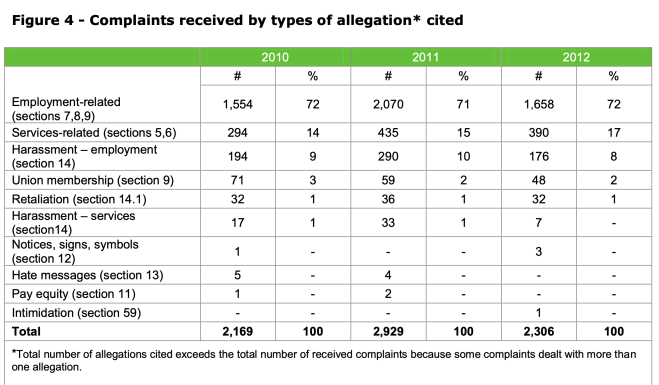
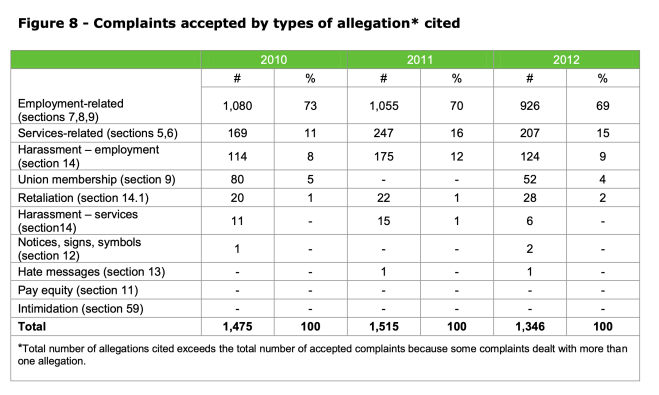
That got me curious about data, so I contacted the librarian at the Commission and asked for numbers on the section 13 caseload before it was repealed. It seems the Commission’s Annual Reports began tracking (or at least reporting) that in 2010 as section 13 became increasingly controversial.
In 2012 for example, the Commission received 1500 complaints overall (not just section 13). Half were weeded out at the complaint stage, 209 were settled, 190 were dismissed and 113 were sent on for adjudication by the Human Rights Tribunal.
As for section 13 complaints here is the data, which may not be what Mr. Thomas or Ms. Atwood would expect.
Complaints received by the Commission:
Complaints “accepted” (i.e. processed for further determination):
Richard Moon, the hate speech expert who recommended in 2008 that section 13 be abolished in favour of greater enforcement of Criminal Code laws, suggested that the flow of human rights complaints through the federal Commission and Tribunal was modest:
BetweenJanuary 2001 and September 2008 the [Commission] received 73 section 13 complaints (about 2% ofthe total number of complaints received by the CHRC). Of these, 32 were closed or dismissed bythe CHRC and 34 were sent to the [Tribunal] for adjudication... Of the 34 complaints that were sent to the CHRT, 10 wereresolved prior to adjudication. In September 2008, 8 of the complaints forwarded to the CHRTwere awaiting conciliation/adjudication. In the remaining 16 cases the CHRT found thatsection 13 had been breached and imposed a cease and desist order. In several of these cases theTribunal also imposed monetary penalties.
***
The federal government has done the expected and made a five-year funding commitment to the Indigenous Screen Office at $13 million annually in production funds, to be disbursed by the ISO to Indigenous filmmakers.
The ISO has emerged as a parallel institution to the Canada Media Fund that channels production dollars to independent Canadian producers for “CanCon” shows that are broadcast on television and streaming platforms. The CMF receives funding from both the federal government and, upon the direction of the CRTC, Canadian cable companies.
One of the regulatory issues to be determined by the CRTC under Bill C-11 is whether both of the CMF and ISO will be able to supplement their existing funding from a levy on foreign streaming platforms.
***
Dipping into the ocean of political opinion out there, I recommend a Canadaland podcast hosted by the very annoying Jesse Brown with an excellent panel consisting of Jen Gerson, Paul Wells and Stephen Marche.
The subject is blue skying about a Pierre Poilievre government.
You know that aphorism about good journalism “saying one true thing”? You will hear lots of that in this podcast. And plenty of annoying stuff too, so it’s worth your time.
***
And if all this politics gets you down, brighten up your day by enjoying London Ontario’s Ryan Gosling knockin’ ‘em dead at the Oscars.
***
If you would like regular notifications of future posts from MediaPolicy.ca you can follow this site by signing up under the Follow button in the bottom right corner of the home page;
or e-mail howard.law@bell.net to be added to the weekly update;
The freshly tabled Online Harms Bill C-63 is going to get a lot of media coverage in this session of Parliament. I said last week that it’s two bills in one; it would be more accurate to say three bills (online harms and safety, criminalized hate speech, and discriminatory hate speech governed by the Human Rights Commission).
There is a lot of detail and, allowing for the usual flights of Parliamentary rhetoric and fundraising posts, it will be overwhelming and confusing. Some of that will be deliberate.
My advice to the keenly interested is to start following Emily Laidlaw’s blog posts on C-63 now. Her Part 1 is a set-up that introduces all of the major elements of the Bill. She has some editorialized opinions, but she’s an expert and scrupulous in her summary. You might even bookmark her site.
***
There have been disparate developments in the ongoing story of the financial sustainability of Canadian news media.
The narrative of the Online News Act Bill C-18 continues with the CRTC inviting news outlets to step forward and apply for eligibility to receive compensation from the $100 million in annual Google funds. Unless this process goes off without a hitch, I would expect some nasty internecine squabbling among news outlets over the apportionment of the funds even though the money is to be distributed on a per journalist basis.
Meanwhile in Australia, from whence the “bargaining model” for the Canadian Online News Act came, Meta has announced it will not renew its expiring compensation deals with Australian media companies. It will also terminate its news aggregation tab on Facebook. In other words, Meta will dare news publishers and the Australian government to make the same choice made here in Canada: cave to Zuckerberg or see news banned from Meta platforms.
On yet another policy front, a majority of MPs on the Canadian House of Commons finance committee just submitted 359 recommendations to the full House of Commons. Recommendation 213 advocates for policy action to “close the [online] loophole” that still allows digital media to escape federal tax laws requiring Canadian businesses to advertise in Canadian media if they want to claim a business expense:
Introduce tax measures to incent businesses to advertise with private sector Canadian news outlets and bring fairness to the different tax treatment of advertising purchased from foreign websites to ensure media organizations are not deprived of revenues.
This policy idea has been mooted for a couple of decades and it just might make it into the next federal budget.
It does feel at times that Canadian news media is on a hamster wheel of government policy action as the red ink, journalist layoffs and closures of news outlets shows no sign of abating.
On the other hand, there are bright spots that inspire the possibility that mainstream news outlets that cover original news could find a new and sustainable business model, especially where it is most needed in local communities and cities. MediaPolicy interviewed Village Media CEO Jeff Elgie and I think you will find that short piece interesting .
***
You will never find in MediaPolicy posts any devotion to the argument that Canadian media companies ought to make their way in the marketplace bereft of government policy intervention. But I do like to spotlight stand-out entrepreneurial examples. Hence, the Elgie interview above. But another example, my recommended read for this week, is a feature on Blue Ant Media’s Michael MacMillan, Canada’s producer/broadcaster extraordinaire.
***
If you would like regular notifications of future posts from MediaPolicy.ca you can follow this site by signing up under the Follow button in the bottom right corner of the home page;
or e-mail howard.law@bell.net to be added to the weekly update;
There’s not much reason for optimism these days in Canadian news journalism. It’s red ink, layoffs and closures as far as the eye can see.
Opponents of government aid to news journalism point to the many digital start-ups but, inspiring as that is, those are opinion sites or niche, single-beat journalism rather than broad spectrum news outlets.
Rare bright spots include La Presse and the Globe and Mail, two news outlets that hold the privileged (and well earned) title of being a number one national news outlet.
But the reason why news journalism is still in crisis is the relative dearth of financially sustainable news journalism in regional, metropolitan and local markets.
Enter Jeff Elgie, Canadian unicorn.
Elgie is the owner and publisher of Village Media, headquartered in the Ontario city of Sault Ste. Marie (population 70,000). A 48-year-old native of “the Soo,” Elgie headed his own digital advertising and IT consulting firms before getting into publishing. Since 2014, he has grown a chain of hyperlocal community news websites from its original base in the Soo to a network spread across the near north and southern regions of Ontario.
He’s continually growing and his operations are in the black. MediaPolicy interviewed him to find out how.
You have a new community news website launching soon in the downtown core of Toronto, south of Bloor Street to Lake Ontario?
Yes, it’s a hyperlocal digital product for people who live and work in the community, like we have for our other 23 local markets. It won’t have a provincial or national focus and we aren’t going to imitate the lifestyle news products that are already out there. It will be local news and information, mostly text journalism, with about eight to ten reporters. I wouldn’t consider it as head-to-head with the Toronto Star or CP24.
It took you ten years to get to 23 markets and now you’re really picking up speed. You’ve just added two Golden Horseshoe communities, Oakville and Flamborough. Now you’re looking at a foothold in Toronto. Are you profitable?
Yes. We have some markets that are stronger than others. Probably about ten of them could not be profitable as stand-alone enterprises – meaning, they wouldn’t support the necessary infrastructure to run independently. Building scale has helped a lot. We launched our own content management system nine years ago. It was purpose built for our business model. It’s not just for publishing editorial content but classifieds, auctions, business directories. A lot of commercial thought went into it. Now we license it to other community publishing companies, like Black Press and Glacier. So our technology line is now a profit-centre, not a cost.
I asked you on Twitter some time ago what makes for a successful market, and you said the saturation level of the ad market was important but the most important thing was whether the local audience was looking for hyperlocal content, as opposed to looking past you to the nearest metropolitan daily?
Yes. So long as the community thinks local first, we’ll succeed. It’s very important to give the community more than just news, but also information.
That’s what print newspapers had in the glory days right? The bundled product. The bundle of news, weather, classifieds, comics, entertainment listings. Then the Internet took that away.
Yes, but you can re-create that in a digital product, adding all sorts of community information. Weather, classifieds, school bus schedules, community web cams and so on. People want that. It’s a huge draw. And if you think about it, it’s the only way we can make this work. Thirty-seven per cent of our monetized page views are news. A third of that slice is basic service journalism, information about what’s happening in the community. The other 23% to 24% is original news reporting, the expensive stuff. We have two full time employees over our entire operation collecting and publishing obituaries. Obits are 20% of our traffic. But it takes 90 journalists to do the original news reporting.
I have often said that we are digital first and only. Creating a digital publishing business is an entrepreneurial pursuit and we built our model from scratch. We were never a print operation, so we have a different mindset. Repurposing print for digital cannot be an entrepreneurial plan. Doing print and digital at the same time splits your focus. We only focus on digital. Our advertising sales reps are entirely digital oriented. Also there’s an audience focus issue. Where markets have lost their print dailies, the audience shifted to digital and we were there to serve. Digital is not a high margin business; you have to be lean and efficient to make it work. Legacy publishers are going to struggle with it.
What’s your next content innovation?
We want to win back the hyperlocal topical discussion from social media platforms. It’s lower cost than original news reporting and it has important community information. I would describe it as “Facebook groups meet Reddit meets NextDoor.” It will be a safer, more moderated and more regulated discussion of community topics than what you see on social today. We’ll have postings from local experts and organizations, who can also host and moderate – we’ve done a lot of research on this. We’ve been working on it for a year and a half and we will be ready to pilot it by summer. There have been attempts by other news organizations to create this kind of forum, but we think ours is more thought out as an editorial product.
What’s it called?
“Spaces.”
And if it works?
We think it could be a game-changer for the business model of local publishing. And we’ll scale it as quickly as possible.
What I really want to know is if your success can be replicated in metropolitan markets. You are succeeding in digital news journalism at the hyperlocal end of the spectrum, and the Globe and Mail has proven the same thing at the other end, at a national scale for premium journalism. But in the big fat middle there seems like so little hope and Postmedia and Torstar are just hanging on.
We like to say that over the years we have been encircling Toronto. We’ve succeeded in a lot of markets where the print publication failed, like Orillia. In the Guelph newsroom we employ seven journalists [Ed Note: approximately the same number of journalists at the defunct Guelph Mercury]
We are going to establish our toehold in Toronto with our new site. If you ask me what would happen if the Toronto Star went out of business, not that I am wishing for that, but yes I think there would be an opportunity and we could make a go of it. But it would take time to scale up to replicate the same news coverage. In time, absolutely we could do it. When you think of it, in markets of 75,000 to 100,000 we cover a lot of institutional news beats. In a larger city, you can cover the same beats with a greater audience scale.
Let me change the subject to ask you about employing journalists. We were both at a news industry roundtable back in 2018 where Paul Godfrey of Postmedia speculated out loud that you might be succeeding by underpaying young journalists. Any truth to that?
(Laughs). We absolutely pay comparatively or better than unionized in the same market. We employ full timers with benefits. Since day one, ten years ago. We are also a Living wage certified employer.
When I organized small market newsrooms many years ago for Unifor I found most were a mix of 20-somethings getting their career start next to lifers from the local community who knew everything about the community. What about Village Media newsrooms?
More of the latter I would say, the local lifers as you call them. It’s not that easy to attract young journalists to some of our markets, especially in the north. But in our Toronto operation we should be able to hire some good young journalists. The challenges of hiring the right journalists is more of barrier-to-market-entry problem than you might think.
Let’s talk about something you and I don’t agree on, government subsidies and the Big Tech bill, C-18.
Okay.
I once asked you how dependent you were on these different programs and you said it was a small portion of your overall revenue. If it all disappeared, what would the impact be on your business?
Well it would all be a direct hit on our bottom line. We could stay in business. I think many other news publishers could not. We might have to shut down some of our more marginal publications. There’s no doubt the extra revenue from government programs has allowed us to scale faster. If it was gone, our growth would slow and we would shut down some unprofitable or new markets. One of the reasons we are launching our Spaces pilot is in anticipation of losing these government programs.
You were very critical of C-18, especially after Facebook embargoed news in response to the Bill.
Yes, our Facebook traffic was 17% of our business. We haven’t lost that much, partly because we’ve been doing other things to grow audiences, like our newsletters, because we anticipated this was going to happen. We’ve also lost the licensing income from Facebook. But we were able to launch in Flamborough anyway, it’s doing okay, although it would have done better if Facebook was available to gather audience. Losing Facebook distribution makes life very difficult for start-ups. The other thing about Facebook’s exit, is that it really hurts any news operation that is in second place in the local market, we’ve seen that happen. That has actually helped Village Media where we are in first place. But it makes start-ups more difficult. If we still had Facebook money and distribution, it would be a gold rush.
Okay, so the big question: what is to be done? If you were Heritage Minister, what would you do about subsidies, incentives, or digital news policy in general?
I look at all of these programs, the Local Journalism Initiative, Aid to Publishers, Special Measures for Journalism, the QCJO salary subsidies, and Bill C-18. The only one I would keep is the QCJO salary subsidy. I would prefer nothing from Big Tech, the traffic is way more valuable than the money. If government wants to do something, the QCJO salary labour tax credit is the best.
And if they are gone under a new government?
If all programs gone, it’s a disaster scenario model. It will devastate a large part of the industry. Although that does leave us an opportunity at Village Media. But I don’t want 3000 journalists to lose their jobs and we can’t fill the gap overnight. We can’t replace 3,000 journalists in a year.
Are there other survival strategies that haven’t been explored?
Well If you look at some of these regional local markets, and you take into account the gradual retreat of broadcasting news, it seems to me there is room for one high quality digital news outlet in each local market publishing in multiple formats, audio, visual, and text. That might be newsroom collaboration and the sharing of news copy among competitors. Imagine if we could focus local journalism investment into one top quality product. Or we may end up with a last man standing.
Speaking of competitors how does the CBC fit in?
It’s time for implementing the idea of a creative commons, where the CBC shares content with private news companies. It would be a win-win and more news would reach more of the population.
And CBC digital must get out of advertising. It’s obscene that the public broadcaster is competing with us for ad dollars. To do that, the government could replace their advertising revenue and fund them properly. They should get out of the ad market and get out of sponsored content. It would make a world of difference.
***
If you would like regular notifications of future posts from MediaPolicy.ca you can follow this site by signing up under the Follow button in the bottom right corner of the home page;
or e-mail howard.law@bell.net to be added to the weekly update;
It is at least two bills in one. The first is the government’s do-over of making social media platforms take more accountability for harmful content. This “duty of responsibility” approach is self regulation: the platforms will have to develop transparent content moderation policies and then live up to them or face large fines. The focus is on revenge porn, harm to children, fomenting hate against identifiable groups, and incitement of violence, extremism or terrorism. There is a helpful YouTube review of the bill from experts hosted by Taylor Owen of the Centre of Media, Technology and Democracy.
The other half of the Bill is a reprise of section 13 of the federal Human Rights Act, narrowly repealed in 2013 in a free vote in the House of Commons. It provides a path for Canadians belonging to identifiable groups to go to the federal Human Rights Commission with a complaint against hate speech over the Internet:
13 (1) It is a discriminatory practice to communicate or cause to be communicated hate speech by means of the Internet or any other means of telecommunication in a context in which the hate speech is likely to foment detestation or vilification of an individual or group of individuals on the basis of a prohibited ground of discrimination.
There is a definition of “hate” set a high threshold:
hate speech means the content of a communication that expresses detestation or vilification of an individual or group of individuals on the basis of a prohibited ground of discrimination. For greater certainty the content of a communication does not express detestation or vilification…solely because it expresses disdain or dislike or it discredits, humiliates, hurts or offends.
Notably, none of this applies to federal broadcasting.
That’s interesting because so far the CRTC has not shown any interest in extending its television and radio rules —-prohibiting “abusive comment” directed at identifiable groups or “misinformation” —- to Internet streamers like Netflix, Crave or US news networks.
Additionally the Online Streaming Act specifically rules out applying these content regulations to social media platforms when they act as broadcasters. During the debate on Bill C-10 in 2021, Liberal MPs deflected attempts to amend the bill on the grounds that harmful content on YouTube would be covered in Bill C-63. It now appears that the remedy for this harm will be left to individual Canadians bringing human rights complaints against the uploader, not the social media platform. In fact, social media platforms and ISP providers are expressly exempted from liability under the Bill.
And finally it should be noted that if the targeting of harm does not fall within the traditional catchments (gender, race, sexual orientation, etc), there can be no complaint. For example, the vilification of politicians, journalists or health professionals is not regulated.
The EU Parliament overwhelmingly passed a resolution —-setting the stage for a binding Directive at some point in the future—- that could require streamers like Spotify and Apple to make their algorithms sufficiently transparent so that artists can verify whether their songs are being repressed. As significant, the EU resolution calls for greater distribution and prominence of European songs on global platforms making music available in EU countries. This suggests that if the major streamers don’t improve the exposure of local European music the EU will replicate its 2018 Directive for video streaming that included inventory quotas and prominence requirements.
As usual, the French government is already ahead of the EU Parliament. In 2023 it passed legislation requiring streamers to pay a content tax to support French music. A government report later suggested 1.75% of revenues as the right amount: Spotify responded by cancelling its support of French music festivals.
None of this has escaped the attention of Québec Culture Minister Mathieu Lacombe, as MediaPolicy reportedpreviously. Lacombe is looking for CRTC action on the discoverability of French language music and, if that doesn’t happen, he is considering a variety options including a streamer tax or a discoverability law. Either brings him into a constitutional confrontation with Ottawa’s exclusive federal power over broadcasting.
***
The CRTC released your mandatory bedtime reading, the Aggregate Financial Returns of Canadian broadcasters. The reports for 2022-23 are a jolt and put in perspective the considerable noise the Canadian broadcasters have been making in demanding regulatory relief from their obligations to make Canadian programming (effectively a $2 to $1 ratio in making Canadian content versus buying American programming).
Regulatory insiders have long described the business model of the large English language broadcasters —Bell Media, Rogers, and Corus— as relying upon the cross subsidy of their specialty television channels laden with cheap and popular American programming to pay the bills for their expensive Canadian news, sports and entertainment which is difficult to monetize outside of our small domestic market.
What’s changed in the last ten years is that the pool of specialty television profits has shrunk while on the other hand the advertising market for Canadian content on conventional network television has plummeted. The 2023 results are really bad.
Here are some numbers demonstrating that:
In 2018, Bell Media made $201 million in net income on its specialty channels while losing $69 million on conventional television (most of which is news). By 2022 its specialty division made $310 million but lost $95 million on conventional. In 2023, its specialty free fell to a $121 million profit. Its conventional losses rocketed to $205 million. For the first time, Bell Media’s combined specialty and conventional television is in the red, an $84 million loss.
In 2018, Corus specialty channels made $167 million in net income but lost $64 million on conventional. By 2022 its specialty profit was $66 million while losing $110 million on conventional for a combined deficit of $54 million. In 2023, its specialty channel profits were flat, losing $420,000. It lost $124 million on its Global network for a combined television loss of $125 million.
The sports-focussed Rogers Media is still in the black with a $50 million profit in 2023 for combined specialty and conventional television. That’s down from $121 million in 2018.
Another factoid is that all three broadcasters, and add Québecor’s TVA here, have held the line on news spending over the same period of time, although there is a modest decline once inflation is factored in.
***
If you are looking for something quick and interesting to read, there is a handy book review of Kara Swisher’s Burn Book: A Tech Love Story, thanks to the Globe’s tech beat reporter Josh O’Kane.
Swisher has been the US’s best known tech journalist over the past three decades. She enjoyed a lot of access to the Silicon Valley heavyweight bros. It seems she can’t abide them any longer.
***
If you would like regular notifications of future posts from MediaPolicy.ca you can follow this site by signing up under the Follow button in the bottom right corner of the home page;
or e-mail howard.law@bell.net to be added to the weekly update;
I am BritBox binging on movies staging Jane Austen novels. The plots invariably centre on the rotisserie of marriage courting. This is a handy segue to the spate of recent news in which Hollywood streamers search for partners, the most recent rumour concerning Viacom-owned Paramount and Comcast NBC Universal’s Peacock getting together.
Just before Christmas, the rumour was Paramount and Warner Bros Discovery (owners of HBO) hitching up. So Austen. If you know the books, at the end of every novel, everyone gets married. Sometimes for love and sometimes for money.
That’s the latest in entertainment streaming. Over in sports, last month we told you about the recently announced streaming joint venture between Fox Sports, Warner Bros Discovery’s TNT and Disney ESPN.
The strategy is to defend market share but also to recapture broadcast rights from digital-only upstarts DAZN and FuboTV. The New York-headquartered Fubo is best known in Canada for broadcasting English Premier League matches. Fubo is objecting to this marriage, challenging the Fox-WBD-Disney joint venture in the US on grounds of anti-trust.
***
Two recommendations for this weekend.
The first is to immediately buy Alexandra Posadzki’s Rogers v Rogers. I will spare you a plot summary, most readers already know it. It’s obviously about the family civil war for control of the telecommunications and media company and the dramatic Rogers-Shaw merger.
It’s page-turning storytelling full of some surprising and humanizing anecdotes and all of the industry backstories rendered decipherable for the lay person. Above all the book leaves you with deep thoughts about organizing economic activity in such a crucial industry. Four stars.
The other recommendation is a 50 minute Press Gazette podcast; an interview with media tech guru Ricky Sutton. The first half of the podcast is Sutton ripping the Big Tech platforms for backing away from a grand bargain to voluntarily provide billions in funding to news journalism; after the break he continues with a proposed solution, bringing together news organizations to license their content to Big Tech’s AI-LLM products.
***
If you would like regular notifications of future posts from MediaPolicy.ca you can follow this site by signing up under the Follow button in the bottom right corner of the home page;
or e-mail howard.law@bell.net to be added to the weekly update;