The Parliamentary House Ethics Committee has met on and off since last January to study threats of foreign election interference in Canada through social media platforms and, in its last meeting on December 13, the MPs hosted Meta’s Canadian representative (and former Stephen Harper policy chief) Rachel Curran.
You may recall that in 2019 —“some years ago” Curran told MPs— Facebook paid a $5 billion fine in the United States for complicity in providing the right-wing political action group Cambridge Analytica with data gleaned from 87 million Facebook users during the 2016 US election and Brexit vote.
Witnesses don’t really have the option of declining an appearance before Parliamentary committees which often resemble the children’s party game of Piñata. Bloc MP René Villemure took the opportunity to get a little off topic with Curran, as she was glued helplessly to the spot across the room, to ask her about Meta’s ongoing blackout of news for Canadian users.
RV: You say that Canadians share information on social media, including news-related content. Meta has chosen to block local Canadian news on its platform. Do you think this is preventing people from accessing quality information?
RC: Monsieur Villemure, we would love to not be in this position. We would love to have news on our platforms. The problem is that the government, through Bill C-18, the Online News Act,has asked us to pay an uncapped amount, an unknown amount,for content that has no commercial value to us.
[Emphasis added]
Now of course the Meta narrative on C-18 has always been that news “has no commercial value to us.” Not a dime. Perhaps the statement is within the realm of spirited advocacy, even if it can’t possibly be true.
But Curran’s other assertion, that the Online News Act “asks us to pay an uncapped amount, an unknown amount” was a lie. Not spirited advocacy. Not some clever hair splitting. A lie.
Those who have followed the C-18 file will recall that the federal government took seriously Google and Meta’s objections to the lack of certainty over financial outcomes from the mandatory bargaining of compensation with news outlets (even though the platforms could benchmark those outcomes against agreements they reached in Australia and Europe). The federal government remedied this by tabling a draft regulation (now finalized) in September 2023 that fixed liability, set at four per cent of either Google or Meta’s Canadian revenues.
Two weeks before Curran’s appearance before the Ethics Committee meeting, the federal government reached a well publicized agreement with Google to lower that fixed amount to $100 million annually in the case of Google, somewhere in the neighbourhood of 2.5% of revenues. Known and capped, as it were.
But consider the glimmer of hope in Curran’s comments that “we would love to have news on our platforms.”
“Mr. Villemure,” she continued, “if you could work with your government colleagues to make amendments to that legislation that would allow us to put news back on our platforms, we would love to do that.
“Meta was very involved in supporting media outlets and supporting journalism in Canada. We had private deals that were worth close to $20 million per year with news outlets across the country, including in Québec. … I think we need to figure out, as industry, as policy-makers, how to support journalism and how to support the local news ecosystem in a way that makes sense for all of us. It doesn’t make sense to try to extract money from two American tech companies to prop up the Canadian news ecosystem, so let’s figure out, together, a better solution.”
A better solution? The Bloc MP followed up:
RV: What can our committee do to bring local media back to Facebook?
RC: I would suggest this, Monsieur Villemure. We have heard this from local publishers as well. We are a very different platform from Google. We do not scrape news content from the Internet or aggregate it in our search results. It has very little commercial value to Facebook or Instagram. If we were carved out of the Online News Act, so that the requirements of that act did not apply to us, or if there was a carve-out for local journalism, we could bring that back onto our platforms.
So there you have the Meta view on its C-18 news throttle and “a better solution.” With $20 million of voluntary licensing agreements cancelled by Meta dangling in the foreground, the Canadian government can either exempt Meta platforms from the Online News Act entirely or exempt all local journalism from the Act. In return, Meta will stop throttling news and allow news outlets that can’t reach their readers on Facebook anymore to resume doing so.
***
If you would like regular notifications of future posts from MediaPolicy.ca you can follow this site by signing up under the Follow button in the bottom right corner of the home page;
or e-mail howard.law@bell.net to be added to the weekly update;
Last week MediaPolicy posted an interview with the former chair of the Ryerson Journalism School, Ivor Shapiro, that opened up a taboo discussion of journalist accountability and autonomy. It got a lot more hits than I expected.
By coincidence, La Presse interviewed Québec Culture Minister and former journalist Mathieu Lacombe who blue-skyed about public standards of journalist accountability as a response to opinion polls charting a decline in public trust in journalism. His position: the media must accept ownership of this falling level of trust.
Lacombe mooted the possibility of giving the Québec Press Council real powers to regulate professional standards, even linking standards to Québec’s subsidies for news journalism that top up federal tax credits.
La Presse Deputy Editor Francis Cardinal volleyed back in an editorial with a derisive “non” arguing that La Presse readership is growing and the challenge is the business model, not public credibility.
“First, let’s get one thing straight,” Cardinal wrote. “There is NO connection between the “media crisis” and public trust. None. The media crisis is a crisis of revenue, of advertising, of innovation.”
“There is therefore reason to question what has been dragging down this confidence in recent years. But to talk about a “crisis of confidence in the media”? In Québec ? I don’t see how we can come to such a conclusion, other than by spending too much time on X…”
So there.
***
The 1000-journalist Washington Post is looking to eliminate 240 jobs. It was only two years ago that the Post was in hire mode.
According to the Axios story, the Post’s finances have taken a turn for the worse despite the fact that the billionaire-owned enterprise ranks third in paid subscribers among the world’s English language news sites. Press Gazette has a list of the “100,000” club of paid subscriptions (top and only Canadian site, the Globe and Mail in 30th place with 246,000).
***
After laying low for several months following the sensational Rogers-Shaw merger, Canadian competition law is back in the news.
The Bureau Commissioner Mathew Boswell —our competition police chief — made a name for himself last year in a losing effort to scrap the Rogers merger and now, despite earlier suggesting he didn’t want another term at the Bureau, has in fact been renewed.
In other competition news, several long awaited reforms to our competition law came into force as part of Bill C-56. University of Ottawa’s Jennifer Quaid does a good job of explaining them.
The much maligned Mulroney-era “efficiencies defence” —a uniquely Canadian trump card for approving mega-mergers where economies of scale outweigh the lessening of competition— is out. In addition, the Bureau will now have more power to force companies to co-operate with the Bureau’s “market studies” that explore the possibility of abuse of market power.
***
France will introduce a first time culture levy on global music streamers in its 2024 budget. During legislative debate, the figure of 1.5% of revenues was frequently discussed. Spotify has condemned the tax as “unfair.”
In CRTC hearings last month on implementing the Online Streaming Act, the world’s leading music streaming platform argued that music streaming is not profitable, streamers should not pay any cash contribution to Canadian content, and that any regulations promoting Canadian songs must not impact the consumer experience.
***
Here’s another news item in an ongoing story for 2024. It’s been clear for some time that the cost of “peak TV” —-the familiar term for Hollywood studios and streamers splurging on premium content in a fight for market share—— is something media companies want out of but can’t figure out how.
Observers have speculated on the possibility of more corporate consolidation through mergers which have a spotty record of working out for the Hollywood giants, never mind the cable companies and viewers who pay the bills.
The latest rumour comes as no surprise: Warner Brothers Discovery might merge with (or buy) Paramount Plus from Viacom. This article investigates the possibility, but also moots the chances of a joint venture or a deal to bundle streaming content.
***
If you would like regular notifications of future posts from MediaPolicy.ca you can follow this site by signing up under the Follow button in the bottom right corner of the home page;
or e-mail howard.law@bell.net to be added to the weekly update;
Holding the powerful to account: including journalists
That’s a provocative headline but leads to an interview MediaPolicy conducted with Ivor Shapiro, formerly chair of the Ryerson School of Journalism, about journalism autonomy and accountability. I hope it’s a worthwhile read.
Heritage Minister divides up the Google cash
Heritage Minister Pascale St.-Onge’s regulation under Bill C-18 the Online News Act nails down the $100M deal she made with Google and sets the ground rules for how it’s to be divided.
The animals at the waterhole look at each other a little differently when the water is low and, with Meta’s news throttle combined with Google negotiating itself a lower financial liability, there is far less to go around.
The CBC will get only $7 million of the Google money. Private television and radio broadcasters, who were anticipating about half of the C-18 money would go their way, are capped at $30 million. The remaining $63 million will mostly go to online publishers of text journalism (i.e. newspapers and magazines).
The regulation appears to give Google the choice of whether it bargains the distribution of the $100 million with a single consortium of news organizations —CBC, broadcasters and online news outlets squeezed together— with each news organization being compensated on a headcount of employed journalists. In truth, that doesn’t leave much to “bargain.” The headcount formula allowed Heritage to project an overall per journalist payment of $17,000. But that’s not distributed evenly because of the caps on broadcasters: Newsmedia Canada pegs the publishers’ share at $20,000 while the Canadian Association of Broadcasters is looking at roughly $7,300 per head. CBC’s per cap will be approximately $2,900.
With less compensation to go around than originally touted, it’s not surprising that St.-Onge decided the CBC would end up with a token amount. This might even seem a Solomon-like compromise if it weren’t for the fact that the CBC is laying off 600 staff, including journalists. No one is standing in the CBC’s corner on this, even some of the CBC’s biggest supporters.
The snarling at the waterhole is emanating from the broadcaster association which is questioning why television and radio news, a dead loss on the accounting sheet, is being given short shrift. The answer is undoubtedly political: the proper nouns “Bell,” “TVA,” and “Rogers” are self explanatory.
The broadcasters are already excluded from the federal government’s direct subsidies to text journalism in the QCJO program, recently juiced by the Liberals in their Fall Economic Statement, likely to counterweight Meta’s boycott. Now with broadcast news getting the short end of the stick under the Online News Act, the pressure on the CRTC to create a local news fund out of financial contributions from foreign streamers and online platforms will intensify.
***
Expert Review of the CBC
Another explosive file that St.Onge is sitting upon is the CBC. Better late than never, the Liberals have announced their intention to strike an expert committee, mandate unknown, to think about the public broadcaster’s future.
Everyone will have an opinion on the CBC’s direction. Everyone should.
Jamie Watt of Navigator, a political consultant for hire, published a piece in the Toronto Star that demonstrates how much more thinking there is to be done. Comparing the CBC, news journalism and conventional television to the long deceased Blockbuster Video, he observes that politicians like Pierre Poilievre appealing to voters directly through social media represents “direct competition” to the news media and that the Fourth Estate must either adapt or die.
Watt’s conclusion seems to be that the CBC (and all news outlets?) need to reinvent journalism for social media platforms, to out-viral the politicians.
On that note, I can hear news producers and editors across the land exclaiming “oh, gosh, why did we never think of that?!” CBC and all other news outlets are experimenting constantly with delivering news over social media as well as new streaming platforms like the free ad-supported CBC Comedy and CBC NewsExplore.
Shooting from the hip on rethinking the CBC will do no one any good. The relationship between audience demographics, limited resources, and the meaning of “public” in public broadcasting seems like a giant riddle but not one that we can’t figure out.
The expert committee, and the government in setting its terms of reference, might use as its launch pad the observations and recommendations of the last expert committee, the Broadcasting and Telecommunications Legislative Review that devoted section 3.7 of its 2020 Report to the CBC. It’s a pity that some of the governance and recommendations for the CBC’s accountability that require legislative action have been left so late in this government’s mandate. But at least the conversation is about to begin in earnest.
***
The cable guy
For those of you intrigued by the big picture of the entertainment media industry, I have belatedly discovered the blog written by Doug Shapiro. He’s a former Turner and Time Warner television executive, now with the Boston Consulting Group.
His latest post zeroes in on the peace deal between the number two US cable operator, Charter Communications, and entertainment colossus Disney. Until September, the two were engaged in a bitter spat over renewing their content distribution deal. Against the backdrop of galloping cord-cutting in the US (15 percentage points ahead of Canada), Charter wanted to drive down the price of Disney’s linear channels or buy less of them. Charter backed up its bargaining position by threatening to drop Disney’s content.
We don’t know the exact wholesale pricing of Disney channels in the final deal. But we do know that Charter will buy and fold into their TV Everywhere (i.e. multi-device viewer access, like Rogers Ignite) cable service some of Disney’s ad-supported streaming content from various sports and entertainment programming services at no extra cost to the consumer. As paid subscriber options, Charter will also market some of Disney’s streaming apps while dropping some of the Disney linear channels it didn’t want to pay for.
The Charter-Disney deal prompts Shapiro to observe that the harmony of linear and streaming content (both premium and free ad-supported) carried on the same platform by major cable companies could result in a win-win-win for television distributors, Hollywood streamers, and paying customers. That winning combination would click in if the streamers and cable companies can team up to sell the most popular pay-streaming services as bundled discounts: for example getting customers to lock into multiple streaming subscriptions if the price is right.
It’s not fantasy to visualize the same opportunity here in Canada, to fight cord cutting and preserve cable television as a dominant and at-scale platform to distribute Canadian content. Keeping the older audience loyal, and drawing in millenials and other cord-nevers, can only be achieved by giving viewers a competitive bundle, better than a la carte shopping for multiple subscriptions and apps. “Free,” “discount,” and “good bundles” are the building blocks.
***
Registration for DM@X January 19-20
Speaking of the future of Canadian broadcasting and the big picture…the annual Digital Media at the Crossroads (DM@X) conference is accepting registrations for the January 19-20, 2024 event.
Over 30 speakers —29 besides your faithful scribe— will address key policy questions, including the obligations of streamers under the Online Streaming Act, social media regulation, artificial intelligence and cultural expression, and many other issues. The Ontario Commissioner of the CRTC Bram Abramson will give the luncheon address on January 20. And broadcasting consultant Nordicity Group will also update its annual report on the digital media universe in Canada.
All the details of the program, Including the bios and photos of the speakers, can be accessed at www.digitalmediaatthecrossroads.com. The website includes Instructions on how to register for the conference.
***
If you would like regular notifications of future posts from MediaPolicy.ca you can follow this site by signing up under the Follow button in the bottom right corner of the home page;
or e-mail howard.law@bell.net to be added to the weekly update;
Earlier this week The Walrus published Ivor Shapiro’s “How Journalists Can Win People Back,” an excerpt from his new book. By coincidence I had just interviewed him for publication in MediaPolicy.ca.
I first met Ivor in 2015 when he was the chair of the School of Journalism at Toronto Metropolitan University (then known as Ryerson) and he agreed to host the launch of Unifor’s “JournalismIs” campaign. He was the kind of person who had collegiality and collaboration coursing through his veins, so putting on the conference with him was a lot of fun. A former magazine writer and editor, he taught and researched media ethics. He’d recommended the formation of what’s now the National NewsMedia Council, founded the still-thriving J-Source online magazine, and led the Canadian Association of Journalists’ ethics committee. He’s now scholar-in-residence at the Centre for Free Expression. Last summer Ivor and I collaborated on an article, “Canada’s Bumpy Ride Toward a National News Strategy,” published online by Policy Options. He and I spoke at length about the Canadian implications of his new book on journalists’ autonomy in democracies. Then, we then edited the AI-generated interview transcript to make it shorter and, we hope, much more intelligible. Please let us know what you think.
Howard: In Disrupted Freedoms (update: reviewed here), you posit a basic quid pro quo between government and journalism, that for journalists to earn the special protections and privileges necessary for a free press there must be accountability for professional standards. Is that a fair summary?
Ivor: I guess so, although it unsettles me to think of it as a quid pro quo, exactly. I spent many years assuming the exact opposite—that freedom of the press is not earned but given by right to anyone who publishes almost anything. I thought it was just one of several forms of free expression. But thinking about disrupted media has forced me to propose this new idea that freedom of the press is a more ambitious, audacious, and conditional claim. It’s a claim of particular privileges by those who conduct a particular kind of activity. Defining that activity takes a few pages in the book so for now shall we just call it “news work”?
Okay, and in the book you list several of those privileges attached to news reporting in democracies— such as shield laws, which allow journalists in many democracies to protect information about confidential sources, and to gain access to restricted spaces, events, and records.
Yes and, in many countries, exemptions or exceptions under laws ranging from trespass to libel. And, though it’s suddenly become controversial in Canada, many governments including ours, have long provided public money to subsidize both publicly and privately owned news organizations. I think we agree on the root idea that it’s a public service to seek and distribute factual information about current affairs.
Yes. News work is a public good, as people say. But your argument, that these privileges must be earned, is new territory, even provocative. You’re saying that if journalists claim to be providing a core public service, they should be accountable for doing so. Well, in that spirit, let me ask you this: how good a job is Canadian journalism doing these days at demonstrating its value as a public service?
Well, to paraphrase Pope Francis, who am I to judge?
Come on, Your Holiness, give it a shot.
Seriously, there’s no single answer to that. And there’s way too much generalization these days about the allegedly ubiquitous failings of what people call “the media.” Who is “the media”? It’s thousands of people in hundreds of large and small organizations and teams. Most of these people, individually, try to make a living by doing decent work, as do most people who work at anything. So of course, there’s a wide range of quality in their output, with no reliable way to evaluate much of it. And that is a major part of the information crisis that confronts people in many democracies today, including ours. So I think it’s time for journalists to consider more self-critically the idea of being accountable for standards of practice.
Yes, and they serve useful purposes. The broadcast bodies are set up by law to regulate the airwaves, and you’ve written about how well they do it.
Or not, but carry on.
The two news-media councils certainly help news publishers resolve the grievances of audience members and may sometimes spur news organizations to reflect on their practices. So people have places to air complaints against news corporations, which is good. And yet Canadians’ reported trust in news media dropped by 15 percentage points in the seven years since the national council was formed. And in Quebec, a recent poll suggested that about one third of Québécois consider journalists independent of political parties or interests; the rest are equally divided between believing the opposite or not knowing. If these numbers roughly reflect people’s confidence in the news they see, how can we speak confidently of news as delivering a public service? Right now, how confident do people have a right to feel that they know the basic facts of what’s happening in Israel or Palestine right now?
Well, let’s treat October 7th and the Gaza war as a case study of sorts. How good a service is being provided by Canadian newsrooms covering this war?
Again, it depends on who’s answering. I have a sense that many people think our major news providers are hopelessly biased toward Israel, many others think the opposite, and many others believe most of the facts reported through the particular news channels they choose to follow.
But what do you, as a former j-school chair, think?
It’s mostly less bad than many people think.
Not exactly a ringing endorsement.
Yeah, because it varies. I do think most individual journalists are trying hard to report facts rather than fiction or propaganda. I’ve noticed careful, contextualized newsgathering and editing. I’ve noticed some simplistic and unverified reports. I’ve watched some outstanding interviews conducted under tough circumstances, and some breathless, deferential, uninformed interviews. And the bigger news organizations are often overcautious, trying to achieve an impossible “balance” in stories and newscasts on any particular day, trying without realistic hope to reduce the number of mass-synthesized resource-guzzling protest emails generated by advocacy groups that claim to want fairness or balance. There are limits in what’s feasible for a news desk. And right now, very few Canadian news reporters, producers, or editors specialize in Israel-Palestine issues, no original news reporting from Gaza by employees of Canadian news outfits, and fewer journalists there, period, because that work is lethally dangerous right now. But my central point is that those claiming to provide a public service should hold themselves accountable to service standards whether they’re publicly traded corporations or crowd-funded startups. For journalists, I think that starts with the defining standard of distinguishing facts from allegations, opinions, guesses, or lies.
So a breach of standards would be the initial Associated Press report on the explosion at al-Ahli Arab hospital in Gaza, which was widely repeated by broadcasters and newspapers?
That’s just one of many stories on which people have disputed essential facts. In war, propaganda defeats facts because no one’s job is to share clear evidence consistently. No one except journalists, that is, and, newsflash, journalists are fallible. So breaking news almost routinely includes assertions that await confirmation, and initial reports often need later correction or contextualization. When the news moves fast, the public value of journalists’ work shouldn’t be judged on the first report or the second but rather on the collective, iterative building of a set of facts on which the public can rely.
Well, then, what’s the standard?
I think of standards in a rather minimalistic way. A standard is not the same as a best practice, or ethical principle, or a marker of excellence. It’s a lower hurdle. Showing indifference to factuality is the clearest possible breach of standards for a journalist, but maybe reasonable people could agree on a bit more. Like, that journalists should follow processes that avoid repeating untruthful information—at least, not without attribution. And that factual errors should be corrected as soon as possible. Recently the leader of the Canadian Opposition laid into the Canadian Press for running a wire story that included three corrections of earlier reporting. But to correct oneself is evidence of effort, not of carelessness.
That’s it—just get stuff right?
If we set the bar just a bit higher, there’s an expectation that daily news should build on previous stories to add layers of new facts. Someone is charged with a brutal crime today and acquitted next year: which story will show up online in 2025? Extra layers of context help people understand the world better. To see a world in which today’s savageries may have been seeded by yesterday’s cruelties and a century of trauma.
So you want journalists to be held accountable for disciplined fact-gathering if they claim press-freedom privileges? What would that look like practically?
That’s for journalists themselves, collectively, to answer, and so far few journalists even agree that they have a problem with accountability. The topic just doesn’t come up! But let’s imagine a representative group of journalists sitting down to seek consensus on their bare-minimum expectations of one another’s work. Maybe they could start with a standard that’s been tested in courts in several common-law jurisdictions, when people’s reputations are damaged.
The responsible-journalism defence for libel, which you include as a “privilege” of a free Press.
Yes. Put simply, some smart English lawyers persuaded their country’s top court around the millennium that if a news report damages someone’s reputation, the journalists can escape punishment if they demonstrably followed a disciplined process of seeking the facts. And within a very few years, that principle was adopted in several other countries. The Supreme Court of Canada renamed it “responsible communication in the public interest,” but essentially it still rests on long-established norms for professional news reporting.
Basically, it says that even if you defame someone objectively, you’re going to be ok if you followed a journalistic process. Should we call it “the pursuit of truth” defence?
Absolutely. What’s privileged is not the outcomes but the work of gathering and sharing facts of current public interest. That’s the opposite of purveying fake news; it’s pursuing what’s called l’information juste in French, which I think implies more than just truthfulness but also relevance and currency. But the simpler English word, “facts,” brings up an important distinction. What press freedom adds to freedom of expression is the availability of news, not comment. Which makes it quite strange when commentary-driven publications boast that they haven’t applied for government support. Well, of course not! You and I are sitting here expressing our opinions for the price of a cup of coffee. Following breaking news, checking facts, investigating corruption, covering a trial: if we don’t pay people to do work like that, it won’t get done.
I’m jumping up and down in agreement with you on that. This issue came up in the discussions about Bill C-18 and, before that, about the tax relief for Qualified Canadian Journalism Organizations. I just went on and on about how you’ve got to restrict it to original news reporting. You’ve got to bake that right in. We have enough opinions out there; they’re cheap and plentiful. We don’t need to regulate it and we don’t need to pay for it.
And nor should regulated Google money go there. But it will, won’t it?
Yes, provided the news outlet primarily covers news, opinion gets subsidized too. But okay, news is a public good, and pursuing accuracy is a minimum standard. We agree. But I‘d assume that it will take more to earn public support than basic do’s and don’ts like getting facts right most of the time or quoting people accurately. How about standards of curation, or detachment? I mean, how do journalists really show that what they produce is essential to democracy?
There are a few almost non-negotiable norms. Internationally, most journalists agree that they should keep promises to sources, for instance, and to refuse payment for confidential information, and to keep photos intact. That kind of red-light concrete standard is different from vaguer catchwords like “objectivity” or “balance” or, yes, even “professionalism.” High-sounding highly malleable catchwords are tools for rhetoric. Weapons with which people can bash journalists whose ideas, perspectives, or social media profiles they find bothersome. They’re worst, maybe, in the hands of employers. When managers rely on loosely defined criteria, their judgments will be selective, blinkered, influenced by their own perspectives, such as racial and cultural difference. And when arbitrary judgments affect career advancement, well, that’s supposed to be illegal. So that’s another reason to get very precise about what we call professional standards.
Could there be a case for going beyond the bare minimum standards to justify public support? Like, could public funds foster higher quality journalism by recognizing and rewarding continuous-improvement efforts?
That sounds good to smell but tough to cook. Like, who should decide what counts as “improvement”? I suspect people who work for the Western Standard, the Narwhal, and Global News have divergent approaches to measuring quality because journalism is not brain surgery. It’s more important to understand how audience recognize quality information and what journalists can do to help. One of my key realisations in researching the book was that the countries where more people trust most of the journalism they see are also places where journalists accept public accountability for meeting professional standards.
Suddenly your argument for “professional autonomy” begins to sound like formal self-regulation, as in tribunals where journalists who fail to meet professional standards could be disciplined and disbarred. Is that where you’re going? I didn’t pick that up in the book.
Meaning, for example, protecting one another’s job security. Look, there will always be tension between editors and the owners or publishers who employ them, and editors will always make unwelcome demands of reporters and producers. But if we want journalists to be driven by a public-interest mission, they shouldn’t be fired or held back for doing so! Amongst other things, that means union contracts that cement professional practices as workplace norms.
Union contracts. Now you’re talking my language!
And yet in Canada, as you know from your days as a union staffer, it is the bosses, not the workers, who write the standards. And it’s publishers, not journalists, who are accountable to industry-run or government-required monitors. Whereas publishers freely hire and fire editors over editorial preferences and journalists know that to keep their jobs they must allow editors to arbitrate standards. News companies focus their brand marketing on something oddly called “fact-based journalism” (like, there’s another kind?) or industry-directed certificates of trust-worthiness. Whereas, if I were designing a transit ad for a news business, I’d show a quote-bubble cartoon where the wearer of the “press” badge says, “Yes, boss,” and the suit responds: “You’re fired.”
C’mon.
Seriously. May I quote the book again?
Reb, can I stop you?
No, boss. This is from Chapter 5: “Robust professionalism in news media—the real thing, not the semblance—means owners ceding autonomy to editors, editors recognizing journalists’ quality concerns as labour rights, and all regular editorial contributors being emboldened by job security.” But that’s actually the easier part. The hardest work could be getting journalists to stop filing stories long enough to reflect on their own methods and assumptions.
Okay, here’s the monkey’s paw. Make your first wish for something that would advance accountability in journalism.
Easy. I’d like to see the leaders of the big journalists’ unions get together on Zoom to brainstorm ways to earn back public trust.
Like what?
Like, for instance, they could convene a group of journalists to draft a single, short list of maximum ten consensus standards for news production—crystal-clear, realistic standards, that can each be stated in 50 words or less! They’d distribute the first draft to members for discussion in guilds, locals, and listservs, and give themselves a year to rewrite the list, request public feedback, and put each item up for an up-or-down vote by organized journalists across the country. Any item that wins consensus would be published on Canada’s first national code of professional standards for news, a work in progress that should be augmented or amended every few years through a similar process. And guess what—the very next time a contract’s being negotiated with unionized journalists…
…recognition of the code is on the table.
Yup. Just as unionized professors’ contracts include guarantees of academic freedom, and hospitals can’t require clinicians to break patient confidentiality. And then suddenly, when an employer makes an arbitrary demand or ruling, a journalist might have a winnable grievance, or even a human-rights complaint, because the professional standard is crystal clear. And conversely, when people or companies claim to be in the journalism business, the public has at least a first-stop litmus test. What do you think?
I’d like to eavesdrop when they discuss tweeting. But seriously, I think half would love it and the other half, at least at the outset, would not trust it. If I can generalize about journalists I would say they are not joiners. But joining a peer movement for autonomy and accountability might be different.
If you would like regular notifications of future posts from MediaPolicy.ca you can follow this site by signing up under the Follow button in the bottom right corner of the home page;
or e-mail howard.law@bell.net to be added to the weekly update;
Last Monday December 4th I hit the ‘publish’ button on the weekly MediaPolicy.ca update just as the CBC was announcing a ten per cent cut to its workforce. That’s 800 jobs at the public broadcaster: 200 vacancies that won’t be filled and 600 layoffs out of 8,000 staff.
The culprit appears to be a combination of falling advertising revenues and a projected three per cent federal budget cut scheduled by Finance Minister Chrystia Freeland, described by the CBC as a $125 million budget gap. The CBC is funded $1.3 billion by the federal government and has a total revenue of about $1.8 billion.
Precisely where the hit will be is unclear. CBC President Catherine Tait is speculating on $40 million annually in less programming of original drama, unscripted TV, and game shows, sparing the emblematic programs of national interest that the public identifies as at the core of the CBC mandate. That’s hard to square with where most employees work, i.e. national, regional and local news. There will be head office jobs slashed, but also 250 in broadcasting operations in each of the English language CBC and French language Radio-Canada divisions. That one-to-one proportionality of cuts didn’t go down well in Québec, but it might be recalled that when the Liberals increased the CBC funding by $150 million in 2016 it was divided evenly without complaint.
Assuming Heritage Minister Pascale St.-Onge had a heads up about all of this, it wasn’t a coincidence that she told the Commons Heritage Committee on November 30th that it was time to move a CBC re-think up the policy queue after the Liberals had studiously avoided it for eight years.
It is certainly time. The CBC is now a brand issue for both the ruling Liberals and Pierre Poilievre’s “defund the CBC” politics with an election in 2025. Justin Trudeau needs to tell voters what the CBC means to him and his party.
What’s next? The layoffs already reduce the broadcaster’s flexibility, and it seems doubtful that we’ll see any funding restored in the next budget, let alone a fulfillment of the Liberals 2021 election promise to replace the CBC’s $400 million in television advertising revenue. The CRTC, meanwhile, is set (whenever) to respond to the federal cabinet’s instructions from September 2022 to reconsider its licensing ruling that, among various ill-considered decisions, released the CBC from any obligation to broadcast local television news in Canada’s six largest cities.
Opinion columnists are already weighing in on how to reshape the CBC. The Globe’s Konrad Yababuski catalogues the usual right-wing grievances. The National Observer’s Max Fawcett has his wish list, reminding us that for every CBC employee there is a member of the audience with their own passionate vision of what the “public” in public broadcasting ought to be.
What we might get is some version of the time-honoured Canadian tradition to “appoint a Royal Commission.” The last time we did that was in the Liberal-appointed Caplan-Sauvageau Report in 1986 which upon release was mostly ignored by the Conservative Mulroney government. If you are curious about the cyclical history of CBC job cuts and government studies of its public mission, I direct you to this easily digested Wikipedia link.
***
There was another bell-weather announcement for Canadian media last week. The Canadian edition of Reader’s Digest will go out of business in 2024. If ever there was a mass media that knew its audience, it was the Digest. The Globe’s Jana Pruden had that story.
***
The recommended read of the week is from the New York Times, an excellent feature story on the Silicon Valley Game of Thrones competition for AI dominance, “Ego, Fear and Money: How the AI Fuse was lit.” Engrossing.
Or if it’s podcasts you prefer, I recommend Paul Wells’ interview of CBC President Catherine Tait which was recorded days before the layoffs (Tait knew but didn’t tell). Eerie and informative all at once.
***
If you would like regular notifications of future posts from MediaPolicy.ca you can follow this site by signing up under the Follow button in the bottom right corner of the home page;
or e-mail howard.law@bell.net to be added to the weekly update;
The week of November 26th was an “everything, everywhere, all at once” moment for Canadian media policy. There’s a lot to catch up on.
Google’s $100 Million
Heritage Minister Pascale St.-Onge announced the federal government had reached a deal with Google to contribute $100 million cash annually to online news organizations under Bill C-18, the Online News Act. The deal ensures that Google does not follow through on its threat to block Canadians from accessing news through its Search Engine.
Everyone’s attention was riveted on the bottom line dollar amount, to the exclusion of deeply principled objections to “link taxes,” which is not a thing anymore. It was always about price, as MediaPolicy suggested previously.
The $100 million is approximately 2.5% of Google’s Canadian revenue, short of the four per cent the government was initially looking for. The 4% target reflected what Google paid out in Australia in 2021. St.-Onge negotiated a “me-too” clause which allows the federal government to re-open Google’s cash contribution should it settle for a higher contribution elsewhere (for example, California, the United States federal jurisdiction, the United Kingdom, or in a renewed agreement in Australia). The 2.5% figure is closer to the deal Google made in France (in a legislative framework also proposed in Canada by a Conservative Senator).
Newsmedia Canada and the Canadian Association of Broadcasters warmly applauded the Google agreement. Torstar CEO Jordan Bitove was noticeable in his dissent.
What the Google deal means for pulling the news-throttling Meta back into news distribution and participation in C-18 is unknown. Although Meta’s re-calibrated contribution would now be closer to $50 million, its defiance of regulation has always been more truculent. While news reports suggested that the Minister was approaching Meta again, her recent description of Meta’s behaviour as “deplorable” does not betray optimism. Meta’s three-year agreements with Australian news outlets expire in early 2024.
There are still significant milestones to pass in implementing Bill C-18.
The final federal regulation will be issued in two weeks. Conservative MPs on the Heritage Committee quizzed St.-Onge on which eligible news organizations would participate in dividing up the $100 million Google cash and her reply appeared to be that all news outlets meeting the statutory criteria in section 11 of the Bill will share in the money (which means the CRTC may have a lot of work to do in vetting news outlets).
The follow up question from Conservatives was whether the CBC, employing about a third of Canadian journalists according to the Minister, will get a full pro rata share of the $100M. The Minister gamely stood up for CBC’s equal status as an eligible news organization but, after some gentle prodding from the Bloc’s Martin Champoux, softened her language to the point that we can speculate the CBC will emerge with a reduced or even token share of the money.
The compromise over the cash amount was a signal for the told-you-so critics of C-18 to crow. Many of those critics are opposed to C-18 in principle (for various reasons). Others, such as the Toronto Star’s Althea Raj, are annoyed by what she characterizes as poor execution by the federal government. Still others make the argument that federal intervention to save news journalism is fruitless in the long run, news journalism must respond to the changing media landscape by upping its game in editorial quality and professional standards.
One of the less fair criticisms of C-18 is the claim that if the government had ignored the Australian model (endorsed by the Conservatives in 2021, incidentally) and imposed instead a direct FaceGoogle corporate tax feeding into a single news fund, the government would have arrived exactly where they are today but without Meta having flown the coop.
While back in 2020 many recommended this one-tax-one-fund model, it also would have been opposed by Big Tech and the US government as a “news industry” iteration of Finance Minister Chrystia Freeland’s 3% Digital Services Tax. We were reminded of the US opposition to the Canadian DST —the Americans argue without particulars that it’s a trade violation— only last week when Freeland’s motion to implement the DST its scheduled January 1st deadline passed the House.
***
Sorry Canada, no change.
The CRTC will wind up hearings this week on its first step implementing the Online Streaming Act, Bill C-11.
The Commission has been entertaining industry pitches on its proposal to levy on foreign streamers a temporary cash contribution to Canadian media funds. That “initial basic contribution” will remain in place at least until such time that the Commission can figure out an appropriate streamer investment in their own Canadian programming.
The proposals have ranged from the ridiculous (Bell and Corus demanding a 20%-of-Canadian-revenue cash contribution) to the very cheap (Rogers suggesting a 2% contribution for fear that it will be imposed on Canadian broadcasters later) to the Motion Picture Association’s defiant “zero.” Several Canadian advocacy groups and small broadcasters are proposing a more plausible figure of five per cent.
The streamers are all saying they can’t afford any cash contribution to a media fund that doesn’t recycle “their” money as a subsidy back into their own programming, streamer by streamer. Currently the existing scheme of media funds (like the Canada Media Fund) recycles dollars back to contributors, but it’s a general fund supporting priority Programs of National Interest (TV drama series, documentaries) and local TV news. The funds are drawn upon by those broadcasters producing that unprofitable programming. As it stands, few Canadian contributors to these media funds reclaim “their” subsidies on a dollar-to-dollar basis and many are ineligible to draw upon them at all.
Spotify had the daring-do to tell the CRTC that it was running a music business on negative margin, contrary to its latest quarterly report. Amazon said the same thing about its music business and then, when pressed by the Commission for a general description of its profit and loss margin on Prime Video, committed to providing confidential revenue numbers (but not profit and loss) to the CRTC.
But the hell-no-we-won’t-pay common front of streamers standing with the Motion Picture Association appears to be cracking. During its presentation the Disney representative on the MPA panel inadvertently undermined the common front for “zero” contributions by citing comparable media fund contributions in the European Union. He described a range of contributions beginning with Portugal at the low end at one per cent, France as an “outlier” at 5.15%, and a mean average among EU nations of 2.7% (in factPortugal is not that low and Denmark is the high point at six per cent).
Last week Netflix must have read the room and reluctantly proposed a two per cent contribution.
During this final week of presentations, the Commission willhear from Apple, ACTRA, Unifor, Friends of Canadian Broadcasting, the Independent Broadcast Group, the Writers’ Guild, and Channel Zero, the owner of Hamilton’s innovative local broadcaster CHCH-TV.
During Heritage Committee hearings last week, NDP MP Peter Julian revived the long dormant policy idea of extending the Income Tax rules on deducting expenditures made on advertising buys on television and print to buys made on online platforms.
The long standing incentive in section 19.1 of the Income Tax Act allows Canadian businesses to deduct their advertising expenditures in Canadian media, but not American media. The ‘loophole’ is that these rules were never extended to Internet advertising, now 60% of the Canadian advertising market and dominated by Google and Meta. The policy concern is that Google and Meta have a far greater share of the Canadian advertising market than they would if they were regulated like a television or print medium. And for the government, that’s a lot of foregone tax revenue (estimates are all over the place, in the hundreds of millions that could be spent by the government on Canadian media if it chose).
Julian’s debating point was how could Google be allowed to escape with contributing $100M for news when it was the windfall beneficiary of a nearly billion-dollar tax loophole. When he asked Minister St.-Onge about reviving the idea of closing the tax loophole, she surprised many by acknowledging that her staff were now studying it.
As a dose of reality however: a Heritage staff study of a policy idea is a long way from it being proposed and, based on past experience, still a challenge to squeeze through the Ministry of Finance’s hobbit-sized door.
Another tidbit emerging from the Minister’s Committee appearance: she said Heritage was also considering extending the federal “QCJO” journalist subsidies for online text journalism to news websites operated by television companies (currently excluded from the program). She also observed that the CRTC was studying the possibility of a local news fund for broadcasters.
***
The CBC
Another nugget panned out of the Minister’s appearance at the Heritage Committee concerns the CBC.
Thanks to the Conservatives pounding away on the CBC potentially claiming a third of Google’s $100M, the Minister said in both English and French that a deep policy review of the CBC was in her mandate letter. In fact, it has been in every Heritage Minister’s mandate letter since 2019. More importantly, she said she wanted to act upon it soon, which is a very different thing from what the previous Minister Pablo Rodriguez told the Committee in June.
Parsing the Minister’s statement optimistically, it may be that the Liberals have finally realized that it cannot cede the field to the Conservatives’ relentless “defund the CBC” campaign and that the fate of the public broadcaster is in fact a two-sided wedge with its own popular support.
It’s a file to watch in the coming months.
Update: Following publication of this post, CBC announced it was laying 600 journalists and other staff in response to “rising production costs, declining television advertising revenue and fierce competition from the digital giants.” As well, the CBC cited upcoming federal spending restraints that will affect the public broadcaster’s annual $1.3 billion Parliamentary grant.
***
If you would like regular notifications of future posts from MediaPolicy.ca you can follow this site by signing up under the Follow button in the bottom right corner of the home page;
or e-mail howard.law@bell.net to be added to the weekly update;
Last week the Opposition Leader resorted to his habitual vilification of the news media in response to a reporter’s question about whether he was too hasty in using Question Period to challenge the Prime Minister on national security after a car explosion at the Niagara Falls border crossing.
As Poilievre well knows, aping Donald Trump in his relentless demonization of the media for political gain endangers journalists.
Coincidentally on the same day of Poilievre’s performance, I received my first death threat by e-mail from “DG”:
That was in the subject line of the e-mail. The text field contained only a link to an article that I co-wrote in the summer regarding the funding of Canadian journalism.
I’m not having too much of a moan about this (and I’m not a journalist). Thanks to Trump and Poilievre, real journalists get these threats all of the time now. Neither am I suggesting a linear cause-and-effect relationship between DG and Pierre. But no other Canadian politician has done as much to incite contempt against journalists for the impertinence of asking politicians difficult questions.
***
The day before the Niagara Falls incident, the Liberals announced in their Fall Economic Statement that the expiring Qualified Canadian Journalism Organization (QCJO) program for federal aid to journalism would be extended and the per journalist subsidy increased.
The original program was established in 2019 with a $600 million price tag. The budget was spread over five years at $120M annually and divided into separate funding envelopes for subscription tax rebates for readers, per journalist subsidies for news organizations, and charitable status for donations to non-profit news outlets. The budgets for the latter two programs were significantly under-subscribed: the journalists subsidies were drawn down annually at $30M out of the allocated $95M, possibly because of the decline in journalism employment.
Under the revised spending program, the per journalist subsidy is increased from 25% to 35% of a maximum $85,000 salary (up from $55,000). The new subsidy cap rises from $14,000 to $30,000.
***
Last week the CRTC completed its first of three weeks of public hearings on “Step One” of implementing the Online Streaming Act, Bill C-11.
This first of three regulatory steps is focussed on cash contributions from Netflix, YouTube and the rest of the online streamers to Canadian media funds that support Canadian content.
The US streamers commissioned a two-question Canadian survey by former Abacus pollster Bruce Anderson to bootstrap their Commission arguments.
The responses to the first question suggested —no poll methodology was published— a significant level of public support for injecting a “Canadian themes” factor into the definition of a Canadian program. Currently the definition of a Canadian program —required in order to allocate subsidies or recognize CanCon efforts made by broadcasters– is based on Canadian ownership of the programming and a headcount of Canadian creative talent employed in making it. Those criteria also earned top scores in the Anderson survey.
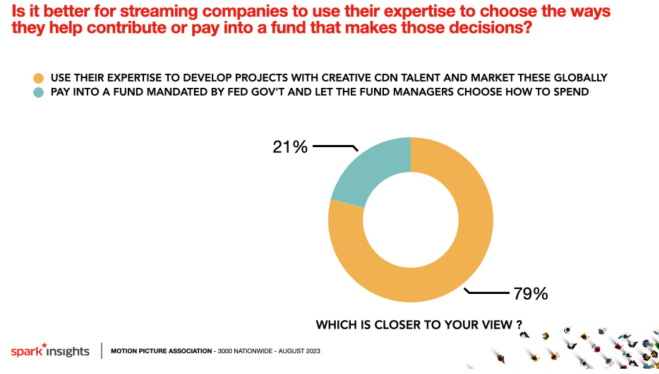
Unfortunately the second Anderson question was misleading, asking respondents if it was better for the Commission to require streamers to make cash contributions to Canadian media funds or broadcast licensed Canadian programs on their platforms.
Putting aside the editorialized phrasing of the question, the Commission is proposing the streamers do both and not either as part of an overall contribution to Canadian content. The final split of in cash and in kind contributions may well be in the neighbourhood of 21/79.
Speaking of the CRTC, last week MediaPolicy digressed far beyond our core expertise to comment on the Commission’s decision to force Bell and Telus to open up their top-end fibre networks to the wholesale broadband market of ISP retailers.
The Commission’s decade long effort to drive down retail Internet bills has been chaotic at times. This recent move seems to have backfired.
***
If you would like regular notifications of future posts from MediaPolicy.ca you can follow this site by signing up under the Follow button in the bottom right corner of the home page;
or e-mail howard.law@bell.net to be added to the weekly update;
If the CRTC’s regulation of Internet broadband pricing was a television series, it would be in something like its 17th season now as one of Canada’s great reality shows.
The most recent episode of Bell’s capital strike in response to a new CRTC ruling on its Fibe network infrastructure is a worthy follow-up to ‘BeerGate,’ that unmissable season two years ago where CRTC Chair Ian Scott and Bell’s Mirko Bibic were accused of cooking up the Commission’s cancellation of a major cut to the broadband wholesale rates the large telcos charge independent ISPs to rent carriage on their networks (the ISPs in turn compete against the major telcos and cable companies).
To recap the most recent episode, Bell announced on November 6th its indefinite deferral of a billion dollars in capital spending to push out its industry-leading fibre telecommunication network to the five million homes it hasn’t reached yet in suburbs, small towns and rural areas. Its refurbished network will replace its legacy copper with fibre-enabled bandwidth download speeds of up to 8 Gbps (compared to cable co-axial speeds topping out at 1.5 Gbps, offered by its major competitors Rogers and Québecor).
The dramatic cancellation of investment, delivered in an angry press release from Bell’s CEO Bibic, was sparked by the CRTC ordering Telus and Bell to rent ‘wholesale access’ to their fibre networks in Ontario and Québec to ISP competitors, especially the independent ISPs TekSavvy and an array of smaller broadband “re-sellers.” Until then, the CRTC had never ordered the telcos to share their top-end fibre networks with the independents, only copper or co-axial.
The CRTC’s regulation of telecommunications is as relentlessly politicized as broadcasting, even more so because of the regulator’s preoccupation with bottom-line numbers on monthly cellphone and Internet bills.
For the last two decades, the Commission has pursued the holy grail of lower retail prices for Internet services with a strategy of adding more competitors into the market through wholesale access to major telco networks, as ordered by the Commission.
The Commission strategy is founded on its unwavering conviction that affordable Internet services are “essential” to Canadians; that the capital-intensive ISP industry is plagued by high levels of corporate concentration that inflate retail prices; and that adding re-seller competitors is the solution. It has two tools at its disposal: the authority to force the major ‘incumbents’ like Bell and Rogers to open up all or part of their networks to these up-and-coming competitors and fixing the “just and reasonable” wholesale price for that access.
The “just and reasonable” wholesale rate is what the Commission has been trying to get right for over a decade. It’s not an easy task given the constantly evolving network technology and, more visibly, the bitter regulatory feud between the incumbents and the independents over identifying the sweet spot between a fair rate of investment return for the networks and a profit margin for the independents that allows them to compete and grow.
The CRTC’s effort to mediate the fight and find the sweet spot always seems to be in chaos. Nevertheless retail prices have declined —even garnering a gold star from the Competition Bureau— but on the other hand many of the leading independents have thrown in the towel, selling their assets and customers to the major networks (E-Box and Distributel to Bell, VMedia to Québecor, and Comwave to Rogers). Critics and the surviving independent ISPs (like TekSavvy and the ISP trade association CNOC) blame the CRTC for setting wholesale rates too high.
It’s fair to say the CRTC is spooked by these market exits which reflect badly on its long-term strategy. It’s in the midst of yet another review of wholesale rates. Its public hearings lumber on with painstaking evidence and analysis of what it costs to build and amortize multi-billion-dollar investments in networks sprawling across the Canadian land mass.
Perhaps this is why the Commission felt the need to do something short-term and dramatic by ordering Bell and Telus to open up their upgraded networks in central Canada that cater to customers with an appetite for up to 8 Gbps bandwidth.
Unfortunately, there is no publicly available map of ultra-speed fibre-network consumption. It seems unlikely that a significant number of customers want to pay for speeds greater than the 1.5 Gbps they can get from the co-axial networks owned by the cable companies that have to share access with the competing independent ISPs.
The median Canadian Internet customer utilizes less than 200 Mbps bandwidth. That’s less than 20% of available co-axial speed. The ultra-bandwidth speeds offered by Telus and Bell’s next-generation fibre networks may be the wave of the future —otherwise why would they spend so much building them— but in 2023 the top fibre bandwidth capacities aren’t what the average or even above-average household needs unless you’ve got multiple 4K televisions or teenage gamers online at the same time. I pay for 500 Mbps bandwidth. What’s in your wallet?
Before making up your mind on anything to do with Canadian telco regulation, I commend you to the blog Telecom Trends published by independent consultant Mark Goldberg.
Goldberg is clearly of the view that CRTC’s regulatory strategy on wholesale broadband regulation is not working because it doesn’t fully appreciate the investment climate for network building by the incumbents.
According to Goldberg, Bell and Telus have already built their fibre networks in the most lucrative, densely populated markets, the “low hanging fruit.” They are now building out to markets where the business case for rate of return on investment is more precarious and requires a disciplined market-by-market business case.
Business considerations are driven by rising capital costs in these less densely populated markets and Goldberg questions why the Commission based its most recent wholesale rate on only the last five years of capital cost, omitting the next five years, which a Scotiabank analyst projects will increase by 33%.
The CRTC wholesale rate does not include cost recovery of the incumbents’ lost opportunity to sell other core services, especially television, to the customers that the retailer is taking away from them. But the opportunity to sell multiple telco services to customers is a big part of the business case for investing the capital to build the fibre network in the first place.
“Look at a business case [for Bell or Telus] to lay fibre in the suburbs,” Goldberg told me in an e-mail correspondence. “Rogers is already offering up to [1.5] gig speeds over their cable plant. The wholesale-based ISPs have access to Rogers and are reselling that service already. Bell puts together a business case that says ‘we should be able to capture, say 50%, of the market if we make the investment, based on some assumed ARPU’ [average revenue per customer for bundled services]. They look at the cash flows and determine if the forecasted revenues are sufficient to undertake the risk. They set up a capital plan based on all the areas where the business case is positive.
“But now, CRTC says they have to allow TekSavvy to resell Bell Fibre there. So they can’t forecast the same retail share… The wholesale revenue from the resellers will be less than the retail revenues that Bell may have otherwise obtained. So the point is that there will be some areas that the business case for fibre will no longer be supportable.”
That perspective leads one to re-evaluate whether Bell’s investment cancellation is a capital strike, intended to arm-twist the Commission into reconsidering its fibre access order, or just a ruthless calculation of the best way to spend a dollar of gross profit.
***
If you would like regular notifications of future posts from MediaPolicy.ca you can follow this site by signing up under the Follow button in the bottom right corner of the home page;
or e-mail howard.law@bell.net to be added to the weekly update;
Last week MediaPolicy published two posts in anticipation of tomorrow’s commencement of CRTC proceedings to implement the Online Streaming Act Bill C-11.
The first post reviewed Heritage Minister Pascale St.-Onge’s final tweaks to the federal government’s broadly worded policy preferences it wants the Commission to follow. There was a surprise addition and perhaps a not so surprising omission.
The second post was a primer for the policy-curious who intend to follow this first of three rounds of CRTC hearings on C-11.
***
The Parliamentary hearings for Bill C-11 in 2022-23 were dominated by the debate over regulating YouTuber videos.
The YouTuber advocacy group Digital First Canada opposed regulation of their user-uploaded videos and at least partly won that battle when both the CRTC and the Heritage Minister announced that for now the CRTC won’t regulate YouTuber videos to meet “discoverability” outcomes for Canadian content.
But it seems the Canada Media Fund thinks Canadian YouTubers are deserving of state support anyway and announced a pilot project (initially at a modest $500,000) to subsidize Canadian YouTubers. The Canada Media Fund typically funds Canadian content that winds up on regulated broadcast platforms so there is a bit of a YouTuber “have my cake and eat it too” going on here. The upside is that deserving Canadian artists and content will get support in the burgeoning “creator economy” platform.
***
My neighbour, the late metallurgist, political thinker and peace activist Ursula Franklin, used to discourage what she called “awfulizing” about bad news.
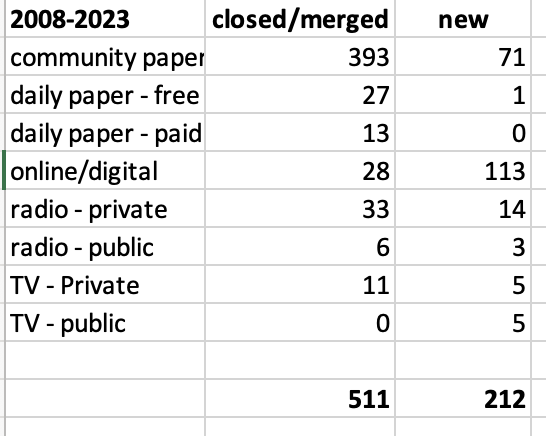
Mea culpa, that happens regularly in this space when the latest metrics are published on the declining capacity in Canadian news journalism.
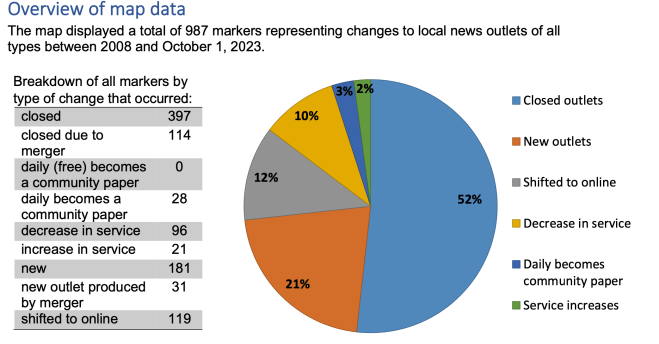
The Toronto Metropolitan University’s annual update to its news poverty survey produced these numbers of local news outlets, of all medias, that closed or opened since 2008:
Cutting the data to include increases or decreases in coverage by the newspaper outlets that didn’t close, TMU reported thus:
Chicago’s Medill School of Journalism (at Northwestern University) also released a report analyzing the socio-economic impact of the lost news coverage at the county level across the United States. The creeping news poverty skewed to a rural, older, lower income, and less educated demographic:
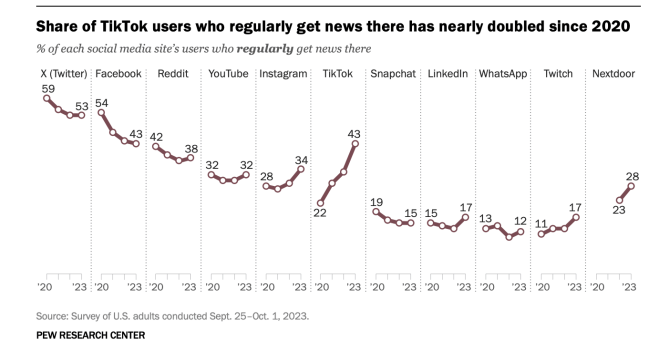
Research released by the American Pew Research Institute noted another important metric, this one concerning the regular consumption of news on social media.
The eye-catching statistic was the meteoric rise of news consumption on TikTok:
***
If you would like regular notifications of future posts from MediaPolicy.ca you can follow this site by signing up under the Follow button in the bottom right corner of the home page;
or e-mail howard.law@bell.net to be added to the weekly update;
Graphic illustration from cultural advocacy group Friends
November 17, 2023
On Monday the CRTC begins three weeks of public hearings on the key points of supporting Canadian content as Bill C-11 brings online platforms into the regulatory circle for the first time.
As typically happens, Parliament paints broadcasting legislation with the broad brushes of principle and ambiguity and then hands off the half-finished canvas to the CRTC. Having also received the Heritage Minister’s somewhat inscrutable policy preferences through last week’s Policy Direction, the CRTC is now tasked with completing the regulatory portrait.
It’s the first of three rounds of Commission hearings over the next year. The popular interest in C-11 normally creates its own cold fusion of energetic news reporting, so for those who will be following the proceeding here’s a basic primer of what is at stake in this first go around at the Commission.
The main task of the Commission’s “Step 1” hearings is to establish a “initial basic contribution” (IBC) to Canadian content to be levied on all broadcasting entities, especially the online streamers, but also licensed Canadian broadcasters, cable companies, and even social media platforms such as YouTube.
The Commission’s proposed IBC —“proposed” as in it’s not decided yet but it’s going to happen anyway— is a cash-only contribution to Canada’s various media funds that subsidize “Canadian” programs.
At the moment, only Canadian cable (and satellite) companies make such cash contributions, pegged since the 1990s at a robust five per cent of their annual revenues (the cable industry’s gross profit margin was 11.2% in 2021-22).
The lion’s share of the $390M in annual cable cash goes to the Canada Media Fund and a short list of bespoke Certified Production Funds (CIPF). After the CMF money is matched by the federal government, the CMF and CIPF cash becomes ten per cent of the financing for Canadian television shows, especially high-cost dramas and documentaries.
As for Canadian broadcasters —major networks as well as “indie” programmers like APTN, Wildbrain or OutTV— they don’t pay into media funds. Instead, they make their contributions to Canadian content in kind, not in cash, by programming Canadian shows, profitable or not. The usual in-kind programming contribution requires these broadcasters to spend about 30% of their revenues on Canadian shows that they either make in-house or commission from Canadian video producers. The Commission calls it Canadian Programming Expenditures (CPE).
(Radio operators also contribute cash, on a much smaller scale, to musician development media funds FACTOR and MusicAction).
As yet, the foreign streamers don’t contribute to Canadian content, neither in cash to media funds nor in kind within their own programming offerings. That’s about to change with Bill C-11.
The Commission wants to move quickly to get streamer cash into the broadcasting system to make up for the cable companies’ declining contributions to media funds, essentially reinflating the tires on the funding of Canadian programming.
So the question is not if the Commission will establish an IBC, but what the tariff will be and whether any broadcasting entities will be exempted.
Some of the regulatory filings submitted to the Commission in advance of the hearings don’t signal a harmonious atmosphere over the next three weeks. The large Canadian media companies are cranky and they have proposed that the US streamers pay in cash at a tariff set at twenty per cent of their annual revenues. That’s a non-starter, and they know it.
The streamers are not cranky, but they are arrogant. In an act of collaborative defiance, the Californian cartel of the Motion Pictures Association of America, Netflix, Apple, Amazon, and Disney —also Spotify on the music side of the streaming ledger— oppose any cash contributions to Canadian media funds and have refused to name a price they would pay. In other words, a tariff set at zero. That’s also a non-starter, and they know it.
The IBC will be the number one focus of these upcoming “Step 1” hearings.
But it won’t be the Commission’s exclusive focus. Later this year in Step 2, the Commission will look at Canadian programming obligations beyond the IBC. Those will be the Canadian Programming Expenditures, the “in kind” programming of Canadian content. Also in Step 2, the Commission will set expectations of “discoverability,” meaning the priority and promotion given to Canadian programming. Finally, the Commission will review the definition of a Canadian program, a perennially contentious set of criteria determining what Canadian programming is eligible for subsidies from the CMF and government tax credits and also what programming expenditures count towards fulfilling CPE obligations.
All of these Step 1 and Step 2 issues weave together into an overall broadcasting policy for Canadian content. So the Commission is expecting Step 2 considerations of Canadian Programming Expenditures, discoverability and Canadian programs to bleed into the Step 1 debate over the IBC over the next three weeks.
Beyond the tariff-setting for the IBC, expect to hear a lot about to whom the media fund cash ultimately flows.
The CMF and CIPFs currently subsidize Canadian television producers to make shows that they license for broadcasting to Canadian networks and indie channels. As well, there is a tiny $19M Independent Local News Fund that bankrolls local news, but only at 18 independent stations not owned by the CBC or the Canadian news networks.
The list of worthy recipients is going to proliferate, the only question is how far.
The Indigenous Screen Office is staking out its claim as a new media fund, making the pitch to be its own CMF for funding Indigenous video content. A similar request for music development has been submitted by a little known group, the Indigenous Music Office.
The Heritage Minister has asked the Commission to consider a more comprehensive local news fund, available to some or all of the 70 local stations operated by the CBC and private TV networks.
Another candidate for a possible media fund is what you might call “the public service channels,” or what the Minister has called programming “of exceptional importance.” That might include programming that is licensed by the Aboriginal Peoples Television Network, Accessible Media, the Weather Network, the gay and lesbian-focussed OutTV or the multi-ethnic channel OMNI. The Black Screen Office has just been recognized by the Commission as a CIPF, so that will also be part of the funding discussion too.
Despite their refusal to name a price for the IBC tariff, the American streamers are talking up the creation of bespoke media funds owned and operated by each streamer as a way of sending cash to, for example, Indigenous producers who would sell their programs directly back to their Hollywood patron: a Netflix Production Fund or a Disney Production Fund is what they have in mind.
That’s enough of a primer to get you started. The Commission’s official notice of consultation will take you a layer deeper. More to come over the next three weeks.
***
If you would like regular notifications of future posts from MediaPolicy.ca you can follow this site by signing up under the Follow button in the bottom right corner of the home page;
or e-mail howard.law@bell.net to be added to the weekly update;