This week I posted about the CRTC’s renewal of OUTtv’s broadcasting licence. The cable specialty channel focusses on LGBTQ+ content.
The post gets a bit heavy-duty on the fine points of CRTC policy, but it is an interesting (and I think important) story of how independently-owned programming services are fighting to enlist the CRTC’s help in getting better audience exposure from the telco and cable companies.
***
Heritage Canada was on the hotseat this week when Jonathan Kay broke the story of the federal government’s retainer of Laith Marouf as an anti-racism consultant for Heritage despite his outrageous Tweets over several years now described by Diversity and Inclusion Minister Ahmed Hussen as “anti-Semitic and xenophobic.”
Hussen effectively fired Marouf but the controversy is far from over. The Marouf tweets were highlighted several times over the twelve months in tweets and blog posts by telecommunications analyst Mark Goldberg, tagging the Heritage Minister and his Department among others.
Kay’s article asks how federal civil servants could have ignored these warnings. While Kay habitually delights in pranging the Left, in this article he has done a public service by opening a taboo policy debate over how government should be advancing its agenda to fight systemic racism without getting lost in negative identity politics.
***
The online threats against Global News journalist Rachel Gilmore —who bravely will not back down— keep getting worse.
In response, the Prime Minister has tweeted an appropriate condemnation.
Between the Marouf scandal and the targeting of journalists with hate and threats of harm, the public is well primed for a good discussion of the federal government’s Online Harms Bill once it is tabled in Parliament.
***
In February I wrote a context-piece about TekSavvy’s accusation that CRTC Chair Ian Scott was in cahoots with Bell. The central allegation was “the beer” shared by Scott and BCE CEO Mirko Bibic in an Ottawa pub, caught on camera.
TekSavvy and other wireless re-sellers have incorporated “the beer” incident into their appeal of a CRTC decision on wholesale rates charged to them by Bell and the other telcos, alleging a “reasonable apprehension of [CRTC] bias.” The Federal Court of Appeal has yet to schedule a hearing.
TekSavvy also filed a complaint to the federal Ethics Commissioner Mario Dion, the same commissioner who found against the Prime Minister in the SNC Lavalin affair in 2019 and against former Finance Minister Bill Morneau in the WE Charity scandal in 2020 (while clearing Trudeau).
This week Dion exonerated Scott in the “beer scandal,” clearing him of allegations he violated section 6 of the federal Conflict of Interest Act.
Section 6 specifies two different standards of illegal conflict of interest. The more demanding standard states that if a public officeholder has an opportunity (for example, just by having a beer in private with a stakeholder) to benefit their self, a relative or a friend, that’s a conflict of interest. It’s a legal presumption that the opportunity is the wrongdoing. Proof of corruption is not required.
But if the opportunity is with just an ordinary “person” then there must be proof of something “improper.”
The headline of Dion’s ruling was that he accepted Scott and Bibic were long-time business acquaintances but never friends and did not socialize outside of work. It was media reports that used the term “friends” (I made the same mistake in my post) but here are Scott’s actual words as reported last February in the Toronto Star:
I went for a beer with someone I have known for many years …. And it ended up he chose to address a broadcasting issue a little of what Bell might be doing in the future.
Dion took Scott at his word and did not open a formal investigation. TekSavvy spokesperson Peter Nowak expressed disappointment, but it’s hard to see how Scott is supposed to prove a negative.
What’s not elaborated upon in Dion’s report is why, if Scott and Bibic’s meeting was between “persons” and not “friends,” he found nothing “improper” in the opportunity that the private meeting created.
There is a helpful passage from Dion’s WE Charity report (it’s called the “Trudeau III Report,” which is some cause for mirth) where Dion explains what “improper” means under the Conflict of Interest Act:
For there to be a contravention of subsection 6(1), those private interests must have been furthered improperly. In the Trudeau II Report, I provided examples of improprieties from past examination reports. I explained that an impropriety under the Act occurs when a public office holder exercises an official power, duty or function that goes against the public interest, either by acting outside the scope of their jurisdiction or by acting contrary to a rule, a convention or an established process.
Although I found no indication of preferential treatment of WE by Mr. Trudeau in my analysis of the matter under section 7 of the Act, it must be pointed out that preferential treatment, in the general sense, could also be viewed as an impropriety under subsection 6(1).
The beer meeting post-dated the CRTC ruling on wholesale rates (so no preferential treatment) and (to quote Scott’s denials) “no rule was broken.” Ergo, no impropriety under the Act.
There is still the matter of whether a federal judge thinks the long-accepted practice of lobbying CRTC commissioners on matters of general policy —participated in widely by industry stakeholders including Bell, TekSavvy, and at one time by yours truly— creates a reasonable apprehension of bias when those same Commissioners sit as adjudicators.
The CRTC has nudged the regulatory needle in the direction of independent programming services seeking better terms of carriage from cable TV companies.
That makes OUTtv CEO Brad Danks “a small ‘h’ happy,” as he told Cartt.ca in a recent interview.
The reason for Danks’ muted joy was the Commission’s licence renewal of his LBGTQ+ focused channel on August 18th. OUTtv is owned by the privately held Stern Partners, but Danks is its long time guiding light and an articulate champion of independent programming services in an industry dominated by big media companies.
The plight of independent programmers gets little public notice. It’s the cable and satellite companies — known in CRTC-speak as “broadcasting distribution undertakings (BDUs)” — that are customer-facing.
Programming services like OUTtv survive by making distribution deals with the BDUs that have more bargaining power. The programmers look to the CRTC to balance the commercial relationship through regulation.
The story of OUTtv is an instructive episode in the David versus Goliath regulatory drama.
The Commission’s renewal of OUTtv’s 2013 licence was the programming service’s first renewal since the Commission relaxed regulatory rules in 2015 governing how programming services obtain BDU carriage.
Before the 2015 changes, OUTtv was one of many licenced Category A channels enjoying “must carry” privileges on BDUs.
“Must carry” was paired with “genre exclusivity,” a CRTC-enforced monopoly benefiting niche Canadian channels, including OUTtv because of its LBGTQ-focussed programming. The “rate card” compensation that BDUs paid to channels like OUTtv was negotiated or if talks broke down fixed by binding arbitration.
But in 2015 the Commission abolished the must-carry/genre exclusivity privileges along with the “Category A” label.
To mitigate the repeal of must-carry, the Commission ordered the vertically integrated BDUs Bell, Rogers, Québecor’s Videotron, and Shaw to carry as many independent channels as their own broadcast services (the “one-to-one” rule). It’s a measure of the BDUs’ dominance of the specialty TV market that, in spite of the one-to-one rule, their own specialty channels still earn $3 for every $1 of revenue earned by the independents.
The Commission also updated the Wholesale Code. Those are the rules of engagement between BDUs and independents around good faith bargaining, reasonable rates and other commercial terms, again backed up by binding arbitration.
The few remaining “must carry” specialty channels on BDU platforms are the so-called “section 9(1)(h)” channels hosted on the basic TV dial: the Aboriginal Peoples Television Network, weather channels, news services for minority anglophone and francophone communities, accessibility programming for disabled Canadians, and most recently the multi-lingual OMNI network. OUTtv is not among them.
Must-carry in the BDU “basic” television package that includes local Canadian and American stations gives these services maximum audience exposure and —-importantly—- a rate-card fixed by the CRTC.
Like any niche content channel, OUTtv’s business model is built on the authenticity of its content. But to be profitable, it must build out audience scale.
In past rulings the CRTC acknowledged the importance of OUTtv’s programming for two reasons: to serve an LBGTQ+ audience that is underrepresented in television and to provide a “bridge” to the mainstream audience.
As Danks put it in his recent licence application, OUTtv programming provides his community with authentic content and positive encouragement while offering straight viewers more insight into the LGBTQ community than they might see on the major TV networks.
The Commission agreed:
44. The Commission agrees with the licensee and the interveners that OUTtv plays an important role in the Canadian broadcasting system as it is the only service in Canada that targets LGBTQ2 communities with all of its programming. OUTtv responds to the needs and interests of these communities and contributes to raising greater awareness and understanding by all Canadians. In addition, OUTtv Network invests significantly in original first-run productions, thereby ensuring the reflection of LGBTQ2 communities in television programming while contributing to the diversity of programming available to Canadians. The licensee also uses independent producers who identify with LGBTQ2 communities. The Commission considers that the service contributes directly to fulfilling objectives of the Act by providing a unique contribution that targets and reflects the LGBTQ2 communities.
But like all television companies today, OUTtv’s linear TV business has faltered over the last decade.
Despite OUTtv increasing programming expenditures devoted to Canadian content (now an eye-catching 58% of revenue), CRTC filings for 2016-2020 show its annual revenues for linear TV in steady decline.
In 2020, it sustained a 30% operating loss ($1.6 million on $4.1 million of revenue). Subscriber numbers grew and peaked in 2019 at 1,056,752 but fell hard to 890,525 the following year.
OUTtv responded by expanding its online audience and digital revenue in Canada and abroad through distribution deals with Amazon, Roku and other platforms,an increasingly common strategy for niche broadcasters. But OUTtv’s bread and butter remains carriage on regulated Canadian BDUs to reach the biggest domestic audience.
In response to an e-mail, Danks said “we have been working hard to grow our revenue in the online platforms in Canada and around world. However it is important that OUTtv be treated fairly on the Canadian system as well. Maintaining these revenues is important to give us time to make the transition to the future.”
To achieve that, CEO Danks wanted three things from the Commission.
First he asked to keep the must-carry BDU privileges from his expiring Category A licence.
Second, he wanted the Commission to fix the tariff at which BDUs would pay for carrying his channel (a difficult ask given the Commission hasn’t done that since 2006 except for the handful of “section 9(1)h” services on the basic dial).
Most importantly, he proposed a better deal from the BDUs on how his channel is sold to cable customers.
This latter point is called “best available packaging” in the CRTC’s Wholesale Code. In the world of specialty TV where audience scale is the key to profitability, placement in the most popular pre-assembled bundles or theme packages is where the success of independent programming services is made or broken.
Currently Bell, Rogers and Shaw relegate OUTtv to their most costly and least subscribed premium bundles and still remain in-bounds of the CRTC’s forgiving interpretation of “best available packaging”.
Other BDUs like Telus —-which offer customers small theme packages instead of general bundles— have placed OUTtv’s unique content in lower-penetration “variety” packs grouped with home improvement and women’s channels.
The promised land for OUTtv and most independent programmers is inclusion in a BDU’s lowest-priced but well subscribed general bundle of specialty channels.
However BDUs don’t let just anyone into the promised land. They are gatekeeping dozens of programming services (including their own), all clamoring for maximum audience exposure.
Protecting their own bottom line, BDUs may package independent channels with a loyal following in a manner that drives customer traffic to a less popular but more expensive package. Fairly or not, popular programming services can be conscripted as cross-subsidizers of other independent services.
More troubling from the independents’ point of view, the BDUs are motivated to look after their own specialty channels first, although that practice is limited by the Wholesale Code’s rule against self-preferencing.
OUTtv had a bad experience with the CRTC’s interpretation of “best available packaging” rules in 2012 when Telus chose to assign OUTtv to its less popular Lifestyle Extra pack with five per cent market penetration instead of the higher (50%) penetration Lifestyle bundle. The Commission’s solution was to leave OUTtv in the Lifestyle Extra pack but order Telus to do a better job marketing it. The Commission’s bottom line was:
Requiring TELUS to place OUTtv in the “Lifestyle” package in the circumstances would unreasonably undermine TELUS’s overall packaging flexibilityand lead to less choice for consumers….the differing penetration levels of packages should not be sufficient in and of itself to sustain a finding of undue preference or disadvantage.” (Emphasis added).
If that was what the Wholesale Code’s prescription of “best available package” really meant for independent programmers, Danks was looking to fix this in his next licence renewal.
In the end the Commission gave OUTtv some of what Danks was asking for in its licence renewal released August 18, 2022.
The decision’s headliner was a “must-carry” order for OUTtv in the licenced English language market.
As a former Category A channel, OUTtv’s “must carry” represents the status quo. But at least the order deprives BDUs of the opportunity to play hardball with OUTtv over distribution deals by serving notice of non-renewal.
On the more important issue of packaging, the Commission appears to have struck a compromise between BDU and OUTtv interests.
Instead of giving Danks the binding order he was seeking, the Commission gave his BDU partners a non-binding “expectation” of packaging privileges that expands on the limited rights of programming services found in the Commission’s Wholesale Code:
To this effect, clause 9 of the Wholesale Code states that “[a]n independent programming service shall, unless the parties agree otherwise, be included inthe best availablepre-assembled or theme package consistent with its theme, programming and language.” Given the exceptional importance of OUTtv to the achievement of the objectives of the Act, the Commission considers it appropriate to set out the following expectation:
The Commission expects broadcasting distribution undertakings to include the OUTtv programming service in pre-assembled or thematic packages, consistent with its theme, programming and language and with the highest penetration rates. (Emphasis added)
What the Commission did here is to request but not compel BDUs to recognize OUTtv as a special case because of the public interest in its LGBTQ+ content and for that reason defined “best available” package as the one with “the highest penetration rates.”
This gives Danks almost everything he needs to get a better deal on packaging.
It does not however temper any of the hardball negotiating tactics —-low balling the rate-card and delaying arbitration proceedings top the list— that independent programmers often accuse BDUs of using (denied by the BDUs, to be sure).
On this point, the Commission gave Danks a consolation prize with another non-binding directive to BDUs:
52. In addition, the Commission encourages BDUs to treat the OUTtv programming service fairly and to avoid withdrawing the service, imposing punitive or retaliatory measures, imposing unreasonable rates, significantly altering the packaging or otherwise substantially reducing the wholesale payment for the service. (Emphasis added)
A dissent from BC/Yukon Commissioner Claire Anderson would have converted the majority’s expectations and encouragements into mandatory orders.
Now that the Commission’s ruling has made Danks “small ‘h’ happy,” OUTtv is headed for some lengthy negotiations with all BDUs, big and small.
The outcome may not be known for months, especially if disputes over rate cards and packaging go back to the Commission for arbitration.
Is this a precedent for future licence renewals of other independent programmers?
It would be optimistic of them to think so.
The OUTtv ruling is clearly tethered to the public interest of giving a boost to underrepresented programming by and for an equity-seeking community. This is similar to what the Commission just did for indigenous, racialized, and disabled communities in the CBC licence renewal.
Meanwhile the independent programmers’ list of grievances against the BDUs were recently aired at the CRTC’s Rogers-Shaw merger hearings but mostly deflected by the Commission.
The independent programmers see themselves getting squeezed by BDUs which are responding to their own profit pressure from Netflix and other foreign Internet competitors.
Verifying that perception, since 2016 the specialty channels owned by Bell, Rogers, Québecor and Shaw have shrunk by two per cent of revenues while the independents are down seven per cent. The PBIT profit rate for the BDUs’ specialty channels was 30% in 2020 while the independents were at ten per cent, even lower if the programming services that enjoy a secure flow of “section 9(1)h” subscriber fees are factored out of the calculation.
Last Thursday I posted an opinion on CTV’s firing of national news anchor Lisa LaFlamme, describing it as self-sabotage of a great news organization. If you want to catch up on the controversy, I recommend Steve Faguy’s blog.
One observation I made in my post was that we can only draw conclusions from the facts we see above the water line. So long as LaFlamme and CTV Editorial VP Michael Melling are not granting interviews we can really only be sure of two things: she was fired and her age had something to do with it.
Below the water-line, there may be more to be seen but with sources inside CTV requiring anonymity to speak out it remains murky for now.
Canadaland published a transcript of the staff meeting CTV executives held with a red-hot newsroom which came across exactly as you might have expected: an exercise in deflection. When asked point-blank if LaFlamme was fired because of her age, Bell Media Senior VP Karine Moses replied that as a woman herself she would not fire LaFlamme because LaFlamme is a woman.
Mainstream media outlets did a thorough job. The Globe reached a source who made a very specific allegation that he or she heard Melling grumble about LaFlamme’s decision to stop colouring her hair and wondered aloud who let her to do that.
Put that in the smoking gun category?
Searching for more facts below the water-line, two other things emerged through anonymous sources.
Canadaland’s Jesse Brown relied on a “high level CTV” source to support several allegations against Melling, the most damaging being an assessment of his general character that includes a stunning factual allegation:
“He’s a company man,” says the high-level CTV source. “He does not stand up for the journalists…He doesn’t like it when women push back and he brags about how he’s destroyed careers of anyone who dares push back.” (Emphasis added).
So far, no one corroborates that Melling has bragged about destroying careers.
The Toronto Sun’s Brian Lilley took another tack by claiming that one of the reasons LaFlamme was fired was because of her newscast’s reporting of the 2018 Patrick Brown story involving young women. The background requires diving down a rabbit hole: you can read about the story here, Brown’s lawsuit against CTV here, and the cashless settlement of the court action here and here.
It’s fair to say that from the beginning of the Brown story Postmedia writers portrayed their rival CTV’s coverage as irresponsible. And editorially Postmedia has supported Brown’s political career.
Lilley’s recent coverage cites at least two anonymous sources quoted thus:
“They were giddy,” said one former colleague of LaFlamme and her executive producer Rosa Hwang as they were working on the story.
“They wanted their own ‘Me Too’ story and were determined to get it,” said another co-worker of the pair.”
The latter source (a co-worker) is offering an opinion (or perhaps the supporting facts were edited out of the story).
The first source —a “former colleague”— makes a damaging allegation against LaFlamme and Hwang— but it’s thin on the facts (“giddy”). And the question must be asked about Lilley’s reporting on such a key and sole sourced allegation: why is a former colleague granted anonymity?
Lilley concludes: “The Brown case wasn’t the only factor in LaFlamme’s dismissal, but it was a factor alongside several others.”
From here, Lilley’s column looks like a relitigation of CTV’s coverage of the Brown story: LaFlamme and Hwang just get smeared in the drive-by.
As a non-journalist I don’t have an intuitive grasp of when ethical lines about the use of anonymous sources get crossed. Feel free to leave a comment on this page.
***
The government has filled on an interim basis the CRTC Broadcasting Vice-Chair vacancy created by the departure of Caroline Simard with Alicia Barin, the current Québec commissioner.
Simard has left the Commission to become the Commissioner of Elections Canada rather than seek a renewal of her five-year term at the CRTC or apply for the CRTC Chair position vacated by the outgoing Ian Scott.
Simard is the author of two very strongly worded dissents against Scott’s majority decisions in the CBC Licence Renewal and the “N-Word” Radio Canada ruling.
Barin voted with Scott on the CBC licence renewal which is being appealed by a number of organizations, including the government of Québec. It’s unknown if Barin was involved in the Radio Canada ruling since the adjudication of the listener complaint was not conducted as a public hearing.
***
Google announced its hosting platform YouTube will offer a multi-channel online broadcasting distribution service in Europe similar to Roku and Amazon Prime. It already offers an online cable bundle as YouTubeTV in the United States.
As I posted previously during the Bill C-11 debate, YouTube operates different lines of broadcasting businesses. YouTube’s “user generated content” ecosystem is just one of them.
Perhaps you had an “I knew it” moment when you read that CTV executive Michael Melling raised the question of national news anchor Lisa LaFlamme’s silver hair colour a few months before he fired her.
We are still learning in bits of divulged information what led up to LaFlamme’s dismissal from her job at the top rated national news show, a role in which she could only be described as wildly successful if that description doesn’t distract from the journalism gravitas she offered Canadians.
As a now retired but life long union staff representative in the media industry, I handled hundreds of dismissals. Each time there was a lot going on below the water line that the public (or the rest of the workplace) didn’t ever hear about. So if we pass judgment on someone’s firing, we can only base it on what we are permitted to see or what emerges later (the circumstances of Wendy Mesley’s departure from the CBC is a textbook case of waiting for the full story).
LaFlamme has said all she wants to for now. She is referring working reporters to her posted video statement. Melling isn’t talking, other than a press release written in corporate-speak that cites appealing to a younger audience.
Melling was on trial in the press and social media this week. It’s fair to say the judgment by a jury of his peers and the general public is guilty as charged. The Globe’s Robyn Urback qualified that today in a columnby reminding us that salary dumping of top-earning stars is a ruthless commonplace in media and especially Bell Media since Wade Osterman took the reins.
Still LaFlamme’s firing remains a very disturbing story about hair colour and the general circumstances of a powerful male executive butting heads with a strong (and more respected) female subordinate.
Melling started his career at the small-ish CTV station in London, Ontario. He didn’t have the reputation as an ogre, more like flinty-eyed but a good listener. Not the kind of BBPD (bad boss personality disorder) you fear working for.
He was good at what he does —-finding economies, containing costs—- and was promoted in December 2018 to a job that included running Toronto’s Cable Pulse 24. That all-news channel is one of CTV’s most financially successful properties at a forty per cent net profit according to CRTC filings. The age of the staff skews 35-ish.
Melling became General Manager of CP24 six months after the 25 on-air reporters and hosts voted to unionize. The issue was pay. It had been a problem for years before he got there.
This is where I joined the story, assigned by Unifor to negotiate the first collective agreement. As soon as we got the confidential salary information it became clear why the staff had opted for the union: the salaries were egregiously polarized by gender, the worst I saw in my thirty-year career as a union negotiator. Most of the female reporters had been at the station several years and were far below the journalist salary line at CTV’s other Toronto news outlet CFTO-TV which has been unionized for decades.
Melling didn’t cause that but he wasn’t eager to fix it either.
Sitting across from him in contract negotiations, Melling did not look very pleased to be there, but my guess is that was either his game face or his dismay at us messing with his budget.
The negotiations took some time to arrive at the standard salary structure in a unionized newsroom which is always a laddered job rate ending in a “maximum” salary for most of the staff, with a handful of top-earners retaining their existing salaries above the union rate with cost of living raises. All staff have the freedom to negotiate more pay in excess of the so-called maximum.
Although the CP24 negotiations were not unlike crawling across broken glass, we reached an agreement to an accelerated phase-in of pay equity. Knowing Bell Media corporate culture as I do, the decision to cough up more salary came from someone well above Melling’s level. (The silver lining in the silver lining is that the station’s exceptional profitability went up).
I am pleased to say that CP24 continues to operate as a money-machine for CTV without having to fire top journalists in a pivot to a younger audience.
And that observation is my take-away from this sordid story. If the executives at Bell Media believe that the path to a younger audience (and retaining the older audience) lays through firing the Lisa LaFlammes of the world, heaven help the whole organization and the rest of the staff still working there.
Unifor National President-Elect Lana Payne is a former journalist. Photo Credit: Jennifer Rowsom/Unifor
August 14, 2022
Last Monday eighteen broadcasting groups and policy advocates filed petitions to federal cabinet asking the government to rescind the CRTC’s controversial renewal of the CBC’s five-year TV licence. The appeals of the 271-page ruling (covering dozens of new and repealed conditions of licence) are itemized and lengthy.
The main argument is that the repeal of key licence conditions supporting Canadian programming is not only bad for public broadcasting of Canadian content but sets a precedent for similar deregulatory rulings for private TV networks and online undertakings in the next two years.
I posted a summary in which I suggest that cabinet has an opportunity to not only reconsider the CRTC’s decision but to refocus the CBC on its public mission.
***
In Australia, there is a ruckus over the first annual review of the “Facegoogle” Bill that is the model for Canada’s Online News Act, Bill C-18. Both Google and Meta are publicly trashing the legislation that pushed them in 2021 to negotiate pay-for-news deals with Australian broadcasters and publishers.
Given that Canada’s C-18 will be in front of the Heritage Committee in September, it’s timely that McGill University’s Taylor Owen and Supriyu Dwivedi have published a review of the Australian situation that segues into a list of recommendations to improve C-18.
Added to a similar list from former CRTC Chair Konrad Von Finckenstein, Heritage MPs should get a running start on improving the Bill.
***
Judging from my Twitter feed, either the tide of vicious and perhaps criminal online abuseof female journalists is rising or the brave defiance of those women is mounting.
Demands are increasing that police forces respond better to the threats of harm directed all journalists, but especially women and Canadians of colour who are the most frequent targets.
***
Speaking of female journalists, Lana Payne was elected National President of Unifor, replacing Jerry Dias. Before joining the labour movement, Payne began her career as an investigative reporter at the legendary St.John’s Sunday Express and later as a columnist at the Telegram.
Unifor represents 10,000 journalists and media workers in print journalism, film production and broadcasting and has been active on a long list of media policy files.
Opponents of the CRTC’s renewal of the CBC’s television licence have petitioned federal cabinet to veto the controversial ruling. The cabinet’s decision is due in early December.
Appeals of CRTC licensing decisions routinely fail, but this time may be different given the far reaching consequences of the CRTC removing key conditions of licence supporting Canadian programming.
The cumulative message from 18 petitions filed by many of the industry groups that participated in the Commission’s licence proceeding is that the results of its 271-page ruling are a mess.
Despite broad-based support for the Commission ordering the CBC to spend more on programming from equity-seeking groups, the petitioners say the CRTC got it badly wrong on local news; badly wrong on support for independently produced Programs of National Interest (PNI); badly wrong on prime-time broadcasting of Canadian content; and badly wrong on striking the balance between encouraging the CBC’s migration to digital while maintaining a vigorous conventional TV platform.
And that’s only a partial list. An exhaustive review of licence conditions can be found here.
To give some context to the controversy, it’s important to look to Canada’s national broadcasting policy that Parliament wrote into section 3(1) of the Broadcasting Act.
That policy makes the CBC the federal flagship of Canadian culture and tells the CRTC what to enforce:
(l) the Canadian Broadcasting Corporation, as the national public broadcaster, should provide radio and television services incorporating a wide range of programming that informs, enlightens and entertains;
(m) the programming provided by the Corporation should
(i) be predominantly and distinctively Canadian,
(ii) reflect Canada and its regions to national and regional audiences, while serving the special needs of those regions,
(iii) actively contribute to the flow and exchange of cultural expression,
(iv) be in English and in French, reflecting the different needs and circumstances of each official language community, including the particular needs and circumstances of English and French linguistic minorities,
(v) strive to be of equivalent quality in English and in French,
(vi) contribute to shared national consciousness and identity,
(vii) be made available throughout Canada by the most appropriate and efficient means and as resources become available for the purpose, and
(viii) reflect the multicultural and multiracial nature of Canada;
By contrast Parliament conveyed to private broadcasters more modest CanCon obligations, balanced against commercial considerations:
(s) private networks and programming undertakings should, to an extent consistent with the financial and other resources available to them,
(i) contribute significantly to the creation and presentation of Canadian programming, and
(ii) be responsive to the evolving demands of the public;
It’s not surprising then that the CRTC’s obligations to spend on Canadian programming (“CPE”) are far greater for the CBC than private broadcasters: the CBC’s 85% of total programming expenses compares to only 30% of total revenue for the big private networks.
In addition to the CBC’s high level of overall spending on Canadian content —commensurate with its $1.3 billion in federal funding— the CRTC has long imposed genre-specific conditions of licence for priority programming on linear TV: local news, PNI, children’s shows, French and official minority language programming, Canadian feature films, and so on.
Until this recent ruling, the Commission also required the CBC to showcase Canadian content during prime time evening hours (80% of programming compared to 50% for private networks).
Also until this ruling, the Commission obliged the CBC to buy 75% of its Programs of National Interest from independent Canadian producers. As the largest purchaser of independent Canadian programming, the CBC sustains an ecosystem of homegrown producers who create authentic Canadian shows.
The CRTC’s new ruling establishes an overall CPE of 85% for the CBC, now to be shared by both linear and digital video platforms, and eliminates most of the existing licence conditions governing programming for priority genres. The exception is the Commission’s newly created and (mostly) well received spending envelopes for programming from racialized, Indigenous, LGBTQ and disabled Canadians.
The Commission’s reasoning behind this deregulation is at times challenging.
As pointed out in the petition filed by the Forum for Research and Policy in Communications, this was very much in evidence in the Commission’s rejection of a proposed network-wide spending envelope for local news (first created by the Commission for private networks in 2017) and its subsequent repeal of the licence condition requiring minimum weekly hours of local programming at the CBC’s largest stations.
The Commission explained its rejection of adopting the network-wide spending envelope thus:
433. If the CBC can fulfill its obligations (relating, for example, to regional relevance, balanced news, and hours of local programming) while reducing related news expenditures, it should not be prevented from doing so. Although the imposition of a condition of licence would provide a sustained commitment on the part of the CBC to news and local programming across all platforms, while giving the CBC the flexibility needed to adjust expenditures in response to fluctuations in revenues or expenses, it would not address concerns regarding spending in metropolitan versus non-metropolitan markets, and would not necessarily mean that the CBC is directing spending to local programming that includes news. Further, while much news-related spending can be planned, it must be recognized that a significant portion of the spending is either cyclical (such as election periods) or related to breaking news or long-term events (such as the pandemic).
434. In light of the above, the Commission finds that it would not be appropriate at this time to impose on the CBC an expenditure requirement relating to news programming.
It appears the Commission rejected a network-wide news spending envelope because it might allow the CBC to cannibalize budgets from some stations to support others.
Not being willing to trust the CBC on this point, the Commission then turned around and expressed such a high degree of trust in the Corporation that it was willing to remove long standing conditions of licence requiring minimum weekly hours of local programming for its seven metropolitan stations in Vancouver, Calgary, Edmonton, Toronto, Ottawa and Montreal despite undisputed evidence placed before it of declining news production:
454. The Commission acknowledges the concerns raised regarding the reduction in local programming broadcast on the CBC’s English-language services. However, even though there was a decline in the number of hours of local programming offered on the CBC’s licensed television services, it has still met and well exceeded its conditions of licence in terms of hours of local programming broadcast.
455. Furthermore, the Commission is not convinced that if it were to accept the CBC’s modified conditions of licence [regarding the existing minimum hours of local programming], the CBC’s actual performance on its conventional television stations would change dramatically, since the Canadian public still consumes a great deal of content on its licensed services. Further, the Commission notes that the CBC’s production studios are located in metropolitan markets, and that those markets are therefore very likely to be adequately served by the CBC’s local programming…
459. After reviewing the CBC’s proposal, for the reasons set out above, the Commission is confident that the CBC will continue to broadcast local programming that is predominantly news in both the English- and French-language metropolitan markets. Accordingly, the Commission finds that imposing a condition of licence relating to the broadcast of local programming in metropolitan markets is not necessary for the CBC to achieve the above-noted outcome in this regard.
It’s an ambiguous policy conclusion.
Either the Commission is inviting the CBC to cut local news in large cities to preserve news budgets in smaller markets, or the Commission has a Polyannish confidence that the CBC will not reduce news programming in the metropolitan markets despite having already done so and now having the regulatory freedom to do more.
Either way, the Commission has left the CBC’s metropolitan stations bereft of licence conditions for both spending and exhibition of local news. Private network stations in those six cities retain both. When the private network licences are up for renewal two years from now the private broadcasters will howl for relief.
That’s not the only knock-on effect of this CBC ruling on the regulation of the private stations.
As the petition filed by the Canadian Association of Broadcasters says, the CRTC’s repeal of the CBC’s obligation to schedule Canadian programming during prime time means it can schedule more lucrative US programming in its head-to-head competition against private networks which are still obliged to schedule Canadian shows for 50% of that window.
By now we should be seeing the pattern.
As several of the petitioners point out, the Commission’s repeal of many CBC licence conditions will be demanded by competing private broadcasters in 2024. Not surprisinglypetitionersbluntlydecry the CBC ruling as a “stealth policy hearing” in which significant deregulation of private broadcasting is rendered a fait accompli.
A similar point about stealth policy change is made by the public interest group Friends in reference to the CBC being permitted to share up to 100% of its CPE obligations over both regulated linear TV and unregulated Internet TV.
The Commission’s first foray into setting ground rules for combined linear-online TV operations before Bill C-11 has even passed into law creates facts on the ground when the CRTC issues a Notice of Consultation to implement Bill C-11’s regulation of online undertakings. Just as an example, the Commission’s decision to repeal prime time exhibition rules for linear TV will encourage YouTube to argue for watering down any proposals on “discoverability” of online content.
The Commission’s choice of the CBC licence renewal to signal a system-wide deregulatory tack also raises the question of whether it’s in line with what the government has in mind for the public broadcaster in the first place.
The Prime Minister’s mandate letter to Heritage Minister Pablo Rodriguez following the 2021 election gives explicit instructions:
Modernize CBC/Radio-Canada, proceeding in a manner that respects the public broadcaster’s independence by:
Updating CBC/Radio-Canada’s mandate to ensure that it meets the needs and expectations of Canadian audiences, with unique programming that distinguishes it from private broadcasters;
Reaffirming its role as public broadcaster in protecting and promoting the French language and francophone cultures in Quebec and across the country;
Increasing the production of national, regional and local news;
Strengthening Radio Canada International, so that it can continue to advocate for peace, democracy and universal values on the world stage;
Ensuring that Indigenous voices and cultures are present on our screens and radios;
Bringing Canada’s television and film productions to the world stage; and
Providing additional funding to make it less reliant on private advertising, with a goal of eliminating advertising during news and other public affairs shows.
On the latter point, the Liberal election platform promised $100M annually in additional funding. That funding did not find its way into the Finance Minister’s “restraint budget” in April but the outstanding promise is a culmination of several years of advocacy (including CBC management as recently as 2016) for the CBC to distinguish itself as a public broadcaster by going ad-free, like the better funded BBC.
The silver lining in the CRTC’s ruling on the CBC licence, and the subsequent petition to cabinet, is that it challenges the Minister and his cabinet colleagues to engage in the hands-on review of the CBC contemplated in the PM’s mandate letter.
Federal cabinet also has the opportunity to think carefully about the intended or unintended consequences of the CBC ruling for the regulation of private domestic broadcasters and also the regulation of online undertakings that the government has fought so hard to introduce in Bill C-11.
This may be a big increase in workload for a Heritage Minister already shepherding three Internet Bills through the House. An alternative proposed by one of the petitioners is for cabinet to veto the CRTC’s ruling (with the exception of the spending envelopes for equity-seeking programming) and instruct the Commission to extend the existing CBC licence until after the Commission has implemented Bill C-11. This would also give Heritage and Finance more time to chart a course for the public broadcaster.
***
This post is already too long. The Commission’s majority and dissenting opinions are 271 pages long covering a long list of repealed licence conditions. The 18 petitions are just as encyclopaedic.
For policy junkies, you can find the petitions hosted on the FRPC’s website.
As a postscript for those of you whose patience is not exhausted yet, at least two more points raised by petitioners are worth mentioning.
PIAC has cited statistics demonstrating the large audience still devoted to linear TV despite years of cord-shaving and cord-nevering.
From the PIAC petition, sourced from the CBC
That age-skewed audience is characterized by a strong preference for linear television and confirmed resistance to Internet adoption.
From the FRPC petition, sourced from Statistics Canada
That has real consequences depending on how far the CBC exploits its new freedom to shift resources from linear to digital and especially away from metropolitan local stations: home to nearly 40% of the Canadian population.
Unthinkable only a few years ago when the previous CBC President advocated for an ad-free CBC, Tait is taking the Corporation in the opposite direction over the objections of her own newsrooms and without a mandate from anyone outside her own office. While advertorial and sponsored content is common-place in commercial news organizations, it is not in public broadcasting.
Most petitioners are asking Cabinet to review the Commission’s decision not to ban Tandem.
Before Parliament broke for the summer, Bill C-18 the Online News Act passed second reading in the House of Commons and is slated for further debate and possible amendments at the Heritage Committee in September.
The Bill is aimed at compelling Facebook and Google to pay more (or at all) for Canadian news content that draws and retains traffic to their sites. It’s modelled on similar legislation in Australia which rebalances the bargaining power between the FaceGoogle platforms and news organizations. The key is the availability of binding arbitration should negotiations fail between Platforms and news organizations (who are allowed to combine into bargaining coalitions).
Like Australia, Canada is small potatoes to Facebook and Google. Their fight back against government regulation is global. The UK, Europe and the US are the prize fights. Canada and Australia are on the undercard.
That’s why it’s important for Canadian policy makers to pay attention to similar legislative efforts in the big markets. Last week, US Senator Amy Klobuchar got her skinny American version of C-18 in front of the Senate Judiciary Committee, fifteen months after she first tabled the Journalism Competition and Preservation Act (JCPA) in the Senate.
The House version of the Bill hasn’t even got to the Committee stage. What is murky in a Beltway kind of way is that the main sponsor of House 1735 is talking openly of a more robust Bill, more like C-18, but has not been able to table it.
The JCPA is skinny not only because it is a single page of text but because it is nothing like C-18. It merely gives news organizations a four-year exemption from powerful American anti-trust rules so they can lawfully bargain as a group to get a better deal from the Platforms: there is no arbitration and no obligation for the Platforms to negotiate in good faith with any news organization.
Facebook and Google would grab this skinny JCPA deal in a New York-minute (okay, Silicon Valley-minute) if it set the bar for similar legislation around the globe.
Things have gone too far for that in Canada unless Google and Facebook can find a way to get Pierre Poilievre to blow up C-18 and no doubt he is game.
Meanwhile Google is engaged in a lobbying and publicity campaign against the Bill, while Facebook is making ominous comments about downgrading news content in their feed (used to be “newsfeed”) algorithm.
As a kind of insurance policy, over the last year both Platforms made confidential pay-for-news deals with individual print news organizations for what are surely on terms dictated by the Platforms.
In the course of summarizing a portion of his narrative about the beguiling power of storytelling in news journalism —that we are imprinted with a primal desire for good storytelling— I unwittingly stumbled into an important academic debate about whether storytelling is truly “innate” and even further that it is “primal” in an evolutionary sense.
For those of you with an academic bent, you may find Jonathan Kramnick’s “Against Literary Darwinism” Critical Inquiry 37 (2011) interesting. If you want to read the full article for the purpose of research, I believe I will be on the right side of the copyright/fair use line by sharing it with you, so just email me at Howard.Law@bell.net.
***
The debate over the Online Streaming Act Bill C-11 has been mercifully quiet for a few weeks.
Today the Globe’s Johanna Schneller wrote an interesting piece on the US streamers’ purported pivot to making and distributing nationally-distinct programming as a global business strategy.
Whether that is just spin for the C-11 debate (the timing is very convenient) or a real change in global programming strategy is something we will have to wait and see about.
There are some insights from Schneller’s interviews with the Californian streaming studios about working on authentically Canadian projects with independent Canadian producers who will expect under current CanCon certification rules to hold onto the intellectual property rights to second seasons, sequels and spin-offs.
Amazon’s Christina Wayne was having none of that when she told the Globe “the deals we do [with Canadian producers] are competitive. If producers want to retain ownership, they can sell somewhere else.”
***
There are other policy issues bubbling to the surface that I hope to post about soon.
A number of broadcasting and policy groups are filing petitions to the federal cabinet to overturn some of the more controversial terms of the CRTC’s renewal of CBC’s licence.
The CBC has filed its own appeal document (to federal court) against the CRTC’s ruling on the use of the N-Word by two Radio-Canada hosts.
A fresh development that impacts the debate over the Rogers-Shaw merger is a complaint filed by a small Canadian broadcaster One Soccer against Rogers for denying access to distribution on the Rogers Cable platform. During the merger approval at the CRTC, the Commission mostly deflected the efforts of small programmers to obtain mandatory access to Rogers’ cable platform which will, if the merger is completed, own 47% of the English Canadian cable market.
More on that once Rogers files its reply a month from now. The One Soccer filing is listed on the CRTC site as Timeless Inc. v. Rogers.
A review of Veils of Distortion: How the News Media Warps our Minds, by John Zada.
This book is yet another introspection in response to the Internet’s fragmentation of media, the undermining of mainstream news journalism, and the degradation of civic debate.
The message from Toronto-based journalist John Zada, who spent several years working for cable TV news outlets at the CBC and Al-Jazeera, is this: mainstream news journalism is messed up.
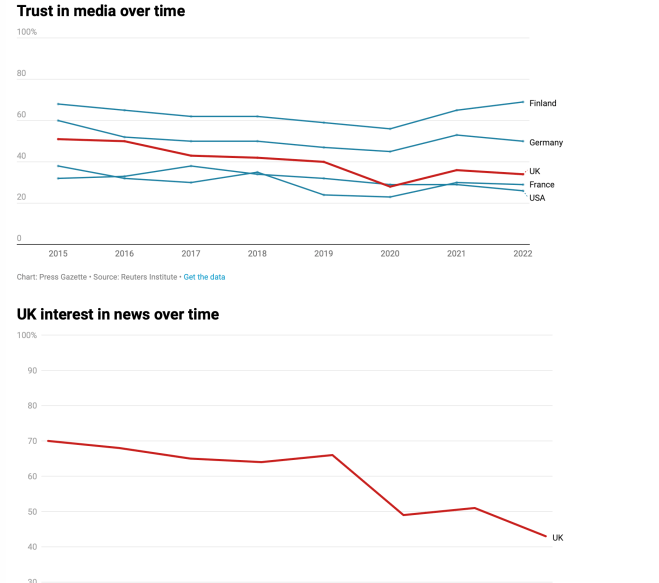
It is true that the strident defense of journalism you will find on MediaPolicy.ca has to contend with some inconvenient poll numbers marking a frayed trust in media and even a possible decline in news consumption.
From the Reuters digital news survey – 2022
Zada’s brief, readable and inexpensive book covers journalism’s shortcomings, both known and many. He also prescribes newsroom solutions for journalists and media literacy for citizens.
What makes his professional mea culpa different are intriguing observations about storytellers and story listeners that might help us better understand the increasingly bloody-minded civic discussion in the modern world.
Journalism, like any attempt to describe what is happening in our world, is a map of reality, not reality itself. Zada sums it up this way:
“Twentieth century Polish-American scholar Alfred Korzybski championed the idea…that humans do not experience objective reality. He claimed that what we know and see of the external world is that which has reached us after being filtered by the brain. “The world is not an illusion, it is an abstraction,” Korzybski once wrote.
“His most famous and oft-quoted maxim “the map is not the territory”….[meant] our mental abstractions and representations of a terrain, no matter how detailed or well constructed, do not resemble the real thing. Rather our maps our grossly inaccurate. They are at best metaphors….
“This map-terrain relation applies to the news…[a] crude “map” that depicts the event-scape of the world.”
If journalism is the map’s cartographer, Zada finds journalism wanting: hence the book title’s harsh accusations of distortion and mind warping.
The first distortion is journalism doing a bad job of news curation by fixating on alarming news of what just happened and almost totally ignoring the mundane long-term improvements in the human condition.
Another veil of distortion is the sensationalism that exaggerates the world as being in constant turmoil or slavishly competes for a mass audience drawn to “infotainment.” The media’s early addiction to reporting on Donald Trump grew his popularity, says Zada, and that illustrates the distorting power of journalism.
Some of the other sins of journalism include uncritical reporting on contentious or speculative scientific studies. Or journalists being manipulated by their news-subjects: commercial interests, celebrities, or governments.
We’ve heard these criticisms of journalism for decades and opinions are going to vary on whether they represent imperfections or fundamental flaws.
As a life-long admirer of journalists, I will go with imperfections.
But another veil of distortion —and here the curiosity of your inner nerd may be piqued— is that of news storytelling itself.
Learning by storytelling is as old as time and primal, as any parent of a small child will know intuitively. “The human mind evolved to become a story processor,” says Zada. “The news both reflects and caters to our sense of mythos and desire for universal narrative archetypes.”
Good story telling requires dramatis personae: heroes, victims and villains as protagonists engaged in contests of will or power.
Good story telling demands human agency: intentional events marked by actions that ring with moral (or immoral) clarity.
Good story telling exploits the human susceptibility to what behavioral scientists call the “narrative fallacy,” our story listening instinct to stitch together facts into an emotionally satisfying narrative even at the cost of eliminating more fulsome but less dramatic explanations of what is happening in the world.
As story listeners we love to simplify, to make the abstract into the familiar, and to comprehend events that conform to our assumptions about the world.
In political reporting this kind of storytelling skews towards assigning blame to archetypal villains. It has an easy affinity with populist politics that pose a binary struggle of the powerful against the powerless.
Is it any accident that one of the proud monikers of the journalism profession is “holding the powerful to account” ?
It even seems that journalists are aware of the seductive power of storytelling and mitigate it with “both sides” reporting which presents news as an inconclusive battle of protagonists where no one is quite sure of who is the hero, villain or victim.
Now Zada is not calling for an end to storytelling any more than he is suggesting our brains should have evolved differently.
He does however issue a call to newsrooms and journalists to take a step back, be cognizant of narrative fallacy, and insist on higher standards.
He endorses “service journalism,” meaning editors should curate in favour of news that informs rather than entertains. That approach works in tandem with solutions-oriented journalism: coverage of more than dramatic differences of opinion, but also of a possible solution.
He recommends more diversity in the newsroom, not just in better representation of equity seeking groups, but in terms of life experience.
All of this is necessary if news reporting is going to remain credible and relevant to an increasingly disaffected audience.
News readers need to do our part too, says Zada, and he pleads for better media literacy: a healthy skepticism towards our news sources and an acknowledgement of the beguilements of narrative.
Zada does not engage in how we are going to pay for all of this better journalism (we seem to have a problem paying for what we already have) but that is a problem for another day.
Last month the CRTC renewed the CBC’s five-year licence in a burst of deregulatory enthusiasm that took many by surprise.
The CRTC’s precedent-setting decision to repeal the core of minimum programming standards and expenditures for most of the public broadcaster’s linear TV operations was not requested by the CBC nor was it included in the CRTC’s detailed agenda when it published the required Notice of Consultation that began the proceeding.
Inevitably the CRTC ruling is being appealed: the Associations representing independent producers supplying much of the CBC’s programming in Quebec (AQPM) and English Canada (CMPA) filed their appeals this week, citing the scathing dissent of the minority Commissioners. The CMPA also suggested it may file a parallel complaint to the federal cabinet.
Court appeals of CRTC decisions are long-shots and excessively technical: they require an “error of law” as opposed to an error of policy. Cabinet appeals are explicitly policy-based but effectively require the government to issue the regulator a vote of non-confidence.
The CBC was also in the public eye this week when former TV host Wendy Mesley emerged in a podcast hosted by Postmedia’s Anthony Furey to explain her departure after 42 years at the public broadcaster (and promote her new podcast Women of Ill Repute, a co-venture with Maureen Holloway).
Mesley gives a mea culpa of her use of the n-word in an internal production meeting and then, with a diplomacy the CBC probably doesn’t deserve, tells the story of her employer suspending her and busting her to junior reporter.
The most combustible podcast I listened to last week (maybe ever) was the June 6th Canadaland interview of National Post columnist Terry Glavin, which I stumbled upon after reading Glavin’s blog update of the long-running controversy surrounding the coverage of graves and graveyards linked to Indigenous children who attended Residential Schools.
For background on the media coverage, you can read Robert Jago and Jonathan Kay. For the grave story itself, in addition to Glavin’s update there is a helpful piece written last year by the CBC’s Ka’nhehsí:io Deer
The Canadaland podcast hosted by Jesse Brown crackles from the first moment of its hour-long length. You won’t find your attention wandering.
In other industry news:
In an earlier post about the declining financials in Canadian broadcasting I noted that yet-to-be-released CRTC data for 2020-2021 would provide more clarity about how broadcasters are coping with the growth of American streaming apps. A grim foreshadowing of that data may be contained in the US Nielsen data released this week.
There may be a breakthrough for a trimmed down version of US President Joe Biden’s legislative program. Included in the package is ratification of Biden’s support for the OECD deal on a minimum 15% corporate tax to fight against international tax avoidance. If the OECD deal goes through, Canada would not trigger its Digital Services Tax on Big Tech companies operating in Canada, set to come into force in 2025.
VMedia announced it has been acquired by Québecor. The Ontario-based VMedia operates multiple telecommunications businesses including retail Internet (ISP) and online television (IPTV). The purchase provoked an outcry against corporate consolidation in the ISP market. Those critics take no solace in the competitive upside of strengthening Québecor’s expansion as a national competitor against the other big telcos in ISP and IPTV outside of its home territory.
Netflix CEO Reed Hastings insisted that linear TV will die in “five to ten years,” as he hosted yet another quarterly investor call to explain the streaming service’s stall in subscription growth (it lost 1.3 million North American customers and will have to get by with its remaining 220 million global subscribers). Hastings’ comments prompted an ode to the staying power of linear TV by Alex Cranz in The Verge.
The uncertain future of linear TV in Canada is the focus of a CRTC report about the revenue impact on Canadian TV companies losing access to programming rights to American premium movies and hit drama series. The Report suggests the Netflix prediction might be true and Hastings’ estimate of “five to ten years” too generous. I posteda summary of the Report’s projections.
Last week I posted that Washington Post columnist J.J.McCullough’s loose description of Bill C-11’s “regulation” of YouTube videos needed to be tightened up: the Bill excludes the possibility of CanCon “exhibition quotas” or abusive content codes for videos posted to social media platforms. When the Heritage Minister’s Chief of Staff John Matheson quoted my post on Twitter he drew fire from C-11 opponents which I summarized briefly because the back and forth seemed to resolve some misunderstandings about the Bill. This is definitely a post for C-11 disputants and Parliamentarians, but of less interest to normal people.
A Globe and Mail editorial weighed in on the tax avoidance strategies of Big Tech companies, in this case Amazon. In passing the Globe mentioned that ratification of the multi-nation OECD agreement on a minimum corporate tax is stalled in US congress along with much of the Biden agenda. If the OECD deal falls apart Canada’s Digital Services Tax on Big Tech would kick in after all. As I wrote in previous post last December, this “audience tax” is the ideal revenue stream to aid Canadian media that has lost its advertising revenue to Google and Facebook.










 MediaPolicy.ca
