Profit/Loss line for Canadian local TV news from CRTC data
June 13, 2022
CRTC commissioners have asked for a mandate to save local radio and TV news. Parliament must give it to them in C-11.
The stack of amendments waiting for Heritage MPs tomorrow no doubt includes the proposal Unifor submitted on local news [Disclosure: as Unifor’s Media Director from 2013-2021 I submitted a similar amendment to the Committee on Bill C-10].
The Unifor amendment mandates the CRTC to boost funding for local news by realigning existing industry cross payments flowing from broadcasting distributors (BDUs) to broadcasters.
Bill C-11 adds the option of tithing matching cross subsidies from foreign streaming platforms as part of their new obligations to support Canadian news, sports and entertainment, keeping in mind that Heritage Minister Pablo Rodriguez expects a $1 billion injection of cash value into the Canadian broadcasting system as a result of C-11.
Everyone —especially the Canadian public– agrees local news is at the core of our Broadcasting Act. While not indisputably the legislation’s first priority, it ranks at the top with Canadian drama and programming in the languages of our founding and Indigenous nations.
The authors of the 2020 “pre-C11” report of the Broadcasting and Telecommunications Legislative Review (BTLR) were emphatic about local news. Writing two years ago, before the pandemic, they said the financial plight of local news required action:
With the decline in BDU revenues averaging 1.5 per cent per year since 2014, the funding mechanisms currently in place are likely to be less effective over time. Conventional television stations — typically the bedrock of audiovisual spending on news and an important source of local news — have not been profitable since 2012 [see chart above]; they have lost over $600 million in revenues between 2013 and 2018. Revenues for radio have also been declining….
There is little doubt that the current model for supporting news is not sustainable. The traditional news industry in Canada, as in many countries around the world, is facing a crisis, which has serious implications for Canada’s democratic system and social values.
And so BTLR Recommendation #71 says:
We recommend that the CRTC consider that some or all of the levies on media aggregation and media sharing undertakings contribute to the production of news content. These contributions would be directed to an independent, arm’s length CRTC-approved fund for the production of news, including local news on all platforms. We further recommend that the CRTC consider redirecting a greater portion of the levy currently paid by broadcasting distribution undertakings to this same fund for the production of news.
The Report reflected a consensus about the importance of local news. It is the community hall where we see, hear and learn about each other. It’s where professional journalists hold power to account and provide fact-based reporting.
Despite the overwhelming case for saving local news, it’s often the case that significant regulatory change doesn’t attract unanimous support within the industry because some players fear losing funding in a zero sum game while some of the large media companies don’t operate enough local stations to make the BDU-to-broadcaster cross-subsidy worth their while.
Among Canadian media companies, only Bell is prepared to champion the Unifor amendment (CTV is the country’s biggest local TV provider with 36 out of 90 local stations).
Sadly, we almost had the local news funding problem sorted out ten years ago.
In the early ‘00s the cracks in the business model for local news began to show: broadcaster profit margins were dropping. The smaller the market, the more likely its local station was losing money.
The CRTC devised a solution. In 2008 it created the Local Programming Improvement Fund (LPIF) ——a $60 million news fund aiding “non-metropolitan” local stations —transferring cable profits to small and mid sized local TV stations. The fund was underwritten by a new levy of 1% of annual BDU revenues.
The 1% levy was on top of the 5% cable operators were already paying to support Canadian drama and community cable stations. Like those other obligations, LPIF was an industry cross subsidy moving from the more profitable BDUs to the less profitable broadcasters.
Around the same time, the cash-squeezed broadcasters sought to put an end to the cable companies’ free lunch, earning subscriber dollars from station signals taken from local TV towers without compensating the broadcasters, especially in large metropolitan areas left untouched by the LPIF.
After saying no to the broadcasters twice, in 2009 the CRTC agreed to force the BDUs to the table to negotiate “fee for carriage” (FFC) payments to the broadcasters.
But before implementing its FFC order, the CRTC asked the courts to confirm it had the jurisdiction to order compensation in the first place. In December 2012 the Supreme Court of Canada said no and struck down FFC in a 5-4 split decision because of conflicts between the Broadcasting and Copyright statutes. Ironically the broadcasters found themselves cross subsidizing the wealthier BDUs with their free content.
But at least the broadcasters still had LPIF money to sustain their small and mid sized stations?
No such luck. By 2012 the industry had consolidated: the big cable and telco companies had splashed out millions to buy specialty channels and local stations. Bell and CTV. Rogers and City. Shaw and Global. Québecor and TVA. They became “vertically integrated” (VI) media companies with presumably a limitless ability to cross subsidize local news and Canadian drama from their cable and specialty profits.
Somewhere in this time frame the consumer-crusading Harper cabinet turned against the four-year old LPIF levy that cable companies had made a line item on Canadians’ monthly bills.
In July 2012 the Commission killed the LPIF news fund, ruling that vertically integrated media companies would just have to absorb the losses in local news, “innovate” (a signal for job cuts that soon followed) and keep ladling money from one side of the business to the other as a condition of keeping their licenses for overall TV operations.
Asked to reconsider in the Commission’s 2015 “Let’s Talk TV” proceedings, Harper’s new CRTC Chair Jean-Pierre Blais was unmoved so far as the VI local stations were concerned.
Instead Blais made two tweaks to the regulation of local news. He allowed the VIs to defund their community stations and reallocate the money to their local stations; and he abolished the CRTC’s Small Market Local Programming Fund and recreated it as an independents-only news fund available to about 20 stations not owned by VIs.
But as for a dedicated stream of funding or cross subsidy for the vast majority of local news stations —-70 out of 90 are owned by the VIs—- not a penny.
That’s how things stand in 2022: an inexplicable regulatory asymmetry in which there is little relief for money-losing news journalism but a 4% revenue tithe supporting Canadian drama.
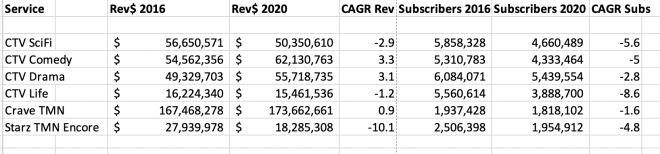
More to the point, our broadcasting economics have only gotten worse for conventional TV, meaning local news, as these 2020 CRTC statistics on PBIT/EBITDA margins demonstrate:
When asked by the Liberal government for advice on a new Broadcasting Act in 2018, the CRTC recommended “supporting television news production through increased access to subscription revenues,” advice that would be repeated by the BTLR Report eighteen months later.
It would be wishful thinking that the CRTC will venture forward on something so bold without an affirmative response to their recommendation.
The Conundrum of Canadian Broadcasting Economics in a graph. Source: CRTC Report “Harnessing Change.” (2020)
June 11, 2022
The Conservative filibuster of the Heritage Committee hearings on C-11 continued throughout the week. CPC committee vice-chair John Nater MP served notice the filibuster would continue into the Fall. I wrote about that here.
Heritage Minister Pablo Rodriguez spoke to the Committee (he was denied the previous week by the filibuster) and revealed some new information about the $1 Billion injection of foreign streamer cash his Department projects.
The Liberal, Bloc and NDP MPs remained tellingly serene throughout the week and on Friday morning the Liberals responded with a closure motion introduced into the House of Commons providing for one nine-hour day of Committee debate (June 14th) on amendments —-Committee meetings normally last two hours—- before C-11 is returned to the Commons for Third Reading.
With C-11 as a springboard, the Conservatives kicked off a summer membership recruitment campaign with a rhapsodic video starring Andrew Scheer MP entitled “I’m not sure how long the government will let this video stay up.”
The tragedy of the filibuster after 10 days of Committee hearings is that the amendments, some of which I profiled in Monday’s post, will receive inadequate debate and be available only to Canadians who tune in to ParlVu.
I also had a volley and response debate with C-11 critic Leonard St. Aubin that began with my proposal to split the difference on regulating user generated programming but ended up being a discussion of the conundrum of Canadian broadcasting economics. Mr. St-Aubin’s first and second replies are here and here.
Enough of C-11 for today and on to the FaceGoogle Bill C-18: you can read a typically incisive article from former CRTC Chair (former Competition Bureau Commissioner, former federal judge, etc.) Konrad von Finckenstein itemizing all the things he think might go wrong with the Bill.
For Rogers-Shaw followers, there is an excellent business feature published this morning in the Globe and Mail covering Québecor CEO Pierre-Karl Péledeau’s bid to buy Freedom Wireless and emerge as a fourth national wireless carrier.
Yesterday’s meeting of Heritage Committee MPs charged with reviewing the Online Streaming Act C-11 was again filibustered by the Conservative party.
Liberal MP Chris Bittle kicked off the two-hour session with a motion to commence clause by clause consideration of amendments on June 13th and, upon finishing C-11, move on to the Conservative motion to investigate whether Hockey Canada used public funds in settling a sexual assault lawsuit.
Conservative MP John Nater —-the Tories’ Committee Vice Chair— opposed the motion and, as a signal of the CPC’s intentions of indefinite filibuster, announced that he had another “twenty witnesses” he wants to call on C-11 in addition to the approximately 30 that have been questioned over the last three weeks.
NDP MP Peter Julian proposed a compromise of assigning the next two Committee days to Hockey Canada and then resuming C-11 and Hockey Canada “simultaneously.”
The Conservatives rejected that and filibustered the remainder of the afternoon without any clear path for the Committee over the remaining two weeks of the Parliamentary session.
Minister Pablo Rodriguez returned to the Heritage Parliamentary Committee this afternoon to answer questions about the Online Streaming Act Bill C-11 after a Conservative filibuster last week left him cooling his heels.
While there was the expected Parliamentary jousting over C-11’s provisions governing hosting platforms like YouTube and TikTok, Heritage MPs and Canadians following the Bill got some other information they had been waiting for.
First, the Minister is not going to unveil a “draft” cabinet policy directive which would give guidelines to the CRTC on the implementation of C-11. He told MPs he would issue the Directive after all amendments are made to the Bill and Royal Assent is granted.
Second, the Minister cited a revised dollar figure for the Canadian content contributions expected under C-11 from foreign online platforms, putting the figure at $1 Billion annually. This is an increase from the $830 million figure cited by the previous Heritage Minister Steven Guilbeault in 2021. Rodriguez explained the increase as a result of additional foreign streamers entering the Canadian market, in particular Disney Plus and Apple TV.
Sitting next to the Minister, Assistant Deputy Minister Thomas Owen Ripley clarified that $900M of the $1 Billion is the expenditure value of the Canadian content the foreign platforms would be obliged to produce. The remaining $100 million would be cash contributions to be distributed through production funds to Canadian-owned media companies.
Bloc MP Martin Champoux raised the profile of one of C-11’s sleeper issues —-so far, user generated programming has sucked most of the oxygen out of Committee debate— which is the ability of Canadian programming services like OutTV or APTN to access carriage on foreign online distribution platforms like Roku, Apple TV or Amazon Prime.
The problem appears to be that C-11 does not completely map over programming access rules binding Canadian cable operators to American online distribution platforms entering the Canadian market. My post from earlier today gives more background: the problem is that C-11 lacks the teeth to deal with foreign platforms that might deny access to Canadian channels.
The Minister’s answer to Champoux was intriguing as he cryptically replied there were problems “with our American counterparts.” A similar question was put to Ripley but his response was cut off in mid-sentence because of time allocation.
The Hill Times published a story this morning in which APTN CEO Monika Ille raised the same access issues and expressed her disappointment that APTN was not given an opportunity to appear before the Committee.
Expect to hear more on that.
Finally and inevitably, not long after the Minister finished answering MPs’ questions, the Liberals renewed their motion from last week to set a deadline for starting the “clause by clause” consideration of C-11 amendments.
The Conservatives reignited their filibuster by moving and speaking to a motion in which C-11 would be put on hold until the Committee conducts hearings and writes a Report in response to the recent House motion requesting an investigation of allegations that Hockey Canada covered up a sexual assault committed by junior hockey players in 2018.
When NDP MP Peter Julian proposed dealing with the Hockey Canada file after C-11 was completed, CPC MP Rachael Thomas told Julian he was “re-victimizing the victim.”
A series of speeches from Conservative MPs used up the final 45 minutes of the two hour committee meeting until adjournment.
As a public service to our community of Bill C-11 watchers, I have collected proposed amendments from as many sources as I could. The following is a curated short list.
These organizations or individuals posted their amendments online or were kind enough to send them to me:
All of the political parties except the Conservatives committed to submitting their C-11 amendments to the Clerk of the Heritage Committee on June 3rd, so not all of these amendments will necessarily go forward (unless adopted by the Conservatives who are not submitting amendments at this time).
1. Broadcasting Economics:
BCE: Authorize the CRTC to devise regulations incentivizing the sharing of content distribution between foreign and Canadian broadcast undertakings.
3(1)(s.1) foreign broadcasting undertakings should
(i) make their programming available to Canadian programming undertakings pursuant to contractual arrangements on reasonable terms; and
(ii) be encouraged to partner with Canadian undertakings in the distribution of their programming throughout the Canadian broadcasting system
5 (2) The Canadian broadcasting system should be regulated and supervised in a flexible manner that
(i.1) Ensures foreign broadcasting undertakings make their content available on reasonable terms to Canadian broadcasting undertakings; and
(i.2) Foreign broadcasting undertakings are incented to partner with Canadian broadcasting undertakings in the distributionof foreign programming in Canada.
Leonard St. Aubin: An amendment following after paragraph 5(2)(h) to ensure that CRTC regulation:
(i) recognizes that market forces, competition, and the increased choice of programming made available over the internet, contribute to achieving the broadcasting policy objectives in subsection 3 of this Act, and therefore ensures that regulation is demonstrably required, efficient and proportionate to its purpose.
Canadian Association of Broadcasters: Abolish Part II Broadcaster Fees, not just for Online Undertakings.
11(3.1) The only fees that may be established with respect to a broadcasting undertaking [delete: that may be carried on without a licence] shall be fees that relate to the recovery of the costs of the Commission’s activities under this Act.
Friends/CMPA: As recommended by the Broadcasting and Telecommunications Review Report, restore the CRTC’s pre-2016 Terms of Trade policy regulating commercial relationships between Independent Producers and Broadcasters.
9 (1) Subject to this Part, the Commission may, in furtherance of its objects,
(i) require any broadcasting undertaking entering into commercial arrangements with independent Canadian producers or independent Canadian broadcasting undertakings to enter into and adhere to collective terms of trade…
Scope of regulation over online undertakings (Streaming Services and Hosting Platforms):
St. Aubin (and others: Peter Menzies and Konrad von Finckenstein): Consistent with the government’s repeated mantra, amend Bill C-11 so that it applies only to online streaming services with a significant presence in the Canadian market — more than $150 million in Canadian revenues.
Von Finckenstein: A variant on the proposal above, limiting the regulation of online streaming services based on the number of Canadian subscribers.
10 (2) The Commission may exercise its powers requiring registration of online undertakings under s.10(1) and its powers to impose conditions under s.9.1 only in respect of online undertakings that
a) in the Commission’s demonstrable opinion compete with licenced broadcasters
b) charge a subscription fee or offer their programs for free but with embedded advertising, and
c) have in excess of 400,000 subscribers.
St. Aubin: Unequivocally exclude user-generated content, and restrict CRTC regulation of social media (hosting platforms) to imposing a reasonable financial contribution to support CanCon, and gathering information and data necessary for that purpose.
YouTube: Restrict section 4.2 (the CRTC’s authority to regulate user generated programming) to full-length commercial music.
FRPC: Eliminate all regulation of user-generated programming unless it is uploaded by a broadcaster:
2) Despite subsection (1), this Act applies in respect of a program that is uploaded as described in that subsection if the program is uploaded to the social media service by a broadcaster.
Access of Canadian Programming Services to Foreign Online Distribution Platforms.
IBG/Friends: Eliminate the exemption of online undertakings from a variety of statutory provisions dealing with programming services’ access to and mandatory carriage on online distribution platforms (the online equivalent of cable and satellite), wholesale code rules regulating commercial negotiations between programming services and broadcasting distributors, and the availability of dispute resolution through binding arbitration.
From the IBG backgrounder:
Currently, the Commission has the authority to regulate the “carriage of any foreign or other programming services by distribution undertakings”. But, this authority is limited to established “distribution undertakings” – i.e. cable and satellite not online distributors to cover activities such as ensuring local television services are distributed locally; providing access to distribution platforms for multicultural Canadian programming services; providing access to distribution platforms for independent programming services; ensuring fair treatment of services and subscribers during disputes (e.g. the “standstill rule”); and providing for consumer protections…
The dispute resolution tool is essential to resolving gatekeeping issues in the broadcasting distribution environment – whether it is a programming service seeking to access a key platform on fair terms; or a distributor seeking access to key programming content. These issues are endemic in any network environment including the Internet. The CRTC should have the same authority to resolve disputes in an online environment as it does currently for distribution undertakings.
1. Changes to proposed section 9.1 regarding the distribution of specified services:
9.1(1)(h) a requirement for a person carrying on a distribution undertaking or an online undertaking that provides the programming services of other broadcasting undertakings to carry, on the terms and conditions that the Commission considers appropriate, programming services specified by the Commission;
Purpose: To enable the CRTC to ensure that specified Canadian apps and services are offered on online platforms. With this change, new section 9.1(1)(i), 9.1(9) and 9.1(10) could be removed or modified.
As an alternative, the existing provisions could be retained, and the Commission provided with explicit authority to set terms for online distribution where good faith negotiations have failed (as follows)
9.1(10) The Commission may facilitate those negotiations at the request of either party to the negotiations and, notwithstanding paragraph (1)(i), if no agreement is reached determine terms and conditions for carriage that the Commission considers appropriate.
2. Changes to proposed section 9.1 regarding the general oversight of online distributors:
9.1(1)(l.1) the carriage of any foreign or other programming services;
Purpose: To enable the CRTC to establish carriage conditions that apply to types of programming services in an online distribution environment (e.g. local services, multicultural services, independently owned services, minority language services) and to provide for other general regulatory oversight of online distribution.
3. Changes to the CRTC’s existing dispute resolution authority to reflect online distributors:
10(1)(h) for resolving, by way of mediation or otherwise, any disputes arising between programming undertakings and distribution undertakings broadcasting undertakings concerning the carriage of programming services originated by the programming undertaking;
Purpose: To ensure that the CRTC has authority to intervene in disputes regarding the carriage of programming services in an online environment.
Discoverability of User-Generated Content.
YouTube: Amend article 9.1 to exclude regulation of recommendation algorithms.
PIAC: Amend section 3(1)(r) authorizing the CRTC to require discoverability of Canadian content by online undertakings to exclude “dynamic discoverability,” i.e. recommendations. Just provide a banner space or portal designated as Canadian content:
s. 3(1)(r), which states: “online undertakings shall clearly promote and recommend Canadian programming, in both official languages as well as in Indigenous languages, [delete following text] and ensure that any means of control of the programming generates results allowing its discovery.”
Bannerman: We need provisions expressly authorizing CRTC to demand platforms collect (not just provide) data, so they can’t deflect requests for relevant data on discoverability:
9 (1) (n) the collection and provision to the Commission […]
9 (1) (o) the collection and provision to the Commission […]
9 (1) (o) (v) information related to discoverability; and [NEW]
ACTRA: C-11 introduces a restriction on the ability of the CRTC to regulate discoverability in subsection 9.1(8). Restricting the ability of the CRTC to require the use of a specific algorithm or source code raises the spectre of opposition by online undertakings to reasonable measures proposed by the CRTC on the grounds that the outcome sought by the CRTC can only be accomplished by way of a specific algorithm or source code change. This could defeat the fundamental objective of the section. Given the CRTC would have no access to a platform’s source code, it would be in no position to contest such an argument. To avoid such a scenario, ACTRA would prefer to see this limitation removed. In the alternative, ACTRA suggests amending the language of subsection 9.1(8) to stipulate that CRTC orders must be outcomes-based, rather than algorithm-based.
Canadian Ownership and Control.
ACTRA/Friends/CDCE/IBG/FRPC: Tighten up Canadian ownership language which is still loose because it exempts foreign broadcasting undertakings from Canadian ownership without the previous requirement that our broadcasting system, overall, is predominantly Canadian. This could be loose enough for a major expansion of American broadcasting in Canada, possibly by purchasing one of our major networks (Fox North).
FRPC:
Bill C-11
FRPC Proposed amendment
3(1)(a) the Canadian broadcasting system shall, with the exception of foreign broadcasting undertakings providing programming to Canadians, be effectively owned and controlled by Canadians;
3(1)(a) the Canadian broadcasting system shall be effectively owned and controlled by Canadians,
(a.01) foreign undertakings may provide programming to Canadians but shall at no time be permitted to own and/or control a majority of the broadcast undertakings in Canada
ACTRA:
3(1)(a) the Canadian broadcasting system shall be effectively owned and controlled by Canadians;
(NEW) (b) where a foreign broadcasting undertaking provides programming to Canadians, the Commission may establish such rules and regulations, and issue such orders, as necessary to ensure it contributes appropriately to the achievement of the objectives of this Act;
Friends/IBG:
3(1)(a) the Canadian broadcasting system shall be effectively owned and controlled by Canadians, recognizing that the Canadian broadcasting system includes foreign broadcasting undertakings that also provide programming to Canadians; shall, with the exception of foreign broadcasting undertakings providing programming to Canadians, be effectively owned and controlled by Canadians;
CDCE:
(a) the Canadian broadcasting system, with the exception of foreign broadcasting undertakings providing programming to Canadians, shall be effectively owned and controlled by Canadians, recognizing that the Canadian broadcasting system includes foreign broadcasting undertakings that also provide programming to Canadians;
6. Making Use of Canadian talent and resources.
ACTRA/Friends/CDCE/FRPC: Eliminate the two-tier obligations created for domestic versus foreign undertakings with respect to employment of Canadian talent and media workers. Restore the existing language requiring predominant use of Canadian talent and resources. (C-11 provides a lower standard for foreign undertakings with other provisions indicating they can make up for it with cash contributions).
ACTRA/Friends/CDCE:
3(1)(f) each broadcasting undertaking shall make maximum use, and in no case less than predominant use, of Canadian creative and other resources in the creation, production and presentation of Canadian programming, and shall contribute significantly to the creation, production and presentation of Canadian programming to the greatest extent that is appropriate for the nature of the undertaking;
FRPC:
3(1)(a.1) each broadcasting undertaking shall contribute to the implementation of the objectives of the broadcasting policy set out in this subsection.
3(1)(f) each Canadian broadcasting undertaking shall employ and make maximum use, and in no case less than predominant use, of Canadian creative and other human resources to create, produce and present programming,
3(1)(f.1) each foreign online undertaking shall (a) make maximum use of Canadian creative and other human resources to create, produce and present Canadian programming, and (b) take into account the linguistic duality of the market they serve;
CAB: There must be a single standard for domestic and foreign undertakings at a lower standard (“significant contribution”):
3 (1) It is hereby declared as the broadcasting policy for Canada that
(f) each [Delete:Canadian] broadcasting undertaking, shall [delete: employ and make maximum use, and in no case less than predominant use, of Canadian creative and other human resources] make a significant contribution to the creation, production and presentation of Canadian programming, unless the nature of the service provided by the undertaking, such as specialized content or format or the use of languages other than French and English, renders that contribution impracticable, in which case the undertaking shall make an appropriate contribution;
7. Trade Compliance, Film Production Funds and Copyright
Von Finckenstein: In order to avoid trade retaliation from the United States, ensure that foreign streaming platforms are able to access any film production fund to which they contribute, which means waiving the “Canadians only” rule for ownership of copyright.
10 (3) Notwithstanding the particular terms of any fund, registered online broadcasting undertakings qualify for all the benefits available from any fund to which they contribute pursuant to a condition imposed by the Commission, regardless of whether they are Canadian or foreign owned or controlled.
8. Local News.
Unifor/Bell: give CRTC the express power to require contributions from all broadcasting undertakings, including online undertakings, to an independent fund for news journalism, taking into account local presence and broadcasting staffing:
Amend section 11.1(1) as follows:
The Commission may make regulations respecting expenditures to be made by persons carrying on broadcasting undertakings for the purposes of
…
(d) developing, financing, producing or promoting local news and information programming, including through contributions made by distribution undertakings either to a related programming undertaking or by distribution undertakings or online undertakings to an independent fund. In making regulations for the distribution of these contributions, the Commission shall take into account the local presence and broadcast staffing of the programming undertaking.
[BCE amendment adds “regional” and “national” to “local” news]
9. CRTC Administration:
CDCE: Preserve cabinet appeals and include appeals from CRTC “orders,” not just licensing conditions (foreign undertakings will not be formally licensed under C-11).
28 (1) If the Commission makes a decision [delete: under section 9 to issue, amend or renew a licence], the Governor in Council may, within 180 days after the date of the decision, on petition in writing of any person received within 45 days after that date or on the Governor in Council’s own motion, by order, set aside the decision or refer the decision back to the Commission for reconsideration and hearing of the matter by the Commission, if the Governor in Council is satisfied that the decision derogates from the attainment of the objectives of the broadcasting policy set out in subsection 3(1).
FRPC: Expand the definition of a CRTC “decision” to include Commission regulations and policies that make rulings on licenses and orders almost moot.
FRPC: A “prove it” approach to taking into account the “administrative burdens” (cost) of regulation to broadcasting undertakings.
C:11: (g) is sensitive to the administrative burden that, as a consequence of such regulation and supervision, may be imposed on persons carrying on broadcasting undertakings, and
(g) considers evidence that costs of regulation and supervision of persons carrying on broadcasting undertakings are unreasonable, and
FRPC: More information should provided by the CRTC in its annual reports.
(vi) notices of violation issued under section 34.8 of the Broadcasting Act in relation to contraventions of any of subsections 42(1) to (4) and (7), 43(1) to (3) and 44(1) to (3) and (6) of the Accessible Canada Act.
(b) the broadcast year, including
(i) statistics describing the implementation of section 3 including but not limited to
1(a) total and first-run hours and numbers of Canadian and non-Canadian programs broadcast by each element of the system during the year
1(b) total and first-run hours and numbers of first run of Canadian programming broadcast in English, in French or in Indigenous languages by each element of the system during the year
1(c) expenditures on Canadian programming broadcast in English, in French or in Indigenous languages by each element of the system during the year
2. total and first-run hours of news, including hours allocated to local news, by each element of the system during the year
3. numbers of Canadian and foreign broadcast undertakings operating in Canada and whether they are licensed, exempted from licensing, registered or other
4. full-time or equivalent employment numbers by each class of broadcasting undertaking including online undertakings and by type of employment (production, technical, sales and promotion and administration)
This week’s Bill C-11 hearings at the Heritage Committee featured 25 witnesses and over 16 hours of MPs deliberating over the Online Streaming Act.
It was entertaining, illuminating and childish in the way that only Parliamentary squabbles can be. The big take away is that the Conservatives have begun on-again off-again filibuster tactics reminiscent of their efforts last year with C-10.
I wrote daily reports for May 30, May 31, June 1 but not June 2 which was filibustered.
In another legislative forum Québec MLAs unanimously endorsed C-11’s inclusion of the CRTC’s general authority to regulate YouTube, Tik Tok, and Facebook, the hot button issue in federal Heritage Committee hearings.
The Committee was supposed to finish witness appearances this week (it didn’t) and move on to amendments next week and then, as far as the government is concerned, return the Bill to the House for third reading before the summer recess later this month.
Flipping over to the Online News Act C-18, the Liberals invoked cloture to force a Second Reading vote and move the Bill to the Heritage Committee. It now seems a foregone conclusion the Committee won’t get to C-18 until September.
That leaves more time for campaigning and lobbying against the “Facegoogle” legislation.
Google has written to all MPs and Senators critiquing C-18. Mindful of the fact it’s known the web giant ultimately played ball in Australia when faced with this kind of “pay-for-news-content” regulation, Google is arguing that additional aspects of the Canadian bill defining “news” and “eligible news outlets” are a problem.
In an interesting strategic move, Google appears to be making common cause with smaller Canadian news outlets who believe the Bill unfairly favours large mainstream publishers and broadcasters. Instead of the “commercial negotiations” model of C-18, Google says it is willing to write one cheque —-for an undetermined amount— to an independent news fund that would be distributed pro-rata to all news outlets in a manner similar to federal journalism tax credits.
Counterintuitively perhaps, Google just agreed to more deals with small publishers in Australia under legislation it says it does not want Canada to repeat.
A poll commissioned by Newsmedia Canada suggests a high level of popular support for “FaceGoogle-pay-for-news-content” legislation.
Meanwhile we get closer to the beginning of Competition Tribunal hearings on the Rogers Shaw merger. The word was it would begin this month, but the Tribunal has still not posted any hearing dates and has another file on its docket until June 17th.
Yesterday Rogers and Shaw filed their Reply to the Competition Bureau’s application to block the merger. As of this morning the Tribunal had not posted the document, but news reports suggest Rogers will be relying on the legislation’s controversial “efficiencies defense” which allows the Tribunal to bless the merger if its cost savings and non-price efficiencies outweigh any hit to consumer prices.
Yesterday Conservative MPs on the Heritage Committee called as a witness their sixth YouTuber in a continuing effort to put a human face on their proposal to exclude hosting platforms YouTube, TikTok and Facebook from the scope of Bill C-11.
The star of the show on this fourth day of Heritage Committee hearings was Vancouver-based J.J. McCullough who broadcasts a YouTube channel and writes an occasional freelance gig in the Washington Post.
Among other things an avowed foe of official bilingualism, McCullough offers the kind of iconoclastic commentary that appeals to the Conservative base. To whit, he describes the Liberals’ C-11 as a law worthy of autocratic Hungarian President Viktor Orban.
Liberal MP Anthony Housefather decided that McCullough’s political theatre was an invitation to join him; it’s worth watching their exchange as Parliamentary jousting but also a stark demonstration of the philosophical divide over C-11 and generally between the populist right and the mainstream.
Earlier in his testimony, McCullough expressed YouTubers’ fears of their videos being “buried” by the platform’s opaque algorithm. That’s consistent with Irene Berkowitz’s observation in her 2019 Watchtime surveyof YouTube that creators express anxiety about YouTube’s all-powerful recommendation tool.
It’s not difficult to empathize with YouTubers’ fears that the proprietary algorithm’s ability to “bury” them might be made worse by an overlay of government-required Canadian content recommendations. On the other hand, that creator anxiety makes more relevant Professor Sara Bannerman’s suggestion that the CRTC take a good look inside the YouTube black box.
The debate over discoverability on hosting platforms will continue until either the Minister issues his Policy Directive or the Bill gets passed and the CRTC holds public hearings on a long list of implementation issues, including this one.
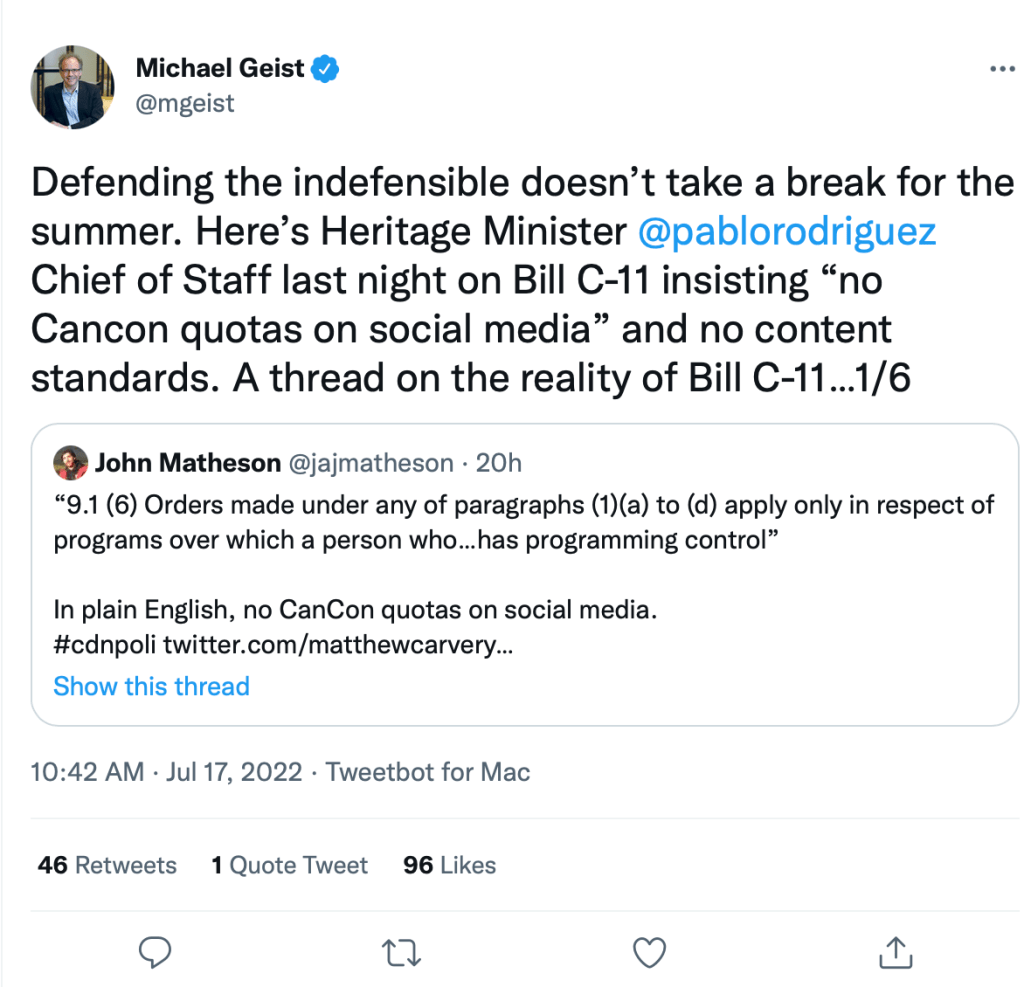
McCullough also claimed that C-11 would result in the CRTC imposing genre quotas and other programming objectives found in sections 9(1)(a-d). However CRTC General Counsel Rachelle Frenette had previously pointed out to the Committee those programming goals —-standard in conventional broadcasting for decades— don’t apply to hosting platforms under sections 9(6) and 2.2 because they do not exercise programming control.
Next up was Bell Canada whose representatives got the usual icy reception telcos get when they show up on Parliament Hill.
Regulatory VP Jonathan Daniels explained to MPs how the economics underpinning the financing of Canadian content are crumbling, specifically that the popular American programming that Bell buys —-and whose high profit margin provides the subsidy for making unprofitable Canadian news and entertainment on CTV—- is becoming not only more expensive but not for even for sale as American media companies shift away from selling Canadian distribution rights to re-sellers like Bell and towards direct-to-viewer Internet television apps like Netflix, Paramount, Disney Plus, and so on.
The C-11 amendment Bell wants is interesting: give the CRTC regulatory authority to “provide incentives” to foreign broadcasters to partner with Canadian broadcasters in the distribution of foreign programming in Canada.
As a corollary to that, another Bell amendment would empower the CRTC to set reasonable “terms of trade” —restrictions on exploitive terms of contract— to make sure that such partnerships aren’t one-sided. The irony that the CRTC abolished the Terms of Trade between the major TV networks and independent producers in 2016 is not to be missed.
Conservative MP Kevin Waugh gave Bell’s representatives a good Parliament Hill hazing but also an opportunity to explain how broadcasting economics work, or used to work, in this country. (The five minute ParlVu clip is availablehere).
While MP Waugh has forgotten more about broadcasting than most of us have learned, not so his colleague Rachael Thomas MP whose errors wouldn’t need correcting if they weren’t repeated so frequently.
In her questioning of YouTuber McCullough she suggested, not for the first time, that under C-11 creators like him would have to pay a 30% revenue tithe to the “arts fund,” (presumably she means the Canada Media Fund, a film production body financed by the federal government and contributions from Canadian cable TV operators) and not be able to draw financing from it as a YouTube creator.
Some fact checking is in order here.
First, YouTube creators will make no financial contributions to any body or have any other regulatory obligations under C-11, as provided in section 2.1 of the Act.
Second, it’s possible that if YouTube were required by the CRTC under C-11 to contribute to the Canada Media Fund (for programming that creators like McCullough post)that a mean-spirited YouTube would try to claw that money back from the creators’ share of the 55/45 split of advertising revenue earned by their posts.
But it would not be 30%. It might end up being four per cent which is what Canadian cable operators pay into the fund based on the programming they distribute. Thomas is confusing the cable companies‘ 4% rate of contributions to the CMF with the Canadian broadcasters‘ obligation to spend 30% of their budget on Canadian programming.
Third, the Canada Media Fund does offer Digital-First funding programs, although there is nothing on its website indicating if YouTubers have accessed them.
Today is the Committee’s last scheduled day to hear witnesses, ending with the Minister’s appearance. And he might tell us if Mr.McCullough has anything to worry about.
****
To any participants in these C-11 hearings, I would like to post a summary of some of the key amendment requests. Please send your’s to howard.law@bell.net
Witness testimony and Parliamentary debate at the Heritage Committee (CHPC) hearings on C-11 continued May 31st with competing narratives from the Conservatives and the other parties.
The Tories maintain a laser focus on whether C-11 will “regulate” user generated content and the digital creators who create and upload to hosting platforms like YouTube, Facebook and TikTok.
On the flip side of the debate, the Liberals, Bloc and NDP want to talk about the core objective of C-11 to integrate foreign online players into a broadcasting system where domestic and foreign media companies finance, create and distribute Canadian content.
Most of the testimony and debating points revisited issues raised in previous sessions:
Discoverability and algorithms: This issue creates most of the political theatre at these hearings. MPs and witnesses opposed to C-11 want a hands-off approach to any government influence on the hosting platforms’ proprietary algorithms.
Section 9(1)(e) of C-11 empowers the CRTC to make orders regarding a variety of matters including:
the presentation of programs and programming services for selection by the public, including the showcasing and the discoverability of Canadian programs and programming services, such as French language original programs;
but also:
Restriction — computer algorithm or source code
9(8)The Commission shall not make an order under paragraph (1)(e) that would require the use of a specific computer algorithm or source code.
As FRPC’s Monica Auer points out on Twitter, C-11 gives the CRTC some regulatory authority over algorithms in the name of discoverability of Canadian content, but stops short of authorizing the CRTC to order a particular modification.
McMaster University academic Sara Bannerman told MPs there are plenty of good policy reasons reflecting the statute’s cultural objectives for the CRTC to review the outcomes of YouTube’s algorithm-driven choices of which content to recommend.
But when CRTC Chair Ian Scott took the stand he downplayed the CRTC’s interest in managing algorithms. While Scott will no longer be Chair of the Commission when the discoverability regulations are designed by the CRTC, he foresaw a regulatory approach which assumed that algorithms might only need a tweaking or small improvement based on regulatory “incentives” rather than “proscriptions.” He appeared to describe his assessment of YouTube compliance as how well their keyword search for “Canadian content” works (note: try, it’s pathetic).
CanCon certification and copyright: Witnesses appearing on behalf of Netflix and the Hollywood studios (Motion Picture Association of Canada) sent MPs the same message as Disney had on the prior day of hearings. The studios want to revisit the central pillar of CanCon certification requiring a Canadian to be the sole producer and owner of copyright.
IATSE’s John Lewis—- the Canadian VP of the US-based film production workers’ union— gave that an amen, adding that the governing “points system” formula for CanCon certification should be expanded to include a “Canadian-ness” assessment of film content as well as a broader recognition of the work performed by Canadian IATSE members.
Today we will likely hear a different view of copyright from the Canadian Media Producers Association, representing independent Canadian film makers.
Part II Fees: Day Three was the first time this issue has arisen. The 1991 Act requires Canadian media companies to pay $120 million annually to the federal treasury in Broadcasting Act “Part II” fees.
The historical origin of Part II fees seems obscure but in modern day terms they appear to operate like a surcharge on broadcasters’ corporate tax obligations (broadcasters pay the CRTC’s cost of regulating them through Part I license fees). Broadcasters say the Part II fees don’t make sense in a squeezed revenue environment.
Québecor CEO P.K. Pélédeau told MPs that Part II fees are just another example of “onerous regulation” of Canadian media companies and queried how the Minister’s stated goal of a level playing field between domestic and foreign companies could be achieved while exempting foreign companies from these fees.
Canadian Association of Broadcasters President Kevin Desjardins made the same point, although his claim that if Part II fees were abolished Canadian broadcasters would reinvest the $120M might have planted a few tongues in cheek around the Committee table.
Ordinarily you wouldn’t give the broadcasters much chance of an amendment to eliminate these fees, but the Conservatives campaigned on it in the last election so a horse-trade on competing amendments is not out of the question.
The Happiest Warrior Title Changes Hands Again: Heritage hearings on C-11 are all about political theatre.
I posted on May 30th that Liberal Chris Bittle had wrestled away bragging rights as the Happiest Warrior MP from Conservative Rachael Thomas with his ruthless cross examination of CPC witness Scott Benzie from Digital First Canada. Thomas lead last year’s Conservative party filibuster of C-10 and has achieved some notoriety with her sandpaper style.
But the pendulum may have swung back to Thomas: on May 31st as she interrupted the order of witnesses with a motion that seemed designed to relaunch the filibuster.
On its face her motion is designed to keep the focus of public debate on user generated content and to exploit messaging gaps between what CRTC Chair Ian Scott had to say —that C-11 includes the general power to regulate hosting platforms, but not the content or the creators themselves— and Heritage Minister Pablo Rodriguez’s public comments suggesting the government doesn’t want to regulate YouTube creators.
Again, a nuanced discussion of “regulation” is what is missing in this tempest, I have posted about this previously.
As of last night it was unclear when Thomas’ motion will be debated.
*****
Here’s the witness line-up for Day Four, today at 3:30 pm on ParlVu:
As an individual
• J.J. McCullough
Association québécoise de la production médiatique
• Hélène Messier, President and Chief Executive Officer
BCE Inc.
• Jonathan Daniels, Vice-President, Regulatory Law
• Karine Moses, Vice-Chair Québec and Senior Vice-President, Content Development & News
Black Screen Office
• Joan Jenkinson, Executive Director
Canadian Media Producers Association
• Reynolds Mastin, President and Chief Executive Officer
• Catherine Winder, Chief Executive Officer, Wind Sun Sky Entertainment Inc.
FRIENDS
• Marla Boltman, Executive Director
Public Interest Advocacy Centre
• John Lawford, Executive Director and General Counsel
Liberal MP Chris Bittle at the Heritage Committee hearings on C-11
May 30, 2022
Until today, Conservative MP Rachael Thomas held the title of Happiest Warrior at Heritage Committee (CHPC) hearings on Bill C-11.
Liberal MP Chris Bittle took her crown today.
In the final five minutes of a four-hour CHPC hearing managed with grace and humour by Liberal Chair Hedy Fry and Conservative Vice-Chair John Nater, the former civil litigator Bittle tore into the Executive Director of Digital First Canada (DFC), Scott Benzie.
A film promoter who uses the YouTube platform, Benzie was put on the witness stand by the Conservatives to speak against C-11 applying to hosting platforms YouTube and TikTok (which I posted about here, here, and here).
Benzie never hid the fact that Digital First Canada is a lobby organization without dues-paying members or any mandate from the 160,000 Canadian YouTube creators (of which 40,000 make some money on the hosting platform). He did claim the authenticity and expertise to make his arguments.
But today he let it slip that 20% of Digital First Canada funding comes from YouTube and TikTok, not noted on its website. Nor did he mention the YouTube and TikTok funding when asked by the Committee in a previous witness appearance on March 23rd.
Bittle blasted him, alleging Benzie was in a conflict of interest by claiming to represent the interests of YouTube artists while taking money from the platform. Bittle also accused Benzie of misleading MPs in his previous appearance before the Committee (see transcript below) and was so aggressive you couldn’t help feeling sorry for Benzie who was not allowed the last word as time ran out on the session’s allocated time.
Update: On June 1st Betakit published a story about the campaign training session run by TikTok for Digital First Canada. The story makes reference to the financing of DFC.
Moving on from politics to policy, there were important take-aways from the witnesses appearing today and asking for amendments to C-11:
Is this an existential moment in broadcasting history for independent Canadian TV programmers?
The Independent Broadcasting Group represents about a dozen major Canadian television channels like APTN, Super Channel, Pelmorex Weather Network, and OutTV that are distributed by cable companies Bell, Rogers, Telus and Videotron.
Under the current Broadcasting Act and CRTC regulations the cable companies must carry a minimum number of these independent channels seeking Canadian audiences. Carriage of some of the channels is mandatory.
There is nothing in C-11 which guarantees these CRTC rules will be applied to the new generation of online “aggregator” platforms Roku, Amazon Prime, or Apple TV. Nor is there anything in C-11 that says they won’t. But the IBG programmers want the Act amended to provide that guarantee.
Disney Plus pleads for regulatory flexibility under C-11
No Netflix or YouTube at these hearings until tomorrow, but Disney Plus VP David Fares appeared as a witness today.
It was a classy performance. Fares resisted Rachael Harder’s invitation to trash C-11 and instead pointed to Disney’s big spending on US service productions filmed in Canada as well as trumpeting threefilmprojects (ah, the good timing!) telling authentic Canadian stories, even if they weren’t certified as official Canadian content under CRTC or federal CAVCO rules.
What he pleaded for was CanCon “flexibility” under C-11. That was code for the expected demand from all American streamers for relief from Canadian content rules requiring a Canadian producer and that those Canadian producers retain sole copyright over any CanCon project. That may be the most challenging task for the CRTC in the post C-11 world as I wrote in a previous post.
Fares had the good manners not to ask Canadian MPs for an amendment.
ACTRA and Directors Guild warn of the watering down of quotas for key Canadian creative talent:
Bill C-11 waters down the “point system” of certifying Canadian content that consists of a head-counting of Canadians in key talent positions (producers, lead actors, directors, writers, etc.)
The dilution in C-11 does not apply Canadian-made movies but to foreign streamers choosing to make certified Canadian content. —-the opposite of a “level playing field”— but certainly something that offers “flexibility” to Disney Plus and Netflix:
Here is the language from the version of C-11 that passed Second Reading:
3(1) f)each Canadian broadcasting undertaking shall employ and make maximum use, and in no case less than predominant use, of Canadian creative and other human resources in the creation, production and presentation of programming, unless the nature of the service provided by the undertaking, such as specialized content or format or the use of languages other than French and English, renders that use impracticable, in which case the undertaking shall make the greatest practicable use of those resources;
(f.1)each foreign online undertaking shall make the greatest practicable use of Canadian creative and other human resources, and shall contribute in an equitable manner to strongly support the creation, production and presentation of Canadian programming, taking into account the linguistic duality of the market they serve;
Further down in the text of the Bill, section 5(2) a.2 suggests that a broadcasting undertaking that does not make maximum use of Canadian creative resources may contribute through cash commitments to production funds:
(a.2) ensures that any broadcasting undertaking that cannot make maximum or predominant use of Canadian creative and other human resources in the creation, production and presentation of programming contributes to those Canadian resources in an equitable manner;
ACTRA and DGC want section 3(1) f.1 struck from the Bill.
From my point of view, watering down the CanCon “point system” is not the “flexibility” the foreign streamers want or need to make CanCon here. Rather they want the domestic and global copyright over the big budget films they are going to make here.
Why can’t the CRTC get its act together?
The CRTC might be Canadians’ second-favourite pinãta (right after the CBC). Many of the criticisms from activists and Internet and Wireless re-sellers are cheap shots. But some of it is deserved.
Veteran CRTC observer and industry analyst Monica Auer of the Forum for Research and Policy in Communications told Heritage MPs there is an opportunity in this once-in-a-generation reboot of the Broadcasting Act to demand more transparency from the Commission.
According to Auer, the Commission possesses a treasure-trove of useful industry data that doesn’t appear in their annual reports.
Regulatory and licensing files linger for years (although often the Commission is entitled to share the blame with litigants).
Even closer to the bone, Auer asks a simple question: why can’t the Commission report every year on how it is meeting the ambitious statutory objectives under the section 3 of the Act ?
Indeed. Publicly traded corporations must provide detailed performance metrics to their shareholders. The CRTC could do the same for Canadians.