Federal media policy continues to swirl in the tempest of Parliamentary politics.
Yesterday Heritage Committee MPs summoned Diversity and Inclusion Minister Ahmed Hussen to explain the government’s role in hiring anti-racism consultant Laith Marouf, the author of a series of Tweets variously described as vile, outrageous, racist and anti-semitic.
I posted a short account of the Committee hearing here, including a selection of Marouf’s most offensive Tweets (be forewarned).
***
Earlier the Senate held further hearings on Bill C-11, the Online Streaming Act. This week Senators focussed on a vital policy issue: the unprecedented role that American studio/streamers will play in making Canadian content.
I posted on that here. You can round out your understanding of the fine points with two excellent explainers published in Cartt.ca by Douglas Barrett and Leonard St. Aubin. Also here‘s commentary from Globe film critic Barry Hertz.
This week’s C-11 political drama was Google’s e-mail to 160,000 Canadian YouTubers asking them to sign an online petition against C-11, hosted by Canadian lobby group Open Media (Google is a Platinum donor to Open Media).
Heritage Minister Pablo Rodriguez responded he didn’t much like Big Tech wading into Canadians politics.
Google’s campaign also put a new perspective on Liberal MP Chris Bittle’s provocative decision to file a complaint with the federal Lobby Commissioner against Digital First Canada for failing to make a timely disclosure of its financial backing from Google.
A final highlight on the C-11 hearings for now: Brock University’s Blayne Haggart and two other academics challenged Senators to think about whether the big platforms’ content algorithms are as neutral and untouchable as many are claiming.
Algorithms are curated by the platforms and, in that sense, are privately regulated. As TMU researcher Irene Berkowicz noted in her Google-funded study on YouTube, YouTubers themselves have mixed feelings about the platform’s algorithmic manipulation.
Haggart tweeted the short version of his argument here.
***
As for the Online News Act Bill C-18, Cartt.ca published a two–part post by Internet Society VP Konrad Von Finckenstein with his fix-it list for the pay-for-news-content legislation that awaits further hearing dates at the Heritage Committee.
A report published by the Parliamentary Budget Officer stated that C-18 will result in compensation for news organizations at the rate of 30% of editorial costs.
That estimate does not rely on any new data but cites the round-figure previously stated by Australian Competition Commissioner Rod Sims.
The federal government was called on the carpet today to take responsibility for the scandal of Heritage Canada hiring Laith Marouf as an anti-racism consultant despite his history of anti-semitic and racist tweets (examples below).
Diversity and Inclusion Minister Ahmed Hussen answered questions from Opposition MPs on the Parliamentary Heritage Committee probing why Marouf was hired and why it took the Minister a month after being notified of the tweets on July 19th to comment publicly and terminate Heritage’s relationship with Marouf.
Hussen reiterated his condemnation of anti-semitism and racism and promised better vetting of consultancy applications and more training for Heritage officials. His explanation for his delayed public response was essentially that is the speed at which the federal civil service moves when lawyers and contract liability are involved.
MPs also asked how Heritage’s vetting of an anti-racist consultant did not include an Internet search that would have discovered the tweets.
Pressing the Minister, Conservative MP John Nater asked if he could confirm a press report quoting Marouf bragging that Heritage Canada was so desperate to appear responsive to racism suffered by media workers that officials pro-actively solicited an application from him to provide anti-racism training.
The Minister said he would check with officials on the report. But with the responsible Assistant Deputy Minister waiting in the witness queue to answer questions, Conservative MP Rachael Thomas began a filibuster of the remaining hour of the Committee session. The official was never questioned and so no answer was provided.
There has been detailed reporting on Marouf’s tweets, his work for Heritage and the government’s accountability in the matter. The pot will continue to boil because despite Heritage Canada banning Marouf from future consultancy contracts, the CRTC has said it may continue funding him under the Broadcasting Participation Fund to take part in certain Commission hearings.
Marouf’s defence —repeated by some— is he doesn’t mean all Jews.
You cannot read Marouf’s incendiary tweets without acknowledging, only to yourself if necessary, that they indiscriminately incite violent feelings and violent actions against Jews, not just Zionists (again, see below).
Everyone knows who Zionists are. They are Jews. There are millions of Jewish Zionists around the world, even if not all Jews are the “white supremacist” Zionists that Marouf insists he is accusing. But if you flood my house with gasoline and walk away, you are still culpable for the deadly spark and explosion that follows. Would we tolerate incitement of murderous hate against Black Lives Matters because not all Blacks belong to BLM?
Yes, the situation in Israel and Palestine makes moral choices hard. Whatever you think injustice or justice means there, the fact remains there is a 75-year war that has never stopped and never will until those who insist on vanquishing their enemies turn to pragmatism and peace.
Laith Marouf’s racist and anti-semitic tweets tells us he stands with the vanquishers. More’s the pity.
Netflix’s Stephane Cardin appeared before the Senate Committee reviewing Bill C-11. He didn’t mince words.
October 4, 2022
Despite the Senate’s singular focus on Bill C-11’s regulation of user generated content, today’s witnesses shed some light on other issues both important and neglected.
The biggest issue that has been mostly avoided in both the House and the Senate is what the post C-11 broadcasting world will look like when the US streamer/studios are placed under new obligations to make and/or finance CanCon, known in CRTC lingo as “Canadian Programming Expenditures (CPE).”
Debate over that issue immediately invokes a hot button issue: what counts as a certified “Canadian” program?
And debate over what is a Canadian program immediately poses a further question: should the current rule requiring Canadian ownership of the production’s intellectual property remain a sine qua non requirement? In film and TV production, “IP” refers to second seasons and spin-offs but also the exploitation of a production’s global distribution.
Netflix, Disney Plus, Paramount Plus and Amazon Prime are not Canadian, of course. So the C-11 question is how US studio/streamers will make Canadian programs in fulfillment of a CPE target handed to them by the CRTC? It’s hardly a secret they will prefer making their own “Canadian” productions rather than writing cheques to a Canadian film fund to finance someone else’s movies.
When a Senator asked Netflix spokesperson Stéphane Cardin today what his priority amendment was, he answered bluntly “copyright,” meaning Netflix should retain full intellectual property rights and be able to certify any movie it makes that otherwise qualifies as Canadian content.
Appearing for the US streamer/studios in Canada (including Netflix, Amazon and Disney Plus), Wendy Noss proposed an amendment stating that “no one factor is determinative” in defining a Canadian program, a swipe at current rules around employment of Canadians in key talent positions but mostly at the inviolable rule on copyright ownership.
The Noss amendment responds to Heritage Minister Pablo Rodriguez’s statement in May that he contemplates a post C-11 government directive to the CRTC to review the long standing CanCon certification rules, although it’s far from certain he had copyright in mind.
The intention of the streamer/studios’ amendment is best understood in the context of existing “CAVCO” rules governing a producer’s claim to “CanCon” production tax credits under the Income Tax Act that are in turn linked to the CRTC’s parallel set of rules governing certification of broadcasted Canadian programs (CPE).
Both the CAVCO and CRTC rules determine Canadian content by a point system that tallies the employment of Canadians in key creative roles. In addition the CAVCO tax rules require the producer to be a Canadian who retains copyright. The CRTC broadcasting rules are not quite as specific about Canadian copyright ownership and up until now that was unimportant because only Canadian-owned broadcasters are regulated by the CRTC, not American streamer/studios.
Here’s the realpolitik that few are saying out loud: if the US streamer/studios are regulated in Canada without the opportunity to retain global distribution rights to their movies, we are going to see a CUSMA trade complaint regardless of its merits.
The Canadian film and TV production industry is equally adamant about copyright 180 degrees in the other direction.
It is not just Canadian movie makers jealously guarding the Canada Media Fund’s $366 million kitty for certified Canadian films (although that matters of course).
It is not just questioning why big American streamer/studios should be permitted to access CanCon tax credits financed by Canadian taxpayers.
It’s instead the concern that unless independent Canadian producers retain full rights to exploit and profit from their best creations (including distribution to global audiences), they will become CanCon sub-contractors in their own land as US streamer/studios insist that Canadian independents surrender copyright and global profits in exchange for distribution on their global platforms.
As both of today’s “Canadian” witnesses (Blue Ant Media and the Canadian Association of Film Distributors and Exporters) stated, without copyright Canadian producers will become the “hewers of wood and drawers of water” of old.
There’s merit to both sides of the argument in an asymmetric way, meaning a win-win compromise is not out of the question. The streamer/studios’ amendment is probably a non-starter for the Liberals, Bloc and the NDP. But perhaps the CRTC —with a gentle nudge from the Minister in a policy directive— will look at it this way:
The US streamer/studios regulated by C-11 are likely to make big budget CanCon movies (with global audience appeal being the key) that just don’t get financed in Canada.
The CRTC could establish a high threshold for production budgets above which it could certify a film for Canadian content if the streamer/studio shares the copyright and exploitation rights 50/50 with a Canadian producer or broadcaster.
Any production below that threshold —-essentially the production budgets of current Canadian movies— would still require 100% Canadian ownership and retention of intellectual property.
Now that might seem like apostasy to some (and no less irksome to Netflix and Disney Plus) but would the Canadian industry and Canadians be better or worse off?
***
This is a post about C-11 hearings so there is no escaping the discoverability issue.
Today the Senate heard from its umpteenth YouTuber witness. But in a refreshing development, Bastien Forrest wanted to talk about how C-11 fails to address how we could nurture Canadian digital first creators by earmarking a portion of YouTube’s CanCon contribution for Canadian creators.
Similar to the pitch made by Andrew Cash on behalf of Canadian independent music companies on September 21st, Forrest argued that the shortest distance between creation and consumption of online Canadian content is subsidizing supply.
Forrest spent four and a half minutes of his five minute Senate presentation making his point, adding at the last moment his agreement with other YouTubers about the perils of interfering with YouTube’s distribution algorithm.
Unfortunately during questioning Senators ignored Forrest’s main point and obsessed about the latter.
This is consistent with the long shot political strategy devised by Digital First Canada who, in an alliance with the Conservatives, insist upon a total exclusion of regulating user generated programs. Meanwhile a consensus Senate amendment to limit its regulatory scope, or directly help digital first creators, might find favour with a majority of MPs in the House of Commons.
***
A C-11 issue concerning labour rights surfaced on September 14thwhen ACTRA appeared before the Senate and it doesn’t reflect well on a Liberal government that has no desire to appear to be anti-union.
Back on June 14th the Liberal, NDP and Bloc MPs on the Commons Heritage Committee broke through the Conservative filibuster and passed 42 amendments in one all-nighter session. Most of the amendments had been publicly tabled and debated by MPs during previous hearings but many had not and were pushed through unceremoniously following ex-camera negotiations among MPs.
One of these secret amendments sought by the US streamers was tabled by MP Michael Coteau on behalf of the government and supported by the Conservatives (though not the Bloc or the NDP).
It said:
31.1 Section 6 of the Status of the Artist Act is amended by adding the following after subsection (2)
Non-application
(3) This Part does not apply in respect of an online undertaking, as defined in subsection 2(1) of the Broadcasting Act.
There is a long explanation for why that defeats labour rights.
It goes like this:
Creator Guilds like ACTRA, the Writers’ Guild and the Director’s Guild represent movie talent whom are technically self-employed and not eligible to be unionized through conventional labour laws.
Instead, union recognition and collective bargaining are enabled by the Status of the Artist federal legislation.
Broadcasters are federally regulated. When they make in-house productions with Guild labour, the federal Status of the Artist Act applies.
Guilds like ACTRA have collective agreements with broadcasters CBC, CTV and the National Film Board. But since broadcasters mostly buy their TV dramas from independent film producers who are not broadcasters and not federally regulated, the Guilds instead have collective agreements with the independent producers under the banner of the Canadian Media Producers Association (CMPA) and the AQPM in Québec. These collective agreements are under provincial jurisdiction with mirrored versions of the federal Status of the Artist legislation.
When Netflix, Disney Plus and the other American streamer/studios become “online undertakings” under Bill C-11, their activities will fall in federal jurisdiction under the Broadcasting Act.
But the Coteau amendment says that these federal regulated streamer/studios are exempted from the federal Status of the Artist Act, meaning that when they make movies in-house (instead of buying from independent producers) their labour obligations do not include recognizing Guilds representing self employed talent.
Bottom line: federally regulated streamers making in-house productions will be able to operate non-union.
Let’s follow the money. As today’s testimony from US studio/streamer spokesperson Wendy Noss appeared to confirm, the amendment came from them.
At the moment, it’s mostly Disney Plus that prefers to make movies in-studio while Netflix tends to make movies in partnership with or through purchase from provincially regulated independents. So Disney Plus is the immediate beneficiary of the Coteau amendment.
But now that the federal Liberals have handed US streamer/studios a path to making movies in Canada non-union, Netflix will have an opportunity to make their movies in-house at cheaper labour rates than they would by continuing to work with the independents bound by the CMPA master agreement with the Guilds.
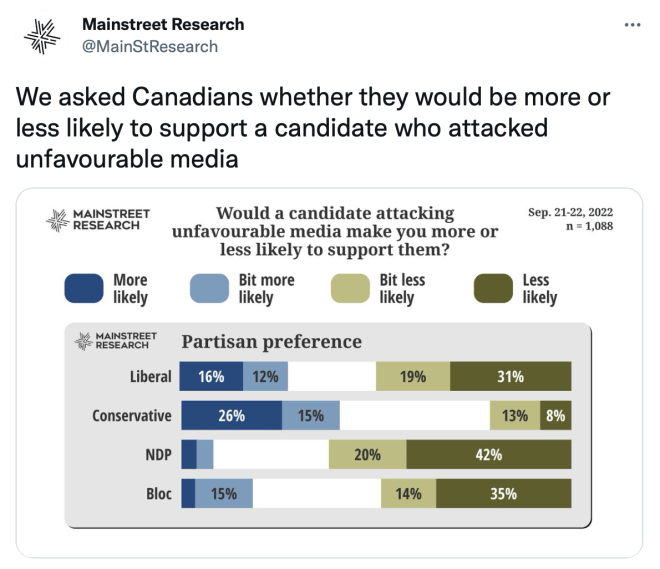
What was not surprising was how much Conservative supporters like it. What was a little surprising was the traction media-bashing also gets from Liberal voters. The hashtag #CanadianMediaFailed often tunes you in to how grumpy some Grit supporters get about news coverage that doesn’t go their way.
Lest this report be misinterpreted as “whataboutism,” I appreciated the reality check provided by Lawrence Martin in his recent Globe column.
***
The Commons Heritage Committee began study of Bill C-18, the Online News Act, otherwise known as the FaceGoogle-Must-Pay-for-News-Content legislation.
The timeliness of C-18, and an ominous portent for local news, was revealed this week by a report in the Globe that the co-owners of the Toronto Star have fallen out, quite possibly over job cuts. Nordstar 50/50 partners Paul Rivett and Jordan Bitove are off to court.
***
The political theatre over Bill C-11 the Online Streaming Act is not as bad as it was last spring during the Conservative filibuster of the Heritage Committee hearings, but the less partisan Senate deliberations are still generating as much heat as light.
I posted about a sleeper issue in C-11 that got some deserved attention this week at the Senate hearings: the Bill gives federal cabinet sweeping powers to override the CRTC on detailed regulatory matters.
***
Canada’s Journalists for Human Rights held a fund raising gala on Thursday night featuring journalists from Afghanistan (Humaira Habib) , Kenya (Wanja Gatu), and Canada (the Globe’s Mark MacKinnon). Unifor National President Lana Payne, a former journalist, also spoke.
Digital First Canada ED Scott Benzie appeared before the Senate Transportation and Communications Committee on September 28th
September 29, 2022
Last year the federal Liberals assigned Ontario MP Chris Bittle as Parliamentary Secretary to the Heritage Minister to neutralize Conservative MP Rachael Thomas’ disruptive tactics in Committee.
It worked to an extent. But like Thomas, the combative courtroom lawyer Bittle has no off-switch.
Last month he engaged in a Twitter spat with Michael Geist over the government’s complicity in hiring Laith Marouf as an anti-racism consultant despite Marouf’s anti-semitic and racist Twitter activity. One of Bittle’s Tweets implied Geist was a racist (of course he’s absolutely not) for criticizing Diversity Minister Ahmed Hussen: Bittle apologized but not before having embarrassed himself.
This week the Globe reported that Bittle and another Liberal MP have filed a complaint with the Lobby Commissioner alleging that Scott Benzie, Executive Director of Digital First Canada (DFC) may have violated federal laws regarding disclosure of his organization’s financial backer, YouTube.
Both DFC and YouTube oppose Bill C-11’s provisions regarding user generated content and online discoverability of Canadian content.
Bittle first made the accusation public during Heritage Committee hearings last June and the important details are as yet unclear: Benzie may have been non-compliant in registering DFC’s connection to YouTube while lobbying MPs.
Having made his valid but limited point about DFC’s relationship with YouTube in June, Bittle still filed a formal complaint. Perhaps it was to hold the truculent representatives from YouTube Canada accountable. Benzie and the Conservatives call it witness intimidation.
The bottom line is that this week this tempest in a teapot is getting more attention than the Bill itself.
***
That wasn’t the only political theatre around C-11 this week. The other was the Senate’s near-exclusive focus on discoverability and the impact on algorithms that drive traffic on hosting platforms TikTok and YouTube.
The Senate is recycling most of the witnesses who already presented on C-11 to the Heritage Committee in June.
The latest slogan from critics is that the CRTC will be “picking winners and losers” among competing YouTube videos if discoverability provisions go forward.
No one explains how of course.
When you keyword search a topic in YouTube you get numerous but limited recommendations ranked in order of responsiveness to the inquiry (or at least we assume so in the absence of YouTube being more transparent about its algorithm).
If YouTube was to tweak its algorithm to spotlight or rank higher any Canadian videos available on the topic—the Bill says it’s up to them how they do it— you may see a little Canadian flag beside one of the videos in the top recommendations, assuming the YouTubers’ video file metadata has been entered accurately and the algorithm is intelligently programmed.
The CRTC would have to decide if the Canadian flag on a recommendation that is otherwise responsive to the inquiry is enough to meet discoverability requirements, or whether Canadian videos actually get pushed up a notch or two.
Yes, it’s possible in this scenario that the bottom ranked video gets booted off the list of recommendations or, as Internet Society VP Konrad von Finckensteinsuggested, the list simply gets longer.
The Internet will remain unbroken.
Critics did raise a couple of troubling points to be considered. The first is that YouTube might just mess it all up and alienate audiences who might blame individual YouTubers.
Another is that other countries (especially the U.S.) might respond with matching preferences for their own YouTubers and our Canadian creators will be net losers.
The latter point is worth the CRTC studying in depth before taking any action on discoverability. The Commission may well end up making limited use of its new powers and/or granting exemptions to YouTubers who are not conventional broadcasters.
***
I have buried the lede about important stuff by giving so much attention to C-11 TV’s bread and circuses.
At Tuesday’s Senate hearing you could visibly observe Senators pick up on the in-depth expertise being offered to them by witness Monica Auer who is Executive Director of the Forum On Research and Policy in Communications, specializing in CRTC regulatory issues.
Auer has spotlighted a serious threat in C-11 to the Commission’s independence from government.
Section 7(7) of the Bill amends the Act’s long standing provisions that permit the government of the day to issue broad policy directives to the Commission.
For example in 2013 the Harper governmentdirected the Commission to expand consumer choice in television, including the option for subscribers to buy channels on the stand-alone basis of “pick and pay.” The Commission went on to issue a very lengthy and detailed ruling on that as part of its “Let’s Talk TV” review of broadcasting policy in 2015.
That ruling followed a year of public consultation, detailed evidence, and thoughtful contemplation by Commissioners with far more non-partisan expertise than their government masters.
But section 7(7) in C-11 would allow the government to write detailed regulatory outcomes into the policy direction itself ——more than likely penned by a political staffer in the office of the Heritage Minister of the day——and direct the Commission to rubber stamp them.
This section 7(7) power arrogated to the federal government would apply not only to regulatory matters (like pick and pay) but to the “orders” that will become the de facto licences for online undertakings like Netflix, Disney Plus, or Bell Crave.
As “licensed” linear broadcasting platforms are displaced by “ordered” online undertakings, the federal cabinet will accrue the power to dictate the minutia of individual broadcasters’ terms of operations.
Here are the provisions in the Bill, both the expanded cabinet powers and the Commission responsibilities they can be substituted for, including the definition of Canadian content:
***
7 (1) Subject to subsection (2) and section 8, the Governor in Council may, by order, issue to the Commission directions of general application on broad policy matters with respect to
(a) any of the objectives of the broadcasting policy set out in subsection 3(1); or
(b) any of the objectives of the regulatory policy set out in subsection 5(2).
…
(7) For greater certainty, an order may be made under subsection (1) with respect to orders made under subsection 9.1(1) or 11.1(2) or regulations made under subsection 10(1) or 11.1(1).
…
Conditions
9.1 (1) The Commission may, in furtherance of its objects, make orders imposing conditions on the carrying on of broadcasting undertakings that the Commission considers appropriate for the implementation of the broadcasting policy set out in subsection 3(1), including conditions respecting
(a) the proportion of programs to be broadcast that shall be Canadian programs and the proportion of time that shall be devoted to the broadcasting of Canadian programs;
(b) the proportion of Canadian programs to be broadcast that shall be original French language programs, including first-run programs;
(c) the proportion of programs to be broadcast that shall be original French language programs;
(d) the proportion of programs to be broadcast that shall be devoted to specific genres, in order to ensure the diversity of programming;
(e) the presentation of programs and programming services for selection by the public, including the showcasing and the discoverability of Canadian programs and programming services, such as original French language programs;
(f) a requirement for a person carrying on a broadcasting undertaking, other than an online undertaking, to obtain the approval of the Commission before entering into any contract with a telecommunications common carrier, as defined in the Telecommunications Act, for the distribution of programming directly to the public;
(g) a requirement for a person carrying on a distribution undertaking to give priority to the carriage of broadcasting;
(h) a requirement for a person carrying on a distribution undertaking to carry, on the terms and conditions that the Commission considers appropriate, programming services, specified by the Commission, that are provided by a broadcasting undertaking;
(i) a requirement, without terms or conditions, for a person carrying on an online undertaking that provides the programming services of other broadcasting undertakings in a manner that is similar to a distribution undertaking to carry programming services, specified by the Commission, that are provided by a broadcasting undertaking;
(j) terms and conditions of service in contracts between distribution undertakings and their subscribers;
(k) access by persons with disabilities to programming, including the identification, prevention and removal of barriers to such access;
(l) the carriage of emergency messages;
(m) any change in the ownership or control of a broadcasting undertaking that is required to be carried on under a licence;
(n) the provision to the Commission, by licensees or persons exempt from the requirement to hold a licence under an order made under subsection 9(4), of information related to
(i) the ownership, governance and control of those licensees or exempt persons, and
(ii) the affiliation of those licensees or exempt persons with any affiliates carrying on broadcasting undertakings;
(o) the provision to the Commission, by persons carrying on broadcasting undertakings, of any other information that the Commission considers necessary for the administration of this Act, including
(i) financial or commercial information,
(ii) information related to programming,
(iii) information related to expenditures made under section 11.1, and
(iv) information related to audience measurement, other than information that could identify any individual audience member; and
(p) continued ownership and control by Canadians of Canadian broadcasting undertakings.
…
Regulations generally
10(1) The Commission may, in furtherance of its objects, make regulations…
(b) prescribing what constitutes a Canadian program for the purposes of this Act;
Regulations — Canadian programs
(1.1) In making regulations under paragraph (1)(b), the Commission shall consider the following matters:
(a) whether Canadian producers, including independent producers, have a right or interest in relation to a program, including copyright or any other right or interest, that allows them to control and benefit in a fair and equitable manner from the exploitation of the program;
(b) whether key creative positions in the production of a program are primarily held by Canadians;
(c) whether a program furthers Canadian artistic and cultural expression;
(d) the extent to which persons carrying on online undertakings or programming undertakings collaborate with independent Canadian producers, with persons carrying on Canadian broadcasting undertakings producing their own programs, with producers associated with Canadian broadcasting undertakings or with any other person involved in the Canadian program production industry, including Canadian owners of copyright in musical works or in sound recordings made in Canada; and
(e) any other matter that may be prescribed by regulation.
…
Regulations — expenditures
11.1 (1) The Commission may make regulations respecting expenditures to be made by persons carrying on broadcasting undertakings for the purposes of
(a) developing, financing, producing or promoting Canadian audio or audio-visual programs, including independent productions, for broadcasting by broadcasting undertakings;
(b) supporting, promoting or training Canadian creators of audio or audio-visual programs for broadcasting by broadcasting undertakings; or
(c) supporting participation by persons, groups of persons or organizations representing the public interest in proceedings before the Commission under this Act.
Order — particular broadcasting undertaking
(2) The Commission may make an order respecting expenditures to be made by a particular person carrying on a broadcasting undertaking for any of the purposes set out in paragraphs (1)(a) to (c).
Former TV journalist and Heritage Committee MP Kevin Waugh (CPC) says Bill C-18 doesn’t help rural news outlets.
September 27, 2022
Members of the Commons Heritage Committee are back on Parliament Hill following summer break —possibly still numb from the filibuster and closure on Bill C-11 the Online Streaming Act— and ready to study the Liberal government’s next media bill, the Online News Act C-18: sometimes known as “FaceGoogle pay-for-news” legislation.
In two days of Committee hearings including today, MPs invited a number of witnesses who sparred over whether the Bill is a good or bad thing.
I’ve written in support of the Bill several times here, here, here and here. For the opposing view, you can read Michael Geist here, or former Calgary Herald Editor Peter Menzies here. There is also an article by Internet Society Vice President Konrad Von Finckenstein that identifies the problems he sees in an Act that he clearly doesn’t like.
If I may be as helpful as I am opinionated, what follows is a synopsis of the Bill’s provisions with select bullet points on what some say are trouble spots.
Sections 3 and 4 describe the overall objective of the Bill (“enhancing fairness in the Canadian digital news marketplace”) as well as principles favouring freedom of expression and journalistic independence when the CRTC or the courts are asked to interpret the Bill. Section 2 includes some key definitions.
Section 2 of the Bill says the scope of bargaining for fair compensation includes news content that is accessed or indexed through links or partial text, likely the legislative draftspersons’ anticipation of regulatory avoidance strategies by Google and Facebook. Michael Geist says this is overreach.
Sections 6 to 10 establish which digital platforms are subject to the Act as “Digital News Intermediaries.” (DNIs) At the moment, it’s anticipated the only DNIs will be Google and Facebook as they were in Australia.
Sections 11-17 describe the exemption option for Google and Facebook should they be able to convince the CRTC they have made enough voluntary deals with Canadian publishers and broadcasters for fair compensation, dispensing with the need for formal designation and arbitration proceedings. This exemption route prevailed in Australia.
The key criterion for granting DNIs an exemption is whether the platform can strike voluntary deals with “a significant portion” of news organizations, implying that some news organizations could be left out in the cold without a deal. In Australia, Facebook refused to make a deal with a small public broadcaster and the investigative news site The Conversation but still achieved an exemption under a similar provision in the Australian legislation. Small Canadian news outlets are worried this could happen here. The architect of the Australian legislation, Competition Commissioner Rod Sims, appeared before the Heritage Committee to reassure small news outlets that their counterparts did very well in Australia. Nevertheless expect this to be a focus of future hearings. As well, the “two employed journalists” threshold that small rural papers must pass over to access fair compensation under C-18 is already a point of contention within the Committee.
Sections 18-22 sketch out the process for formal bargaining between DNIs and news organizations (dubbed Eligible News Organizations – ENOs). Sections 27-31 cover how news organizations get certified as ENOs and thereby access bargaining with DNIs over fair compensation. Section 49 refers to a bargaining Code of Conduct that the CRTC is charged to develop to make bargaining go more smoothly.
Section 27(1) sets the bar for the kind of news journalism required before a news outlet can be certified as an ENO. There appears to be a loophole where daily newspapers already certified under the federal government’s “QCJO” aid to journalism funding program are required to provide original news, but smaller publishers and any broadcasters are not. Geist is all over this and, forgiving his hyperbole, I agree.
Sections 33-41 describe the final offer binding arbitration that is available for ENOs if they can’t get a fair deal from Facebook or Google. It’s sometimes called “baseball style” arbitration where the arbitrator can only pick one of the two proposals in their entirety, without compromise.
There are a number of technical provisions in the Act dealing with how the bargaining regime intersects with the Copyright Act (sections 23-32) and the Competition Act (Sections 47-48).
There are conflicting academic views on the copyright and trade compliance features of this Bill. Compare Geist to the University of Calgary’s Hugh Stephens on this.
There is an important “undue preference” provision in section 51 that limits Google and Facebook’s discretion in ranking news content (it can’t be unjust, undue or unreasonable).
There are several sections on how news organizations and the CRTC can compel information from Google and Facebook so that the bargaining and CRTC proceedings aren’t frustrated by the asymmetrical information gap about the inner workings of their platforms.
Because of this information problem, as well as the public’s and news organizations’ interest in transparency, section 86 speaks to an annual audit and information report about the commercial value of the agreements that are struck under the Act.
David Skok, CEO of The Logic, says small news organizations need “real time” access to information on other bargaining outcomes in order not to be shortchanged.
This week’s update begins as last week’s: a story of a moment’s lack of judgment by a Parliament Hill journalist, exploited by the Conservative Party to continue its vilification of the media.
Last week the story was about the confrontation between David Akin of Global News and Pierre Poilievre.
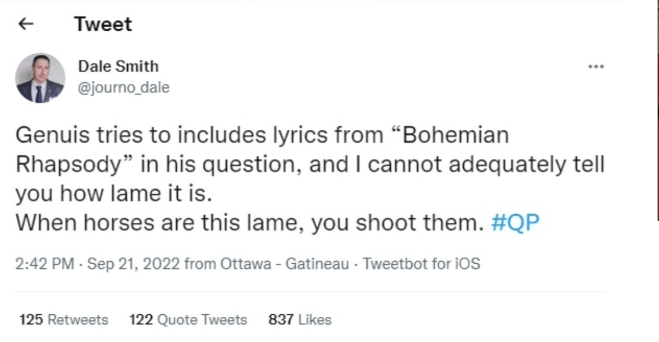
This week the focus was freelance journalist Dale Smith who poked Conservative MP Garnett Genuis’ for his conduct in Question Period:
Smith has solid journalist credentials, but according to some a reputation for “snark.” His Twitter feed has an edge.
You can follow the ensuing series of events here in the CBC account of it.
But to summarize, the Tories alleged a threat of violence by Smith. Genuis said he feared for his own safety. Conservative voice True North equated Smith’s Tweet to other, less ambiguous threats made against politicians.
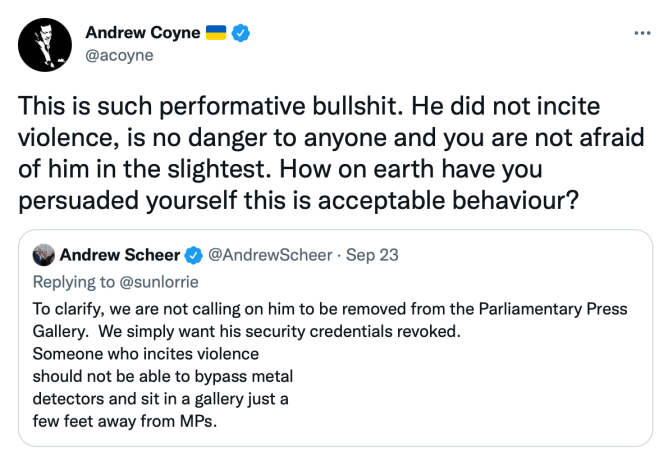
The Globe’s Andrew Coyne denounced the Conservatives for engaging “in performative bullshit.”
Smith was defiant and refused to apologize.
The Conservatives upped the ante and demanded Smith be booted from the Parliamentary Press Gallery and, effectively, reporting on federal politics.
As expected, the self-governing Press Gallery refused the demand but not without admonishing Smith:
“The Gallery wishes to dissociate itself from the comments made by this journalist … the Press Gallery would like to emphasize that intimidation, in all its forms, is unacceptable … it is important to remember that it is not for politicians to determine who is or isn’t a member of the Gallery.”
The Toronto Star’s Bruce Arthur, who wrote an excellent column on Akin-Poilievre encounter last week, had this to say about Smith-Genuis:
Like l’affaire Akin last week, the problem is a major Canadian political party has decided to demonize the media as a strategy, and acts in bad faith while doing so. This, however, was an escalation, because the Conservatives demanded the press gallery and Parliament intervene over a journalist’s hacky tweet. The gallery operates under the purview — usually and appropriately at arm’s length — from the Speaker of the House. Imagine what mischief a dedicated anti-media Conservative Party in power could get up to. Imagine how bad this could get.
To add my own opinion, the “how-bad” is more than the harassment, vilification, and doxing of reporters, or Conservative attempts to ban unfriendly journalists.
“Bad” is also about turning off audiences and fueling news avoidance.
Some stark statistics from Nic Newman, lead author of the @risj_oxford’s Digital News Report, presented at #futuremediatech. In the US, 15% don’t consume news on TV, online, social media, in newspapers or on radio. In the UK, news avoidance has rocketed in five years. pic.twitter.com/prxUVXiYCm
“Bad” is also the latest feature of media bashing: Internet trolls that counterfeit news posts to “prove” the alleged bias of professional journalists.
Global News’ Rachel Gilmour, a frequent target of the populist troll army’s ugliest harassment, retweeted a couple of these counterfeit posts aimed at her:
Some people have decided it’s a fun hobby to photoshop news articles and see who takes the bait.
THIS is fake news. I never wrote it.
If it’s a screenshot — not a link — and the text looks off, consider googling before getting outraged. pic.twitter.com/V8BZ3aVXvs
The Senate hearings on Bill C-11 the Online Streaming Act continue.
Senators are giving critics lots of air time to dwell on the controversy over user generated content and platform algorithms. Commentators like myself accommodate this oxygen-sucking debate by writing about it.
In my latest post, I suggested that the competing claims about the need for, or danger of, discoverability tools to promote Canadian content mostly concern the music industry and ought to be meticulously examined by the CRTC after C-11 passes into law.
Not getting enough public attention are the provisions of Bill C-11 weakening the CRTC’s ability to ensure that Canadian programming services get carried on foreign-owned online platforms operating in Canada. Senators do appear to be paying attention.
…consider how toensure that, as the national public broadcaster, the Canadian Broadcasting Corporation continue to make asignificant contribution to the creation, presentation, and dissemination of local news, children’s programming,original French-language programming, and programming produced by independent producers.
Those instructions explicitly reference some of the worst of the CRTC’s ruling but are less clear about others such as scheduling of Canadian programs during evening prime time hours and the relationship between digital and linear television programming expenditures.
In a previous post I suggested the petition gave cabinet an opportunity to signal a broader consideration of the CBC, slated for review by the Minister’s 2021 Mandate Letter. There’s no sign of that yet, although there is an appetite for it.
***
The House of Commons Heritage Committee (CHPC) began its examination of Bill C-18 the Online News Act. The legislation is intended to rebalance the bargaining power between Canadian news organizations and digital platforms Google and Facebook over the value of the media’s intellectual property (I hesitate to use the loaded term “copyright.”). I previously wrote about C-18 here.
There’s a Globe and Mail report on the first day of Committee hearings here. There is also a helpful account on Cartt.ca.
In US Congress, a slightly different version of C-18 emerged from the Senate Judiciary Committee’s “mark-up” hearing and will go forward to the full Senate after sponsor Amy Klubachar (D-Minnesota) struck a deal with Ted Cruz (R-Texas) over the issue of platform content moderation.
***
I may have already spilled too much ink over the BeerGate controversy involving CRTC Chair Ian Scott, Bell CEO Mirko Bibic, and Tek Savvy’s appeal of the Commission’s Wholesale Internet Broadband pricing decision.
This summer Scott was cleared by federal Ethics Commissioner Mario Dion of any violation of the Conflict of Interest Act.
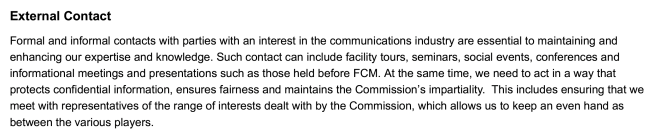
In reviewing the legal filings on the Tek Savvy appeal to Federal Court I noticed a reference to the CRTC’s internal Code of Conduct which, the Bell factum correctly points out, contemplates Commissioners engaging with stakeholders at social events.
That got me interested in reading the CRTC Code for myself. When I couldn’t find it online I requested it from the Commission. The Commission responded that it was confidential and refused to release it.
With the assistance of a couple of colleagues I discovered the Code had in fact been posted on the Commission website as late as June. Thanks to the Wayback tool, I got a copy and indeed it verifies what Bell is telling the Federal Court:
If you are interested in the ongoing debate about the wholesale pricing of Internet and mobility services, or the dynamics behind the Rogers-Shaw merger, there is a series of articles in the Globe and Mail that focuses on the capital commitments to building fibre networks.
The articles are based on interviews of the CEOs of Shaw, Bell and Telus.
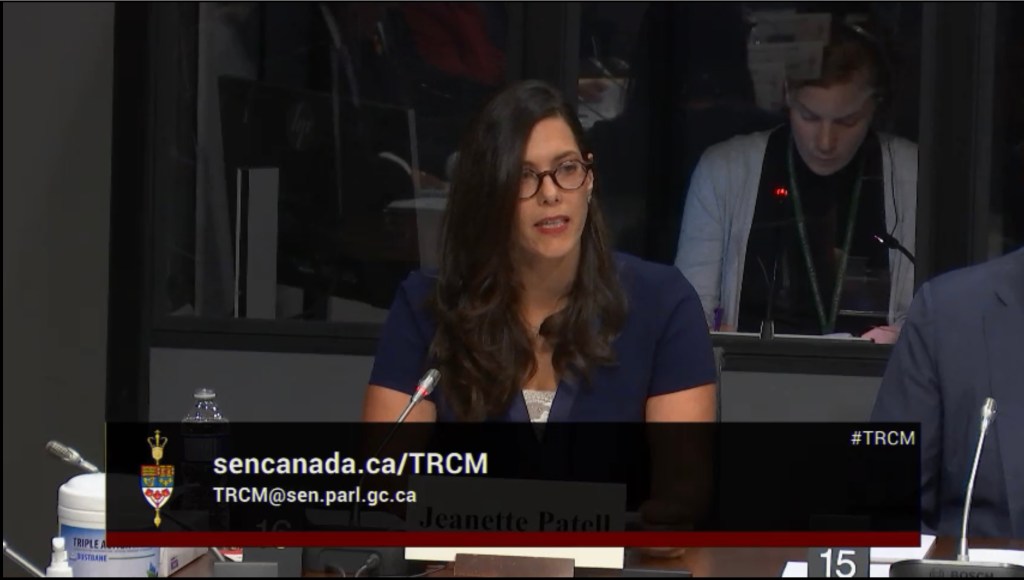
YouTube spokesperson Jeanette Patell appeared before the Senate Transportation and Communication Committee on September 21, 2022
September 22, 2022
Google isn’t having it. They sent YouTube Canada lawyer Jeanette Patell to tell a Senate Committee reviewing Bill C-11 to draw a line in the sand on algorithms.
No CRTC-dictated “corrupting signals”. Period.
No CRTC “picking winners and losers” on YouTube’s hosting platform. Ever.
YouTube’s algorithm is 100% based on user consumption, said Patell, and it must stay that way. When pressed by Senators to explain the manner in which YouTube would be willing to promote Canadian content she responded in an elevated voice, “it’s all in the name, YouTube.”
No doubt Senators found that helpful.
When Senator Donna Dasko finally insisted she sketch out what YouTube will eventually tell the CRTC it is willing to deliver on discoverability, Patell said Google would consider non-algorithmic marketing tools in collaboration with “the industry,” as if appearing in front of Canada’s national broadcasting regulator was too distasteful to contemplate.
And that, was that. Good Parliamentary television but not illuminating.
The illumination came from others appearing before the Senate Committee on Wednesday night.
But first a recap is in order.
I posted last week that the Bill C-11’s discoverability controversy is a more focussed issue than most assumed.
That is, the French-language music associations in Quebec are the main drivers of the issue. Jérôme Payette, Director-General of the Association des Professionnels de l’Edition Musicale (APEM) was also in front of Senators last night to speak about the dramatic drop-off in the consumption and revenues of French language music since streaming platforms surpassed radio as the dominant music platform:
“Since 2016, the revenues paid by SOCAN to Quebec music publishers have fallen by 24%. Revenues from traditional sources such as radio and TV are decreasing, and Canadian music is unable to achieve a significant share of revenues from online businesses, which are nevertheless growing.
“Only 10% of the sums collected in Canada by SOCAN from digital broadcasters are paid to Canadian authors and composers, the rest goes abroad. The decline is dramatic compared to traditional broadcasters, and it is explained by the lack of regulation.
“Online, Quebec music struggles to reach its audience. According to the Observatoire de la culture et des communications du Québec, our market share is only 8% on online music services, while it is 50% for record sales.”
Payette views the Internet-driven changes in the music industry as an existential threat to French language culture. Quebec’s cultural sovereignty is at stake and Google, he said, is playing dirty pool on C-11, funding domestic critics like Digital First Canada and Open Media, and fear-mongering about C-11’s impact on consumer choice.
Here’s how the dispute relates to the Bill itself:
The major music streaming platforms appearing before the Senate —-YouTube, Spotify, and TikTok —-all agree to write big cheques to fund the development of Canadian music talent based on the commercial value of their own curated music services of “full length songs.” They hasten to point out they already contribute to some of this development on a voluntary basis.
YouTube and TikTok represent a special sub-set of funding obligations because Bill C-11’s article 4.2 —-the controversial provision stating that user-generated content (e.g. user-curated playlists and videos) can be commercially regulated in certain circumstances—- means YouTube and TikTok will also be tithed on the commercial value of that business.
It also means that user generated content will be governed by whatever CanCon marketing outcomes (“discoverability”) are required by the CRTC under section 9 of Bill C-11, and it’s not ruled out by the Bill that the CRTC may order platforms to figure out a suitable tweak to their algorithms.
Those same CRTC-mandated discoverability outcomes will apply to the platforms’ own curated music services.
The music services all agree on this second point: they are adamantly opposed to discoverability that might impact their algorithms.
What they haven’t done is say what discoverability they are for.
That was why it was disappointing that, despite the best efforts of several Senators to pin down YouTube’s Patell or TikTok spokesperson Steve de Eyre on this point, none of the Senators asked what they thought of the compromise floated by PIAC spokesperson John Lawford last week: increasing the discoverability of Canadian artists through the use of banner ads and hyperlinks.
I promised illumination however.
The first interesting point was the deference shown by Music Canada’s Patrick Rogers to YouTube and TikTok. Music Canada is the alliance of major music labels, foreign owned but in the business of developing Canadian artists. Rogers told Senators he accepted “at face value” claims by Patell and de Eyre that tampering with their algorithms will backfire and harm Canadian artists.
An even more interesting intervention came from the English Canadian musicians’ association CIMA, represented by former punk rock artist and ex-MP Andrew Cash.
While choosing his words carefully, Cash came down squarely on TikTok and YouTube’s side of the argument. The “demand-side” regulation of distribution won’t work in an Internet environment, he said.
In the past radio CanCon regulations helped to build a strong domestic music industry, he said, but radio no longer drives exposure and commercial success. The way to help Canadian artists now is to contribute financially to their development, a “supply side” strategy endorsed by TikTok’s de Eyre.
As for his French language counterparts, Cash recommended they get their day in the CRTC’s court to make their case for stronger discoverability tools under C-11. To tack on the obvious addendum to that recommendation, that CRTC hearing is also the place and time where YouTube and TikTok get to argue that user generated content and algorithms are best left alone.
By the end of the Senate hearing, it became reasonable to conclude that the crux of the discoverability problem is how Bill C-11 and the CRTC can meet the cultural goals of the French language music industry.
But as I observed at the outset, Google isn’t having it.
They insist that all user generated content or algorithms be permanently walled off from any future regulation by exclusion from the Act and French language music does not get its day in court.
And I am going to predict that Liberal, Bloc and NDP MPs are not having that.
Brad Danks is the CEO of one of Canada’s niche broadcasters OutTV and he never claimed to be Wayne Gretzky.
But when talking to Senators about Bill C-11 today, he was not thinking about linear TV and where the puck has been. He was thinking about where the puck is going to be in a future where linear TV has been fully eclipsed by online distribution.
Apart from Bell, Rogers, and perhaps Videotron, the future of Canadian broadcasters is not their own destination streaming apps competing against global broadcasters Netflix or Disney Plus.
Their future is securing distribution deals from online channel aggregators Roku, AppleTV, or any number of foreign platforms around the world. Or perhaps free advertising-supported TV (FAST) like Pluto TV. That’s not just an export strategy aimed at expanding audiences, it’s a domestic strategy for reaching Canadian cord-nevers and cord-cutters.
That’s why Danks, joined by Monika Ille of the Aboriginal Peoples Television Network (APTN), implored Senators to pass C-11 amendments that would empower the CRTC to order both domestic and foreign online distributors to not only to accept Canadian channels but to provide a fair rate as the CRTC is authorized under current legislation applying to cable and satellite companies.
Under the current Act, the Commission has the power to backstop commercial negotiations between Canadian channels and cable and satellite companies if those distributors are tempted to be unreasonable about revenue splits that are more or less standard in the industry. The backstopping is the Commission’s power to fix reasonable terms through binding arbitration.
But the drafters of C-11 rejected a matching Commission authority over online undertakings, as seen in the reference to making an order “without terms and conditions” in section 9.1(1)(i):
(i) a requirement, without terms or conditions, for a person carrying on an online undertaking that provides the programming services of other broadcasting undertakings in a manner that is similar to a distribution undertaking to carry programming services, specified by the Commission, that are provided by a broadcasting undertaking;
It’s not clear why the drafters of C-11 didn’t just map over the CRTC’s full authority on these matters from linear broadcasting to the world of online distribution.
Minister Pablo Rodriguez made a cryptic comment to the Commons Heritage Committee that there might be international trade repercussions to giving the Commission such powers over foreign distributors operating in Canada. But we have heard nothing since.
Giving weight to Danks and Ille’s pitch to Senators is the fact these amendments were on the very short list of changes to C-11 endorsed by CRTC Chair Ian Scott.
It’s possible that the pressure point is how foreign distributors will react to the CRTC ordering them to carry the so-called “section 9(1)(h)” channels APTN, the Weather Channel, the French-language news consortium TV5, AMI-TV for disabled viewers, CPAC, the multi-ethnic channel OMNI, etc.
These channels have the CRTC to thank for their mandatory inclusion in the basic cable package, but also for above-market rates —-a deliberate cross-subsidy— that the Commission orders the Canadian cable companies to pay to these broadcasters based on so many cents per month for each cable customer (for APTN it is set at 35 cents, for AMI-TV at 20 cents, etc.).
As APTN’s Ille told Senators, it has taken 20 years to build up an indigenous broadcasting presence on Canadian cable TV thanks to its “section 9(1)(h)” status.
Are we going to leave its survival in the hands of American distribution companies?
This post was updated to clarify the interpretation of section 9.1(1)(i) of C-11.
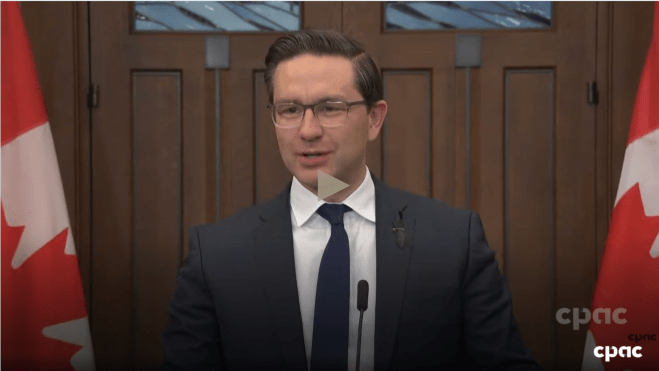
The media event of the week was the combustible encounter between Opposition Leader Pierre Poilievre and Global News reporter David Akin at a Parliament Hill press conference, followed by Poilievre fundraising off the incident and doxing Akin.
There’s no need to put in my two cents, Karen Pugliese’s account of what occurred and what it means for Canadian media and politics covers it.
***
One of Poilievre’s least favourite Liberal bills is C-11, the Online Streaming Act.
The controversial “Netflix Bill” broke through the Tory filibuster in June and has now moved on to the Senate Transportation and Communications Committee. As the Orcs of Middle Earth would say, “meat’s back on the menu.”
Except that Senators are taking a different approach than their House colleagues: less partisanship and a real curiosity about the policy issues. The Senators spent two days studying the Bill in June and two more this week, I posted an update that attempts to get at what is feeding the heated “discoverability” debate.
You can get more detailed reports from Cartt.ca here ,here and here.
Also, Marie Woolf of the Globe and Mail writes this morning about the role of “intellectual property” (ownership of exploitation rights) in making Canadian content film and TV. American streamers Disney and Netflix are currently barred from retaining these commercial rights for certified CanCon, so their movies don’t qualify. You will hear a lot more about this issue in the weeks and months to come.
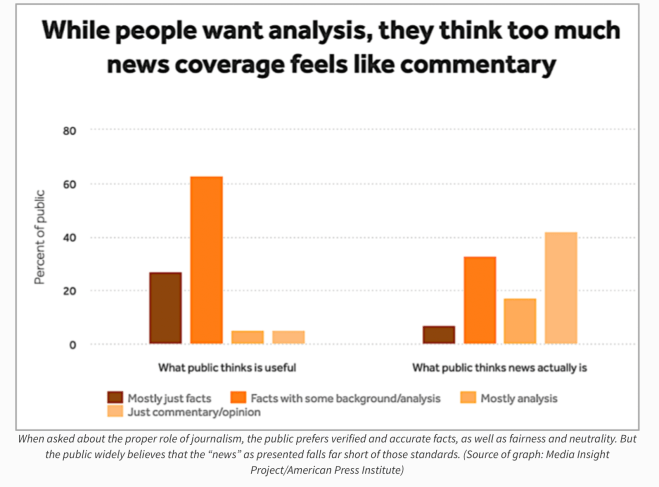
There’s a recently published reflection on Canadian journalism provocatively entitled “Objectivity: What Journalists Hate but the Public Still Craves.”
Former Calgary Herald Editor Peter Menzies is looking at audience data from the American Press Institute suggesting readers are disappointed in how much opinion they believe they are getting in news stories instead of facts and analysis.
Menzies delivers quite a scolding to his fellow journalists. While some of his comments might be considered polemic, the data that he’s looking at is thought provoking.
***
I’ve been following the American version of our Bill C-18, the Online News Act. Democratic Senator Amy Klubachar’sJournalism Competition and Protection Act(JCPA) ran into a major snag in “mark-up” debate at the Senate Judiciary Committee, despite having bipartisan support lined up.
Senator Ted Cruz (R-Tex) tossed in an amendment on platform content moderation that Democrats wouldn’t accept and it was approved in the absence of a Democrat sick with Covid. Klobuchar had to withdraw the Bill and will resubmit it.
The California program will fund 40 local newsroom interns in three consecutive annual cohorts, each internship lasting three years. The program will be administered by Berkeley’s School of Journalism.
***
Minister Pablo Rodriguez has tabled his response to the May report of the Commons Heritage Committee on the Rogers-Shaw merger.
Another CRTC file I am following is the complaint filed by One Soccer (on the CRTC website under its corporate name Timeless Inc.) against Rogers for refusing to put the independent soccer channel into its cable package, even on a pick-and-pay basis.
Rogers has now filed its response, as has Telus as an intervenor. Telus is the only Canadian cable provider that carries One Soccer, which holds programming rights for the Canadian Premier League and several game broadcasts of our national teams.
Based on the filings, One Soccer is a long shot to win cable access under the long standing CRTC rules. Whether those rules are still “in the public interest” may be something to comment upon after we get the Commission’s ruling.