Canadian YouTuber and Washington Post columnist J.J. McCullough has a summer DIY: rallying fellow YouTubers to fight Bill C-11.
McCullough was the star of the show on behalf of the Conservative Party during Parliamentary Committee hearings on the Online Streaming Act last month (sheepishly acknowledged in this video on June 4th which six weeks later has nearly 500,000 streams.)
Since then McCullough has made more videos about C-11 and is asking fellow YouTubers and his 800,000 subscribers not to bother with petition-signing but concentrate on mobilizing public opinion against the Bill through YouTube’s network.
If you haven’t caught his act yet, McCullough posts vlogs about C-11, Canadian nationalism, and all manner of politics and popular culture. A gifted explainer, he salts his narratives with libertarian tropes and irreverent cheek.
No doubt the cheek has helped him earn him a bigger audience. When he appeared before the Heritage Committee, he scolded the Liberals for tabling a Bill that would enable autocrats like Hungary’s Viktor Orban to censor their media because, well, Canada did it first. A few logical leaps taken, but quotable as heck.
The insouciance also sees him pushing boundaries like proposing “Quebecreïch” as the name of a sovereign Québec should Canada break apart.
As part of his summer project to evangelize against C-11 he recently appeared on another YouTuber’s channel, the Gary Klutt show, where he aired it out on C-11 for an hour.
After briefly discussing controversial “discoverability” provisions he and other C-11 opponents criticize, McCullough said the Bill would also “mandate Canadian content quotas and Canadian genre quotas” on YouTube.
That is misleading, to choose my words carefully. The Bill exempts You Tube and other uncurated social media platforms from CanCon exhibition requirements like those in place for television and radio. The Bill also exempts social media platforms from any regulation of what YouTubers like McCullough can say, unlike TV or radio which are governed by “abusive comment” and “misinformation” codes.
McCullough also sought to stoke any resentments YouTubers might be feeling about “old media” protecting their parochial interests while continuing to air unwatchable CanCon every evening on television (his words, not mine).
The “old guard” is so jealous of the new media, McCullough said in earnest, they want to regulate YouTube so that it becomes “less attractive” and less distinct from conventional Canadian television.
This inspired his host to chime in that old media is “just like Walmart,” supporting minimum wage laws to “minimize competition from smaller stores that can’t pay that wage.” In reply, McCullough either mumbled “yes, that’s fair” or choked on his coffee, it was difficult to tell.
As of now, what little we know about public opinion on Bill C-11 suggests that McCullough has his work cut out for him.
A Nanos poll taken in May (before much of the C-11 Parliamentary fireworks began) suggested solid support for C-11.
This should not be too surprising. A 2019 Nanos poll showed that public support for Canadian programming policies in general is very strong.
And a recent opinion poll from the University of Saskatchewan took the temperature of Canadians on freedom of expression, revealing that the rhetoric we are hearing from C-11 opponents might not be an accurate reading of Canadian opinion.
But the summer is only half over and the stream count is rising.
Last week I provided a summary of the CRTC’s tectonic shift in regulating audio visual broadcasting. The occasion was its renewal of CBC/Radio Canada’s television licence.
The three-to-two majority ruling endorsed by Chair Ian Scott made three dramatic licence changes.
Its headline move was to guarantee programming dollars for Indigenous and equity-seeking communities (racialized, disabled, LBGTQ and official minority language communities). That spending envelope will be 35% of CBC’s programming acquisitions on the English network and 15% on the French network.
This should deservedly earn the CRTC praise. But it was two other regulatory changes that were unexpected and resulted in strident dissents from two prominent Commissioners, Broadcasting Vice Chair Caroline Simard and Ontario Commissioner Monique Lafontaine.
The first change was to merge the CBC’s existing Canadian programming expenditure obligations for its core television operation with its digital platforms, until now unregulated and without any conditions of license. Going forward, the CBC is free to shift an almost unlimited amount of its linear television budget to its digital platforms like CBC Gem, cbcnews.ca or their Radio-Canada counterparts.
The majority’s companion piece to this shared digital/linear approach to Canadian programming was to crop back the remaining conditions of licence on how much Canadian programming, especially local news, must be aired on the CBC’s network of 26 stations across the country.
Key changes were:
Exhibition minimums for prime-time evening programming on linear television were eliminated;
Exhibition minimums for “programs of national interest” (PNI) (i.e. Canadian stories in dramas and documentaries) were also eliminated, although they were replaced with conditions of license for continued spending that aligns with the CBC’s current budgeting.
Exhibition minimums for French-language children’s programming were also removed on the grounds that Radio-Canada has far exceeded the 2013 minimums (English children’s programming has only just kept up, so the CBC keeps its license conditions).
Most controversially, programming obligations for seven local stations in Vancouver, Calgary, Edmonton, Toronto, Ottawa and Montréal (French and English) were deleted and were not replaced by spending requirements or by any network-wide “news” spending obligation (the CBC’s English and French language national news services are regulated separately from its local network).
This is sharply different from the belt-and-suspenders regulations the Commission imposed in 2017 on private sector broadcasters who were not only obliged to keep their exhibition minimums for local stations but also to spend no less than 11% of network-wide revenue on local news.
The reasoning behind the majority decision seemed to be (a) accommodate a long-term shift of television programming to digital platforms and (b) trust the CBC will pursue the best programming priorities without having to strictly comply with standards of exhibition or expenditure.
Other than the easily obeyed obligation to spend 85% of its programming budget on Canadian programs on either digital or linear platforms, the remaining conditions of licence governing the CBC’s accountability are now mostly restricted to doing audience surveys, public consultations, and the reporting of data to the CRTC.
Dissenters Simard and Lafontaine zeroed in on the Commission’s unprecedented deference to broadcaster autonomy. According to Broadcasting Vice Chair Simard:
The majority decision proposes an approach that is different from the results-based approach applicable prior to the majority decision coming into force. The essence of this new approach consists in imposing conditions of licence requiring the CBC to file reports to demonstrate how its programming choices take into account public opinion research (or perception surveys) and public consultations. No binding measurable targets will be set by either the Commission or the CBC, either before or as part of this public opinion research and public consultation.
Lafontaine —the Ontario Commissioner representing nearly 40% of the national audience— agreed with that point:
Consultations and perception studies are not regulatory tools. CBC itself said that the perception studies, which it already conducts, are not appropriate tools for evaluating regulatory compliance.
Lafontaine also condemned the nearly unlimited pooling of the CBC’s Canadian programming obligations across linear and digital platforms:
In my view, the majority decision has approved a licensing framework for CBC/Radio-Canada that is fundamentally different from the Commission’s licensing approach for television broadcasting, without first conducting a detailed policy review to consider what, if any, measures would be appropriate for the digital age. We are therefore left with a majority-approved programming framework that allows hundreds of millions of dollars to leave the Corporation’s regulated platforms each year and flow to its unregulated online audiovisual platforms.
Lafontaine argued the majority was skipping over a vital policy discussion of how to regulate online platforms and was putting the policy cart before the horse for the entire broadcasting system.
It could hardly go unnoticed that this ruling for the CBC licence effectively sets a precedent for the upcoming renewal of licences for the major private broadcasters in 2024. Bell Media, Rogers, and Québecor compete with the CBC and will demand equal relief from regulatory obligations.
The implications of the majority ruling for local news is the most alarming. Their blasé repeal of all licence obligations to air programming at the seven local stations in our six largest cities came out of left field without any warning in the Commission’s 2019 Notice of Consultation that announced the public hearings.
After years of public concern over the decline in local news coverage —-which the Parliamentary Heritage Committee insisted in its 2017 report required dramatic legislative action—- the majority chose to repeal licence obligations for local news without identifying a compelling policy objective for doing so. They also declined to set news expenditure minimums for the overall network (as proposed by the CBC itself) which would have been a less drastic alternative.
Simard pointed out the obvious:
In the age of disinformation and misinformation, and considering the central and pivotal role that the CBC plays in providing reliable, unbiased and objective news, there is no legally binding framework in the majority decision in regard to news presented on the CBC’s digital platforms.
Lafontaine was concerned that CBC’s news spending may just migrate to its unregulated digital television and alphanumeric news websites:
With online news, who knows how the CBC will leverage its digital platforms, or other digital platforms, to innovate (one hopes) and, at the same time, rethink the exhibition of traditional television news reports….
…The removal of the minimum licensing obligations for local/news programming in metropolitan markets across Canada is inappropriate at this time given the crisis that has arisen in the provision of news and information. …
Canadians who reside in metropolitan markets should not be compelled to access their news programming online, as suggested in the introduction to the majority decision. Not all Canadians can access news and information content on online platforms in major centres for a variety of reasons.
Adding to the bite of the minority’s critique is that the Commission’s Notice of Consultation only raised the possibility of digital/linear sharing of Canadian programming expenditures provided that exhibition on linear television remained protected by licence conditions.
And it was not as if the CBC was asking for these regulatory innovations. Lafontaine listed all of the long-standing licence obligations that the public broadcaster applied to renew or tweak, but were struck down by the majority anyway:
Broadcast of Canadian programming: the conditions of licence for the broadcast of a predominance of Canadian programming on the Corporation’s English- and French-language conventional networks and television stations as well as its three discretionary services ICI ARTV, the documentary Channel and ICI EXPLORA.
Broadcast of French-language local programming in the metropolitan market of Montréal: the condition of licence for Radio-Canada’s conventional television network and station to broadcast a minimum number of weekly hours of French-language local programming, most of which is news programming, in the metropolitan market of Montréal.
Broadcast of English-language local programming in metropolitan markets across the country: the conditions of licence for CBC’s English-language conventional television network and stations to broadcast a minimum number of weekly hours of English-language local programming, most of which is news programming, in the metropolitan markets of Calgary, Edmonton, Ottawa, Toronto and Vancouver, as well as in the English-language OLMC of Montréal.
Broadcast of French- and English-language independently produced Canadian programming: the conditions of licence that provide minimum requirements for the broadcast of French- and English-language Canadian independently produced programs on CBC/Radio-Canada’s conventional television stations (networks and stations), ICI ARTV and the documentary Channel.
Broadcast of programs of national interest in peak time: the conditions of licence for the broadcast of programs of national interest (PNI) during the peak viewing hours of 7 p.m. to 11 p.m. on CBC’s and Radio-Canada’s conventional television networks and stations, and the requirements regarding the broadcast of Canadian independently produced PNI content.
Broadcast of French-language children’s and youth programming: the conditions of licence for the broadcast of French-language Canadian children’s and youth programming by Radio-Canada (conventional network and stations) in Quebec and across Canada. The conditions of licence include the obligation for Radio-Canada to broadcast at least 15 hours per week of Canadian programming for children under the age of 13, and the obligation for Radio-Canada to broadcast original Canadian French-language children’s and youth programs.
Broadcast of English-language children’s and youth programming: the condition of licence for the broadcast of 15 hours per week of English-language Canadian programming on CBC’s conventional television network and stations aimed at children under the age of 13.
Broadcast of original and original first-run Canadian programs: the condition of licence for Radio-Canada’s conventional television stations to broadcast original French-language Canadian children’s and youth programming, and the obligation for the documentary Channel to license from independent production companies not less than 75% of its original, first-run Canadian content hours.
Broadcast of Canadian feature films once per month on CBC: the condition of licence for the broadcast of one Canadian feature film during each broadcast month on the CBC’s conventional television network and stations.
In so many words, Lafontaine accused the majority of blindsiding everyone including the Canadian public to whom the Notice of Consultation was issued in 2019.
So the question remains, why did majority take these exceptional steps?
Surely the majority Commissioners know that whatever is left unprotected by a condition of licence is vulnerable to cost cutting, budget cannibalization or defunding.
The Corporation’s Parliamentary funding is $1.3 billion out of $1.8 billion total revenue and has remained stable during Justin Trudeau’s run in the Prime Minister’s office (in fact the Liberals boosted the grant by $150 Million in 2017).
But under a Conservative administration that seems likely to change.
The CPC 2021 election platform did not hide its intentions to gut the CBC English network while protecting CBC North and Radio-Canada:
CBC and Radio Canada have made important contributions to Canada over the past 84 years. While parts of it remain as relevant as ever, including Radio Canada, CBC Radio, and CBC North, many question whether CBC’s English TV continues to live up to its mandate. There are also concerns that CBC’s online news presence is undermining the viability of Canadian print and online media, reducing the diversity of voices available to Canadians.
Canada’s Conservatives will: * Give Radio-Canada a separate and distinct legal and administrative structure to reflect its distinct mandate of promoting francophone language and culture while maintaining its funding and providing for continued sharing of resources and facilities where applicable…
*Protect CBC Radio and CBC North
*Review the mandate of CBC English Television, CBC News Network and CBC English online newsto assess the viability of refocusing the service on a public interest model like that of PBS in the United States, ensuring that it no longer competes with private Canadian broadcasters and digital providers.
Ongoing Conservative political messaging about “CBC bias” and “defunding the CBC” has become so routine its almost goes unreported.
The absence of licence conditions on the major local stations removes an important obstacle to implementing deep budget cuts.
So the answer to the question of “why” must be a compelling policy reason to remove those safeguards. You won’t find it in the majority ruling.
The CRTC/Radio Canada “mot d’n” controversy raged (not an overstatement) this week especially in Québec where politicians and journalists demanded the CBC appeal the Commission’s ruling chastising two radio hosts for saying the full n-word in quoting the name of Pierre Vallières’ classic text.
There’s much reading material to choose from: I recommend Xavier Boisrond’s piece in La Presse.
Also, industry analyst Monica Auer tweeted her view that on a close reading of the Broadcasting Act the CRTC “decision” doesn’t appear to be one as defined in the legislation and because of that may not be appealable (or enforceable for that matter).
The Commission ruling does not cite any violation of the Radio Regulations (which contain the Commission’s Abusive Comment and Equitable Portrayal Codes) or any of Radio Canada’s licence conditions. It would be an interesting turn of events if the CBC —which is under pressure to appeal— sat on its hands and did not act on the Commission’s directives to apologize and edit the online audio file and then see what the CRTC did next.
While eyes were fixed on this controversy, the Commission’s renewal of the CBC’s licence flew under the radar. It is a mere 270 pages in length featuring tectonic shifts in licence conditions followed by fire-breathing dissents: I posted about that here with a follow-up scheduled for next week.
Everyone knows about the Rogers service outage but some may have missed the news that the mediation efforts between Shaw, Rogers and the Competition Bureau failed to deter the Bureau’s effort to block the $26 Billion merger.
That means the Bureau will commence its case before the Competition Tribunal in November. The Alberta government announced it intends to seek intervenor status before the Tribunal, possibly to support the merger which includes Rogers’ promise to create 500 new jobs in Calgary. Québecor also joined in to support its proposed purchase of Freedom Wireless assets.
The hearing should be a nerd-fest of competition law and industry jargon, still CPAC should televise this one.
With all eyes fixed upon the CRTC’s ruling in the Lamour “mot d’n” complaint against Radio Canada, the Commission’s June 22nd release of its long awaited renewal of the CBC’s license has flown under the radar.
The Commission’s five-year re-set of the CBC’s license conditions —implementing Parliament’s mandate in section 3 of the Broadcasting Act— had some catching up to do since its previous renewal in 2013.
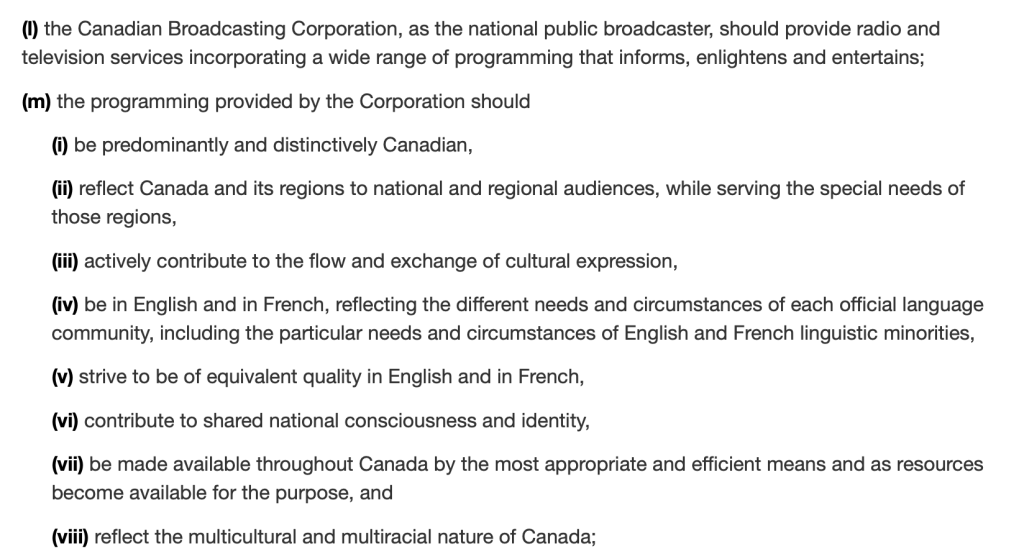
The social foundation underneath the CBC’s programming priority of “national consciousness and identity” in section 3(m)(vi) of the Broadcasting Act has shifted since 2013, especially the mainstream awakening to the recommendations of the Truth and Reconciliation Commission on Indigenous peoples and the consciousness-raising surge of the Black Lives Matter movement.
From the Broadcasting Act, section 3, defining the national broadcasting policy.
Also since the 2013 renewal we have witnessed a revolution in video distribution technologies. These current license renewal proceedings begun in 2019 were the Commission’s first opportunity to apply regulatory changes to the CBC that it implemented in 2016 and 2017 for private sector TV broadcasters.
The signature change in this license renewal is a dedicated spending envelope (“Canadian Programming Expenditure”) for television content made by producers from Indigenous peoples and from Canadian racialized, disabled, and LGBTQ equity-seeking communities.
No such legally binding programming priorities existed previously, either as exhibition quotas or budget lines. Prior to this renewal, the only regulatory requirement for diversity in CBC programming expenditure was for Official Language Minority Communities (OLMC), meaning anglophones in Quebec and francophones outside it.
Because the Commission chose to shy away from defining the genre content of programming priorities and preferred to link spending requirements to whom is making the programming — independent producers from the priority communities— the Commission turned to population demographics to measure the slices of the CBC’s budget pie.
In the end the Commission fixed the spending on independent producers thus:
Overall, 35% of all Canadian programming dollars in CBC’s English network must go to producers from Indigenous, diverse, and Official Language Minority communities. The corresponding figure on the French network is 15% (and the CRTC explains the difference).
The CBC can bank a 50% intersectionality credit (meaning one dollar of actual spending will satisfy $1.50 of its expenditure target) if that producer is a woman.
Within the overall 35% and 15% spending requirements, an 8% (English) and 1.8% (French) spending sub-envelope is carved out for Indigenous producers, the gap explained by the demographics of languages spoken within Indigenous communities.
The existing spending requirement of 6% for OLMCs is also included as a carve out.
These are big regulatory moves, perhaps a zero to sixty moment for the CBC and by the end of its five year renewal the difference in programming priorities should be quite noticeable.
However that regulatory spree is the exception to the rule in the 2022 license renewal: otherwise the Commission was looking to reduce its governance of CBC programming decisions.
It did so by deleting a bevy of 2013 binding license conditions, reducing many of them to non-binding “expectations” and “encouragements,” or outright eliminating them, in the name of “outcomes” which in this particular instance seems to be regulatory-speak for “we trust you.”
The centrepiece in the new regulatory scheme is the Commission setting a license condition that the CBC spend at least 85% of programming dollars on any genre of Canadian content on either its traditional linear television platform, which until now has been regulated by detailed conditions of license, or its Internet platforms like CBC Gem, which in this pre Bill C-11 world has never been regulated by the Commission.
The thinking behind the merged two-platform expenditure target is to incent the CBC’s shift from linear to Internet.
The thinking behind eliminating most genre-specific programming rules around news, children’s shows, dramas and documentaries in favour of an overarching 85% “CanCon” expenditure minimum is that exhibition rules (minimum hours of scheduled programming) are less useful for satisfying television audiences that increasingly expect on-demand rather than scheduled shows. The Commission’s rule of thumb for shedding exhibition quotas from the linear platform is whether or not the CBC has been comfortably exceeding them in the past.
The resulting deregulation looks like the following (for a more encyclopedic summary you can’t do better than Steve Faguy’s analysis in Cartt.ca, but if the paywall stops you the CRTC ruling contains its own summary):
Exhibition minimums for prime time evening programming on linear television are eliminated;
Exhibition minimums for “programs of national interest” (PNI) (i.e. Canadian stories in dramas and documentaries) are also eliminated, although they are replaced with conditions of license for spending minimums that align with the CBC’s current budgeting.
Exhibition minimums for French-language children’s programming are also removed on the grounds that Radio Canada has far exceeded the 2013 minimums (English children’s programming has only just kept up, so the CBC keeps its license conditions).
Most controversially, all minimum programming obligations on local stations in Vancouver, Calgary, Edmonton, Toronto, Ottawa and Montréal are deleted and are not replaced by minimum spending requirements or by any network-wide “news” spending obligation (the CBC’s English and French national news services are regulated separately from local stations). This is sharply different from the belt-and-suspenders regulations the Commission imposed in 2017 on private sector broadcasters who were obliged to keep their exhibition minimums for local stations and spend a minimum of 11% of network-wide revenue on local news.
The Commission says this deregulation is guardrailed by its expansion of the CBC’s obligations to report programming data that should confirm they are spending the overall 85% on CanCon; that they are meeting their new programming obligations for Indigenous and diverse communities as well as PNI spending; and that at least keeps tabs on how they are spending on local news and children’s.
Even further, the Commission has dictated specific survey questions it wants the CBC to use in gathering qualitative data on audience satisfaction over the next five years. In a move that some find odd, the Commission is not especially concerned about consumption data on audience attention and market share.
The 271-page ruling by the Commission was a split decision, with two out of five commissioners filing dissents. That included Broadcasting Vice Chair Caroline Simard who also dissented in the “mot d’n” case and has now left the Commission.
Still, the majority of Commissioners will feel they have continued down a measured path of television deregulation begun several years ago under the previous Chair J.P. Blais in his “Let’s Talk TV” regulatory re-set for private sector broadcasters.
If there is a continuity of approach, it certainly includes a Commission philosophy that it isn’t the regulator’s job to substitute its own wisdom for broadcaster programming decisions provided the broadcaster is doing a reasonable job operating within the broad policy mandate of the Act.
The dissenting Commissioners couldn’t disagree more and in the next post we will look at what they said.
Earlier this week the CRTC upheld a complaint from Montréal artist Ricardo Lamour and ruled the CBC must apologize after both the host and guest commentator of the CBF-FM radio afternoon show spoke aloud the full “n-word” while discussing the controversy embroiling a Concordia professor who did the same in a classroom reference to Pierre Vallières’ iconic sovereigntist text, “Les N**res blanc d’Amérique” (in English, “White N***ers of America.”)
The show’s segment title was “Certaines idées deviennent-elles taboues?”
Both white, the Radio Canada program hosts repeated the unabridged title of Vallières’ 1968 book four times in six minutes. The majority of CRTC Commissioners found this offside the CBC’s obligation to broadcast programs of “high standards,” the legislative term of art in section 3(1)(g) of the Broadcasting Act.
The Commission ruled the hosts should only have have used the abbreviated “n-word” in English or “mot d’n” in French.
In addition to a public apology, the Commission ordered the CBC to draw up new guidelines for its journalists on appropriate language as well as “mitigating” the online archive of the program (presumably bleeping the offending language).
The ruling split the Commission panel hearing the case with Chair Ian Scott in a three person majority while two commissioners filed dissents.
The majority decision is only five pages long and it must be said is a little terse in its legal reasoning. The main hook in the majority opinion is the section 3(1)(g) “high standards” clause which for decades has provided the legal foundation for CRTC regulations governing “abusive comment” and “equitable portrayal” of identifiable groups.
In laypersons’ terms, the majority says that public tolerance of racist language has changed dramatically since 2020 when George Floyd was murdered by Minneapolis police and the Black Lives Matter movement against systemic racism surged in many countries including Canada. The majority clearly views the CBC hosts as having been too cavalier with their repeated use of the full n-word, regardless of the purpose of the program.
The first of two dissents written by Broadcasting Vice Chair Caroline Simard is thorough and appears to be written in anticipation that CBC might choose to appeal to Federal Court which only second guesses the Commission on errors of law, not fact. (The CBC has not commented on a possible appeal but the Editor-in-Chief of Le Devoir has called upon the CBC to file).
Simard’s first point is that the majority erred in law by not clearly applying the Charter of Rights’ protection of freedom of expression. That’s somewhat of a legal rabbit hole: the Supreme Court cases don’t go quite that far with respect to administrative tribunals and it may also be relevant that neither the complainant nor the CBC appear to have raised those constitutional arguments.
Simard offers her own analysis of that Charter right of expression in the circumstances brought forward by the complainant but then —in a puzzling move— drops the inquiry without applying the Charter’s section 1 analysis of the reasonable limitations to free expression that can be set by Commissioners empowered by statute to regulate communications. A reasonable limitation would undoubtedly include a statutory provision like the “high standards” of section 3(1)(g), applied judiciously.
Her second legal point might just trip up the Commission in the event of a CBC appeal. If the majority felt it could censure the radio hosts’ free speech based on the Broadcasting Act’s statutory goal of “high standards of programming,” Simard points out equally important statutory objectives which the majority ignored:
(2)(3) This Act shall be construed and applied in a manner that is consistent with the freedom of expression and journalistic, creative and programming independence enjoyed by broadcasting undertakings.
3(1) (c) English and French language broadcasting, while sharing common aspects, operate under different conditions and may have different requirements;
The majority’s explicit reliance on one statutory goal to the exclusion of other relevant goals (even if they did implicitly or silently consider them) is just the kind of legality that gets the Court of Appeal’s attention.
Legalisms aside, Simard’s real challenge to the majority is that in her view its ruling is blind to differences between the English Canadian and Québec social contexts.
She suggests the evidence of public attitudes underpinning a restriction of free expression should zoom in on the prevalent opinion about “mot d’n” in the black francophone community, especially in greater Montréal, which she argues in an anecdotal way does not support censorship of the full epithet. At the very least, she says, a public consultation (or opinion poll?) would be better than just assuming the full n-word is always unacceptable in the relevant community of listeners.
It’s the other dissent by Commissioner Joanne Levy that really caught my attention because she views the situation through the eyes of the Radio Canada journalists investigating a difficult topic of public importance.
She argues the hosts conducted a professional show with a respectful tone and employed euphemisms for the n-word many more times than they did the full word itself. Listeners sometimes join a show in progress, she says, and they would need to know the name of the book at the centre of the controversy.
If journalists aren’t afforded leeway to be “reasonable” in making the judgment call about the n-word in these very specific circumstances, says Levy, think of the chilling effect on all Canadian TV and radio journalists and the programming they want to air.
As others have said, this is a “hard case.” It’s interesting that none of the Commissioners delved into the related CRTC ruling in 2009-548 where the Commission censured the CBC for airing the French language comedy show “Bye Bye 2008.” That show included a number of excesses including the use of the full n-word in a satirical skit about the racist reaction to the election of US President Barack Obama. The Commission censured CBC for the use of racist language.
The Bye Bye 2008 case (very much pre-2020) is an interesting benchmark: there might well be a meaningful difference between trawling for laughs baited with racist language under the cover of comic satire versus analyzing the appropriateness of Vallières’ provocative choice of book title.
****
The Québec National Assembly already weighed in on the n-word issue, It tabled (in April 2022) and passed Bill 32 instructing universities to enact codes protecting academic speech and freedom and to allow the government to have the final say on those codes.
****
I might have expected that, if the phrases “CRTC” and “freedom of expression” were found in close proximity, Internet activist Michael Geist would link them to Bill C-11, the Online Streaming Act, now in the hands of the Canadian Senate.
Mr. Geist cites the CBF-FM ruling as a reason to suggest that the CRTC might run amok with censorship once handed the responsibility under C-11 to regulate broadcasting on Internet streaming and hosting platforms, in particular the administration of “discoverability” of Canadian content through algorithmic recommendations.
The CRTC is not censorship happy by instinct if the last 50 years is any indication. The Commission long ago set regulatory standards of content supervision relating to abusive comment, discriminatory stereotyping, and so on relying upon section 3(1)(g) of the Act (“high standards of programming”) and then downloaded enforcement to industry self regulation. Ever since, the Commission has made rulings like CBF-FM when appellants bring issues to their doorstep.
Bill C-11 exempts hosting platforms (i.e. YouTube posts) from section 3(1)(g). That would oust CRTC jurisdiction to rule on the Radio Canada case if the CBF-FM program —or something even more offensive— was uploaded to YouTube. If there is ever going to be content supervision on social media posts it would have to come in an Online Harms Bill which the Liberals have yet to table.
Bill C-11 also exempts hosting platforms and YouTubers from any programming priorities (e.g. more drama, less news, etc).
Bill C-11 was amended (thanks to Peter Julian MP) to expressly subject regulation of YouTube videos to the freedom of expression guarantees in the Charter of Rights.
Two weeks ago on June 15th Heritage Minister Pablo Rodriguez announced that the final summary of his Expert Panel on Online Safety will be published in the coming weeks. Presumably, that Report sets the table for a Bill or a further public consultation.
A Canadian Online Harms Bill would replicate measures being taken by Germany and the United Kingdom responding to harmful posts on social media. Any version of such a Bill in Canada, no matter how well crafted, will unleash genuine censorship issues in contrast to the risible “freedom of expression” messaging we endured from the critics of the Online Streaming Bill C-11.
The heated debate that follows the tabling of such a Bill will conjure up images of Wile E. Coyote detonating the proverbial canister of TNT.
The Minister was understandably eager to “expert-fy” such a combustible issue. And so this Spring his panel of 12 experts met nine times (the minutes are online) grappling with the best way to tame the dangerous and uncivil excesses of social media and even less savoury online “services.”
For the most part, the panel leaned towards the UK model of a legally-binding “duty of care” imposed by government on social media platforms to improve their content moderation results overall while avoiding piece-by-piece content moderation as much as possible.
In their own words, the panel stated that “the objective is to reduce the amount of harmful content online and the risk it poses to Canadian users. Based on the responses to the 2021 public consultation, a harmful content regulatory model should not be organized around whether a regulated platform appropriately moderates a given piece of content. Instead, and similar to the proposal brought forward by the United Kingdom in its recent Online Safety Bill, a regulatory model focused on the systems, tools, and approaches that platforms have in place to address harmful content would be preferred.” (Emphasis added)
In practice that means social media platforms would be expected to exploit the proprietary knowledge of their own content moderation data and AI tools, and then develop codes of conducts (“Digital Safety Plans”) dealing with harmful posts that would trigger countermeasures, whether deleting posts, warning authors of offside content, labelling “awful but lawful” content as dangerous or untruthful, and so on.
The government would also expect the platforms to share their data and AI decisions with a government-appointed Digital Enforcement Commissioner so that the public would be able to verify the platform’s efforts to reduce harmful content.
In this “systems” approach, the piece-by-piece moderation of posted content would play a peripheral role in the platform’s duty of care, deferring to the demonstrated improvement in overall results. Censorship (deleting posts or expelling unrepentant authors) would likely be restricted to posts advocating terrorism, criminal hate expression, threats of physical harm, sexual exploitation of minors, and possibly revenge porn.
This systems approach is industry self-regulation by the social media platforms with the government looking over their shoulder and breathing down their necks. The government would be looking for results in the long term but letting platforms off the hook for the occasional screw up on a bad post.
The political payoff in such an approach is it reduces censorship, especially over-censorship by liability-averse platforms, and relieves government and the platforms of the burden of an elaborate administrative law regime with legal red-lines, justiciable complaints and appeals in a digital environment of millions of daily posts (which means that any Bill must not take away the right of Canadians to file tort actions in civil court).
The least difficult task will be separating the regulation of illegally bad posts from the awful-but-lawful.
The sleeper issue is how far the list of regulated posts might extend into the awful-but-lawful territory, something that the general public may well be expecting.
Said the panel’s minutes of April 21, 2022: “Some [panel] experts explained that additional types of harmful content would need to be included if the framework were to delineate specific objects of regulation. A range of harmful content was said to be important to scope in, including: fraud; cyberbullying; mass sharing of traumatic incidents; defamatory content; propaganda, false advertising, and misleading political communications; content or algorithms that contribute to unrealistic body image, or which creates a pressure to conform; and content or algorithms that contributes to isolation or diminished memory concentration and ability to focus.” [Emphasis added]
The most vexing of all is political or civic misinformation, whether spontaneous or coordinated by malign actors. In the end, the minutes reveal a panel of experts dreading the destructiveness of misinformation yet backing away from the precipitous ledge of censorship that beckons.
If the sophomoric flap over the Online Streaming Bill C-11 demonstrates anything, it is that reasoned policy solutions don’t get much of a hearing once the shouting starts.
Regardless of how well thought out the details of an Online Harms Bill might be, any impact on freedom of expression will trigger political narratives of censorship versus safety and freedom versus harm.
As the panel’s minutes repeatedly note, the constitutional and moral values at stake include both freedom of expression and equality. The latter is described clinically as everyone’s equal right to freely express themselves —-even provocatively—- online without being subject to racist or misogynist abuse. More fundamentally, you can take “equality” as code for the constitutional claim of the victims of hateful content to the protection of society.
And that is what might get lost if free speech ultras —-an august but disproportionately white and male assembly—- don’t empathize with fellow Canadians who do the actual experiencing of hate online.
When it comes to acting against Online Harms, no one should be morally bullied into acquiescing to the government’s approach, but everyone must keep an open mind and an open heart.
Internet Society VP and former CRTC Chair Konrad Von Finckenstein
June 24, 2022
The Senate Committee on Transportation and Communications held two days of hearings this week on the Online Streaming Act, teeing off with former CRTC Chair Konrad Von Finckenstein. Also appearing were Heritage Canada’s lead civil servant on C-11, Thomas Owen Ripley, current CRTC Chair Ian Scott, and Internet activist Michael Geist.
We learned some interesting things:
• Von Finckenstein offered his criticisms of the Bill with matching amendments. His number one issue is the lack of a threshold for annual corporate revenues below which all but the biggest online undertakings would be exempted from regulation (he proposes $100M, or alternatively a minimum of 100,000 subscribers).
He argued that, as a practical matter, without some kind of exemption threshold the CRTC will be swamped with exemption applications.
Another C-11 critic Peter Menzies has also argued that online companies need the business certainty of a bright line between obligations and exemption.
If C-11 isn’t amended as they suggest, the CRTC will certainly set a threshold, much for the reasons cited by these critics, although Heritage representative Ripley suggested there could be small public broadcasters that the CRTC might want to regulate regardless of revenues.
There are actually two possible revenue thresholds have been discussed during House proceedings and now the Senate: the first as cited by Von Finckenstein with respect to the online undertakings that will be regulated.
The second might be a revenue threshold for user programming channels on YouTube when, under section 4(2) of the Bill, the CRTC needs to calculate YouTube’s “five percent of revenue” contribution to Canadian production funds and so the Commission can total up YouTube’s programming revenues aggregated by its “commercial” user channels.
• On a different issue, CRTC chair Scott boldly requested Senators to amend C-11 in three different ways related more to administrative powers than policy issues. One in particular is the current Bill’s surprising omission of the CRTC’s authority to impose binding arbitration in commercial disputes between niche Canadian programmers (for example, APTN) and major online distribution platforms (for example Amazon Prime), the Internet equivalent of cable TV carriers.
Under the existing Broadcasting Act, the CRTC has the power to mediate and arbitrate disputes over the carriage of programming services on cable TV services on terms that are fair to the small programmers.
For some reason (the Minister was cryptic when questioned about this by Heritage MPs), binding arbitration is not carried over in C-11 to the modern version of cable distributors, the Internet content distributors. Scott says Senators should fix this before sending the Bill back to the Commons.
• The partisan opposition to discoverability of Canadian content on YouTube —-and the potential for its recommendation algorithm might be tweaked accordingly— continues unabated. We heard an unexpected intervention from Von Finckenstein —-a Vice President of the Internet Society—- who recommended that discoverability ought to be limited to supplementing YouTube’s recommendations in response to customized viewing preferences with additional links to similar Canadian content.
An eminently sensible solution (for video, if not music streaming).
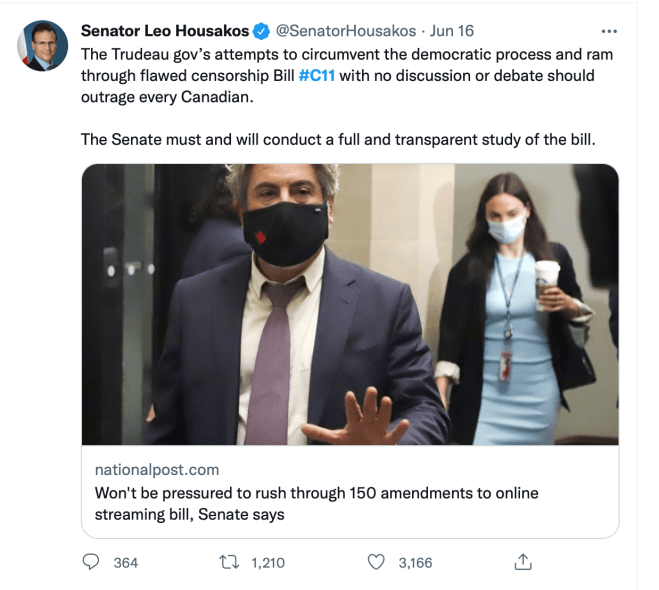
The House of Commons will send the Online Streaming Act to the Senate where Conservative Senate Leader Leo Housakos’tweet (above) heralds one last furious lap around the legislative oval for Bill C-11.
If I had the ear of Canadian Senators, here is what I would tell them.
First, if it was ever in question, maintain that Senatorial chill. It will be an improvement on the debate so far.
This won’t be the first time Senators have been handed a controversial C-Bill filibustered by the Official Opposition to get public attention and then expedited by a Government using closure with majority support.
Bill C-11 was reviewed by Heritage Committee MPs for 20 hours over ten sittings with more than 50 witnesses. And that’s not counting all the Committee time spent on its forerunner C-10 in 2021.
At the end of those meetings, which included four sittings of undisguised filibustering, Conservative Committee vice-chair John Nater said (a) he wanted to schedule another 20 witnesses and (b) he would not agree to amend and return the Bill to House for Third Reading until after the Committee put aside C-11 to conduct an inquiry and complete a report on the incident concerning Hockey Canada.
That put clause-by-clause amendments (of which Mr. Nater would submit more than 120) into the late Fall. On that timetable C-11 would pass —to recall Mr. Nater’s own word— “eventually.”
The Conservatives’ goal was and remains to force the Liberals to walk away from their Bill’s provisions relating to videos and music streaming on hosting platforms, while messaging to voters about freedom of expression and censorship.
Throughout the Committee proceedings there was nary a hint of a side conversation to find a compromise which I suggested in a previous post is well within reach.
In the end the Conservatives gave the Liberals a binary choice: wait out an indefinite filibuster or capitulate to CPC demands. Instead the Liberals joined with the Bloc and NDP to end the filibuster and surrender nothing.
That meant a single day in Committee for amendments, a political farce by any measure. There were at least 150 amendments on the table. Nevertheless in a thirteen-hour sitting on June 14th, forty-two amendments to the Bill were approved. Many were unanimous.
That much Senators already know. What about substance of the Bill?
The majority of the forty-two approved amendments were not contentious, inserted into the Act’s clause on the objectives of national broadcasting policy.
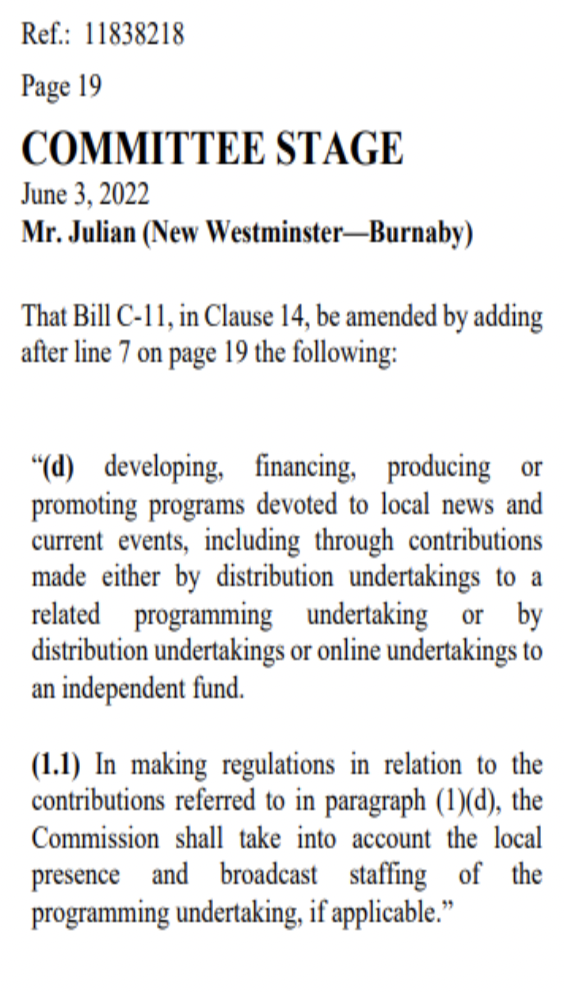
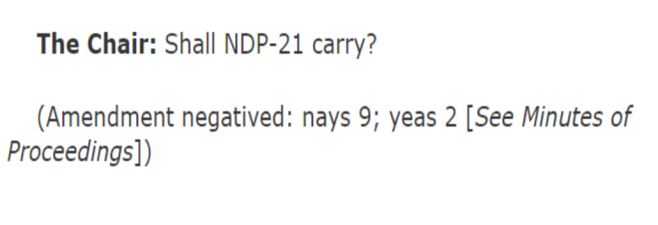
Many amendments tabled by groups supporting the Bill did not make the cut: for example, the local news amendment recommended by the CRTC and the government’s own expert panel was voted down by both Liberals and Conservatives.
The sticking points were the four signature amendments sought by the Conservatives.
They got their first, drawn from their 2021 election platform: the repeal of $120 million in annual Part II fees paid by broadcasters to the Consolidated Revenue Fund.
Their second ought to have fallen like ripe fruit off the policy tree but did not: a minimum revenue threshold below which Internet broadcasters would be exempted from regulation. If Senators don’t fix that, the CRTC will.
Next came the hard part: amendments to delete sections 4.1, 4.2 and 9.1(1)(e). That meant ousting CRTC regulation of any uploads to YouTube, TikTok and Facebook; as well as prohibiting “discovery” orders to promote Canadian music or videos if that would require the platforms to tweak their recommendation algorithms. Those were key sections in the Bill and deleting them was a dealbreaker for the other parties.
In the theatre that the Committee proceedings became, the Conservatives accused Heritage Minister Pablo Rodriguez and outgoing CRTC Chair Ian Scott of contradicting each other and obscuring the meaning of section 4.1. The Minister told Canadians that “platforms are in, users are out” while Scott acknowledged that both the current Broadcasting Act and Bill C-11 would allow the CRTC to “regulate” user programming.
In the interest of clearing that up, here are the facts.
The current legislation is technologically neutral and makes no distinction between conventional and Internet broadcasting platforms. Instead of tabling C-10 or C-11, the federal cabinet could have opted to issue a policy directive to the CRTC reversing the Commission’s 20-year exemption of Internet broadcasting platforms and provide a regulatory road map similar to Bill C-11.
That is what Scott meant when he said the current Act already gives the CRTC free rein over Internet hosting platforms and user programming. The new Bill makes that existing CRTC power explicit but also instructs the Commission in section 4.2 to draw a regulatory boundary between “commercial” and non-commercial programming, and also take into account “direct and indirect revenue.”
YouTube has been the main focus of debate. The hosting platform’s channels are a mix of programming formats: an additional platform for long-form video from linear broadcasters; music streaming services; aggregated channel menus (we used to call that “cable TV”) but mostly niche video content posted by “YouTubers” competing for audiences via the platform’s proprietary recommendation algorithm.
The Liberals (and anyone else in their right minds) have zero interest in micro-regulating 160,000 Canadian YouTubers and their thousands of short-form videos. That is why section 4.2 gives the CRTC the discretion to exempt non-commercial programming while YouTube has the right to appeal to the courts if they get it wrong.
While there is criticism that section 4.2 lacks specifics and leaves too much room for the Commission to define “commercial” and quantify “revenue,” not one of C-11’s opponents have offered a more fulsome version. There has been only one demand: exclude YouTube and all other hosting platforms from regulation forever. Pointe finale.
The policy case for Bill C-11’s regulation of commercial programming on hosting platforms is twofold.
Right now, YouTube’s music uploads and streaming services compete head-on with Canadian radio. This is a policy no-brainer: quite reasonably You Tube has publicly agreed to regulation of its music services.
As for video content, in the long term (if such a thing exists for the Internet) YouTube may evolve into a major distribution platform for commercial video falling into the priority genres of Canadian news, sports, and entertainment we currently see and hear on linear platforms. The policy question is why would an important broadcasting technology of the future be permanently excluded from the Act?
But to cut through the fog of war on section 4.2, it is helpful to turn the spotlight on the word “regulate.”
Up until now the word “regulate” has been used too loosely in the C-11 debate.
In the current Broadcasting Act, “regulating” content includes at least these four major points:
Who makes or pays for Canadian content? The Act empowers the CRTC to determine which media companies write cheques to production funds or make CanCon themselves. For Internet broadcasting, Bill C-11 imposes contributions on platforms and expressly excludes users. That is why section 4.2 refers to user programming on hosting platforms: so the Commission knows what programming revenue to count for the purpose of calculating CanCon contributions from the platforms.
What kind of CanCon programming is supported by regulated funding or spending? The CRTC establishes priority categories of Canadian content, for example News and Drama. But as for YouTube being affected, section 9(6) of Bill C-11 expressly prohibits the CRTC from applying any such genre regulation to hosting platforms. This was pointed out to Heritage MPs by the CRTC’s General Counsel on June 1st but seems to have flown under the radar. There will be no CRTC programming goals or quotas for YouTube.
Oversight of programming content: The CRTC has historically taken a light touch to oversight of programming containing abusive comment, misinformation, discriminatory stereotypes, or age-inappropriate content. Its authority to do so is rooted in the section 3(1)(g) requirement that programming be “of a high standard.” Crucially section 3(1)(g) cannot apply to hosting platforms because Bill C-11 amends it to require “control” of programming and then in section 2.2 deems YouTube not to possess that programming control. That is why claims of Bill C-11 “censorship” are categorically false.
The discovery and promotion of Canadian content: The CRTC has always required radio and TV companies to showcase home grown programming and Canadian artists. Bill C-11 applies this to all Internet broadcasting platforms including YouTube although section 9.1(1)(e) prohibits the Commission from ordering a specific change to recommendation algorithms.
That means the fury over C-11 boils down to discoverability of Canadian video content and the role that hosting platforms’ recommendation algorithms play in that.
Which brings us to the “backfire” argument raised by Google and Canadian YouTubers.
The concern is that Canadian YouTubers’ videos may be ignored or disliked if a CanCon recommendation algorithm pushes their niche content to millions of Canadians who have no interest in that niche. If the existing YouTube algorithm is indeed that badly designed, viewer disinterest could result in YouTubers’ videos being “buried.”
You would have to be empathy-depleted to ignore YouTubers’ fears given that a quarter of them are trying to make a living from their channel. My own view is that it would be surprising if YouTube’s algorithm engineers, who possess reams of data on individual viewing preferences, were unable to figure out a solution to such a massive misfiring of their recommendation tool. At the very least we ought to give the CRTC its opportunity to conduct the expected public consultation on discoverability and recommendation algorithms before any discoverability requirements are imposed or rejected.
But to reach the harbour where Senators might be allowed to coolly appraise C-11, it would be helpful if both the Liberals and Conservatives reconsidered their political messaging.
So far Conservatives are committed to the heat-seeking narrative of “freedom” and “censorship.”It is grist for a summer membership drive, so it’s unlikely to change. But maybe they will have second thoughts.
As for the Liberals, the Minister’s assurance that “platforms are in, users are out” isn’t getting much traction judging from the one-way traffic against C-11 on social media.
Even though a public opinion poll in early May suggested solid support for the government’s approach, the Conservatives are trying to change that. The Liberals appear serenely disengaged on C-11, as if they can get out their message through ParlVu and CPAC. Most Canadians are not going to study the text of the Bill and 900-word news stories are unlikely to zero in on the legal nuances of “regulate.”
The Liberals raised expectations of YouTubers three months ago when they vowed in the House to issue a Ministerial policy directive that would “not include digital first creators” in regulatory contributions or discoverability. The Liberals never revisited that commitment in Committee and the Minister never released a draft CRTC Policy Directive that might have taken the air out of the Conservative ginned up accusations of censorship.
Here’s a proposal for a summer project for the Minister: publish a draft policy directive exempting YouTuber videos from discoverability regulation for the next five years.
La Chambre des communes a transmis la Loi sur la diffusion continue en ligne au Sénat, où le tweet du chef des conservateurs au Sénat Leo Housakos (ci-dessus) annonce un dernier round acharné, au sein de cette assemblée, pour le projet de loi C-11.
Si les sénateurs canadiens voulaient bien m’écouter, voici ce que je leur dirais.
Tout d’abord, si tant est qu’il ait plané un quelconque doute à ce sujet, gardez votre calme très sénatorial. De quoi rehausser le ton du débat tel qu’il a été mené jusqu’à présent.
Ce ne sera pas la première fois que les sénateurs se voient remettre un projet de loi C controversé pour lequel l’opposition officielle fait de l’obstruction afin d’attirer l’attention et qui est ensuite adopté de façon accélérée par un gouvernement qui utilise la clôture par appui majoritaire.
Le projet de loi C-11 a été examiné par les députés du Comité du patrimoine pendant 20 heures réparties sur dix séances, avec plus de 50 témoins. Et c’est sans compter tout le temps passé sur le C-10 par le Comité en 2021.
À la fin de cette période, qui a inclus quatre séances d’obstruction non déguisée, le vice-président du Comité conservateur, John Nater, a déclaré (a) qu’il voulait programmer 20 autres témoins et (b) qu’il n’accepterait pas d’amender et de renvoyer le projet de loi à la Chambre pour la troisième lecture tant que le Comité n’aurait pas mis de côté le C-11 pour mener une enquête et rédiger un rapport sur l’incident concernant Hockey Canada.
De quoi repousser l’examen des amendements article par article (dont M. Nater soumettrait plus de 120) à la fin de l’automne. Selon cet échéancier, le projet de loi C-11 serait adopté, pour reprendre les mots de M. Nater, « éventuellement ».
L’objectif des conservateurs était et demeure de forcer les libéraux à renoncer aux dispositions de leur projet de loi relatives à la diffusion de vidéos et de musique sur les plateformes d’hébergement, tout en adressant aux électeurs des messages sur la liberté d’expression et la censure.
Tout au long des travaux du comité, il n’y a eu aucune allusion à une conversation parallèle pour trouver un compromis qui, comme je l’ai suggéré dans une publication précédente, est tout à fait possible.
En fin de compte, les conservateurs ont placé les libéraux devant un choix binaire : attendre la fin d’une obstruction indéfinie ou capituler face aux exigences du CPC. Au lieu de cela, les libéraux se sont joints au Bloc et au NPD pour mettre fin à l’obstruction parlementaire et ne rien céder.
Ce qui a signifié une seule journée en Comité pour les amendements, une farce politique à tout point de vue. Il y avait au moins 150 amendements sur la table. Néanmoins, au cours d’une séance de treize heures le 14 juin, quarante-deux amendements au projet de loi ont été approuvés. Beaucoup ont suscité l’unanimité.
Cela, les sénateurs le savent déjà. Qu’en est-il de la substance du projet de loi?
La majorité des quarante-deux amendements approuvés n’étaient pas litigieux, insérés qu’ils étaient dans la disposition de la Loi sur les objectifs de la politique nationale de radiodiffusion.
De nombreux amendements déposés par des groupes soutenant le projet de loi n’ont pas été retenus : par exemple, l’amendement relatif aux nouvelles locales recommandé par le CRTC et le groupe d’experts du gouvernement a été rejeté par les libéraux et les conservateurs.
Les points de friction étaient les quatre amendements majeurs demandés par les conservateurs.
Ils ont obtenu leur premier, tiré de leur programme électoral de 2021 : l’abrogation des 120 millions de dollars de droits annuels de la partie II versés par les radiodiffuseurs au Trésor.
Leur deuxième amendement aurait dû tomber comme un fruit mûr de l’arbre politique mais ce n’a pas été le cas :un seuil de revenu minimum en dessous duquel les diffuseurs Internet seraient exemptés de la réglementation. Si les sénateurs ne règlent pas cette question, le CRTC s’en chargera.
Puis est venue la partie difficile : les amendements visant à supprimer les alinéas 4.1, 4.2 et 9.1(1)(e). Ce qui signifiait exclure la réglementation par le CRTC des téléchargements sur YouTube, TikTok et Facebook, ainsi qu’interdire les ordres de « découverte » visant à promouvoir la musique ou les vidéos canadiennes si cela oblige les plateformes à modifier leurs algorithmes de recommandation. Il s’agissait de parties clés du projet de loi et leur suppression a été un facteur de désaccord pour les autres partis.
Dans le théâtre que sont devenus les travaux du Comité, les conservateurs ont accusé le ministre du Patrimoine Pablo Rodriguez et le président sortant du CRTC Ian Scott de se contredire et d’obscurcir le sens de l’article 4.1.Le ministre a déclaré aux Canadiens que « ce sont les plateformes qui sont à l’ordre du jour, pas les utilisateurs », tandis que M. Scott a reconnu que la Loi sur la radiodiffusion actuelle et le projet de loi C-11 permettraient au CRTC de « réglementer » la programmation des utilisateurs.
Afin d’éclaircir ce point, voici les faits.
La législation actuelle est technologiquement neutre et ne fait aucune distinction entre les plateformes de diffusion conventionnelles et Internet. Au lieu de déposer le projet de loi C-10 ou C-11, le Cabinet fédéral avait la possibilité d’émettre une directive de politique à l’attention du CRTC dans le but d’annuler l’exemption des plateformes de diffusion sur Internet accordée par le Conseil pendant 20 ans et, si le Cabinet choisissait de le faire, de fournir une feuille de route semblable aux dispositions du projet de loi C-11.
C’est ce que M. Scott voulait dire lorsqu’il a affirmé que la loi actuelle donnait déjà au CRTC le champ libre pour contrôler les plateformes d’hébergement Internet et la programmation des utilisateurs. Le nouveau projet de loi rend explicite ce pouvoir existant du CRTC, mais demande également au Conseil, à l’article 4.2, de tracer une frontière réglementaire entre la programmation « commerciale » et la programmation non commerciale, et de tenir compte des « revenus directs et indirects ».
Les chaînes YouTube d’aujourd’hui sont un mélange de formats de programmation : des vidéos de longue durée provenant de diffuseurs linéaires; des services de diffusion de musique en continu; des menus de chaînes agrégées (que nous avions coutume d’appeler « télévision par câble »), mais surtout du contenu vidéo de niche publié par des « vidéastes web » qui se disputent les audiences via l’algorithme de recommandation propriétaire de la plateforme.
Les libéraux (et toute autre personne saine d’esprit) n’ont aucun intérêt à micro-réglementer 160 000 vidéastes web canadiens et leurs milliers de vidéos de courte durée. C’est pourquoi l’article 4.2 donne au CRTC le pouvoir discrétionnaire d’exempter la programmation non commerciale, tandis que Google conserve le droit de faire appel aux tribunaux s’il se trompe.
Bien que l’on reproche à l’article 4.2 de manquer de précision et de laisser trop de place au Conseil pour définir le terme « commercial »et quantifier les « revenus », aucun des opposants au projet de loi C-11 n’a proposé une version plus précise ou plus complète de cet article. Il n’y a eu qu’une seule exigence : exclure à jamais toutes les plateformes d’hébergement de la réglementation, pointe finale.
L’argument politique en faveur de la réglementation de la programmation commerciale sur les plateformes d’hébergement par le projet de loi C-11 est double.
À l’heure actuelle, les services de téléchargement et de diffusion en continu de musique de YouTube sont en concurrence directe avec la radio canadienne. Il s’agit là d’une évidence politique : de façon tout à fait raisonnable, YouTube a accepté publiquement la réglementation de ses services musicaux.
Quant au contenu vidéo, à long terme (si tant est qu’une telle notion existe pour l’Internet), YouTube pourrait devenir une plateforme de distribution majeure pour les vidéos commerciales relevant des genres prioritaires des nouvelles, du sport et du divertissement canadiens que nous voyons et entendons actuellement sur les plateformes linéaires. La question politique est de savoir pourquoi une technologie de radiodiffusion importante de l’avenir serait exclue de façon permanente de la loi.
Mais pour dissiper la confusion qui règne, dans le feu de l’action, à propos de l’article 4.2, il est utile de braquer les projecteurs sur le mot « réglementer ».
Jusqu’à présent, le mot « réglementer » a été utilisé de façon trop vague dans le débat sur le projet de loi C-11.
Dans l’actuelle Loi sur la radiodiffusion, « réglementer » le contenu englobe au moins ces quatre points principaux :
Qui fabrique ou paie le contenu canadien? La Loi habilite le CRTC à déterminer quelles compagnies médiatiques font des chèques aux fonds de production ou réalisent elles-mêmes du contenu canadien. Pour la diffusion sur Internet, le projet de loi C-11 impose des contributions aux plateformes et exclut expressément les utilisateurs.C’est pourquoi l’article 4.2 fait référence à la programmation des utilisateurs sur les plateformes d’hébergement :ainsi, le Conseil sait quels revenus de programmation il doit comptabiliser pour calculer les contributions au contenu canadien provenant des plateformes.
Quel type de programmation de contenu canadien est soutenu par un financement ou des dépenses réglementés?Le CRTC établit des catégories prioritaires de contenu canadien, par exemple les nouvelles et les dramatiques.Mais pour ce qui est d’affecter YouTube, l’article 9(6) du projet de loi C-11 interdit expressément au CRTC d’appliquer une telle réglementation des genres aux plateformes d’hébergement. Cette interdiction a été signalée aux députés du Patrimoine par l’avocat général du CRTC le 1er juin, mais il semble qu’elle soit passée inaperçue.Il n’y aura pas d’objectifs ou quotas de programmation du CRTC pour YouTube.
Surveillance du contenu de la programmation : le CRTC a toujours fait preuve de légèreté dans la surveillance des émissions contenant des commentaires abusifs, de la désinformation, des stéréotypes discriminatoires ou du contenu inapproprié pour l’âge. Ce pouvoir lui est conféré par l’article 3(1)g), qui exige que la programmation soit « de haut niveau ». Élément crucial : l’article 3(1)g) ne peut s’appliquer aux plateformes d’hébergement, en effet le projet de loi C-11 le modifie pour exiger le « contrôle » de la programmation, puis, à l’article 2.2, considère que YouTube ne possède pas ce contrôle. C’est pourquoi les allégations de « censure » du projet de loi C-11 sont catégoriquement fausses.
La découverte et la promotion du contenu canadien : le CRTC a toujours exigé des compagnies de radio et de télévision qu’elles mettent en valeur les émissions locales et les artistes canadiens. Le projet de loi C-11 applique cette exigence à toutes les plateformes de diffusion sur Internet, y compris YouTube, bien que l’alinéa 9.1(1)(e) interdise au Conseil d’ordonner une modification spécifique des algorithmes de recommandation.
Cela signifie que la fureur suscitée par le projet de loi C-11 se résume à la possibilité de découvrir du contenu vidéo canadien et au rôle que les algorithmes de recommandation des plateformes d’hébergement jouent à cet égard.
Ce qui nous amène à l’argument du « retour de flamme » soulevé par Google et les vidéastes web canadiens.
Ils craignent que les vidéos des vidéastes web canadiens soient ignorées ou ne fassent pas l’objet de « J’aime » si un algorithme de recommandation de contenu canadien impose leur contenu de niche à des millions de Canadiens qui n’ont aucun intérêt pour cette niche. Si l’algorithme actuel de YouTube est effectivement si mal conçu, le désintérêt des spectateurs pourrait entraîner l’« enterrement » des vidéos des vidéastes web.
Il faudrait être dépourvu d’empathie pour ignorer les craintes des vidéastes web, étant donné qu’un quart d’entre eux essaient de vivre de leur chaîne. Pour ma part, je pense qu’il serait surprenant que les ingénieurs en algorithmes de YouTube, qui possèdent des tonnes de données sur les préférences de visionnage individuelles, ne parviennent pas à trouver une solution à un dysfonctionnement aussi massif de leur outil de recommandation. À tout le moins, nous devrions donner au CRTC l’occasion de mener la consultation publique prévue sur la découvrabilité et les algorithmes de recommandation avant d’imposer ou de rejeter toute exigence de découvrabilité.
Mais pour en arriver au stade où les sénateurs pourraient être autorisés à évaluer froidement le C-11, il serait utile que les libéraux et les conservateurs reconsidèrent leurs messages politiques.
Jusqu’à présent, les conservateurs se sont engagés dans le narratif en quête d’attention de la « liberté » et de la « censure ».Il s’agit d’une source d’inspiration pour une campagne d’adhésion estivale, il est donc peu probable qu’il y ait du changement à ce niveau. Mais peut-être y réfléchiront-ils à deux fois.
Quant aux libéraux, l’assurance du ministre selon lequel « ce sont les plateformes qui sont à l’ordre du jour, pas les utilisateurs », n’a pas beaucoup de poids à en juger par le trafic à sens unique contre le C-11 sur les réseaux sociaux.
Même si un sondage d’opinion réalisé au début du mois de mai laissait entrevoir un soutien solide à l’approche du gouvernement, les conservateurs tentent de changer la donne. Les libéraux semblent désengagés en ce qui concerne le C-11, et ce, en toute sérénité, comme s’ils pouvaient faire passer leur message par ParlVu et la CPAC.La plupart des Canadiens ne vont pas étudier le texte du projet de loi et il est peu probable que des reportages de 900 mots se concentrent sur les nuances juridiques du terme « réglementer ».
Les libéraux ont suscité des attentes chez les vidéastes web il y a trois mois lorsqu’ils ont promis à la Chambre d’émettre une directive ministérielle qui « n’inclurait pas les premiers créateurs numériques » dans les contributions réglementaires ou la découvrabilité. Les libéraux ne sont jamais revenus sur cet engagement en comité et le ministre n’a jamais publié un projet de directive d’orientation du CRTC qui aurait pu faire taire les accusations de censure lancées par les conservateurs.
Voici une proposition de projet d’été pour le ministre : publier un projet de directive politique exemptant les vidéos des vidéastes web de la réglementation sur la découvrabilité pour les cinq prochaines années.
De quoi faciliter quelque peu le travail du Sénat.
Bill C-11 the Online Streaming Act is likely to pass Third Reading in the House of Commons early next week after the Liberals teamed up with the Bloc and the NDP to impose closure on the Conservative filibuster.
The Heritage Committee passed 42 of about 150 amendments submitted by MPs (approximately 120 submitted by the Conservatives) and I offer a brief inventory here.
One amendment that didn’t make the cut was the NDP-submitted proposal for local TV news recommended by both the CRTC and the government’s expert panel, voted down by the Liberals themselves. I wrote about the urgency of that amendment here.
The Online News Act C-18 (the “FaceGoogle pay-for-news” legislation) will return in the fall Parliamentary session. It has passed Second Reading and now moves on to the Heritage Committee. There has been industry muttering about whether Facebook is planning to aggressively shed news content from its Feed and what that means for legislation like C-18. US commentator Joshua Benton is a long time opponent of FaceGoogle legislation and has an interesting take on it all.
Benton’s view might be tempered by the latest industry metrics on news viewership over social networks published by Oxford Reuters. The same study has data about news audience disengagement that left me slightly queasy.
The Competition Bureau has filed its pre-hearing rebuttal to Rogers and Shaw on the Bureau’s application asking the Competition Tribunal to block the $26 Billion merger. The Globe coverage is here.
Bureau Chief Matthew Boswell’s litigation blood is up it seems, as he offered this zinger: “[The deal] will result in a transfer of wealth from low- and moderate-income groups in society to the respondents, whose shareholders include ultra-rich members of the family ownership groups of these companies.”
And here is something that just popped into my Inbox: the CRTC has announced it will release its ruling on the long expired CBC license this coming week.
Updated and Breaking: The Globe is reporting that Rogers has negotiated the sale of the Shaw wireless division Freedom Mobile to Québecor for $2.85 billion, likely removing the last regulatory obstacle to its $26 billion merger.