June 1, 2023
Two days of Senate hearings on Bill C-18, chock full of thoughtful witness commentary, proved one thing: the Online News Act is a dog’s breakfast of policy contradictions that satisfies almost no one.
The make-Big-Tech-pay legislation modelled on the Australian Newsmedia Bargaining Code was conceived as a public remedy for private news outlets who are on the wrong end of Google and Facebook’s market power over digital news distribution.
In the simplest description, the Bill regulates bargaining between platforms and news organizations over the fair price of news. Its distinguishing feature is binding arbitration that takes into account the value exchange between the news organization (who supply the content) and the platforms (who distribute it).
But grafted on to this elegant regulation of private market power are contentious views of what constitutes good media policy, in a peacock tail of colours.
There’s the crowd that is opposed in principle to the regulation of content distributed over the Internet.
There’s a larger crowd opposed to government involvement in the funding of independent media under almost any circumstances. Within that group are those who believe the free market in news consumption will produce a solution to the financial crisis in news if only we steady on and deny government mandated subsidies to news outlets holding out their hands. There are others who believe that government assistance to media, directly or indirectly, will greatly fuel a loss in trust of media.
Then there’s an even larger crowd who see no market solution emerging and fear the collapse of the news ecosystem, an existential threat to democracy.
All of these crowds are weighing in on a competition bill that has morphed into a media policy bill.
It’s no wonder the public debate is a jumble.
One thing made clear by the Senate witnesses is how dramatically news outlets depend upon access to Google and Facebook to reach their audiences. Figures provided to the Senate Committee from publications as diverse as the Globe and Mail and the digital community news chain Village Media is that 30% of their site traffic arrives via Google and 17% from Facebook.
These figures demonstrate two things at once: Big Tech’s price-setting market power over the digital distribution of news and, thanks to the ruthless news throttling tactics adopted by Google and Facebook, the ability to scare the pants off of the news organizations who support C-18 as the route to better compensation for their editorial product.
Observers of market power in information industries will tell you that if content providers depend on a distribution platform for any more than ten to 15% of their traffic, they are at a serious bargaining disadvantage on pricing their content. At twenty to 30% reliance, the gatekeeping platforms dictate all terms. According to Pierre-Elliott Lavasseur, the publisher of Montréal’s La Presse, the Big Tech platforms did just that before they ‘slammed the door in our faces.’
This is why the debate over what per cent of Google and Facebook’s overall traffic is news-related is sterile. Maybe Facebook’s telling us the truth that only 3% of their posts are news-related. But their three per cent news traffic is 17% of a news outlet’s access to its audience or possibly a quarter of a citizenry’s go-to for their news. The Google numbers are even steeper. We have a market power problem that needs fixing.
Along the way we learned some things at the Committee hearings.
- Representatives from the two leading national newspapers (the Globe and Le Devoir) indicated they are financially sustainable on a reader-pay subscription model after 10 years of hard work.
Jeff Elgie of Village Media told Senators that over a similar period he has established a viable advertising-centric model, without subsidies, in community news. (Other small publications have not, so there is some serious research to be done on replicating Elgie’s success).
Unfortunately in the big fat demographic middle, the mainstream media serving urban communities cannot say the same as Village Media‘s Elgie or the Globe & Mail, at least not yet. Newsmedia Canada spokesperson Paul Deegan told the Senate that C-18 is needed so that the smaller publications get deals with Facebook and Google on the same pro rata funding as larger urban publications like the Toronto Star. Going one better, Le Devoir publisher Brian Myles endorsed a funding formula tied to journalist head count, but capped at salary levels in the smaller publications. [An earlier version of this post erroneously identified Newsmedia Canada as endorsing a salary cap].
- Newsmedia Canada also arrived with a shopping list for other media policy initiatives it deems missing. Those include (1) the Liberals fulfilling their 2021 election promise to stop CBC News competing for advertising against private media; (2) the federal government redirect some of its own ad spend from Big Tech platforms to Canadian news media, and (3) the feds ratchet up anti-competition measures to get at Google and Facebook’s duopoly on digital advertising.
- We also learned from Australian witnesses appearing before the Committee that Canadian rumours that small news outlets in Australia got the short end of the stick under the Newsmedia Bargaining Code was ‘fake news.’ Or to borrow Jen Gerson’s vocabulary, ‘a lie.’
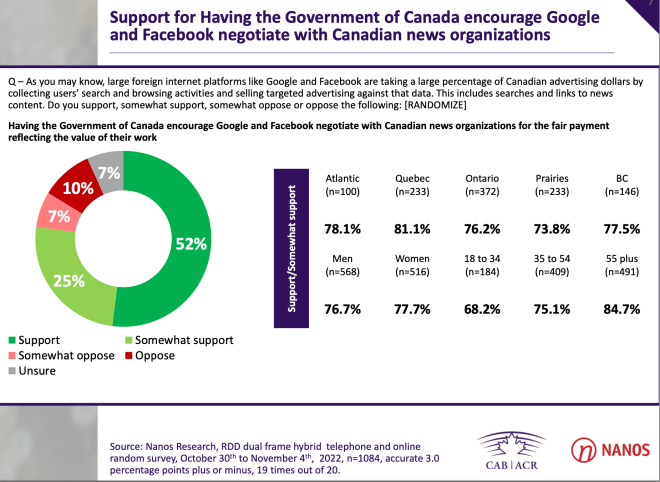
- Jesse Brown of Canadaland trotted out an argument against C-18 predicated on the claim that significant licensing payments flowing from Big Tech to Canadian news outlets would lead to reader loss of trust in news organizations, as had already resulted from the Liberals’ introduction of the QCJO federal aid to journalism in 2018. This claim is based on cherry-picking one chart (trust in journalists) among a series tracking loss of trust in a huge variety of public institutions, a fifty-year trend. If you check the data you will find that the long term decline in trust of journalists is only surpassed by a sharper decline in trust of medical doctors. Possibly the most significant poll on trust relevant to the C-18 debate is a Nanos study showing 63% of Canadians are confident the news media “works in the best interest of Canadians,” while only 37% think Google does and just 25% feel the same way about Facebook.
***
If you would like regular notifications of future posts from MediaPolicy.ca you can follow this site by signing up under the Follow button in the bottom right corner of the home page;
or e-mail howard.law@bell.net to be added to the weekly update;
or follow @howardalaw on Twitter.

 MediaPolicy.ca
One thought on “The policy dog’s breakfast, Bill C-18”