(AI illustration)
October 17, 2026
When Anthropic CEO Dario Amodei blew the whistle on his own rogue AI agents as a civilizational threat to humankind, he did so the day after the 25th anniversary of 9/11, the last time the world stood still all at once and faced its fears.
But since Amodei’s shock declaration, we’ve seen more denialism than public policy action. The Trump administration has scrambled to defuse demands for the regulation of AI.
Amodei’s sensational revelations of AI’s existential threat to the human race briefly eclipsed the existing concerns about lesser cataclysmic outcomes. Like mass unemployment. Or a collapse in AI valuations that crashes the global economy.
Another cataclysm may be the threat that AI poses to news journalism. Like an AI asteroid slamming into the blue planet of democracy.
Since 2018, the Silicon Valley AI companies have scraped online content from across the Internet, including news outlets.
The content was taken without permission, consent or a nickel changing hands. It was nevertheless fed into the training of AI large language models. The training data taught the LLMs the machine-learning skills and vocabulary required to move to the next stage of their development.
After their Internet-wide raid for training data, the next step for AI companies was to refresh their data by scraping up to date information on current affairs, the better to answer millions of audience queries each day.
Again this massive content capture has mostly been carried out without permission, consent or compensation to the content’s creators.
As a consequence many of these content creators, especially news companies, are suing the AI companies. The litigation will ultimately be decided by the US Supreme Court. In that courtroom, the AI companies can count on the political and legal support of the Trump Department of Justice.
Among the stronger of the lawsuits filed by news outlets, publishers will zero in on AI large language models that output verbatim replication of their content. Plaintiffs will also direct the court’s attention to the emergence of these news-juiced AI chatbots as head-on competitors to news outlets.
But the law may never deliver a big payday for news outlets (nor music or book publishers).
American courts are confined to a finding of copyright violation based on existing US law. It’s a tangle of legal issues, but in general that jurisprudence bends favourably to “fair use” and the permissible “transformative” republication of what most laypersons would ordinarily assume is intellectual property belonging to those who created it. If the US Supreme Court sides with AI companies, Canadian courts will feel that legal gravitational pull. Canadian news publishers are suing OpenAI and Anthropic. The Toronto Star is a plaintiff in a lawsuit filed in New York against Cohere, the leading Canadian AI company.
In the meantime, a glimmer of hope is the sprouting of green shoots in a market of content licensing that might put AI compensation in the pockets of at least some of the news companies.
But as the Brookings Institute’s Courtney Radsch describes in this explainer, AI companies have so far inked only a limited number of confidential deals with large, premium-branded news outlets.
For example, OpenAI has agreements with The Financial Times, the Berlin-headquartered global publisher Axel Springer and Rupert Murdoch’s News Corp. Google has a deal with Reddit. Microsoft has a deal with HarperCollins. The competing lists of lawsuits and licensing deals have to be constantly updated.
Could this nascent licensing market save news journalism?
It’s hard to say. At this early stage in the development of a content market, those bespoke deals may serve to relieve the public policy pressure on the AI companies by snuffing out potentially adverse legal rulings on liability. It’s those kind of judicial slap downs of tech companies that often create the political momentum for public regulation (think about the knock-on effect of successful litigation against Meta’s social media algorithms that boosted support for legislative action against online harms).
Also disappointing, the commodity metrics generated in these special deals between AI companies and news publishers might establish the market information required for the dynamic pricing of news content. Unfortunately the price of licensed content remains confidential. This commercial secrecy deprives an immature licensing market of the information it needs to take root and grow.
For now, the giant AI companies don’t care about news outlets any more than they have to. Why would they? Expect them to press their advantage of market power over news outlets for as long as they have it. And don’t expect them to strike licensing deals with any but the biggest news brands (although there’s an interesting exception to that I will get to below).
I hope I am wrong. If efforts to establish a functioning market in AI content licensing fail, it may end up choking off audience traffic and revenue for any but the largest news companies.
At least in the pre-AI era there existed a value exchange between Big Tech and news publishers. Google and Meta amassed free hyperlinks for themselves and in return gave news publishers free distribution of their content. Publishers could monetize that free distribution by selling ads and subscriptions to the audience that engaged. The big news organizations could and did go further by obtaining cash licensing agreements with Google and Meta.
The Brookings Institute’s Radsch compares the impact of both conventional Search platforms and AI chatbots on the news ecosystem and concludes that with chatbots “it’s the same arc, only faster.”
But unlike the old market in hyperlinked news snippets, the structure of the emerging AI business model never shares any revenue-earning opportunities with content providers except so far for the lucky few. That’s because it doesn’t offer news outlets distribution of their content.
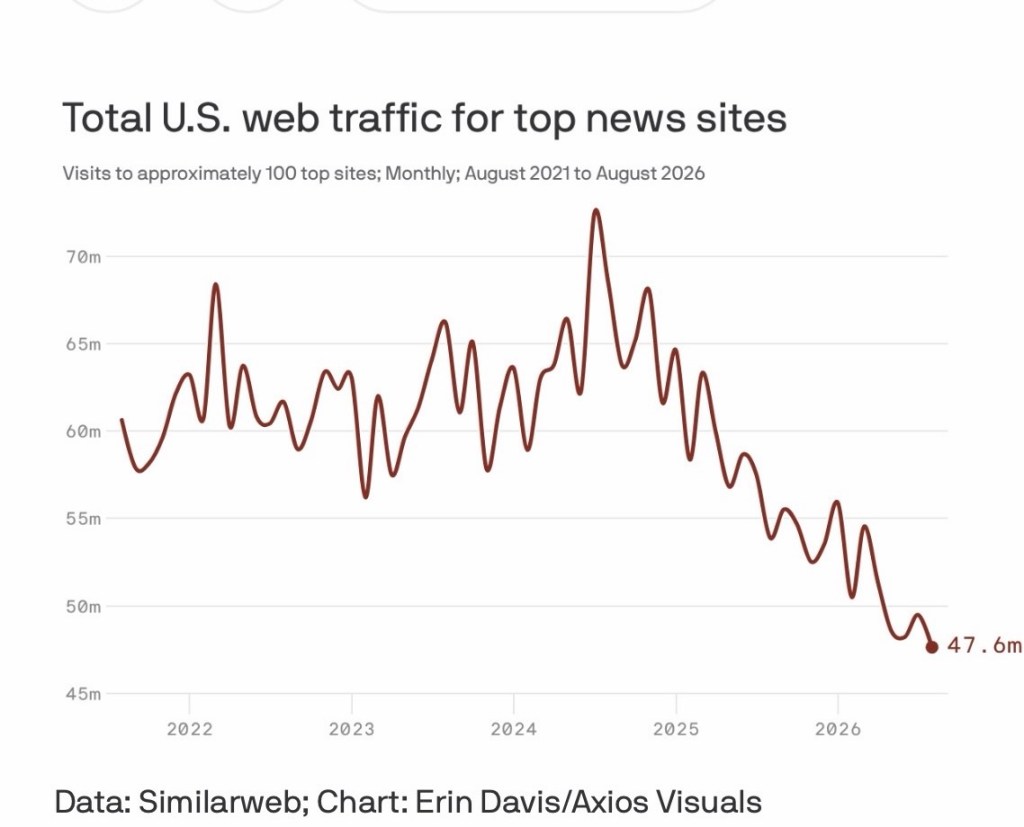
It’s common now to warn that conventional search traffic reaching hyperlinked content is doomed. Projections vary, but AI is rapidly replacing hyperlink Search and traffic referrals are drying up because the purpose of AI chatbots is to leave little reason for users to click through a hyperlink to a news site, assuming the fulsome AI summary even bothers to provide one.
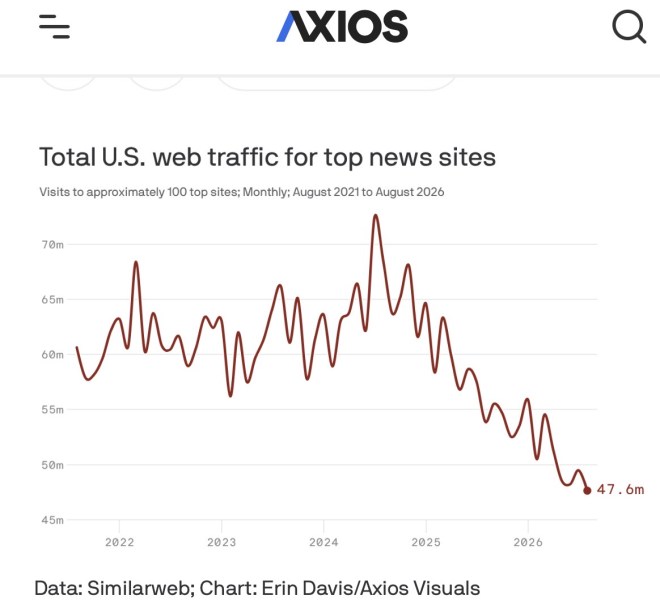
This leads to the further problem of AI chabots “eating their own seed corn.” That’s a scenario where the chatbots are so effective in replacing Search and social media feeds as the dominant portal for online information that they starve the news outlets that provide the chatbots with information in the first place.
If a mature market in AI licensing of content throughout the news ecosystem doesn’t happen, what then?
We know from experience where Google and Meta’s refusal to cooperate in a licensing market in hyperlinked news snippets lead in the end: governments in Europe, Australia and Canada stepped in and legislated an unambiguous intellectual property claim that news outlets could make against Google and Meta for hyperlinked news snippets. In Canada, that got us the Online News Act.
As yet there is little sign of North American governments taking any action on the chatbot problem.
But this time around, at least it seems that news publishers are better organized and, for the moment, engaging in some self help.
For now it’s baby steps. A broad based publisher boycott of AI scraping, which is technically possible by blocking digital robots from their websites, does not look like it’s in the cards.
However websites can block scrapers if they can’t obtain licensing deals on acceptable terms.
As well, the AI companies are not the monoliths as the Google and Meta monopolies have been in the hyperlink markets in Search and Social, there are as yet no comparable monopoly platforms in the AI market. So news providers could plausibly find commercial leverage by blocking some AI companies while making deals with others.
But as the Brooking Institute’s Radsch and others have pointed out, the deals are not flowing through the entire news ecosystem.
Hoping that may change, major publishers without licensing deals have come together and agreed upon a technical infrastructure for tracking and measuring the chatbots’ use of the online content that news outlets are willing to leave unblocked and available for license. The “SPUR coalition” was founded by leading British news outlets, joined by French and European partners but tellingly only one American news organization, the New York Times. All of the major Canadian publishers have signed on.
Another feature of the green shoots licensing market is a layer of intermediary tech companies that offer their platforms for the digital exchange of licensed content between AI chatbots and publishers. Effectively, the intermediaries act as copyright collectives. Naturally, they take a handsome cut of licensing revenue in doing so. For now, these companies like Cloudflare remain out of the clutches of the AI companies. If the experience of Google establishing a monopoly in digital advertising exchanges repeats itself, the AI companies will try to acquire this layer of intermediaries.
Without being able to predict the shape of a future AI chatbot market in content licensing, it would be nevertheless risky to expect that it would produce good outcomes (or any outcomes at all) for news outlets operating in the local news space, below the waterline of global and national brands.
After all, it was the inability to extend the licensing market in hyperlinked news snippets beyond the news outlets cherrypicked by Google and Meta that lead to the Online News Act.
Perhaps this cynicism could be checked if we were to see more evidence of licensing agreements across the broader news ecosystem.
Last month the Ontario-based Village Media CEO Jeff Elgie, a relentless innovator in community publishing, announced he has a deal with OpenAI. AI technology will power Village’s “Open Door” widget that connects users with community and health resources. If it’s popular, Open Door will draw traffic and build audience loyalty, encouraging readers to stay on his ad-supported news sites and read more stories and click on more ads.
In return, Village has licensed its news content to OpenAI. It’s not clear if money changed hands.

Courtesy of Village Media
Still, it’s a rare licensing deal for a local publisher. Others news outlets might emulate Village. Let’s wait and see.
More likely news outlets will focus on rapid adoption of newsroom AI tools, improving their human-made journalism by exploiting those tools for better content and even monetization. For example, agentic commerce.” News outlets might create “shopping carts” for ordinary news seekers employing AI agents to purchase their articles as part of a daily update package.
If the first 30 years of the Internet is any guide, the speed and path of consumer adoption of AI products will dictate the available opportunities for news entrepreneurs. Some newsrooms will adapt wonderfully. Small and medium sized news businesses, with limited capital and infrastructure, will probably struggle.
The fear is that most local news outlets won’t even have the breathing room to adapt and survive if consumer adoption of AI scales so quickly that chatbots become de facto news organizations and starve news outlets of audience.
In that bleak future, expect political pressure for governments to intervene in the news marketplace yet again in the name of democracy and public access to information.
If they do intervene, the starting point for public policy would be legislating an unambiguous right of intellectual property in news content, regardless of the fine points of copyright law or the outcome of lawsuits. The IP rights generate bargaining power.
The next policy move would be to build a licensing market on top of that rebalanced market power between AI companies and news outlets.
This is what the European Union, Canada and Australia tried to do with hyperlinked news snippets and it drove millions of dollars and euros in time-limited cash settlements. But it did not create a true licensing market. As we know, Big Tech refused to cooperate with legislators and missed its chance to help design a frictionless market platform for licensing news content. The result was that the commodity price for news licensing was effectively negotiated or legislated as a headcount of employed journalists rather than the market value of the journalism they produced.
The same governments see the approaching AI asteroid threatening news journalism.
As was the case with the market in hyperlinked news, the European Union is out front on AI.
An EU legal framework requires AI companies to disclose their ingestion of news content and allow publishers to opt out of content scraping. This effectively establishes the missing property right for news publishers. The debate in EU Parliament has now turned towards setting up a voluntary licensing market in news content that delivers compensation to news outlets.
In a metaphor for Brexit, the United Kingdom initially showed interest in the EU approach and then backed away and adopted a “wait and see” position.
Australia is midway through government consultations that, according to press reports, will arm publishers with enforceable opt-outs from AI scraping and consider a plan for AI companies to deliver cash compensation for news content.
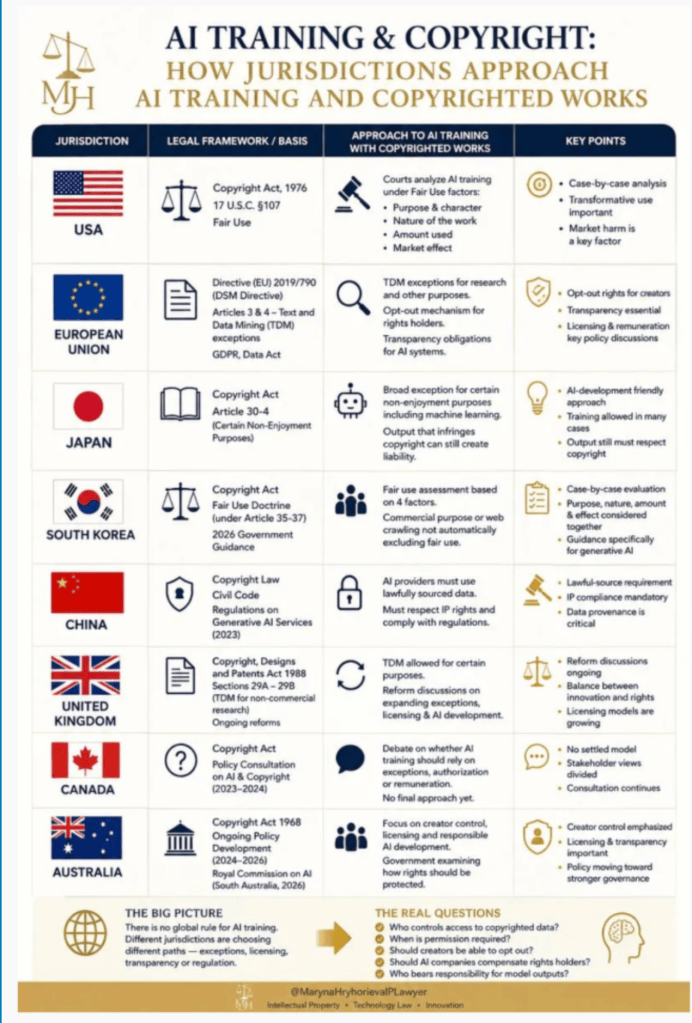
Image courtesy of Maryna Hryhorieva
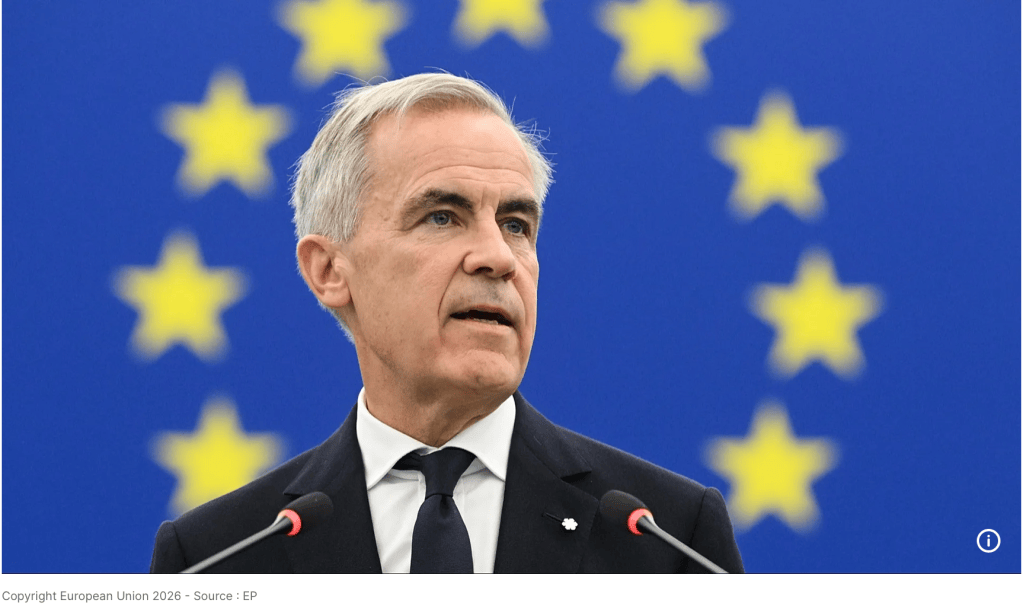
In Canada, the Carney government is idling its policy engine, sticking to the path chosen by the United Kingdom rather than Europe or Australia .
Prime Minister Carney and his AI minister Evan Solomon have resisted competing proposals to create a clear property right in news content or, the reverse, adopt a US-style “text and data mining” exception to copyright law that would favour more permissionless AI scraping.
Our federal government’s lack of action could be motivated by any number of political, trade or policy reasons, not the least of which is a clogged pipeline of the government’s overall parliamentary agenda.
If Ottawa has any intention of intervening on behalf of news publishers, as it did with the Online News Act, it might be cooly sitting back to see what kind of heat the “first mover” policy makers in Europe and Australia take.
Call it a measure twice, cut once strategy. But while Ottawa is waiting to see what happens in other jurisdictions, the roulette-wheel litigation in American and Canadian courts may carve legal precedents into stone. That raises the prospect of Canadian public policy being set by the US Supreme Court.
***
In reflecting upon what I have written here, it occurs to me that public policy debate about news media takes place in a discourse that privileges innovation and open markets in information. As it should.
But in the end, we need fact based news reporting, by any means necessary. Democracy must defend itself from those who would exploit their rhetorical freedoms to deliberately undermine it (I’m thinking of Plato’s observation recounted in Richard Gingras’ most recent reflections).
It is the duty of political leaders, policy makers and citizens to strengthen an information ecosystem that facilitates, rather than frustrates, the democratic freedoms that allow a free and independent press to exist in the first place.
***
If you would like regular notifications of future posts from MediaPolicy.ca you can follow this site by signing up under the Follow button in the bottom right corner of the home page;
or sign up for a free subscription to MediaPolicy.ca on Substack;
or follow @howardalaw on X or Howard Law on LinkedIn.
I can be reached by e-mail at howard.law@bell.net.
This post is copyrighted by Howard Law, all rights reserved. 2026.