June 3, 2023
The big media news story of the week was Meta’s announcement that they will perform an experiment on Canadians. As Google did in February, Meta CEO Mark Zuckerberg has decided to hobble the Facebook accounts of a million Canadians by preventing the sharing of news articles. That may include news organization accounts too.
This is in retaliation against Canada’s House of Commons for passing the Online News Act Bill C-18, a public policy remedy to Google and Meta’s monopolistic control of news distribution on digital platforms.
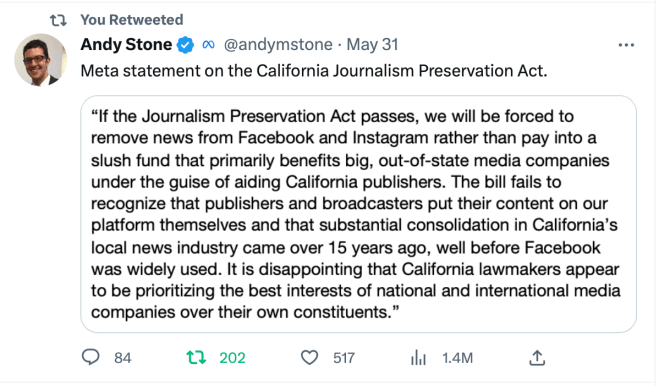
As the publisher of the Montréal news site La Presse told the Senate Committee reviewing C-18 this week, Big Tech is making a demonstration project out of Canada so that US Congress gets the message. By coincidence, Big Tech is doing the same in its home state of California where the a far milder version of C-18 was passed by the legislature on Thursday. (Check out the tweet above: the global hydra Meta lashing out at ‘out of state’ news organizations).
MediaPolicy.ca took a closer look (sorry, Seth Meyers) at what is at stake in a report on this week’s Senate Committee’s deliberations on C-18.
Either the Heritage Minister Pablo Rodriguez doesn’t know how to counter these Big Tech intimidation tactics or he has some political judo in mind and is waiting for the right moment. He wasn’t giving anything away in a recent CBC interview.
MediaPolicy.ca has been offering the Minister some free advice from time to time. Here’s some more: pull all government advertising from Google and Facebook until the experiments are stopped and the threats are withdrawn. Go a step further, challenge all political parties to do the same in unison.
In the meantime you won’t be able to share our posts on Facebook, I have disabled the button. Zuckerberg, take note. Our posts will only be shared on Elon Musk’s Twitter. As for Google, I am personally moving to Bing Search but you will note that the CBC video link above is to YouTube. There is no escaping some monopolies.
***
There have been two television industry developments that flew under the radar (or at least MediaPolicy’s notice).
Bell Media announced at the beginning of May that it has negotiated the renewal of its exclusive Canadian licensing and distribution deal for Warner Brothers’ Home Box Office and Discovery channel (i.e. the content distributed direct-to-consumer in the US by Warner Brothers’ Max) . That means Bell retains this very profitable stream of US programming for its linear and streaming Crave service.
Another development and perhaps another weathervane event is that Eastlink, the mid-sized telco and cable provider based in Halifax, broke off talks to renew its carriage of Corus channels. It’s about price of course and the public statements from each party displayed the expected measure of commercial bravado. It’s one to watch.
***
When the Heritage Minister appeared before the Commons committee last Monday he was asked by NDP MP Peter Julian when we can expect him to act on the Prime Minister’s instructions in his 2021 mandate letter to review the strategic direction of the CBC.
The Minister’s answer was that the CBC is no better than third in line at Heritage: first he has to complete his C-11 Policy Direction to the CRTC, then bring the Online Safety Bill to the House, and only then will the CBC mandate be up to bat. Maybe. News reports that action was any more likely than that were overly optimistic. It is unlikely the government has the administrative bandwidth or political will to do otherwise.
Reading the tea leaves, the government’s decision to extend CBC President Catherine Tait’s term until the end of 2024 doesn’t shout ‘change.’
***
If you would like regular notifications of future posts from MediaPolicy.ca you can follow this site by signing up under the Follow button in the bottom right corner of the home page;
or e-mail howard.law@bell.net to be added to the weekly update;
or follow @howardalaw on Twitter.

 MediaPolicy.ca