
July 9, 2023
I miss Christie Blatchford’s writing a lot. She had a beguiling, unnameable quality to her journalism. I think I will call it ‘pith.’
But now we have Paul Wells whose writing has always been great but increasingly it is…again I search for words, but so as not to embarrass him I will call it ‘oak casked.’ You know, like good wine.
Of course this is my chance to segué to my recommended read of the week which is Wells’ third instalment in his dirge for news journalism. Except the final instalment takes us somewhere I had not expected (I had expected a graveside ceremony). That somewhere is a reflection on how social media is not only responsible for tearing down the old world of curated journalism but also for the disfigurement of political communications from politicians and governments.
I will tantalize you with this piece of proverbial wisdom quoted in his last piece, attributed to a former Harper staffer who observed “you’re either driving a message, or you’re getting run over by a Mack truck. Take your pick.”
The link to Wells’ substack blog is here. The paywall will cut you off at a certain point. Just shell out the $5 monthly, you won’t regret it.
***
After several weeks of Meta and Google dictating the pace of politics of the Online News Act Bill C-18 by threatening and now (in Meta’s case) beginning to block news to Canadians, the federal government and the Canadian news industry are pushing back.
The federal government has paused advertising on Facebook and has been joined by major television and online journalism outlets. The Liberal Party is continuing to advertise on Facebook and is unlikely to unilaterally disarm without all-party participation which of course the Conservatives will not provide.
As for Heritage Minister Pablo Rodriguez, he’s now more engaged and fighting a two-front war. On one side he is lashing the Conservatives for their opportunism (see the tweet above) and on the other he is pursuing his own divide and conquer tactics by seeking a resolution with Google while isolating Meta politically. In a press conference in which Rodriguez was flanked by NDP and Bloc MPs, the Minister stated his optimism that the government can get a deal with Google.
This feels like the middle part of the battle over C-18. Rumours that Meta will implement a full news block in August seem plausible: it would arm the Conservatives with a wedge issue when Parliament resumes in September.
Largely unnoticed in the fray, the regular meeting of US and Canadian trade ministers on July 6th was notable in that no mention was made by either party to Bills C-11 or C-18, unlike previous meetings. Reading the tea leaves, this may suggest that the White House has not been won over by Californian studios and Big Tech companies who routinely try to leverage Canadian politics and regulation by threatening trade sanctions.
There was an intriguing message left dangling by US Trade Representative Katherine Tai’s post-meeting ‘read-out:’
Ambassador Tai underscored the need for Canada to fully meet its USMCA commitments, including on home shopping. In addition, she urged Canada to refrain from imposing a digital services tax while the OECD process continues this year.
This suggests the US is concerned about the looming January 1, 2024 implementation date for the Digital Services Tax which, it is widely assumed, will disappear if the US agrees to implement OECD recommendations for corporate tax on offshore companies. The DST is the prime policy alternative for the Liberals to impose an ‘audience tax’ on Big Tech companies seeking to escape Bill C-18. Did Canadian trade minister Mary Ng raise it at the meeting?
***
MediaPolicy.ca has been tracking the CRTC applications by Canadian broadcasters to deregulate their obligations to broadcast local news. Steve Faguy has a good summary here. Two public interest groups, PIAC and FRPC, are pushing the CRTC to combine all of the applications into one proceeding.
This week MediaPolicy.ca drew attention to a hot CRTC file that has flown under the radar. Its the CRTC application by Global News and its 15 stations to access the $19 million Independent Local New Fund currently shared by 18 local stations that, like Global, are not owned by a Canadian cable company. These are the chickens coming home to roost for the CRTC which has neglected the local television file for years. No longer.
***
The ‘$600 million’ federal aid to journalism programs that were introduced in the 2019 tax year are finally generating some Canada Revenue Agency data (pages 93 and 107). The five-year program has three envelopes: ‘QCJO’ journalist salary subsidies up to $15,000 per reporter, a reader subscription tax deductibility credit up to $75, and tax write-offs for charitable donations to journalism.
The programs are either under subscribed or were deliberately over budgeted. The salary subsidy was budgeted for $95 million annually, but is being drawn upon at $30 million per year. The subscription credit was earmarked for $40 million annually but is being used at the rate of $15 million. There are no numbers available for charitable donations (projected at $25 million) but I am guessing it’s very small given the short list of news organizations that registered for the program.
What was estimated to be a $120 million per year program is coming in at under $50 million. That compares to the $85 million ‘Aid to Publishers’ program available to paid circulation weeklies that has existed in one form or another since 1867. A publication cannot claim both ATP and QCJO.
***
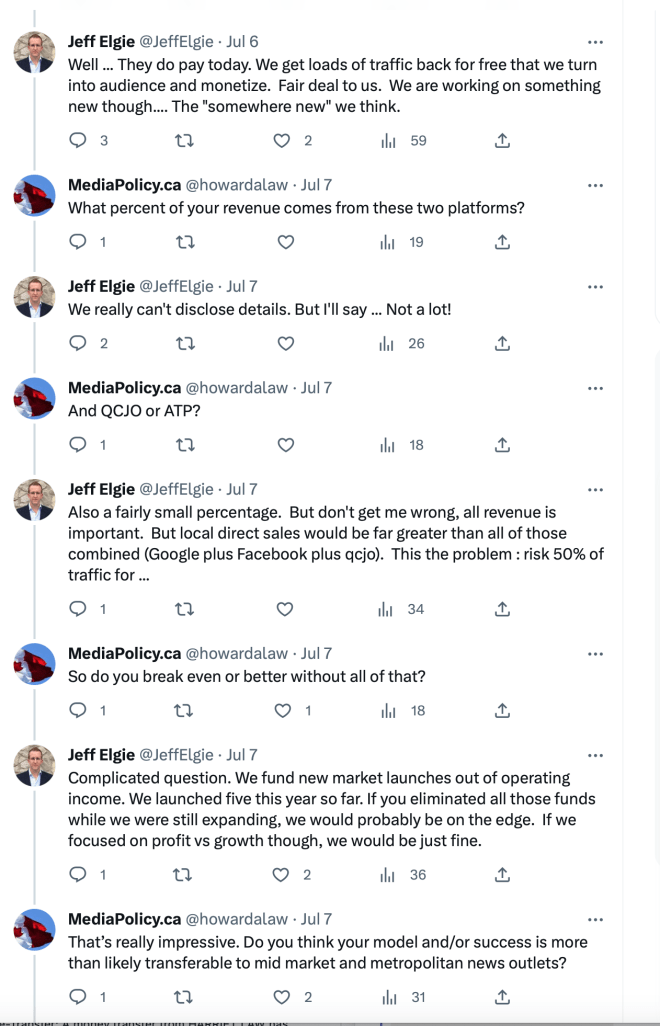
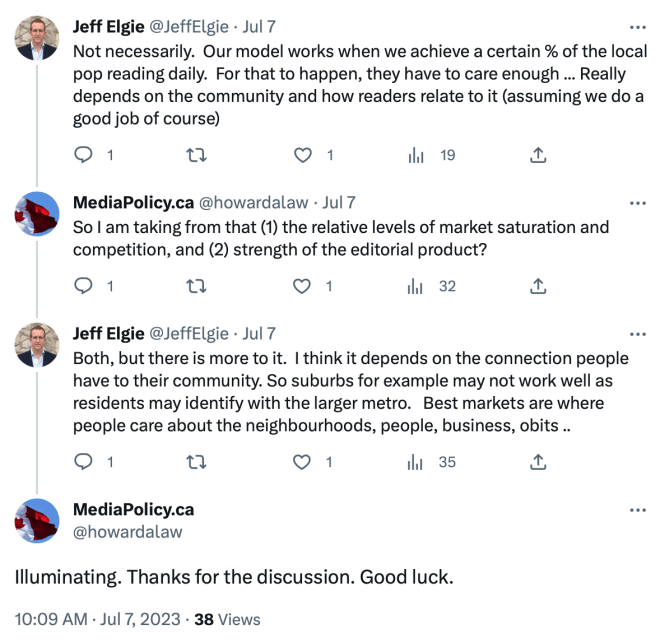
Back to C-18 and the general state of crisis in Canadian news journalism. I was fortunate to have a very useful Twitter dialogue (ah, so rare) with Jeff Elgie of Village Media when I barged into an exchange he was having with Barry Kiefl and Heidi Legg. The topic was how he has managed after a decade of hard work to turn his chain of digital community news sites into a viable business model. Elgie has been sharply critical of the Liberals over Bill C-18 because news throttling by the Big Tech twins could devastate his business.
There were two things I wanted to know about his entrepreneurial success. First, how reliant is he on government subsidies and his deals with Google and Facebook? Second, does he think his success in small market community publishing is transferrable to mid market and metropolitan news dailies? Here are his answers:
***
If you would like regular notifications of future posts from MediaPolicy.ca you can follow this site by signing up under the Follow button in the bottom right corner of the home page;
or e-mail howard.law@bell.net to be added to the weekly update;
or follow @howardalaw on Twitter.

 MediaPolicy.ca
One thought on “Catching Up on MediaPolicy.ca – the C-18 empire strikes back – local news is back on the CRTC menu – lessons from Village Media’s success”