July 11, 2023
Yesterday we had a flurry of activity on the Bill C-18 file. What got the most attention was Heritage Minister Pablo Rodriguez announcing that draft regulations under the recently proclaimed Online News Act that will —if I am parsing the opaque government-speak correctly— establish a scale of minimum financial contributions to news journalism payable by Big Tech platforms to a minimum number of news organizations if they want to qualify for a regulatory exemption. The dollar amount of that minimum will depend upon the size of the platform.
The timing suggests that the government has made some progress in its talks with Google, but there is more to be revealed in time.
The other development on the C-18 file was the publication of an Angus Reid poll, “Concern over backlash and blocked access to Canadian content drives pushback against Bill C-18,” on popular support for the Bill.
In the past, we’ve seen Abacus polls published on C-18 and Bill C-11 (the Online Streaming Act) which were built on argumentative and manipulative questions.
Not so this new one from Angus Reid. But judge for yourself, the questions are here.
This is the first poll on C-18 in quite some time after several months of opposition to the Bill expressed by the Conservatives and others on social media. And of course, it is the first poll to take into account the full impact of Google and Facebook’s temporary news throttling and their threats to make it permanent.
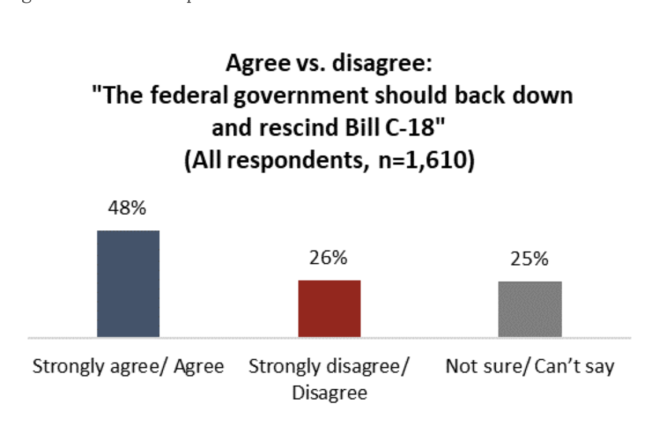
The pollster’s announcement leads with the figure that 48% of respondents want the government to blink in response to those threats, 26% do not, and the remaining 25% aren’t sure.
Another interesting change in public opinion is that the overall support for a policy of Big Tech paying for news content has fallen from over 80% to 62%. (It had been quite even across all voter preferences.)
Exploring the poll results by data categories, we can make some other observations.
The responses to the “blink” question are heavily skewed by voting preference. Seventy-five per cent of Conservative voters want to blink, but only 33% of NDP and Liberal voters, and 15% of Bloc supporters. On the other hand, the ‘not sure’ vote is firmly parked with those latter three parties; the Conservative voters are very sure of themselves (some blog humour, forgive me).
The Liberals might have cause for reassurance with these numbers: they have taken just about everything thrown at them in opposition to the Bill and have now priced in the Big Tech threats, at least until Facebook begins its full news block in the coming weeks. Then we’ll see what happens to that ‘not sure’ vote.
***
If you would like regular notifications of future posts from MediaPolicy.ca you can follow this site by signing up under the Follow button in the bottom right corner of the home page;
or e-mail howard.law@bell.net to be added to the weekly update;
or follow @howardalaw on Twitter.

 MediaPolicy.ca
5 thoughts on “Opinion Poll measures the impact of Big Tech threats of news throttling”