
August 4, 2023
Reading CRTC regulatory filings can be an eye-rolling experience. Almost without exception, the written submission from each industry player is self-serving and chock full of cherry picked quotations and wildly overstated arguments. And this is just in their initial submissions. The reply filings commenting on each other’s views are even more fun.
The Motion Picture Association of America (MPAA) represents the Hollywood studios and streamers —Netflix, Disney, Paramount, Warner Discovery, NBC Universal et al— collectively, the new 900-pound gorilla in the CRTC regulated system.
The MPAA’s first bid on regulatory obligations filed in early July went something like this:
- MPAA opposes the Commission’s proposal to levy an ‘initial base contribution,’ in cash, from all foreign and Canadian broadcasters to feed the various television funds that underwrite Canadian TV production. The MPAA wants to limit the streamers’ CanCon obligations entirely to making their own Canadian shows, known in CRTC vocabulary as “Canadian Programming Expenditures” that normally amount to 30% of annual revenue (and translate into a higher percentage of programming budgets).
- The MPAA proposal means no mandatory cash contributions from Hollywood streamers to news funds, Indigenous content production, or any other media funds that Canadian cable companies (but not TV networks or channels) have always sponsored through a tithe set at five per cent of annual revenue. In fact, the MPAA (and all of the other streamers) are ignoring the Commission’s requirement to table a number.
- The MPAA says that the streamers’ Canadian shows should be certified under a new definition of Canadian content that relies less on the participation of Canadian producers and creative talent and more on Hollywood writers and actors (to wit, the much-touted British model for certifying home-grown video content permits the use of an All-American cast and key creative talent provided the show is ultra-British in its story and setting).
As for the CRTC process, the MPAA and all foreign online undertakings participating for the first time in Canadian regulatory hearings object to the Commission determining an ‘initial base contribution’ before moving on in a second phase of hearings to consider Canadian programming expenditures and a review of the definition of Canadian content. The MPAA says the CRTC is putting the cart before the horse and this is prejudicial to the streamers’ regulatory presentations.
There certainly are common sense reasons for the CRTC to have considered all three big regulatory pieces at the same time, but it appears Chair Vicky Eatrides is eager to get some US money into Canadian media funds quickly and that in the long term a sustainable flow of cash contributions has to come from broadcasting undertakings whose business models are on the rise (the US streamers) and in decline (Canadian legacy broadcasters).
The MPAA is so disgruntled by Eatrides’ approach that it is already threatening court action if it doesn’t like the outcome of the hearings: it cites a rather weak administrative law argument about procedural fairness.
And all of this was before MPAA Canadian director Wendy Noss got a peek at rival submissions filed simultaneously by Canadian broadcasters. Two weeks later, her reply submissions to the CRTC filed are so ferocious you imagine you can see the veins bulging in her forehead.
The Canadian broadcasters, as this space has observed previously, want to lower their regulatory obligations to sponsor media funds and make Canadian shows while raising matching obligations on the US streamers from zero to parity with Canadian competitors. They fix this ‘meet you in the middle’ figure at 20 % of annual revenues and provide a handy bar graph demonstrating that the entire CanCon system will be flush with cash from both foreign and domestic broadcasters.
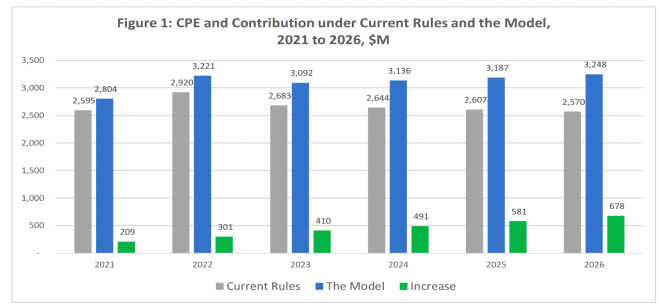
Bell proposal for a harmonized 20% CanCon contribution from US streamers & Canadian broadcasters.
But there is a twist to this harmonization. The Canadian broadcasters want the US streamers to contribute their 20% entirely in cash contributions (before even discussing programming expenditures on their own Canadian shows).
Cue the vein popping and some truly provocative arguments from the MPAA.
The first pitch Noss makes on behalf of Hollywood is that when Bill C-11 says that US streamers must contribute ‘equitably’ to Canadian content, it really means ‘contribute less than Canadian competitors.’
This is bunk of the highest order but, to summarize, she has misconstrued the notorious section 3(1)(f) of the new Broadcasting Act that grants US streamers some yet to be defined flexibility in using American talent as authority for the proposition that Hollywood’s overall level of contributions should be less than Canadian contributions.
Then there is her slap down of the Canadian Media Producers Association which had the temerity to tell the CRTC that under the new regime independent Canadian producers should retain intellectual property in the ‘CanCon’ shows they make and then license to broadcasters and streamers.
The control of long-term commercial exploitation of Canadian shows is important to the CMPA whose members earn a lot of money making shows for the US audience on a ‘turn-key’ contract arrangement with the streamers but want to keep growing the base of their original business, which is making Canadian shows for the Canadian market.
Noss cuffs the CMPA around for being ungrateful for the Hollywood patronage and then, in the coup de grâce, claims that Hollywood already makes ‘more genuine’ Canadian content than Canadian producers:
43. We note that while many members of the CMPA have benefitted from the contributions that have been made over the years by foreign streaming services and studios, the CMPA now argues that the Commission’s new contribution framework must distinguish between the domestic production industry and foreign service production based on a theory of cultural and competition policy versus industrial policy. We believe this theory is without merit. If a production is advancing the broadcasting policy objectives of the Act — with respect to use of Canadian creative and human resources; the telling of Canadian stories; displaying Canadian talent; encouraging the development and export of Canadian programs globally; serving the needs and interests of all Canadians; reflecting and being responsive to the preferences and interests of various audiences (among others) — we fail to see how that production is not advancing cultural policy. As set out in the individual submissions filed by Disney, Netflix and Paramount, oftentimes so-called “service productions” tell more genuinely Canadian stories that showcase Canadian storytellers, talent, culture and geography than domestic “Canadian content.”
Ouch. Can’t wait for the return volley.
***
***
If you would like regular notifications of future posts from MediaPolicy.ca you can follow this site by signing up under the Follow button in the bottom right corner of the home page;
or e-mail howard.law@bell.net to be added to the weekly update;
or follow @howardalaw on Twitter.

 MediaPolicy.ca
Some zingers indeed! Nice set up.
Sent from my iPhone
<
div dir=”ltr”>
<
blockquote type=”cite”>
LikeLike