August 12, 2023
MediaPolicy asked in a recent post whether Competition Bureau commissioner Matthew Boswell wants to sink his investigatory fangs into the Meta news throttle as tenaciously as he bit into Ed Rogers’ ankle during the Rogers-Shaw merger episode earlier this year.
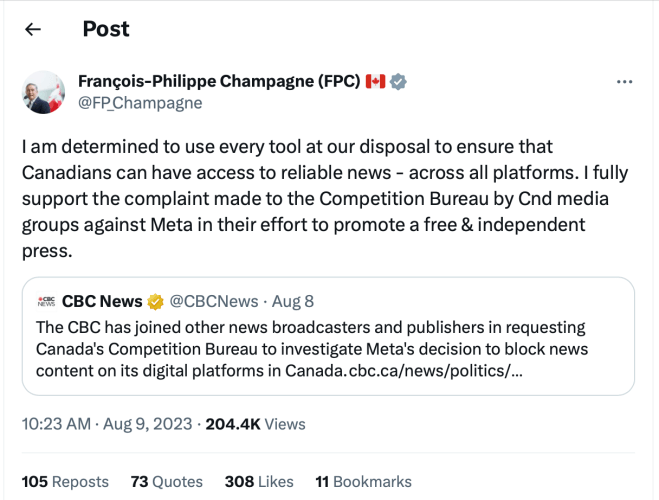
Clearly admiring my approach, ISED Minister François-Philippe Champagne tweeted his own encouragement. Champagne is Boswell’s governing cabinet minister.
Cue the entirely justified outrage from conservative commentators. Norman Spector tweeted that such blatant interference with the Bureau’s independence ought to result in Champagne’s dismissal from cabinet.
I will second that motion provided its retroactive to September 8, 2014 when Stephen Harper’s Heritage Minister Shelley Glover made public statements forbidding a CRTC “Netflix tax” culture levy while the Commission was in the thick of considering it:
We will not allow any moves to impose new regulations and taxes on Internet video that would create a Netflix and Youtube tax – Heritage Minister Shelley Glover, September 8, 2014
The Commission complied.
Cabinet ministers just can’t seem to resist the catnip of asking for regulatory outcomes they aren’t supposed to influence. You could write a book about it going back decades. The most recent examples include Heritage Minister Pablo Rodriguez ordering the CRTC to ban Russia Today from cable TV or CRTC Chair Vicky Eatrides’ telepathic connection with cabinet on wholesale Internet pricing and YouTube videos.
Champagne should disavow his tweet.
(Update: A reader contacted me pointing out the Minister has the authority under section 10(1) of the Competition Act to direct the Bureau to investigate. Possibly this mitigates Champagne’s actions but also raises the question of why the Minister didn’t act on his own, prior to the request being made by news agencies).
***
Charlotte Gray has a piece in the Globe spotlighting the dire prospects for publishing Canadian non-fiction. The loser is educating Canadians in the history of our country.
Gray discusses the role of corporate concentration of Canadian book publishing but she could have added, for more context, the disruption and monopolization of book distribution by Amazon. For that you might turn to Chapter 2 of Cory Doctorow and Rebecca Giblin’s recent book, Chokepoint Capitalism.
News in the book and movie worlds overlapped this week when Paramount (owned by ViacomCBS) announced it was selling its book division Simon & Schuster for $2 billion to a private equity firm. The sale coincides with some bad quarterly financial numbers for Paramount, something it shared this week with Disney.
***
The weekend read I am recommending today runs in the same vein as my suggestions from previous weeks: what conservatives are to do about the presence of fascists and near-fascists in their midst. I am only plugging Andrew Coyne’s column today because I finally agree with him on something, an occasion that I mark.
Coyne is responding to Sean Speer’s description of the “definitional fight” between “FreeCons” and “NatCons.” Says Coyne, that’s a contest involving no more than one authentic stream of conservatism:
This dichotomy, it should be said, puts rather a more dignified face on things than is probably warranted. Whatever its intellectual pretensions, national conservatism is essentially an exercise in on-the-fly revisionism, an attempt to put a retroactive cerebral gloss on the bundle of inchoate resentments and grievances that assembled behind the figure of Donald Trump. As such, it seeks to give coherence to a phenomenon that is fundamentally incoherent: Trumpism gone to college.
***
If you would like regular notifications of future posts from MediaPolicy.ca you can follow this site by signing up under the Follow button in the bottom right corner of the home page;
or e-mail howard.law@bell.net to be added to the weekly update;
or follow @howardalaw on Twitter.

 MediaPolicy.ca