CRTC 1987 Television regulation
October 8, 2023
The outrage over the CRTC’s regulation on registering online undertakings, including podcasts, reached firehose levels this week. It’s mostly a contrived recycling of the familiar policy arguments over regulating broadcasting delivered over the Internet, and from some commentators it’s about getting rid of any broadcasting regulation at all.
But in the interest of facts, here’s a primer for those with a limited amount of time.
The CRTC is going through a multi-step process to implement the Online Streaming Act, Bill C-11, that received Royal Assent last April.
One of its first steps is to take an inventory of online undertakings operating in Canada by requiring them to register the following basic information:
- name, head office address, and contact e-mail of the operator
- nationality of incorporation
- nature of the online service
- language of programming
That’s it. The new regulation does not require any information about programming or revenues since this is already covered by the CRTC’s annual digital media survey that applies to large video (greater than $50M in revenues) and audio ($25M) services.
The new registration requirement does not apply to the following:
- Any “social media creator,” meaning anyone uploading their content to YouTube or another sharing platform, regardless of how popular the program might be. This is excluded by Ministerial fiat to the CRTC in June.
- Video games (also excluded by Ministerial directive)
- Text-based content (because it’s not “broadcasting”)
- Any online platform with less than $10 million in annual broadcasting revenues. The CRTC is exempting from registration all “small” online undertakings of up to $10M.
So other than video games, all digital broadcasting operations above $10 million in annual revenue must register. On the audio side, that includes streaming platforms and stand-alone podcasters. No one has been able to point out a Canadian podcaster big enough to register on its own account. Most podcasters are either small independents (e.g. Canadaland) or their programs are hosted by the big streamers (e.g. Joe Rogan Experience on Spotify) or major Canadian broadcasters.
It’s fair to say that the Commission’s $10 million threshold for registration is a good indication which platforms will eventually be tasked through further regulations to produce and promote Canadian programs. It might be higher, not lower.
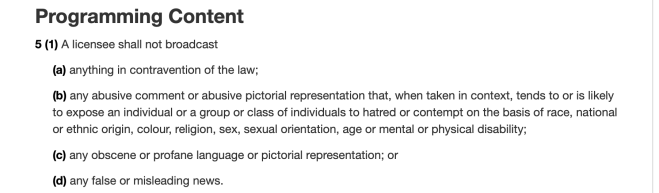
It’s also possible that the Commission will extend its 1987 television and radio codes of conduct limiting “abusive content” and “false or misleading news” to online undertakings. This is what has the free-speech absolutists upset and is worth a longer conversation in this space.
***
Anya Karadeglija of the National Post did some good freedom-of-information digging and came up with an internal Canadian Heritage memo revealing that the federal government may take a wait-and-see approach to the copyright issues raised by the explosive growth of ChatGPT and other AI large language models. Lawsuits in response to the new technology are in their early days.
The copyright issues include the rights of content creators whose material is being scraped, and monetized, by Big Tech platforms. They also raise the question of whether the AI platforms can claim their own copyright over the end-product, despite the fact that copyright is normally the property of a human being, not a machine, that created the work.
***
The Washington Post reports that Amazon’s AI-powered home-assistant Alexa had been telling listeners that the 2020 US election was stolen, citing a source from Rumble. Amazon says it has fixed the problem.
***
There’s lots that could be said about this week’s news items on Bill C-18, the Online News Act. Google observed the expiry of the 30-day public consultation on the federal government’s draft regulation by reissuing its threat to follow Meta and ban Canadian news from its search engine. It’s worth a longer review in a future MediaPolicy post.
For the moment, I will just recommend an interesting and related read. Joshua Benton of Nieman Journalism Lab is probing the question of whether Google’s 90% market dominance of Search could be broken up by a federal court.
***
If you would like regular notifications of future posts from MediaPolicy.ca you can follow this site by signing up under the Follow button in the bottom right corner of the home page;
or e-mail howard.law@bell.net to be added to the weekly update;
or follow @howardalaw on Twitter.

 MediaPolicy.ca