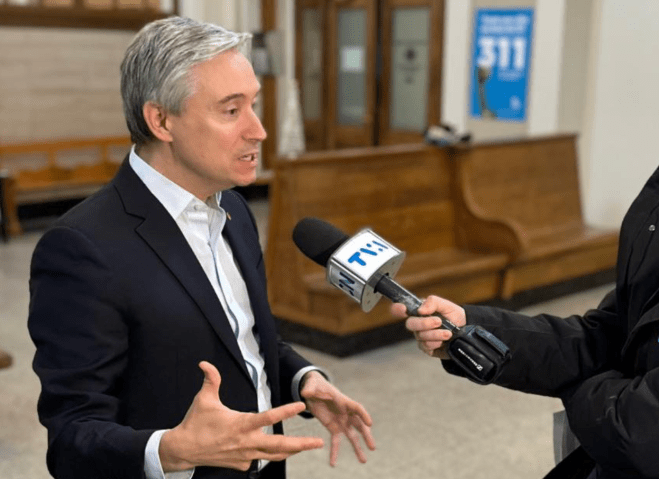
ISED Minister François-Philippe Champagne is overseeing a public consultation on copyright
November 12, 2023
Yesterday MediaPolicy posted an update on the political trouble brewing in Québec for federal Heritage Minister Pascale St.-Onge over regulatory support for French-language music streaming on Spotify and the other global platforms.
In my view, French language music is a test case for whether the mandate given to the CRTC under the Online Streaming Act is going to be taken seriously where the discoverability of Canadian content is at a severe disadvantage in the Internet media environment.
***
The 118-day Hollywood actors’ strike is over. SAG-AFTRA is claiming victory and Netflix’s Ted Sarandos doesn’t disagree, publicly commenting “we didn’t just come toward you, we came all the way to you.”
Major issues were compensation, health benefits and the studios’ use of AI. The settlement follows resolution of the 146-day Writers’ strike in September.
***
The federal Department of Innovation, Science and Economic Development’s December 4th deadline is approaching for public submissions on the copyright issues raised by AI large language model products that scrape the Internet to ingest media content.
Here is a brief summary of the issues from a Bay Street law firm. Here is the ISED consultation document:
The US is in the midst of a similar public consultation and The Verge published a handy summary of the arguments made by Big Tech and the AI industry. Those arguments could be boiled down to this: our AI products ought to be protected by copyright and the content we scrape to make them should not.
There is of course more nuance than that. Meta says it’s ingesting so much content, from so many creators, that individual payments for content would be trivial, so why bother (tell that to Getty Images, which is suing for unlicensed copying of its enormous photo library).
Google says that unlicensed ingesting of text and images is like “reading” or “studying” the scraped content but not “copying.” Other less risible submissions from Anthropic and Adobe get to the heart of copyright theory: where is the line between imitating an idea and copying the corporeal expression of an idea?
Still other submissions put the issue even more starkly: do society’s interest in the productivity gains from AI outweigh the property rights of creators? However these tech companies then want to claim copyright for their AI products, once the copyright holiday on content scraping is over.
On the other side of the coin, the US Newsmedia Alliance of news publishers offered its policy recommendations:
- The Copyright Office should clarify publicly that use of publishers’ expressive content for commercial generative AI training and development is likely to compete with and harm publisher businesses, which is disfavored as a fair use.
- Substantial transparency measures should develop around the ingestion of copyrighted materials for uses in generative AI technologies.
- Further development of relevant licensing models should be encouraged, including by acknowledging the potential feasibility of voluntary collective licensing to facilitate licensing for ingestion of news and media materials for generative AI purposes.
- The Copyright Office should swiftly promulgate an updated registration option to enable online news publishers to register groups of news articles published online.
- Considering the large bargaining power disparity between media publishers and very large online platforms, measures to correct this negotiating disparity, such as the Journalism Competition and Preservation Act, should be supported.
- Measures to address the scraping of protected content from third-party pirate websites should be adopted.
In both the US and Canada, the ingesting of these policy recommendations (to indulge in a little copyright humour) may lead to legislative action or, possibly, remain a public discussion while lawsuits make their way through the courts under current copyright legislation.
The copyright issues raised by AI are just one piece of a much larger political-technological phenomenon. The issues of public safety, national security, spreading deep fakes and disinformation, job loss, and harm to children are already obvious. On these, Columbia University professor Tim Wu has a thoughtful piece in the New York Times.
***
If you would like regular notifications of future posts from MediaPolicy.ca you can follow this site by signing up under the Follow button in the bottom right corner of the home page;
or e-mail howard.law@bell.net to be added to the weekly update;
or follow @howardalaw on Twitter.

 MediaPolicy.ca