
From TMU News Poverty Report 2023
November 19, 2023
Last week MediaPolicy published two posts in anticipation of tomorrow’s commencement of CRTC proceedings to implement the Online Streaming Act Bill C-11.
The first post reviewed Heritage Minister Pascale St.-Onge’s final tweaks to the federal government’s broadly worded policy preferences it wants the Commission to follow. There was a surprise addition and perhaps a not so surprising omission.
The second post was a primer for the policy-curious who intend to follow this first of three rounds of CRTC hearings on C-11.
***
The Parliamentary hearings for Bill C-11 in 2022-23 were dominated by the debate over regulating YouTuber videos.
The YouTuber advocacy group Digital First Canada opposed regulation of their user-uploaded videos and at least partly won that battle when both the CRTC and the Heritage Minister announced that for now the CRTC won’t regulate YouTuber videos to meet “discoverability” outcomes for Canadian content.
But it seems the Canada Media Fund thinks Canadian YouTubers are deserving of state support anyway and announced a pilot project (initially at a modest $500,000) to subsidize Canadian YouTubers. The Canada Media Fund typically funds Canadian content that winds up on regulated broadcast platforms so there is a bit of a YouTuber “have my cake and eat it too” going on here. The upside is that deserving Canadian artists and content will get support in the burgeoning “creator economy” platform.
***
My neighbour, the late metallurgist, political thinker and peace activist Ursula Franklin, used to discourage what she called “awfulizing” about bad news.
Mea culpa, that happens regularly in this space when the latest metrics are published on the declining capacity in Canadian news journalism.
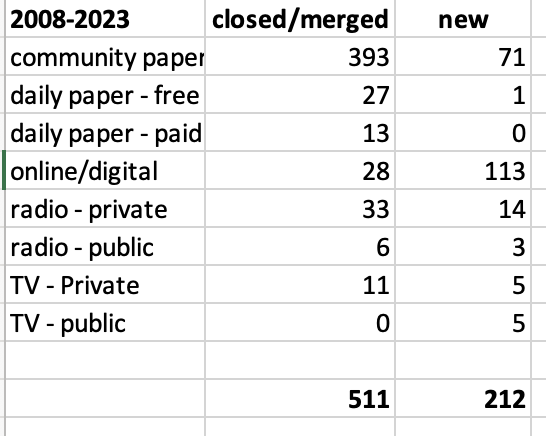
The Toronto Metropolitan University’s annual update to its news poverty survey produced these numbers of local news outlets, of all medias, that closed or opened since 2008:
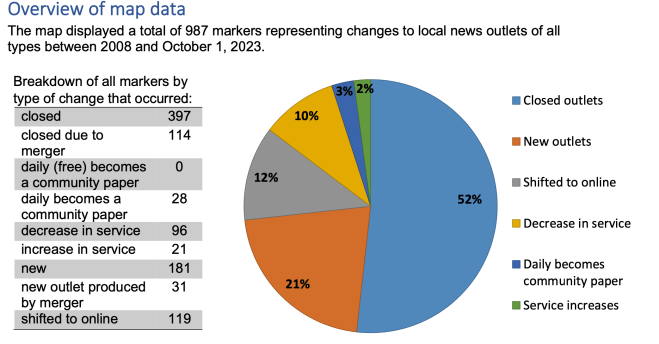
Cutting the data to include increases or decreases in coverage by the newspaper outlets that didn’t close, TMU reported thus:
Chicago’s Medill School of Journalism (at Northwestern University) also released a report analyzing the socio-economic impact of the lost news coverage at the county level across the United States. The creeping news poverty skewed to a rural, older, lower income, and less educated demographic:

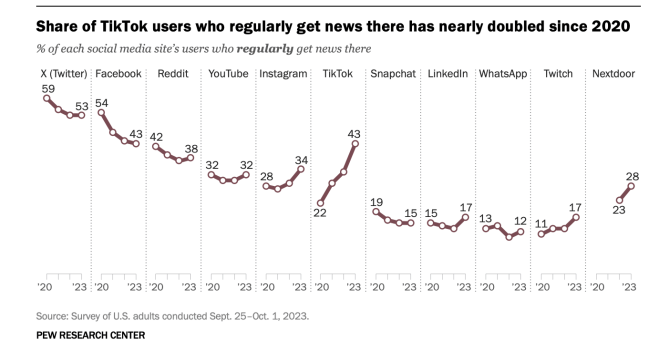
Research released by the American Pew Research Institute noted another important metric, this one concerning the regular consumption of news on social media.
The eye-catching statistic was the meteoric rise of news consumption on TikTok:
***
If you would like regular notifications of future posts from MediaPolicy.ca you can follow this site by signing up under the Follow button in the bottom right corner of the home page;
or e-mail howard.law@bell.net to be added to the weekly update;
or follow @howardalaw on Twitter.

 MediaPolicy.ca