December 16, 2023
An interview with Ivor Shapiro, author of The Disputed Freedoms of a Disrupted Press
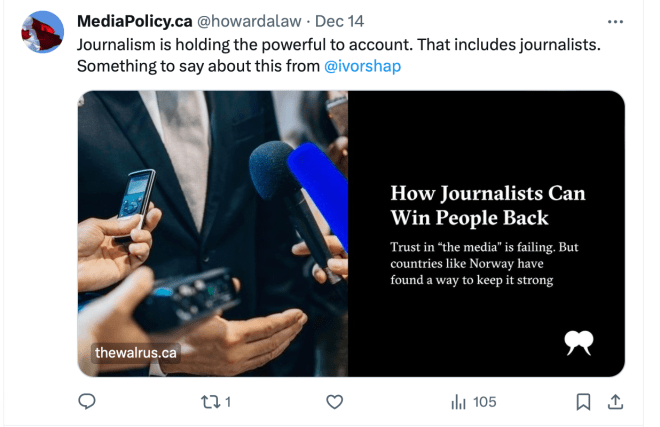
Earlier this week The Walrus published Ivor Shapiro’s “How Journalists Can Win People Back,” an excerpt from his new book. By coincidence I had just interviewed him for publication in MediaPolicy.ca.
I first met Ivor in 2015 when he was the chair of the School of Journalism at Toronto Metropolitan University (then known as Ryerson) and he agreed to host the launch of Unifor’s “JournalismIs” campaign. He was the kind of person who had collegiality and collaboration coursing through his veins, so putting on the conference with him was a lot of fun. A former magazine writer and editor, he taught and researched media ethics. He’d recommended the formation of what’s now the National NewsMedia Council, founded the still-thriving J-Source online magazine, and led the Canadian Association of Journalists’ ethics committee. He’s now scholar-in-residence at the Centre for Free Expression. Last summer Ivor and I collaborated on an article, “Canada’s Bumpy Ride Toward a National News Strategy,” published online by Policy Options. He and I spoke at length about the Canadian implications of his new book on journalists’ autonomy in democracies. Then, we then edited the AI-generated interview transcript to make it shorter and, we hope, much more intelligible. Please let us know what you think.
Howard: In Disrupted Freedoms (update: reviewed here), you posit a basic quid pro quo between government and journalism, that for journalists to earn the special protections and privileges necessary for a free press there must be accountability for professional standards. Is that a fair summary?
Ivor: I guess so, although it unsettles me to think of it as a quid pro quo, exactly. I spent many years assuming the exact opposite—that freedom of the press is not earned but given by right to anyone who publishes almost anything. I thought it was just one of several forms of free expression. But thinking about disrupted media has forced me to propose this new idea that freedom of the press is a more ambitious, audacious, and conditional claim. It’s a claim of particular privileges by those who conduct a particular kind of activity. Defining that activity takes a few pages in the book so for now shall we just call it “news work”?
Okay, and in the book you list several of those privileges attached to news reporting in democracies— such as shield laws, which allow journalists in many democracies to protect information about confidential sources, and to gain access to restricted spaces, events, and records.
Yes and, in many countries, exemptions or exceptions under laws ranging from trespass to libel. And, though it’s suddenly become controversial in Canada, many governments including ours, have long provided public money to subsidize both publicly and privately owned news organizations. I think we agree on the root idea that it’s a public service to seek and distribute factual information about current affairs.
Yes. News work is a public good, as people say. But your argument, that these privileges must be earned, is new territory, even provocative. You’re saying that if journalists claim to be providing a core public service, they should be accountable for doing so. Well, in that spirit, let me ask you this: how good a job is Canadian journalism doing these days at demonstrating its value as a public service?
Well, to paraphrase Pope Francis, who am I to judge?
Come on, Your Holiness, give it a shot.
Seriously, there’s no single answer to that. And there’s way too much generalization these days about the allegedly ubiquitous failings of what people call “the media.” Who is “the media”? It’s thousands of people in hundreds of large and small organizations and teams. Most of these people, individually, try to make a living by doing decent work, as do most people who work at anything. So of course, there’s a wide range of quality in their output, with no reliable way to evaluate much of it. And that is a major part of the information crisis that confronts people in many democracies today, including ours. So I think it’s time for journalists to consider more self-critically the idea of being accountable for standards of practice.
We do have standards bodies, like the National NewsMedia Council, the Quebec Press Council, the CRTC, or the CBSB.
Yes, and they serve useful purposes. The broadcast bodies are set up by law to regulate the airwaves, and you’ve written about how well they do it.
Or not, but carry on.
The two news-media councils certainly help news publishers resolve the grievances of audience members and may sometimes spur news organizations to reflect on their practices. So people have places to air complaints against news corporations, which is good. And yet Canadians’ reported trust in news media dropped by 15 percentage points in the seven years since the national council was formed. And in Quebec, a recent poll suggested that about one third of Québécois consider journalists independent of political parties or interests; the rest are equally divided between believing the opposite or not knowing. If these numbers roughly reflect people’s confidence in the news they see, how can we speak confidently of news as delivering a public service? Right now, how confident do people have a right to feel that they know the basic facts of what’s happening in Israel or Palestine right now?
Well, let’s treat October 7th and the Gaza war as a case study of sorts. How good a service is being provided by Canadian newsrooms covering this war?
Again, it depends on who’s answering. I have a sense that many people think our major news providers are hopelessly biased toward Israel, many others think the opposite, and many others believe most of the facts reported through the particular news channels they choose to follow.
But what do you, as a former j-school chair, think?
It’s mostly less bad than many people think.
Not exactly a ringing endorsement.
Yeah, because it varies. I do think most individual journalists are trying hard to report facts rather than fiction or propaganda. I’ve noticed careful, contextualized newsgathering and editing. I’ve noticed some simplistic and unverified reports. I’ve watched some outstanding interviews conducted under tough circumstances, and some breathless, deferential, uninformed interviews. And the bigger news organizations are often overcautious, trying to achieve an impossible “balance” in stories and newscasts on any particular day, trying without realistic hope to reduce the number of mass-synthesized resource-guzzling protest emails generated by advocacy groups that claim to want fairness or balance. There are limits in what’s feasible for a news desk. And right now, very few Canadian news reporters, producers, or editors specialize in Israel-Palestine issues, no original news reporting from Gaza by employees of Canadian news outfits, and fewer journalists there, period, because that work is lethally dangerous right now. But my central point is that those claiming to provide a public service should hold themselves accountable to service standards whether they’re publicly traded corporations or crowd-funded startups. For journalists, I think that starts with the defining standard of distinguishing facts from allegations, opinions, guesses, or lies.
So a breach of standards would be the initial Associated Press report on the explosion at al-Ahli Arab hospital in Gaza, which was widely repeated by broadcasters and newspapers?
That’s just one of many stories on which people have disputed essential facts. In war, propaganda defeats facts because no one’s job is to share clear evidence consistently. No one except journalists, that is, and, newsflash, journalists are fallible. So breaking news almost routinely includes assertions that await confirmation, and initial reports often need later correction or contextualization. When the news moves fast, the public value of journalists’ work shouldn’t be judged on the first report or the second but rather on the collective, iterative building of a set of facts on which the public can rely.
Well, then, what’s the standard?
I think of standards in a rather minimalistic way. A standard is not the same as a best practice, or ethical principle, or a marker of excellence. It’s a lower hurdle. Showing indifference to factuality is the clearest possible breach of standards for a journalist, but maybe reasonable people could agree on a bit more. Like, that journalists should follow processes that avoid repeating untruthful information—at least, not without attribution. And that factual errors should be corrected as soon as possible. Recently the leader of the Canadian Opposition laid into the Canadian Press for running a wire story that included three corrections of earlier reporting. But to correct oneself is evidence of effort, not of carelessness.
That’s it—just get stuff right?
If we set the bar just a bit higher, there’s an expectation that daily news should build on previous stories to add layers of new facts. Someone is charged with a brutal crime today and acquitted next year: which story will show up online in 2025? Extra layers of context help people understand the world better. To see a world in which today’s savageries may have been seeded by yesterday’s cruelties and a century of trauma.
So you want journalists to be held accountable for disciplined fact-gathering if they claim press-freedom privileges? What would that look like practically?
That’s for journalists themselves, collectively, to answer, and so far few journalists even agree that they have a problem with accountability. The topic just doesn’t come up! But let’s imagine a representative group of journalists sitting down to seek consensus on their bare-minimum expectations of one another’s work. Maybe they could start with a standard that’s been tested in courts in several common-law jurisdictions, when people’s reputations are damaged.
The responsible-journalism defence for libel, which you include as a “privilege” of a free Press.
Yes. Put simply, some smart English lawyers persuaded their country’s top court around the millennium that if a news report damages someone’s reputation, the journalists can escape punishment if they demonstrably followed a disciplined process of seeking the facts. And within a very few years, that principle was adopted in several other countries. The Supreme Court of Canada renamed it “responsible communication in the public interest,” but essentially it still rests on long-established norms for professional news reporting.
Basically, it says that even if you defame someone objectively, you’re going to be ok if you followed a journalistic process. Should we call it “the pursuit of truth” defence?
Absolutely. What’s privileged is not the outcomes but the work of gathering and sharing facts of current public interest. That’s the opposite of purveying fake news; it’s pursuing what’s called l’information juste in French, which I think implies more than just truthfulness but also relevance and currency. But the simpler English word, “facts,” brings up an important distinction. What press freedom adds to freedom of expression is the availability of news, not comment. Which makes it quite strange when commentary-driven publications boast that they haven’t applied for government support. Well, of course not! You and I are sitting here expressing our opinions for the price of a cup of coffee. Following breaking news, checking facts, investigating corruption, covering a trial: if we don’t pay people to do work like that, it won’t get done.
I’m jumping up and down in agreement with you on that. This issue came up in the discussions about Bill C-18 and, before that, about the tax relief for Qualified Canadian Journalism Organizations. I just went on and on about how you’ve got to restrict it to original news reporting. You’ve got to bake that right in. We have enough opinions out there; they’re cheap and plentiful. We don’t need to regulate it and we don’t need to pay for it.
And nor should regulated Google money go there. But it will, won’t it?
Yes, provided the news outlet primarily covers news, opinion gets subsidized too. But okay, news is a public good, and pursuing accuracy is a minimum standard. We agree. But I‘d assume that it will take more to earn public support than basic do’s and don’ts like getting facts right most of the time or quoting people accurately. How about standards of curation, or detachment? I mean, how do journalists really show that what they produce is essential to democracy?
There are a few almost non-negotiable norms. Internationally, most journalists agree that they should keep promises to sources, for instance, and to refuse payment for confidential information, and to keep photos intact. That kind of red-light concrete standard is different from vaguer catchwords like “objectivity” or “balance” or, yes, even “professionalism.” High-sounding highly malleable catchwords are tools for rhetoric. Weapons with which people can bash journalists whose ideas, perspectives, or social media profiles they find bothersome. They’re worst, maybe, in the hands of employers. When managers rely on loosely defined criteria, their judgments will be selective, blinkered, influenced by their own perspectives, such as racial and cultural difference. And when arbitrary judgments affect career advancement, well, that’s supposed to be illegal. So that’s another reason to get very precise about what we call professional standards.
Could there be a case for going beyond the bare minimum standards to justify public support? Like, could public funds foster higher quality journalism by recognizing and rewarding continuous-improvement efforts?
That sounds good to smell but tough to cook. Like, who should decide what counts as “improvement”? I suspect people who work for the Western Standard, the Narwhal, and Global News have divergent approaches to measuring quality because journalism is not brain surgery. It’s more important to understand how audience recognize quality information and what journalists can do to help. One of my key realisations in researching the book was that the countries where more people trust most of the journalism they see are also places where journalists accept public accountability for meeting professional standards.
Suddenly your argument for “professional autonomy” begins to sound like formal self-regulation, as in tribunals where journalists who fail to meet professional standards could be disciplined and disbarred. Is that where you’re going? I didn’t pick that up in the book.
Look, free expression means anyone should be able to publish their work somewhere without prior approval, except maybe their employer’s. What I’m after is what comes after publication—the principle of peer-accountability. I mean, what’s the realistic alternative? We agree that the privileges of a free press go beyond the mere absence of external constraints such as censorship or the demands of governments, businesses, and other interests. So either those privileges are available to all, which means they’re not privileges at all, or they will be subject to constraints. Best practices, if you like. And best practices are arrived at by discussion and consensus amongst peers.
Meaning what, in practice?
Meaning, for example, protecting one another’s job security. Look, there will always be tension between editors and the owners or publishers who employ them, and editors will always make unwelcome demands of reporters and producers. But if we want journalists to be driven by a public-interest mission, they shouldn’t be fired or held back for doing so! Amongst other things, that means union contracts that cement professional practices as workplace norms.
Union contracts. Now you’re talking my language!
And yet in Canada, as you know from your days as a union staffer, it is the bosses, not the workers, who write the standards. And it’s publishers, not journalists, who are accountable to industry-run or government-required monitors. Whereas publishers freely hire and fire editors over editorial preferences and journalists know that to keep their jobs they must allow editors to arbitrate standards. News companies focus their brand marketing on something oddly called “fact-based journalism” (like, there’s another kind?) or industry-directed certificates of trust-worthiness. Whereas, if I were designing a transit ad for a news business, I’d show a quote-bubble cartoon where the wearer of the “press” badge says, “Yes, boss,” and the suit responds: “You’re fired.”
C’mon.
Seriously. May I quote the book again?
Reb, can I stop you?
No, boss. This is from Chapter 5: “Robust professionalism in news media—the real thing, not the semblance—means owners ceding autonomy to editors, editors recognizing journalists’ quality concerns as labour rights, and all regular editorial contributors being emboldened by job security.” But that’s actually the easier part. The hardest work could be getting journalists to stop filing stories long enough to reflect on their own methods and assumptions.
Okay, here’s the monkey’s paw. Make your first wish for something that would advance accountability in journalism.
Easy. I’d like to see the leaders of the big journalists’ unions get together on Zoom to brainstorm ways to earn back public trust.
Like what?
Like, for instance, they could convene a group of journalists to draft a single, short list of maximum ten consensus standards for news production—crystal-clear, realistic standards, that can each be stated in 50 words or less! They’d distribute the first draft to members for discussion in guilds, locals, and listservs, and give themselves a year to rewrite the list, request public feedback, and put each item up for an up-or-down vote by organized journalists across the country. Any item that wins consensus would be published on Canada’s first national code of professional standards for news, a work in progress that should be augmented or amended every few years through a similar process. And guess what—the very next time a contract’s being negotiated with unionized journalists…
…recognition of the code is on the table.
Yup. Just as unionized professors’ contracts include guarantees of academic freedom, and hospitals can’t require clinicians to break patient confidentiality. And then suddenly, when an employer makes an arbitrary demand or ruling, a journalist might have a winnable grievance, or even a human-rights complaint, because the professional standard is crystal clear. And conversely, when people or companies claim to be in the journalism business, the public has at least a first-stop litmus test. What do you think?
I’d like to eavesdrop when they discuss tweeting. But seriously, I think half would love it and the other half, at least at the outset, would not trust it. If I can generalize about journalists I would say they are not joiners. But joining a peer movement for autonomy and accountability might be different.
***
Also from MediaPolicy: Journalist, heal thyself.
***
If you would like regular notifications of future posts from MediaPolicy.ca you can follow this site by signing up under the Follow button in the bottom right corner of the home page;
or e-mail howard.law@bell.net to be added to the weekly update;
or follow @howardalaw on Twitter.

 MediaPolicy.ca
6 thoughts on ““Holding the powerful to account.” Journalists included.”