
January 27, 2024
The National Post published a very readable column from its Parliamentary Bureau Chief Stuart Thomson on public perceptions of media bias.
The gist of the column is that journalists lean “left” because their ranks are dominated by urban intellectuals. Plausible but arguable, I suppose. Meanwhile, the author exclusively interviewed conservative commentators. He published his conclusions in a conservative news outlet located in downtown Toronto.
My cynicism aside, there is no doubt that ‘bias in journalism’ as a matter of perception is important, fair or not. But that begs many follow up questions to poll respondents on what content they are perceiving: opinion columns or news coverage? Which news outlets?
Then there is the question of whether perception is affected by partisan loyalties (the Abacus public opinion survey that Thomson relies upon indicates it is) and whether continuous partisan complaining about alleged bias in news coverage is shaping public perception.

Conservative Fundraising Post
And finally there is the question of actual bias, always a challenge to define and measure. Regardless of whether an ideological demography of news reporters suggests a ‘left-wing’ (or urban intellectual) bias in their personal views, the question arises of whether it exerts a gravitational pull on news content? My own view is that the bias and dominant ideology of journalism —- the thing that gets journalists fired up every day— is the desire to be the public’s watchdog, to hold the powerful to account.
***
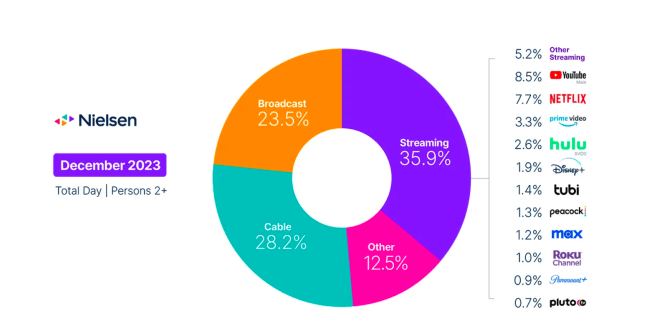
The ongoing shakeup in the television economy was illustrated by a couple of news items this week.
Netflix announced strong quarterly results, beating expectations on both revenue and subscriber growth. Reuters quoted an analyst saying that “Netflix has won the streaming war.”
All of that reinforces the prevailing wisdom that the streaming market in premium video is divided between Netflix and those who lose money. That would be misleading however because YouTube’s wildly successful creator-economy is thriving and at least two streamers (Amazon and Apple) are ballasted by their non-streaming business. Nonetheless, the other major streamers Disney Plus, Paramount Plus, NBC Universal, Max, etc are not quite so hedged.
For some reference points, check out the US Nielsen ratings represented in the graphic above. A similar pie chart for Canada would have a larger slice for cable TV because cord-cutting is less advanced than in the US.
On that point, the other weekly news item was Canadian telco provider Telus announcing its discount-priced bundle “Stream+” —-Netflix, Disney Plus and Amazon Prime— available to its cable and mobility subscribers.
The Canadian market of nine-million cable households represents a win-win opportunity for Canadian cable companies and American streamers. But in the long run it depends on whether it’s a win-win-win-win, including paying customers and advertisers.
***
This week the billionaire-owned LA Times laid off 115 journalists, a quarter of its newsroom.
It’s a morbid watching brief to constantly bring this kind of thing to your attention.
On that note I recommend a Sean Speer podcast with perhaps the most engaging federal Senator of all time, former journalist Paula Simons, on “Canada’s News Media and the future of journalism.”
On the bright side, it’s 45 minutes of delightful ‘back in the day’ stories for media nerds. As well, at the host’s relentless prodding, the podcast episode grapples with the conundrum of public policy efforts to save Canadian news journalism.
Off the top, Simons makes it clear she hates the Online News Act. She characterizes it as a government “shakedown” of Big Tech; an illegitimate response to the market power of Google-Meta in digital advertising. In fact, at least in theory the bill was a response to Big Tech market power in news distribution, not advertising. On that point, allow me to re-recommend my post from last weekend; “The Online News Act is law: a buzzer-beater win or epic miscalculation?”
But as for the conundrum about how to pay for news journalism without impairing its independence, Simons is hoping the public appetite for news reaches a tipping point where the public is more willing to pay for news; or perhaps innovative news providers figure out how to cover the news in a way that wins back advertisers.
That said, she doesn’t sound especially confident about the tipping point arriving any time soon. As pointed out on the podcast, the business model that worked for newspapers depended on that medium being the public square for shared local community and information. That was aided by a lucrative pre-Craigslist business in classified advertising that brought even more readers and further enlarged the mass audience. Today, the Senator observes, the “attention” marketplace for news and information, what was once the public square, is fragmented beyond repair.
***
If you would like regular notifications of future posts from MediaPolicy.ca you can follow this site by signing up under the Follow button in the bottom right corner of the home page;
or e-mail howard.law@bell.net to be added to the weekly update;
or follow @howardalaw on Twitter.

 MediaPolicy.ca