This weekend’s blog, again. Blame Microsoft.

As of today, MediaPolicy.ca merges its two e-mail distribution lists.

You received this update through the WordPress publishing software that I use for MediaPolicy.ca. It automatically sends you a new blog as it is posted.

The other distribution list, a group e-mail (blind copied) from howard.law@bell.net is discontinued. For some unfathomable reason, known only to some very patient Microsoft software engineers, group e-mails sent on the Outlook program can corrupt MS 365 and require re-installation.

A reminder: the WordPress software makes it easy to unsubscribe. Nobody needs inbox clutter.

Many of you reading this update did not receive this weekend’s post, owing to the failure of my e-mail program. Here it is:

Catching Up on MediaPolicy – Streamers will pay 5% – Paywalls falling? – Arts sector in trouble

The highlight of the week in Canadian media has to be the CRTC’s release of its Phase One ruling on implementing the Online Streaming Act, Bill C-11.

News reports describe how beginning in September video and music streaming platforms must contribute five per cent of their annual Canadian revenues to various media funds that subsidize Canadian news and entertainment programming. With the details, here are reports from the Globe and MailCBC and Radio-Canada.

As to the wisdom of the Commission’s ruling, try Peter Menzies (critical) or Barry Hertz (supportive).

For my own comments, I am still working on that and hope to have something in a few days.

***

Copyright law is everyone’s bedtime tea, yes? 

For the last decade, the federal statute regulating the ability of content creators to monetize their own work, including news reporting, can’t seem to escape the gravitational pull of the “user rights” singularity. That refers to the judicially expanded rights of other people to consume content without paying for it.

Simple, it is not. The legal test drawing the line between ripping off creators by not paying or, on the other hand, using the copyrighted material for a limited non-commercial purpose is one of those “multi factor” things that turns the policing of content piracy into an unpredictable contest of competing claims.

There is a story to be told at greater length about how Blacklock’s Reporter, the uber-watchdog of the federal government, has now lost two Federal Court decisions in an effort to enforce its paywall subscription model without which it cannot remain in business. 

Unlike some streaming services or news websites we could name, Blacklock’s does not wink at sharing content or passwords.

In 2016 Blacklock‘s lost a case of copyright violation at the Federal Court. The news site had filed suit against the federal government when Finance Canada officials  circulated news stories among themselves that the Department received from a Blacklock’s subscriber:  despite that private subscriber buying only an individual subscription and clicking the standard “browser wrap” consent to terms and conditions of purchase which prohibited sharing.

At the time, user rights advocate Michael Geist celebrated a victory for “the right to read,” while the country’s foremost copyright lawyer Barry Sookman said the court got it wrong on copyright violation. 

There was a round two in the fight between Blacklock‘s and the feds, this time on the issue of whether sharing a password without permission violated rules on technological protection measures. TPMs include software locks and passwords.

No matter, last week the feds won again: password sharing is fine if the non-paying customer successfully claims “user rights.” Professor Geist celebrated again. And we are waiting for Barry Sookman to weigh in.

The implications for not only the Canadian news industry, but also any subscription-based streaming services, should be obvious.

Blacklockpublisher Holly Doan has not decided yet on an appeal, telling me “the ruling has huge implications for large password-using corporations and Canada’s agreements with the U.S. and Mexico on TPMs. No small business should be expected to litigate the meaning of the word “password” in 2024.”

Users rights” are a strange beast.

The right or privilege to quote from copyrighted content, even at great length, seems a reasonable concession to the public interest and at least arguably sends more buyers to creators.

But the Federal Court’s endorsement of the right to reproduce or share without payment or permission the entire piece for the self-declared purpose of “research” or “education” is difficult to understand. After all, what is the difference between breaking a news paywall —-oh sorry, accepting a shared password—— to satisfy your curiosity about current events and claiming to do so legally “for research purposes?”

***

Josh O’Kane has written a feature in the Globe and Mail on the alarming state of finances in Canada’s arts sector (visual arts, books, music, theatre, dance and other live performances).

The confluence of inflation (hitting venue rents and ticket purchases), shrinking philanthropic donations and flat-lined government subsidies are hitting a cultural sector that already seems to live hand to mouth.

The biggest (and flat-lined) funder is the federal Canada Council of the Arts ($365 million in annual funding). Provincial governments modestly or generously top that up (Alberta at $30 million, Ontario at $60 million and Québec at $150 million).

The high visibility Canada Council may be set to become a political football yet again. Its funding was cut by Harper Conservatives, restored by the incoming Trudeau Liberals, and may soon fall under the beady eye of a Poilievre government’s finance minister.

Book publisher Ken Whyte has written a scorching review of the Council, suggesting its policy goals (by which I think he means priority funding for Indigenous, official minority language groups, and equity-searching communities) contribute to “a gulf between the Canada Council and the Conservative Party of Canada [that] is vast and unbridgeable.”
Catching Up on MediaPolicy – Streamers will pay 5% – Paywalls falling? – Arts sector in trouble

June 8, 2024

The highlight of the week in Canadian media has to be the CRTC’s release of its Phase One ruling on implementing the Online Streaming Act, Bill C-11.

News reports describe how beginning in September video and music streaming platforms must contribute five per cent of their annual Canadian revenues to various media funds that subsidize Canadian news and entertainment programming. With the details, here are reports from the Globe and Mail, CBC and Radio-Canada.

As to the wisdom of the Commission’s ruling, try Peter Menzies (critical) or Barry Hertz (supportive).

For my own comments, I am still working on that and hope to have something in a few days.

***

Copyright law is everyone’s bedtime tea, yes?

For the last decade, the federal statute regulating the ability of content creators to monetize their own work, including news reporting, can’t seem to escape the gravitational pull of the “user rights” singularity. That refers to the judicially expanded rights of other people to consume content without paying for it.

Simple, it is not. The legal test drawing the line between ripping off creators by not paying or, on the other hand, using the copyrighted material for a limited non-commercial purpose is one of those “multi factor” things that turns the policing of content piracy into an unpredictable contest of competing claims.

There is a story to be told at greater length about how Blacklock’s Reporter, the uber-watchdog of the federal government, has now lost two Federal Court decisions in an effort to enforce its paywall subscription model without which it cannot remain in business.

Unlike some streaming services or news websites we could name, Blacklock’s does not wink at sharing content or passwords.

In 2016 Blacklock‘s lost a case of copyright violation at the Federal Court. The news site had filed suit against the federal government when Finance Canada officials circulated news stories among themselves that the department received from a Blacklock’s subscriber: despite that private subscriber buying only a single subscription and clicking the standard “browser wrap” consent to terms and conditions of purchase which prohibited sharing.

At the time, user rights advocate Michael Geist celebrated a victory for “the right to read,” while the country’s foremost copyright lawyer Barry Sookman said the court got it wrong on copyright violation.

There was a round two in the fight between Blacklock‘s and the feds, this time on the issue of whether a Parks Canada official sharing a password without permission violated rules on technological protection measures. TPMs include software locks and passwords.

No matter, last week the feds won again: password sharing is fine if the non-paying customer successfully claims “user rights.” Professor Geist celebrated again. And we are waiting for Barry Sookman to weigh in.

The implications for not only the Canadian news industry, but also any subscription-based streaming services, should be obvious.

Blacklocks publisher Holly Doan has not decided yet on an appeal, telling me “the ruling has huge implications for large password-using corporations and Canada’s agreements with the U.S. and Mexico on TPMs. No small business should be expected to litigate the meaning of the word “password” in 2024.”

Users rights” are a strange beast.

The right or privilege to quote from copyrighted content, even at great length, seems a reasonable concession to the public interest and at least arguably sends more buyers to creators.

But the Federal Court’s endorsement of the right to reproduce or share without payment or permission the entire piece for the self-declared purpose of “research” or “education” is difficult to understand. After all, what is the difference between breaking a news paywall —-oh sorry, accepting a shared password—— to satisfy your curiosity about current events and claiming to do so legally “for research purposes?”

An earlier version of this post inaccurately identified Parks Canada as the respondent in the 2016 case.

***

Josh O’Kane has written a feature in the Globe and Mail on the alarming state of finances in Canada’s arts sector (visual arts, books, music, theatre, dance and other live performances).

The confluence of inflation (affecting venue rents and ticket purchases), shrinking philanthropic donations and flat-lined government subsidies are hitting a cultural sector that already seems to live hand to mouth.

The biggest (and flat-lined) funder is the federal Canada Council of the Arts ($365 million in annual funding). Provincial governments modestly or generously top that up (Alberta at $30 million, Ontario at $60 million and Québec at $150 million).

The high visibility Canada Council may be set to become a political football yet again. Its funding was cut by Harper Conservatives, restored by the incoming Trudeau Liberals, and may soon fall under the beady eye of a Poilievre government’s finance minister.

Book publisher Ken Whyte has written a scorching review of the Council, suggesting its policy goals (by which I think he means priority funding for Indigenous, official minority language groups, and equity-searching communities) contribute to “a gulf between the Canada Council and the Conservative Party of Canada [that] is vast and unbridgeable.”

***

If you would like regular notifications of future posts from MediaPolicy.ca you can follow this site by signing up under the Follow button in the bottom right corner of the home page; 

or e-mail howard.law@bell.net to be added to the weekly update; 

or follow @howardalaw on X.

Catching Up on MediaPolicy – AI and Canadian culture – Et tu, Bryan Adams – How to pitch Canada on Hollywood

June 2, 2024

Earlier this week I posted a report on the opening day of a conference convened in Québec City by the Canadian chapter of the Coalition for the Diversity of Cultural Expression (CDCE), sponsored by the federal and provincial governments.

The Coalition is an unapologetic and energetic advocate of regulating media content to promote Canadian content domestically, but also in exchange with other like-minded countries around the world that put a high value on cultural diversity and sovereignty.

In the last few years, especially throughout the Parliamentary journey of the Online Streaming Act, the Coalition prioritized the importance of regulating platform algorithms to give greater exposure to French language music which, its fair to say, is not offered up to French speaking audiences in anywhere near the volume that radio promotes those songs.

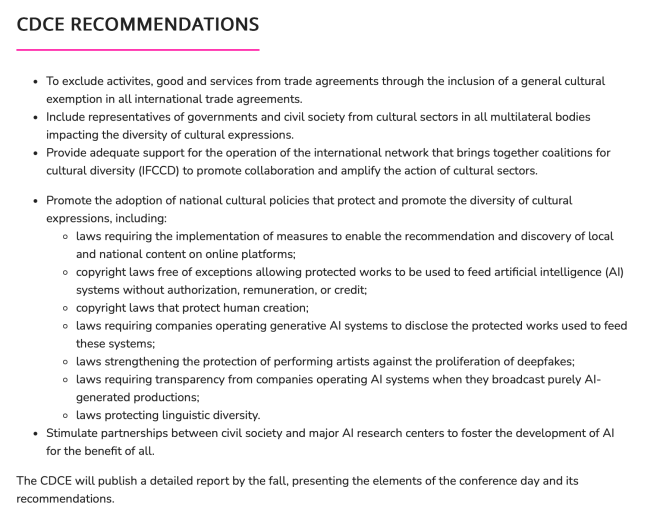
But the Coalition also takes the long view and is the only Canadian cultural organization raising questions about the impact of AI on culture and media. The final recommendations emerging from the CDCE’s conference are captured in the photo at the beginning of this post. The recommendations not only deal with AI’s current threats to culture (for example, copyright and the interests of content creators), but focus on the public getting a look inside the Big Tech black box that holds the secret to what AI will do next.

Not so long ago the Internet took centre stage in our lives as a good thing, until we discovered that sometimes it could also be a bad thing. AI, just so, except it’s obvious right from the beginning. On that note I recommend a terrific feature piece by Navneet Alang in The Walrus.

***

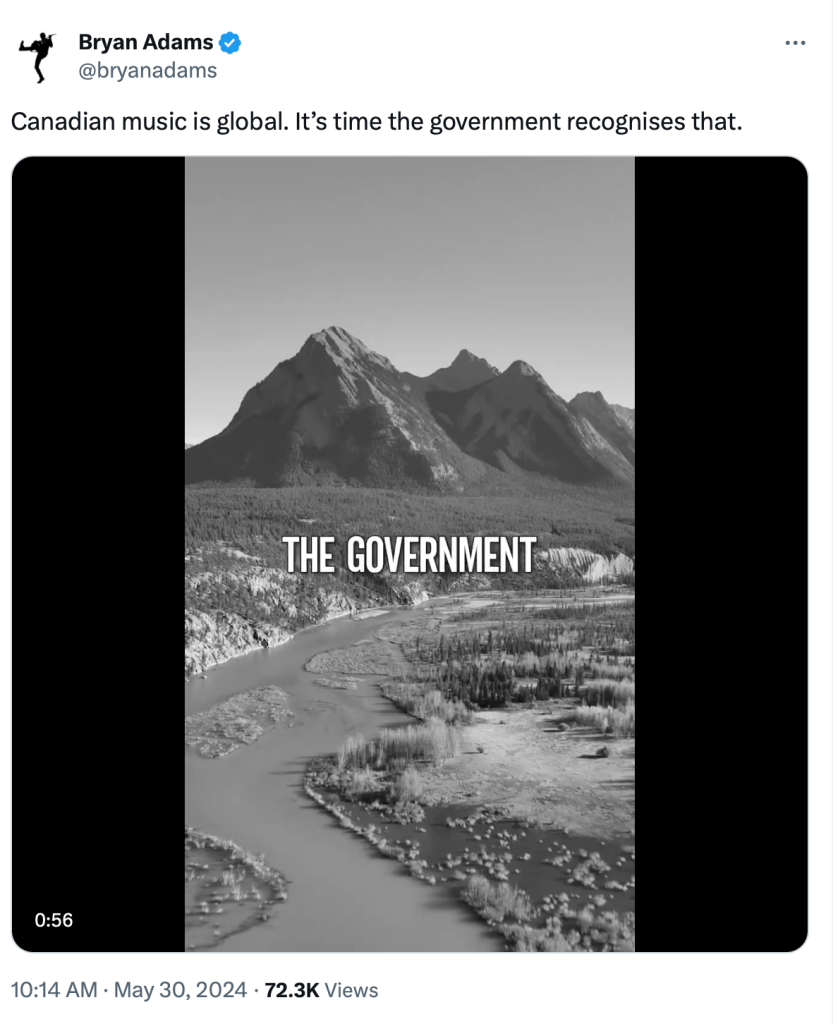
Canadian rocker Bryan Adams is back, letting off steam again about CRTC regulation of Canadian content.

Adams just posted a one-minute video calling out “hey, Justin Trudeau” and weighing in on the up-for-grabs regulatory rule defining a Canadian song. That legal definition drives the key regulatory rules that increase exposure of Canadian music on radio and satellite. The Heritage Minister posted a gentle response, mindful that famous Canadian artists who publicly rebuke Canadian politicians will usually get the last word in any debate that turns nasty. The Globe & Mail‘s report is here.

Adams’ complaint is a do-over of his last, successful, political campaign against the CRTC rule that impacts how much collaboration and credit-sharing with foreign artists is allowed when Canadian artists get the benefit of the added exposure for “Canadian” songs.

In 1992 Adams was outspoken about a CRTC rule that gave Canadian credit for songs in which the music was written entirely by a Canadian, or the lyrics were written entirely by a Canadian, but not where music or lyrics were co-written by a Canadian and a foreign artist. His protest worked. The CRTC changed the rule: co-writing with non-Canadians no longer disqualifies a song.

But for Adams, it isn’t just about fixing a “bad” rule. It’s about any rule: he famously pronounced “the Canadian government should just take a step out of the music business entirely.” Another candid comment from the global superstar: “I never thought much about CanCon anyway. I always thought that it did nothing but breed mediocrity.”

Nice.

The CRTC is already thinking about watering down its “M.A.P.L.” definition of a Canadian song, which currently requires a song meet at least two out of four criteria: a Canadian performing artist (A), a Canadian music composer (M); a Canadian lyricist (L); and recorded in Canada (P). The Commission issued a ruling in December 2022 suggesting it might drop (P) and rejig the regulatory test as a two-out-of-three exercise with the remaining criteria for Canadian performers and songwriters.

The Commission then put the MA(P)L definition of a Canadian song on pause, to be resumed when the Commission re-engages the issue of “CanCon” as part of its implementation of the Online Streaming Act (although the definition of a song will be overshadowed by the debate over audio visual CanCon).

The music industry –the streamers and the labels– no doubt wish to further water down the definition of a Canadian song, part of an overall strategy of minimizing regulatory obligations to promote Canadian music on their platforms.

Here’s a bit of political irony for Adams. Justin Trudeau already weighed in on the MAPL issue, indirectly. A cabinet directive to the CRTC last November dodged the request of the Québec music industry to take a strong position on regulating the streamers’ algorithms to boost French language music.

That cabinet decision —-it’s hard to believe it was the outcome the Heritage Minister sought— did not go down easily in Québec and is the engine behind a provincial plan to step into the regulatory fight over CanCon.

***

Okay, one last thing for today.

When Hollywood showed up last November at the CRTC hearings on implementing the Online Streaming Act, I remember thinking the pitch from the Motion Picture Association was miles off base.

Instead of lecturing the Commission on how great Hollywood is for Canada —because it shoots so many American movies and TV shows here— they should have just sent Netflix CEO Ted Sarandos.

The guy is a down-to-earth charmer and very good at explaining how hard it is to be the 900-pound gorilla of the global entertainment industry. Have a listen to this New York Times podcast with Sarandos, it’s great.

***

If you would like regular notifications of future posts from MediaPolicy.ca you can follow this site by signing up under the Follow button in the bottom right corner of the home page; 

or e-mail howard.law@bell.net to be added to the weekly update; 

or follow @howardalaw on X.

Québec moving on more regulation of digital media

Québec Culture Minister Mathieu Lacombe

May 28, 2024

Yesterday Québec Culture Minister Mathieu Lacombe announced the next step in his plan to introduce, in one form or another, legal standards for the prominence of French language media available on global streaming platforms operating in the province.

The CAQ government will kick off a public consultation and then report back “what we heard” in January 2025. That report will probably be followed by a provincial bill, possibly in coordination with a federal government that has exclusive jurisdiction over broadcasting.

If Lacombe’s bill does emerge in 2025, it might arrive during a Fall 2025 federal election campaign. Federal parties might be expected to take a position on it, setting up an uncomfortable test of Pierre Poilievre’s anti-regulation position and his electoral prospects in Québec. The Conservatives have been there before, notably in 2008.

The majority CAQ government does not face election until the Fall of 2026.

Lacombe made the announcement of the public consultation at a conference convened by the Coalition for Diversity of Cultural Expression, in Québec City. He was joined by his cabinet colleague Martine Biron, the Minister responsible for women’s issues and relationships with the global francophonie.

Biron was the more quoteworthy, perhaps understating that there is a “sense of emergency” in Québec regarding the survival of French language culture in the global digital environment. Her Boomer generation, she said, bears the responsibility of preserving the availability of French language culture for a younger generation immersed in English-language digital offerings.

Biron said that the alarm in Québec is not just about the English language domination of TikTok and YouTube content. An even larger concern is that the next technological wave of AI-driven media content will be (American) English-dominated and far more intrusive into language and culture than the current digital giants.

In fact, most of the CDCE conference focussed on the development of AI, especially the ingestion of linguistic and cultural data that will set the parameters for user tools as AI takes a hold in daily lives.

***

If you would like regular notifications of future posts from MediaPolicy.ca you can follow this site by signing up under the Follow button in the bottom right corner of the home page; 

or e-mail howard.law@bell.net to be added to the weekly update; 

or follow @howardalaw on X.

Catching up on MediaPolicy – Cancel culture and the CBC – The YouTube wave of destruction

May 25, 2024

This week MediaPolicy continued its practice of ripping and rewriting Doug Shapiro’s blog on the future of premium entertainment programming.

The former television executive’s prediction is that Netflix’s direct-to-consumer disruption of popular television will soon —much sooner than he previously predicted— be followed by the next wave, the YouTuber “self-broadcasting” disruption.

You can read the MediaPolicy post here.

***

Last month Heritage Minister Pascale St.-Onge announced her CBC re-think panel. We will no doubt have to wait a few months to hear what the panelists have rethought. They carry on their work in the shade of an election of a Pierre Poilievre government that will mark the end of nearly a century of English-Canadian public broadcasting.

When St.-Onge made her roster of experts public, MediaPolicy remarked upon the diversity of backgrounds, but mostly the deep experience in media and public broadcasting. The noteworthy outsider is David Skok, CEO of the online business news outlet The Logic

The panel is not a political car rally, nor is it particularly representative of the Canadian population. The appointees are mostly technocrats and industry insiders. And, as Saskatchewan’s Peter Menzies points out, they mostly hail from the spiky-fenced Laurentian redoubt of central Canada.

Will the panel be hobbled by its own industry expertise? Menzies throws out a dare to the panel: surprise me.

Senator Andrew Cardozo also wants to widen the CBC discussion. On May 21st he rose on the Senate floor to kick off what he hopes will be a robust debate. Having followed the Senate’s 2022 deliberations over the Online Streaming Act, I have come around to taking the upper chamber very seriously as the forum for sober second thought of Canadian legislation. Given the low-brow political theatre to which MPs have descended, the Senators now render themselves indispensable.

On the CBC debate, Cardozo has invoked what the Parliamentary manual calls “an inquiry.” That means he gave a speech and invited other Senators to do the same. Fingers crossed.

Cardozo is pro-CBC. His argument is that we still need a national media institution that provides a place to share Canadian community and Canadian content that contributes to our national narrative. Far from the CBC being eclipsed by the explosion of a global media universe, Cardozo says that while the Internet may have provided us with boundless alternatives to the $1.4 billion public broadcaster it has also fragmented and segregated us into mini-communities more than ever.

He also puts out some of the more obvious questions about what Canada looks like without an English-language CBC.

For instance, how will Canadian democracy survive in the absence of CBC News and —keeping in mind Poilievre’s other promises to kill federal funding of journalism as well as repeal Bill C-11—  the possible collapse of mainstream news media?

And, post-defunding, will English Canadian voters tolerate the continued funding of French-language Radio-Canada ?

And what does a rethought CBC look like anyway? As Cardozo points out, every Canadian imagines their own CBC or at the very least has an opinion on which CBC services ought to walk the plank:

As I wind up — I know you’re waiting for those words — here are a few ideas: divest CBC Radio 2 and return the licences to the CRTC; drastically increase programming that advances dialogue, such as “Tout le monde en parle” and “Cross Country Checkup,” so that Canadians can hear each other and from each other; include at least one news story — a national and regional newscast — about local news in various areas in the country; increase the ability for all political parties and supporters to have substantial and unfiltered airtime; increase the number of small‑town bureaus, whether using small studios or part-time stringers; consider the world as the oyster, with world-class programming that brings in the best and brightest from around the world to talk about topical issues, and do this a lot more — programming that will be sought the world over; lastly, develop a five-year digitization plan to make all programming digital and, importantly, create programming that will be primarily for the digital world.

The Senator wrapped up with a lyric so stirring it might have made it onto rock-and-roller Kim Mitchell’s old radio program “damn, I wish I wrote that”:

I want to close with one thought: In today’s world — the hyper-information world; the social media world; an increasingly polarized world, both internally in many countries and between countries — we need to seek ways to bring people together. Cancelling the CBC is easy. Cancel culture is easy. Cancelling our culture is easy. I challenge you, colleagues, to focus on putting forward new and bold ideas that will help build up our country in the new hyper-information age that we live in and face in the years ahead.

***

Senator Andrew Cardozo

Getting back to Senator Cardozo’s thoughts about ‘cancelling the CBC…’

The journalism put out by any Canadian newsroom can result in actual cancellations. Irate readers cancel their subscriptions all of the time. Perhaps that’s a clue to appreciating the popularity of the “defund the CBC” thing: if you can’t cancel your free CBC newsfeed, maybe you and your friends can cancel the newsroom itself. I think Cardozo has it right about the defunders. This is their cancel culture: nobody should listen to what they don’t like.

News organizations including CBC News are never going to be the perfect newsroom to each Canadian. There are just too many news stories to cover, too much reporting to be done, too many taboos to be picked at, and too many mistakes to be made. All on deadline.

If ever there was a demonstration of this basic conundrum of news journalism, it’s CBC’s coverage of the post-October 7th Gaza Conflict. 

On May 16th an anonymous CBC news producer, who recently walked away from her temporary stint with the public broadcaster, published her side of what she describes as the newsroom’s suppression of legitimate journalism covering the Palestinian narrative. It’s a first-person piece: there are no rebuttals from the suppressors.

The next day, CBC News Editor in Chief Brodie Fenlon responded here.

***

If you would like regular notifications of future posts from MediaPolicy.ca you can follow this site by signing up under the Follow button in the bottom right corner of the home page; 

or e-mail howard.law@bell.net to be added to the weekly update; 

or follow @howardalaw on X.

Disruption in Hollywood: The Army of the Dead is on the march.

“Her” (IMDB)

May 23, 2024

If you search for “Artificial Intelligence content” you get a week-long reading list of news commentary. So much reading that an AI large language model summary wouldn’t be a bad idea.

We’re still figuring this out. AI seems to promise the unknown at best, apocalypse at worst.

In this dream landscape, we can’t leave alone our fascination with the ambiguity of hybridized human and AI creativity. Our imaginary world is populated with androids, Terminators, Replicants, and Borg-zombies and Officer Data from Star Trek.

Or Scarlett Johansson.

The voice-only star of Her, a 2013 movie about a man who falls in love with his virtual assistant, made a splash this week when she called out the Microsoft-controlled OpenAI for impersonating her voice in their new products.

An expected to and fro ensued on whether this is a clear cut case of stealing the actor’s intellectual property or…well you can read OpenAI’s Sam Altman’s side of it yourself.

This kind of headline-grabbing incident is to be expected as the AI giants grapple with making the choice between licensing and permission-less taking of creative talent and content. A recent news item is OpenAI making a deal with Rupert Murdoch’s News Corporation to license a body of news content.

This brings me to the latest blog post from media futurist Doug Shapiro.

A former Time Warner media executive, Shapiro thrives at looking around the corner and prognosticating the video entertainment industry’s direction.

He starts with the widely held assumption that Hollywood’s spending binge on high-cost video production is coming to an end. Here’s a chart demonstrating what many consider an unsustainable growth in blockbuster production budgets:

He moves on to another widely held assumption: that the relentless downward trajectory of content cost through technology is transforming YouTuber creators into the new marketplace power. Significantly, Shapiro sees new AI-assisted tools delivering better and better production values and, pushing from the other direction, he shares a belief (not well documented) that video consumers are getting less and less picky about production values.

Always colourful, Shapiro thinks the sheer scale of the YouTuber creation community will overwhelm the Hollywood/Netflix model for premium video content:

Just to be clear what I mean by this, I’m not making the case that we’re going to have a GenAI-created or -enabled blockbuster movie any time soon. What I’m arguing is that GenAI will democratize high quality production, and in doing that, it will exacerbate a low end disruption that’s already underway from creator content...

The last thing I’ll say—and then I’ll stop and we can hash this all out—is that I think another question is how quickly could this happen? I drew a parallel between the last disruption [by Netflix] and this pending one. And I think in a lot of ways, this could happen much faster.

One of the things to keep in mind is just the math of this, how overwhelming the math may be. Last year, Hollywood put out about 15,000 hours of TV and film, and there were 300 million hours uploaded to YouTube. If .01% of that is considered competitive with Hollywood, that’s twice Hollywood’s annual output.

To me, there’s always this Game of Thrones analogy where we can argue Disney versus Sony versus NBCU versus WBD versus Netflix versus Amazon—it’s like the Lannisters versus the Snows versus the Targaryens, while the Army of the Dead is amassing at the wall.

That’s what the industry needs to be worried about—the Army of the Dead. So that’s one thing, the math is overwhelming. This isn’t one disrupter. This is 10 million disruptors, 20 million disruptors.

Shapiro has lots more to say about who might survive the Army of the Dead: top-of-food-chain creators, working actors, below-the-line production workers. It’s worth reading the whole thing and he’s got great graphs.

The blog is a transcript of a panel discussion, you can watch it here.

***

If you would like regular notifications of future posts from MediaPolicy.ca you can follow this site by signing up under the Follow button in the bottom right corner of the home page; 

or e-mail howard.law@bell.net to be added to the weekly update; 

or follow @howardalaw on X.

Catching Up on MediaPolicy – US Reps rattle trade sabres over #C11 – Québec Loi 57 breaks new ground in regulating online harms – CRTC relief for Corus and Québecor

May 19, 2024

“Music knows no borders,” tweeted US Congressman Lloyd Smucker (Rep, Pa-11) this week in an expression of American hubris familiar to Canadians.

But it’s been a few months since US members of Congress moaned to President Joe Biden about Canadian media regulation. So we were due.

Smucker, a mid ranking Republican on the House Ways and Means Committee, publicized his letter sent to Biden’s Trade Representative Katherine Tai warning that Canada’s CRTC might be poised to harm US music streaming interests by imposing regulatory obligations under Bill C-11.

Smucker got nearly half of the 43-member Ways and Means to endorse his letter, including a handful of Democrats led by the Los Angeles-area Representative Linda Sanchez. Perhaps significantly, the Democrat co-chair of the Trade Sub-Committee did not sign.

Legislative committee work is always an opportunity for federal politicians —-in both Washington and Ottawa— to get attention by making contentious accusations.

In that context, US House Representatives trying to intimidate Canada into retreating from exercising its cultural sovereignty is hardly new. The intimidation typically takes the form of threatening retaliatory trade sanctions against Canada without first proving a trade violation. I wrote about this as a central theme of my newly released book about C-11, Canada vs California: How Ottawa took on Netflix and the Streaming Giants. More in-depth accounts are found in Peter Grant and Chris Wood’s 2005 classic Blockbusters and Trade Wars or Garry Neil’s Canadian Culture in a Globalized World (2019).

Here’s Smucker’s accusation:

We are concerned that under the new law [the Online Stremaing Act] Canada will apply the logic of [35% Canadian song airtime] designed for [radio] broadcasters to modern music streaming services. 

The new law also gives the [CRTC] power to condition market access for music streaming services on making financial contributions to certain government-linked funds intended for the domestic music industry.

No doubt drafted by one of his staffers, Smucker’s letter overlooked the following:

  • “National treatment” trade laws binding the US and Canada under the 2018 CUSMA agreement are activated by first proving discriminatory treatment of foreign versus Canadian companies, not the mere presence of regulation obligations imposed on both of them. Any regulations passed by the CRTC will bind music streamers headquartered on either side of the border but operating in Canada. 
  • If trade law requires a direct comparison between CRTC-regulated Canadian radio stations and global music streamers operating in Canada, it might end up being an apple and oranges exercise and here’s betting the regulation of streaming will be considerably lighter than radio. On Canadian radio quotas, CRTC Chair Vicky Eatrides all but ruled out song quotas for streamers in a hasty statement issued shortly after the Bill passed. On cash contributions to Canadian music development funds —-they are run by industry, not “government linked”—-Canadian radio broadcasters carry a minimal obligation of one-half of one per cent of annual revenues, perhaps in acknowledgement of the weight of song quotas (35% of airtime in English Canada and 65% at French language stations). Somewhere in the middle range of potential outcomes for making Canadian music discoverable in Canada, the CRTC has assigned satellite music broadcaster Sirius a modest 10% Canadian song quota (25% for French language audiences) and a more substantial 4% of annual revenue cash contribution.
  • Another wild card is whether foreign music streamers will be obliged to contribute to a Canadian news fund (Canadian radio stations meet that obligation by producing their own news).

There may be more of a back story to why these US Representatives decided to huff about Canadian music regulation at this particular time.

Certainly the major global music streamers continue to steadfastly oppose any Canadian obligations at all, in cash or “airtime.” However there are no new hair-on-fire public statements coming from the US Digital Media Association (DiMA), the lobby coalition representing music streamers YouTube, Amazon, Apple, and Spotify. 

In fact Smucker’s letter does not ask for pre-emptive trade sanctions against Canada, so for the moment this is a very quiet Yankee gunboat shot across the Canadian bow.

If there is any magic in the timing of Smucker’s letter, it could be that the CRTC is, at this very moment, contemplating the quantum of the cash contribution that DiMA’s members are going to pay to Canadian media funds. 

***

While we’re still on the subject of Bill C-11, MediaPolicy posted earlier this week about two CRTC decisions to lighten (modestly) the regulatory burdens of Québecor TVA’s station in Québec City and Corus’ spending on Programs of National Interest. 

The rulings came with the Commission’s warning that it wasn’t going to look at any other regulatory relief for Canadian broadcasters until 2025 at the earliest.

***

Last month Francois Legault’s CAQ government introduced Québec Loi 57. The law would impose fines of up to $1500 on anyone “threatening, intimidating or harassing” elected officials in a manner that “unduly hinders” or “obstructs” them from carrying out their duties at the municipal and provincial level. 

One clause may entitle an elected official to obtain a judge’s injunction against a citizen if the official “is the subject of remarks or gestures that unduly hinder the exercise of his duties or infringe his right to privacy.” 

Another clause contemplates a fine if a citizen obstructs the exercise of the functions of a deputy or a municipal elected official “by threatening, intimidating or harassing him in such a way as to make him reasonably fear for his integrity or safety.”

As an editorial aside, fining a citizen because of a public official’s “fear for my integrity” seems to jump off the page.

The Bill was introduced after several years of public comment, a government sponsored public awareness campaign, and impact studies on democratic participation resulting from abusive social media comments directed at politicians, including widespread misogyny. 

Across Canada, many elected officials have retired from politics citing online harassment as the cause. On the federal level, Canadians may recall the gravel-throwing incident targeting the Prime Minister during the 2021 election campaign.

Quebec’s Municipal Affairs Minister Andreé Laforest cited the province’s upcoming 2025 municipal election, with 8000 positions being contested, as an imperative for moving quickly on the issue.

In an opinion editorial published in Le Devoir, University of Montreal law professor Pierre Trudel questions the need for the law, given existing laws that protect privacy and prohibit harassment and threats. He wants to know why the legislation is needed, or more bluntly how much further does it want to go? He concedes that a judge will ultimately decide what citizen speech or actions “unduly hinder” elected officials, but do we really need to find out?

The major news organizations in the province have objected to the legislation out of concern the harassment and privacy protections are too vague and could be used by elected officials to frustrate or chill investigative reporting of government activity.

The timing of introducing the Bill was not the greatest. Only last week the municipal government of Sainte-Pétronille, a suburb of Québec City, got a slap on the wrist from the province’s Municipal Commission for threatening to stop its financial contributions to the local paper that was about to report on the village’s new general manager. The Commission acknowledged the threat to press freedoms but found “no reprehensible acts.”

The upside of the new law being promoted first in Québec is that it serves as a petri-dish experiment in the limits of regulating online harms. The Trudeau Liberals’ federal bill C-63 has a more demanding and precise threshold for prosecuting online hate or else leaves it up to the social media platforms to police their own online turf. 

***

If you would like regular notifications of future posts from MediaPolicy.ca you can follow this site by signing up under the Follow button in the bottom right corner of the home page; 

or e-mail howard.law@bell.net to be added to the weekly update; 

or follow @howardalaw on X.

CRTC inches forward on broadcaster pleas for regulation relief

May 14, 2024

It may be moving forward at a funereal pace, but this week the CRTC granted modest regulatory relief to two major Canadian broadcasters, Corus and Québecor TVA.

Corus gets its scaled down request to reduce its obligation to produce “Programs of National Interest” from 8.5% to 5% of its annual revenues, effectively shifting the difference to spending on lower cost (and profitable) Canadian programming such as lifestyle or reality shows.

Corus is the operator of the Global News network of 15 local stations as well as several specialty TV channels. It is owned by the Shaw family who cashed out in 2022 by selling its telecom and media distribution assets to Rogers and Québecor.

Meanwhile, the Commission is allowing Québecor’s TVA network to cancel its weekend news casts in the Québec City region, where it runs third behind local Bell and CBC stations. TVA is now free to reassign, at least on paper, its five hours of weekend-news programming to weekdays where it is already operating north of regulatory requirements. The Commission’s benign confidence that the job impact on the station’s news staff will be “limited” may not square with the elimination of weekend shifts.

In both cases, the Commission insists that the regulatory relief is targeted to special circumstances and it is not offering sweeping regulatory relief to all Canadian broadcasters, especially Bell Media and Rogers Sports & Media, despite previous demands for urgent reductions in overall Canadian Programming Expenditures and news programming. That debate is put off to the Commission’s “Phase 2” implementation of Bill C-11 sometime over the next two years. The Commission sent a letter to Bell and Rogers telling them to cool their heels.

The Commission was satisfied that Corus finances are in worse shape than the media divisions at Bell and Rogers.

One of the reasons for that is the Shaw family cut Corus loose from its access to $13 million in supplementary news funding when it sold its cable division to Rogers, depriving Global News of about 10% of its annual news budget in one move. Cementing that loss of news dollars, the Commission has now decided that Corus will not get access to any share of the $18 million annual Independent Local News Fund that was set up by the Commission in 2017 without foreseeing that 15 Global stations would become “independent stations” overnight as an outcome of the Shaw family selling its cable division to Rogers.

The regulatory relief the Commission has given Corus is not earth shaking.

For historical reasons related to an overweight portfolio of specialty channels, Corus had a higher programming obligation (8.5% of revenues) than Bell or Rogers (5%) to produce the dramas and documentaries that make up the Programs of National Interest (PNI) regulatory category. The Commission had previously knocked down that higher requirement in 2016 only to be reversed by the Liberal cabinet in 2017.

The effect of this new Commission ruling is to redirect the 3.5% difference, about $33 million in annual programming dollars, from high-cost PNI to other lower cost shows that make money. The extra profit (as opposed to a loss on PNI) earned on that $33 million investment is not a game changer for Corus.

Even though the Commission was at pains to limit the justifications for the targeted regulatory relief to special circumstances —Corus’ poor balance sheet and TVA’s veiled threats to close its Québec station— the writing is on the wall suggesting much more difficult deliberations to come.

While the Commission has made a distinction between the hard luck of Quebecor and Corus on one hand and finances of Bell and Rogers on the other, the bottom lines of all large Canadian broadcasting operations have become ugly. The business model in which profits earned by specialty channels or cable subscriptions underwrote losses at network stations has run out of gas.

Take Bell as an example.

In 2022 Bell lost $85 million in “conventional TV” (network stations). But it made $310 million in specialty television. As for cable and satellite distribution, it lost $474 million. But for its accountants chalking off its annual depreciation of its fibre network investment it would have made a $177 million profit in distribution.

The picture changes in 2023. Bell lost $205 million in conventional television. Its specialty television profits fell to $121 million. Factoring out the fibre network depreciation, its distribution operations went from black to red with a $66 million loss. (And frankly, one can’t just “factor out” the normal depreciation of billion dollar networks).

There is an adult conversation coming. But who knows when.

***

Correction: The capital equipment depreciation write-offs for Bell’s cable and satellite operations do not include fibre network construction, rather broadcasting related hardware such as set top boxes and satellite equipment.

***

If you would like regular notifications of future posts from MediaPolicy.ca you can follow this site by signing up under the Follow button in the bottom right corner of the home page; 

or e-mail howard.law@bell.net to be added to the weekly update; 

or follow @howardalaw on X.

Catching Up on MediaPolicy – CBC review panelists are appointed- CRTC slows down C11 changes – new tv data from the CMPA

The Logic CEO David Skok joins the Heritage panel to review CBC Radio-Canada

May 13, 2024

Heritage Minister Pascale St.-Onge has announced the seven-person expert panel that will advise her on updating the programming vision for CBC-Radio Canada.

The panelists have a good diversity of backgrounds including the former Editor-in-Chief of CBC News (Jennifer McGuire); the CEO of the French language news consortium TV5 (and former Radio-Canada executive) Marie-Philippe Bouchard; the National Film Board (Loc Dao of DigiBC); and former Canada Media Fund analyst Catalina Briceño of UQAM.

Jesse Wente, CEO of the Canadian Council of the Arts (and formerly the Indigenous Screen Office), is a no-brainer appointment.

David Skok, CEO of the online business journal The Logic, is a surprise but promising appointment given the central role that digital news plays in the corporation’s mandate.

Canadian-born academic Mike Ananny of the University of Southern California is an outlier.

***

The CRTC has broken its silence on when it’s going to get things done implementing the Online Streaming Act Bill C-11.

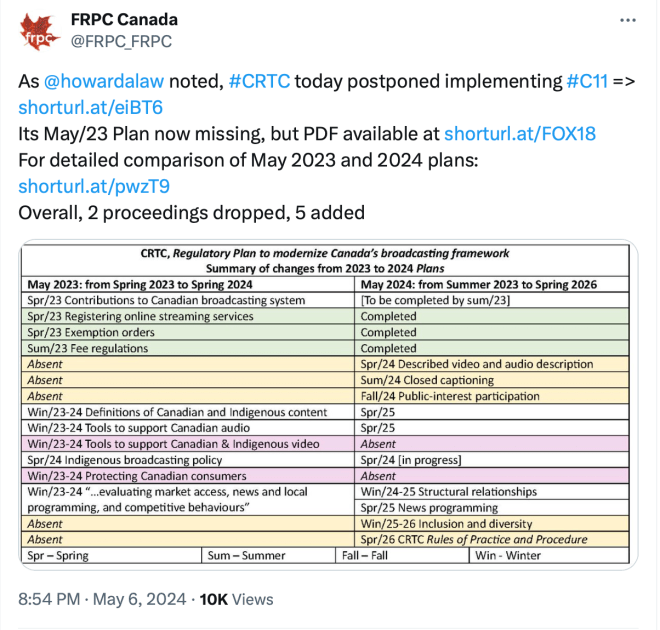
The big news is that the Commission is delaying proceedings to re-examine the definition of a Canadian program by a full year, now to begin sometime in the Spring of 2025.

The CRTC announcement also fails to clarify when it will consider the two biggest pieces of regulation: the obligations of foreign streamers to provide original Canadian programming and to make it discoverable on their platforms. At the earliest, the Commission will tell us more about that when it releases its ruling on streamer cash contributions to Canadian media funds, a decision not expected until this “summer.” So anytime between June 21 and September 21?

Monica Auer of FRPC posted this comparison of the CRTC’s initial agenda published in May 2023 and last week’s recalibrated schedule:

A blog post from a Toronto law firm noted that the CRTC’s new timetable appears to put it in violation of the two-year limit directed by the Heritage Minister only last November.

***

The Canada Media Producers Association (CMPA) released its annual industry-bellwether “Profile” report on television and film production in Canada.

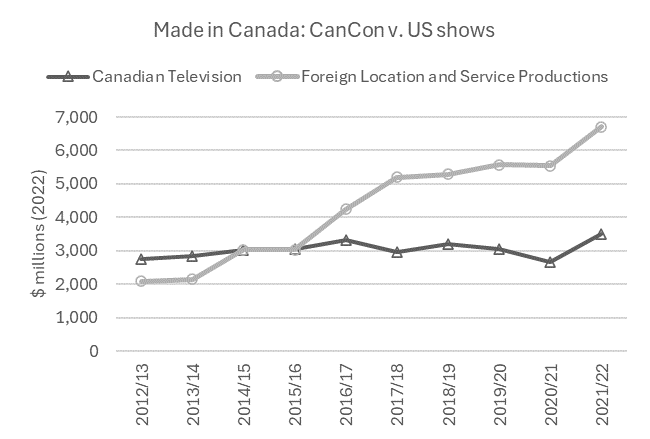
The long-term data that CMPA presents in these annual reports is indispensable to tracking the health of Canadian content production and the “service” market for US studios shooting in Canada for American release. The two most important long term (10+ years) trends are a stagnation in Canadian content production and a boom in making television and movies for the American market.

Here’s a chart based on the now outdated Profile 2022 that you will find in Chapter 7 of my book, Canada vs California: How Ottawa took on Netflix and the Streaming Giants.

Even in ordinary times, Profile’s year-by-year numbers oscillate up and down, bidding caution. In addition to that, the impact of the pandemic shut-down, the post pandemic catch-up, and the recent Hollywood actor and writer strikes has made results from the last three years into a series of one-ofs.

The newly released Profile 2023 shows solid growth for the production year ending March 31 2023 but the authors note that the effect of the Hollywood strikes won’t be measured until next year’s report. In the meantime, a report from Ontario Creates (with nine more months of data up until December 2023) reveals that the good news of Profile 2023 is unlikely to carry over into Profile 2024. Ontario government data says the province’s 2023 Canadian program production was down 21% and US service production was down 55%.

***

My recommended read this week is not a freebie. I reviewed Kim Kierans’ history of the Canadian equivalent of the Pulitzer Prize: the Michener Award for investigative journalism. Have a look at the review and decide if it’s for you. It was a great read!

***

If you would like regular notifications of future posts from MediaPolicy.ca you can follow this site by signing up under the Follow button in the bottom right corner of the home page; 

or e-mail howard.law@bell.net to be added to the weekly update; 

or follow @howardalaw on X.

We love watchdogs.

May 11, 2024

We love watchdogs. Of the journalist breed, that is.

That is the article of professional faith to which Kim Kierans subscribes in her new book about Canada’s Michener Award in public service journalism, Journalism for the Public Good: The Michener Awards at 50.

A one-time chief judge and president of the Michener Foundation, Kierans has written a needed institutional history of the investigative journalism award that was created under the flag of Governor-General Roland Michener in 1969 to pace the famous American Pulitzer Prize.

Public service journalism, writes Kierans, ferrets out the misdeeds of the powerful, “stands up to bullies, uncovers secrecy, fraud and wrongdoings, and gives voice to marginalized communities.”

This kind of journalism, alas, is blindingly expensive. Consider this graphic I put together a few years ago that puts a price tag on it:

Watchdog journalism risks being romanticized, particularly if indulging in cringeworthy homilies like “speaking truth to power.” In the book’s Foreword, former Governor General David Johnston quotes literary great George Orwell’s maxim “journalism is printing something that someone does not want printed. Everything else is public relations.”

That sentiment is mostly bullshit, but as Kierans works her way through fifty years of winning stories and exposés, you are reminded of just how explosive Canadian public service journalism has been, each and every year throughout our adult lives.

Especially important to the folks running the Micheners, recognition is awarded to stories that have had produced measurable change: a public inquiry launched, legislative action taken, restitution made, wrongdoers fired or thrown out of office.

Have a look at this list to be reminded of how many Award winners were at the centre of a major political controversy or prodded action on a burning policy issue that years later we simply take for granted as a citizen’s due.

This walk down investigative journalism’s memory lane is the best part of the book (Kierans weaves the chronology of the annual awards with the narrative of the Michener Foundation’s financial and governance issues). If you can’t respond with respect and gratitude to journalists after reading these stories, buddy you are a dead loss to humanity. 

Contemplating the idea of watchdog journalism is a good opportunity to observe the political animus towards the media that is cynically stoked by bad actors on a daily basis. Most of it comes from the right, but the populist left puts a lot of effort into it too. 

The accusation made over and over again is that journalists and their newsrooms are political, in fact partisan on a left-right basis. There could be something to that on a “curatorial” level: what kind of stories do and don’t get commissioned or published. But on a story-by-story and journalist-by-journalist basis, the huff about left-right bias is nonsense and usually spewed by people who haven’t met too many journalists.

If journalists subscribe to any “ism” it’s to the watchdog creed: that the powerful are usually up to something nasty, are covering it up, and need to be exposed so we can fix it. 

And on that basis, Kierans’ book is a salutary and enjoyable read.

***

2023 Michener Award finalists announced.

***

If you would like regular notifications of future posts from MediaPolicy.ca you can follow this site by signing up under the Follow button in the bottom right corner of the home page; 

or e-mail howard.law@bell.net to be added to the weekly update; 

or follow @howardalaw on X.