April 4, 2024
The federal government’s new Online Harms bill C-63 resembles the Online Streaming Act in at least one respect: 10% of the bill is getting 90% of the attention.
In the case of Bill C-63, the attention-getters are the hate speech provisions, covered here, here and here in this blog. I’ve included again a cheat-sheet to help you follow the precise criminal and human rights code amendments.
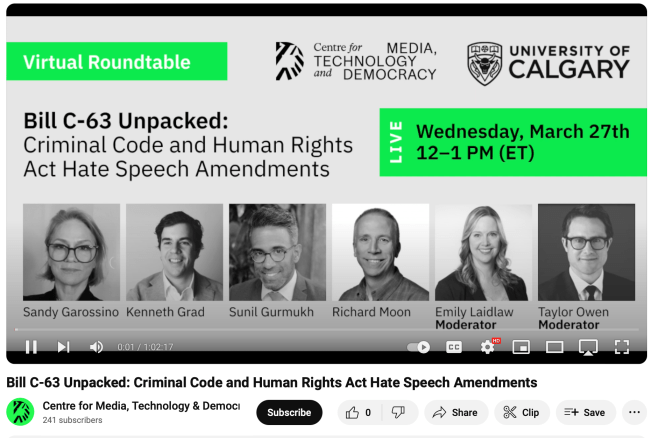
University of Calgary law professor Emily Laidlaw has posted a summary of C-63 and last week she joined Taylor Owen of the Centre for Media, Technology and Democracy to chair an expert panel, available now on YouTube.
Before giving you the experts’ headline observations, be reminded that the bill’s hate speech provisions build upon pre-existing criminal code provisions on the one hand, and on the other hand reinstate a human rights law repealed by a 2013 free vote in Parliament.
The criminal code amendments didn’t get a ringing endorsement from the panel. York University law school professor Kenneth Grad suggested that the slow and resource-heavy regulation of hate speech through the criminal code is an inefficient approach to combatting hate speech. He didn’t think that the increased prison penalties in C-63 would have much of a deterrent effect.
The other experts generally agreed with him. Sandy Garossino —the National Observer columnist and former prosecutor— said that the bill would be improved by giving the Crown the option to prosecute hate speech through “summary conviction” rather than indictable offense, chiefly because the latter requires a resource-heavy preliminary inquiry. The difference between the two prosecutorial options is that the summary conviction route is faster, carries lighter maximum prison terms (less than two years) and is more likely to get police and Crown support for laying a charge.
Garossino also favoured the bill’s expansion of the peace bond option to cover yet-to-be-committed hate speech. The peace bond provision has been the target of a fair amount of public hyperventilation over an Orwellian “pre-crime” police state. But Garossino suggests a hate speech peace bond would replicate Canada’s success with peace bonds as a de-escalating intervention in cases of stalking and repeated domestic abuse. The hate speech peace bond would have the added requirement of obtaining the Attorney-General’s consent to appear before a judge seeking prior restraint based on past behaviour.
The experts appeared divided on the “signalling” attributes of hate speech amendments. None of them used the term “virtue signalling” as the Liberals’ motivation for tabling the bill, but law professors Grad and Richard Moon saw more symbolism than substance in the criminal code amendments. Laidlaw raised the signalling question in a different light: that the bill might be society’s indication to victims in targeted communities that their interests are being taken more seriously.
The experts were more supportive of the bill’s reprise of the human rights proscription against vilifying hate speech. Grad characterized that route as more victim-centred: a civil burden of proof, cease and desist orders prioritized over punishment, and de-emphasizing the respondent’s criminal right to the defense of hate as “truth” that is prone to creating a platform for more hate speech.
Law professor Sunil Gurmukh argued that the line drawn between vilifying hate speech and awful-but-lawful speech was a lot brighter than assumed. A series of litigation precedents has already been done —for example, identifying the no-go zones of publicly vilifying Jews, women, and LBGTQ+ Canadians by using degrading stereotypes.
A note of caution was sounded by Professor Moon who cited the “disinformation campaign” behind repealing the human rights ban on hate speech. His concern was that, since 2012, hate speech has exploded on social media and any litigation-lead effort to contain it will result in the legal process being clogged and the overall effort to support human rights being needlessly disparaged and undermined.
The panel did not have time to delve into another controversial feature of the human rights amendments: the power of the Commission, under certain circumstances, to allow an anonymous complaint to proceed.
***
If you would like regular notifications of future posts from MediaPolicy.ca you can follow this site by signing up under the Follow button in the bottom right corner of the home page;
or e-mail howard.law@bell.net to be added to the weekly update;
or follow @howardalaw on X or on LinkedIn.


11 thoughts on “C-63 hate speech laws dissected by legal experts”