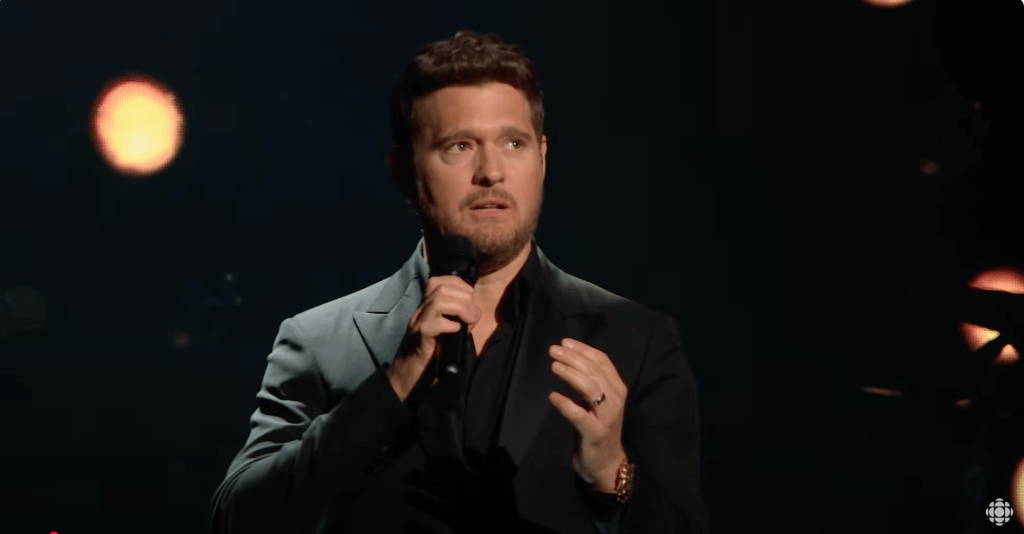
Vancouver’s Michael Bublé hosted the Junos again this year
April 1, 2025
The Toronto Star observed this week that Pierre Poilievre has become eerily quiet about defunding the CBC.
That could be because only 11% of Canadians wanted to defund the CBC when last polled in October. “Defund the CBC” has been a great fundraising and data base enrichment tool for the Conservatives, but that’s mission accomplished now.
Then there’s the roughly 30% of Canadians who, according to a year old poll, put the CBC on probation depending upon undefined “changes” being implemented.
This past weekend MediaPolicy offered an opinion on how to relaunch the public broadcaster, here.
***
This year’s Juno awards for the best Canadian musicians and songs were an opportunity for performers and fans alike to huddle together and feel the warmth of the tribe.
There’s a good background piece on the Junos from radio personality and music historian Alan Cross on why the Junos work, but not as a knock-off of the Grammys.
CBC streamed and televised the awards. Host Michael Bublé kept hitting the right note. Not just the right musical note (although check out the video above) but the right emotional connection. Bublé’s self-deprecating humility was a perfect fit for the occasion and the times.
Done as well as they were this year, the polish without pretence Junos reveal our secret cultural power as a small country.
We all know at least some of the artists with only a few degrees of separation —they are from our home town or we’ve seen them live— in a way that is less likely to happen for Americans in America.
Canada may not have the big market that puts a lot of coin in our artists’ pocket, but we have a lot of love to give them. And if this year’s show is any indication, they know how to give back.
One of the big winners was Alberta’s rising global star Tate McRae (for best artist, single, album and pop album of the year) although she was on tour in Brazil.
McRae’s accolades were an occasion for CEO Steve Jones of Canadian music broadcaster Stingray to publish another instalment in his LinkedIn campaign to make any song performed by a Canadian artist automatically eligible as a Canadian song for inclusion as Canadian content on radio.
Jones archly pointed out that the Juno panel is not wedded to the additional participation of Canadian songwriters, as is the CRTC.
The possibility that the CRTC’s “MAPL” formula for Canadian airplay quotas will be revisited is up for grabs in the Commission’s upcoming public consultation on radio and music streaming.
***
There were a flurry of announcements this week from Canadian broadcasters that typically fly below the radar.
Blue Ant’s Michael MacMillan (Cottage Life, Love Nature) teamed up with investor Prem Watsa to engineer a $100 million merger with Canadian production house Boat Rocker.
Here’s a Bloomberg video interview of MacMillan giving an easily digested synopsis of the deal, but also a neat summary of the entrepreneurial mission of Canadian broadcasters who are making television for global audiences first, domestic audiences second. Blue Ant’s big strength is in nature programming.
It’s a well known strategy that plays in both the television/streaming space ——similar announcements were made by Bell Media and Wild Brain this week— and Canadian music.
The bottom line: making Canadian content doesn’t pay in the brave new world of streamed entertainment content unless you can successfully export beyond our modest domestic market. English-language Canadian broadcasters have always exported successfully to the US cable market, but the global online audience is the future.
That’s not to write off the vital importance of the domestic market to these Canadian broadcasters, all of whom deliver on CRTC-mandated Canadian content. Making margin in their home market is still essential which is why the upcoming CRTC hearings on market dynamics in content distribution will be so hard fought.
As media consumption see-saws slowly from cable-first to streaming-first, the opportunity for Canadian broadcasters to obtain any kind of prominence for their apps or their shows in their home market through a distribution network dominated by American-owned platforms —-whether its Amazon, Roku or the prime real estate of smart television home screens —— is to be considered by the Commission in hearings scheduled in May and June.
The Commission will be especially challenged to address the online opportunities for Canadian broadcasters who by their nature will always rely almost entirely upon the domestic market: CPAC (public affairs), TV5 (French language minorities), OMNI (third language news), and Indigenous broadcaster APTN to name a few.
The Commission’s authority to compel the US distribution platforms to do anything at all is severely limited. That’s because of Parliament’s decision to exclude the online applicability of many of the CRTC’s existing powers over cable platforms that open up the opportunities of Canadian broadcasters to get carriage, prominence and fair commercial terms from the gatekeepers of Canadian audiences.
In the end there will be one set of rules for cable gatekeepers and another for online content distributors, including Canadian online distributors like Rogers Infinity.
This was all very predictable two years ago when MPs and Senators were debating the Online Streaming Act. A deeper discussion of that is included in my book on Bill C-11, Canada vs California: How Ottawa took on Netflix and the streaming giants.
***
If you would like regular notifications of future posts from MediaPolicy.ca you can follow this site by signing up under the Follow button in the bottom right corner of the home page;
or sign up for a free subscription to MediaPolicy.ca on Substack;
or follow @howardalaw on X or Howard Law on LinkedIn.
I can be reached by e-mail at howard.law@bell.net.
This blog post is copyrighted by Howard Law, all rights reserved. 2025.

 MediaPolicy.ca
admirable! 77 2025 Catching up on MediaPolicy – Carney’s CBC platform – Rogers renews NHL deal – Google’s Richard Gingras joins Village Media wonderful
LikeLike