
April 16, 2025
It’s no shocker that cultural issues, even CBC funding, haven’t emerged on any list of key ballot box issues in the upcoming federal election. Most pollsters don’t even bother asking.
The Canadian Media Producers Association nudged the political parties this week by publishing an Abacus poll on how Canadians feel about Canadian content. The CMPA represents television show producers that make almost all CanCon entertainment shows that TV companies buy and broadcast.
The cresting wave of Canadian patriotism is reflected in the CMPA/Abacus polling results. By a measure of 80% to 90%, Canadians believe that our cultural identity is important and would like to see that reflected in more and better Canadian stories on their screens through TV network investments and public funding.
The core value of protecting Canadian culture and identity from the influence of the United States is captured in this graph:
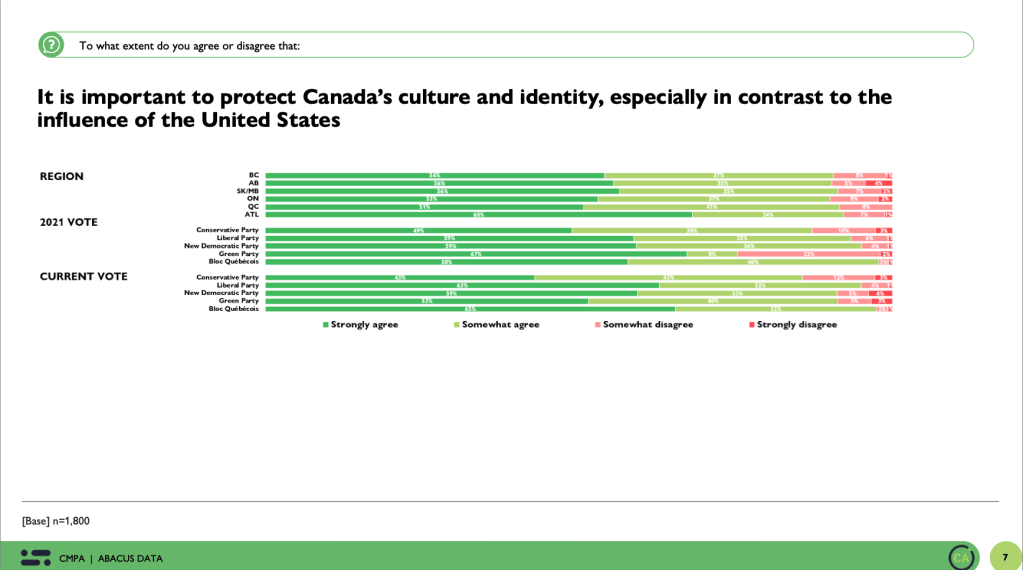
The results have a small skew by political affiliation: Conservative and Green voters are slightly less enthusiastic, but nevertheless a strong majority of those voters back Canadian content.
What’s also unmissable is the evenly spread support across Canada. In sovereignty there must be unity.
Is it a ballot box issue? The same poll says that 58% of Canadians want their political party of choice to back cultural issues, only 3% don’t. That leaves 39% as indifferent. The majority sentiment exists in each voter pool, by party.
Today I attended an all-party forum in Toronto on cultural issues sponsored by the Coalition for Diversity of Cultural Expression. Unfortunately all 50 of the Conservative candidates running in the City of Toronto were busy and the Party went unrepresented.
The CDCE held a similar meeting in Montréal on Monday. Despite the fact that Pierre Poilievre has promised to leave Radio-Canada and cultural spending in Québec alone (“no impact,” he said) he didn’t send anyone to the debate for which he was ripped in La Presse by arts columnist Mario Girard.
Liberal Culture and Identity Minister Steven Guilbeault used the opportunity to declare cultural issues as being off the trade negotiations table.
We’ll know more when the major parties table their full election platforms.
***
CTV and CBC dominate federal election news reporting on TikTok, but a study released by Reset Tech observes that 13% of videos uploaded by non-Canadian media and influencer accounts make up 45% of election-related video views. Americans, it seems, make popular videos about Canadian elections.
As observed in the Globe and Mail coverage of the report, TikTok videos may be playing a larger role in election coverage because of Meta’s self imposed news ban that blocks mainstream news reporting on Facebook and Instagram.
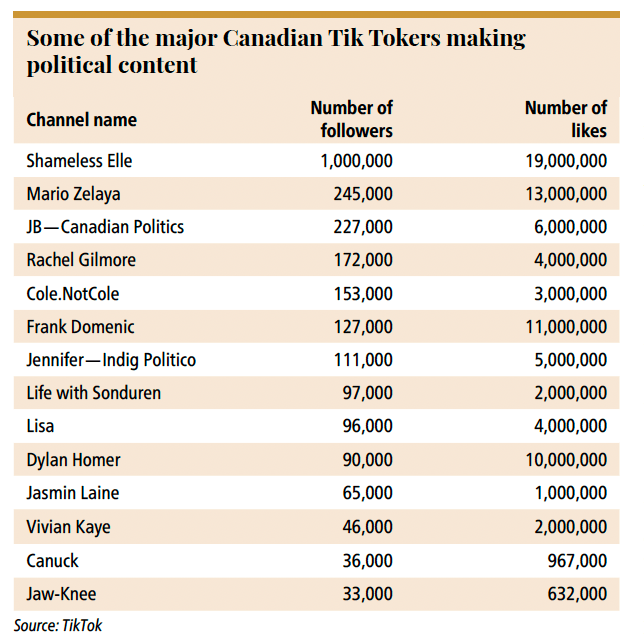
The Hill Times profiled some of the Canadian TikTokers making election content. Top spot went to a pro-Liberal account, second place to a pro-Conservative, and there is one Canadian journalist in the top ten.
MediaPolicy was able to review Reset Tech’s interim report and other than the viral success of videos uploaded by foreign-based accounts, there wasn’t anything sinister to be found, at least to date.
Of the number of videos uploaded by the top 50 accounts commenting on the election, “progressive” and “conservative” accounts were each at 40%. The remainder belong to neutral accounts such as CTV, CBC and mainstream media.
But by number of views, progressives led conservatives, 40% to 25%. The viewership gap was even wider for videos posted by non-Canadian accounts: half were progressives and 14% were conservative.
TikTok’s Canadian director Steve de Eyre published an explanation of the platform’s approach to content moderation during the election campaign. He describes the policy thus:
Support, criticism, or parody of political leaders and their policies: Allowed.
Misleading AI-generated content of political leaders, false claims about the voting process, or incitement of hate or violence: Not allowed.
Reset will release a final report after the election.
***
Two recommended reads for you.
The first is for serious policy nerds: the McGill Centre for Media, Technology and Democracy has published a comprehensive history and analysis of the Online News Act. It’s lengthy but it has an executive summary.
The other recommendation is more fun (and short). David Wilson, historian and the Editor of the Canadian Dictionary of Biography, has published a timely piece about D’Arcy McGee, an expansionist United States and Canadian sovereignty, circa 1865.
***
If you would like regular notifications of future posts from MediaPolicy.ca you can follow this site by signing up under the Follow button in the bottom right corner of the home page;
or sign up for a free subscription to MediaPolicy.ca on Substack;
or follow @howardalaw on X or Howard Law on LinkedIn.
I can be reached by e-mail at howard.law@bell.net.
This blog post is copyrighted by Howard Law, all rights reserved. 2025.

 MediaPolicy.ca
One thought on “Catching Up on MediaPolicy – Overwhelming public support for “culture and identity” – TikTok influencers make their election mark”