I am retired staff of Unifor, the union representing 300,000 Canadians in twenty different sectors of the economy, including 10,000 journalists and media workers. As the former Director of the Media Sector and as an unapologetic cultural nationalist, I have an abiding passion for public policy in Canadian media.
Today The Washington Post hosted a video interview of Senator Amy Klobuchar (D-Minn) and Congressman Ken Buck (R-Col), co-sponsors of the US version of Canada’s Bill C-18, the Online News Act.
Klobuchar’s proposed Journalism Competition and Preservation Act (JCPA) has been stuck in the Senate for two years now, cleared the Judiciary sub-committee in June, but has not come to a vote on the Senate floor. During today’s interview it became clear that Klobuchar has no idea when it will get a vote in the full Senate, although she says Senate Majority Leader Chuck Schumer (D-NY) is committed to getting it there before the end of 2024. Only then can the JCPA move to the highly dysfunctional House of Representatives.
The House sponsor Buck stole the show during the WAPO interview. The five-term incumbent from Colorado’s rural Fourth District is an interesting cat. He is a member of the conservative House Freedom Caucus but not a Trump acolyte. He has cut himself a profile as a trust-buster and foe of Big Tech market power. His commitment to saving local news outlets is that “news is what binds our community” and its decline “is a threat to the rural way of life.”
Buck’s support for the JCPA is closely aligned with the policy foundation of the Australian News Media Bargaining Code which emphasized above all the correction of Google and Facebook market power over news distribution by overriding anti-trust limitations on news outlets combining to bargain over news value with the larger tech platforms. “This isn’t ‘intervention in the marketplace,'” Buck told WAPO, “we don’t have a market, we have a monopoly.”
Klobuchar chimed in, suggesting that if US Congress can make anti-trust exceptions for farmer co-ops it can do the same for small news outlets.
As for getting a vote on the JCPA, Buck thinks Klobuchar and Schumer could get the required sixty Senators on board for an unfilibustered majority. On the other hand, Buck acknowledged in a massive understatement that getting a Senate Bill passed by the House during this session “is more difficult than in the last Congress.”
***
If you would like regular notifications of future posts from MediaPolicy.ca you can follow this site by signing up under the Follow button in the bottom right corner of the home page;
or e-mail howard.law@bell.net to be added to the weekly update;
The CRTC has tabled an application by Égale Canada to boot Fox News off of Canadian cable for allegedly violating television regulations prohibiting misinformation and abusive comment directed at transgendered people. Instead, the Commission announced its intention to review its overall policy of granting cable access to foreign television channels for unlicensed carriage at the request of Canadian cable companies.
The application arose out of comments by former Fox News host Tucker Carlson in April 2023, described by Egale as follows:
During the segment, Carlson made the inflammatory and false claim that trans people are “targeting” Christians. To position trans people in existential opposition to Christianity is an incitement of violence against trans people that is plain to any viewer. The segment also contained a range of other malicious misinformation about 2STNBGN people, including that trans people are given preferential treatment in employment and other opportunities. This is clearly an attempt to stoke resentment against 2STNBGN people
8(1) No licensee shall distribute a programming service that the licensee originates and that contains
(a) anything that contravenes any law;
(b) any abusive comment or abusive pictorial representation that, when taken in context, tends to or is likely to expose an individual or group or class of individuals to hatred or contempt on the basis of race, national or ethnic origin, colour, religion, sex, sexual orientation, age or mental or physical disability;
(c) any obscene or profane language or pictorial representation; or
(d) any false or misleading news.
The first impression of the CRTC apparently burying Égale’s application is that the Commission is either dodging a hot potato or is so overwhelmed by other telco and broadcasting files that it is content to park this one at the end of a very long queue.
A thoughtful review of the abusive comment regulation is overdue nonetheless. Over a year ago in the weeks following the Russian invasion of Ukraine, the Commission expelled Russia Today from Canadian cable in hasty obeisance to the Heritage Minister’s demand.
The Canadian abusive comment regulation is important and worth defending. Media junkies may recall that in 1987 the Reagan administration in the United States scrapped the “fairness policy” binding FCC-regulated local broadcasters (but not unregulated national cable news operations) that checked the more partisan instincts of some American broadcasters.
Irrespective of the specifics of Carlson’s ugly comments about transsexuals and the fact that he is no longer employed by Fox, the right-wing network spread and legitimized falsehoods and libels about the 2020 US election. That kind of thing might qualify as “false or misleading news” in Canada.
The Commission would be well advised in today’s political environment to think carefully about how to draw the line between political speech and disinformation as well as a measured approach to punishment other than a permanent ban. An instructive example is the CRTC’s 2004 decision to deny a licence renewal to Québec City’s CHOI-FM after its radio hosts defiantly carried on making racist and misogynistic comments.
As anyone might observe, Fox News is free to spread their editorial views, including frequently extreme opinions, over the Internet. But access to Canadian cable, reaching up to 60% of Canadian households, is an economic opportunity and a regulatory privilege, not a right.
Update: A reader reminded me that the “abusive comment” regulations for broadcasters and cable distributors don’t apply directly to non-licensed foreign channels such as Russia Today or Fox News. However the Commission has said in the Russia Today ruling they apply indirectly: “The Commission’s general approach to the addition of English- and French-language non-Canadian services to the List was set out in Public Notice 2000-173 and revised in Broadcasting Public Notice 2008-100. In regard to non-Canadian news services, the Commission determined that an open-entry approach would be consistent with the importance it places on a diversity of editorial points of view. Accordingly, the Commission stated that, “absent clear evidence, as determined by the Commission, that a non-Canadian news service would violate Canadian regulations, such as those regarding abusive comment, the Commission will be predisposed to authorize non-Canadian news services for distribution in Canada.”
***
Still on the free speech theme, former Heritage Minister (and current Environment Minister) Steven Guilbeault avoided his day in court by consenting to remove his Twitter block of the attention-starved provocateur Ezra Levant.
Guilbeault’s block was a response to Levant’s dogged Twitter insults and arguably libellous injury to reputation. The Minister had opted for blocking instead of muting which would have allowed Canadians following Guilbeault’s Twitter handle to continue seeing Levant’s disparagements.
Trolling the Twitter accounts of others is the digital equivalent of grabbing their microphone to speak to an audience the troll hasn’t earned, but federal Ministers will just have to grin and bear it.
***
The National Post has updated the ongoing story of Canada’s Digital Services Tax, set to come into force at the end of the year.
The story hasn’t changed: Canada is one of the few countries that has refused to extend the December 31st deadline for a further twelve months in hopes that the United States Congress will confirm the global tax deal negotiated by the Biden administration. The Biden deal would replace a series of Digital Services Taxes legislated by several countries with a comprehensive international agreement combatting corporate tax avoidance.
The National Post story adds the recent news that both Republicans and Democrats on the House Ways and Means Committee have published a letter decrying Canada sticking to the deadline. The letter repeats unsubstantiated claims that various national DSTs (including those already implemented by Britain and France) violate trade rules and that the US may retaliate against Canada for following the process negotiated by their President. Canada’s reputation is smeared by associating us with the few holdouts against Biden’s request to extend the agreed deadline, those holdouts being Belarus, Pakistan, Russia and Sri Lanka.
Nobody expects Congress will actually pass Biden’s tax deal and the Post story quotes an expert expressing doubt the US Congress will comply. In fact, a cursory glance at the Ways and Means Committee website (curated by majority House Republicans) makes it clear that extending the deadline until the end of 2024 is pointless: in a recent news release targeted at European countries that have already acquiesced to Biden’s deadline extension, the Republicans describe the Biden deal as “a global tax surrender.”
In view of the Republicans’ position, it’s unclear why 138 countries agreed to Biden’s deadline extension. Our federal government is keeping its strategic considerations close to the vest.
***
Today’s recommended read is a video. The Wall Street Journal has an eight-minute explainer of US Federal Trade Commissioner Lina Khan’s aggressive approach to anti-trust enforcement.
***
If you would like regular notifications of future posts from MediaPolicy.ca you can follow this site by signing up under the Follow button in the bottom right corner of the home page;
or e-mail howard.law@bell.net to be added to the weekly update;
Yesterday the federal government satisfied Google’s and Facebook’s number one demand on the Online News Act Bill C-18, limited liability.
The draft regulation establishes 4% of their Canadian revenues as the minimum compensation owed to Canadian news outlets to avoid binding arbitration. Government briefings pegged the total amounts as $172 million for Google and $62 million for Facebook.
The four per cent is a lump sum for Canadian journalism, divided among eligible news businesses. The regulation provides the Big Tech platforms with elbow room on how to distribute it through negotiated settlements with news outlets, either individually or in bargaining coalitions assembled by smaller media outlets.
Platforms are permitted to negotiate non-cash compensation to news outlets, such as technical support and training, although the CRTC will decide if substitutes for real money are authentic. Perhaps more critically, the regulation contemplates a 20% value range of compensation outcomes, meaning the Platforms can negotiate richer deals with some news outlets, thinner with others. That should spark some commentary from advocates for niche news outlets who fear getting the short end of the stick.
The regulation also limits the number of independent news outlets that Google or Facebook can ignore to “any group of 10 independent news businesses operating local news outlets.” An independent news business is defined as having five or fewer news outlets, for example a regional publisher with several community titles, so up to 50 community news websites could be left out.
Facebook flatly rejected the regulation and continues its Canadian news throttle. Google is quiet and keeping its powder dry. As the CRTC has already delayed the beginning of negotiations until early 2025, an election year, the platforms may choose to wait out the government.
Both platforms can still avoid the 4% payment and test the validity of their claims that they owe nothing and that news publishers and broadcasters are in fact the beneficiaries of the value exchange between platforms and journalism. The proposed regulation applies only to the “exemption” of Big Tech from submitting to binding arbitration where their claims can be put to the test.
Two weeks ago, I drew your attention to a story in The Logic that the University of Toronto Law School had secretly accepted a $600,000 gift from Amazon to fund scholarship in competition law.
The university is now returning the unspent balance to Amazon. Law Dean Jutta Brunée explained that her initial decision to keep it all secret was that she didn’t want competition scholars to be influenced by the donation from a major monopolist. The federal government is currently reviewing the Competition Act and considers public submissions from law professors and the general public.
Brunée issued a statement saying she was right to have kept the gift secret but now, the matter having been exposed by The Logic, she is giving the money back because of public perception:
The Faculty of Law upheld the University’s firm commitment to academic freedom, institutional autonomy and integrity. Nonetheless, we acknowledge the important questions raised about the lack of full transparency pertaining to the gift, and the perception of external influence on our academic activities.
It would be interesting to have been a fly on the wall at the most recent meeting of the law faculty (the academics having been kept in the dark about the gift). I feel rather confident there was a rebellion. Prior to the Dean changing her mind, the U of T Faculty Association condemned the gift. UTFA’s principal objection was “most disturbingly, the [Logic] article reveals that Amazon’s donation was not disclosed to the academic community or to the public, and further, that speakers who participated in a seminar funded by the donation were chosen from a list prepared by Amazon.”
No doubt a parallel may be drawn between Amazon funding and trying to influence research on competition law and its Big Tech cousins funding news under Bill C-18. One difference between the two situations is the presence or absence of transparency and regulatory controls on how the money is distributed.
***
Amber Dowling has a well-worth-reading piece in the Globe and Mail marking the gap between what Hollywood streamers said they were already doing for Canadian content and what they are in fact doing.
***
If you would like regular notifications of future posts from MediaPolicy.ca you can follow this site by signing up under the Follow button in the bottom right corner of the home page;
or e-mail howard.law@bell.net to be added to the weekly update;
Last week saw another lap around the Meta news throttle oval.
Not a great deal has changed. The new Heritage Minister Pascal St.-Onge invited local Meta spokespersons for a chat and St.-Onge emerged with an upbeat message on breaking the impasse over Bill C-18 and Big Tech payments for news content. Meta did not, sticking to its “repeal the Bill or else” messaging.
As the weeks go by, the government will continue to harvest the news cycle windfall of Meta catching important news sources and public interest information in its news throttle net. Meta’s blackout of wildfire news stories is embarrassing for the company, as are the latest throttles of a Facebook page spotlighting inadequate palliative care and another page belonging to an American online literary journal run by Canadian ex-pats.
In the latter case Meta is learning a new lesson: don’t mess with literary journals. The Globe caught some zinger quotes from page owner Matthew Friedman who described the news throttle “as a form of corporate gunboat diplomacy” because Meta “wants to make an example of Canada. They want to put out this fire before it runs out of control. This is corporate colonialism.”
Facts.
None of this back and forth appears to be changing the battle lines drawn on C-18. However a significant development that must affect the strategic choices of all concerned is the out-of-left-field CRTC announcement that its pre-implementation consultation on Bill C-18 will stretch out a full 18 months until early 2025, when bargaining for news payments will only begin.
Another C-18 development flying under the radar was an academic study published in Switzerland with the support of news publishers. The point of the study can be traced back to the origins of the Australian New Media Bargaining Code as a public remedy to a private Big Tech duopoly in news distribution over Search (Google) and social media (Facebook and Instagram).
These studies are published from time to time, backed either by Big Tech or news publishers, so take them with a grain of salt. Also, they can’t be run on large data sets since those belong to the platforms and they aren’t sharing. Instead these studies are self described experiments. In this recent case 1,573 Swiss respondents looked for information on Google Search but also on a re-engineered mock-up that eliminated news sources.
The Swiss study concludes that news is of value to search engines, it generates advertising for search engines, and —the money shot— a series of industry benchmarks on the sharing of advertising revenue suggests that in a competitive market news publishers ought to get 40% of Google’s ad revenue associated with information searches. The study doesn’t use YouTube’s advertising revenue split as a benchmark, but the Google-owned hosting platform compensates YouTuber creators with 55% of the ad revenue associated with their viewership.
Quick math, that’s $233 million in Google payments to news outlets in a country with 8.5 million population.
The English-language public broadcaster of public programming and educational content is a shadow of its former self after years of funding neglect and layoffs by provincial governments of all stripes. Steve Paikin’s news magazine The Agenda remains its flagship.
Wages have fallen behind the cost of living by about 30% in the last 10 years, accelerated by TVO being caught in the widely cast net of Premier Doug Ford’s public service wage controls (now ruled unconstitutional but under appeal).
Another sticking point is a concession demanded by the management-side: deleting a long standing contract clause that puts a two-year time clock on temporary positions before they become permanent. It’s a clause found in several mature media collective agreements. If removing this clause really is a sticking point (and not just a hostage taken by management because of the strike over wages) it’s probably a sign that TVO doesn’t want to be candid with their political masters about employee headcount.
***
Bell is terminating its 28-year patronage of the Toronto International Film Festival. According to various reports, the funding is worth $5 million per year. Bell’s name and logo will come off of TIFF’s downtown headquarters within the year. This September’s festival will be the last with Bell’s resources just as TIFF has emerged from the Covid crisis and run smack into the Hollywood talent strike.
There is a helpful background piece from Etan Vlessing in the Hollywood Reporter. It would be interesting to know exactly when Bell made this decision (apparently “earlier this year”). Like the mass layoffs it announced in June, Bell’s retreat from TIFF has a touch of political theatre for the benefit of the CRTC and perhaps the rest of us too. Any observer will remark on the trifling amount of money involved for Canada’s largest media company. Maybe Netflix will step in.
There is a conceptual segue here from the TIFF story to the topic of the corporate cross-subsidies we have come to expect (and the CRTC has enforced) in media. I recommend a recent blog post from Mark Goldberg who is a telecommunications consultant with a flair for reminding us of what’s what.
***
If you would like regular notifications of future posts from MediaPolicy.ca you can follow this site by signing up under the Follow button in the bottom right corner of the home page;
or e-mail howard.law@bell.net to be added to the weekly update;
Opposition Leader Pierre Poilievre’s testy relationship with journalists, and his campaign team’s best efforts to portray it as a grudge match, re-emerged this week.
Poilievre was challenged by a CBC reporter on why he has revived conspiracy theories about the World Economic Forum during his summer campaign tour. He refused to answer the question and instead demanded the CBC reporter cite the source of the allegations. When she stumbled, he dismissed her questions as “another CBC smear job.” Other news organizations reported on the story, so Poilievre followed up the attack on the public broadcaster in a tweet claiming that “CBC’s news service CP [Canadian Press] wrote a hit piece on me because I dared criticize the World Economic Forum.” (The news agency Canadian Press is owned by three private news organizations, not the CBC).
When the Canadian Press story was carried online by several news sources, with the CP-supplied headline intact on all platforms as is often the case, Conservative MP Andrew Scheer alleged “media collusion.” (See above).
A number of journalists condemned the opportunism. On Canadaland, Jesse Brown’s guest Nora Loreto suggested the press could do better than re-hashing a stale story about Poilievre peddling conspiracy theories and should have focussed on a different angle, perhaps that the Conservative leader’s economic program is likely to be aligned with views expressed by ‘globalist’ participants in the WEF. Or maybe journalists ought to focus on his recent ‘make-over’ bid that includes losing the glasses and struggling into an undersized T-Shirt (on the latter point, recall former leader Erin O’Toole’s 2021 campaign photos).
On the other hand, the conspiracy story is fresh and not stale if it focusses on Poilievre continuing to dip into the well of antisemitic far-right anthems while simultaneously trying to broaden his appeal through the make-over.
***
The wildfire-induced evacuation of the city of Yellowknife is in the news as was a similar tragedy in Fort McMurray in 2016 and Lytton in 2021.
Updated news journalism about the wildfire’s threat to life and property was not available on Facebook or Instagram because of the Meta news throttle in retaliation against Bill C-18. Unlike Facebook’s Australian news throttle in 2021, this time the social media giant is not blocking official emergency information distributed by government agencies.
The Liberals were immediately on it, condemning Meta for the news throttle and raising the question why it didn’t temporarily rescind the block on news sites. This touched off another round of the blame-game about whether the federal government or Meta is responsible for the throttle. Expect this to continue indefinitely.
If anything helpful can come out of this argument about assigning responsibility, it would be a discussion of Facebook’s market power over news distribution, something along the lines offered by news sources in this Canadian Press story. (no Mr. Poilievre, not the one owned by CBC, the other one).
***
The Logic did some good work this week in publishing Martin Patriquin’s investigation of Amazon’s $600,000 donation to the University of Toronto Faculty of Law to influence debate about Canadian competition law reform. The story offers some disturbing revelations about administrative secrecy and torquing the debate in favour of maintaining Canada’s status quo of how it polices the market power of companies like Amazon. As an alumnus, I found it especially upsetting.
(The story is paywalled but if you surrender your e-mail address you can access it, a small price to pay given the quality of the stuff you can read on The Logic).
***
If you would like regular notifications of future posts from MediaPolicy.ca you can follow this site by signing up under the Follow button in the bottom right corner of the home page;
or e-mail howard.law@bell.net to be added to the weekly update;
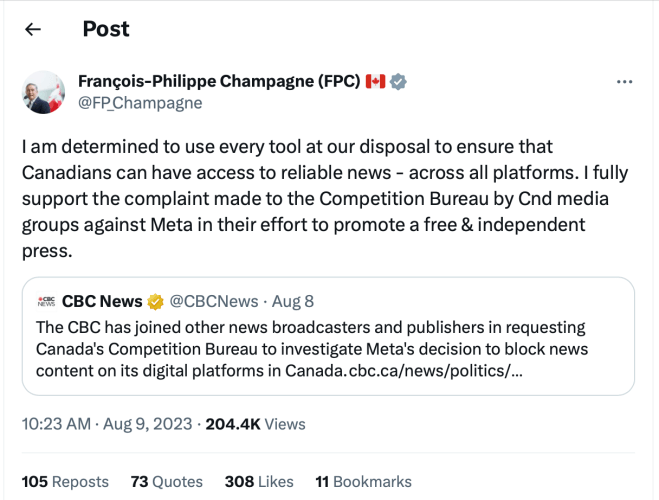
Clearly admiring my approach, ISED Minister François-Philippe Champagne tweeted his own encouragement. Champagne is Boswell’s governing cabinet minister.
Cue the entirely justified outrage from conservative commentators. Norman Spector tweeted that such blatant interference with the Bureau’s independence ought to result in Champagne’s dismissal from cabinet.
I will second that motion provided its retroactive to September 8, 2014 when Stephen Harper’s Heritage Minister Shelley Glover made public statements forbidding a CRTC “Netflix tax” culture levy while the Commission was in the thick of considering it:
We will not allow any moves to impose new regulations and taxes on Internet video that would create a Netflix and Youtube tax – Heritage Minister Shelley Glover, September 8, 2014
The Commission complied.
Cabinet ministers just can’t seem to resist the catnip of asking for regulatory outcomes they aren’t supposed to influence. You could write a book about it going back decades. The most recent examples include Heritage Minister Pablo Rodriguez ordering the CRTC to ban Russia Today from cable TV or CRTC Chair Vicky Eatrides’ telepathic connection with cabinet on wholesale Internet pricing and YouTube videos.
Champagne should disavow his tweet.
(Update: A reader contacted me pointing out the Minister has the authority under section 10(1) of the Competition Act to direct the Bureau to investigate. Possibly this mitigates Champagne’s actions but also raises the question of why the Minister didn’t act on his own, prior to the request being made by news agencies).
***
Charlotte Gray has a piece in the Globe spotlighting the dire prospects for publishing Canadian non-fiction. The loser is educating Canadians in the history of our country.
Gray discusses the role of corporate concentration of Canadian book publishing but she could have added, for more context, the disruption and monopolization of book distribution by Amazon. For that you might turn to Chapter 2 of Cory Doctorow and Rebecca Giblin’s recent book, Chokepoint Capitalism.
News in the book and movie worlds overlapped this week when Paramount (owned by ViacomCBS) announced it was selling its book division Simon & Schuster for $2 billion to a private equity firm. The sale coincides with some bad quarterly financial numbers for Paramount, something it shared this week with Disney.
***
The weekend read I am recommending today runs in the same vein as my suggestions from previous weeks: what conservatives are to do about the presence of fascists and near-fascists in their midst. I am only plugging Andrew Coyne’s column today because I finally agree with him on something, an occasion that I mark.
Coyne is responding to Sean Speer’s description of the “definitional fight” between “FreeCons” and “NatCons.” Says Coyne, that’s a contest involving no more than one authentic stream of conservatism:
This dichotomy, it should be said, puts rather a more dignified face on things than is probably warranted. Whatever its intellectual pretensions, national conservatism is essentially an exercise in on-the-fly revisionism, an attempt to put a retroactive cerebral gloss on the bundle of inchoate resentments and grievances that assembled behind the figure of Donald Trump. As such, it seeks to give coherence to a phenomenon that is fundamentally incoherent: Trumpism gone to college.
***
If you would like regular notifications of future posts from MediaPolicy.ca you can follow this site by signing up under the Follow button in the bottom right corner of the home page;
or e-mail howard.law@bell.net to be added to the weekly update;
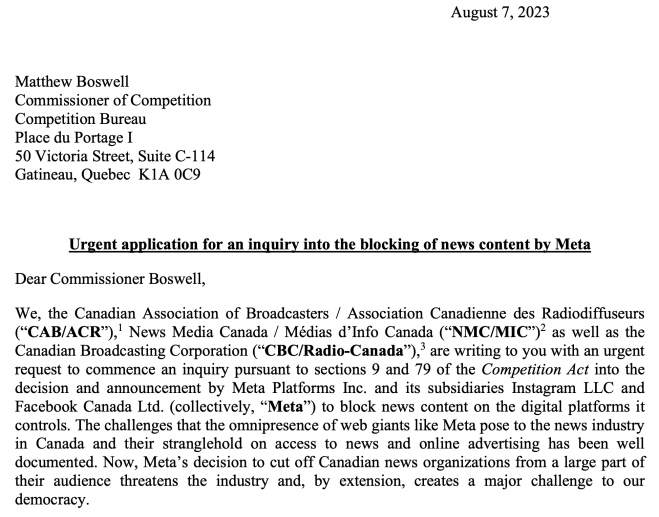
Now we may see what he might do about foreign owned web giants that are several times the size and market power of Rogers in response to a request from Canadian news organizations —broadcasters, news publishers and the CBC—- asking the Bureau to open an abuse of dominance investigation against Meta for blocking Canadian news on Facebook and Instagram. They want the Bureau to order Meta to stop the throttle.
The request cites Meta’s 70% dominant position in news distribution and digital advertising over social media platforms. Its domination of social media impacts 25% of news organizations’ access to Canadians on all platforms and the advertising revenue that comes with it. Meta’s news throttle will harm many news organizations (who compete with Meta for digital advertising) and possibly put some out of business.
There aren’t a great many competition law experts in Canada: two experts who could hardly be tagged as defenders of Big Tech, Keldon Bester and Vass Bednar, have publicly expressed skepticism about the legal merits of the complaint under the Competition Act as it is currently drafted.
The University of Ottawa’s Jennifer Quaid, whose opinions are to be sought in competition matters, was diplomatic in her comments this morning on CBC radio, acknowledging only that the complaint is well drafted.
There will be some close legal arguments around defining “the market” in which the alleged anti-competitive news throttle has occurred. If the Bureau decides that Meta does possess sufficient market dominance in either news distribution and/or the advertising revenue it generates, the remainder of the legal requirements to prove the news throttle is an anti-competitive practice and harms competitors may fall like dominoes. They did in France in 2020 after Google responded with its own news throttle to a law similar to Bill C-18: the French competition bureau found Google culpable of abusing its dominant market position and ordered an end to the news block.
Google’s position in Canadian news distribution and digital advertising is at least as dominant in Search as Meta is in social, so this new complaint is for Google’s benefit as well.
As I have posted previously, the Big Tech revolt against Bill C-18 is a nine-inning game and we are probably in the middle innings. There will be more parry and thrust before it’s over.
If you would like regular notifications of future posts from MediaPolicy.ca you can follow this site by signing up under the Follow button in the bottom right corner of the home page;
or e-mail howard.law@bell.net to be added to the weekly update;
The first was co-written with Toronto Metropolitan University’s Ivor Shapiro and appeared on the IRPP website. It is a continuation of the policy discussion on a national news strategy that was kicked off in June by Peter Menzies and Konrad von Finckenstein.
The contribution from Ivor and myself is to build on the Menzies/KVF idea that the CBC is the foundation of any strategy countering the market failure of news journalism. And the four of us agree that we have to get back to a place where there is a truly “private” private-sector news industry that co-exists with the publicly funded CBC. The question is how to get there and the disagreement I would suggest is what we are willing to risk —given the existential requirement of news journalism in our democracy— to get there.
In practical terms, Ivor and I have added two essential elements to this work-in-progress: prioritizing news gathering in state support for journalism and reinforcing its political legitimacy with far more transparency in its administrative governance. My own pet idea is a constituent assembly that elects a board of directors to oversee the administration of public subsidies and incentives.
The other MediaPolicy post turns back to Bill C-11 with a summary of ‘What Hollywood Wants.’ It’s a review of the Motion Picture Association’s written submissions to the CRTC regarding how the US studios and streamers should contribute to Canadian content under the new legislation.
Related to that post, Johanna Schneller has an analysis piece in the Globe suggesting that lately Hollywood has been making a bad bet on high-budget thrillers. I’m not convinced of that without the full monetization numbers for those movies, especially the foreign box office receipts which are typically two-thirds of the take.
In any event, Schneller isn’t entirely hyperbolic when she says that the Hollywood streaming platforms “are bankrupting their studios to keep up” with each other. Only Netflix makes money and one feels that either cost retrenchment or a culling of the streamer herd is only a matter of time.
***
If you are looking for some good reading, here are some suggestions.
Sean Speer has co-written a brief column with Pierre Poilievre’s communications director Ben Woodfinden describing the political ideology of Canada’s first Prime Minister Sir John A. Macdonald’s as a hybrid of nineteenth-century conservativism and classical liberalism.
That’s not a contentious point but what is interesting is they latch on to the idea of “state capacity” conservativism which they describe, in its circa 1867 context, as nation building under the shadow of the American juggernaut to the south.
Their line of argument could easily apply to cultural regulation in this modern era —it certainly did in Brian Mulroney’s Conservative Party— though no doubt Speer and Woodfinden would say times are different now. Speer has suggested Bill C-11 is the “hidden agenda” of Quebec cultural nationalists and Woodfinden’s boss wants to repeal it.
More bingeing on Speer, he has an excellent podcast (24 minutes) with David Frum exploring the phenomenon of young conservative men “falling down a far-Right path” or as Frum puts it “young conservatives and the fascist temptation.” (My contemporary, Frum made me chuckle by describing left-wingers of the 1970s and 1980s as “emotional.”)
This follows a Speer column I linked to last week which positions Pierre Poilievre as a libertarian conservative competing for the soul of Canada’s conservative movement with ‘nationalist’ conservatives.
***
If you would like regular notifications of future posts from MediaPolicy.ca you can follow this site by signing up under the Follow button in the bottom right corner of the home page;
or e-mail howard.law@bell.net to be added to the weekly update;
Reading CRTC regulatory filings can be an eye-rolling experience. Almost without exception, the written submission from each industry player is self-serving and chock full of cherry picked quotations and wildly overstated arguments. And this is just in their initial submissions. The reply filings commenting on each other’s views are even more fun.
The Motion Picture Association of America (MPAA) represents the Hollywood studios and streamers —Netflix, Disney, Paramount, Warner Discovery, NBC Universal et al— collectively, the new 900-pound gorilla in the CRTC regulated system.
The MPAA’s first bid on regulatory obligations filed in early July went something like this:
MPAA opposes the Commission’s proposal to levy an ‘initial base contribution,’ in cash, from all foreign and Canadian broadcasters to feed the various television funds that underwrite Canadian TV production. The MPAA wants to limit the streamers’ CanCon obligations entirely to making their own Canadian shows, known in CRTC vocabulary as “Canadian Programming Expenditures” that normally amount to 30% of annual revenue (and translate into a higher percentage of programming budgets).
The MPAA proposal means no mandatory cash contributions from Hollywood streamers to news funds, Indigenous content production, or any other media funds that Canadian cable companies (but not TV networks or channels) have always sponsored through a tithe set at five per cent of annual revenue. In fact, the MPAA (and all of the other streamers) are ignoring the Commission’s requirement to table a number.
The MPAA says that the streamers’ Canadian shows should be certified under a new definition of Canadian content that relies less on the participation of Canadian producers and creative talent and more on Hollywood writers and actors (to wit, the much-touted British model for certifying home-grown video content permits the use of an All-American cast and key creative talent provided the show is ultra-British in its story and setting).
As for the CRTC process, the MPAA and all foreign online undertakings participating for the first time in Canadian regulatory hearings object to the Commission determining an ‘initial base contribution’ before moving on in a second phase of hearings to consider Canadian programming expenditures and a review of the definition of Canadian content. The MPAA says the CRTC is putting the cart before the horse and this is prejudicial to the streamers’ regulatory presentations.
There certainly are common sense reasons for the CRTC to have considered all three big regulatory pieces at the same time, but it appears Chair Vicky Eatrides is eager to get some US money into Canadian media funds quickly and that in the long term a sustainable flow of cash contributions has to come from broadcasting undertakings whose business models are on the rise (the US streamers) and in decline (Canadian legacy broadcasters).
The MPAA is so disgruntled by Eatrides’ approach that it is already threatening court action if it doesn’t like the outcome of the hearings: it cites a rather weak administrative law argument about procedural fairness.
And all of this was before MPAA Canadian director Wendy Noss got a peek at rival submissions filed simultaneously by Canadian broadcasters. Two weeks later, her reply submissions to the CRTC filed are so ferocious you imagine you can see the veins bulging in her forehead.
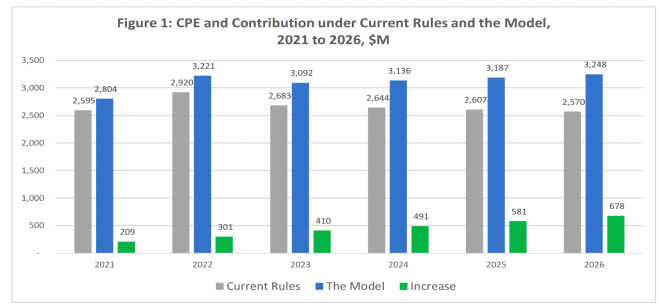
The Canadian broadcasters, as this space has observed previously, want to lower their regulatory obligations to sponsor media funds and make Canadian shows while raising matching obligations on the US streamers from zero to parity with Canadian competitors. They fix this ‘meet you in the middle’ figure at 20 % of annual revenues and provide a handy bar graph demonstrating that the entire CanCon system will be flush with cash from both foreign and domestic broadcasters.
Bell proposal for a harmonized 20% CanCon contribution from US streamers & Canadian broadcasters.
But there is a twist to this harmonization. The Canadian broadcasters want the US streamers to contribute their 20% entirely in cash contributions (before even discussing programming expenditures on their own Canadian shows).
Cue the vein popping and some truly provocative arguments from the MPAA.
The first pitch Noss makes on behalf of Hollywood is that when Bill C-11 says that US streamers must contribute ‘equitably’ to Canadian content, it really means ‘contribute less than Canadian competitors.’
This is bunk of the highest order but, to summarize, she has misconstrued the notorious section 3(1)(f) of the new Broadcasting Act that grants US streamers some yet to be defined flexibility in using American talent as authority for the proposition that Hollywood’s overall level of contributions should be less than Canadian contributions.
Then there is her slap down of the Canadian Media Producers Association which had the temerity to tell the CRTC that under the new regime independent Canadian producers should retain intellectual property in the ‘CanCon’ shows they make and then license to broadcasters and streamers.
The control of long-term commercial exploitation of Canadian shows is important to the CMPA whose members earn a lot of money making shows for the US audience on a ‘turn-key’ contract arrangement with the streamers but want to keep growing the base of their original business, which is making Canadian shows for the Canadian market.
Noss cuffs the CMPA around for being ungrateful for the Hollywood patronage and then, in the coup de grâce, claims that Hollywood already makes ‘more genuine’ Canadian content than Canadian producers:
43. We note that while many members of the CMPA have benefitted from the contributions that have been made over the years by foreign streaming services and studios, the CMPA now argues that the Commission’s new contribution framework must distinguish between the domestic production industry and foreign service production based on a theory of cultural and competition policy versus industrial policy. We believe this theory is without merit. If a production is advancing the broadcasting policy objectives of the Act — with respect to use of Canadian creative and human resources; the telling of Canadian stories; displaying Canadian talent; encouraging the development and export of Canadian programs globally; serving the needs and interests of all Canadians; reflecting and being responsive to the preferences and interests of various audiences (among others) — we fail to see how that production is not advancing cultural policy. As set out in the individual submissions filed by Disney, Netflix and Paramount, oftentimes so-called “service productions” tell more genuinely Canadian stories that showcase Canadian storytellers, talent, culture and geography than domestic “Canadian content.”
If you would like regular notifications of future posts from MediaPolicy.ca you can follow this site by signing up under the Follow button in the bottom right corner of the home page;
or e-mail howard.law@bell.net to be added to the weekly update;
The path toward a consensus strategy to bolster news journalism took a few new twists in Canada’s smoke-filled early weeks of summer, 2023.
The federal parliament passed the Online News Act, a.k.a. Bill C-18, and its chief targets, Meta and Google, promised news-throttling countermeasures. Bell Media, owner of the country’s biggest private TV network, cut 340 jobs and then asked the CRTC for relief from all license conditions for local news. Meanwhile, the two biggest online journalism companies in Canada – Postmedia and NordStar – announced merger negotiations (only three years after their “swap and close” deal shuttered 44 local publications) and then halted talks citing, amongst other things, “regulatory and financial uncertainty.”.
Into this conflagration of reminders of Canadian journalism’s sustainability crisis came an ambitious proposal for a national news strategy from respected conservative voices Konrad von Finckenstein and Peter Menzies, published June 7th by the Macdonald Laurier Institute…
Please continue reading in English or French at Policy Options, the Institute for Research on Public Policy.








 MediaPolicy.ca