Six C-11 amendments the Senate must pass.

November 21, 2022

The Senate Transportation and Communications committee is set to debate amendments to Bill C-11 at Wednesday evening’s session.

Unelected Senators are expected to be the chamber of sober second thought but not the gallery of second guessers. 

After all, the Online Streaming Act was studied by the Commons Heritage Committee for twelve days before being approved in a blur of amendments on June 14th. The Bill was a reboot of the previous Parliament’s thoroughly debated Bill C-10 and subsequently placed before Canadian voters in the federal Liberals’ 2021 election platform.

But grâce à the Conservatives’ avowal to indefinitely filibuster C-11 in the Heritage Committee, the other parties representing a majority of MPs and voters set a June 14th deadline. That resulted in 42 amendments rushed through the Heritage Committee in a mere twelve hours; some for better, some for worse and some left on the table.

That ugly Parliamentary episode is why it’s legitimate for Senators to aggressively amend the Bill and offer the Minister and the House an opportunity to pass a better one.

Without knowing whether a back channelled discussion of amendments between Senators and Heritage Minister Pablo Rodriguez has occurred, MediaPolicy.ca hereby tenders some gratuitous advice on a better C-11:

Parliamentarians, Do No Harm.

There are provisions in C-11 that are a step backwards for Canada’s broadcasting policy and fixing them deserves non-partisan support.

1. Repeal section 7(7). This dangerous power grab on behalf of federal cabinet to micromanage almost anything under the Act that is normally the responsibility of the arm’s length CRTC has got to go. There is no acceptable version of it. MediaPolicy.ca explained why, here, as did broadcasting experts Robert Armstrong and Monica Auer.

2. Update the public’s right under section 28(1) to appeal to federal cabinet any Commission “orders” to the newly created class of (mostly foreign) online undertakings that play the same role as licence conditions for (mostly Canadian) conventional broadcasting. Appeals to federal cabinet are an important safety valve in the event of egregious policy errors by the Commission. Some might advocate for either a broader or narrower right of appeal to cabinet but including “orders” under section 28(1) simply maintains the status quo in the Internet era.

3. Defend Canada’s cultural sovereignty. The CRTC routinely enforces fair treatment of Canadian programming services by cable companies. That includes a short list of “section 9(1)(h)” public interest channels the Commission deems “must carry” at a fixed compensation rate. The House Bill fails to make these Commission powers binding on foreign online undertakings like Roku, Pluto TV or any number of content aggregators, apparently reflecting Heritage Canada’s fear of an American trade complaint. Do it anyway.

4. In the same vein, repudiate the two-tier favourtism shown to Hollywood studios to use less Canadian talent and production workers than expected of Canadian filmmakers and domestic media companies. Heritage Canada never explained why foreign companies deserve special treatment under a revised section 3(1)(f) but the House Bill certainly gives a new twist to the phrase “most favoured nation status.” And it’s not Canada.

5. Repeal the anti-worker, Hollywood-appeasing section 31.1 which exempts Canadian actors, writers and directors working for online undertakings from the federal Status of the Artist Act and invites American studios to make movies in Canada, draw from our hefty film production tax credits, and operate non-union. It’s hard to understand how federal Liberals would want to be within a thousand miles of this odious provision (it was introduced last minute by the Liberals in the chaos of June 14th as a sop to foreign streamers ).

6. Save local news. This ought to be an easy one. The Unifor amendment strengthens the Commission’s authority to order better financing for local newsgathering, flowing from broadcasting distribution undertakings (e.g. cable companies) to broadcasters. After all, the House Bill removed $120 million in annual “Part II fees” that big Canadian media companies have been paying into the federal treasury, so they can afford it. The Unifor amendment also modernizes the Commission’s authority by including “online undertakings” as the source of news funding when inevitably it will be necessary.

Send a message.

One can’t discuss amendments to C-11 without acknowledging the campaign by Google, Digital First Canada and the Conservative Party to remove provisions in C-11 regulating uploaded videos and music on social media platforms.

In fact their campaign demands a roll back of the Commission’s broadcasting jurisdiction by permanently removing American hosting platforms from Canadian regulation.

The campaign has a libertarian inspiration that clashes with the policy objectives of the Act, but it has been fueled by YouTubers’ visceral fears of regulatory overreach once the Bill has passed. It doesn’t help that the Minister elected not to publish a draft policy directive that might have given the CRTC clear instructions to exempt programs made by small scale content creators and ensure that “discoverability” measures don’t backfire.

But the Liberals, Bloc and NDP don’t share those fears of overreach so the most the Senate can do, if so inclined, is to send a message to the Minister for the Policy Directive he says he will publish after Royal Assent.

That message might be expressed as regulatory exemptions tied to revenue thresholds applied to either the platforms’ and/or creators’ businesses. Another message might express regulation of recommendation algorithms as an exceptional measure.

Don’t hold your breath.

The House Bill includes an elevated process of public consultation over broadcasting policy affecting Official Minority Language Communities in a manner that seems more geared to an expression of respect for those communities than practical necessity.

However an amendment will likely go nowhere. 

And so.

Perhaps an unnecessary last word to Senators: debate but don’t delay this Bill.

***

If you would like regular notifications of future posts from MediaPolicy.ca you can follow this site by signing up under the Follow button in the bottom right corner of the home page;

or e-mail howard.law@bell.net to be added to the weekly update;

or follow @howardalaw on Twitter.

Catching Up on MediaPolicy.ca – Senate moving towards C-11 amendments – Conservatives begin filibuster of C-18 – “Viral News” doc on Toronto Star covid coverage

Toronto Star photographer Steve Russell fends off a resident preventing him from shooting the aftermath of an apartment fire. From Kevin McMahon’s documentary “Viral News.

November 19, 2022

MediaPolicy.ca posted a summary of Wednesday’s Senate Committee hearing on Bill C-11 in which Senators tried to pin down CRTC Chair Ian Scott on how a future CRTC might apply the Bill to video and music uploads on YouTube, Spotify and other platforms.  The post called on the Committee to move on to amendments. 

Yesterday the Senate announced a final day of hearing witnesses (Minister Rodriguez and his staff) next Tuesday, followed by debate over amendments beginning Wednesday.

Earlier in the week I posted about C-11 amendments proposed by Bell that have flown under the radar. The amendments are aimed at recapturing Canadian broadcasters’ opportunity to buy American programming for retail to Canadians, in line with the long-time strategy of subsidizing local news and Canadian content with profits earned from hit US shows. 

The first day of amendments to the “FaceGoogle” Bill C-18 began yesterday at the House of Commons Heritage Committee. The Conservatives are filibustering the Bill as they did C-11 last spring. Only two Conservative amendments and one NDP motion were voted on.

We might be headed for another C-11 debacle where a Conservative filibuster forces the other parties to set a deadline, resulting in inadequate debate over important amendments.

The Committee will continue clause by clause consideration of C-18 on Tuesday.

Toronto documentary maker Kevin McMahon (Borealis, Stolen Spirits of Haida Gwaii) started filming soon-to-be-commercially-divorced Torstar owners Jordan Bitove and Paul Rivett just as they took over the Star a few months into the pandemic. 

The Viral News project turned into a compelling record of Star journalists covering the pandemic, replete with busting bad health data and enduring anti-vaxxer harassment. You won’t be bored. In Ontario you can watch it Sunday night on TVO or any time on YouTube.

Hoping for a spin off starring Queen’s Park reporter Rob Benzie (watch, you’ll get it).

The long awaited federal public consultation on potential amendments to the Competition Act has been opened by the Competition Bureau. That includes publication of the Bureau’s consultation paper.

If you are looking for a context piece, a MediaPolicy.ca post from last February should help.

***

If you would like regular notifications of future posts from MediaPolicy.ca you can follow this site by signing up under the Follow button in the bottom right corner of the home page; 

or e-mail howard.law@bell.net to be added to the weekly update; 

or follow @howardalaw on Twitter.

Senators, it’s time to put up or shut up on C-11.

November 17, 2022

If the Senate Committee’s Wednesday night hearing on the Online Streaming Bill C-11 revealed anything, it’s time for Senators to stop talking and start legislating.

By now the Senators know the Bill inside out. They know what could conceivably go wrong with the Bill, plausibly or not. 

Yet the committee had CRTC Chair Ian Scott in front of them for a second time as Senators sought to pin him down on his interpretation of the most controversial elements in C-11.

Most of the questioning was about how the Commission would use its powers under section 9.1(8) which explicitly authorizes the CRTC to order YouTube or Spotify to tweak their recommendation algorithms in the name of showcasing Canadian video and music content. The clause only limits the Commission’s power to dictate the precise kind of tweak.

Scott’s answer picked up from where he left off in his previous appearance in June. He minimized the likelihood that algorithms would be entangled in regulation and emphasized all of the other discoverability measures the platforms could implement, including more financial support for artists.

Senators weren’t having Scott’s deflection, demanding a hard answer to a hard question.

What became clear is that the likelihood of tweaking recommendation algorithms hinges on whether the Commission sets consumption targets for Canadian content (particularly in the French language music market) known in CRTC vocabulary as exhibition quotas. 

Scott’s comments about consumption targets confirmed his track record as a Commission chair with little affection for the few exhibition requirements remaining on linear platforms. In fact, his controversial elimination of exhibition minimums for local news and prime time CanCon on CBC television was repudiated by federal cabinet.

Senators were also hoping Scott would cast shade on the Bill’s broad regulatory scope over uploaded videos and music, in particular whether programs generate commercial revenue “directly or indirectly.”

Both Scott and CRTC General Counsel Rachelle Frenette replied —indirectly it might be added— that the Commission might exercise its well-known power under section 9(4) to narrow the regulatory scope through exemptions. 

It’s now clear that more Senate questioning of witnesses is not going to provide a eureka moment and that political theatre around the Bill has become tedious. It’s time for Senators to move on to clause-by-clause consideration of amendments and, with all due respect to Parliamentarians, to put up or shut up.

***

If you would like regular notifications of future posts from MediaPolicy.ca you can follow this site by signing up under the Follow button in the bottom right corner of the home page; 

or e-mail howard.law@bell.net to be added to the weekly update; 

or follow @howardalaw on Twitter.

C-11 amendments: Bell seeks partnerships with American streamers to recapture programming rights

November 15, 2022

Senate committee chair Leo Housakos says Bill C-11 hearings will be “wrapping up soon” and it looks like representatives of Bell Canada will not appear before the Senate as they did June 1st before the House of Commons Heritage Committee.

But Bell submitted some intriguing amendments to the Senate which deserve consideration.

The common reaction to anything Bell has to say is that anything good for Bell is bad for everyone else, and vice versa.

So Bell’s C-11 amendments probably won’t get a warm reception.

That’s too bad. As our biggest domestic cable provider and broadcaster at $4.3 billion annually in television revenues, Bell is trying to figure out a way to keep profit margins healthy enough to keep spending about $870 million of that on Canadian content and TV news that doesn’t make money.

As any historian or analyst of Canadian broadcasting will tell you, the algebra of the industry’s finances has been domestic broadcasters retailing American shows and spending the profit on Canadian shows.

“To be clear,” says Bell in its Senate brief, “everything we are able to achieve is directly related to the profits we make by accessing foreign content, and through a regulatory regime that enabled this,” although others believe it’s a timid and unimaginative strategy.

Bell wants to keep that business model alive, hence its proposal for four key amendments to C-11 and its renovated regulatory scheme.

The first amendment (reproduced at the bottom of this post) is to empower the CRTC to encourage, reward, prod or force the Hollywood studios and streamers into content distribution co-ventures with Canadian TV companies.

“The Act must ensure the regulatory regime continues to incent foreign content owners to partner with Canadian broadcasters which our regulatory system historically supported,” says the brief.

Those co-ventures already exist on a small scale: Canadian media ownership laws in the Broadcasting Act and regulations restrict foreign equity stakes in Canadian programming services to a minority investment: examples are TSN/ESPN, Discovery Canada, or the branded licensing agreement Bell has with HBO.

Bell wants to scale up these programming co-ventures so they can continue to buy American hit shows whose prices are spiralling upwards or not even for sale because they are increasingly released as exclusives on American streaming apps.

The Bell amendment would force Hollywood to keep making licensing deals with Canadian TV companies or else create co-venture apps with Canadians, perhaps a Netflix Maple, jointly owned with Bell or Corus.

That’s on the distribution end. 

On the production side, Bell lines up with other Canadian broadcasting stakeholders in favour of equal responsibility on both domestic and foreign media companies to make use of Canadian talent and labour when making Canadian programming (the House of Commons version of C-11 holds foreign companies to a less onerous standard).

Unfortunately in doing so, Bell and the Canadian Association of Broadcasters break ranks with the rest of the Canadian industry by proposing to water down the obligations in section 3(1)(f) to “employ and make maximum use, and in no case less than predominant use, of Canadian creative and other human resources in the creation, production and presentation of programming.”

Here’s the legal text beginning with the existing Broadcasting Act, then the C-11 text, and finally the CAB/Bell proposal:

Current Broadcasting Act, s.3(1)(f)

each broadcasting undertaking shall make maximum use, and in no case less than predominant use, of Canadian creative and other resources in the creation and presentation of programming, unless the nature of the service provided by the undertaking, such as specialized content or format or the use of languages other than French and English, renders that use impracticable, in which case the undertaking shall make the greatest practicable use of those resources;

From C-11

(f)each Canadian broadcasting undertaking shall employ and make maximum use, and in no case less than predominant use, of Canadian creative and other human resources in the creation, production and presentation of programming, unless the nature of the service provided by the undertaking, such as specialized content or format or the use of languages other than French and English, renders that use impracticable, in which case the undertaking shall make the greatest practicable use of those resources;

(f.‍1)each foreign online undertaking shall make the greatest practicable use of Canadian creative and other human resources, and shall contribute in an equitable manner to strongly support the creation, production and presentation of Canadian programming, taking into account the linguistic duality of the market they serve;

Bell/CAB:

each broadcasting undertaking, shall make a significant contribution to the creation, production and presentation of Canadian programming, unless the nature of the service provided by the undertaking, such as specialized content or format or the use of languages other than French and English, renders that contribution impracticable, in which case the undertaking shall make an appropriate contribution;

delete 3(1)(f.1)

Bell’s third amendment already has broad support (including a rare endorsement by the CRTC): legislate that foreign online undertakings carrying on business as Internet cable companies (e.g. Roku, Pluto TV) must obey Canadian rules on mandatory carriage of public service channels, some of which come with compensation at a subsidized rate set by the Commission. MediaPolicy.ca previously wrote about that here.

The fourth amendment is to produce a larger stream of industry dollars flowing from both foreign and domestic media companies to a fund supporting money-losing local TV news.

Similar to the Unifor amendment on local news, the Bell proposal permits the CRTC to tithe both profitable domestic cable companies and online undertakings and then distribute the funds to all Canadian news networks (including CTV’s 30 stations) or independent stations. 

The broad drafting of the Bell amendment gives the CRTC the option to assign asymmetric responsibilities for the creation of Canadian dramas, documentaries and news programming: perhaps more “Programs of National Interest” from the foreign streamers (who are good at making drama) and less for Canadian companies who can divert resources into the news production at which they excel.

***

Bell partnership amendment:

3.(1) (s.1) foreign broadcasting undertakings should 

(i) make their programming available to Canadian programming undertakings pursuant to contractual arrangements on reasonable terms; and 

(ii) be encouraged to partner with Canadian undertakings in the distribution of their programming throughout the Canadian broadcasting system. 

***

If you would like regular notifications of future posts from MediaPolicy.ca you can follow this site by signing up under the Follow button in the bottom right corner of the home page; 

or e-mail howard.law@bell.net to be added to the weekly update; 

or follow @howardalaw on Twitter.

Catching Up on MediaPolicy.ca – the most important fix for C-11 – Nanos poll shows strong support for C-18

The sliding public trust in news from the 2022 Reuters poll

November 12, 2022

The Senate committee studying the Online Streaming Act Bill C-11 took a rare week off. It’s unclear how many more days of hearings (currently at 20 days and 125 witnesses) it will convene, although it has scheduled two more days and ten more witnesses next week. The unofficial agreement to have the Bill voted upon by the full Senate and returned to the House by November 18th obviously will not be met. 

Other than the unusual length of the Committee proceedings, there is no overt sign of a filibuster. However the Québec-based Coalition for Diversity in Cultural Expression (CDCE) has drawn attention to the fact that spirited opposition to the Bill from the Chair of the Committee, Conservative Senator Leo Housakos, has spilled over into making partisan videos (in English and French) inviting the audience to sign the CPC’s anti C-11 petition . In the video, Housakos identifies himself as chair of the committee. He also says that the Committee hearings “will be wrapping up soon.” 

In case the Committee moves on to amendments soon, I posted (“The Next Internet Czar”) on the biggest flaw in C-11 that the Senate should fix (and it’s not about YouTube videos). 

The House debate on the Online News Act C-18 will begin clause-by-clause (amendments) consideration on November 18th. Earlier this week a Nanos poll sponsored by the Canadian Association of Broadcasters revealed strong public support for the legislation. I posted a brief evaluation of the questions and the results and then segued into comments on this year’s Reuters poll on “trust in news” which provides important context to public policy and regulation of the news industry. 

McGill University’s Taylor Owen published his views on C-18 here. Owen is the school’s Chair in Media, Ethics and Communication and recently lead Heritage Canada’s study of online harms and safety.

The Globe’s Phillip Crawley posted a rare Publisher’s comment with a luke warm endorsement of C-18. Crawley indicates some discomfort with the CRTC’s stewardship of the new regime and a lot of discomfort with the Commission’s authority to compel disclosure of advertising rates charged by news organizations to their commercial clients.

The Rogers-Shaw merger hearings continued all week at the Competition Tribunal and the proceeding is really just getting started. So much hearing time was spent reviewing confidential documents in camera that the Globe had little to report and instead focussed on the lack of public transparency.

***

If you would like regular notifications of future posts from MediaPolicy.ca you can follow this site by signing up under the Follow button in the bottom right corner of the home page; 

or e-mail howard.law@bell.net to be added to the weekly update; 

or follow @howardalaw on Twitter.

Nanos survey shows public support for C-18 but also the limits of polling.

“What do you read my lord?”

“Polls, polls, polls.” (not Hamlet, Act II, Scene II)

Nanos Poll: Popular Support for Bill C-18

November 10, 2022

Nanos has released its public opinion polling on Bill C-18, sponsored by the Canadian Association of Broadcasters. Television companies are expected to benefit from the Online News Act currently before the House of Commons’ Heritage Committee.

The headline result is 77% popular support for the Bill, based on the poll’s following two questions and preamble:

As you know, large foreign internet platforms like Google and Facebook are taking a large percentage of Canadian advertising dollars by collecting users’ search and browsing activities and selling targeted advertising against that data. This includes searches and links to news content. Do you support, somewhat support, somewhat support, somewhat oppose or oppose the following:

Q1.Having the Government of Canada encourage Google and Facebook negotiate with Canadian news organizations for the fair payment reflecting the value of their work.  (Results: 52% Support, 25% Somewhat Support, 7% Somewhat Oppose, 10% Oppose, 7% Don’t Know.)

Q2. Google and Facebook paying nothing to Canadian news organizations for the value of their news content (Results: 6% Support, 6% Somewhat Support, 20% Somewhat Oppose, 60% Oppose, 9% Don’t Know.)

The Nanos poll corroborates outcomes favourable to C-18 from the May 2020 Pollara poll sponsored by Newsmedia Canada as well as a previous Globe/Nanos poll that surveyed Canadians on the Liberal government’s three Internet bills: Bill C-18, the Online Streaming Act C-11, and the yet to be tabled Online Safety legislation. 

The results of the new Nanos poll also run contrary to conclusions in the Abacus C-18 survey sponsored by Google which MediaPolicy.ca opined was compromised by its loaded questions calibrated to Google’s objections to the legislation.

Aside from the Nanos poll’s verdict of public support for the legislation, it demonstrates the limits of broad public opinion polling on complex policy problems and solutions. 

The questions in the Nanos and Pollara surveys test public attitudes towards “in-principle” support of the Bill compelling Facebook and Google to recognize the value of news content on their platforms rather than mining the public mind for nuanced opinions on policy issues. The Abacus poll acknowledged that only 8% of respondents believed they had a full understanding of C-18.

But the polling results don’t necessarily rebut informed criticisms of the legislation, which will continue. Those objections share an opposition to government involvement in media and regulation of communications over the Internet.

A central tenet of opposition to C-18 is that even the perception of government coming to the rescue of media (since the Bill does not involve public funds) will discredit the independence of news media.

Its trite but true that this analysis mostly (not entirely) comes from the Right where antagonism towards the publicly funded CBC is historic and opposition to the federal government’s 2019 subsidies to mainstream news journalism is equally well known.

On the latter point, funding of Qualified Canadian Journalism Organizations has been roiling in conservative political messaging ever since 2019 as a “bail out” and “buy out” of journalistic independence from the Liberal government.

Bill C-18 has drawn opposition on the same grounds (although less prominent federal programs for journalism interns and small news publications drew more limited fire).

This concern for the credibility of independent news journalism is a good opportunity to take another look at the polling data released June 2022 in the Reuters Digital News Report covering 46 global markets including a segmented report from Canada. (A similar Canadian poll from Maru/Kaiser was released November 8th).

The Reuters report shows with brutal clarity that public trust in news is down and avoidance of news consumption is up.

The data allows us to make two important observations relevant to the impact of the federal QCJO program on Canadian public opinion regarding the independence of the media. 

First, the twin threats of declining news trust and rising news avoidance were immediately apparent as Reuters tracking began in 2016 and do not appear to have reacted to the introduction of the QCJO program in 2019. Perhaps more significantly, those two threats have been tracked by Reuters since 2016 as nearly universal around the world, including the US, UK and France, where nothing like QCJO exists or is on the table.

If anything, those global trends from 2016 to 2022 correlate more closely to a rise in Internet disinformation and right-wing populist politics.

This leads MediaPolicy.ca to propose that the perception that QCJO or C-18 will undermine journalistic independence is limited to elites and/or a confirmation bias (“these programs prove that mainstream media is in already thrall to big government/federal Liberals/BigTech/Big Business”).

But take no solace in confirmation bias. The findings in the Reuters study ought not to be dismissed as political noise or the cynical gaming of the democratic process.

Look at the Canadian results on trust in news organizations:

  • At 42%, trust in most news most of the time is at its lowest level in the seven years of Canada’s participation in the Digital News Report survey. This amounts to a decrease of three percentage points from 2021 and 13 in relation to 2016.
  • Only 27% of Canadians think the news media in their country are independent of undue political influence, a decrease of 10 points since 2017. 
  • 29% think the same about business influence, a decrease of nine points since 2017. 
  • Half of respondents think the country’s news organizations are very or quite close together politically, with those respondents skewing Right and older. The same demographic correlates with low trust in news.

As mentioned, the trust trends are consistent with those in other nations around the world. Canadian results are in middle between some European nations (e.g. Finland, Germany) with higher trust in news and much lower trust in the UK, France and US. This suggests that different polities, and perhaps differential editorial traditions, influence trust levels, but the downward direction is everywhere.

The trending provokes the question “what is increasing the lack of trust”? Is it the static interference of Internet disinformation? The networking of contrarians finding each other on the Internet? A general alienation from mainstream institutions that haven’t solved the problems of our Age? Opportunistic politicians pandering to it all?

If those questions about trust in news aren’t sufficiently vexing, Reuters also reminds us of rising news avoidance.

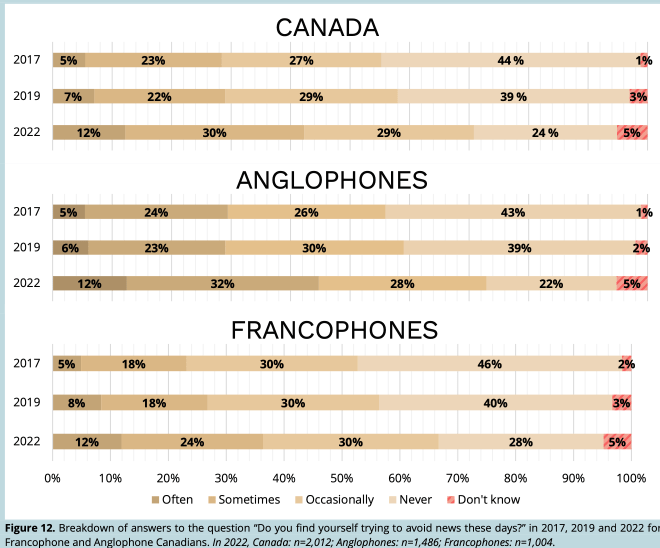
In response to the question “do you find yourself trying to avoid news these days?” Canadians polled in 2017, 2019 and 2022 are increasingly fed up with the news:

A whopping 71% of Canadian respondents said they had at least occasionally (i.e. including “sometimes” and “often”) tried actively to avoid the news in the recent past, up 13 percentage points from 2019.

The “occasionally” avoiding news figure hasn’t changed much, but the “often” has doubled and the “sometimes” has grown about 40%. On the other end, “never” avoiding the news has shrunk twenty points from 44% to 24%.

These are hair-on-fire figures.

What’s driving the despair?

Reuters data suggests the common theme is negativity about the world journalists report on. This might be the problems we face (war, political polarization, climate change, pandemic) or their magnification by news reporting that dramatizes conflict and suffering:

The leading causes of the news avoidance (above) were potential negative effect on mood (47%) and excessive coverage of topics such as politics and Covid-19 (46%).

Other news avoidance stemmed from feeling worn out by the amount of news (32%) and considering news untrustworthy or biased (29%). (Unfortunately Reuters did not benchmark this data against 2017 or 2019 results).

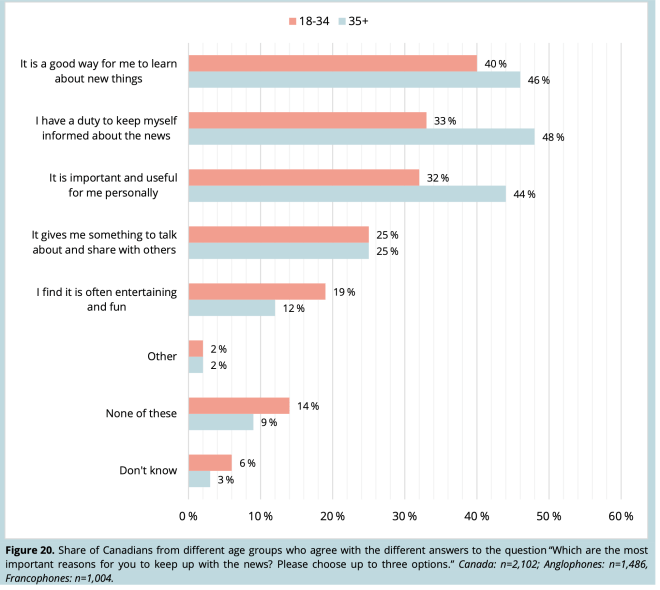
As a corollary to news avoidance, respondents were asked why they seek out news. The answers were encouraging from the point of view of democratic participation:

In a word, respondents want to know what’s going on in civil society.

It’s gratifying that local news was the leading topic of interest (65%), followed by international news (53%), pandemic information (47%) political news (45%) and environment/climate change (39%) although those results are heavily generational (the under-35 crowd consumes less news in general).

The Reuters study provoked some soul searching advice from its lead author, Oxford University’s Nic Newman. Interviewed by Poynter, he said:

“Subjects that journalists consider most important, such as political crises, international conflicts and global pandemics, seem to be precisely the ones that are turning some people away…

“Some of this is a function of the move to digital — people feel they are being bombarded/overloaded often when they haven’t asked for it. Also that the abundance of other (more entertaining) choices means it is easier to avoid/select something less depressing.”

Newman also offered some solutions:

  • Addressing trust issues is part of the answer. Be sure that stories are evidence-based, avoid sensationalist hype and label opinion as such. Still, current “levels of partisanship” will block progress even with best practices.
  • “Making news more accessible/easier to understand. This is one of the other reasons why young people and less educated groups avoid. The news is often written for avid news consumers with a lot of knowledge. So more explanation, answering questions, easy to consume digital formats (e.g. video) that are fact-based and accessible. Avoiding jargon and insider speak will help.”
  • “Some publishers are working on personalization that automatically formats stories to fit consumption styles (bullet points or more videos, pictures). That may also help over time to make news more accessible and relevant … Television has an outsized influence on perceptions of ‘too much COVID, too much politics.’ So a wider and more diverse agenda there might help, but I suspect they think they will then lose their core avid news follower audience which is what matters commercially.”

Others might add to Newman’s recommendations the avoidance of “storytelling” as a substitute for observation and explanation; a fearless appetite for inconvenient facts; and a rejection of journalist celebrity.

***

If you would like regular notifications of future posts from MediaPolicy.ca you can follow this site by signing up under the Follow button in the bottom right corner of the home page; 

or e-mail howard.law@bell.net to be added to the weekly update; 

or follow @howardalaw on Twitter.
The Next Internet Czar: Bill C-11 gives cabinet sweeping powers it shouldn’t have

Adversaries in the House of Commons Heritage Committee, CPC MP Rachael Thomas and Liberal MP Chris Bittle

November 7, 2022

“Internet Czar” is a political trope stoking fears of an all-powerful Ottawa mandarin —either the Heritage Minister or CRTC Chair—  imposing one-person rule over culture and freedom of expression.

All you have to do is imagine your worst partisan enemy being that person. Depending on your point of view, one day that could be either the Liberals’ Chris Bittle or the Conservatives’ Rachael Thomas elevated to cabinet as Heritage Minister with oversight of the newly amended Broadcasting Act.

No, that’s not because C-11 activates the CRTC’s long dormant jurisdiction over Internet broadcasting, although some would tell you that. 

Rather it’s because a low-profile change to the Broadcasting Act in C-11 in section 7(7) would give the federal cabinet and future Heritage Ministers the power to pre-emptively “order” detailed terms of operation for broadcasting undertakings that are currently vested in the CRTC, our independent and arm’s length regulator.

You might recall that in September 2017 then-Heritage Minister Melanie Joly announced a $500M five-year deal with Netflix to spend studio money on film production in Canada.  Presumably Joly’s end of the deal was to deflect rising public demands to regulate the foreign streamers, demands that Justin Trudeau refused for another three years (and one election) until he relented by tabling Bill C-10.

You might also recall the terms of the Netflix deal were secret, wrapped in cabinet confidentiality to escape Access to Information laws.

To this day, there is nothing to indicate that this deal required Netflix to dedicate a dollar of that $500M to Canadian content or French language programming, as opposed to just carrying on making movies for the American market while drawing upon the low Canadian dollar and generous Canadian tax credits.

Indeed Netflix surpassed the $500M in Canadian spending less than two years later. This allowed us to infer that the $500M was a lowballed commitment and that Joly had likely begged Netflix for the deal, any deal.

The substance of Joly’s secret Netflix deal was pre-emptive regulatory action. This was an expedient alternative to cabinet asking the CRTC to conduct public hearings and revive its dormant jurisdiction over Internet broadcasting. 

So think of Bill C-11’s new section 7(7) as the Joly/Netflix scenario writ large.

Having said that, I am afraid the rest of this post is so technical it may seem like watching paint dry. But if Senators studying Bill C-11 don’t read every last word of it and take it to heart, they are in dereliction of their duty.

All are forgiven for overlooking the innocuous wording of section 7(7) in C-11:

(7) For greater certainty, an order may be made under subsection (1) with respect to orders made under subsection 9.‍1(1) or 11.‍1(2) or regulations made under subsection 10(1) or 11.‍1(1).

Here’s a tip, any time you see “for greater certainty” look under the hood. 

First, you have to split your C-11 screen to view 7(7) next to 7(1) of the current Broadcasting Act (just kidding, I will explain).

Section 7(1) is where cabinet retains a political override to do two important things: clarify any of the encyclopedic broadcasting policies under section 3(1) of the Act and, at an operational level, give precise guidance to the CRTC in formulating regulations under section 5(2) implementing those policies on broadcasting undertakings:

7(1) Subject to subsection (2) and section 8, the Governor in Council may, by order, issue to the Commission directions of general application on broad policy matters with respect to

(a) any of the objectives of the broadcasting policy set out in subsection 3(1); or

(b) any of the objectives of the regulatory policy set out in subsection 5(2).

Take note the existing section 7(1) confines the cabinet override to “general application on broad policy matters.” To give you a flavour of that, the last time cabinet used that power was in 2013 when the Harper government ordered the Commission to implement a general scheme of “pick and pay” of specialty TV channels. 

C-11’s section 7(7) blows the doors off of section 7(1). 

Far from “general application on broad policy matters,” s.7(7) authorizes the Heritage Minister/Internet Czar, through cabinet, to “order” anything in the long list of detailed broadcasting conditions historically carried out by the CRTC as conditions of licence or regulations. 

Normally the CRTC must give public notice and hold hearings or accept submissions in licensing matters . Once completed, the conditions of licence can be appealed to Federal Court as an error of law or, more effectively, brought to federal cabinet on matters of policy.

But section 7(7) allows an Internet Czar to short circuit all of that with a pre-emptive order.

Here are the new powers cabinet will have.

First under section 9.1.(1), cabinet will have the same powers as the CRTC over critical programming policies that are implemented as operational terms (either as “licences” or “orders”) for individual broadcasting undertakings, on both linear and Internet platforms:

  • Programming objectives relating to priority genres (news, drama, etc.), languages, original content and discoverability;
  • “Must carry” orders for distribution platforms to carry public service or high priority programming;  
  • Fair terms and conditions of consumer subscriptions;
  • Mergers (e.g. Rogers-Shaw);
  • Protecting Canadian ownership of the broadcasting system as a whole (e.g. foreign takeovers of Canadian broadcasters).

In addition, under sections 10.1 and 11.1 cabinet will have the same powers as the CRTC over equally critical programming policies as “regulations” covering several broadcasting undertakings at once:

  • The definition of Canadian content in programming;
  • For Canadian content, the obligations imposed on both domestic and foreign media companies (e.g. Crave, Netflix) to either finance or make Canadian content;
  • The exhibition of Canadian programming during evening prime time;
  • Programming standards including limits on abusive content and misinformation (except for user generated content which is unregulated under C-11);
  • Advertising;
  • Election advertising and broadcast time;
  • Allowing foreign channels to be carried by broadcasting undertakings (recall Russia Today being expelled from cable).
  • [For the full list see here]

Not only would cabinet have the same powers as the CRTC, it could exercise them pre-emptively as a trump card over the CRTC.

No Canadian ever asked for section 7(7). 

Possibly Netflix and the Hollywood studios did. 

After all, an unrestricted cabinet power to carve in stone conditions acceptable to the Hollywood streamers without having to worry about the CRTC imposing tougher conditions would go a long way to neutralizing the hardball threats of trade complaints the studios always keep in their back pocket.

If that’s what’s driving section 7(7) it would be an unworthy justification. Canada must be pragmatic but principled about appeasing the Hollywood streamers. 

We fought for, won and maintained Canadian cultural sovereignty in the 1988 FTA and 2018 CUSMA trade deals. That sovereignty may have a price tag (the US can retaliate with countervailing measures) but both Mulroney Conservatives and Trudeau Liberals rightfully bragged to Canadians about having preserved it.

Whatever the origins of section 7(7), Senators should send back C-11 to the House with the clause deleted. 

That message has already been delivered by broadcasting experts Robert Armstrong and Monica Auer’s Forum for Research and Policy in Communications.

Armstrong also reminded Senators of another problem with C-11. The Bill substitutes “orders” for “licences” governing online undertakings.

That could mean two unintended consequences, both bad.

Public hearings are not required for “orders,” still aren’t under C-11, and this would make it possible for either the CRTC or cabinet to short circuit the public consultation process for Netflix and any other online undertakings. As “licenced” television on linear platforms fades, orders will displace licences.

Secondly, C-11 does not update the Broadcasting Act’s “break glass in case of emergency” feature in case of the CRTC’s occasionally bad policy decision (the CBC licence renewal as a recent example). Specifically, C-11 does not amend the existing section 28(1) to expand the right to appeal “licensing” renewals to federal cabinet to encompass “orders,” at least insofar as “orders” are about to become the “licences” for online undertakings. The Coalition for the Diversity of Cultural Expression has submitted an amendment to the Senate fixing that.

Lastly, Professor Armstrong recommended deleting section 34.995 which allows cabinet to “order” additional regulations relevant to the CRTC’s powers to levy fines on non-compliant broadcasting undertakings. 

However it is a familiar regulatory tool in Canadian public policy to leave cabinet elbow room to deal with unforeseeable enforcement challenges. That section should be left alone to stand.

***

If you would like regular notifications of future posts from MediaPolicy.ca you can follow this site by signing up under the Follow button in the bottom right corner of the home page;

or e-mail howard.law@bell.net to be added to the weekly update;

or follow @howardalaw on Twitter.

Catching Up on MediaPolicy.ca: Heritage Committee hears its last C-18 witness, on C-11 the Senate has heard 124 and still counting – the skinny on Rogers-Shaw – Musk’s hellscape.

Meta’s Kevin Chan threatens MPs with a blackout of Canadian news on Facebook.

November 5, 2022

There was no MediaPolicy.ca round-up last weekend because I could not get near a computer. So there’s catching up to be done.

Both Bills C-18 (the “FaceGoogle” Online News Act) and C-11 (the Online Streaming Act) were on the boil, at the Commons Heritage and the Senate Transportation & Communications committees respectively.

The Commons Committee heard its last witnesses on C-18 yesterday afternoon (and will debate amendments beginning November 18th).

MediaPolicy.ca posted three reports on MP deliberations:

The first post was written October 27th in the aftermath of Facebook’s threat to shut down Canadian news in hopes of intimidating Canadian MPs, titled  “Must it be war? A peace proposal for C-18.” The post recommends several amendments.

The second post is an account of Facebook’s ensuing appearance before the Heritage Committee on October 28th where Global Policy Chief Kevin Chan repeated the threat and got an angry response from most MPs…. followed by the cringeworthy supplication of Facebook representatives by CPC MP Marilyn Gladu.  It was so bad that Toronto Sun columnist Brian Lilley wrote a column questioning the Conservatives’ support for Big Tech.

The third post covering the November 1st hearing delves into the debate over “link taxes,” the plight of small publishers, as well as the Conservatives’ proposal to ban news outlets CTV, City-TV or the CBC from receiving compensation for their news content from Facebook and Google. 

On November 3rd a story appeared in the Globe and Mail noting Heritage MPs are likely to amend C-18 to cover more small news organizations, presumably by relaxing the eligibility criterion of “at least two journalists employed.” There’s also an op ed in the National Post and Le Devoir from Emma MacDonald of the Australian Minderoo Institute describing how her public interest group provided resources to small publishers who successfully negotiated as a group with Big Tech.

At yesterday’s hearing, CPC MP Kevin Waugh and Internet activist Michael Geist went all in against including major TV news organizations in the Bill: here’s video footage of what McGill University’s Taylor Owen had to say about that during his appearance before the Committee.

As for C-11, after 20 days of hearings the Senate Committee may be suffering from what Cartt.ca described as “witness exhaustion” (124 so far) although we haven’t reached the point yet of an obvious filibuster. 

This week’s hearing raised at least two important issues. The first is what is described in a MediaPolicy.ca contribution to Cartt.ca as the Senators’ surprising disinterest in a Unifor amendment to remedy C-11’s neglect of local TV news. 

The other, which appears to have grabbed the Committee’s attention, is C-11 massively expanding cabinet powers over almost every aspect of broadcasting regulation, including Internet broadcasting. You can expect a MediaPolicy.ca post on that early next week.

Turning to other matters,  if you want to learn more about what the Competition Bureau’s dogged opposition to the Rogers-Shaw merger is all about, read one of the best pieces of business journalism of the year by the Globe’s Tim Kiladze.

And lastly, you might already know that Elon Musk fired half of Twitter’s workforce by e-mail notice. So if you want a good weekend read at Musk’s expense on his hellscapish future, try this from the Verge.

***

If you would like regular notifications of future posts from MediaPolicy.ca you can follow this site by signing up under the Follow button in the bottom right corner of the home page; 

or e-mail howard.law@bell.net to be added to the weekly update; 

or follow @howardalaw on Twitter.
Local TV news gets no love from Parliamentarians considering C-11

November 3, 2022

If journalists in politics are the friends of news media, perhaps it needs new friends.

At the Commons Heritage Committee, former CTV reporter and Conservative MP Kevin Waugh continues to thunder that major TV networks Bell CTV, Rogers City-TV and CBC should be excluded from the “FaceGoogle” Bill C-18. 

This Monday at the Senate committee studying the Online Streaming Act Bill C-11, former Edmonton Journal columnist Paula Simons and former CBC TV correspondent Julie Miville-Dechêne suggested Unifor’s recommendation for better cable and streamer funding of local news was unnecessary because TV companies are set to cash in under Bill C-18.

Meanwhile Senator Pamela Wallin, another former TV journalist, tried to get Unifor Media Director Randy Kitt to agree that the problem was the CBC competing in the advertising market with private networks.

One gets the feeling that off camera there are a lot of Senators and MPs stifling a big yawn about local TV news.

They would be in good company. Despite all of the piety and genuflection about the vital role of local TV news, the CRTC has done zilch in the last ten years. Ergo Unifor’s C-11 amendment to get the Commission to do its job.

In a 2006 study, the Commission projected the coming collapse of the advertising-only business model for local TV. By 2010 the Commission under Konrad Von Finckenstein —-no Leftie it’s safe to say—- came up with two separate schemes to compel the profitable cable companies to cross subsidize local broadcasters.

In 2012 the Supreme Court struck down the “fee-for-carriage” scheme on a 5 to 4 vote as contrary to copyright legislation. The same year, Von Finckenstein’s successor as Chair Leonard Katz terminated the other project, the Local Programming Improvement Fund (LPIF), on the rosy prediction that advertising revenues would rebound for TV.

In 2015 the next CRTC chair J.P. Blais pontificated from the Commission dais about how the major networks ought to be better corporate citizens and keep losing money on local news (private conventional TV has lost money every year since 2012, currently running at a 12% loss). 

Blais remodelled and marginally increased an existing industry cross-subsidy for independent stations, the Independent Local News Fund, which since 2017 has shrunk from $23M to $17M in tandem with declining cable revenues. 

The ILNF will be bankrupted next year when an additional twelve Global TV stations, divested by Shaw, become eligible.

That brings us to the Unifor amendment which MediaPolicy.ca wrote about here before it was rejected in the House by Liberal and Conservative MPs (who simultaneously approved abolishing $120M in “Part II” fees paid by TV companies to the CRTC):

Amend section 11.1(1) as follows:

The Commission may make regulations respecting expenditures to be made by persons carrying on broadcasting undertakings for the purposes of

(d) developing, financing, producing or promoting local news and information programming, including through contributions made by distribution undertakings either to a related programming undertaking or by distribution undertakings or online undertakings to an independent fund. In making regulations for the distribution of these contributions, the Commission shall take into account the local presence and broadcast staffing of the programming undertaking.

Elegant, isn’t it? Full disclosure: as Unifor’s former Media Director when Bill C-10 was debated in 2021, I drafted it.

The amendment accomplishes two things.

First, the CRTC would have a fresh and explicit mandate from Parliament to increase the flow of internal cross subsidies from the cable and satellite businesses to local broadcasting stations. 

This is exactly what the LPIF did before it was killed off ten years ago at the urging of the cable companies. The reference to “online undertakings” is future proofing: as Bell, Rogers, Telus and Videotron move from cable to digital, the obligation to fund local news would follow them to the new platform.

It’s worth noting that the cable companies’ financial ability to cross subsidize the expensive task of news journalism has diminished over time, with profit margins dropping to around 10% over the past few years. 

However the windfall $120M from repealed Part II fees should go straight into local news, something CAB President Kevin Desjardins told Heritage MPs might happen, but the TV companies have made no such commitments.

Second, the CRTC would be instructed to consider tithing foreign online undertakings Netflix, Disney and others to support local news. Whether that’s a good idea would be up to the CRTC when it designs the overall scheme for streamer contributions to Canadian content. It might be the big streamers split their CanCon contribution between drama and news, or just do drama. It’s worth remembering that local news spending is a third of Canadian Programming Expenditures.

Some of the push back to the Unifor amendment was expressed by Senator Simons as skepticism about propping up local news on the declining linear TV platform:

I have boundless sympathy with argument you are making.

Second question, I think that we have seen such a disruption of our long standing media paradigm, people don’t watch the news on TV, some older people do. I don’t watch the news on TV ever anymore, I get my news on digital platforms. Even with all the money in the world do we get back to people watching the supper hour news on television sets.

But my first question is, won’t the problem be dealt with in some ways by C-18.

That sort of view chafes the CAB’s Desjardins, who had to remind senators earlier this fall that video “television” news may be made by journalists employed at Canada’s eighty or so local stations, but it’s distributed and consumed on all platforms: linear, web, and a bevy of social media apps:

Watch: CAB spokesperson Kevin Desjardins at Senate hearings on C-11, September 15, 2022

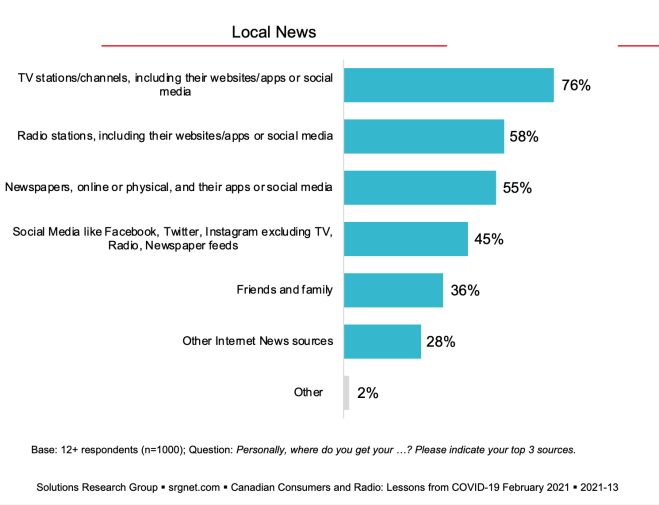
On multiple platforms, “television” news is by far the biggest source of Canadian local news:

There is also the matter of whether TV companies should be better funded by both cable companies (Bill C-11) and digital platforms (Bill C-18). (You will note that public money is involved in neither of them.)

It was inevitable that an argument of “double recovery’ would be tendered with these two Bills in Parliament at the same time.

The policy basis for Bill C-18 is to rebalance the one-sided bargaining power between Canadian media companies and the digital platforms over fair compensation for monetizing and distributing the intellectual property in news content. 

It could be there is no Facebook or Google money owing at all to TV companies, or perhaps there will be as much as the $247M predicted by the Parliamentary Budget Officer. 

Once the dust settles and the bill is paid, the CRTC will be able to assess the financial stability of Canadian local TV stations and decide which if any of them still need the industry cross subsidies that the Unifor amendment would permit. 

***

If you would like regular notifications of future posts from MediaPolicy.ca you can follow this site by signing up under the Follow button in the bottom right corner of the home page; 

or e-mail howard.law@bell.net to be added to the weekly update; 

or follow @howardalaw on Twitter.

Heritage MPs debate C-18 “link taxes” and the theory of one waterhole

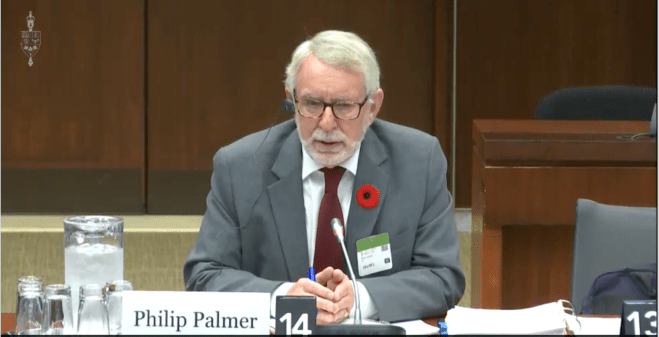
 Internet Society President Philip Palmer appeared before the Heritage Committee on November 1st.

November 1, 2022

The dark cloud of Meta’s threat to impose a blackout of Canadian news on Facebook will linger over the Heritage Committee’s study of the Online News Act Bill C-18 for weeks to come. 

But the good news is that this morning’s line up of witnesses sharpened some of the policy and implementation issues in legislation that is aimed at better recognizing the value exchange between Facebook, Google and Canadian news organizations.

The big idea that some C-18 critics have begun to rally around as a deflection to the Bill is that the government should dump its scheme to rebalance bargaining power between platforms and news organizations in favour of imposing a special tax on digital platforms and then allocating the funds to Canadian journalism outlets in a manner similar to the federal government’s 2019 aid to journalism program.

Such a journalism fund bankrolled by a “FaceGoogle tax” might be a more elegant idea than C-18 in both policy and implementation. MediaPolicy.ca and other advocates such as Unifor have long supported it. Unfortunately the vehicle for that levy, the Digital Services Tax, is unlikely to come into effect because of its entanglement with multi-lateral discussions on minimum global corporate taxes.

Even so, the chances of the Conservatives holding fire on another government-administered fund to support journalism are precisely zero. Heck, they want to defund the CBC. This might be one reason the Liberals went with C-18’s regulation of bilateral commercial negotiations instead.

Here are some issues debated today in Committee:

Payments for Links.

FaceGoogle insists that forcing them to pay compensation for news content “made available” through hyperlinks (accompanied by titles and text snippets) is alien to how the Internet works, or more precisely how the Internet ought to work.

It’s a self-interested argument when made by Google and Facebook. After all Google already contributes millions to Wikipedia, its biggest contributor of Search replies, in what very much looks like pay for links. You don’t hear much about that breaking the Internet.

Other critics of C-18 such as the Internet Society (“extortion by legislation”), Michael Geist, or Open Media fear that once a precedent is set by paying news organizations for posting content on the Internet, every content creator posting to the web will lobby for equal legislative treatment and, at some point, the cost of that will drive digital platforms to charge user fees for content that has been free. 

Of course that would require government giving a C-18 to anyone who asked. 

But more importantly, given that in pre-Internet days our media platforms thrived on advertising-only business models, it seems a speculative point that Facebook and Google would undermine their immensely profitable digital advertising business by charging link fees.

Another FaceGoogle objection is that payment for links posted by content creators means unlimited liability for the platforms. In other words, if payment is trigged by publishing a link, news organizations will milk the platforms by posting an endless stream of worthless content or clickbait and then claim compensation.

There is a reason that didn’t happen in Australia and won’t happen under C-18. When FaceGoogle bargains with news organizations, the platforms will be sure to negotiate a fixed or capped payment for news content. Even if the parties end up in arbitration, the same result will prevail. 

Small News Organizations.

Small news organizations are the lovable underdogs in this debate, but the legislation does not shortchange them in any significant way. Any amendments will be incremental (perhaps a change to the two-journalist rule) or symbolic.

Internet Society President Philip Palmer suggested to MPs that small news organizations would be out gunned by FaceGoogle in negotiations or arbitrations under C-18 because of the lack of resources to pay lawyers, economists and digital experts.

However almost all of the smaller organizations belong either to Newsmedia Canada or the Canadian Association of Broadcasters. As well, the CRTC will have the power under sections 44 and 80 to award them costs.

In Australia, the philanthropic public interest organization Minderoo successfully coordinated and resourced FaceGoogle bargaining on behalf small news organizations.

Big News Organizations.

The Conservatives have discovered Canada’s worst kept political secret, that Telco bashing always pays. 

MP Kevin Waugh doubled down yesterday on his theory that large and small news organizations are gathered around the same FaceGoogle waterhole and that the telco TV companies Bell and Rogers (with the CBC thrown in for good measure) will drink it dry.

The inconvenient truth is that there is not one waterhole. 

Each news organization entering the C-18 bargaining scheme, whether it’s a big or small broadcaster or a big or small publisher, will have to negotiate with Facebook and Google for what their own content is worth, not someone else’s. Section 38 of the Act compels an arbitrator to focus exclusively on the value exchange between the news organization and the platform: how much or little the platform has already spent on other deals will be inadmissible. 

But the platforms will undoubtedly try to satisfy all of their C-18 obligations by negotiating a comprehensive series of voluntary agreements and then approaching the CRTC for an “exemption” from the Act. 

The criteria for that exemption is found in section 11(1) and the language suggests the CRTC must ensure that news businesses receive fair compensation, not that Google or Facebook merely create an adequate pot of money:

Exemption order

11 (1) The Commission must make an exemption order in relation to a digital news intermediary if its operator requests the exemption and the following conditions are met:

(a) the operator has entered into agreements with news businesses that operate news outlets that produce news content primarily for the Canadian news marketplace and the Commission is of the opinion that, taken as a whole, the agreements satisfy the following criteria:

(i) they provide for fair compensation to the news businesses for the news content that is made available by the intermediary,

(ii) they ensure that an appropriate portion of the compensation will be used by the news businesses to support the production of local, regional and national news content,

(iii) they do not allow corporate influence to undermine the freedom of expression and journalistic independence enjoyed by news outlets,

(iv) they contribute to the sustainability of the Canadian news marketplace,

(v) they ensure a significant portion of independent local news businesses benefit from them, they contribute to the sustainability of those businesses and they encourage innovative business models in the Canadian news marketplace, and

(vi) they involve a range of news outlets that reflect the diversity of the Canadian news marketplace, including diversity with respect to language, racialized groups, Indigenous communities, local news and business models; and

(b) any condition set out in regulations made by the Governor in Council.

Journalist Headcount.

Bloc MP Martin Champoux has been a dog with a bone on quality journalism.

He’s been determined to link the eligibility of news organizations to professional standards and today he focussed on journalist headcount as a metric of quality journalism. 

The existing federal aid to journalism is tied to such a headcount because the labour subsidy is per editorial employee. 

That headcount could be replicated under C-18 in its provisions instructing the CRTC to certify voluntary agreements, in particular section 11(1)(a)(ii) quoted above, but it should be more explicit if headcount is a key metric.

Unlike the criteria in section 11(1) dealing with voluntary agreements, there is no indication in section 38 of the Act that the arbitrator should concern itself with quality journalism:

Factors

38An arbitration panel must take the following factors into account in making its decision:

a) the value added, monetary and otherwise, to the news content in question by each party, as assessed in terms of their investments, expenditures and other actions in relation to that content; and

b) the benefits, monetary and otherwise, that each party receives from the content being made available by the digital news intermediary in question.

By contrast, the Australian Newsmedia Bargaining Code adds at least one criterion relevant to quality journalism in the arbitrator’s mandate:

 (c)  the reasonable cost to the registered news business of producing covered news content;

That text introduces the notion of newsgathering costs. If the Heritage Committee adopts journalist headcount as a key arbitral criterion, it should be even more explicit.

The Committee resumes on C-18 hearings on Friday and then will begin debate on amendments on November 18th.

Also on MediaPolicy.ca:

Canadian MPs confront, supplicate Meta over threat of C-18 retaliation

Must it be war? A peace proposal for Bill C-18

Google takes the C-18 heat at Heritage Committee

The error-riddled C-18 Abacus Poll commissioned by Google tells us nothing.