I am retired staff of Unifor, the union representing 300,000 Canadians in twenty different sectors of the economy, including 10,000 journalists and media workers. As the former Director of the Media Sector and as an unapologetic cultural nationalist, I have an abiding passion for public policy in Canadian media.
Last month the CRTC renewed the CBC’s five-year licence in a burst of deregulatory enthusiasm that took many by surprise.
The CRTC’s precedent-setting decision to repeal the core of minimum programming standards and expenditures for most of the public broadcaster’s linear TV operations was not requested by the CBC nor was it included in the CRTC’s detailed agenda when it published the required Notice of Consultation that began the proceeding.
Inevitably the CRTC ruling is being appealed: the Associations representing independent producers supplying much of the CBC’s programming in Quebec (AQPM) and English Canada (CMPA) filed their appeals this week, citing the scathing dissent of the minority Commissioners. The CMPA also suggested it may file a parallel complaint to the federal cabinet.
Court appeals of CRTC decisions are long-shots and excessively technical: they require an “error of law” as opposed to an error of policy. Cabinet appeals are explicitly policy-based but effectively require the government to issue the regulator a vote of non-confidence.
The CBC was also in the public eye this week when former TV host Wendy Mesley emerged in a podcast hosted by Postmedia’s Anthony Furey to explain her departure after 42 years at the public broadcaster (and promote her new podcast Women of Ill Repute, a co-venture with Maureen Holloway).
Mesley gives a mea culpa of her use of the n-word in an internal production meeting and then, with a diplomacy the CBC probably doesn’t deserve, tells the story of her employer suspending her and busting her to junior reporter.
The most combustible podcast I listened to last week (maybe ever) was the June 6th Canadaland interview of National Post columnist Terry Glavin, which I stumbled upon after reading Glavin’s blog update of the long-running controversy surrounding the coverage of graves and graveyards linked to Indigenous children who attended Residential Schools.
For background on the media coverage, you can read Robert Jago and Jonathan Kay. For the grave story itself, in addition to Glavin’s update there is a helpful piece written last year by the CBC’s Ka’nhehsí:io Deer
The Canadaland podcast hosted by Jesse Brown crackles from the first moment of its hour-long length. You won’t find your attention wandering.
In other industry news:
In an earlier post about the declining financials in Canadian broadcasting I noted that yet-to-be-released CRTC data for 2020-2021 would provide more clarity about how broadcasters are coping with the growth of American streaming apps. A grim foreshadowing of that data may be contained in the US Nielsen data released this week.
There may be a breakthrough for a trimmed down version of US President Joe Biden’s legislative program. Included in the package is ratification of Biden’s support for the OECD deal on a minimum 15% corporate tax to fight against international tax avoidance. If the OECD deal goes through, Canada would not trigger its Digital Services Tax on Big Tech companies operating in Canada, set to come into force in 2025.
VMedia announced it has been acquired by Québecor. The Ontario-based VMedia operates multiple telecommunications businesses including retail Internet (ISP) and online television (IPTV). The purchase provoked an outcry against corporate consolidation in the ISP market. Those critics take no solace in the competitive upside of strengthening Québecor’s expansion as a national competitor against the other big telcos in ISP and IPTV outside of its home territory.
Netflix CEO Reed Hastings insisted that linear TV will die in “five to ten years,” as he hosted yet another quarterly investor call to explain the streaming service’s stall in subscription growth (it lost 1.3 million North American customers and will have to get by with its remaining 220 million global subscribers). Hastings’ comments prompted an ode to the staying power of linear TV by Alex Cranz in The Verge.
The uncertain future of linear TV in Canada is the focus of a CRTC report about the revenue impact on Canadian TV companies losing access to programming rights to American premium movies and hit drama series. The Report suggests the Netflix prediction might be true and Hastings’ estimate of “five to ten years” too generous. I posteda summary of the Report’s projections.
Last week I posted that Washington Post columnist J.J.McCullough’s loose description of Bill C-11’s “regulation” of YouTube videos needed to be tightened up: the Bill excludes the possibility of CanCon “exhibition quotas” or abusive content codes for videos posted to social media platforms. When the Heritage Minister’s Chief of Staff John Matheson quoted my post on Twitter he drew fire from C-11 opponents which I summarized briefly because the back and forth seemed to resolve some misunderstandings about the Bill. This is definitely a post for C-11 disputants and Parliamentarians, but of less interest to normal people.
A Globe and Mail editorial weighed in on the tax avoidance strategies of Big Tech companies, in this case Amazon. In passing the Globe mentioned that ratification of the multi-nation OECD agreement on a minimum corporate tax is stalled in US congress along with much of the Biden agenda. If the OECD deal falls apart Canada’s Digital Services Tax on Big Tech would kick in after all. As I wrote in previous post last December, this “audience tax” is the ideal revenue stream to aid Canadian media that has lost its advertising revenue to Google and Facebook.
Last week the CRTC quietly released a disquieting study it commissioned on the decline in Canadian television broadcasters’ opportunity to buy and re-sell popular US programming on their networks.
The take-away from the report written by industry analyst Peter Miller is that the entry of more foreign, mostly American, “Direct to Consumer” (DTC) television apps into the Canadian market threatens to cancel the Canadian broadcasting system’s meal ticket.
The DTCs include the California-based studios Disney, Paramount (CBS) and Apple TV, increasingly selling exclusive access to their premium movies and hit drama series. Competing apps from Peacock (NBC) and Warner/Discovery’s HBO are potential market entrants in Canada. The DTCs compete for subscribers against Netflix and Amazon Prime but also against traditional broadcasters whose audiences watch drama and comedy shows for forty per cent of their monthly viewing hours according to the CRTC.
The popularity of US dramas with Canadian audiences drives broadcaster profits that set-off losses they sustain making Canadian news, information, sports and Canadian “programs of national interest.”
If the supply of US programming to Canadian broadcasters is severely diminished, says Miller, the rate of cable-cutting and cable-nevering will increase. That will push Bell, Corus, Québecor, and Rogers ever closer to the dreaded tipping point where subscribers and national advertisers no longer view cable TV as a must-see or a must-buy platform. Miller doesn’t make the comparison, but this is what happened in the newspaper market several years ago.
The Report says that whatever television services are most exposed to the loss of US drama programming are at the greatest risk: specialty television channels and Video-on-Demand services will suffer the most. Given that specialty TV has been the profit-engine of Canadian TV for decades (and “conventional” local stations are generally unprofitable), the Report concludes the Canadian broadcasting system faces an existential moment in the near future. Miller maps out a range of outcomes from best to worst case scenarios.
Although traditional television revenues have fallen steadily since 2014, so far the profit margins of our major media companies are holding, at least in cable distribution and specialty programming if not conventional broadcasting.
Also there is as yet no hard data measuring the loss of US programming rights: most of the CRTC’s relevant data metrics are confined to Canadian programming and Numeris does not appear to have access to data that would support a metric on the loss of US programming.
Of necessity, Miller’s observations are documented by numbers that show the revenue growth of foreign Internet TV apps in the Canadian market; the market entry of new DTC apps based on exclusive programming offerings; and a series of confidential interviews he conducted with Canadian TV executives about the declining availability of programming rights.
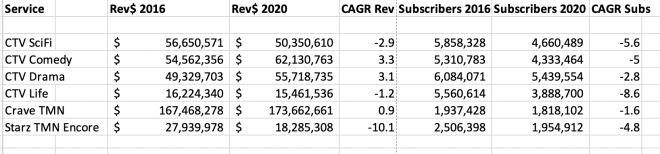
We can engage in limited data snapshots of the specialty channels most likely to be impacted by the loss of programming rights to premium American movies and drama series. As of August 31 2020, data submitted to the CRTC by our largest broadcaster Bell Media reveals revenue, subscriber and growth metrics for its key English Canadian specialty and VOD services:
As you can see revenue is treading water but subscriber numbers are falling and that can’t last indefinitely. Fresh CRTC data for 2020-2021 is due soon.
This 2020 data may or may not measure the full impact of market entry (and exclusivity practices) by Disney Plus in November 2019 and Paramount Plus (formerly CBS All Access) in 2018. At this point in time the precise pace and impact of the loss of US programming rights is still informed guess work.
A significant variable in that guess work is the entrepreneurial response by Canadian broadcasters. (An insightful article by OutTV CEO Brad Danks both acknowledges the omnipotence of the American streaming apps and suggests an entrepreneurial response).
The latest development in television business models is the emergence of free-advertising supported TV (FAST), embedded advertising for shows streaming on Internet TV platforms.
FAST could be the coup de grâce to ad-supported conventional television (already having lost market share to Google and Facebook) or it could be an opportunity to reclaim it.
Another innovation is Corus distributing its conventional programming, including Global News, on digital platforms like Fubo TV, Paramount’s Pluto TV, Amazon Prime and Roku for a negotiated fee, something not available to them from cable companies who are permitted by Canadian copyright law to retransmit broadcaster programming for free from their over-the-air signals.
Bell Media clearly would like to partner up with Netflix to make Canadian content: it unsuccessfully urged the federal government to amend Bill C-11 in a manner which would have given the CRTC the regulatory power to create co-production opportunities.
Niche Canadian programmers like OutTV, Blue Ant, and independent YouTubers are increasingly seeking out global distribution by major digital distribution platforms, a strategy available to other Canadian broadcasters.
Whether these are winning entrepreneurial plays or just whistling past the graveyard is something we will watch unfold in the next few years.
Miller’s Report recommends a government policy response, and quickly, given his projection of a major downturn in the financial viability of Canadian broadcasters impacted by the loss of programming rights. Regrettably neither the CRTC’s 2018 forecast (“Harnessing Change”) nor the 2020 report of the Broadcasting and Telecommunications Legislative Review tackled the programming rights issue or recommended any policy response.
Bill C-11 is not that policy response, says Miller.
Bill C-11 will result in an injection of $1 billion (according to government estimates) into the production of Canadian programming by foreign owned Internet TV companies. While the legislation should bring the foreign streamers’ regulatory costs up to the same level of Canadian broadcasters, it does not provide any incentives or requirements to continue selling programming rights to Canadian broadcasters instead of pushing their TV apps as the exclusive access to their hit programming.
Miller writes enigmatically at the conclusion of his report that Canada should consider a range of pro-Canadian policy measures that revive wholesaling programming rights as the most attractive option to American media companies seeking Canadian audiences:
… structural measures that financially advantage or give priority to Canadian owned and controlled broadcasting services (such as Internet advertising tax deductibility, zero rating of wireless data usage, preferential access to Canadian productionfinancing and expanded rights protection measures) should be under serious consideration.
Thank goodness we are now getting at the truth of how Bill C-11 will regulate YouTube, and how it will not.
The most industrious critic of C-11 Michael Geist has acknowledged that C-11 excludes the authority of the CRTC to devise quota regulations for online undertakings for Canadian programming in general or even for specific genres like drama, news or children’s programming. That’s the outcome of the “quota” sections 9(1)(a-d) being excluded by section 9(6) because YouTube doesn’t have programming control over its videos.
Also Mr.Geist no longer contests that uncurated hosting platforms (YouTube, TikTok, Facebook) will be exempt from CRTC Codes governing misinformation or abusive content because the enabling provision of the Act [section 3(1)g] for those Codes is inoperative for those platforms. For better or worse, the CRTC cannot apply those standards to YouTube because once again the platform doesn’t exercise “programming control” over YouTubers [sections 3(1)h and 2.2].
Now perhaps Mr Geist’s fellow C-11 critics —Open Media, Digital First Canada, Washington Post columnist J.J.McCullough, and Conservative MP Rachael Thomas— will make the same acknowledgements and be more precise in their public statements.
It’s the “discoverability” provisions of C-11 that still trouble its critics.
Mr Geist claims that under section 9(1)(e) of C-11 the CRTC will have the authority to order YouTube to make Canadian content thirty per cent of its algorithmic recommendations, a number he has picked out of the air. Keep in mind this requirement in C-11 to “showcase and discover” Canadian content applies equally to domestic broadcasters, Netflix and other online streamers, as well as YouTube and the other hosting platforms.
Putting the “30%” aside —maybe it should be a different number— is expecting media companies to “showcase and discover” Canadian content bad?
Is it bad to connect Canadians to the availability of Canadian news, drama, sports, children’s programming et al, given there is no obligation to watch it?
Also, it might be helpful to our debate over C-11 to describe exactly what we mean or fear about asking YouTube to connect Canadians to CanCon either through search responses or personalized recommendations based on past viewing history.
One of Mr. Geist’s wise companions from the Internet Society, former CRTC Commissioner Konrad Von Finckenstein, was helpful when he appeared before a Senate Committee on June 21st. He suggested the CRTC should only use these 9(1)e powers to ask YouTube to supplement (not replace) algorithmic recommendations with Canadian videos that are responsive to viewers’ search queries or consumption habits.
If C-11 passes and the CRTC convenes its public hearings to consider “showcasing and discoverability” expect a common sense solution like that advanced by Mr Von Finckenstein to find a lot of support.
The CBC will appeal the CRTC’s censure of CBF-FM and two Radio-Canada radio hosts in the N-Word controversy following a public backlash in Québec and demands from Premier François Legault and Radio-Canada journalists to take the CRTC to Federal Court.
The CBC press release announcing the appeal is a marvel of craft: the public broadcaster issues a full throated apology but states categorically the CRTC has no right to tell journalists what to say. CBC lawyers may have difficulty convincing a federal judge that the protections of journalistic independence in the Broadcasting Act go that far, but they still have a good case that the CRTC erred in completely ignoring that legislative provision in its decision.
There are two further insightful commentaries on the controversy from Québec journalists, one for anglophones written by Jérome Lussier and the other in French authored by Vanessa Destiné.
On Mediapolicy.ca I completed my two-part analysis of the CRTC’s renewal of the CBC licence which was released just before the N-Word decision. I argue the Commission made hasty and unnecessary regulatory changes that may leave the public broadcaster’s programming (especially local news) vulnerable to slash and burn from a hostile government.
For some added perspective on public broadcasting, Press Gazette published a good summary of the BBC’s annual report. Although the BBC is better funded and more commercially successful than the CBC, it is unloved by the current Conservative government and so is trying hard to demonstrate its fiscal responsibility.
***
Bill C-11 is on summer hiatus but the Washington Post’s J.J. McCullough is spending some time video-campaigning among his fellow Canadian YouTubers to put public pressure on the Senate and the Liberal government to exempt their creator community from the legislation. The lad is a communications genius but he has key facts about the Bill wrong which required me to blog a response.
***
The Heritage Minister’s expert panel on regulating Online Harms submitted its final report that leaves the government with some complex policy choices to make. Pollsters at the University of Saskatchewan released their findings on public attitudes towards freedom of expression that may encourage the government.
***
Lastly, Postmedia ended its holdout and became the last major Canadian publisher to accept Google’s terms for a deal providing syndicated news to the Google News platform. Its not clear if this impacts Bill C-18, the government’s “FaceGoogle” compensation-for-online-news-content legislation. This is a global story that Press Gazette follows diligently, so expect something soon from them.
On the topic of Postmedia, it is worth checking out Canadaland reporter Jonathan Goldsbie’s tweet chain beginning with National Post columnist Rex Murphy’s unhinged attack on Canadian journalists caught on video (at the event where Convoy organizer Tamara Lich violated her bail conditions) and ending with National Post Editor in Chief Rob Roberts asking extremists to stop abusing his reporters.
Canadian YouTuber and Washington Post columnist J.J. McCullough has a summer DIY: rallying fellow YouTubers to fight Bill C-11.
McCullough was the star of the show on behalf of the Conservative Party during Parliamentary Committee hearings on the Online Streaming Act last month (sheepishly acknowledged in this video on June 4th which six weeks later has nearly 500,000 streams.)
Since then McCullough has made more videos about C-11 and is asking fellow YouTubers and his 800,000 subscribers not to bother with petition-signing but concentrate on mobilizing public opinion against the Bill through YouTube’s network.
If you haven’t caught his act yet, McCullough posts vlogs about C-11, Canadian nationalism, and all manner of politics and popular culture. A gifted explainer, he salts his narratives with libertarian tropes and irreverent cheek.
No doubt the cheek has helped him earn him a bigger audience. When he appeared before the Heritage Committee, he scolded the Liberals for tabling a Bill that would enable autocrats like Hungary’s Viktor Orban to censor their media because, well, Canada did it first. A few logical leaps taken, but quotable as heck.
The insouciance also sees him pushing boundaries like proposing “Quebecreïch” as the name of a sovereign Québec should Canada break apart.
As part of his summer project to evangelize against C-11 he recently appeared on another YouTuber’s channel, the Gary Klutt show, where he aired it out on C-11 for an hour.
After briefly discussing controversial “discoverability” provisions he and other C-11 opponents criticize, McCullough said the Bill would also “mandate Canadian content quotas and Canadian genre quotas” on YouTube.
That is misleading, to choose my words carefully. The Bill exempts You Tube and other uncurated social media platforms from CanCon exhibition requirements like those in place for television and radio. The Bill also exempts social media platforms from any regulation of what YouTubers like McCullough can say, unlike TV or radio which are governed by “abusive comment” and “misinformation” codes.
McCullough also sought to stoke any resentments YouTubers might be feeling about “old media” protecting their parochial interests while continuing to air unwatchable CanCon every evening on television (his words, not mine).
The “old guard” is so jealous of the new media, McCullough said in earnest, they want to regulate YouTube so that it becomes “less attractive” and less distinct from conventional Canadian television.
This inspired his host to chime in that old media is “just like Walmart,” supporting minimum wage laws to “minimize competition from smaller stores that can’t pay that wage.” In reply, McCullough either mumbled “yes, that’s fair” or choked on his coffee, it was difficult to tell.
As of now, what little we know about public opinion on Bill C-11 suggests that McCullough has his work cut out for him.
A Nanos poll taken in May (before much of the C-11 Parliamentary fireworks began) suggested solid support for C-11.
This should not be too surprising. A 2019 Nanos poll showed that public support for Canadian programming policies in general is very strong.
And a recent opinion poll from the University of Saskatchewan took the temperature of Canadians on freedom of expression, revealing that the rhetoric we are hearing from C-11 opponents might not be an accurate reading of Canadian opinion.
But the summer is only half over and the stream count is rising.
Last week I provided a summary of the CRTC’s tectonic shift in regulating audio visual broadcasting. The occasion was its renewal of CBC/Radio Canada’s television licence.
The three-to-two majority ruling endorsed by Chair Ian Scott made three dramatic licence changes.
Its headline move was to guarantee programming dollars for Indigenous and equity-seeking communities (racialized, disabled, LBGTQ and official minority language communities). That spending envelope will be 35% of CBC’s programming acquisitions on the English network and 15% on the French network.
This should deservedly earn the CRTC praise. But it was two other regulatory changes that were unexpected and resulted in strident dissents from two prominent Commissioners, Broadcasting Vice Chair Caroline Simard and Ontario Commissioner Monique Lafontaine.
The first change was to merge the CBC’s existing Canadian programming expenditure obligations for its core television operation with its digital platforms, until now unregulated and without any conditions of license. Going forward, the CBC is free to shift an almost unlimited amount of its linear television budget to its digital platforms like CBC Gem, cbcnews.ca or their Radio-Canada counterparts.
The majority’s companion piece to this shared digital/linear approach to Canadian programming was to crop back the remaining conditions of licence on how much Canadian programming, especially local news, must be aired on the CBC’s network of 26 stations across the country.
Key changes were:
Exhibition minimums for prime-time evening programming on linear television were eliminated;
Exhibition minimums for “programs of national interest” (PNI) (i.e. Canadian stories in dramas and documentaries) were also eliminated, although they were replaced with conditions of license for continued spending that aligns with the CBC’s current budgeting.
Exhibition minimums for French-language children’s programming were also removed on the grounds that Radio-Canada has far exceeded the 2013 minimums (English children’s programming has only just kept up, so the CBC keeps its license conditions).
Most controversially, programming obligations for seven local stations in Vancouver, Calgary, Edmonton, Toronto, Ottawa and Montréal (French and English) were deleted and were not replaced by spending requirements or by any network-wide “news” spending obligation (the CBC’s English and French language national news services are regulated separately from its local network).
This is sharply different from the belt-and-suspenders regulations the Commission imposed in 2017 on private sector broadcasters who were not only obliged to keep their exhibition minimums for local stations but also to spend no less than 11% of network-wide revenue on local news.
The reasoning behind the majority decision seemed to be (a) accommodate a long-term shift of television programming to digital platforms and (b) trust the CBC will pursue the best programming priorities without having to strictly comply with standards of exhibition or expenditure.
Other than the easily obeyed obligation to spend 85% of its programming budget on Canadian programs on either digital or linear platforms, the remaining conditions of licence governing the CBC’s accountability are now mostly restricted to doing audience surveys, public consultations, and the reporting of data to the CRTC.
Dissenters Simard and Lafontaine zeroed in on the Commission’s unprecedented deference to broadcaster autonomy. According to Broadcasting Vice Chair Simard:
The majority decision proposes an approach that is different from the results-based approach applicable prior to the majority decision coming into force. The essence of this new approach consists in imposing conditions of licence requiring the CBC to file reports to demonstrate how its programming choices take into account public opinion research (or perception surveys) and public consultations. No binding measurable targets will be set by either the Commission or the CBC, either before or as part of this public opinion research and public consultation.
Lafontaine —the Ontario Commissioner representing nearly 40% of the national audience— agreed with that point:
Consultations and perception studies are not regulatory tools. CBC itself said that the perception studies, which it already conducts, are not appropriate tools for evaluating regulatory compliance.
Lafontaine also condemned the nearly unlimited pooling of the CBC’s Canadian programming obligations across linear and digital platforms:
In my view, the majority decision has approved a licensing framework for CBC/Radio-Canada that is fundamentally different from the Commission’s licensing approach for television broadcasting, without first conducting a detailed policy review to consider what, if any, measures would be appropriate for the digital age. We are therefore left with a majority-approved programming framework that allows hundreds of millions of dollars to leave the Corporation’s regulated platforms each year and flow to its unregulated online audiovisual platforms.
Lafontaine argued the majority was skipping over a vital policy discussion of how to regulate online platforms and was putting the policy cart before the horse for the entire broadcasting system.
It could hardly go unnoticed that this ruling for the CBC licence effectively sets a precedent for the upcoming renewal of licences for the major private broadcasters in 2024. Bell Media, Rogers, and Québecor compete with the CBC and will demand equal relief from regulatory obligations.
The implications of the majority ruling for local news is the most alarming. Their blasé repeal of all licence obligations to air programming at the seven local stations in our six largest cities came out of left field without any warning in the Commission’s 2019 Notice of Consultation that announced the public hearings.
After years of public concern over the decline in local news coverage —-which the Parliamentary Heritage Committee insisted in its 2017 report required dramatic legislative action—- the majority chose to repeal licence obligations for local news without identifying a compelling policy objective for doing so. They also declined to set news expenditure minimums for the overall network (as proposed by the CBC itself) which would have been a less drastic alternative.
Simard pointed out the obvious:
In the age of disinformation and misinformation, and considering the central and pivotal role that the CBC plays in providing reliable, unbiased and objective news, there is no legally binding framework in the majority decision in regard to news presented on the CBC’s digital platforms.
Lafontaine was concerned that CBC’s news spending may just migrate to its unregulated digital television and alphanumeric news websites:
With online news, who knows how the CBC will leverage its digital platforms, or other digital platforms, to innovate (one hopes) and, at the same time, rethink the exhibition of traditional television news reports….
…The removal of the minimum licensing obligations for local/news programming in metropolitan markets across Canada is inappropriate at this time given the crisis that has arisen in the provision of news and information. …
Canadians who reside in metropolitan markets should not be compelled to access their news programming online, as suggested in the introduction to the majority decision. Not all Canadians can access news and information content on online platforms in major centres for a variety of reasons.
Adding to the bite of the minority’s critique is that the Commission’s Notice of Consultation only raised the possibility of digital/linear sharing of Canadian programming expenditures provided that exhibition on linear television remained protected by licence conditions.
And it was not as if the CBC was asking for these regulatory innovations. Lafontaine listed all of the long-standing licence obligations that the public broadcaster applied to renew or tweak, but were struck down by the majority anyway:
Broadcast of Canadian programming: the conditions of licence for the broadcast of a predominance of Canadian programming on the Corporation’s English- and French-language conventional networks and television stations as well as its three discretionary services ICI ARTV, the documentary Channel and ICI EXPLORA.
Broadcast of French-language local programming in the metropolitan market of Montréal: the condition of licence for Radio-Canada’s conventional television network and station to broadcast a minimum number of weekly hours of French-language local programming, most of which is news programming, in the metropolitan market of Montréal.
Broadcast of English-language local programming in metropolitan markets across the country: the conditions of licence for CBC’s English-language conventional television network and stations to broadcast a minimum number of weekly hours of English-language local programming, most of which is news programming, in the metropolitan markets of Calgary, Edmonton, Ottawa, Toronto and Vancouver, as well as in the English-language OLMC of Montréal.
Broadcast of French- and English-language independently produced Canadian programming: the conditions of licence that provide minimum requirements for the broadcast of French- and English-language Canadian independently produced programs on CBC/Radio-Canada’s conventional television stations (networks and stations), ICI ARTV and the documentary Channel.
Broadcast of programs of national interest in peak time: the conditions of licence for the broadcast of programs of national interest (PNI) during the peak viewing hours of 7 p.m. to 11 p.m. on CBC’s and Radio-Canada’s conventional television networks and stations, and the requirements regarding the broadcast of Canadian independently produced PNI content.
Broadcast of French-language children’s and youth programming: the conditions of licence for the broadcast of French-language Canadian children’s and youth programming by Radio-Canada (conventional network and stations) in Quebec and across Canada. The conditions of licence include the obligation for Radio-Canada to broadcast at least 15 hours per week of Canadian programming for children under the age of 13, and the obligation for Radio-Canada to broadcast original Canadian French-language children’s and youth programs.
Broadcast of English-language children’s and youth programming: the condition of licence for the broadcast of 15 hours per week of English-language Canadian programming on CBC’s conventional television network and stations aimed at children under the age of 13.
Broadcast of original and original first-run Canadian programs: the condition of licence for Radio-Canada’s conventional television stations to broadcast original French-language Canadian children’s and youth programming, and the obligation for the documentary Channel to license from independent production companies not less than 75% of its original, first-run Canadian content hours.
Broadcast of Canadian feature films once per month on CBC: the condition of licence for the broadcast of one Canadian feature film during each broadcast month on the CBC’s conventional television network and stations.
In so many words, Lafontaine accused the majority of blindsiding everyone including the Canadian public to whom the Notice of Consultation was issued in 2019.
So the question remains, why did majority take these exceptional steps?
Surely the majority Commissioners know that whatever is left unprotected by a condition of licence is vulnerable to cost cutting, budget cannibalization or defunding.
The Corporation’s Parliamentary funding is $1.3 billion out of $1.8 billion total revenue and has remained stable during Justin Trudeau’s run in the Prime Minister’s office (in fact the Liberals boosted the grant by $150 Million in 2017).
But under a Conservative administration that seems likely to change.
The CPC 2021 election platform did not hide its intentions to gut the CBC English network while protecting CBC North and Radio-Canada:
CBC and Radio Canada have made important contributions to Canada over the past 84 years. While parts of it remain as relevant as ever, including Radio Canada, CBC Radio, and CBC North, many question whether CBC’s English TV continues to live up to its mandate. There are also concerns that CBC’s online news presence is undermining the viability of Canadian print and online media, reducing the diversity of voices available to Canadians.
Canada’s Conservatives will: * Give Radio-Canada a separate and distinct legal and administrative structure to reflect its distinct mandate of promoting francophone language and culture while maintaining its funding and providing for continued sharing of resources and facilities where applicable…
*Protect CBC Radio and CBC North
*Review the mandate of CBC English Television, CBC News Network and CBC English online newsto assess the viability of refocusing the service on a public interest model like that of PBS in the United States, ensuring that it no longer competes with private Canadian broadcasters and digital providers.
Ongoing Conservative political messaging about “CBC bias” and “defunding the CBC” has become so routine its almost goes unreported.
The absence of licence conditions on the major local stations removes an important obstacle to implementing deep budget cuts.
So the answer to the question of “why” must be a compelling policy reason to remove those safeguards. You won’t find it in the majority ruling.
The CRTC/Radio Canada “mot d’n” controversy raged (not an overstatement) this week especially in Québec where politicians and journalists demanded the CBC appeal the Commission’s ruling chastising two radio hosts for saying the full n-word in quoting the name of Pierre Vallières’ classic text.
There’s much reading material to choose from: I recommend Xavier Boisrond’s piece in La Presse.
Also, industry analyst Monica Auer tweeted her view that on a close reading of the Broadcasting Act the CRTC “decision” doesn’t appear to be one as defined in the legislation and because of that may not be appealable (or enforceable for that matter).
The Commission ruling does not cite any violation of the Radio Regulations (which contain the Commission’s Abusive Comment and Equitable Portrayal Codes) or any of Radio Canada’s licence conditions. It would be an interesting turn of events if the CBC —which is under pressure to appeal— sat on its hands and did not act on the Commission’s directives to apologize and edit the online audio file and then see what the CRTC did next.
While eyes were fixed on this controversy, the Commission’s renewal of the CBC’s licence flew under the radar. It is a mere 270 pages in length featuring tectonic shifts in licence conditions followed by fire-breathing dissents: I posted about that here with a follow-up scheduled for next week.
Everyone knows about the Rogers service outage but some may have missed the news that the mediation efforts between Shaw, Rogers and the Competition Bureau failed to deter the Bureau’s effort to block the $26 Billion merger.
That means the Bureau will commence its case before the Competition Tribunal in November. The Alberta government announced it intends to seek intervenor status before the Tribunal, possibly to support the merger which includes Rogers’ promise to create 500 new jobs in Calgary. Québecor also joined in to support its proposed purchase of Freedom Wireless assets.
The hearing should be a nerd-fest of competition law and industry jargon, still CPAC should televise this one.
With all eyes fixed upon the CRTC’s ruling in the Lamour “mot d’n” complaint against Radio Canada, the Commission’s June 22nd release of its long awaited renewal of the CBC’s license has flown under the radar.
The Commission’s five-year re-set of the CBC’s license conditions —implementing Parliament’s mandate in section 3 of the Broadcasting Act— had some catching up to do since its previous renewal in 2013.
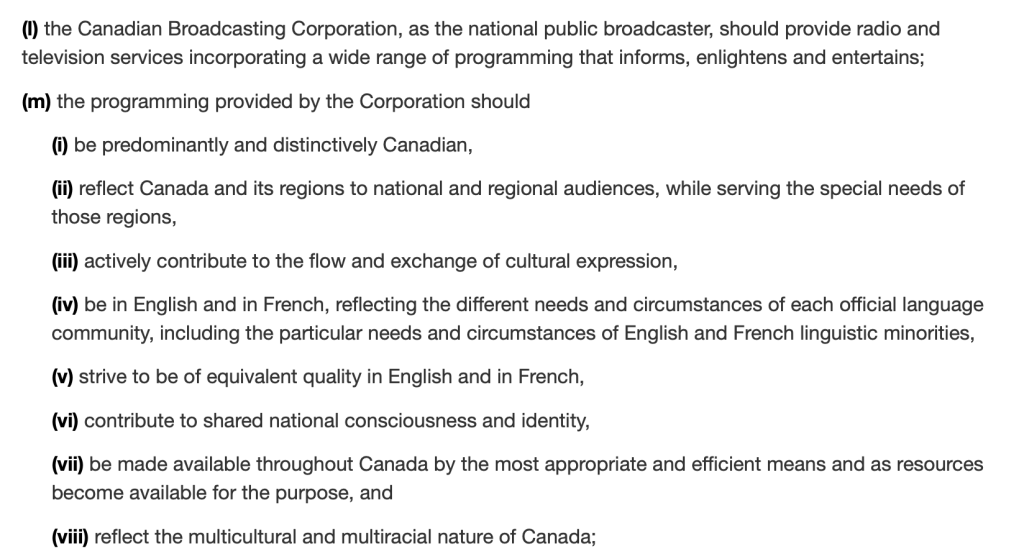
The social foundation underneath the CBC’s programming priority of “national consciousness and identity” in section 3(m)(vi) of the Broadcasting Act has shifted since 2013, especially the mainstream awakening to the recommendations of the Truth and Reconciliation Commission on Indigenous peoples and the consciousness-raising surge of the Black Lives Matter movement.
From the Broadcasting Act, section 3, defining the national broadcasting policy.
Also since the 2013 renewal we have witnessed a revolution in video distribution technologies. These current license renewal proceedings begun in 2019 were the Commission’s first opportunity to apply regulatory changes to the CBC that it implemented in 2016 and 2017 for private sector TV broadcasters.
The signature change in this license renewal is a dedicated spending envelope (“Canadian Programming Expenditure”) for television content made by producers from Indigenous peoples and from Canadian racialized, disabled, and LGBTQ equity-seeking communities.
No such legally binding programming priorities existed previously, either as exhibition quotas or budget lines. Prior to this renewal, the only regulatory requirement for diversity in CBC programming expenditure was for Official Language Minority Communities (OLMC), meaning anglophones in Quebec and francophones outside it.
Because the Commission chose to shy away from defining the genre content of programming priorities and preferred to link spending requirements to whom is making the programming — independent producers from the priority communities— the Commission turned to population demographics to measure the slices of the CBC’s budget pie.
In the end the Commission fixed the spending on independent producers thus:
Overall, 35% of all Canadian programming dollars in CBC’s English network must go to producers from Indigenous, diverse, and Official Language Minority communities. The corresponding figure on the French network is 15% (and the CRTC explains the difference).
The CBC can bank a 50% intersectionality credit (meaning one dollar of actual spending will satisfy $1.50 of its expenditure target) if that producer is a woman.
Within the overall 35% and 15% spending requirements, an 8% (English) and 1.8% (French) spending sub-envelope is carved out for Indigenous producers, the gap explained by the demographics of languages spoken within Indigenous communities.
The existing spending requirement of 6% for OLMCs is also included as a carve out.
These are big regulatory moves, perhaps a zero to sixty moment for the CBC and by the end of its five year renewal the difference in programming priorities should be quite noticeable.
However that regulatory spree is the exception to the rule in the 2022 license renewal: otherwise the Commission was looking to reduce its governance of CBC programming decisions.
It did so by deleting a bevy of 2013 binding license conditions, reducing many of them to non-binding “expectations” and “encouragements,” or outright eliminating them, in the name of “outcomes” which in this particular instance seems to be regulatory-speak for “we trust you.”
The centrepiece in the new regulatory scheme is the Commission setting a license condition that the CBC spend at least 85% of programming dollars on any genre of Canadian content on either its traditional linear television platform, which until now has been regulated by detailed conditions of license, or its Internet platforms like CBC Gem, which in this pre Bill C-11 world has never been regulated by the Commission.
The thinking behind the merged two-platform expenditure target is to incent the CBC’s shift from linear to Internet.
The thinking behind eliminating most genre-specific programming rules around news, children’s shows, dramas and documentaries in favour of an overarching 85% “CanCon” expenditure minimum is that exhibition rules (minimum hours of scheduled programming) are less useful for satisfying television audiences that increasingly expect on-demand rather than scheduled shows. The Commission’s rule of thumb for shedding exhibition quotas from the linear platform is whether or not the CBC has been comfortably exceeding them in the past.
The resulting deregulation looks like the following (for a more encyclopedic summary you can’t do better than Steve Faguy’s analysis in Cartt.ca, but if the paywall stops you the CRTC ruling contains its own summary):
Exhibition minimums for prime time evening programming on linear television are eliminated;
Exhibition minimums for “programs of national interest” (PNI) (i.e. Canadian stories in dramas and documentaries) are also eliminated, although they are replaced with conditions of license for spending minimums that align with the CBC’s current budgeting.
Exhibition minimums for French-language children’s programming are also removed on the grounds that Radio Canada has far exceeded the 2013 minimums (English children’s programming has only just kept up, so the CBC keeps its license conditions).
Most controversially, all minimum programming obligations on local stations in Vancouver, Calgary, Edmonton, Toronto, Ottawa and Montréal are deleted and are not replaced by minimum spending requirements or by any network-wide “news” spending obligation (the CBC’s English and French national news services are regulated separately from local stations). This is sharply different from the belt-and-suspenders regulations the Commission imposed in 2017 on private sector broadcasters who were obliged to keep their exhibition minimums for local stations and spend a minimum of 11% of network-wide revenue on local news.
The Commission says this deregulation is guardrailed by its expansion of the CBC’s obligations to report programming data that should confirm they are spending the overall 85% on CanCon; that they are meeting their new programming obligations for Indigenous and diverse communities as well as PNI spending; and that at least keeps tabs on how they are spending on local news and children’s.
Even further, the Commission has dictated specific survey questions it wants the CBC to use in gathering qualitative data on audience satisfaction over the next five years. In a move that some find odd, the Commission is not especially concerned about consumption data on audience attention and market share.
The 271-page ruling by the Commission was a split decision, with two out of five commissioners filing dissents. That included Broadcasting Vice Chair Caroline Simard who also dissented in the “mot d’n” case and has now left the Commission.
Still, the majority of Commissioners will feel they have continued down a measured path of television deregulation begun several years ago under the previous Chair J.P. Blais in his “Let’s Talk TV” regulatory re-set for private sector broadcasters.
If there is a continuity of approach, it certainly includes a Commission philosophy that it isn’t the regulator’s job to substitute its own wisdom for broadcaster programming decisions provided the broadcaster is doing a reasonable job operating within the broad policy mandate of the Act.
The dissenting Commissioners couldn’t disagree more and in the next post we will look at what they said.
Earlier this week the CRTC upheld a complaint from Montréal artist Ricardo Lamour and ruled the CBC must apologize after both the host and guest commentator of the CBF-FM radio afternoon show spoke aloud the full “n-word” while discussing the controversy embroiling a Concordia professor who did the same in a classroom reference to Pierre Vallières’ iconic sovereigntist text, “Les N**res blanc d’Amérique” (in English, “White N***ers of America.”)
The show’s segment title was “Certaines idées deviennent-elles taboues?”
Both white, the Radio Canada program hosts repeated the unabridged title of Vallières’ 1968 book four times in six minutes. The majority of CRTC Commissioners found this offside the CBC’s obligation to broadcast programs of “high standards,” the legislative term of art in section 3(1)(g) of the Broadcasting Act.
The Commission ruled the hosts should only have have used the abbreviated “n-word” in English or “mot d’n” in French.
In addition to a public apology, the Commission ordered the CBC to draw up new guidelines for its journalists on appropriate language as well as “mitigating” the online archive of the program (presumably bleeping the offending language).
The ruling split the Commission panel hearing the case with Chair Ian Scott in a three person majority while two commissioners filed dissents.
The majority decision is only five pages long and it must be said is a little terse in its legal reasoning. The main hook in the majority opinion is the section 3(1)(g) “high standards” clause which for decades has provided the legal foundation for CRTC regulations governing “abusive comment” and “equitable portrayal” of identifiable groups.
In laypersons’ terms, the majority says that public tolerance of racist language has changed dramatically since 2020 when George Floyd was murdered by Minneapolis police and the Black Lives Matter movement against systemic racism surged in many countries including Canada. The majority clearly views the CBC hosts as having been too cavalier with their repeated use of the full n-word, regardless of the purpose of the program.
The first of two dissents written by Broadcasting Vice Chair Caroline Simard is thorough and appears to be written in anticipation that CBC might choose to appeal to Federal Court which only second guesses the Commission on errors of law, not fact. (The CBC has not commented on a possible appeal but the Editor-in-Chief of Le Devoir has called upon the CBC to file).
Simard’s first point is that the majority erred in law by not clearly applying the Charter of Rights’ protection of freedom of expression. That’s somewhat of a legal rabbit hole: the Supreme Court cases don’t go quite that far with respect to administrative tribunals and it may also be relevant that neither the complainant nor the CBC appear to have raised those constitutional arguments.
Simard offers her own analysis of that Charter right of expression in the circumstances brought forward by the complainant but then —in a puzzling move— drops the inquiry without applying the Charter’s section 1 analysis of the reasonable limitations to free expression that can be set by Commissioners empowered by statute to regulate communications. A reasonable limitation would undoubtedly include a statutory provision like the “high standards” of section 3(1)(g), applied judiciously.
Her second legal point might just trip up the Commission in the event of a CBC appeal. If the majority felt it could censure the radio hosts’ free speech based on the Broadcasting Act’s statutory goal of “high standards of programming,” Simard points out equally important statutory objectives which the majority ignored:
(2)(3) This Act shall be construed and applied in a manner that is consistent with the freedom of expression and journalistic, creative and programming independence enjoyed by broadcasting undertakings.
3(1) (c) English and French language broadcasting, while sharing common aspects, operate under different conditions and may have different requirements;
The majority’s explicit reliance on one statutory goal to the exclusion of other relevant goals (even if they did implicitly or silently consider them) is just the kind of legality that gets the Court of Appeal’s attention.
Legalisms aside, Simard’s real challenge to the majority is that in her view its ruling is blind to differences between the English Canadian and Québec social contexts.
She suggests the evidence of public attitudes underpinning a restriction of free expression should zoom in on the prevalent opinion about “mot d’n” in the black francophone community, especially in greater Montréal, which she argues in an anecdotal way does not support censorship of the full epithet. At the very least, she says, a public consultation (or opinion poll?) would be better than just assuming the full n-word is always unacceptable in the relevant community of listeners.
It’s the other dissent by Commissioner Joanne Levy that really caught my attention because she views the situation through the eyes of the Radio Canada journalists investigating a difficult topic of public importance.
She argues the hosts conducted a professional show with a respectful tone and employed euphemisms for the n-word many more times than they did the full word itself. Listeners sometimes join a show in progress, she says, and they would need to know the name of the book at the centre of the controversy.
If journalists aren’t afforded leeway to be “reasonable” in making the judgment call about the n-word in these very specific circumstances, says Levy, think of the chilling effect on all Canadian TV and radio journalists and the programming they want to air.
As others have said, this is a “hard case.” It’s interesting that none of the Commissioners delved into the related CRTC ruling in 2009-548 where the Commission censured the CBC for airing the French language comedy show “Bye Bye 2008.” That show included a number of excesses including the use of the full n-word in a satirical skit about the racist reaction to the election of US President Barack Obama. The Commission censured CBC for the use of racist language.
The Bye Bye 2008 case (very much pre-2020) is an interesting benchmark: there might well be a meaningful difference between trawling for laughs baited with racist language under the cover of comic satire versus analyzing the appropriateness of Vallières’ provocative choice of book title.
****
The Québec National Assembly already weighed in on the n-word issue, It tabled (in April 2022) and passed Bill 32 instructing universities to enact codes protecting academic speech and freedom and to allow the government to have the final say on those codes.
****
I might have expected that, if the phrases “CRTC” and “freedom of expression” were found in close proximity, Internet activist Michael Geist would link them to Bill C-11, the Online Streaming Act, now in the hands of the Canadian Senate.
Mr. Geist cites the CBF-FM ruling as a reason to suggest that the CRTC might run amok with censorship once handed the responsibility under C-11 to regulate broadcasting on Internet streaming and hosting platforms, in particular the administration of “discoverability” of Canadian content through algorithmic recommendations.
The CRTC is not censorship happy by instinct if the last 50 years is any indication. The Commission long ago set regulatory standards of content supervision relating to abusive comment, discriminatory stereotyping, and so on relying upon section 3(1)(g) of the Act (“high standards of programming”) and then downloaded enforcement to industry self regulation. Ever since, the Commission has made rulings like CBF-FM when appellants bring issues to their doorstep.
Bill C-11 exempts hosting platforms (i.e. YouTube posts) from section 3(1)(g). That would oust CRTC jurisdiction to rule on the Radio Canada case if the CBF-FM program —or something even more offensive— was uploaded to YouTube. If there is ever going to be content supervision on social media posts it would have to come in an Online Harms Bill which the Liberals have yet to table.
Bill C-11 also exempts hosting platforms and YouTubers from any programming priorities (e.g. more drama, less news, etc).
Bill C-11 was amended (thanks to Peter Julian MP) to expressly subject regulation of YouTube videos to the freedom of expression guarantees in the Charter of Rights.










 MediaPolicy.ca