Catching up: the Last Week on @MediaPolicy.ca

December 4, 2021

#JournalismIs essential to democracy. The next few months of the legislative agenda in Ottawa promise an intense chapter in the history of Canadian media as three Heritage Bills are scheduled to hit the order table; a revised Broadcasting Act, a Platform pay-for-news-content Bill, and online harms legislation.

There’s a cross connection between the three Bills: both the Broadcasting Act and the Platform Bill respond to the declining financial viability of news journalism. Conversely much of the political fuel for the online harms legislation is about anti-journalism, meaning the misinformation and online intimidation that pollutes social media platforms.

A Nanos poll says almost 80% of Canadians have had enough of online toxicity and want something done about it. That will embolden the Liberals to bring forward what will inevitably be a controversial Bill.

Meanwhile the changing of the CEO guard at Twitter suggests that there is one social media giant that might take its curation responsibility more seriously than a guy named Mark.

Doctor Media, heal thyself. A nice muckraking piece by Jon Horler says that 1 out of 10 television news panelists is a lobbyist with undisclosed conflicts of interest, but presented by the host network as a “strategist” or some other banality.

I have to admit I’m enough of a journalism homey that I mostly see the integrity of the flip side 9-out-of-10. But kudos to Horler for challenging the networks to be transparent.

Kevin. Not a Pearl Jam song. But rather Kevin Chan the face of Facebook in Canada. Martin Patriquin has written a terrific feature that tees off like a typical is-he-really-a-corporate-bad-guy profile but ends with a bang. Great read.

Canada’s “audience tax” on GAFAM companies stands, for now.

December 1, 2021

There’s a helpful article in the National Post regarding Finance Minister Chrystia Freeland’s stick handling of the yet-to-be implemented Digital Services Tax owed by American tech giants Google, Facebook and Amazon for their monetization of personal data harvested from Canadians online.

The three per cent digital services tax —legislated by the Liberals in 2021 and supported by the Conservatives in their election platform— was scheduled to be implemented January 1, 2022. It was expected to raise $700 million annually in government revenue, rising to $900 million when fully implemented.

Despite the original purpose of the tax being described as an instrument to get American Big Tech to pay its “fair share” for cornering the digital advertising market (thus disrupting the financial viability of media companies around the world), most sovereign governments including Canada signalled very early that a Digital Services Tax was less an “audience tax” than a down payment on a minimum corporate tax for foreign tech companies.

Now that OECD nations including the US and Canada have agreed in principle to a minimum corporate tax beginning in 2024, it’s likely the audience tax will be repealed. Other countries like Turkey have already done so in an effort to resolve trade issues with the US. For now, Freeland is pausing the collection of the Canadian Digital Services tax pending the implementation of the corporate tax in 2024.

The Finance Minister might displease the US administration by not cancelling the 3% tax outright, but likely she is keeping her powder dry until 2024. Also perhaps the latest eye gouging from the Biden administration on Buy America and lumber has something to do with it.

How the Platforms Should Pay for Journalism, September 17 2021

Rogers lays out a hiring plan for western City-TV stations; and Proposes a one-time $8.5 Million transfer to Independent Local News Fund.

November 30, 2021

Tasked by the CRTC to provide more detail about hiring journalists with the windfall $13 million local expression funding it would prise from the hands of Global News, yesterday Rogers filed the following with the Commission:

  • The headline is that City-TV stations in Vancouver, Edmonton, Calgary and Winnipeg will double their “journalist” headcount (plus an additional 12 non journalists) to beef up news coverage capacity at those four stations.
  • This is in addition to the commitment Rogers previously made in its merger application to hire 6 Indigenous journalists (one in each major market) to cover First Nations, Métis and Inuit issues and;
  • Hire two western-based journalists to cover Parliament Hill.

Rogers is willing to make these commitments as a condition of merger approval until their station licenses expire in 2023 but wish to keep their powder dry on anything further, pending the CRTC’s upcoming licensing hearings.

The additional reporters will increase news gathering capacity in each coverage area and Rogers has committed to broadcasting 12 news specials in each of the four western City-TV markets, every year.

The precise number of the “doubled” newsroom staffing is unknown thanks to Rogers claiming “competitive confidentiality” which the CRTC has granted in posting a redacted version of Rogers’ submission.

The CRTC’s reflexive shielding of the most mundane “competitive” information has been going on for years and does the regulator no credit.

Without a doubt, all of City-TV’s competitors (including Bell CTV and Global) know exactly how many videographers and reporters are employed by their rivals. It’s hard to keep something like that secret without demanding that journalists appear masked on air.

How all of that stacks up against the 162 television salaries (estimating $80,000 each) you can fit into $13 million is something we will have to keep guessing at. Depending on what Rogers means by “journalist” my wild guess is 95 new hires in total.

However, Rogers has also read the room on the impact of the $13 million de-funding of Global News.

Upon being asked by the CRTC to pitch a revised “tangible benefits” package — a long standing requirement of merger approvals, pegged at 10% of the value of the transferred assets— Rogers proposed an exemption to the standard expectation to target film production funds, in favour of local news:

“Rogers has proposed an exception be made to this allocation [of 40% of the $26 Million package to Certified Independent Film Production Funds] and request that [$8,518,400] be redirected to the Independent Local News Fund (ILNF) as a lump sum payment upon close of the transaction.”

If approved, this transfer would partially mitigate the $13 million switch in local expression funding from Global News to City TV while leaving the shortfall in the hands of the Commission’s review of the ILNF funding envelope.

Rogers/Shaw Wrap Up: What the CRTC Might Do with the Merger

CRTC Commissioner Ian Scott, looking for a little help on the file.

November 29, 2021

The dust has settled after a week-long CRTC hearing reviewing the $5 billion broadcasting distribution end of the $26 Billion Rogers-Shaw merger. 

Don’t be surprised if we wait a long time for the decision, long enough for the Competition Bureau and the federal government to first rule on the other 80% of the deal that isn’t in the CRTC bailiwick, namely the Internet and Wireless assets.

If the merger gets that first green light the next question is what will CRTC Chair Ian Scott and his four commissioners do with Rogers’ proposal to buy Shaw’s cable and satellite broadcasting operations in the western provinces?

The dramatic increase in Rogers’ share of the broadcasting distribution market  —from 20% to 47% of the English language market, with Bell in second place at 28% —  is the hottest of potatoes for the Commission.

Even in an industry as heavily regulated for competitive fairness as Canadian broadcasting, market power is an insidious enabler of economic bullying, especially in the negotiations between the cable companies and scores of programming services making deals for the video content distributed to millions of Canadians.

Every extra dollar that an omnipotent Rogers Cable squeezes out of other Canadian media companies means 30 cents less spent by those programming services on Canadian Programming Expenditures, including local news, drama, documentaries and the like, the very reason for the Broadcasting Act’s existence.

The opponents of the merger tap into something very real: our healthy distrust of concentrated corporate power. Bigger is not better, the wisdom goes, it’s inherently dangerous.

On the other hand, the Rogers pitch to the Commission on market concentration is this: the “market” is global, not Canadian. In the age of Internet TV giants and multi-billion dollar capital spending on broadband infrastructure, Canadian media companies need economies of scale.

In fact the Shaws defend their decision to sell to Rogers as an admission they don’t have the scale or capital to compete in the race to build today’s Internet Protocol TV platform and the fibre-to-the-home and 5G hardware that supports it.

Rogers argued before the Commission that if Canada doesn’t have a national champion capable of delivering Internet video through cable subscriptions, Canadians will cut the cord even faster, the regulated broadcasting system will crumble, and so will a system designed to cross subsidize Canadian news, sports, and entertainment.  We’re not monopolizing the Canadian broadcasting system, says Rogers, we’re saving it.

But like a lot of government regulation, much depends on what we think will happen, because we often don’t know what will happen. It’s the regulator’s comfort (or delusion) that today’s hypothetical problems can always be fixed later.

Here’s another trite but true observation about regulators: they don’t as a rule begin their day blue skying about the ideal model of their industry. They take a look at the market direction of the industry and then mitigate and modify in the public interest.

I would be surprised if the Commission turned Rogers down, but they do have few conditions they could impose:

First, they could require Rogers to divest some broadcasting assets. It’s not easy to imagine which of Shaw’s cable or satellite assets could be sold off and operated as a viable business on its own. More likely by the time the Commission writes up its decision, the federal government will have already forced Rogers to sell off Shaw’s Freedom wireless division.

Second, the Commission could answer the pleas of the many programming services who asked for stronger bargaining rules under the CRTC’s Wholesale Code that regulates negotiations between big and small media companies over the “fair market value” of content distribution. Much of the week long hearing was a deep dive on what that might look like. 

Third, they could do something about the collateral damage to the Global News network resulting from the merger, something I discussed in a previous blog. [Update: Rogers has proposed to make a one-time payment of $8.5 million to the Independent Local News Fund, the $20M annual funding envelope for all independent Canadian TV stations. Post-merger, Global would be expected to apply for ILNF funding].

And there are other caveats and consolation prizes they might think up.

But one thing I will predict (and it isn’t rocket science): if the Commission says it’s okay for Rogers and Shaw to merge into a super media company owning 47% of the English language broadcast distribution market, it is opening the door wide to the remaining media companies to do the same.

Expect Bell and Telus, who already share a wireless network across Canada, to walk right through that doorway.

Catching up: the Last Week on @MediaPolicy.ca

November 28, 2021

While the CRTC Rogers-Shaw hearing was the big show in town, elsewhere lots was going on in Mediaville:

The Platforms on the far side of the world. There were two interesting international developments concerning the issue of Google and Facebook paying for news content.

In Australia a group of small publishers are banging on the door to negotiate revenue sharing with Google and Facebook. Calling themselves the Public Interest Publishers Alliance, 18 niche and ethnic news organizations have applied for “collective bargaining” certification under the Media Bargaining Code that relaxes the usual rules against commercial collusion and allows them to bring Google and Facebook to the table. This follows on the recent developments under Australia’s Platform Bill in which Facebook has refused to bargain with the investigative news site The Conversation and ethnic TV broadcaster SBS.

Meanwhile, the Indonesian government is publicly speculating about following the Australian example by passing a Platform Bill. With a population of nearly 275 million, an Indonesian initiative will grab the attention of Silicon Valley and perhaps set an example for other non G-20 nations.

The Netflix Bill is back. The federal Liberals announced in the Throne Speech that Bill C-10 is back on the menu. Canadian Press published an article restricted to comments from opponents and critics of the last Bill that was ground to dust by Conservative filibusters in the Commons Heritage Committee and the Senate.

C-10 has rock solid support in Quebec and with the Bloc. The NDP supported C-10 last time but was vague in its election platform commitment, while MP Charlie Angus has made some spirited attacks that make the NDP approach to C-10 unclear for now.

#JournalismIs and the RCMP isn’t. The Mounties’ arrest, imprisonment, and release of two Canadian journalists covering the Wet’suwet’en blockade protest near Prince George, British Columbia was yet another leaden touch from a police force that respects neither freedom of the press nor recent judicial precedent making it very clear that journalists are not breaking the law while reporting on those who may be breaking the law.

The police force also appeared to have lied when issuing a statement that the journalists had not identified themselves immediately, contradicted by video evidence posted on Twitter.

Out of jail, photojournalist Amber Bracken made a couple of good points. While she was glad to be out of custody, she was uncomfortable taking the spotlight away from the land claim and Indigenous sovereignty issues she was covering. Secondly, she pointed out that news covered by financially-precarious freelancers is especially vulnerable to the RCMP’s tactics, she was just lucky that the editors of The Narwhal stuck with her.

Trolls Unmasked? In the media regulation Petri dish that is Australia, the Morrison government has announced legislation providing a legal process for anyone who believes they’ve been defamed by anonymous trolls on social media to compel the Platforms to unmask the troll or accept liability as the responsible publisher of the defamation. While this might be hailed as a victory over cowardly trolls, it appears to let the Platforms off the hook after a ruling by the Australian High Court imposing what lawyers call absolute liability on You Tube for defamatory comments posted to its site.

#SaveLocalNews: Aid to News Journalism Passes the US House of Representatives. A journalist subsidy similar to the Canadian program has been passed by the House as part of President Joe Biden’s two-trillion dollar Infrastructure and Climate Change Bill and is headed to the Senate.

The subsidy would apply only to local news and would pay $25,000 per journalist in the first year of a five-year program, then $15,000 subsequently.

The Wall Street Journal, a nationally focussed news site owned by Fox News, said the Bill “calls on the American taxpayer to subsidize Democrats’ media allies.”

The CRTC’s chickens come home to roost on Internet TV and Local News

November 24, 2021

Rogers is going to screw us on sports content, spokespersons for cable distributor Telus warned CRTC Chair Ian Scott on Tuesday. 

If the CRTC sanctions Rogers’ merger with Shaw and becomes the dominant Internet TV platform in English Canada it will be perfectly positioned to withhold must-watch sports events from the cable TV system altogether and broadcast them exclusively on its Internet platform Sportsnet Now, said Telus Regulatory VP Stephen Schmidt. The CRTC’s exemption of Internet broadcasting in the 1999 New Media Exemption Order allows Rogers to end-run the usual CRTC rules requiring broadcasters to sell programming to all cable distributors at a fair price. 

If Schmidt turns out to be right, that’s not the only example of the regulatory chickens coming home to roost.

Take local TV news.


If the merger goes through Rogers will claw back $13 million in annual funding from Shaw’s Global News stations in a dozen communities across the country: Vancouver, Kelowna, Lethbridge, Calgary, Edmonton, Saskatoon, Regina, Winnipeg, Peterborough, Kingston, St.John and Halifax. The $13 million is about 10% of Global’s budget.

Rogers will reinvest that $13 million in Rogers’ chain of four City-TV stations in Vancouver, Edmonton, Calgary and Winnipeg. 

An important explanatory sidebar: in 2016 the CRTC tinkered with some obscure but important rules governing the cable and satellite TV companies’ “Canadian content” obligations. 

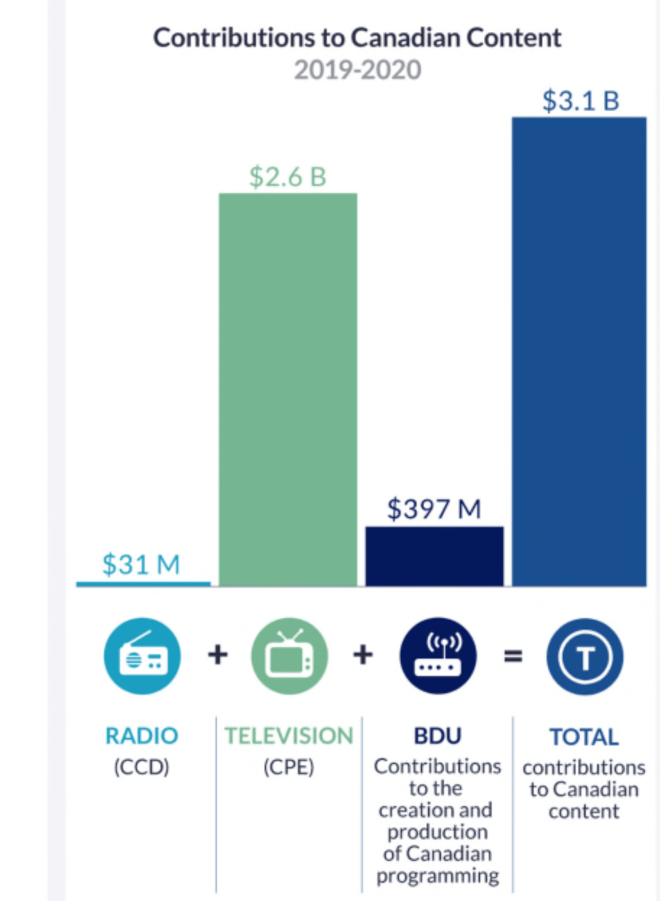
The CRTC mandates a pool of roughly $400 million annually —5% of the revenue earned by regulated cable and satellite companies— to be divided among various content producers. The majority of it goes to the Canada Media Fund and similar “CanCon” funds to make Canadian film and documentaries. The rest goes to “local expression” which until 2016 was each cable company’s own hyperlocal community stations across the country. 

Source: CRTC Financial Summary 2020

The CRTC’s 2016 funding tweak gave major networks like Rogers and Shaw the option to re-direct some or all of their “community” funding to their own “local” stations providing daily news coverage in the same geographical market. That tweak was the Commission’s acknowledgment that the local news industry had been operating in the red for four straight years (today, it’s nine years running).

Rogers and Shaw chose their local news stations over community programming and re-directed those dollars: Shaw’s  boost to their declining revenues at Global News was $13 million. If the merger goes through, it’s gone, the equivalent of about 160 Global News salaries across Canada. It would be naive to think Global is just going to eat that $13 million. There will be less news coverage.

Yet there will be a $13 million windfall for Rogers’ City TV stations in four markets —Vancouver, Calgary, Edmonton, and Winnipeg— which will inherit the “community” funding from the former Shaw cable stations in those markets. 

The City stations are a distant third or fourth in viewership in each of those markets: in Vancouver they are 1/20th the size of the market-leading Global News. Rogers has not given the Commission even a hint of its hiring or programming plans to close that gap in viewership.

Short a cool $13 million, Global News can still apply to the Independent Local News Fund (ILNF) to mitigate that loss. 

The INLF was created by the CRTC in 2016, reallocating a sliver of the existing local expression funding called the Small Market Local Programming Fund, to help local news stations not owned by cable companies and therefore without access to the CRTC’s “community cable” funding. But that $20 million annual funding is already divided up among 20 independent stations such as Hamilton’s CHCH, Victoria’s CHEK, or Newfoundland TV. 

The $20 million pie will be divided into thinner slices for all and certainly won’t replace Global’s $13 million.

This is a perverse result for local news, but once again it’s the regulatory chickens coming home to roost.

In 2008 the Commission took the decline of local news seriously and added a 1% revenue tithe (on top of the existing 5%) on cable companies that flowed to all small and mid market local stations in Canada, almost $100 million annually. During the financial crisis the levy increased to 1.5%. But in 2012 the Commission decided to terminate the funding citing a post-crisis surge in advertising revenues which did not in the end materialize.

It wasn’t long afterwards that it became undeniable to the CRTC that the financial viability of local news was heading relentlessly downwards (See the graph at the top of this post). And so we got the aforementioned 2016 tweaks to local news funding which reallocated rather than increased the Canadian content funding expected from major cable companies.

Corus, which owns Global News along with a strong position in specialty TV channels, has a typical solution to the dilemma of local news: the CRTC should redivide the 5% Canadian content envelope yet again, this time taking money away from films and documentaries funded by the Canada Media Fund and giving it to the ILNF so there is enough money for all of the independent local stations once Global comes looking to replace its $13 million. The beefed up ILNF would have close to $50 million in the kitty.

Corus Submission to CRTC

Does this constant robbing of Peter to pay Paul seem as comical to you as it does to me?

There is a way through however. And that is Bill C-10. 

The Liberals announced in November 23rd’s Throne Speech that they will re-introduce their overhaul of the Broadcasting Act. The raison d’être of C-10 is to get Netflix and the other American Internet TV providers to either make their share of Canadian content or make payments to the “5% fund” we use for Canadian content, including local news.  Bigger pie, bigger slices.

C-10 is an opportunity to provide long term stable funding for local TV news and the government should seize it.

Correction: An earlier version of this blog stated that Rogers only intends to re-invest $7 million of Shaw’s $13 million community cable funds. In fact it intends to re-invest all of the $13 million at the four City-TV stations instead of the twelve Global News stations.

What’s at Stake in the Rogers/Shaw CRTC Broadcasting Hearing

November 22, 2021

The week-long CRTC hearing on the proposed $26 billion Rogers-Shaw merger that kicked off today in Gatineau has nothing to do with issue that commands the most public attention: cheaper wireless and Internet services.

CRTC Chair Ian Scott has no say on the merger of wireless and ISP assets: he only has to decide if the merger of cable, satellite, and broadcasting assets is in the public interest. It’s up to the Competition Bureau and also the federal Minister of Innovation, Science and Economic Development to look out for consumer interests in wireless and ISP.

What’s at stake this week is Rogers’ application to assume control of broadcasting licenses for Shaw’s cable and satellite properties in the western provinces and northwest Ontario.

Even though 80% of this $26 Billion deal won’t be adjudicated by the CRTC,  Rogers spokespersons couldn’t resist touting the importance of Rogers delivering on the national objective of faster broadband speeds and rural access over wireless and ISP. That’s technically irrelevant in this hearing as the many interveners in this hearing, like industry rivals BCE and Telus, are quick to point out.

Focussing on cable operations, the Rogers makes a great deal of the fact that a post-merger company with deeper pockets will accelerate the adoption of its Ignite IPTV service, the technology that delivers programming over broadband at much higher speeds with a customer-friendly control dashboard. Shaw cable subscribers will get better service and, the reasoning goes, be less likely to cut or shave the cord on their subscriptions. Since CRTC regulations require that five cents of every cable dollar be reinvested in the production of Canadian content and independent news stations, keeping cable customers happy is in the public interest contemplated by the Broadcasting Act.

Like any CRTC regulatory proceeding, the hearing draws industry competitors and content creators who raise a long list of issues.

The biggest objection is that a post merger Rogers will own a staggering 47% of the cable and satellite market in English Canada. 

Rogers points out that it has no presence in western provinces and north-western Ontario: it is merely stepping into Shaw’s shoes as a distributor in those regions. Viewers in each region will still have the same variety of cable options (usually just two) as they do now.

But merely continuing the current level of local corporate concentration isn’t the point, say those contesting the merger.

If Bigger Rogers can boast 50% nationally of the English Canadian distribution market, it will be even better positioned to play hardball when selling a place on the dial to independent specialty channels and, as the owner of the Sportsnet channels, do the same to rival cable companies like Telus in British Columbia and Alberta when selling popular sports programming. 

The Telus brief asks very bluntly: since media companies constantly play hardball with each other when making programming deals (they would know!), how can we trust Bigger Rogers not to screw over other cable companies when selling hockey broadcasts? 

Rogers believes it has the answer: the CRTC’s 2015 Wholesale Code requires all cable companies and programming services to make distribution deals that allow customers to view content with any provider, bargain fairly with each other over price, and submit to binding arbitration if they can’t agree. Unimpressed, Telus wants a much tougher Wholesale Code so Rogers can’t find creative ways around the rules governing fair pricing.

Rogers may also have trouble parrying some of the other concerns about fair bargaining between distributors and programming services in the new era of Internet streaming.

As Telus points out, the Internet TV market is unregulated thanks to the CRTC decision over 20 years ago to exempt “new media.” With this gaping hole in the regulatory net, Rogers could skirt the CRTC rules requiring it to make its hockey broadcasts available to every regulated cable company by withholding hockey from all cable outlets including Rogers…and then broadcast them exclusively on their unregulated Sportsnet Now streaming platform. In the US, Comcast just did that with a handful of baseball playoff games. Would Rogers be tempted to do it with Canuck playoff games (hypothetically speaking for now)?

Or what if Rogers, sitting pretty with half of the English Canadian cable audience, convinced Netflix to make an exclusive deal with them to put its app only on Rogers, the biggest Canadian cable platform? In response, Rogers says Netflix and the other direct-to-customer apps want to find paying customers on every platform they can and have no interest in making exclusive deals with only one Canadian cable company.

These aren’t the only big issues at stake this week, we’ll come back to them next time. 

News Publishers Break Ranks, Have Google and Facebook Won?

November 15, 2021

Pablo Rodriguez returns to the Heritage portfolio.

On October 27th the Toronto Star caved to Google by signing a take-it-or-leave deal on payment for news content appearing in Google. Six days later, it caved to Facebook too.

Don’t be too hard on Torstar owners Jordan Bitove and Paul Rivett: almost every other Canadian news publisher had knuckled under, months earlier.

It’s all down to the web giants’ global strategy countering national governments trying to make them share those unseemly profits earned from news content appearing on Google Search and Facebook’s Newsfeed. 

With the re-elected Liberal government promising Canadian voters to compel Google and Facebook to make a much bigger contribution to journalism, the Silicon Valley digital titans have been making pre-emptive agreements with financially desperate publishers. Getting the Star to join the Globe and Mail, Saltwire, Black Press, La Presse et al in cutting a deal (the details of which are shielded by non-disclosure agreements) on pay for content was a victory for the giants.

Postmedia CEO Andrew MacLeod now stands alone in holding out for a better deal through legislated measures. Let’s hope he has a winning game plan, because it’s starting to look like a long shot that the Liberals will get a Platform Bill through Parliament in 2022 and that the “market price” of pay-for-content hasn’t already been set as a fait accompli by the other Platform-publisher deals, which is the Google-Facebook game plan.

Only ten months ago in February 2021 it looked like Australia had whipped the American giants into line after Facebook’s failed capital strike which shut off its Australian Newsfeed for one week in an attempt to scupper the pending legislation creating a mandatory Media Bargaining Code. 

Australian PM Scott Morrison’s unflinching performance inspired sovereign countries around the world: Canada’s Heritage Minister Steven Guilbeault made it clear we were getting something much like the Australian model of “collective bargaining” between publishers and Platforms. 

If it weren’t for the Conservatives’ filibuster of the Netflix Bill last May, we might well have got the Australian solution through Parliament before the election call.

Instead we didn’t and Canadian news publishers were too desperate and too divided to wait any longer. They signed Google and Facebook’s offer sheets dictating which news content they would pay for and for how much.

The deals vindicate Google’s and Facebook’s triumphalist talking point which goes something like “we bring more value to news publishers through distribution than news publishers give back to us through advertising revenue, but here’s a little bit of cash to get everyone off our backs.”

At this point we might do well to revisit whether the Australian model is as good as it looked last February. This requires a bit of a drill down on the legislation.

To refresh our memories, the Australian Bill (An Act to Amend the Competition and Consumer Act) is intended to fix the imbalance in bargaining power between Platforms and news companies. It authorizes the government to create a Media Bargaining Code in which the Platforms are forced to negotiate with publishers and broadcasters mostly over pay-for-content, but also over secondary matters like changes to content-ranking algorithms. If negotiations aren’t successful, binding arbitration is available. That’s the key to correcting the imbalance in bargaining power and getting news organizations a better deal.

But none of that applies unless the government first exercises its discretion to enforce the legislation by “designating” a Platform. And the government won’t necessarily designate Google or Facebook —-this being the key amendment that Morrison surrendered to end the Facebook strike— if the Platform “has made a significant contribution to the sustainability of the Australian news industry through agreements relating to the news content of Australian news businesses (including agreements to remunerate those businesses for their content) [s. 52E (3)].

A significant contribution to journalism. Remember those deliciously vague words.

Having made deals with almost every major domestic news publisher and broadcaster in the month before the legislation was passed (again, the details including price are secret), the Australian government elected not to “designate” either Google or Facebook.

Fast forward a few months: Facebook (but not Google) refuses to negotiate with two small but well established domestic news organizations, the non-profit investigative news website The Conversation (which has parallel news organizations in seven other countries including Canada) and the Special Broadcasting Service, a public broadcaster providing multi-ethnic news and documentary programming not unlike Canada’s OMNI News.

The Conversation’s CEO Lisa Watts said “I think they’ve just sought to avoid arbitration by sealing several multimillion dollar deals with major influential media companies and they feel they’ve done enough to avoid it.”

Rod Sims, the scrappy Competition Bureau chief responsible for potentially recommending to the Australian government that it “designate” Facebook under the still-suspended Media Bargaining Code, is not happy. He publicly hinted he might ask the government to designate Facebook and force them to negotiate with all legitimate Australian news organizations, not just the one’s they like. 

So far, Facebook isn’t blinking: its existing deals with other publishers and broadcasters might mean it is already “significantly contributing to journalism” without paying a dime to two news organizations that without question meet the eligibility requirements under the yet-to-be-imposed Bargaining Code. 

It’s worth noting the legislation does not say that Facebook has to get a deal with every legitimate news organization to avoid designation and arbitration.

Here in Canada, the new again Heritage Minister Pablo Rodriguez  (it’s his second tour of duty) is due to table a Platform Bill by Christmas, according to the Liberal election promise.

We will see then if the Australian model has lost any of its lustre for the federal government or whether Rodriguez will instead propose a conventional news fund in which the government sets the ground rules for recognizing legitimate news organizations and the price of “a significant contribution to journalism.” 

Howard Law

September 17, 2021 – How Google and Facebook Should Pay for Journalism

September 15, 2021 – The Global Battle Between Parliaments and Platforms

September 11, 2021 – How Facebook and Google Monetize Your Privacy

September 1, 2021 – The Rise of Google and Facebook and the Decline of Canadian Local News

Whistleblower rips the lid off Facebook’s Online Harms

October 8, 2021

Somebody had to say the emperor had no clothes. In the end it was Frances Haugen, a 37-year old career data scientist from Iowa who worked for Facebook’s version of Internal Affairs, the Civic Integrity Unit.

What she found at Facebook should not have surprised anyone: her understaffed unit was dramatically incapable of dealing with the gusher of dangerous content posted to Facebook and Instagram including revenge porn, incitement to murder and political violence, political polarization, and vaccine disinformation. Meanwhile a white-listing protocol exempted celebrities and elected politicians from Facebook’s few rules on harmful posts.

Senior Facebook leadership, including CEO Mark Zuckerberg, deflected and suppressed the Integrity Unit’s reports, even keeping their celebrated Oversight Board in the dark. Eventually Zuckerberg disbanded Haugen’s unit and reassigned its self-policing responsibilities to operational divisions of the company.

Haugen was the source of thousands of internal documents proving her point, information that once leaked formed the basis of investigative news reports in the Wall Street Journal and CBS’s 60 Minutes, and now have become the key allegations in a series of complaints she has filed to the US Securities Exchange Commission. In the name of protecting investors in a publicly traded company, the SEC and Congressional sub-committees are about to give Facebook a political migraine that just won’t quit.

For political news junkies and journalists, the significant chapter in this story is the 2018 tweak that Zuckerberg made to Facebook’s News Feed algorithm.

Zuckerberg was worried about stagnating growth in audience time spent on the platform, which directly impacted advertising revenue for the $1 trillion company. The algorithm tweak pushed downwards on less sensational news content and upwards on clickbait-style “engagement” content that earned likes, comments and shares. Whatever got an emotional response, says Haugen.

As political actors and news publishers discovered soon after, the Zuckerberg tweak fed an appetite for uploading polarizing content, especially on political issues and campaigns. According to Haugen, political parties warned Facebook that the new algorithm was driving them to emphasize divisive and polarizing content in order to compete for voter attention on Facebook.

Haugen was also mortified by Facebook’s role in developing countries where the incitement of political violence and genocide, and the open recruitment of assassins by drug cartels, was running unchecked, either because of inadequate staffing or because the moderators did not understand the language of the posts.

Another one of her complaints exposes Facebook’s whitelisting practices, consisting of moderators flagging problematic posts in their AI-driven monitoring program, and then giving celebrities and incumbent politicians preferential treatment on take-downs or warnings.

There is no shortage of outrageous whitelisting anecdotes to choose from. There was the deliberate delay in removing soccer star Neymar’s revenge porn posting in retaliation against an accuser, causing her nude images to be shared 54 million times. Zuckerberg personally gave race-baiting US President Donald Trump a free pass on inciting murder with his 2020 post “When the Looting Starts, the Shooting Starts.”

And Haugen found a way into almost every American parental conversation, revealing Zuckerberg’s plan to mitigate an aging Facebook audience by on-boarding young girls to its Instagram app. The Civic Integrity Unit warned Zuckerberg that the celebrity-driven culture of perfected body images was fueling teen eating disorders and depression. He did nothing.

For Canadians who suffered through the C-10 Netflix Bill debate this spring, note the key take-away from the whistleblower’s revelations: it’s Facebook’s algorithm that decides what content gets pushed or buried on their platforms, for better or worse. The much denounced provision in C-10 requiring Netflix to tweak their algorithm in favour of Canadian content seems benign by comparison.

The whistleblower’s story has legs and, in Canada, we can expect it to find its way into the discussion of the Liberal government’s pending legislation to regulate Online Harms, promised by Christmas.

Haugen’s complaints illustrate in a most public way the prevalence of severe online harms and Facebook’s lousy job dealing with it.

But they also raise the important public policy questions of how to regulate a wide-open global communications platform full of the best and worst of what humanity has to offer.

More on that, in our next blog.