Part five. How the Platforms Should Pay for Journalism

September 17, 2021

If the next federal government makes Google and Facebook contribute to Canadian journalism, the big question is how.

The Liberal election platform is aggressive: in the first 100 days of a new mandate, Ottawa will legislate the same collective bargaining regime between the Platforms and news organizations as was adopted in Australia.

The Conservative platform touts a royalties-for-news scheme adopted in France and recently tabled by the Tories in the Senate. Newsmedia Canada estimates the Platform payment per journalist in Australia at about $CDN 50,000 compared to $7500 in the French scheme. The CPC platform references “best practices” from both countries.

None of the major political parties are advocating for a News Fund similar to the many we already have in Canada supporting weekly newspapers, newscasting by independent television stations, and journalist salary subsidies for daily newspapers. The Heritage Canada consultation on Platform contributions to journalism showed interest in a News Fund, but the consultation has apparently been eclipsed by the election promises of both the Liberals and the Conservatives.

Without a doubt, the “Australian model” is by far the most successful effort by sovereign nations to challenge the power of Big Tech.

It legalizes collusive bargaining groups of news organizations and forces Google and Facebook to negotiate a fair deal on payment for news with each group. No deal is done until each news group gets one, so the Platforms can’t engage in divide and conquer tactics, picking favourites or stonewalling other publishers. And most importantly, fair payment is guaranteed by access to final offer (so-called “baseball-style”) binding arbitration.

The policy virtue of the Australian model is unambiguous: the Platforms must pay for news content.

Like any journalism media, the Platforms draw readers and advertisers with the promise of good material, whether you read it all or not. Accordingly, the Australian legislation requires the bargaining parties (and arbitrators) to take into account the direct value of a news organization’s content that gets read, but also the indirect value of content you pass over and decide not to read. This applies both to Google’s Search results and your scroll through Facebook’s News Feed.

The Australian model also has some practical advantages over other solutions. Once legislated, the negotiations between news organizations and Platforms are completed in a few months or less. The bargaining and arbitration regime doesn’t involve government so it doesn’t attract swarms of critics and opportunists denouncing government meddling in the media.

Newsmedia Canada believes the Australian model will deliver up to $620M annually to news publishers, compared to $95M per year from the federal government’s aid to journalism program. More than a band-aid, that kind of cash injection should mean more reporters and more coverage.

Yet despite the Australian model’s advantages, there are limitations and flaws.

The exclusive focus on paying for news content —-ignoring the Platforms’ dominant monopoly over the advertising revenue that historically paid for news – invites the Platforms to engage in hair splitting over the value of the news they monetize.

While the Platforms blinked in Australia and settled with news organizations to avoid arbitration (a rebuttal to skeptics of whether the Platforms profit from news content), they may still choose to fight it out at arbitration in Canada. Throwing the future of Canadian journalism into the hands of an arbitrator is a high-risk gambit considering the public interest in a solvent business model for journalism.

Another limitation of the Australian model is that the negotiated deals are shielded from public view (unless the government legislation says otherwise) and provide no rules about what kind of journalism is being aided. In a private commercial deal, the news organizations can spend their cash on anything they like. Including executive compensation.

In other words, what’s lacking in the Australian model is the primacy of the public interest in an informed citizenry, the justification for government intervention in the first place.

The straightforward way to put the public interest first is with a News Fund, distributed to news organizations on a transparent basis, with Google and Facebook paying their share at a government-fixed tariff.

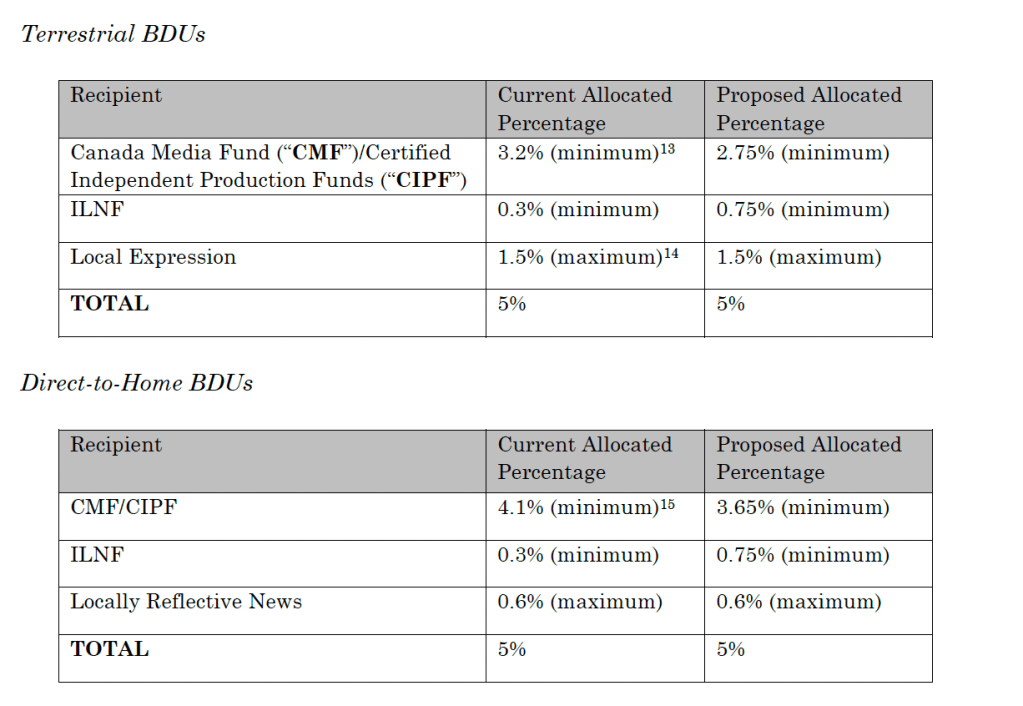
We did something exactly like that in 2019: the federal assistance to news journalism legislated by the Liberals enacted a $14,000 per journalist wage subsidy for all professional written news organizations, otherwise known as aid to Qualified Canadian Journalism Organizations.

Despite the politicized hysteria about government intervention in media, the end of democracy and so on, the highly transparent QCJO program is a success for the news organizations that qualify (which excludes broadcasters), though not enough money to stem the loss of news coverage. In the intervening two years since 2019 you may have noticed the complete absence of scandals or complaints about the program’s administration. If the newly subsidized Press has suddenly gone soft on the ruling government, no one has been able to point that out.

There are other public news funds too. In 2017 the CRTC mandated a $20 million per year subsidy for struggling local news stations. The Independent Local News Fund is financed and administered by the industry’s cable companies. No scandals, no complaints.

There is also the long-standing Canadian Periodical Fund providing modest subsidies to magazines and community weekly papers, funded and administered by Heritage Canada. Again, no scandals, no complaints.

Ditto the federal Local Journalism Initiative set up by the federal government in 2017 and administered by News Media Canada. With a modest $10 million per year, the LJI creates 342 temporary journalist positions in the most under serviced local communities. No scandals, no complaints.

Primary in all of these News Funds is the public interest. Clear and transparent rules are set for what kind of news journalism deserves public support. Either taxpayers or companies finance it at contribution rates set by regulation, and government is accountable for the integrity of its administration.

In fact, there is an opportunity at this point in our history to combine a number of these funds into a publicly accountable, arms-length super-news fund with mixed private-public funding from governments, Google, Facebook, our Canadian cable companies, and philanthropic donors.

In addition to the public interest of keeping news organizations alive, a News Fund model that mandates contributions from Google and Facebook has the added benefit of holding the Platforms accountable for the monopoly harm of hoarding advertising dollars and failing to share them reasonably with Canadian news media. This is something the Australian model doesn’t do.

And what’s interesting about creating a News Fund to mitigate the harm caused by the Platforms’ monopoly over digital advertising is that as a matter of public policy we are already half way there.

One of the Liberals’ 2021 Budget measures that flew below the political radar was a Digital Services Tax on foreign tech companies, set for now at 3% of their Canadian revenue. Scheduled to become a $900 million contribution to federal coffers by 2025, the DST is explicitly a “digital audience” tax. Big Tech, which includes Google and Facebook as the third and fifth wealthiest members of that elite club, is required to pay the government for gathering and monetizing the private data of Canadian citizens.

You will have quickly deduced that the DST money, even the share paid by Facebook and Google, doesn’t go to Canadian media. It goes to the federal government. But, a willing Ottawa could earmark at least part of the DST for a News Fund, just as it earmarks a CBC Parliamentary grant.

The DST may or may not be a permanent feature of federal landscape, though both the Liberals and the Conservatives support it. For now, the Ministry of Finance is describing it as an interim measure until international talks on a minimum corporate tax for offshore businesses reach an agreement. At that point, the DST would lose its unique character as an audience tax.

Advocating for a News Fund and a media-dedicated DST may end up amounting to no more than an interesting policy debate. Neither the Liberals nor the Conservatives seem to be interested for now. Like a lot of things in play during this federal election, we are going to have to wait until the next Throne Speech to see whether the next government is going to hold the Platforms to account and save local news.

And if this hadn’t been dragging on for the last five years you could almost be patient. As Canadian news organizations continue their financial decline, the question may not be how, but now.

Part four. Online News Content: The Global Battle Between the Platforms and Parliaments

September 15, 2021

Google and Facebook don’t want to pay for news. They are fighting on every front to defend their digital empires from legislatures and regulators around the world.

There are many theatres of battle in this contest between sovereign governments and the Platforms, not just paying for the news they monetize. There’s privacy abuses, online disinformation, and market power over digital advertising and the treasure trove of data underpinning it.

Google and Facebook know they’ll be regulated eventually. But they want it on their terms which don’t include putting limitations on their market power over advertising and consumer data or paying for news. From their jurisdictional Alamo in Silicon Valley where they remain taxed but unregulated, the Platforms play the long game.

The first challenge to Google and Facebook emerged in the European Union (EU), the obvious staging ground for legislatures governing a market of 450 million citizens and holding a keen sense of cultural sovereignty.

In 2014 the Spanish government ordered Google to compensate news organizations for using news snippets in their Search product. In response Google flamboyantly pulled its Google News service from Spanish market and it’s still not available in that country. A similar German effort also failed.

Yet different tactics often bring different results. The EU competition authorities and justice ministries turned to slapping the Platforms with lawsuits.

It got results. In 2017 the EU fined Facebook $US 122 million for misleading the public and governments over the impact of its $14 billion acquisition of WhatsApp in 2014.

The EU gave Google a hiding as well with three fines totalling $US 10 billion to punish abuses of market power in online advertising, search engine results, and its Android operating system.

On taxation, EU governments were irked by the Platforms’ avoidance of corporate income taxes thanks to domiciling in the United States and exploiting offshore tax havens. So in 2018 Great Britain passed a Digital Services Tax of 2% of revenue earned in the UK by companies like Google and Facebook on the grounds that the digital giants should pay the government for monetizing its citizens’ personal data (Canada recently legislated a 3% tax to come into force in 2022).

Perhaps mindful of the Spanish failure in 2014 to force the platforms to compensate news organizations, it was not until 2019 that the EU returned to this fight by passing framework legislation enabling member states to force Google and Facebook to offer richer licensing agreements with news publishers for their content.

France did so in 2019. But its approach, based on the notion of copyright in news content, played into Google’s hands over hair-splitting arguments about whether news headlines and snippets are “content.”

The needle really moved in 2020 when the Australian competition authority made sweeping recommendations to Prime Minister Scott Morrison. His Conservative government indicated they were receptive to a making the Platforms pay for news.

A coalition of Australian news publishers and television broadcasters —-including billionaire Newscorp CEO Rupert Murdoch— persuaded Morrison’s government to dispense with the copyright approach and get to the heart of the matter: the unequal bargaining power over compensation for news content creates an unacceptable market externality: the impoverishment of newsgathering.

I will do a deeper dive into the Australian model in our next and final blog in this series, but the crux of the legislation legalizes collective bargaining by groups of news companies with each of Facebook and Google, significantly with the leverage of binding arbitration if a deal isn’t reached.

It is binding arbitration that changes the publisher-Platform content from a might-makes-right contest to one based on reason, even if a precise formula for valuing content — which would likely produce a bottom-line payment to publishers in excess of what the Zuckerberg and Google CEO Sundar Pichai were offering to pay —would ultimately be left for an arbitrator to decide.

Faced with legislation, Facebook tried Google’s Spanish power play: in February 2021 CEO Mark Zuckerberg pulled the plug on Facebook’s news content for its 12 million Australian users. But Australian PM Morrison didn’t blink. Zuckerberg folded. The blackout had lasted a week.

After the Zuckerberg blackout failed, the prospect of arbitration was so daunting that by May both Facebook and Google struck deals with different bargaining groups of news companies.

As of today, the Australian legislation is the high-water mark of the sovereign legislatures’ regulation of the Platforms.

Back on the Platforms’ home turf, the American government has lagged: perhaps because the Big Tech companies Google, Amazon, Facebook, Apple and Microsoft represent 15% of the stock market’s capitalization, or perhaps because of the usual Congressional paralysis. The Platforms don’t lack for political enemies on either side of the aisle.

Political paralysis or not, Congress could hardly ignore the Cambridge Analytica scandal. When Facebook’s data-gathering prowess was made available to Cambridge Analytica, the right-wing political consultants used Facebook’s data profiles on 87 million Americans and Britons to feed political actors in the 2016 US Election won by Donald Trump and the UK’s “Leave” forces in the Brexit referendum of the same year.

The fall out of the Analytica scandal in Washington was that in 2018 CEO Zuckerberg had to prostate himself before Congress and the Federal Trade Commission (FTC) fined him $5 billion.

Meanwhile the FTC also filed an anti-trust suit against Facebook for its earlier take-overs of Instagram and WhatsApp that had consolidated the social media market in Zuckerberg’s hands. That suit was recently booted by a circuit judge but has been re-filed by the Biden administration.

Google is also the subject of a raft of anti-trust suits from 48 US states against its market consolidation in Search and display advertising.

But other than legal sparring and big fines, there is no apparent prospect of US Congress regulating the Platforms.

Here in Canada the agitation for a fair deal between Publishers and Platforms goes back years, but it didn’t advance as a significant political issue until the federal Liberals committed to it after the 2019 election.

The charge is being lead by publishers belonging to News Media Canada with vocal support from Unifor and the Friends of Canadian Broadcasting.

It looked like Heritage Minister Steven Guilbeault might table a Platform Bill in the Spring of 2021, probably modelled on Australia.

But Guilbeault’s timetable was derailed by the Conservative Party’s successful filibuster of the Netflix Bill C-10.

The consequence of the filibuster, combined with the impending dissolution of Parliament in advance of the September election, meant that publishers reasonably concluded an Australian-style Platform Bill was at best another year or two away.

Google and Facebook, which had just lost an important battle in Australia, smelled the publishers’ desperation and quickly struck deals with a handful of breakaway publishers from the Newsmedia coalition. The deals do not compensate publishers for any content —including Google’s Search and Facebook’s News Feed —except stories which the Platforms’ agree to post in their special news tabs. The Globe and Mail signed on, however the major two newspaper chains Torstar and Postmedia did not.

The deals are a big win for the Platforms who are surely desperate to recover from the blow they suffered in Australia before US Congress gets any ideas.

Still, the contest in Canada between the Platforms and media companies is far from over.

The Liberals’ campaign for re-election includes a Platform Bill. The Conservatives’ election platform supports some form of it.

If that political support remains in place after an election, the next question will be what shape a Platform Bill would take. More on that in our next blog.

Part three. How Facebook and Google Monetize Your Privacy

September 11, 2021

“Web Giants hoard mountain of cash” isn’t news.

The Platforms Google and Facebook do make a lot of money: in 2020 Google raked in $USD 182 billion for an operating profit of $41 Billion. Facebook took in $86 Billion revenue and $32 Billion in profit.

To give you a sense of scale, Canada’s biggest news organization, Bell Media recorded $USD 2.4 Billion in revenue and a net profit of $0.6 Billion in pre-pandemic 2019.

Big companies throwing their weight around isn’t big news.

But unregulated foreign-owned communications companies holding monopoly-scale power is news: We were reminded of that in 2020 when CEO Mark Zuckerberg pulled the plug on Facebook’s Australian users for a week in retaliation against proposed government regulation.

And like all powerful companies with dominant market power, the Platforms impact not only their customers and competitors but also the public good. Remember the 1989 Exxon Valdez oil tanker spill on the Alaskan coastline? Or green house gases circa 2021? What economists antiseptically call the “externalities” of bad corporate behaviour really means that citizens suffer the collateral damage and the corporation may or may not pay for it.

In the case of Google and Facebook, their chief externality has been to corner the market on media advertising, the golden goose that used to pay the bills for news journalism, a public good that keeps our democracy alive. Making it worse, Facebook hosts disinformation on its Platform.

Western democracies want to do something about it. But so long as US Congress sits idle on the market power of the Platforms, the options for other sovereign nations are limited.

One of the tactics employed by other governments is to challenge the Platforms on anti- competition grounds. In the UK, which has a more powerful regulator than Canada, the Competition and Markets Authority (CMA) published a 437-page report in July 2020. It concluded the Platforms has captured overwhelming market power and are in many cases abusing it. The CMA recommended regulatory interventions into many aspects of the Platforms’ business practices.

At the core of the Platforms’ market power are parallel monopolies in digital communications: Google’s search engine and Facebook’s News Feed.

Google owns a cool 95% of the global search engine business. Facebook, with its purchases of Instagram and WhatsApp, controls 70% of the world’s social media traffic.

The Platforms have been wildly successful in their bargain with digital consumers: in return for the Platforms’ tracking and accruing digital data in every nook and cranny of your every day life, you get an array of free digital products which, in this day and age, most people can’t seem to do without.

Again, advertisers and ad dollars are the golden goose. The Platforms’ ability to build rich data profiles on hundreds of millions of people allows them to sell custom-fit demographic audiences to advertisers at reasonable prices (Google ran an experiment for publishers in 2019 showing that ads not guided by consumer data fetched only 70% of the price of the usual data-guided digital ad).

As you can see, the Platforms’ monetize your private daily life. This is not news to most of us.

But their secret is this: they need interesting content that draws you to their products in the first place. News is not the number one draw, but it’s a big one. Just think how often you go to Google Search looking for breaking news, or even old news. Think about how frequently you scan your friends’ Facebook shares as part of your daily take on the news.

It doesn’t end with Search or News Feeds of course. The Platforms have branched out, growing their digital empires into an ecosystem of complimentary digital products that are mostly free and feed their voracious appetites for your personal data.

Google has about 270 digital products in Search, advertising, video broadcasting (YouTube), personal communications, publishing, maps, business analytics, and so on. Unless you’ve been secluded in a log cabin since 2002, you’ve used a lot of them. Each time you give your personal information to Google, you add to their treasure trove of data.

Facebook has expanded too: it owns not only Instagram, WhatsApp, and Messenger, but also a host of complimentary digital freebies like Facebook Live, Facebook Marketplace, the list also goes on.

Besides building their profile on you with basic personal data, the Platforms consume your daily digital life through your searches, browser visits, phone location systems, online shopping, e-mail, messaging, likes, and comments. In other words, everything about you. And you pretend not to mind (or you would rather not know).

In the digital world, data is everything, because it’s what gets monetized if advertising is in play. The Platforms’ golden data goose just keeps getting fatter.

What’s worse, the Platforms occasionally abuse their stewardship of your data. In 2013, Facebook’s third party app Open Graph allowed Cambridge Analytica, a right wing consulting company, to build data-driven “psychological profiles” of millions of Facebook users and their contacts. They used this private data to fuel disinformation campaigns during the 2016 US election and the Brexit referendum. When a Cambridge Analytica employee blew the whistle in 2018, Facebook CEO Zuckerberg was forced to apologize to the US Congress and paid a $USD 5 Billion fine to the Federal Trade Commission.

Under the leadership of its far more likeable CEO Sundar Pichai, Google is an even bigger data gorilla than Facebook. Its abuses, as documented by the CMA Report, are on the advertising side of the business rather than the user side.

In addition to having captured 95% of advertising in Search and roughly half of the entire digital advertising business around the world, Mr. Pichai also does a brisk business in display advertising through Google Ads and, for good measure, controls about a third of the “open display” advertising market.

Open Display is a marketplace for publishers to sell ads on their web pages to advertisers through “real time” auctions of ad space. The auctions are triggered when you open a web page, instantly offering your data profile to be matched with a suitable ad. This speed of light auction is conducted through a commercial chain of computer servers known as “the Ad Stack.”

Surprise, Google holds the dominant ownership position in this Ad Stack at every link in the server chain. In fact, Google is the dominant provider in both the supply (publisher-side) and the demand (advertiser-side) links in the server chain, providing a surely irresistible opportunity to favour its own business interests over any given client at any given time, for millions of ads each day.

You get the picture: the Platforms are the global data juggernauts and they don’t always play nice.

For news publishers the implications are as follows.

First, the publishers clearly can’t compete with the Platforms for data-driven advertising dollars. As print advertising winds down—at about 10 to 20% every year— the news publishers’ dilemma only gets worse.

Second, the Platforms’ monopoly control of two indispensable platforms for drawing news consumers —-Google Search and Facebook News Feed— means that negotiations to pay for editorial content between thousands of individual news publishers and the monolithic Platforms is hopelessly lopsided in favour of Google and Facebook.

True, spokespersons for Google and Facebook are fond of arguing that they drive viewer traffic to publisher websites that can be paywalled to earn money.

There is merit to their argument, but it’s of little consolation to publishers who are struggling to convince you and I —-life-long addicts of free or subsidized news content that we are—- to start paying full tariff for it. Nor do the Platforms acknowledge they have cornered the market on the ad dollars that used to pay for news.

It’s notable that the British competition authority recommended a number of market interventions to mitigate the harms that the Platform monopolies inflict on their own customers and would-be competitors in digital products. As for the publishers, the CMA struggled to identify any market corrections that might mitigate the “externality” of bankrupting or otherwise impoverishing news journalism.

In other words, the news publishers will never acquire the data resources allowing them to compete for ad dollars with the Platforms through some intervention by competition authorities. There is no unscrambling this omelette.

Unless of course…the CMA could have grabbed some headlines with a recommendation as dangerous as it is taboo: the Platforms could re-unite news content and advertising dollars by getting into the journalism business themselves.

Just imagine mergers of media companies with data companies to provide a so-called level playing field between global giants. Perhaps a marriage between Fox and Facebook. And another between Google and the New York Times. And just imagine Steve Bannon or Rupert Murdoch as CEO.

If that doesn’t make your blood run cold, check for a pulse.

Our next blog poses the question: what if anything can sovereign nations do to save their news media.

Part Two. The Rise of Google and Facebook and the Decline of Canadian Local News

September 1, 2021

News journalism – especially professional and fact checked journalism – is essential to democracy. It is a public good. But that doesn’t mean there is a financial model to support it – anymore.

For decades a robust financial model paid for news. The model was ads. Lots of ads. Our written and broadcast media enjoyed the mercenary patronage of advertisers looking for customers. Thanks to them, we never paid more than a sliver of the cost of our news. We still don’t. 

Many Canadians don’t know that for a century the costs of reporting the news was subsidized 80% to 100% by advertisers, depending on whether you got it from newspapers, radio, over the air TV, or cable. Our news was free, or at least highly subsidized by advertisers.

In the new digital environment, those advertisers have flocked to Google and Facebook thanks to their mass audience and laser targeting of users and buyers.

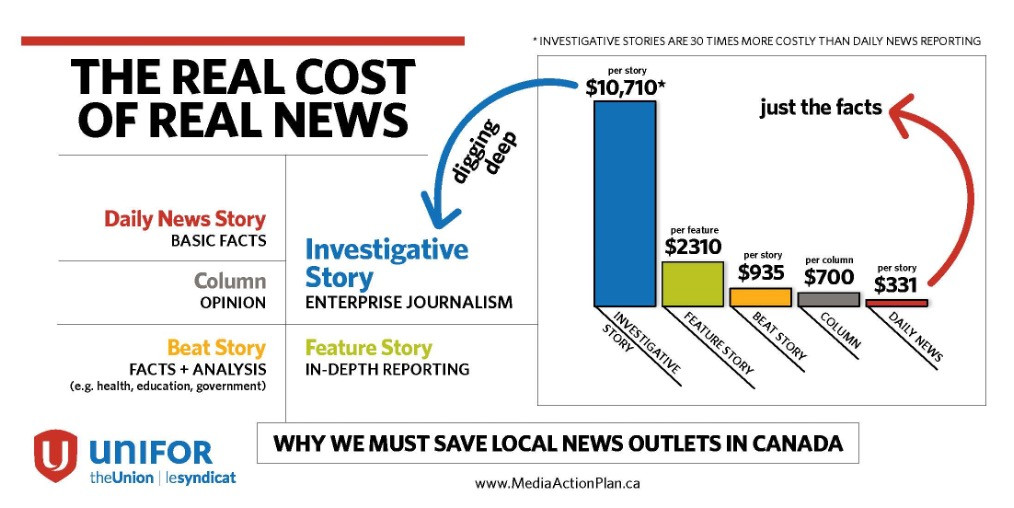
But our appetite for news hasn’t let up. Canadians devour it online, especially on our phones. Unfortunately, professional coverage of news, especially local news, has shrunk as advertising revenues and journalist employment have declined. Picture how thick your local newspaper was 30 years ago compared to today, how many fewer local stories can you find now.

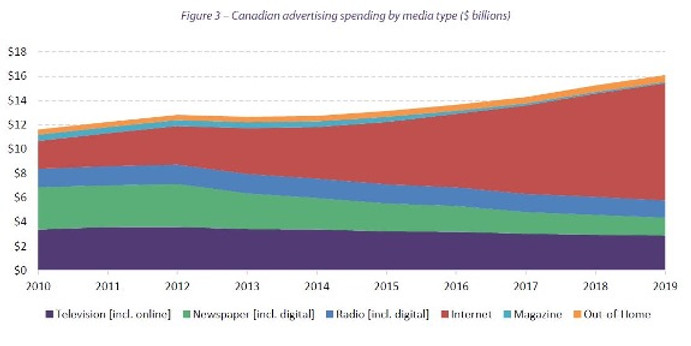
The unravelling of this business model for local news was documented in grinding detail by the Public Policy Forum’s 2017 report “The Shattered Mirror.” If you’ve been following the annual reports of Canadian news organizations since then – it’s only got worse. This chart shows how the advertising market share of written and television news organizations, compared to online advertising, flipped on its head in a decade. 

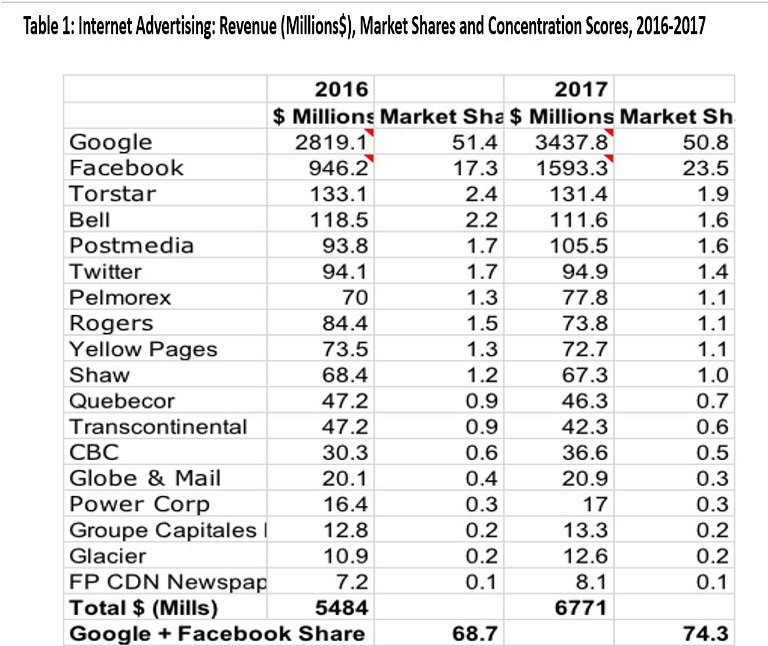
Another chart shows us that the Platforms Google and Facebook have 75 % of the online pie, news websites have about 6 %: 

Written journalism generates the lion’s share of original reporting in this country and it’s been hardest hit by the Platforms’ success. From a peak in 2012, advertising revenues for Canadian news publishers have steadily declined to half of what they were.

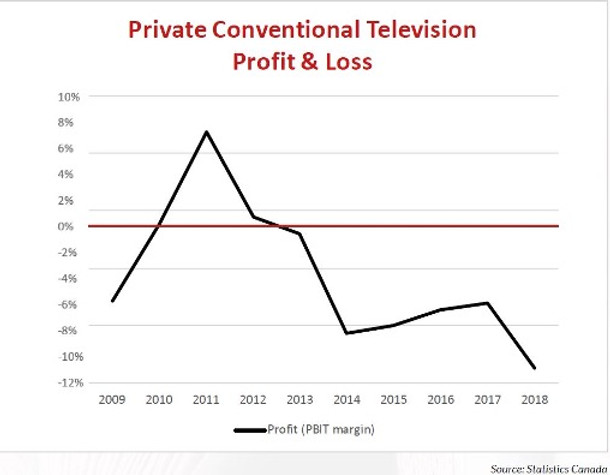
Meanwhile Google’s ad revenues have doubled and Facebook’s have quadrupled. In the same time frame, newsroom staffing shrunk by one-third, diminishing the capacity to cover local news. Television news is going in the wrong direction too. According to job data collected by Unifor, the TV union, newsgathering staffing is down 20% since 2014. The decline in newsgathering employment matches the same trajectory in broadcaster earnings: CRTC data reveals that “conventional” broadcasters (i.e. excluding subscriber-pay channels) have reported an average 8% loss since 2012. 

Radio is highly dependent on local advertising but prior to the pandemic boasted a 20% profit margin, apparently weathering the Google / Facebook storm, thanks to its captive audience in automobile commuting. Radio is an indispensable platform for informing the public. Always thinly staffed, radio is known for its “rip and read” re-caps of original reporting done by newspapers and TV.

Unfortunately, radio got hit with a 50% loss in advertising during the pandemic. In a sign of the times, Bell Media news talk stations in Montreal and Toronto laid off most of their reporters in early 2021.

What the last decade has shown is that the loss of the advertisers’ subsidy of newsgathering is not being replaced. And so, we cast about for a solution.

Subscriber revenue is the logical replacement for the loss of ad revenue. Unfortunately, the typical news consumer is used to getting free or low cost news and resists paying for it.

The few success stories in expanding subscriber revenues are mostly limited to smaller niche publications with highly loyal and affluent news consumers. For the mass audience, the only North American digital news organizations that have succeeded in building a thriving subscriber-pay business model are the Washington Post and New York Times. Obviously, they are national newspapers with limited local or regional coverage. Even more obviously, they play in the largest wealthy country on the planet, with a mass market of 340 million Americans.

It’s a legitimate question whether a Canadian news organization can duplicate that subscription success in a country of 35 million. The leader of the pack, the Globe and Mail, hasn’t achieved the same success as the Times or the Post although it may be within reach. Note the Globe caters to a well educated and affluent demographic, not a truly mass audience and diverse citizenry that needs to consume news in order to make a democracy work.

The Toronto Star has met with mixed success increasing the number of paid subscribers, and tellingly Torstar’s new owners are aggressively turning to their non-media assets to generate profits that might cross subsidize its newsgathering.

The National Post has turned up the volume on opinion journalism in hopes of attracting more paying subscribers, but Postmedia is not breaking out the profit-and-loss for the Post in its quarterly reports.

And these are the news organizations vying for a paying national audience. There are few if any examples of a successful pay-subscriber model in local metropolitan markets, cities and towns.

The fate of local news is only slightly less grim in television. There are fewer independently-owned stations still on-air and they are struggling. The CRTC threw them a lifeline in 2017 by creating the Independent Local News Fund: a modest $21M industry subsidy tithed from Canadian cable companies that goes to stations like CHEK TV Victoria, CHCH Hamilton and NTV in St.John’s.

Unlike independent stations, national networks like Bell Media CTV, Quebecor TVA and Corus’ Global News have the opportunity to mitigate the loss of ad revenues through internal cross-subsidies within their broadcasting operations to keep local TV news afloat. For example, some local network stations in big metropolitan areas – like Global News in Vancouver or CTV in Toronto – make money, allowing their parent networks to sustain broadcasting in smaller markets with fewer local advertisers. But as TV ad revenues dwindle, there is less profit to cross subsidize sister stations.

An even bigger pool of cross-subsidies for local news is the cable subscription revenue taken in by the major broadcasting networks’ profitable sports and entertainment programming. But even these profitable TV operations are declining. That’s because Internet TV has disrupted the decades-old model of Canadian TV networks buying the Canadian distribution rights to hit American programming and retailing them to Canadian viewers at a profit – that pays for local news.

As TV migrates from cable to Internet, Netflix and the growing ranks of foreign owned Internet TV streamers like Disney Plus and DAZN Sports have cast aside the Canadian re-sellers and market their movies, shows and sporting events directly to Canadian audiences.

Not surprisingly, the Canadian TV companies’ revenues and profits are falling in response. That is one of the biggest reasons Canadian TV networks and other public interest groups supported Bill C-10, the Netflix Bill that was stopped by the Conservative Parliamentary filibuster this Spring. The purpose of C-10 was to compel foreign-owned Internet TV companies to contribute financially – as our domestic media companies do already under the Broadcasting Act – to Canadian content in news, sports and entertainment programming.

As we head into the federal election, our news organizations continue to gasp for air. Newsrooms have shrunk. Subscriber-pay models have yet to succeed in written journalism. Internal subsidies haven’t stopped the decline of television local news. And the cause, maybe the culprits, are Facebook and Google. More on them in the next blog post.

Part one. News Journalism v. Google & Facebook: Why the Web Giants Should Pay

August 30, 2021

With an election on September 20th don’t be surprised if federal intervention on behalf of Canadian media emerges as a wedge issue.

​The pro-regulation crowd will point to the unravelling business model for journalism and the making of Canadian news, sports and entertainment content.

The anti-regulation folks detest the very idea of “government” and “media” in the same sentence. They are fond of wrapping themselves in the Free Speech flag to get their point across.

Likely, we can expect an encore performance of last June’s Parliamentary drama, the “Netflix Bill” C-10.

An even more existential media issue may not get the attention it deserves: how to save Canadian news journalism from being put out of business by the spectacular success of “The Platforms,” i.e. Google and Facebook. Nearly 300 Canadian newspapers closed in the last decade, mostly in towns and smaller cities, while most local TV stations lose money.

Beginning in 2020, Liberal Heritage Minister Steven Guilbeault repeatedly promised that the federal government would legislate mandatory financial contributions by The Platforms to Canadian journalism.

However, the Conservatives’ filibustering of C-10 and the tar-heeled bureaucracy of Heritage Canada ruled out a Platform Bill this Spring. This summer, Heritage was mid-way through a second public consultation on the topic when the writ was dropped, sending everyone back to Square One.

Alive to the delay in federal action, the Platforms seized upon the financial desperation of news publishers to strike symbolic —and cut-rate— deals with some Canadian publishers (most notably the Globe and Mail) to increase the compensation they’ve paid when publishers voluntarily post news items (user generated shares of proprietary news content remain uncompensated). The two biggest newspaper chains Postmedia and Torstar spurned the offer.

Guilbeault responded by telling the Platforms their cherry picked series of publisher deals —shielded from public view by non-disclosure agreements—- aren’t good enough to avoid legislation for more significant contributions to journalism.

So far, the Liberals are not facing much political opposition to this. In fact the Conservatives, who oppose the Netflix Bill (but say they would table a Bill that sounds similar), flogged the Liberals for lagging behind on a Platform Bill and their election platform seems to support one.

The few remaining opponents of a Platform Bill mostly hale from the pundit class and university campuses. Globe & Mail columnist Andrew Coyne recently denounced a Platform Bill as a publisher shake-down: “Stripped of its endless, shifting rationalizations, the newspapers’ position remains the same as ever: Facebook and Google have a lot of money. Make them give us some.”

This leaves us with the question: what is the case for a Platform Bill?

We’ll explore that in the next four blog posts:

Part 2 – The crisis in journalism: the crumbling business models of written and television news.

Part 3 –The Platforms’ unregulated market power in audience, advertising and data.

Part 4 – Why the Platforms should pay: other sovereign responses to the crisis in journalism and how Canada might do it.

Part 5 – If the Platforms pay, how do they pay?

ANALYSIS: MPs play games with Bill C-10

May 5, 2021 (first published by CARTT Magazine).

UNTIL LAST WEEK, PARLIAMENT’S Standing Committee on Canadian Heritage was plodding through the clause-by-clause review of Bill C-10 with no tasty headlines. Perhaps the bill’s revamp of the Broadcasting Act, which would sweep in Netflix, isn’t controversial anymore.

Of course, federal political partisanship is inevitable, as Canadian as bad weather.

And so, we now have the Conservatives’ faux controversy over free expression on social media platforms. In an e-mail blast from CPC MPs across the country, they made their case:

“Recently, the Liberal government introduced Bill C-10 – a bill that would regulate social media websites like Facebook, YouTube, and Twitter.

That means that a government-run organization – the CRTC – would have the final say on what Canadians can and cannot post on the internet.”

It was a cue for the usual suspects to pile on. The much-quoted Michael Geist, a law professor opposed to regulation of the Internet, gave journalists some good sound bytes.

Then, footnoting Geist, the activist group Open Media decided it all made good fundraising material. In its own email blast, it said:

“Last week the Department of Canadian Heritage blindsided us at the third reading of Bill C-10, adding a last minute change so that all user generated content on the internet will be regulated by the CRTC. This means that this government (and all future governments) would have the power to unilaterally censor or shadow ban ANY of the pictures, videos and audio we put online.

Your photos, your Mother’s day Facebook post, your tweets or memes. All of it.

Will you help us fight back?

DONATE.”

Aside from setting their hair on fire, Open Media didn’t get its facts quite right. It wasn’t Heritage bureaucrats and it wasn’t third reading. It was MPs on the Parliamentary Heritage Committee combing through the bill for errors and omissions, before punting it back to the House for third reading. A majority of MPs (Tories excluded) dumped a clause that would have given a blanket regulatory exemption to any social media platform that might get involved in broadcasting programming.

But, it made a provocative story with the right spin – that MPs had just handed the CRTC the power to ban Facebook and YouTube posts.

An explanation and a little context is in order.

Bill C-10 will update the Broadcasting Act. — originally passed in 1968 by Pierre Trudeau and updated in 1991 by Brian Mulroney — for today’s Internet.

The Broadcasting Act has never been about policing content. Since 1968, job number one for the CRTC has been to protect Canadian culture from being overwhelmed by a tide of American content.

That’s why the business end of the Act has been to levy funds from major cable TV companies – Bell, Quebecor, Rogers, Telus and Shaw—–to subsidize Canadian films, documentaries, and local news. The CRTC also requires major broadcasters like CTV, City, TVA and Global (owned by the major cable companies) to spend 30% of their budgets on airing Canadian news, sports and entertainment.

Before the Internet disrupted media on a global scale, Canadian TV companies did not have to compete against foreign streamers, search engines, or social media for advertising or subscription dollars.

Of course, things are different now. At first the federal government was slow to act, but the monopoly power of Big Tech got so out of hand it began to draw political fire and political will.

C-10 is the first, but won’t be the last, piece of federal legislation that will oblige foreign internet companies to play by the same rules as Canadian media companies, primarily to contribute to those cultural subsidies or make Canadian content of their own.

As for policing content, there is nothing new about that in the bill even though the CRTC has had that power over broadcasting entities since 1968. They have used it to regulate commercials and fair election advertising, but not much else.

Going back decades, the CRTC showed very little interest in policing the programming content you watch. It downloaded any content cop role to the broadcasters themselves, the self-policing Canadian Broadcasting Standards Council. A quick search will tell you that council is toothless or, depending on your point of view, appropriately unmotivated to interfere with content complaints.

Here’s how the controversial clause removed from Bill C-10 fits in to all of this.

When Heritage bureaucrats drafted the bill last winter, they decided to exempt Google’s YouTube, Facebook, and other social media platforms (like the right-wing app Parler) from any kind of regulation even if they engaged in broadcasting. The platforms’ exemption appeared to be solely because their content came from third party uploads (from cat videos to commercial channels).

Significantly, the bill exempted the uploaders themselves (and still does).

Given the revised Broadcasting Act will likely serve for another three decades, it was odd to give away exemptions to such powerful media companies as Google and Facebook. Netflix obviously doesn’t get that exemption and neither will any Canadian TV companies.

It’s not surprising a majority of MPs on the committee thought it was a bad idea.

But here’s the twist in the story.

The Tories on the committee knew very well that censoring social media posts was not on the menu. In fact, they weren’t opposed to dropping the exemption. They are just fine regulating Facebook and YouTube if those platforms get into broadcasting.

To make a point during committee proceedings, CPC MP Kevin Waugh pointed out that Facebook and YouTube are already experimenting with broadcasting, when he said: “Thank you, Mr. Chair. We are seeing a lot of non-broadcasters going on Facebook and so on. Even now YouTube has major league baseball and yesterday offered a game with the Houston Astros on YouTube.”

However, for reasons best known to themselves, the Tories wanted a blanket exemption for social media platforms with fewer than 250,000 subscribers or $50 million in annual revenues. When they didn’t convince the other MPs, somebody at Tory HQ must have seen an opportunity to run the skull and crossbones up the mainmast.

The Tories have been effective enough that the Liberals are this week going to introduce an amendment to make it even more explicit that social media posts won’t be regulated.

The Conservatives will continue to slow the committee consideration of the stack of 118 amendments on the order table before the bill can go back to the House for third reading. Then expect the Tories in the Senate to hold up C-10 this summer.

Meanwhile in California, Big Tech is having a big laugh.

Broadcasters Sound the Alarm on Local News

August 30, 2020

The Canadian Association of Broadcasters (CAB) is warning the public, and especially our federal government, that the journalism-sustaining ad revenues that pay for radio and TV news are about to get clobbered by the double whammy of the Internet and the Covid-induced recession.

The precarious survival of broadcast news, especially local news, is hardly a secret to industry analysts.

But for the last five years most public attention has been focussed on the fate of “print” newsrooms. No question, 270 newspaper closures in the last 10 years is hard to ignore. Any news junkie could tell you local newspapers have closed in small and mid-sized communities across the country. Even in large cities, news coverage has either shrunk or been filled out by syndicated news from outside the community.

Just as the Public Policy Forum riveted policy-makers’ attention on the dire prospects of Canadian newspapers in its 2017 report “The Shattered Mirror,” the CAB has released its own bell-weather analysis in CMI’s prosaically titled report “The Crisis in Canadian media and the future of local broadcasting.” It’s considerably shorter reading than the Shattered Mirror, with a bullet-point executive summary.

Here’s a spoiler alert: the Internet has been blasting Canadian radio and TV for years. Covid is turning it into a perfect storm.

CMI predicts a $1 billion shortfall in advertising revenue in the next two years because of Covid. With fifty per cent of the nearly 800 private radio stations already operating in the red prior to Covid, and seventy per cent of 95 private television stations in a loss position for several years, it’s not adventurous to project mass closures of broadcasting stations. The loss of local news, already hugely impacted by newspaper closures, is the grim reality of what’s in store for our democracy.

The CMI Report’s author Ken Goldstein —the veteran media analyst based in Winnipeg— says the long-term erosion of broadcasting’s advertising revenue caused by the Internet means even a “V” recovery from the Covid recession will not result in a real recovery of broadcasting revenues. Covid is merely accelerating the pre-pandemic decline.

CMI predicts between 50 and 200 money-losing radio stations going off-air, and an unspecified number of TV stations (some network TV stations are obliged by CRTC licences to keep operating until 2022).

The at-risk stations are likely to be small and independently owned. They can’t spread overhead or lean on profitable sister stations in the same ownership group, unlike stations operated by large media networks owned by Bell Media, Quebecor, Rogers and Corus. The vulnerable stations are more likely to be in the Atlantic, the West or in Ontario outside of the golden horseshoe.

For decades, Canadian broadcasting thrived, and now merely survives, on a multi-layered system of cross-subsidization, beginning with money-losing small market stations sharing in the wealth from stations in major metropolitan areas. The same cross subsidization effect transfers profits within large ownership groups from cable divisions to broadcasting operations, and within broadcasting operations from sports and entertainment channels to local TV.

Additionally, Canadian television broadcasters make healthy profits by retailing popular American shows —-think the NFL Super Bowl or the Oscars—- to pay the bills for local journalism.

But that industry profit, which allows for cross-subsidization of local radio and TV news, has been completely disrupted by the foreign Internet giants: Netflix, Amazon, Google, Facebook, DAZN…..the list gets longer every year.

What CMI is saying is not just that many money-losing independent stations won’t survive Covid, but that the cross-subsidization capacity of big media like Bell or Rogers to keep their smaller regional stations afloat is fast eroding.

If you’ve endured the steady stream of bad news from our “print” media conglomerates —- like Postmedia and Torstar—- you will see evidence of the fact that Canadian journalism is not going to be saved by economies of scale. Corporate consolidation is merely resisting the gravity of decline.

If there is a glimmer of hope, we do seem to have a Heritage Minister —-rookie Montreal MP Steven Guilbeault—- who gets it and wants to fix it, not always a given in a cabinet role that seems to be treated as a training assignment.

But convincing the responsible cabinet Minister to legislate solutions is only the first step in dealing with a problem as challenging as the survival of Canadian media. Without sign-off from the PMO and senior cabinet ministers, the media file goes to the bottom of the Parliamentary pile.

The Liberal government has been studying the vexing problem of media and local journalism for five years now. In 2017 a Liberal-majority parliamentary committee told them what to do. The CRTC gave them options in a major report issued the same year.

The government appointed a blue-ribbon committee that in early 2020 gave them a roadmap for legislative reform.

Now the Prime Minister just has to decide if he wants to do something.

Australian-Rules Regulation: How Google and Facebook will at last pay for news content

June 8, 2020

In little Australia (viewed from afar by little Canada), the Competition Commission is bravely bringing to heel the data giants Google and Facebook.

Australian news publishers may soon win relief from their one-sided commercial relationships with the digital platforms run by the Silicon Valley monopolists: most notoriously Google’s search engine and Facebook’s news feed, but also a wide array of their supporting platforms like You Tube, Instagram and Google News.

For the most part, Google and Facebook just rip off news publishers for their content, either through news content links in Google search engine results or user-uploaded news articles on Facebook.

The billion-dollar data giants monetize all this stolen* news content: directly through advertising against the very content they are taking, indirectly by drawing more consumers to their digital platforms, and very directly by harvesting precious personal data on news consumers visiting their platforms.

When businesses like Google and Facebook become monopolists, government watchdogs like the Competition Commission struggle to find the best response.

Since only the US government can break up this Californian monopoly, there remain two options for other countries.

Do we regulate big data like public utilities, telling them what they must do in the public interest? Or instead do we try to level the playing field between big data and the news publishers, not unlike how Canada regulates transactions between cable companies and broadcasters?

Despite the fact that the Commission shares the consensus view that journalism is a public good, which might suggest the regulated utility approach, it is pushing a mandatory “bargaining code” to redress the imbalance of bargaining power between big data and the news publishers.

Although the Commission’s latest document is formally a request for submissions on a long list of pregnant questions, it’s possible to guess what the Commission might fashion in a mandatory bargaining code.

Will the code focus on hard news or cast a wider net to capture sports, listings, and entertainment? What is a legitimate news organization? What degree of professional accreditation will be required of its journalists?

Once those parameters are set, next up is how to enshrine bargaining rules. The Commission considers whether a collective bargaining model would work: news publishers banding together to take on big data.

But what if the collective solidarity of the publishers falters? This in fact seems likely. The similarities to conventional labour negotiations between unions and employers suggest that Facebook will divide and conquer the various news organizations unless regulatory oversight is very tight.

The Commission sees bilateral negotiations between individual news organizations and big data as a possible model. To level the playing field, a bargaining code not unlike a Labour Code might be offered. That would mean policing Google and Facebook’s good faith at the bargaining table, requiring them to share commercial data with publishers, and imposing an end-game solution of independent binding arbitration.

Once the regulation model is resolved, next comes the rolling up of sleeves and the nose-biting negotiations. At the bargaining table, it might be straightforward to identify the “direct value” of Facebook’s and Google’s advertising revenue tied directly to the use of publishers’ news content. Finding a fair price might not be too hard.

But big data’s big money is also found in the “indirect value” it gets from news content that invites news consumers to their platforms for all sorts of digital visits unrelated to news. That draw generates more traffic, more advertising, and….crucially….more user data. Putting a price on all of that is going to be hard, the Commission reckons.

And make no mistake: it’s mostly about data. Given that Google and Facebook constantly accrue data from the publishers’ news consumers, the publishers have a very legitimate interest in negotiating access to Google’s and Facebook’s even richer data on news consumers.

Another bargaining item will be the impact of Facebook’s and Google’s frequently tweaked algorithms on news publishers. In the past both companies infamously blind-sided news publishers by changing algorithms without notice, completely reshuffling the kind of news content that platform visitors see. The Commission’s new code might require big data to provide advance notice of some changes in algorithmic curation of news so publishers can adapt.

The Australians are moving fast and aim to have a draft code out in July. Compared to the dilatory pace of the Canadian public policy, this is moving at Warp 10. Here in little Canada where the Liberal government twiddles its thumbs, we will be watching with rapt attention.

***

* An update and mea culpa (October 2023). The word “stolen” is literally untrue in this context and polemic in its use. A better word would have been “unjust enrichment” which is still polemic but very arguably true. “Unjust enrichment” is a phrase taken from a law dictionary where it refers to a situation of two parties in a legal relationship and one party inequitably profits from the other party’s labour and the windfall gain is not captured by a binding contract or tort law. In the context of Google and Facebook monetizing news content that is made available on the open Internet by news organizations, the Australian competition authority has characterized the compensation (if any) paid by the Platforms to news organizations as inadequate because the Platforms have so much market power over news organizations as the dominant distributors of online news in Search and Social. In other words, news organizations cannot find substitute Platforms to reach audiences using these kinds of online platforms to access news.

Janet and the Goliaths

February 21, 2020

What to do about the Data Giants?

It’s hardly news that data giants Facebook and Google are destroying the viability of Canadian media while their platforms pump out fake news and misinformation. What if anything can Canada do about it?

Over in Europe, the authorities are not amused and have resorted to blunt force.

In 2018 the EU fined Facebook $122 million (US) for misleading the world over its acquisition of WhatsApp. https://www.cnbc.com/2019/11/09/facebooks-antitrust-investigations-a-timeline-of-events.html

Google got a hiding as well. In three whopping fines totalling $10 billion (US), the EU whacked Google for market power abuses in online advertising, search engine results, and its Android operating system.

Seems the idea caught on across the pond. In 2019 the US Federal Telecommunications Commission fined Facebook $5 billion for its complicity in the Cambridge Analytica scandal. Anti-trust suits filed by the FTC and 48 American state governments against Google and Facebook are currently backed up like jets on an ice-coated runway.

https://www.cbsnews.com/news/google-antitrust-probe-48-u-s-states-launch-antitrust-investigation-of-google-dominance-in-search-ads-and-data/

Enter Canada.

Serendipity being one of those beautiful things that keeps life interesting, this January the independent industry committee headed by Janet Yale released its Broadcasting and Telecommunications Legislation Review (BTLR) Report.

Yale’s inaugural mandate in 2018 was to recommend first drafts of Broadcasting and Telecommunications legislation revamped for the digital age. In addition to answering important questions about broadband infrastructure and mobile phone plans, the Committee’s big task was how to deal with Netflix and a growing crowd of American movie channels that have invaded the long-protected Canadian TV market and could care less about Canadian stories or sensibilities.

But to keep up with the evolving world of digital communications, Yale and her Committee embraced the question of Canada’s response to the Data Giants, Google and Facebook. (The Canadian Competition Bureau has been poking its nose around too).

Just three years ago, this kind of regulatory intervention into data platforms seemed politically impossible. What happened?

In two words, Cambridge Analytica. In a scandal as sinister as a Hollywood thriller, Facebook acknowledged its complicity in allowing the online data belonging to 87 million Americans to be hacked and exploited by political actors targeting voters in the 2016 election.

When the scandal broke, the Data Giants went from shiny penny to malign influence. All of the sudden, their free digital tools no longer seemed so benevolent if they were masking a data vacuum exploited for questionable purposes. People started making the connection between their private data, the oligopoly power of the Data Giants, and some very ugly changes in our democratic life.

Yale’s BTLR Report was perfectly timed to formulate the Canadian response to the power not only of Netflix, but of Google and Facebook too.

The Report’s cultural agenda is hardly a surprise to anyone following the decline of Canadian media.

It recommends extending current cultural regulations —-rules that compel Canadian media companies to bankroll the expensive public goods of journalism and Canadian culture—- to Netflix and other foreign Internet TV companies that have grabbed audience share from Canadian broadcasters while evading all obligations. The CRTC had recommended the same thing two years previously.

Yet it is the Yale Committee’s approach to the Data Giants that many didn’t see coming and raised a few eyebrows.

In addition to dealing with Netflix, the Report recommends that “media sharing platforms” (i.e. Facebook or Google’s You Tube) should also pay the standard regulatory contribution to Canadian media outlets’ sponsorship of journalism and Canadian content. The Report specifically recommends that Google and Facebook ——owning 75% of online advertising revenue in Canada—- should contribute financially to Canadian news production.

Now there are those who will argue Canadian media just can’t compete anymore: they’ve lost their advertising-dependent business model to the Data Giants, fair and square. Maybe they don’t deserve regulatory help?

But whether or not you blame mainstream media for losing a massive share of its life-sustaining ad revenue to the Data Giants, the reality is a comeback is out of the question. They can never hope to reposition themselves to compete again because of the Giants’ market power and huge data banks.

No media organization in the world can overcome the data giants’ economies of scale, unparalleled collection of private data, patents, multinational reach, and oligopoly over the different digital products required to compete with the Giants.

To illustrate how unlevel the playing field has become, imagine we allowed media organizations around the world to combine themselves into two or three global media companies big enough to compete with the Data Giants in the advertising market? The competition for eyeballs might even out, but the implications for democracy would be grotesque.

Or suppose we sanctioned media companies selling out to the data giants themselves? Picture Fox News merging with Facebook; or how about Postmedia doing a deal with data-rich VISA?

Such outrageous hypotheticals make the case for doing something dramatic about the giants’ iron grip over the data-driven advertising market.

What is to be done? The go-to anti-trust remedy is to break-up oligopoly. But in the case of the Silicon Valley oligopoly, that is far beyond the power of Canadian regulators.

In the meantime, the Yale Committee seems to be on the right track.

Will the Next Parliament Save Journalism?

November 18, 2019

Now that the dust of Election 43 has settled, the NDP, Bloc Quebecois and Greens will be nipping at the government’s heels to implement progressive legislation. That must include saving journalism and Canadian culture.

They need saving. The quarterly corporate reports published by Torstar and Postmedia just days after the Election illustrate that.

Postmedia results were less horrible than last year. But the downward trend continues relentlessly: the nation’s biggest written news organization sustained a 16% ($64 million) decline in print revenue on an annualized basis, mitigated by $8.6 million growth on the digital side. That digital growth is less than the year before. So don’t hold your breath waiting for the dramatic turnaround.

Torstar results were arguably worse. Print advertising was down 23%.

Both Torstar and Postmedia booked federal journalist labour tax credits from the 2019 Budget, worth an annualized $10 million for Postmedia and $6 million for Torstar.

The federal aid package announced last March is $595 million over five years: fold in the $50 million federal Local Journalism Initiative announced a year earlier and some quick arithmetic gives you $130 million annually for sinking news organizations.

The federal aid is, in theory, countervailing the losses caused by Google and Facebook siphoning off the news industry’s advertising income. Ad revenue accounts for somewhere between 80 and 90% of news organizations’ total revenue. It pays the bills for journalism.

Last year the print news industry saw a $143 million decline in advertising revenue, a nine per cent loss, a repeat of results from the previous six years.

Based on the latest Torstar and Postmedia results of 23% and 16% in further losses, that rate of decline has likely increased. The federal assistance was probably too small to begin with. It’s already falling further behind.

NDP leader Jagmeet Singh said during the Election campaign that the Liberals’ aid package was only a band-aid. That might have been a harsh assessment had the industry been able to make bigger gains in signing up digital subscribers and selling digital advertising to supplement the federal aid. But the much hoped for countervailing gains in digital revenue are not materializing. The federal aid is indeed a band-aid and it’s peeling off.

That’s why the Liberal government has to get bolder on saving journalism: it must legislate an end to the $1.6 billion corporate tax loophole that rewards Canadian advertisers for choosing Google and Facebook over Canadian online advertising at which our news organizations excel. Closing the loophole will repatriate millions of digital ad dollars and swell federal tax coffers with money that can be used to increase the aid to journalism program: exactly what the NDP and the Greens campaigned on. The Bloc supports it too.

Local TV news, which is excluded from the federal aid program, is headed in the same downward direction though the worst of the crisis is not yet upon us. This has been a cue for inaction by the federal Liberals and the federal broadcasting regulator, the CRTC.

CRTC regulations force Canada’s biggest media companies to cross subsidize their unprofitable local news operations by complying with minimum spending requirements. But the spending requirements are tied to a fixed percentage of steadily declining advertising revenue thanks (again) to Google and Facebook.

Our broadcasters have responded to sinking revenues by cutting spending on local news, which CRTC regulations allow them to do. The cost cutting shows up in staff reductions, most recently in the CTV and Global local news operations where both broadcasters have replaced the journalist-videographer tandem with stand-alone videojournalists. City-TV cut local content from its Breakfast Television show at its western stations. This steady drip of staff reductions has been going on for years.

If the federal government thinks its important that Canadians have local TV news, it’s going to have to do a better job of regulating broadcasting. So long as cross subsidies to money-losing local news are tied to a percentage of shrinking revenues, our broadcasters are going to reduce staffing.

What’s frustrating is that the overall revenue pie in broadcasting is not shrinking: in fact it’s exploding. But all of the growth is going to the unregulated American streaming companies —Netflix, Amazon, Disney, Apple, CBS, DAZN, and NBC Universal—-who don’t pay anything into the cross subsidization pot that pays the bills for Canadian news, sports and entertainment.

The Liberals made a campaign promise to fix that, as did the NDP and the Greens. The Bloc is also onside. Importantly, we don’t have to wait for Broadcasting Act to be painstakingly reviewed and debated over the next four years. Under the existing legislation, the federal cabinet can direct the CRTC to immediately end the regulatory exemption enjoyed by Netflix and the other Big Tech broadcasters. It just might save local TV news.