If you search for “Artificial Intelligence content” you get a week-long reading list of news commentary. So much reading that an AI large language model summary wouldn’t be a bad idea.
We’re still figuring this out. AI seems to promise the unknown at best, apocalypse at worst.
In this dream landscape, we can’t leave alone our fascination with the ambiguity of hybridized human and AI creativity. Our imaginary world is populated with androids, Terminators, Replicants, and Borg-zombies and Officer Data from Star Trek.
Or Scarlett Johansson.
The voice-only star of Her, a 2013 movie about a man who falls in love with his virtual assistant, made a splash this week when she called out the Microsoft-controlled OpenAI for impersonating her voice in their new products.
An expected to and fro ensued on whether this is a clear cut case of stealing the actor’s intellectual property or…well you can read OpenAI’s Sam Altman’s side of it yourself.
This kind of headline-grabbing incident is to be expected as the AI giants grapple with making the choice between licensing and permission-less taking of creative talent and content. A recent news item is OpenAI making a deal with Rupert Murdoch’s News Corporation to license a body of news content.
This brings me to the latest blog post from media futurist Doug Shapiro.
He starts with the widely held assumption that Hollywood’s spending binge on high-cost video production is coming to an end. Here’s a chart demonstrating what many consider an unsustainable growth in blockbuster production budgets:
He moves on to another widely held assumption: that the relentless downward trajectory of content cost through technology is transforming YouTuber creators into the new marketplace power. Significantly, Shapiro sees new AI-assisted tools delivering better and better production values and, pushing from the other direction, he shares a belief (not well documented) that video consumers are getting less and less picky about production values.
Always colourful, Shapiro thinks the sheer scale of the YouTuber creation community will overwhelm the Hollywood/Netflix model for premium video content:
Just to be clear what I mean by this, I’m not making the case that we’re going to have aGenAI-created or -enabled blockbuster movie any time soon. What I’m arguing is thatGenAI will democratize high quality production, and in doing that, it will exacerbate a low enddisruption that’s already underway from creator content...
The last thing I’ll say—and then I’ll stop and we can hash this all out—is that I thinkanother question is how quickly could this happen? I drew a parallel between the lastdisruption [by Netflix] and this pending one. And I think in a lot of ways, this could happen muchfaster.
One of the things to keep in mind is just the math of this, how overwhelming the math maybe. Last year, Hollywood put out about 15,000 hours of TV and film, and there were 300million hours uploaded to YouTube. If .01% of that is considered competitive withHollywood, that’s twice Hollywood’s annual output.
To me, there’s always this Game of Thrones analogy where we can argue Disney versus Sonyversus NBCU versus WBD versus Netflix versus Amazon—it’s like the Lannisters versusthe Snows versus the Targaryens, while the Army of the Dead is amassing at the wall.
That’s what the industry needs to be worried about—the Army of the Dead. So that’s onething, the math is overwhelming. This isn’t one disrupter. This is 10 million disruptors, 20million disruptors.
Shapiro has lots more to say about who might survive the Army of the Dead: top-of-food-chain creators, working actors, below-the-line production workers. It’s worth reading the whole thing and he’s got great graphs.
The blog is a transcript of a panel discussion, you can watch it here.
***
If you would like regular notifications of future posts from MediaPolicy.ca you can follow this site by signing up under the Follow button in the bottom right corner of the home page;
or e-mail howard.law@bell.net to be added to the weekly update;
Smucker got nearly half of the 43-member Ways and Means to endorse his letter, including a handful of Democrats led by the Los Angeles-area Representative Linda Sanchez. Perhaps significantly, the Democrat co-chair of the Trade Sub-Committee did not sign.
Legislative committee work is always an opportunity for federal politicians —-in both Washington and Ottawa— to get attention by making contentious accusations.
We are concerned that under the new law [the Online Stremaing Act] Canada will apply the logic of [35% Canadian song airtime] designed for [radio] broadcasters to modern music streaming services.
The new law also gives the [CRTC] power to condition market access for music streaming services on making financial contributions to certain government-linked funds intended for the domestic music industry.
No doubt drafted by one of his staffers, Smucker’s letter overlooked the following:
“National treatment” trade laws binding the US and Canada under the 2018 CUSMA agreement are activated by first proving discriminatory treatment of foreign versus Canadian companies, not the mere presence of regulation obligations imposed on both of them. Any regulations passed by the CRTC will bind music streamers headquartered on either side of the border but operating in Canada.
If trade law requires a direct comparison between CRTC-regulated Canadian radio stations and global music streamers operating in Canada, it might end up being an apple and oranges exercise and here’s betting the regulation of streaming will be considerably lighter than radio. On Canadian radio quotas, CRTC Chair Vicky Eatrides all but ruled out song quotas for streamers in a hasty statement issued shortly after the Bill passed. On cash contributions to Canadian music development funds —-they are run by industry, not “government linked”—-Canadian radio broadcasters carry a minimal obligation of one-half of one per cent of annual revenues, perhaps in acknowledgement of the weight of song quotas (35% of airtime in English Canada and 65% at French language stations). Somewhere in the middle range of potential outcomes for making Canadian music discoverable in Canada, the CRTC has assigned satellite music broadcaster Sirius a modest 10% Canadian song quota (25% for French language audiences) and a more substantial 4% of annual revenue cash contribution.
Another wild card is whether foreign music streamers will be obliged to contribute to a Canadian news fund (Canadian radio stations meet that obligation by producing their own news).
There may be more of a back story to why these US Representatives decided to huff about Canadian music regulation at this particular time.
Certainly the major global music streamers continue to steadfastly oppose any Canadian obligations at all, in cash or “airtime.” However there are no new hair-on-fire public statements coming from the US Digital Media Association (DiMA), the lobby coalition representing music streamers YouTube, Amazon, Apple, and Spotify.
In fact Smucker’s letter does not ask for pre-emptive trade sanctions against Canada, so for the moment this is a very quiet Yankee gunboat shot across the Canadian bow.
If there is any magic in the timing of Smucker’s letter, it could be that the CRTC is, at this very moment, contemplating the quantum of the cash contribution that DiMA’s members are going to pay to Canadian media funds.
***
While we’re still on the subject of Bill C-11, MediaPolicy posted earlier this week about two CRTC decisions to lighten (modestly) the regulatory burdens of Québecor TVA’s station in Québec City and Corus’ spending on Programs of National Interest.
The rulings came with the Commission’s warning that it wasn’t going to look at any other regulatory relief for Canadian broadcasters until 2025 at the earliest.
***
Last month Francois Legault’s CAQ government introduced Québec Loi57. The law would impose fines of up to $1500 on anyone “threatening, intimidating or harassing” elected officials in a manner that “unduly hinders” or “obstructs” them from carrying out their duties at the municipal and provincial level.
One clause may entitle an elected official to obtain a judge’s injunction against a citizen if the official “is the subject of remarks or gestures that unduly hinder the exercise of his duties or infringe his right to privacy.”
Another clause contemplates a fine if a citizen obstructs the exercise of the functions of a deputy or a municipal elected official “by threatening, intimidating or harassing him in such a way as to make him reasonably fear for his integrity or safety.”
As an editorial aside, fining a citizen because of a public official’s “fear for my integrity” seems to jump off the page.
The Bill was introduced after several years of public comment, a government sponsored public awareness campaign, and impact studies on democratic participation resulting from abusive social media comments directed at politicians, including widespread misogyny.
Across Canada, many elected officials have retired from politics citing online harassment as the cause. On the federal level, Canadians may recall the gravel-throwing incident targeting the Prime Minister during the 2021 election campaign.
Quebec’s Municipal Affairs Minister Andreé Laforest cited the province’s upcoming 2025 municipal election, with 8000 positions being contested, as an imperative for moving quickly on the issue.
In an opinion editorial published in Le Devoir, University of Montreal law professor Pierre Trudel questions the need for the law, given existing laws that protect privacy and prohibit harassment and threats. He wants to know why the legislation is needed, or more bluntly how much further does it want to go? He concedes that a judge will ultimately decide what citizen speech or actions “unduly hinder” elected officials, but do we really need to find out?
The major news organizations in the province have objected to the legislation out of concern the harassment and privacy protections are too vague and could be used by elected officials to frustrate or chill investigative reporting of government activity.
The timing of introducing the Bill was not the greatest. Only last week the municipal government of Sainte-Pétronille, a suburb of Québec City, got a slap on the wrist from the province’s Municipal Commission for threatening to stop its financial contributions to the local paper that was about to report on the village’s new general manager. The Commission acknowledged the threat to press freedoms but found “no reprehensible acts.”
The upside of the new law being promoted first in Québec is that it serves as a petri-dish experiment in the limits of regulating online harms. The Trudeau Liberals’ federal bill C-63 has a more demanding and precise threshold for prosecuting online hate or else leaves it up to the social media platforms to police their own online turf.
***
If you would like regular notifications of future posts from MediaPolicy.ca you can follow this site by signing up under the Follow button in the bottom right corner of the home page;
or e-mail howard.law@bell.net to be added to the weekly update;
It may be moving forward at a funereal pace, but this week the CRTC granted modest regulatory relief to two major Canadian broadcasters, Corus and Québecor TVA.
Corus gets its scaled down request to reduce its obligation to produce “Programs of National Interest” from 8.5% to 5% of its annual revenues, effectively shifting the difference to spending on lower cost (and profitable) Canadian programming such as lifestyle or reality shows.
Corus is the operator of the Global News network of 15 local stations as well as several specialty TV channels. It is owned by the Shaw family who cashed out in 2022 by selling its telecom and media distribution assets to Rogers and Québecor.
Meanwhile, the Commission is allowing Québecor’s TVA network to cancel its weekend news casts in the Québec City region, where it runs third behind local Bell and CBC stations. TVA is now free to reassign, at least on paper, its five hours of weekend-news programming to weekdays where it is already operating north of regulatory requirements. The Commission’s benign confidence that the job impact on the station’s news staff will be “limited” may not square with the elimination of weekend shifts.
In both cases, the Commission insists that the regulatory relief is targeted to special circumstances and it is not offering sweeping regulatory relief to all Canadian broadcasters, especially Bell Media and Rogers Sports & Media, despite previous demands for urgent reductions in overall Canadian Programming Expenditures and news programming. That debate is put off to the Commission’s “Phase 2” implementation of Bill C-11 sometime over the next two years. The Commission sent a letter to Bell and Rogers telling them to cool their heels.
The Commission was satisfied that Corus finances are in worse shape than the media divisions at Bell and Rogers.
One of the reasons for that is the Shaw family cut Corus loose from its access to $13 million in supplementary news funding when it sold its cable division to Rogers, depriving Global News of about 10% of its annual news budget in one move. Cementing that loss of news dollars, the Commission has now decided that Corus will not get access to any share of the $18 million annual Independent Local News Fund that was set up by the Commission in 2017 without foreseeing that 15 Global stations would become “independent stations” overnight as an outcome of the Shaw family selling its cable division to Rogers.
The regulatory relief the Commission has given Corus is not earth shaking.
For historical reasons related to an overweight portfolio of specialty channels, Corus had a higher programming obligation (8.5% of revenues) than Bell or Rogers (5%) to produce the dramas and documentaries that make up the Programs of National Interest (PNI) regulatory category. The Commission had previously knocked down that higher requirement in 2016 only to be reversed by the Liberal cabinet in 2017.
The effect of this new Commission ruling is to redirect the 3.5% difference, about $33 million in annual programming dollars, from high-cost PNI to other lower cost shows that make money. The extra profit (as opposed to a loss on PNI) earned on that $33 million investment is not a game changer for Corus.
Even though the Commission was at pains to limit the justifications for the targeted regulatory relief to special circumstances —Corus’ poor balance sheet and TVA’s veiled threats to close its Québec station— the writing is on the wall suggesting much more difficult deliberations to come.
While the Commission has made a distinction between the hard luck of Quebecor and Corus on one hand and finances of Bell and Rogers on the other, the bottom lines of all large Canadian broadcasting operations have become ugly. The business model in which profits earned by specialty channels or cable subscriptions underwrote losses at network stations has run out of gas.
Take Bell as an example.
In 2022 Bell lost $85 million in “conventional TV” (network stations). But it made $310 million in specialty television. As for cable and satellite distribution, it lost $474 million. But for its accountants chalking off its annual depreciation of its fibre network investment it would have made a $177 million profit in distribution.
The picture changes in 2023. Bell lost $205 million in conventional television. Its specialty television profits fell to $121 million. Factoring out the fibre network depreciation, its distribution operations went from black to red with a $66 million loss. (And frankly, one can’t just “factor out” the normal depreciation of billion dollar networks).
There is an adult conversation coming. But who knows when.
***
Correction: The capital equipment depreciation write-offs for Bell’s cable and satellite operations do not include fibre network construction, rather broadcasting related hardware such as set top boxes and satellite equipment.
***
If you would like regular notifications of future posts from MediaPolicy.ca you can follow this site by signing up under the Follow button in the bottom right corner of the home page;
or e-mail howard.law@bell.net to be added to the weekly update;
The Logic CEO David Skok joins the Heritage panel to review CBCRadio-Canada
May 13, 2024
Heritage Minister Pascale St.-Onge has announced the seven-person expert panel that will advise her on updating the programming vision for CBC-Radio Canada.
The panelists have a good diversity of backgrounds including the former Editor-in-Chief of CBC News (Jennifer McGuire); the CEO of the French language news consortium TV5 (and former Radio-Canada executive) Marie-Philippe Bouchard; the National Film Board (Loc Dao of DigiBC); and former Canada Media Fund analyst Catalina Briceño of UQAM.
Jesse Wente, CEO of the Canadian Council of the Arts (and formerly the Indigenous Screen Office), is a no-brainer appointment.
David Skok, CEO of the online business journal The Logic, is a surprise but promising appointment given the central role that digital news plays in the corporation’s mandate.
Canadian-born academic Mike Ananny of the University of Southern California is an outlier.
***
The CRTC has broken its silence on when it’s going to get things done implementing the Online Streaming Act Bill C-11.
The big news is that the Commission is delaying proceedings to re-examine the definition of a Canadian program by a full year, now to begin sometime in the Spring of 2025.
The CRTC announcement also fails to clarify when it will consider the two biggest pieces of regulation: the obligations of foreign streamers to provide original Canadian programming and to make it discoverable on their platforms. At the earliest, the Commission will tell us more about that when it releases its ruling on streamer cash contributions to Canadian media funds, a decision not expected until this “summer.” So anytime between June 21 and September 21?
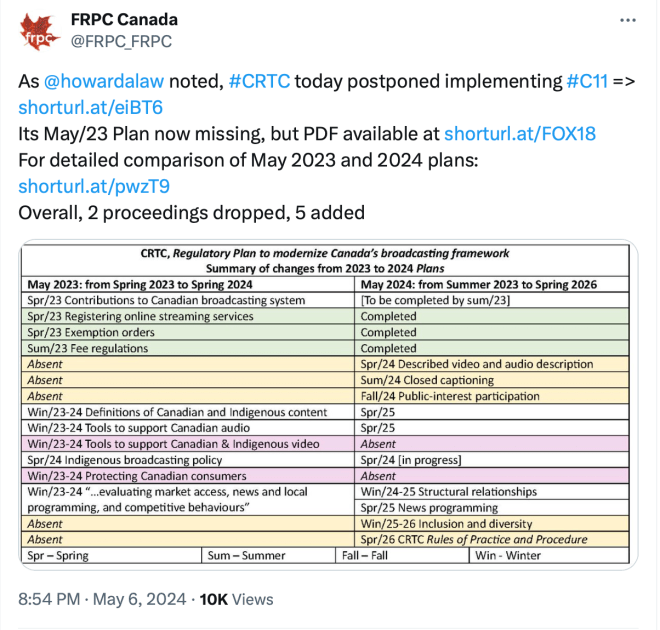
Monica Auer of FRPC posted this comparison of the CRTC’s initial agenda published in May 2023 and last week’s recalibrated schedule:
A blog post from a Toronto law firm noted that the CRTC’s new timetable appears to put it in violation of the two-year limit directed by the Heritage Minister only last November.
***
The Canada Media Producers Association (CMPA) released its annual industry-bellwether “Profile” report on television and film production in Canada.
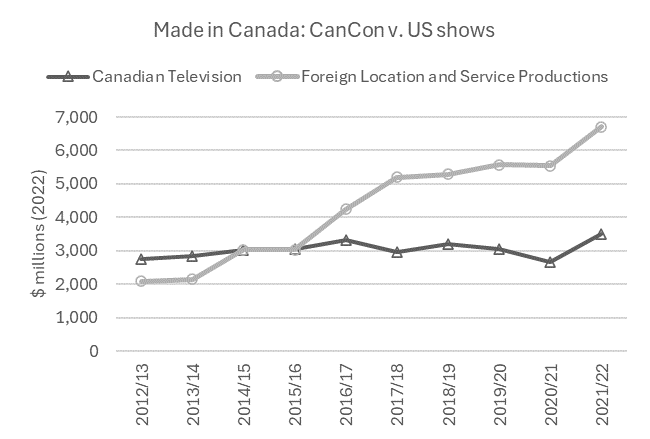
The long-term data that CMPA presents in these annual reports is indispensable to tracking the health of Canadian content production and the “service” market for US studios shooting in Canada for American release. The two most important long term (10+ years) trends are a stagnation in Canadian content production and a boom in making television and movies for the American market.
Here’s a chart based on the now outdated Profile 2022 that you will find in Chapter 7 of my book, Canada vs California:How Ottawa took on Netflix and the Streaming Giants.
Even in ordinary times, Profile’s year-by-year numbers oscillate up and down, bidding caution. In addition to that, the impact of the pandemic shut-down, the post pandemic catch-up, and the recent Hollywood actor and writer strikes has made results from the last three years into a series of one-ofs.
The newly released Profile 2023 shows solid growth for the production year ending March 31 2023 but the authors note that the effect of the Hollywood strikes won’t be measured until next year’s report. In the meantime, a report from Ontario Creates (with nine more months of data up until December 2023) reveals that the good news of Profile 2023 is unlikely to carry over into Profile 2024. Ontario government data says the province’s 2023 Canadian program production was down 21% and US service production was down 55%.
***
My recommended read this week is not a freebie. I reviewed Kim Kierans’ history of the Canadian equivalent of the Pulitzer Prize: the Michener Award for investigative journalism. Have a look at the review and decide if it’s for you. It was a great read!
***
If you would like regular notifications of future posts from MediaPolicy.ca you can follow this site by signing up under the Follow button in the bottom right corner of the home page;
or e-mail howard.law@bell.net to be added to the weekly update;
A one-time chief judge and president of the Michener Foundation, Kierans has written a needed institutional history of the investigative journalism award that was created under the flag of Governor-General Roland Michener in 1969 to pace the famous American Pulitzer Prize.
Public service journalism, writes Kierans, ferrets out the misdeeds of the powerful, “stands up to bullies, uncovers secrecy, fraud and wrongdoings, and gives voice to marginalized communities.”
This kind of journalism, alas, is blindingly expensive. Consider this graphic I put together a few years ago that puts a price tag on it:
Watchdog journalism risks being romanticized, particularly if indulging in cringeworthy homilies like “speaking truth to power.” In the book’s Foreword, former Governor General David Johnston quotes literary great George Orwell’s maxim “journalism is printing something that someone does not want printed. Everything else is public relations.”
That sentiment is mostly bullshit, but as Kierans works her way through fifty years of winning stories and exposés, you are reminded of just how explosive Canadian public service journalism has been, each and every year throughout our adult lives.
Especially important to the folks running the Micheners, recognition is awarded to stories that have had produced measurable change: a public inquiry launched, legislative action taken, restitution made, wrongdoers fired or thrown out of office.
Have a look at this list to be reminded of how many Award winners were at the centre of a major political controversy or prodded action on a burning policy issue that years later we simply take for granted as a citizen’s due.
This walk down investigative journalism’s memory lane is the best part of the book (Kierans weaves the chronology of the annual awards with the narrative of the Michener Foundation’s financial and governance issues). If you can’t respond with respect and gratitude to journalists after reading these stories, buddy you are a dead loss to humanity.
Contemplating the idea of watchdog journalism is a good opportunity to observe the political animus towards the media that is cynically stoked by bad actors on a daily basis. Most of it comes from the right, but the populist left puts a lot of effort into it too.
The accusation made over and over again is that journalists and their newsrooms are political, in fact partisan on a left-right basis. There could be something to that on a “curatorial” level: what kind of stories do and don’t get commissioned or published. But on a story-by-story and journalist-by-journalist basis, the huff about left-right bias is nonsense and usually spewed by people who haven’t met too many journalists.
If journalists subscribe to any “ism” it’s to the watchdog creed: that the powerful are usually up to something nasty, are covering it up, and need to be exposed so we can fix it.
And on that basis, Kierans’ book is a salutary and enjoyable read.
If you would like regular notifications of future posts from MediaPolicy.ca you can follow this site by signing up under the Follow button in the bottom right corner of the home page;
or e-mail howard.law@bell.net to be added to the weekly update;
The CRTC decided on Friday to deflate rumours that it is set to announce its ruling on Phase 1 of implementing the Online Streaming Act Bill C-11 and set out the agenda for Phase 2. Yet another week flips by on the regulatory calendar without the Commission determining the obligations of foreign streamers to fund and distribute Canadian content.
No matter, that gives everyone a chance to catch up with their reading.
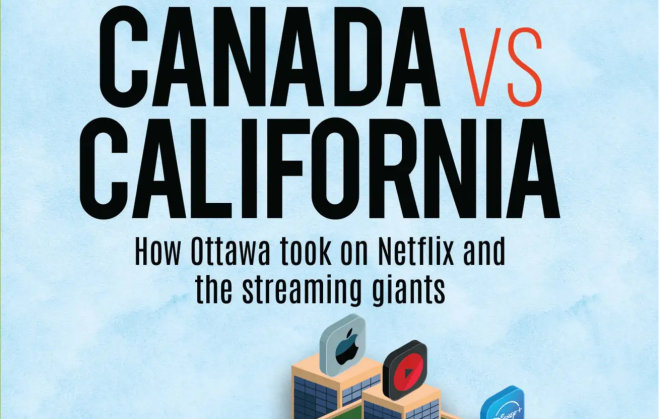
Allow me to recommend Canada vs California, my primer on the culture war over regulating Internet broadcasting. It was officially released on May 1st and is now available in Canadian bookstores and online. (Indigo has it listed as available on Thursday May 9th).
A history of the Online Streaming Act is an opportunity to tell some culture war stories and, testing your patience, take some deep dives into the regulatory minutiae behind the generous amount of rhetoric expended on the bill.
The Online Streaming Act had a long run up, beginning with amendments to the Broadcasting Act in 1991 that anticipated the Internet, followed by the CRTC decision in 1999 not to regulate Internet broadcasting for the indefinite future.
Here’s an excerpt from the book:
The Internet was still young in 1991 but the Mulroney Conservatives’ new definition of broadcasting was waiting for it to grow up. It would not be long before audiovisual and audio programs would be broadcast over the Internet’s “means of telecommunications,” as the Broadcasting Act now read.
The Liberal government of Jean Chrétien, elected in 1993, kept its eye on the Internet in a low-key manner as befitted a prime minister who was fond of saying that half of life’s problems solved themselves. The Liberals did what governments often do with important policy that can be left on a political backburner: commission a study.
In 1994 the Liberal cabinet asked the Canadian Radio-Television and Telecommunications Commission to report on content and competition policies for new communications technologies comprising “the information highway.” The report projected that broadcasting of programs would eventually take place over the Internet.
Industry and public policy groups also recognized the Internet as a future broadcasting platform and urged the CRTC to take the first regulatory steps…
On July 31, 1998, the CRTC issued a public notice convening a discussion of what, if anything, it should do about new media and got lots of advice from industry and the public. On May 17, 1999, the Commission issued its ruling.
The Commission immediately narrowed the scope of what Internet activity fell under the definition of “broadcasting (audio and audiovisual programs) by means of telecommunications.” First, Internet content predominantly in written form was out of bounds. Next, peer-to-peer and point-to-point communications were out. That excluded video games, e-mail, online paging, faxing, e-commerce and Internet-protocol telephony.
Finally the Commission punch-line: online programs for public distribution “do fall under the definition of broadcasting [but] the Commission has concluded that regulation is not necessary to achieve the objectives of the Broadcasting Act.” Accordingly, the Commission served notice that it would issue an exemption order under its frequently used power to suspend regulation of any broadcasting service that did “not contribute in a material way” to public policy…
Next, the Commission reaffirmed the toolkit policies behind fostering Canadian programming in mitigation of the market power of US media, in exactly the terms described in Chapter 1 of this book:
Under its mandate to implement the policy objectives set out in the Broadcasting Act, the Commission has imposed Canadian exhibition and expenditure requirements on traditional broadcasters, as well as requirements for distributionundertakings to contribute financially to the production of Canadian programming. This was done in recognition of the fundamental importance of broadcasting to Canadian sovereignty and cultural identity and the realization that market forces alone would not provide a significant amount of Canadian broadcasting content. Canada’s small domestic market makes it difficult to finance the creation of competitive Canadian programs. Whereas U.S. producers can recover the majority of their production costs through domestic licence fees, the licence fees earned in Canada by most Canadian program producers represent only a fraction of their total production costs.
The economies of scale that exist in the United States make American programming less expensive for Canadian broadcasters to acquire than Canadian programming. At the same time, American programming has tended to attract larger Canadian audiences than Canadian programming because of its higher production values and well-established star system. This has particularly been the case for English-language television. American broadcasters cannot provide their programming directly to Canadian viewers except in situations where off-air signals are directly receivable. This has resulted in a system whereby profitable non-Canadian programming is purchasedby Canadian broadcasters to subsidize the cost of Canadian programming . . .
Be that as it may, in 1999 the Internet was still too young to regulate: the Commission projected at least seven to ten years before audiovisual and music broadcasting could become a significant presence on the Internet. For the time being, the Commission considered what little video and audio streaming there was to be complementary to conventional broadcasting and noted that Canadian media companies regarded the Internet as mostly a marketing platform for their television programming. Clearly, any regulatory squeeze on Internet broadcasting would not be worth the juice.
The Commission then made a couple of observations that twenty-five years later can only be described as prescient. The Commission said it could not project what broadband video broadcasting might look like one day but speculated the broadcasters of the future might be the Hollywood studios Disney, 20th Century Fox (now Disney) or Metro-Goldwyn-Mayer (now Amazon) streaming directly to Canadian subscribers instead of retailing their shows through Canadian broadcasters. Moreover, the Commission perfectly anticipated YouTube in projecting an Internet platform distributing a fragmented media universe of countless channels:
Many Canadians will increasingly have access to a diversity of content and services that might not have been available to them through conventional broadcasting. This may benefit Canadians who belong to communities of interest that have not been well represented by mainstream media. This also raises the question of whether the Internet will ever have the ability to create mass audiences in a manner similar to that of conventional television, which is driven by mass-oriented entertainment programming,or whether the sheer number of “channels” offered by the Internet will always result in fragmentation. While some [submissions to the Commission] spoke of mass market Internet services, others were of the view that the successful content creators on the Internet will be the ones who target narrower communities of interest such as sports fans, art and music lovers, youth culture, and so on.
But those new distribution platforms were years in the future. For the Commission, the Internet was not ready for regulation and the regulator was not ready for the Internet. In December 1999 the Commission issued its formal New Media Exemption Order.
Over the next twenty years the Commission declined to revoke the New Media Exemption Order. The last refusal would be issued by CRTC Chair Jean-Pierre Blais on August 6, 2015, the day after Stephen Harper posted his “no Netflix tax” video on social media. The Commission’s reasoning in every renewal of the exemption was that unregulated broadcasting over the Internet posed no threat and “would not contribute materially” to the Broadcasting Act’s Canadian programming objectives. In other words, the regulatory squeeze was still not worth the juice.
Stephen Harper political ad, August 2015
One CRTC Commissioner who could see where it was all going wanted to put a stake through the heart of regulating broadcasting over the Internet. Concurring in the 2009 renewal of the exemption, Timothy Denton foresaw the day the tide of public opinion might change and a future Commission would be under pressure to revoke the Internet exemption:
Unless the decision-making framework is changed, there is a good chance that a future Commission will feel obliged to extend broadcasting licensing over Canadian portions of the Internet in an effort to preserve an obsolete system.
Denton said the “decision-making framework” — the Broadcasting Act — was itself “an artifact of history” and must be amended to permanently prevent the regulation of the Internet.
Stephen Harper had another six years in power after 2009, four in majority, to take Commissioner Denton up on his challenge to put the Internet forever out of the reach of the CRTC. But despite the no Netflix tax video, the Conservative election platforms in 2011 and 2015 were silent on broadcasting, as were their previous platforms in 2004, 2006 and 2008.
Then, on October 19, 2015, Harper’s Conservatives lost the general election and were replaced by a Liberal majority government headed by Justin Trudeau. The Liberal election platform promised more money for the CBC and the reversal of Harper budget cuts to Telefilm, the National Film Board and the Council of the Arts. Of course, Trudeau had already promised to keep his hands off of Netflix. His signature election promise was to legalize cannabis.
The incoming Trudeau Liberals were indeed modern: as hip as weed and the Internet. So was the new heritage minister, Mélanie Joly, a rookie member of Parliament and rising star from the Montréal riding of Ahuntsic-Cartierville. When her mandate letter from the prime minister’s office arrived three weeks after election day, it was an unremarkable list of priorities and included nothing about the Internet or broadcasting other than the promised $150 million for the CBC.
***
If you would like regular notifications of future posts from MediaPolicy.ca you can follow this site by signing up under the Follow button in the bottom right corner of the home page;
or e-mail howard.law@bell.net to be added to the weekly update;
“People believed his lies. Everything he said was bullshit, from top to bottom.” Opposition Leader Pierre Poilievre on Prime Minister Justin Trudeau
April 27, 2024
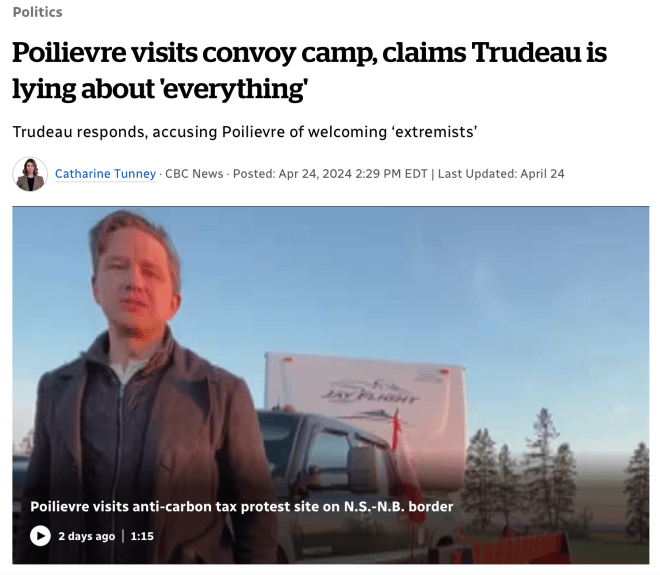
There was a media bunfight last week asNational Post Managing Editor Carson Jerema lambasted Parliamentary reporters Althia Raj of the Toronto Star and Catherine Tunney of the CBC for their coverage of Pierre Poilievre’s roadside visit to a New Brunswick carbon tax revolt camp where some participants had ties to the far-right insurrectionist outfit, Diagolon.
Weighing in, Poilievre tormentor-in-chief Rachel Gilmore posted a video report tracing the connections between some of the tax protesters and Diagolon.
The Diagolons in question are one of the few right-wing groups that Poilievre has publicly repudiated (for threatening to sexually assault his wife). He notably has not disavowed an endorsement from US conspiracist Alex Jones and was an enthusiastic supporter of the Ottawa convoy protesters in 2022.
All of that is grist for the mill in the CBC news story (Poilievre enthusiastically identifying with Convoy-style voices) and the Star’s opinion piece (Poilievre’s associations with those voices alienates a lot of Canadian voters).
The Post’s Jerema thinks it’s all left-wing journalism and especially believes the CBC manufactured a smear story. Coming from the Post, which has gushed a daily flow of anti-Trudeau political columns since at least 2015, it’s a bit rich.
But you be the judge, the columns and story are linked above.
An observation from MediaPolicy.ca: Jerema criticizes the wording of the CBC story lede —-that Poilievre “is facing questions after stopping to cheer on an anti-carbon tax convoy camp”—- as disingenuous since most Canadians were blissfully unaware of the isolated tax protest and didn’t have any questions about Poilievre’s unscheduled pit stop until the CBC reporter said they might.
The very experienced Jerema no doubt recognized this journalistic convention as the near-cousin of “some say” that relies on the assumption that some members of an informed public likely have an opinion on a controversial news item. It’s not great journalism, but hardly a new or partisan phenomenon.
In fact, these kinds of gotcha stories are legion in “watchdog” reporting, otherwise known as investigative journalism. The journalistic assumption is that political guilt by association, or implied wrongdoing (with the news subject being allowed to offer rebuttal comments), is fair ball. Let the reader judge.
Poilievre’s past comments and uninhibited comfort with far-right groups, however you perceive those, are a legitimate political story that Canadians appear to be interested in. Were the Prime Minister to repeat one of his known foibles (pick one) he’d get the same treatment.
***
Judging from the public debate and media coverage of cultural policy in Québec, you can expect that every federal and provincial political party is going to be expected to do something about the outsized consumption of English-language streaming and social media content by francophone youth.
The anxiety level is palpable. La Presse’s well known arts columnist Mario Gerard reported from a recent conference at the University of Montréal with a dire description of young people’s waning consumption of French language culture in Québec and francophone nations across the Atlantic:
So, when I hear about measures and laws, I say yes. We must act on all fronts. Provincial, national and international. But above all, let’s do it in a concerted way. These laws will not settle everything, for sure. But we must give ourselves the means to fight against this beast that is suffocating us.
Gerard reported that the federal Heritage Minister Pascale St.-Onge and the Québec Culture Minister Mathieu Lacombe are speaking in categorical terms about the need for regulatory action. It’s doubtful Québec voters are going to be satisfied with words.
A good guess is that St.-Onge and Lacombe are already having private conversations about action, money, and that oh-so-tricky topic of federal-provincial jurisdiction.
***
Two weeks ago MediaPolicy posted about the demoralizing performance of Heritage Committee MPs in passing up an opportunity to engage Bell CEO Mirko Bibic in a policy discussion, opting instead for a belligerent hazing.
Bibic’s interrogation by MPs was a command appearance following Bell’s decision to shore up its share price by protecting dividends at the cost of mass layoffs.
Here’s the follow up no-nonsense commentary from telco industry analyst Mark Goldberg and also former Bloomberg reporter Theo Argitis publishing on the conservative website The Hub.
By the end of his column, Argitis manages to boil it down to this pithy advice for MPs:
In an ideal world, we get cheap telecom services, minimal regulation of the internet, and robust news ecosystems financed by the telcos. In the real world, at least one of those objectives may need to be abandoned. Policymakers get to decide which one.
To round out the story, here’s a good investment story from the Globe’s Tim Kiladze on the BCE balance sheet, share price and dividend payout going forward. Some useful context.
***
If you would like regular notifications of future posts from MediaPolicy.ca you can follow this site by signing up under the Follow button in the bottom right corner of the home page;
or e-mail howard.law@bell.net to be added to the weekly update;
This week’s federal budget consigned major media and cultural programs to the treadmill: either formalizing previous spending commitments or announcing incremental adjustments to keep up with inflation.
$20 million to double the funding for the Local Journalism Initiative that pays for 400 news interns across Canada.
As promised in 2021, $13 million in permanent annual funding for the Indigenous Screen Office that channels production financing to TV and film projects.
As promised, maintaining the $50 million in annual funding of Telefilm (for the next two years).
Maintaining funding levels for the Canada Music Fund at $50 million annually, as promised in 2021. (Correction: Heritage officials clarify that the existing budget line of $25.3 million annually has been increased by $16 million for the next two years. Therefore the cumulative $41.3 million falls short of the Liberal campaign promise in 2021).
Doubling the spending envelope for the federal journalism salary subsidy from 25% to 35% of newsroom payroll (the program does not apply to radio or television companies).
There was a new budget line of $15 million over two years for public service channels Accessible-TV, CPAC, Aboriginal Peoples Television News, the French language news consortium TV5, and Radio Canada ICI-tv. CPAC gets the lion’s share to pay for capital expenditures.
The public service funding is a follow-through on a promise made during the Parliamentary debate over Bill C-11 by former Heritage Minister Pablo Rodriguez.
***
I’m told that the CRTC is about to roll out the timetable for the remaining regulatory issues flowing from the Online Streaming Act Bill C-11.
If the Commission is moving on to this next phase you would also expect the release of the Commission’s ruling on streamer contributions to video and music media funds, reviewed by the Commission back in November and December. The regulatory exemption of YouTuber videos will be confirmed as well.
Here are the major outstanding issues still to be contested by Canadian broadcasters and foreign video and music streamers:
On the video side, the streamers’ spending obligations to make, license and release Canadian programs;
Related to that, revisiting the definition of a “Canadian” program;
Also related to that, the streamers’ obligations to make their Canadian programs “prominent” or “discoverable” to viewers.
On the music side, the main debate will be over discoverability of Canadian songs, a thorny issue as the music streamers are opposed to making any special efforts;
Related to Canadian music, the “MAPL” definition of a Canadian song may find its way onto the agenda.
At some point the Commission will have to deal with the Canadian broadcasters queued requests for regulatory relief on Canadian program spending, as well as a laundry list of radio issues put on hold by the Commission back in December 2022.
Also, the Commission continues to leave Global News and the small independent TV stations hanging, an outcome its March 2022 approval of the Rogers-Shaw merger. That ruling left 12 Global News stations cut loose from Shaw vying against the 18 existing independent stations in non-metropolitan markets for limited subsidies from the Commission’s Independent Local News Fund. Two years later, perhaps the Commission will get around to this.
A sign that media industry players are anticipating the next phase of regulatory hearings was the release of a public statement by Spotify and a discoverability study by Music Canada (the voice of the international music “majors” Universal, Sony and Warner).
Spotify wants two things. It wants the Commission to acknowledge the streaking success of Canadian musicians on its global platform, implying that no special measures are required to mimic radio regulations that favour airtime for Canadian songs. And it wants to water down the MAPL definition of Canadian song — by diminishing the contributions of Canadian songwriters in favour of Canadian singers and bands—- so that the international hits from Tate McRae, Drake, Justin Bieber, The Weeknd, Ikkyet al eat up any Canadian prominence obligations that might get set for streaming services.
Music Canada released the report it commissioned from Will Page, Spotify’s former Chief Economist. Not surprisingly, Page’s views align with Spotify, particularly on the streaming platforms having opened the door for Canadian musicians to reach a global audience, surpassing any success they could achieve in the Canadian market, even with regulatory assistance. The argument is that radio regulation did its job in establishing a strong domestic music industry and now it’s time to move on.
That leads Page to make the contentious claim that Canadian musicians get paid better under the global streaming model than they do from a radio-driven Canadian market. While musician earnings are not a regulatory issue for the CRTC to rule upon, they are highly relevant to regulatory efforts such as a Commission-imposed streamer contribution to Canadian music development funds. As well, the distribution of those streamer earnings as between new artists, mid-success bands, and global superstars is relevant to a ruling on prominence regulations.
As far as imitating radio regulations designed to make Canadian songs prominent to domestic audiences, the Page report reiterates the streamers’ plea to leave their song curation alone (even for francophone music, perhaps themost important issue in music regulation and glossed over in his Report).
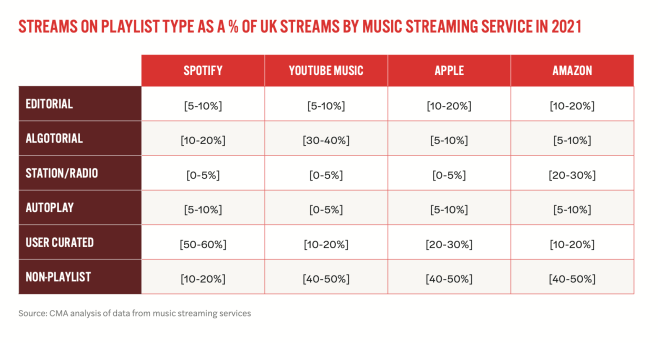
The report offers a helpful chart of sub-platforms for each major streamer based on song “pushing” by curating streamers and song “pulling” by listeners.
The streamer-controlled “push” curation (human-curated, hybrid human/algorithmic, and radio-imitating “station-play”) are more likely candidates for regulatory expectations of promoting Canadian songs than are the algorithm-assisted creation of playlists and song picking by listeners.
As this chart illustrates, the major streaming platforms don’t always put equal emphasis upon the available song picking options:
Song-picking is certain to be an attention-grabber once the Commission gets down to its regulatory business later this year. I have “freedom of expression” on every square of my CRTC Bingo card.
And the MAPL song definition will remind Boomers and GenXrs of the 1991 dust-up over “who is a Canadian musician?” That controversy broke out when Vancouver-rocker Bryan Adams and his manager staged a public temper tantrum over his hit song “(Everything I do) I do it for you” being left out of the CanCon airtime quota because it was co-written with non-Canadians. The multiple-time Juno and Grammy winner is 48th on the all-time Billboard Hot100.
***
Here are two things to read this weekend.
The first is a slam-the-door piece from National Public Radio journalist Uri Berliner arguing that the US public broadcaster has become narrowly partisan and ideological. After publishing it, he got fired. I know your mind has already skipped to the CBC: just knock it off.
The other piece is more light-hearted. I’m in a Ken Whyte Substack groove these days and his latest post is about why guys read less than gals and maybe we (the guys, that is) are too interested in stuff we can use (instead of expanding our horizons). Venus and Mars, it seems.
Then Whyte offers some fun details on what famous guys are reading these days.
So that’s the MediaPolicy recommended read for this weekend: from a guy (me), telling you what another guy says some guys are reading.
Stuff you can use.
***
If you would like regular notifications of future posts from MediaPolicy.ca you can follow this site by signing up under the Follow button in the bottom right corner of the home page;
or e-mail howard.law@bell.net to be added to the weekly update;
Politics makes a fool of public policy on any given day.
To prove this theory, you can tune into ParlVu and watch MPs delight in berating Bell CEO Mirko Bibic for two hours, cutting off his answers, and then clipping their performances for their social media accounts here, here and here.
I digress.
Opinion polls also make a fool of public policy, quite often. The latest is a Nanos poll commissioned by the Globe & Mail to take the public’s temperature on the Liberal government’s suite of Internet legislation.
The legislation in question was Bill C-11 (the Netflix Bill), Bill C-18 (the FaceGoogle Bill) and the freshly tabled Bill C-63 (online harms and hate speech).
The results were decidedly in favour of Internet regulation: 56% in strong or moderate support with 37% opposed (and 7% undecided).
Here’s the question:
The federal government has proposed a package of laws and policies that would give federal officials new powers to regulate the internet. These include an Online News Act, an Online Streaming Act and proposals to curb online harms such as hate speech. Based on what you have heard, do you support, somewhat support, somewhat oppose or oppose greater regulation of the internet by the federal government?
And here’s what is remarkable about the survey: the results haven’t budged an inch since a poll with the very same question was taken in May 2022.
If you check your calendar, May 2022 was the month in which the controversy over regulating YouTube videos under Bill C-11 was cresting. It was before Bill C-18 was tabled and attacked by critics as a public policy face-plant. The public consultation over the online harms bill generated heat over the government’s initial support for removal of hate posts.
Two years later, there could be many reasons for the public’s constancy despite heated public policy debate over Internet legislation.
It’s a very small portion of the public that educate themselves about the fine points of the bills. Instead many are going with a gut feeling like “censorship is bad,” “Bell is bad” or “Big Tech is bad.” I’m not diminishing the lived experience that leads to such polarization.
On the other hand the public does respond to criticism of the downside risks of government regulation if enough attention is drawn to them. At the same time that public support for regulating the Internet in principle held firm, polls also revealed that critics hit a nerve about regulating YouTubers or triggering Meta’s decision to block Canadian news.
***
So long as it’s still early days in the commercial development of AI large language models we’ll keep getting wild guesses over its trajectory.
The Big Tech companies now have to make a key decision about acquiring more data. It appears that the capacity of AI-LLM to perform miracles may depend on scraping, stealing or buying a lot more copyrighted content.
The question is what decisions about data acquisition are made at this fork in the road. By way of example, it’s been reported that Meta considered buying a major book publisher so that it could feed the content (often licensed from authors for all platforms and uses) to its LLM Venus Fly-Trap.
By way of another example, it’s been reported that Google is thinking of changing its corporate interpretations of copyright and fair use so that they can feed the audio tracks from YouTuber videos to its LLM.
The financial sustainability of news journalism doesn’t stop being in crisis in between rounds of layoffs.
A valuable part of the public policy discussion is sustainability’s companion crisis: falling public trust in news journalism (and so many other public institutions). What, if anything, can journalists and friends of journalism do about it?
Ivor Shapiro, the retired chair of Toronto Metropolitan University School of Journalism, has something to say about how to rehabilitate public trust in journalism:
Journalists in [many other] countries think it’s simply reasonable in democracies to demonstrate their accountability for standards of factual reporting, and to provide plausible evidence of journalists’ autonomy from the interests of their employers and others.
Yet, these reasonable ideas are practically taboo in historically anglo-Saxon news cultures, for reasons that have more to do with tradition and habit than with common sense or legal rights. Journalists in my generation, especially, have clung with striking self-confidence to inherited habits of news judgment and have largely resisted organizing themselves collectively beyond individual workplaces.
We have refused, in short, to be a profession.
And professionals heed to a code. Shapiro proposes a place to start, here.
***
If you would like regular notifications of future posts from MediaPolicy.ca you can follow this site by signing up under the Follow button in the bottom right corner of the home page;
or e-mail howard.law@bell.net to be added to the weekly update;
The hate speech provisions of the federal Online Harms bill C-63 trigger the most common policy argument against content regulation, on the Internet or anywhere. It’s the “slippery slope” metaphor depicting the idea that any regulation of free expression teeters at the top of a steep precipice greased to deliver us to a waiting police state. Or a waiting thought-police state.
What’s more, if the worst fears of hate speech laws creating a freedom-killing regime of national censorship in Canada come to pass, the State will have become so powerful that it will be impossible to roll it back. The judgment of “I told you so” will come too late.
To accept this worst-case scenario, one has to evaluate the plausibility of Canadian democracy circa 2024 making the long political journey to a police state, or something too close to a police state, and to contemplate what role hate speech regulation would play in making that happen. One has to evaluate how steep and slick the C-63 slippery slope is.
That’s the task of Parliamentarians evaluating C-63. One of the key provisions in the bill is the definition of “hate speech.” It’s effectively transcribed from Supreme Court jurisprudence into clear statute law that can be enforced by police, Attorneys-General, courts and human rights tribunals. The gist of the definition is to draw a line between illegal vilification and degradation of target groups and milder bigotry (explicit or imputed):
Criminal Code amendment;
hatred means the emotion that involves detestation or vilification and that is stronger than disdain or dislike. For greater certainty, the communication of a statement does not incite or promote hatred, for the purposes of this section, solely because it discredits, humiliates, hurts or offends.
Human Rights Act amendment:
hate speech means the content of a communication that expresses detestation or vilification of an individual or group of individuals on the basis of a prohibited ground of discrimination. For greater certainty, the content of a communication does not express detestation or vilification solely because it expresses disdain or dislike or it discredits, humiliates, hurts or offends
Last week MediaPolicy posted a summary of an expert panel parsing the hate speech provisions. Law professor Sunil Gurmukh argues the C-63 hate speech provisions are not going to enable a wide-open persecution of haters, both real and imagined. He points to the Supreme Court’s endorsement of the “hallmarks of hate,” mapping out the line between the vilification of targeted Canadians and, on the side of the line, non-vilifying bigotry.
A key federal human rights precedent that illustrates the hallmarks is the 2006 federal Tribunal finding against Edmonton’s Peter Kouba who posted repeatedly for three years to the Canadian page of the Nazi white power website, Stormfront. Kouba’s posts were chock full of explicitly racist vocabulary and an ongoing series of “true stories” that put forward the case for white power and persecution (including expulsion, violence and execution) of Jewish, Indigenous, Black, LBGTQ and Muslim Canadians.
The Tribunal listed the hallmarks of vilifying hate speech, reduced here to point-form:
The communication uses not only racial epithets but dehumanizing vocabulary by associating members of the targeted group with animals, vermin, excrement, i.e. sub-human.
The communication trivializes or celebrates past tragedy suffered by the targeted groups (e.g. the Holocaust, but could be other events).
The use of “true stories” that are either not true or are presented as the targeted group’s characteristics, using racist vocabulary.
Members of targeted groups are described as predators of the old, vulnerable, women, young etc.
Members of targeted groups are the cause of society’s problems, generally.
Members of targeted groups are dangerous or violent by nature.
Members of targeted groups are devoid of typical human qualities and are innately evil, e.g. “… it’s in their DNA to be bad.”
The “take action” is violent action against members of targeted groups, to banish, segregate or kill them.
The hate is indelible and historic. The hallmarks include vilifications assigned to each group: Jews are described as a powerful menace at every level of society and contriving a lie about the Holocaust in order to extract financial reparations; LGBTQ Canadians are falsely accused of seeking to legalize pedophilia; Indigenous peoples are depicted as sub-human and fabricating a narrative of colonial injury in order to collect federal funds, etc.
I repeat these odious lies only to remind myself and everyone of how bad it can be.
The messages conveyed the idea that Black and Aboriginal people were so loathsome that white Canadians could not and should not associate with them. Some of the messages associated members of the targeted groups with waste, sub-human life forms and depravity. By denying the humanity of the targeted group members, the messages created the conditions for contempt to flourish.
Moreover, the level of vitriol, vulgarity and incendiary language contributed to the Tribunal’s finding that the messages in the case were likely to expose members of the targeted groups to hatred or contempt. The tone created by such language and messages was one of profound disdain and disregard for the worth of the members of the targeted groups. The trivialization and celebration in the postings of past tragedy that afflicted the targeted groups created a climate of derision and contempt that made it likely that members of the targeted groups would be exposed to these emotions. Some of the posted messages invited readers to communicate their negative experiences with Aboriginal people. The goal was to persuade readers to take action. Although the author did not specify what was meant by taking action, the posting suggested that it might not be peaceful. The Tribunal found that the impugned messages regarding Aboriginal Canadians and Jewish people attempted to generate feelings of outrage at the idea of being robbed and duped by a sinister group of people.
The outcome of the Kouba case may be instructive: the Tribunal issued a cease-and-desist order against his repeated hate speech that had rung the bell on virtually every “hallmark of hate” listed above. Also it fined him $7500 because of the relentless posting over three years, as opposed to a one-of.
The hallmarks of hate do raise a difficult question for the rest of us: what are we prepared to do for Canadians who, despite the free-marketplace-of-ideas, continue to be publicly vilified and threatened by haters?
The rebuttal to that question so far has been that expanding hate speech prohibitions against an army of bigots and haters posting to social media will be futile and beyond the means of the legal system.
More on that in the weeks ahead. At the moment, the House of Commons Justice committee has yet to take up the bill.
***
If you would like regular notifications of future posts from MediaPolicy.ca you can follow this site by signing up under the Follow button in the bottom right corner of the home page;
or e-mail howard.law@bell.net to be added to the weekly update;










 MediaPolicy.ca