It’s the policy of MediaPolicy.ca not to host links to petitions.
I’m making an exception over the actions of the public broadcaster TV Ontario in repudiating its contract with the producers of the anti-war documentary, Russians at War. The documentary was made by Russian-Canadian journalist Anastasia Trofimova who embedded with a platoon of Russian soldiers deployed in the illegal invasion of Ukraine.
The film was denounced by the Ukrainian government, some Canadian-Ukrainian organizations, and Canada’s Deputy Prime Minister Chrystia Freeland who said “it is not right that public money” supported the production of the film. The Toronto International Film Festival (TIFF) screened it anyway, as did the Venice festival.
The public broadcaster TVO, however, announced it was “withdrawing its support” for Russians at War and will not be airing it.
It’s not clear what “withdrawing support” means. TVO is the main Canadian financing partner for the documentary and purchased the exclusive first window broadcasting rights. In the ordinary course of distributing a first window film after its theatrical release, the film would be broadcast over television and streaming platforms some time in the next few months. With TIFF concluded, you can’t view the film anywhere in Canada and it’s unclear if you ever will.
What’s even more remarkable is that the film was approved for financing by curation staff at TVO, (as well as the public-private Canada Media Fund (CMF) and the Rogers Hot Doc fund). Yet it was TVO’s Board that intervened to announce the withdrawal of support, which could mean anything from refusing to make scheduled payments to the film’s producers, to burying the film.
The chair of the board Chris Daysaid “TVO will be reviewing the process by which this project was funded and our brand leveraged,” his “wasn’t me” gesture to the public and a rebuke to his organization, four days after TVO had publicly defended the documentary.
The TVO Board is appointed by Ontario Premier Doug Ford who, as far as I can tell, has had nothing to say on the matter. Maybe no one asked him.
As an international co-production between producers in France and Canada, the documentary was eligible for financing from federal “CAVCO” Canadian video production credits and the CMF, proportional to the participation of Canadian talent and investments in its production.
The film has been rated reasonably well by professional film critics and considered an anti-war movie, not “Russian propaganda.”
For another perspective, you can read an opinion editorial by Alexander Rodnyanskypublished in the Globe and Mail. The Oscar-nominated producer concedes that Russians at War is “well-made, deserving of professional praise and the good reviews it has received.”
He also says that the film is “seemingly objective” but maintains it is “cunning and sophisticated” Russian propaganda, not because it humanizes Russian soldiers but because “it provides a platform for active duty soldiers to freely repeat the propaganda that poisoned them in the first place while war and death continue.”
While commercial broadcasters and film festivals always retain the right (if not the wisdom) to reconsider screening commitments, public broadcasters should be held to a higher standard of free expression and public debate.
The Documentary Organization of Canada has posted an online petition demanding that TVO reverse its decision to “withdraw support” and not to air Russians at War.
***
If you would like regular notifications of future posts from MediaPolicy.ca you can follow this site by signing up under the Follow button in the bottom right corner of the home page;
or e-mail howard.law@bell.net to be added to the weekly update;
Angus Reid has published a helpful public opinion poll in anticipation of a federal election likely to be won by Pierre Poilievre’s Conservatives.
The poll focusses on Canadians’ gut feelings on eight major governing issues including defunding the CBC. The poll surprisingly ignores the carbon tax and climate change. But it includes questions on a bundle of fiscal issues such as budget balancing, income tax cuts, and increased defence spending.
The notorious “defund the CBC” plank in the Poilievre platform is unpopular, something we already knew from the recent Abacus poll. But once that data is broken down by voting intention, it remains a Conservative voter favourite. Unsurprisingly, Canadians of all voter stripes assume Poilievre will follow through:
The Canadian voter — the fictional voter representing aggregate opinion— has sniffed out Poilievre pretty well. He’s presumed to have a secret agenda. That’s probably because it’s awfully difficult to square the circle of budget balancing, reduced taxes, and increased defence spending unless you are a Ronald Reagan Republican (who famously ran up the national debt). The virtual voter long ago figured that out.
The poll also establishes some wedge issues. Only Conservative voters support defunding the CBC, closing Canada’s borders to immigrants, mass layoffs in the federal public service, and encouraging more privatization of health care.
Assuming the Liberals, Bloc and NDP are game to exploit that voter divide, they might make a lot of noise on the campaign trail about a Conservative “hidden agenda” on those issues.
***
Last week there was a minor kerfuffle on social media after Liberal MP Taleeb Noormohamed chastised National Post Senior Editor Terry Newman for having the temerity to twitter troll his colleague, Liberal Immigration Minister Marc Miller.
Noormohamed’s brain fart was to scold Newman for her taunts as so much ingratitude, considering that the Liberal-authored federal journalism subsidies keep the Post afloat:
Conservatives and others opposed to journalism subsidies as a threat to the independence of the press had a field day and were all over his statement.
My guess is that Noormohamed let his emotions get the better of him out of loyalty to a colleague and the guilty admission that, yes, Liberals are so committed to saving a mainstream media that is essential to democracy that they willeven fund that bullhorn of a Trudeau-derangement syndrome news outlet, the National Post.
Nobody honourably resigns from anything anymore, but Noormohamad either has to apologize or resign from his portfolio as Parliamentary Secretary to the Heritage Minister, the cabinet member responsible for the federal news funding programs.
Since neither will happen, I recommend an alternative remedy that he be required to read aloud in the House of Commons from the following essay on press freedom penned by New York Times publisher AG Sulzberger.
***
The documentary Russians At Warproduced by Canadian-Russian filmmaker Anastasia Trofimova about the brutal Russian invasion of Ukraine has roiled nationalist passions and cries for censorship.
Trofimova’s embedded reporting on a platoon of Russian soldiers souring on the war was denounced by many, including Canada’s Deputy Prime Minister Chrystia Freeland, as “Russian propaganda” that ought to be repressed, stripped of federal film subsidies, or outright censored. Conservative Party free speech crusaders are conspicuously without an opinion on the matter. On the other hand, the freedom of expression organization CJFE came to the defence of distributing the film.
Several mainstream reviewers saw the film and categorically rejected the Russian propaganda label and agreed that it lived up to its billing as an anti-war documentary.
Myself, I haven’t seen the documentary. I spoke to a couple of friends about it. One, a reporter, reminded me that embedded reporting gives the audience a front-row seat to reality with great emotional impact, but embedded reporters are limited in their ability to sharply question news subjects holding loaded weapons in their grasp. Better not to be the “ded” in “embedded.”
Another, a filmmaker, thought that Trofimova might have executed some better context and editing in a couple of scenes where Russian soldiers are conceded unfiltered speech, but that overall Russians At War is an anti-war documentary.
***
We haven’t heard much from the Liberals on when they will push forward Bill C-63, the Online Safety Act they tabled during the spring session of Parliament. MediaPolicy previously commented on the bill here, here and here.
My free political advice is the Liberals should split the Bill and proceed only with the online safety features. The hotly debated anti-hate provisions that increase criminal penalties for hate speech and re-establish human rights litigation can go into the Liberals’ next election platform for Canadians to pass judgment.
There’s also some merit in watching what the Americans are doing. The trumpeted success of the US Senate passing an online harms bill to protect kids is now getting watered down in the House, according to The Washington Post, possibly an outcome of heavy lobbying by Big Tech companies.
***
Any time a Canadian media company begins talking up an innovative or start-up idea, it swivels my head.
Here’s a couple.
Jeff Elgie’s Village Media has done a soft launch of his foray into the Toronto market for digital news. The full-on launch of the TorontoToday.ca website will be in October. At the moment, he’s aggregating reader e-mail addresses and pushing out a daily news e-mail update that links to news and information content published on his competitors’ websites. That will change next month to his own reporters’ content.
Elgie has expanded Today’s initial target audience in the condo-heavy downtown core to go a little further north and west (now capturing yours truly in a modest semi-detached).
He’s up against some stiff competition for eyeballs in the Toronto Star, BlogTO et al. His journalism will be more hyperlocal than the Star and is likely to be better than BlogTo and the various neighbouhood print monthlies (and as a resident I’d be grateful if they raised their game in response).
It will be interesting to see how Elgie innovates with information items and listings that draw in more readers, like cheaper (than the Star) obits or his Spaces social media product that invites readers to moderated community chats. He’s the most innovative publisher in the Canadian digital landscape, so TorontoToday is a space to watch.
Then there’s the announcement of Postmedia Studios creating a partnership with the Los Angeles based media creation company Contend. The product is video entertainment, drawing on Postmedia’s IP and historical archive.
The words “Postmedia” and “innovation” in the same sentence, you ask? There’s not a great deal of reveal in the press release, so it’s another space to watch.
***
There are so many ways to tell the news story of Rogers $4.7 billion buy out of Bell’s share of MLSE, the operator of the Toronto Maple Leafs, the NBA Raptors, the Argonaut CFL club and the MLS club Toronto FC.
Another angle is what if anything Bell is signalling about long term plans for its media division. That’s a question that keeps getting asked every time big blue sells radio stations or lays off television employees.
There’s no clear answer to that question: Bell CEO Mirko Bibic passed on the opportunity to make the announcement into a “retreating from media” story, although he certainly didn’t describe broadcasting assets as a core business.
The Globe’s Tim Kildaze provides a good explainer on Bell’s decision to pay down debt and prop up both the BCE share price as well as its ability to meet its high dividend payout.
***
As media-playing smartphones have long served as a second television, radio receiver and music stereo, I keep track of the never-ending debates over Canadian cell plan prices.
There’s been a lot of regulatory action. The federal cabinet has ordered the CRTC to kick butt. The Commission has responded with its “MNVO” plan which forces the majors to rent out their infrastructure to price-piranha independents.
The same federal cabinet waded into the Rogers-Shaw merger last year and cleaved Shaw’s Freedom Mobile from the deal, now sold to Quebecor as a disruptor in the BC and Ontario markets.
You may also follow the spirited debates about what cell phone prices really are. The singular focus on basic plan price, or sometimes total monthly bills for all services, is ripe for cherry picking the numbers.
To place plan price within its full value package, the majors must be presumed to deliver quality. After all, what’s the point of tolerating market power in telco ownership if their customers aren’t getting the premium brands’ promise of great customer service and reliable connectivity?
So here’s my recent experience as a mobility customer.
I felt I was paying too much to Bell. Despite the trumpeted price-war, Bell raised prices this spring. I was up to $61 per month for cross-Canada calling, 15 GB of data monthly, and an additional $13 for the Apple Watch connectivity (a second wireless line).
It was August with back-to-school pricing in full swing, so I went to Freedom Mobile which might as well be an indie in Ontario. A great price of $30 per month (US calling and lots of data included) but another $30 for the Watch line. Fair enough, I don’t think Freedom is targeting the Apple Watch crowd.
So I went down the street to Rogers.
The sales guy quoted $55 for the phone plan, Canada and US calling, 100 GB monthly, and $15 (first 24 months free with a $70 connection fee) for the Watch line. Beat Bell by some margin.
Okay, sold to the man in the red golf shirt.
That’s when the quality and service nightmare began.
The Apple Watch line wouldn’t activate. It took Rogers a week to fix it: six hours of my time spent in queues and five chat calls with tech support before they figured out it was a coding problem for customers bringing their own phone. Once they figured it out, Tech Support messaged me it was “fixed” but neglected to tell me to do a factory reset on the watch. Another hour of my time in a queue to get that key instruction.
Then two other things immediately happened that can’t be coincidental.
My iMessage no longer synchs properly across my four Apple devices.
And suddenly I’m getting at least two scam texts daily (with Bell it used to be two per week).
Price ain’t everything.
***
If you would like regular notifications of future posts from MediaPolicy.ca you can follow this site by signing up under the Follow button in the bottom right corner of the home page;
or e-mail howard.law@bell.net to be added to the weekly update;
Back in April 2023, I posted that the Liberal government needed to make its case for defending or re-engineering the CBC.
Every month that went by with the Prime Minister ignoring the relentless Conservative messaging to “defund the CBC,” the more his detachment resembled Trudeau pater’s famous shrug.
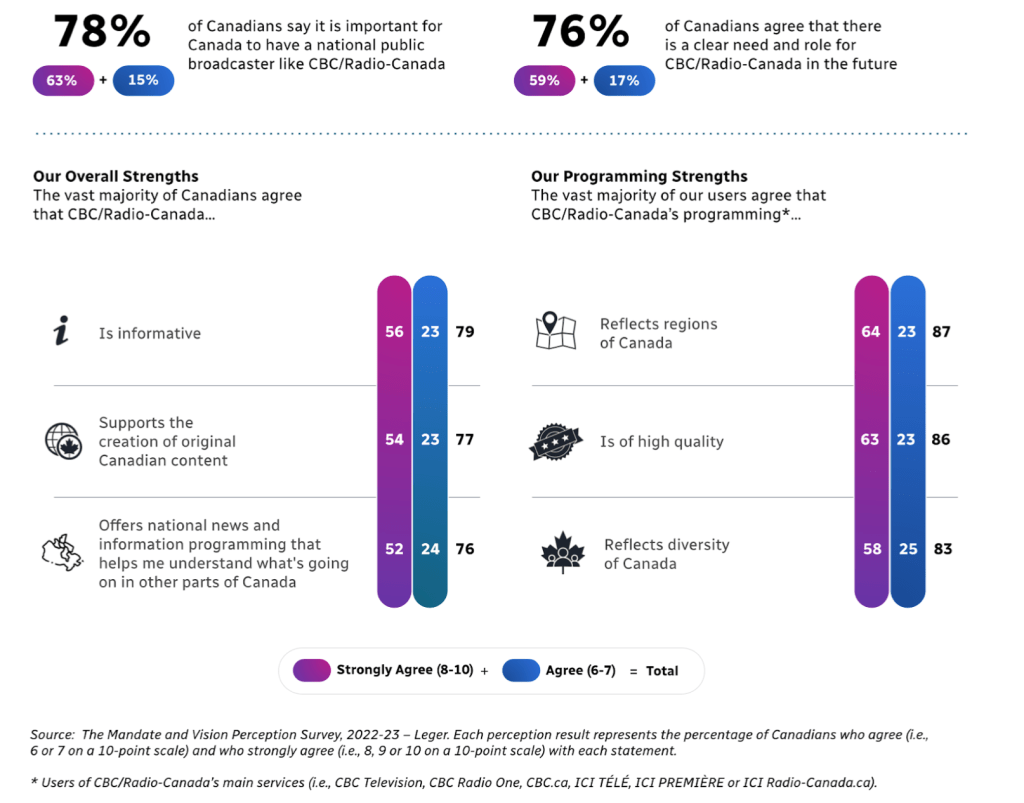
The CBC is no longer the political sacrament it once was (except in Québec) yet public opinionpolling continues to reveal clear majority support for the public broadcaster, including one poll that showed a big appetite for improving it.
Heritage Minister Pascale St.-Onge got things going a year later in May 2024 when she appointed an expert committee to “advise regularly” on the CBC. So far, no reports.
This week the Minister posted a rather good pitch on social media posing intelligent questions about rethinking the CBC.
Why do we need a public broadcaster?
How do we keep CBC-Radio Canada independent, accountable, and serving the audience?
How does CBC stay relevant in the sea of Internet content?
How can CBC better reflect Canada?
All great questions, if obvious. What’s lacking are answers: the 81 second video ends with the message “Stay Tuned.” Let’s hope she’ll have something more to say about this before a Liberal election Red Book just repeats the good questions.
In the meantime, you can have your say through the Friends of Canadian Media survey portal.
Update: I recommend this recent commentary from Kirk Lapointe moving the yardsticks along on the public debate about rethinking the CBC.
***
I wrote last week about the internecine friction between indie news publishers and mainstream news outlets in both Canada and California, scrapping over the spoils of settlements made with Google for its monetizing of linked news content on Search.
A spokesperson for the indie point of view —which is that mainstream digital publishers should not get their proportional share of any settlement —- was Ken Doctor, writing in Nieman Lab.
Doctor is the publisher of the Californian digital outlet, Lookout Santa Cruz, where his newsroom won the 2023 Pulitzer Prize for breaking news. The non-profit Lookout is not making money, but it’s stable, and Doctor is expanding his business model to another small community, this time up the coast in Eugene-Springfield, Oregon.
He was interviewed recently in Nieman Lab and gives away a few trade secrets there.
***
Last weekend I told you about my debate with Len St.Aubin. It began with his article in CARTT.ca touting the significance of Netflix’s investments in certified Canadian content over the last ten years and, as a consequence, his view that the CRTC should go easy on formal investment obligations for foreign streamers.
In his mid-week rebuttal, St.Aubin said that the increase in CanCon investment by foreign streamers is bigger than I gave them credit for, particularly after 2015.
Aside from the difficulty in measuring how much foreign investment in Canadian shows has grown since 2011, the real data problem we both struggle with is that we don’t know whether it was the Hollywood streamers or international broadcasters who fed it. As a former regulatory consultant to Netflix, St Aubin feels quite certain it’s the streamers. As a former Unifor spokesperson, I’m skeptical of the claim.
Regardless, that still leaves us evaluating St.Aubin’s contention that CRTC levies on the streamers will only eat up the streamers’ existing market-driven investments.
In an earlier article, St.Aubin suggested (reluctantly it seemed) no more than a 7.5% of revenue CanCon levy on streamers in the form of direct investments in Canadian dramas and documentaries (compared to the 29% benchmark for Canadian specialty broadcasters).
The two figures —7.5% versus 29%— don’t seem “equitable” between foreign and domestic broadcasters, required by the federal cabinet’s directive to the CRTC. But that argument is further down the regulatory road when the CRTC deals squarely with the issue.
I note that lately the CRTC chair Vicky Eateries has taken to describing the Commission’s future expectations of the foreign streamers’ CanCon spending as needing to be “meaningful.”
Parse, parse.
***
As you may recall, the US 3rd Circuit Court of Appeal recently ruled that Google is operating an illegal monopoly in Search.
Last week another anti-trust trial began for Google in the US. This time the Department of Justice is trying its case that Google has illegally cornered the Ad Tech market that feeds digital display advertising on websites.
On the third day of the trial, prosecutors began to introduce evidence of how Google employees thought about the company’s products at the time when the government alleges it set out to dominate the ad tech market.
“We’ll be able to crush the other networks and that’s our goal,” David Rosenblatt, Google’s former president of display advertising, said of the company’s strategy in late 2008 or early 2009, according to notes shown in court...
Rosenblatt came to Google in 2008 when it acquired his former ad tech company, DoubleClick, and left the following year. The notes of his talk showed him discussing the advantages of owning technology on both sides and the middle of the market.
“We’re both Goldman and NYSE,” he said, according to the notes, referring to one of the world’s biggest stock exchanges at the time and one of its biggest market makers.
“We’ll do to display [advertising] what Google did to search,” Rosenblatt said.
By owning publisher ad servers, the advertiser ad network would have a “first look” at available spots for ads, he said according to the notes. He also said it was a “nightmare” for publishers to switch platforms.
“It takes an act of God to do it,” he said.
***
If you would like regular notifications of future posts from MediaPolicy.ca you can follow this site by signing up under the Follow button in the bottom right corner of the home page;
or e-mail howard.law@bell.net to be added to the weekly update;
Well before the Online News Act Bill C-18 was tabled in the House of Commons in April 2022, I sat in on a heated debate about the wisdom of such an endeavour, held at the Ted Rogers School of Management in Toronto.
The debaters were from Canadian news outlets, the independents and niche digital outlets outnumbering those from mainstream newsrooms.
The majority of the participants were opposed to legislation that would force Google and Facebook to bargain news licensing payments. But mostly they were opposed, vehemently opposed, to anything that would give mainstream organizations a farthing. In fact, if there were any farthings to be had, they should go to the independents and “let the dinosaurs die.”
The mainstream folks bit their lips. The Globe & Mail guy left early, begging another appointment.
That was behind closed doors.
Today, the antagonism is out in the open. It is reflected in the CRTC filings in response to Google’s application to recognize its exemption from the Online News Act on the basis of its $100 million brokerage deal with the champion of the independents, the Canadian Journalism Collective.
In the same vein Scott White, the outgoing Editor-in-Chief of The Conversation, took the occasion of his departure to comment on the family feud in an LinkedIn post written out of exasperation with the denial of QCJO federal wage subsidies for his journalism enterprise:
Being rejected by an expert panel whose members cut their teeth in the days of ink on paper was a clear indication that funding programs are not open to new models. The federal funding and the subsequent Google money for journalists has laid bare an ugly battle between traditional and new media. Established broadcasters and newspapers want most of the money to go to them. New media say the old models have failed and funding should instead be used to invest in fresh enterprises.
This internecine rivalry continues to be one of the biggest threats to Canadian journalism. Old media, with their established brands, needs to innovate to survive. New media needs better brand recognition to thrive. New and old working together would be the best path forward – and yet the history of the profession shows that’s unlikely. Self-interested rather than collective strategies, outdated news wars and C-suite egos have led to the tattered playing field that is today’s journalism industry.
How one parses the statement that “established broadcasters and newspapers want most of the [QCJO and Google] money to go to them” depends on the meaning of the word “most.”
The mainstream news outlets that cover 98% of the news with 98% of the paid journalists support the equal wage subsidy for each employed journalist that is baked into the rules for both the Google and federal money.
Putting aside the fact that the federal QCJO program isn’t available to broadcaster news websites or that the federal government has drastically capped the broadcasters’ pro rata share of Google money, the headcount funding formula could be described as fair. If headcounts aren’t fair, everyone is at liberty to argue for “merit of news product” based upon audience data of clicks, views, or paid subscribers.
If the failed business model is the advertising model, then nearly everyone in the news game is a failure, in Canada and elsewhere (Jeff Elgie’s Village Media notwithstanding).
Meanwhile, the “failed” mainstream outlets do try. Try to innovate, that is.
The billionaire-backed Globe and Mail has made a state-of-the-art transition to digital. If Postmedia wasn’t being sucked dry by never-ending debt payments incurred by a bad business bet from 15 years ago, it might have done the same. The unpaywalled La Presse is a success with its tablet innovation and small donor fundraising. The Toronto Star blew $25 million trying to imitate La Presse, its former owners losing their family fortunes in the effort.
The same independent versus mainstream media spat is being played out at this moment in California. Instead of vetoing the Californian legislature’s version of the Online News Act, Governor Gavin Newsom has struck a five-year funding deal that allows Google to pay a very modest price to evade news licensing legislation, lets Facebook off the hook completely, and looks to government subsidies to take the sting out of disappointed expectations.
The money looks like this:
A public-private News Transformation Fund administered by a California journalism school (with majority control awarded to independent news outlets) funded $14 million annually from the state budget and another $10 million each year from Google.
The continuation of Google’s $10 million per year funding of Californian news journalism through the Google News Initiative and its Showcase aggregation site.
A $12 million dollar per year Google-sponsored Artificial Intelligence Accelerator fund, paving the way for AI adoption, something that may end up being the best or worst thing that ever happened to news journalism.
In sum, Google will shell out $32 million per year for Californian journalism, Facebook is out of the picture, and government has picked up $14 million in annual subsidies.
With a Californian-sized population, Canada has $100 million annually in Google money (with $37 million going to private broadcaster and CBC websites) and $95 million per year from various federal aid to journalism programs. That’s about four times the Californian news money (not counting the CBC parliamentary grant).
Writing in the American journalism site Nieman Lab, Ken Doctor claims victory in California. Doctor is the publisher of an independent news outlet, Lookout Santa Cruz and if Santa Cruz was located in Canada he would doubtless have joined the Canadian Journalism Collective that represents 2% of journalism but 100% of the brokerage deal with Google.
The reason that the Californian deal is a win, says Doctor, is because:
Facebook is off the hook, so there is no news throttle and Californian news outlets continue to reach their audience on that platform.
Local broadcasters get no money.
12% of the News Transformation cash is ear marked for news outlets with five or less journalists operating in underserved markets.
A fund governance structure keeps mainstream news outlets in a voting minority.
Says Doctor:
The relatively low level of [financial] support, ironically, may address one of the concerns many of us have had throughout this process: Why should the state use its hammer — and taxpayer dollars — to support the financially driven companies (Alden, Gannett, McClatchy) that have disinvested in California local news? For a bevy of political reasons, no settlement or legislation emerged that effectively deprived them of funding; they, like the ethnic press and digital startups, will receive the same per-headcount funding, with no apparent cap. That still seems like bad public policy, but there’s where it landed.
In other words, less is more so long as corporate media gets less.
***
The Facebook Swiss-cheese news ban continues in Canada. In last week’s post I noted that Facebook has not blocked a Telelatino News interview of Pierre Poilievre uploaded on August 23rd by the Conservative Party (it’s still up).
The news and information site Narcity has celebrated its “organic social” audience recovery only a month after Facebook reinstated its account. In the LinkedIn post graphic at the top of today’s blog, Narcity publisher Chuck Lapointe charts a full recovery of social media audience in a very short period of time.
An interesting visual on the left side of the graph is the precipitous decline of Narcity audience that occurred before the Meta news ban, consistent with long term trends for news publishers.
***
Blacklock’s Reporter is appealing the Federal Court’s summertime ruling that Parks Canada violated no copyright or contractual rules by purchasing an individual subscription to the investigative news site and then sharing the paywall password with multiple employees.
The incongruous battle between the tightly paywalled news site and a federal government that spends nearly $100 million annually to support news journalism is described by Peter Menzies in an op ed published in the Globe and Mail.
The federal cabinet minister responsible for Parks Canada is Steven Guilbeault, a former Heritage Minister who sponsored the pre-legislative consultations on the Online News Act. The current Heritage Minister is Pascale St.-Onge. Possibly, the two are acquainted with the issue at hand.
The data is now a year out of date, so caveats all around. But I noted three items for future reference:
Revenue for music streaming has plateaued. If that sticks, it will reinforce the transition of the global music streamers from prioritizing growth to making profit.
Conventional television losses keep getting worse, 11 years running. The large television companies are in a 34.3% loss position (the small independents that receive local news subsidies from cable companies are in a 2% profit position).
The overall market share for broadcasting across all platforms is approaching the symbolic cross-over point where Internet streamers earn more Canadian revenues than domestic cable operators.
***
Cartt.ca has done a terrific job of reporting on Bell’s lawsuit against Warner Brothers Discovery and Rogers in the wake of WBD cancelling its content deals with Bell and Corus.
The story lede was that Bell has withdrawn its matching legal action against Rogers for scooping the highly profitable Discovery programming now that Rogers has disclosed that WBD had kept it in the dark about the key non-compete clause in the expiring Bell-WBD agreement.
The juicy stuff in the story is how WBD plans to lawyer its way out of liability by describing the non-compete clause as turning on the dissolution of the Bell-WBD legal entity governing their joint venture in Canada, not the continued availability of the programming rights to Discovery content. Presumably, WBD has no intention of dissolving the numbered company that served as the now empty bucket for content rights.
***
If you would like regular notifications of future posts from MediaPolicy.ca you can follow this site by signing up under the Follow button in the bottom right corner of the home page;
or e-mail howard.law@bell.net to be added to the weekly update;
Last week MediaPolicy responded to policy arguments suggesting Netflix and the unregulated US video streamers have boosted Canadian content with a rising tide of production investment over the last ten years.
As it turns out, not so much. You can read about that here.
***
As of this week, Pierre Poilievre’s August 23rd upload of his by regulated broadcaster TLN Media interview ——replete with describing Liberals as “wackos,” “radicals” and “extremist socialists”—-remains on Facebook, despite the Meta ban on Canadian news.
***
I wrote last week about the conservative movement’s varying opinions on defunding the CBC.
A good addition to the discussion is a National Post interview with conservative journalist and book publisher Ken Whyte who most definitely does not want to defund the public broadcaster.
I think Whyte puts his finger on the pulse of CBC hating: what he describes as the “lack of ideological diversity” that results in conservative-minded voters not seeing themselves in the CBC’s media mirror.
***
MediaPolicy recently offered an overview of Canada’s $900 million Digital Services Tax (DST) and the American strategy to overturn it.
Last week the White House announced it was moving the impasse over the DST from rhetoric to a formal trade dispute under CUSMA. The US Trade Representative’s press release is sedate and the Canadian reply even more low key.
With a federal election in November between the Democrat ticket headed by Vice-President Kamala Harris and the protectionist Donald Trump, it is not surprising that Democrats don’t want to be caught on the wrong side of an America-first trade issue.
This development will make Big Tech happy. Those digital companies and their Congressional allies are resisting the international tax treaty negotiated by President Joe Biden with OECD nations to curtail Big Tech profit-shifting to low-corporate tax jurisdictions. If ratified by US Congress, the treaty would make the DSTs enacted in Canada and across Europe unnecessary.
***
Big Tech is turning the tide against government regulation enforcing mandatory licensing payments for online news.
In Australia, Facebook continues to defy regulation by refusing to renew its 2021 licensing agreements with news media organizations.
The Australian government has not taken any action and Meta has not had to make good on its threat to banish news from its platform. Meanwhile, Google is renewing its agreements but according to reports seeks to reduce the payments dramatically.
In California, a state law mimicking Canada’s Bill C-18 seemed on track until Governor Gavin Newsom announced an agreement in principle with Google (but not Meta) to withdraw legislation if Google makes more contributions to Californian journalism (the amount described by the Sacramento Bee’s editorial page as a “relative pittance.”)
Reports of the tentative deal provide a flurry of dollar figures for news funding from Google (including current voluntary news payments), new funding by the state government, and possibly contributions from other participants.
Based on California’s population count (comparable to Canada’s 40 million) it certainly looks like Google will be paying at a rate much lower than in Canada (which was much lower than Australia).
The Californian agreement bears a resemblance to the Canadian settlement with Google last November with less than expected Google payments being supplemented by state government funding.
***
It’s not all roses for Google.
In the wake of last month’s US federal court ruling that its Search product is an illegal monopoly, the restaurant search service Yelp has filed a lawsuit against Google for allegedly downgrading Yelp recommendations in favour of Google’s preferred search results.
In a case involving a 10-year old girl who accidentally killed herself after viewing a “blackout challenge” video on her curated “for you” TikTok feed, the Court ruled that the 1996 US federal law that has shielded online services from liability for harmful third party content is not a “get out of jail free” card for social media platforms promoting it.
The case will undoubtedly go to the US Supreme Court.
Canada has no equivalent of the US liability exemption and the Liberals’ Bill C-63 is designed to force social media platforms to deal with harmful content.
If you want to get a more granular account of the ruling, and its implications, here is Matt Stoller’s Substack analysis.
***
Two years ago the CRTC changed course on its 2015 hands-off policy that deferred to cable companies refusing to carry small independent TV services if those channels were adjudged by the cable company to be poor earners.
The soccer television service OneSoccer holds a modest inventory of broadcast rights for national Canadian soccer, perhaps enough to warrant a shot at commercial success that might follow a carriage deal with Rogers. At the time, MediaPolicy wrote about that here.
In granting OneSoccer an unlikely win over the Rogers Goliath, the Commission was probably sensitive to the fact that the old policy had been superseded by the Commission’s approval of the Rogers-Shaw merger that made Big Red the dominant cable company in English Canada, at 47% market share.
But as MediaPolicy concluded, OneSoccer winning carriage on Rogers was one thing. Negotiating fair rates was another.
And so here we are a year and, most likely, a failed negotiation later: Rogers is now refusing to implement the CRTC’s decision because OneSoccer’s ownership structure when it commenced its litigation may not have been Canadian controlled (it’s since been corrected).
If you would like regular notifications of future posts from MediaPolicy.ca you can follow this site by signing up under the Follow button in the bottom right corner of the home page;
or e-mail howard.law@bell.net to be added to the weekly update;
Two years ago St-Aubin and I volleyed back and forth on the merits of the Online Streaming Act as it passed the House of Commons. I suppose the two grumpy old men are back at it again: St-Aubin’s recent column is an indictment of the current regulatory state of affairs and here I am responding.
For the sake of brevity and avoiding repetitious debate I will just focus on his argument about the benevolent impact of the American streamers on Canadian content in the ten unregulated years prior to Bill C-11, what he describes as market driven streamer investments in Canadian television programs.The gravamen of his argument…
If you would like regular notifications of future posts from MediaPolicy.ca you can follow this site by signing up under the Follow button in the bottom right corner of the home page;
or e-mail howard.law@bell.net to be added to the weekly update;
Tanya Talaga in The Knowing – photo courtesy of CBC
August 24, 2024
This week MediaPolicy posted on the Conservative plan to kill CBC programming and, just maybe, a small-c conservative plan for the public broadcaster to continue operations.
With autumn upon us, CBC has announced its English-language television line-up. The new originals highlighted are two documentaries, the first bringing Tanya Talaga’s book The Knowing about her family experience with residential schools to the screen and another co-commissioned with the BBC titled Paid in Full, a retrospective on the North American black music and musicians.
The returning series are classic Canadiana —Britain’s Coronation Street being the exception– such as Heartland, Murdoch Mysteries, Still Standing, ThePassionate Eye, and This Hour has 22 Minutes.
What’s missing (says this one member of the audience) is a new and zippy drama series, à la Sort Of.
None of that value for the taxpayer dollar is going to make a bit of difference to the politics of “defund the CBC.” The bloodlust to put the CBC down is about its insufficiently conservative news curation, not entertainment programming.
***
Canada’s agonizing transition from the dominant cable TV platform to streaming is always on preview in the United States where cord-cutting is much further advanced.
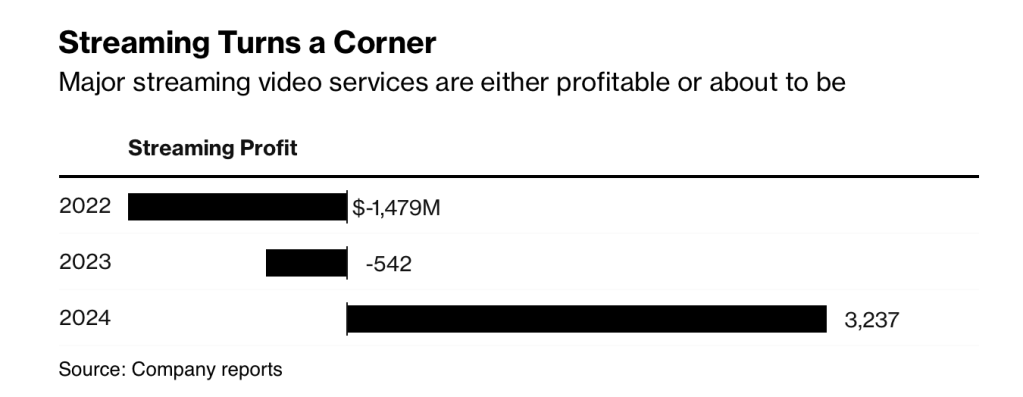
This summer two major US cable/streamers Warner Brothers Discovery and Paramount announced write-downs of their cable division assets, $9 billion and $6 billion respectively. Of the US studios, those two companies are the most exposed to the declining cable market.
Graphic from Bloomberg News
You can read more on the write-downs here and here.
Some of the market analyst commentary sounds like the last rites. But the short version is this: first off, all is not lost. Streaming is a successful business as witnessed by Netflix’s strong profit position and even the money-losing studios are turning the corner on their transition from cable-only:
The downer is the relentless fragmentation of the advertising market. Competing against the subscription-first streamers are YouTube’s rampaging growth in advertising revenue from the creator economy world of short video and free advertising supported television platforms (mostly third window re-runs). Some of the FAST channels are alternative platforms owned by streamers and Hollywood studios, others belong to device manufacturers embedding them as apps in smart television operating systems.
***
If you would like regular notifications of future posts from MediaPolicy.ca you can follow this site by signing up under the Follow button in the bottom right corner of the home page;
or e-mail howard.law@bell.net to be added to the weekly update;
But this time the pollster has a new angle on Canada’s biggest culture war issue. It’s measured the intensity of “defunding” opinions by plotting data on how close “defund the CBC” is to a “third rail” issue, a provocative policy in danger of backfiring on the political party promising action.
The poll results show that a campaign promise to defund the CBC is a ballot box winner with 22 per cent of voters and a dead loser with 30%. According to Abacus, a promise to kill the CBC brings it very close to that electrified third rail and, in an observation brimming with irony, puts it in the same territory as reviving the death penalty.
An important point from the survey not underlined by the pollster is that nearly half of respondents either didn’t have an opinion or indicated they “might” vote for a party pushing the defund CBC agenda. We should keep in mind that federal voter turnout in 2021 was only 59%: not all poll respondents vote and there may be a correlation between “I don’t know” on a poll and “I don’t vote” on election day.
Nevertheless, the existence of those “maybe” defunders is good enough for Pierre Poilievre and the Conservatives to stay the course. It also keeps the fundraising spigot open. Here’s a typical social media message from the Tory shadow Minister for Heritage, Rachel Thomas:
Without a doubt, defunding the CBC has long been a great fundraising hook for the Conservatives. The question the rest of us ask is whether they mean it quite so literally.
Despite the firehose of CPC social media messaging, the Party’s latest publication of soberly-worded policy resolutions from its September 2023 convention is far more restrained on CBC bashing and even less emphatic than Erin O’Toole’s 2021 election platform (now scrubbed from the CPC website) which unambiguously promised to defund CBC English language television.
The CBC/SRC is an important part of the broadcasting system in Canada.It must be a true public service broadcaster, relevant to Canadians. We will accordingly ensure the CBC/SRC:
rationalizes any programming that overlaps or competes with private sector equivalents;
reduces its reliance upon government funding and subsidy;
reflects regional and demographic diversity of Canada in its role as a public broadcaster;
responds and is accountable to its audience;
supplies balanced and non-partisan programming.
…We believe that control and operations of the CBC/SRC could be best accomplished through establishing distinct budgets for the operations of the internet, TV, and radio broadcast functions.
(Emphasis added)
Reading that, it sounds more like the CBC might be overdue for a regular dental check-up.
Still, Poilievre and Thomas are so personally committed in their messaging that it’s hard to see them backing down without sacrificing a great deal of political capital (in fact Thomas is so hot on the issue she refused to endorse her leader’s continuation of funding for French-language Radio-Canada).
What applies here is the expression ‘when people keep telling you who they are, believe them.’
It’s interesting to consider what small “c” conservatives think of all this. With the 2025 federal election looming, they may be expected to fall in line.
Globe & Mail columnist Andrew Coyne and Editorial Page Editor Pat Brethour don’t need any encouragement and have already called for defunding the CBC. Coyne would of course have to find a new side-gig to replace his regular appearances on CBC’s At Issue. Brethour has suggested the $1.4 billion budget savings be turned over to Canadian content creators in the guise of subsidies.
Sean Speer’s The Hub appears to have turned from grudging supporter of public broadcasting to pronouncing time’s up on the CBC’s last chance to appease conservative critics.
The last straw was a CBC human interest story concerning a transgendered man who gave birth to a child. While many might regard such a news item as a man-bites-dog story for the modern age, for Speer it’s the provocation worthy of the CBC’s coup de grâce:
Whatever one thinks about the story it’s hard to argue that it reflects broad public interest journalism. The article itself indicates that the individual’s chance of conceiving a child was 1.8 percent. The nature of their experience—particularly in St. John’s—is even more atypical. It’s highly niche content that is neither representative of the broad-based local experience nor informative of major national or international developments for a local audience.
It didn’t have to be this way.
…The decline in local news isn’t a new issue. It’s been a slowing-moving crisis. The CBC had plenty of time to reorient itself as a key part of the government’s response to these developments. But it has chosen not to.
In a parallel universe, the public broadcaster could have reconfigured its staff and other resources beyond the 40 or so communities (which mostly comprise provincial capitals and key population centres) in which it’s currently present.
…There may be a role for public policy to support local journalism. That’s the subject of a worthy policy debate. But however one comes down on the question the CBC isn’t the answer. The CBC doesn’t do public interest local journalism anymore. It does identity politics. And that will ultimately be its downfall.
On the other hand, Rewrite blogger Peter Menzies is more interested in a mission re-boot for a public broadcaster that tacks further to the centre, stops competing with private news organizations for advertising revenue, and focuses on underserved audiences and markets. Here are some of his comments from an interview with Canadian Affairs, worth reading at full length:
FD: Poilievre has indicated he would cut $1 billion in federal subsidies from the CBC, while maintaining French and Indigenous programming. What do you make of this plan?
PM: I think [the plan] needs a lot of work. It depends how they want to define “defunding.” Right now, the CBC operates with a little under $2 billion in total revenue [and] $1.4 billion of that comes from the federal government. If you cut $1 billion [in federal funding], that leaves about $400 million. Currently, it costs about $500 million to run the French programming. So the math doesn’t work. You can’t cut a billion dollars and have much left over for French or English.
You could [however] trim down its operations. So instead of having two radio networks in each language, you would just have one. You could get rid of what’s left of Radio Canada International, which is essentially an ethnic radio station. You could get rid of sports, etc. But [the Conservatives] need a far more precise plan.
FD: In your opinion, what are the services that the CBC should be providing? And which of its current functions should be pared down?
PM: The CBC has the country’s most popular news-carrying website. So it’s doing that well.
CBC Radio One is a market leader — often in first place and no worse than second — in every major population centre in the country from Halifax to Vancouver. I think other [functions] like ICI Musique and its English equivalent are unnecessary. Private sector players like Apple Music and Spotify are already serving people with music.
You could take a good long look at merging CBC News Network and CBC over-the-air.
But leave the French services alone, because the French market is entirely different from the English market. The [French] content is quite popular in Quebec.
That still leaves about $400 million in television entertainment programming to discuss.
In the event you have concluded that MediaPolicy.ca endorses any of this budget cutting, I most emphatically do not. What is exciting from a policy point of view is the opportunity to reconsider what public broadcasting means to us, what we want to pay for, and whether we in fact might pay more not less.
I am not holding my breath that such a discussion will happen in an organized way prior to the next election. The government’s blue-ribbon committee is already charged with reporting to the Heritage Minister “regularly” and at some point perhaps we will know what they are telling her. In January, Pascale St-Onge said “I really want to achieve that before the next election, to make sure that our public broadcaster is (as) well-positioned as possible for the future.”
But unless the Liberal government deliberately chooses an expansive policy rethink over returning Conservative fire with its own wedge politics, the potential for thoughtful discussion will be overtaken by the rhetoric of election campaigns.
***
If you would like regular notifications of future posts from MediaPolicy.ca you can follow this site by signing up under the Follow button in the bottom right corner of the home page;
or e-mail howard.law@bell.net to be added to the weekly update;
Whenever MediaPolicy posts about mandatory digital news licensing payments —my description of the Online News Act Bill C-18 — I situate the Canadian narrative in the story of Google and Meta resisting similar regulatory schemes around the globe.
Canada was not the first to hang a price tag on Big Tech exploiting its market power over news publishers. Featherweight Australia (population 26 million) did it in 2021 and recently news organizations renewed their agreements with Google. The European Union (450 million) broke ground a few years earlier with a scheme of mandatory copyright payments. A Senate bill modelled on Australia’s code failed in US Congress in 2022 (340M), but the Californian (40M) state legislature is considering a version of our C-18 right now.
What about in the United Kingdom (70M)?
In June the British parliament passed the Digital Markets, Competition and Consumer Act (DMCC). The bill is designed to give the Competition and Markets Authority (CMA) better police powers over Big Tech.
The CMA’s priority issues in digital are those you frequently hear about from the American and European jurisdictions: the phone app environment, digital advertising and most recently the Google monopoly in Search.
However the CMA now says it is going to get around to mandatory news licensing payments in due course. An analysis of the potential CMA approach to that issue was released July 31st by the British media consulting firm Enders and appears to speak in the voice of the public regulator.
Alas the Report is paywalled, so I offer some of its observations.
“Google undoubtedly gets value out of publisher content, but quantifying this is very difficult, as so much is indirect (with news queries not monetised). Regimes in Australia and Canada have in practice avoided direct quantification of a ‘fair’ value exchange even though that was their original intention. In Canada, Google ended up agreeing to a set payment amount annually.”
In fact the report has nice things to say about how Canada handled the news licensing problem. It comments that “the ‘exception’ route of Canada involves some uncoupling of payments from a direct value exchange [pricing of news] —this seems like a fudge but in fact is more sensible in practice and principle, given the challenges of that direct calculation.”
I think that’s a good description of how initially both Australia and Canada designed “market correction” legislation for news payments, using binding arbitration as an enforcement backstop, with unpredictable pricing outcomes. But in the end Google and Meta just cut a deal with Australian news organizations and Google came to terms with the Canadian government at a fixed price they could live with. The lower, the better.
And then Meta walked away from news. First in Canada, probably soon in Australia. Since 2018, Meta has been degrading and down ranking news on its platforms and their news consumption in all countries has plummeted. So it looks like regulating them hastened the inevitable.
Enders thinks the UK can do a better job regulating news licensing payments.
The availability and prominence of news on platforms is the prime directive of any public policy, says the report, “even if it isn’t directly legislated for.” That phrasing ought to tip you off.
Enders then lionizes Google’s various donations and collaborations with the news industry, geared towards staving off regulation, and concludes “any regime should incentivize —and must not disincentivize— such effective collaboration….The Act does not directly set out a news publisher bargaining regime [like Australia or Canada] and the UK may not end up with a dedicated news bargaining code at all if the CMA decides that existing [voluntary] deals [between platforms and publishers] and its own other interventions are sufficient.”
As for Meta, the Enders report appears to write off Facebook and Instagram.
The underlying assumption in the report is that it’s too hard to make Big Tech play nice if government is making the prescriptive rules on how they must pay for news. You have to find a “participative approach” they like better, at a price they are willing to pay.
Now that might strike you as defeatist, but Enders (and British Parliament) would see it as pragmatic.
Here’s a chart Enders prepared which does a pro and con summary of the Australian, Canadian and EU regulatory efforts:
The bottom line in the report is its suggestion of a made-in-Britain approach with these features:
News licensing payments aren’t the top CMA priority under the DMCC, so while the regulatory body concentrates on digital advertising and mobile applications this gives Google and news publishers a window to come to terms that everyone can live with. It also leaves time to observe what kind of impact AI large language models are making on search engines and the news content that feeds them.
If that voluntary approach doesn’t work then the CMA may move. The DMCC already includes binding arbitration as the toughest measure on Google, but there would be alternatives.
Those alternative funding mechanisms —both are familiar to Canadians— might include a digital levy on Big Tech that is distributed directly to news organizations, or perhaps a direct government subsidy from a treasury increased by taxing Big Tech.
Another potential policy move is to regulate news prominence on Big Tech platforms, although Enders flinches at the idea of a “must carry” rule for news on the platforms.
Throughout the report, its clear Enders believes that any price Big Tech pays for news must be fixed, not driven one arbitration outcome at a time, and (although Enders avoids saying so) low enough for Big Tech.
How the news journalism industry in the UK, Canada and around the world sorts this out will be the key to its financial sustainability. As this graphic in the Enders Report demonstrates, the digital news audience is declining not only on legacy platforms but on direct visits to owned and operated digital news sites, while rising on links through social media and search:
***
MediaPolicy wrote last month about the stunning Rogers scoop of high-margin programming licensed in Canada by Warner Brothers Discovery to Bell and Corus when those deals expire at the end of 2024.
Bell filed in Ontario court for an injunction against Rogers and WBD on the grounds of a two-year post-termination non-compete clause in the Bell-WBD licensing agreement.
The drama has many more acts (I haven’t seen the WBD filing as yet). But if Bell is right about its non-compete protection, you have to wonder about the due diligence process just completed by Skydance Studios in its purchase of WBD.
An amazingly urbane and sensible commentary on the continuing saga of the Online StreamingAct, if I may so say so.
***
If you would like regular notifications of future posts from MediaPolicy.ca you can follow this site by signing up under the Follow button in the bottom right corner of the home page;
or e-mail howard.law@bell.net to be added to the weekly update;
The beginning of August marked the first anniversary of Meta’s 2023 ban on Canadian news content, its response to mandatory licensing payments required by the Online News Act, Bill C-18.
McGill University researchers released a report taking stock of the ban’s impact on the distribution and consumption of news on social media platforms including Meta’s Facebook and Instagram but also Twitter, YouTube and TikTok.
The Report’s headline finding is that engagement with Canadian news on Meta’s platforms is down 85% from before last year’s ban, to the tune of eleven million views daily. It’s not an airtight 100% disengagement, according to the Report, because Meta is not weeding out the user uploaded workarounds, screen shots of news items and modified hyperlinks to online news.
The Facebook/Instagram presence on social media is so dominant that an 85% reduction in Meta news engagement results in a 43% decline in total social media distribution of news. TikTok was up 24%, but Google’s YouTube was down 22%. Twitter held its ground. (See the right-side graphic above).
It’s unclear what role is played by the known increase in “news avoidance” by consumers. The Canadian breakout of the global Reuters survey of digital news noted that news engagement on Facebook had been declining long before its news ban came into effect: from 46% to 29% of Canadians seeking news at least weekly on Facebook in the seven years preceding Meta’s news ban. The downdraft of news engagement on the ban-free YouTube also suggests there is more going on than the Meta news block.
Nevertheless, the loss of news engagement on Meta platforms has a major (and alarming) impact on news consumption by “incidental” consumers who graze for news about current affairs on social media instead of conventional print, broadcast and digital news platforms. According to the McGill Report:
Some highly-motivated Canadians seek news outside of social media platforms through other means, either via news subscriptions, digital news websites, or television and radio, and are likely not severely impacted by the ban. However, active news seekers are the minority. The average Canadian does not frequently consume news, particularly about politics (in fact, 40% actively avoid it) and will likely only become aware of current events by being incidentally exposed to content about it online. Much of this incidental exposure to news is facilitated by social media, such as through friends and family discussing politics online or algorithmic feeds pushing trending content whenever a major event happens. This news exposure has been dramatically reduced due to the Meta news ban.
The McGill Report’s dismal findings about post-ban news consumption on Meta platforms, expected as they were, reignited public criticism of both the government’s decision to legislate in the first place or, on the other hand, Meta’s response.
One of the fuse lighters was Chuck Lapointe, publisher of Narcity.com, a chain of local news and lifestyle websites. Like many other small or local publishers, Lapointe describes the loss of Meta platforms as a disaster for his content distribution.
The first anniversary of the Meta ban coincided with Lapointe’s Narcity losing its appeal of eligibility for the federal Qualified Canadian Journalism Organization (QCJO) program that subsidizes the salary of each employed journalist provided the news site is “engaged” in publishing “original news.”
According to Lapointe, his publications were declared ineligible for being insufficiently “engaged” in producing original news; that’s legalese for not publishing first-hand reporting frequently enough. Lapointe says that his site posted original news —-as opposed to aggregated or re-written content—- once or twice weekly.
There is no bright red line in federal QCJO guidelines on how frequently a news site must publish original news to be eligible for QCJO. The only useful benchmark in the guidelines is that once a news outlet is determined to publish original news on a frequent basis, the news outlet is remunerated up to $30,000for the annual salary of each journalist who works at least 75% of their working hours “engaged in the production of original written news content.”
As you can see, the QCJO funding rules for “per journalist” payroll subsidies are not the same as Online News Act licensing payments that instead are tied to the publication of “news content” that is “made available” by a “Digital News Intermediary” platform, i.e. Facebook or Google. The “news content” does not have to be original reporting and there is no requirement for the frequency of “availability.”
On the heels of that QCJO ruling, Lapointe announced that his site has been welcomed back on Facebook and Instagram because, as he said in a LinkedIn post, Meta has accepted his argument that Narcity’s ineligibility for QCJO means the publication is no longer a “news outlet” that Meta bans so that it can avoid financial liability for “making news available” under Bill C-18.
Lapointe characterized Meta replatforming his editorial content as Narcity “opting out” of the Online News Act itself, encouraging other news outlets to forgoing QCJO payments in exchange for regaining distribution on Facebook:
All news publications — who are QCJO designated — even if you want no part in Bill C-18, are LOCKED-IN. The Online News Act automatically includes you if you are designated as QCJO…
You have no way to opt-out and no way to get your Meta distribution back.
I hope that the news of our Re-instatement on Meta will trigger a re-evaluation of the Online News Act and allow the option for people to opt-out if they don’t see the business benefits of participating.
We should’ve done this earlier. What a f*cking trip. Anywho, we’re back on Meta, see you there.
Meta has always maintained a portal inviting outlets such as Narcity to declare themselves not to be “news outlets” as defined by the Online News Act (which is not quite the same as being disqualifying from the QCJO program which requires frequent original news reporting). Says the Meta attestation:
“Furthermore, you acknowledge that this submission constitutes a legally binding statement acknowledging that you are not a news outlet or business producing news content within the meaning of the Canadian Online News Act.”
No doubt Meta’s lawyers have thought about this, but a news site’s ineligibility for QCJO payments is not dispositive of whether a media website is a “news outlet” publishing “news content” under the Online News Act Bill C-18 (for example, digital news published by television companies is ineligible for the QCJO program but they are clearly C-18 “news outlets” whose “news content” is being blocked by Meta).
Just as an illustration of this strange state of affairs, it didn’t take me long yesterday to locate on Facebook an organic posting of my own linked news content (published by Monitormag.ca) posted last January in the thick of the news ban:
The question then arises, how much of the 15% of remaining news engagement on Meta platforms is not screen grabs or modified links but rather organic posts of “news content” cleared for flight by Meta? Could Meta be ghosting into “making news available,” the legal trigger for licensing payments under the Online News Act?
Heritage Minister Pascale St.-Onge, whose government certainly did not appreciate being punked by Meta last August, publicly expressed her concerns but acknowledged that Meta’s status as a Digital News Intermediary (DNI) under Bill C-18 is something for the CRTC to determine.
For its part, the CRTC’s response to a Canadian Press reporter was an audible diving beneath a desk. A Commission spokesperson confirmed that section 7 of the legislation requires a company like Meta to self identify as a DNI. Section 7 is oddly silent on the consequence of a DNI failing to notify the Commission of DNI status, although there exist general provisions for the CRTC assessing fines for non-compliance under the Act.
“Some reports have claimed that Meta continues to make news available; however, the CRTC would require further evidence to take further action,” the Commission stated.
Where does that leave us? If Meta is making news content available on its platforms, whether posted by users or media “opt-outs,” then any one of several hundred news outlets that have lost access to Facebook and Instagram might take it badly.
The “undue preference” rules in section 51 of C-18 could come into play as news outlets might ask the CRTC to get out from beneath the desk and consider whether Meta is favouring some media outlets and discriminating against others in the operation of its leaky news ban.
The context for all of this remains Meta’s global strategy to resist mandatory news licensing payments wherever it can.
Although the European Union’s scheme of licensing payments for news appears cemented, Meta has announced its refusal to renew compensation agreements in Australia, with a preemptive threat of another news ban, while the Australian government is considering its legislative response “imminently.”
Within the walls of Big Tech’s Alamo, that is to say in California, the state legislature is proceeding with a version of Canada’s Bill C-18 that has cleared legislative committee votes by large voting margins.
***
In commenting on the Big Tech issues above, I may have buried the lede.
Last week a US federal judge ruled that Google is operating an illegal monopoly in its Search Engine business. The case turned on the judge’s finding that Google’s multi-billion dollar deals with Apple to become the default search engine on iPhone browsers was an abuse of market power. Matt Stoller has an excellent summary here.
Google also chose the first of August to pass along corporate tax liabilities to its customers in Canada, Italy, Turkey and Spain in response to national Digital Services Taxes activated in each of those countries. MediaPolicy published an analysis of the Canadian DST and the retaliatory Google increase to Canadian advertising rates here.
***
If you would like regular notifications of future posts from MediaPolicy.ca you can follow this site by signing up under the Follow button in the bottom right corner of the home page;
or e-mail howard.law@bell.net to be added to the weekly update;