Big Tech’s news throttle looks headed to a December end game when the Online News Act, Bill C-18, comes into force. Facebook has already choked off Canadian news and now Google has reissued its list of demands.
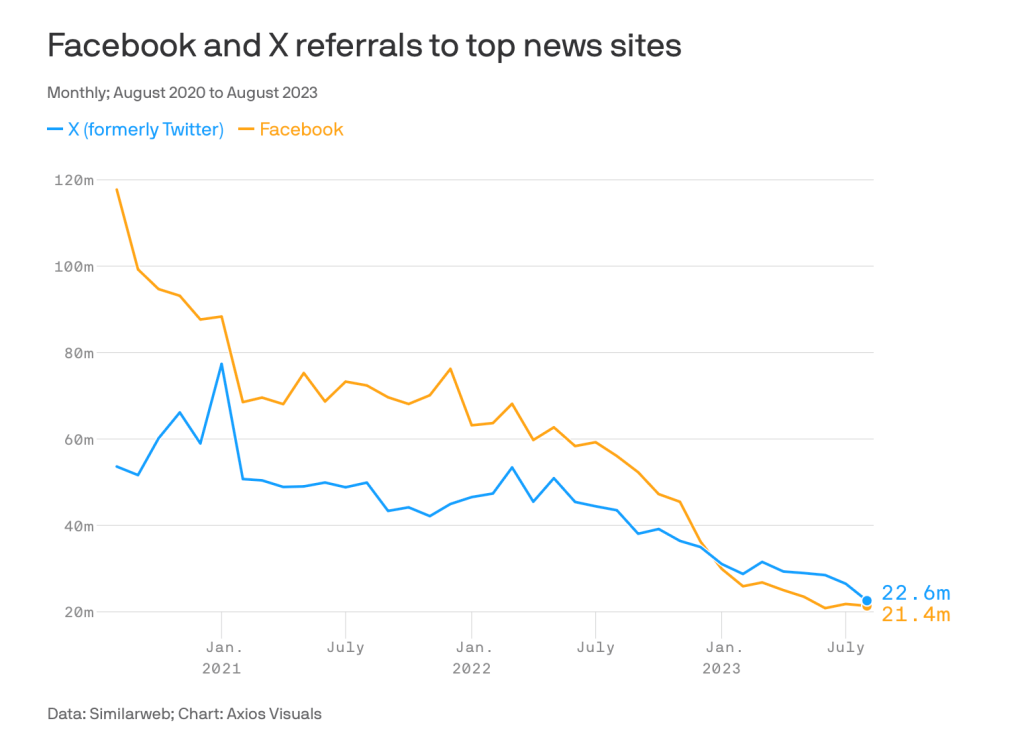
Facebook’s blocking of Canadian news harms both news outlets and readers alike, although it should be seen in the global perspective: Axios reports that post-2020 Facebook and Twitter referrals of reader traffic to top global news sites are sinking like a stone.
Most people following Meta are convinced that Canadian news on Facebook isn’t coming back. We are therefore left with the blame game of whether CEO Mark Zuckerberg or Prime Minister Justin Trudeau ought to be held responsible.
What’s less debatable is the fact that Facebook will no longer balance its distribution of misinformation in Canada with reliable news and therefore will devolve into a platform – if you will excuse the hackneyed phrase – for fake news.
As for Google’s threats of a news throttle, it may come down to the wire: one gets the feeling from recent developments that December will see some deadline bargaining between the Canadian heritage minister, who is responsible for the Act, and the Google C-Suite.
Minister of Sport Pascale St-Onge rises during Question Period in the House of Commons on Parliament Hill in Ottawa on Tuesday, June 14, 2022. THE CANADIAN PRESS/ Patrick Doyle
October 24, 2023
The broadcasting community is still waiting for Heritage Minister Pascale St.Onge to finalize the terms of the federal cabinet’s Policy Direction to the CRTC on implementing the Online Streaming Act, Bill C-11.
Cabinet Policy Directives, authorized by the statute, provide an opportunity for the government of the day to send veiled hints to the CRTC in the guise of broad policy statements on the action points emerging from the new legislation.
St.Onge’s predecessor in the Heritage portfolio, Pablo Rodriguez, floated his draft Policy Directionon June 10th in the Canada Gazette and we are well beyond the minimum thirty day consultation period. With 1400 public submissions on record, it’s a safe bet that St.Onge has heard from all and sundry on what the final version of the Directive ought to say. The CRTC public hearings begin November 20th, so the final Policy Direction is likely to be issued before then.
In the Parliamentary session prior to the October 2021 election, before St.Onge was elected as a rookie MP from Brome-Missisquoi in a razor-thin win over the Bloc Québécois, she appeared before the Commons Heritage Committee. As the Chair of the Fédération nationale des communications et de la culture (FNCC-CSN), she was there to comment on then-Heritage Minister Steven Guilbeault’s draft Policy Direction on Bill C-10, the first version of the Online Streaming Act that died on the order table when Justin Trudeau called a federal election in August 2021.
The yet-to-be-MP St.Onge represented journalists and media workers in Quebec. In fact her job was similar to my own at Unifor —mostly for English Canada—- and we appeared before the Heritage Committee on the same day, March 22, 2021.
Guilbeault’s draft Policy Direction (download below) had been circulated ten days earlier and St.Onge, myself and a long list of participants had gone over it in detail in case it offered clues to where the government might, or might not, go with amendments to the First Reading version of Bill C-10.
We were on the same wavelength, as her opening comments revealed:
First, the appeal of deregulation and a race to the bottom to help integrate the digital giants is an illusion. In reality, our media and audiovisual ecosystem has been able to thrive because we’ve protected it from the hegemony of Hollywood and other wealthier and more powerful foreign competitors.
If we want to continue to stand out, not only for our Canadian productions but also for our social fabric, values and diversity, we must ensure that the modernization of our legislation will continue to protect our cultural sovereignty and enable our content to shine.
Nobody on the “Canadian content” side of the debate was very happy with Guilbeault’s first effort. The draft Directive was chock full of buzzwords such as “flexible,” “incentivize,” “dynamic marketplace,” and “streamlining.” It seemed like the Minister’s semaphore to the CRTC was signalling a light regulatory touch on Canadian content. St.Onge had the same criticism, and said so.
She also pointed out a raft of major issues in C-10 that were in fact addressed by amendments a month later. The issues concerned Canadian ownership, the exclusion of YouTube’s user generated content from regulations on the visibility of French language music, and the lack of emphasis on funding for original French language programming. With the exception of the Liberals’ change of heart on YouTube content, most of the amendments dealing with those issues came from Bloc MP Martin Champoux.
St.Onge also called out as “unacceptable” the Liberals’ gutting section 3(1)(f) of the Act. That section is the legal foundation for the 40-year definition of a Canadian “program” based on a headcount of Canadian producers, directors, writers, actors and other key roles. Amendments a month later from the NDP and the Bloc partly rehabilitated 3(1)(f) and they were confirmed when Bill C-11 was passed two years after that.
Now St.Onge-as-Minister has the opportunity to fine-tune her predecessor’s Policy Direction.
Pablo Rodriguez’s Policy Direction on C-11 is not identical to Guilbeault’s previous effort on C-10. For one, the resplendent use of deregulatory vocabulary is mostly gone. For two, Rodriguez signalled to the CRTC that the headcount approach to defining a Canadian program is still public policy and that broadcasters must continue to “maximize” the employment of Canadian creative leads. That appears to apply to both Canadian and Hollywood-made “Canadian” programs and would be a long way from where the Liberals started with their first draft of Bill C-10 in November 2020.
A hot potato that St.Onge-the-Minister might dare to grab is the issue of user generated programs. That could happen in a couple of different ways.
The first would be rethinking her predecessor’s surprisingly narrow ambit for regulating user uploaded videos and music. Rodriguez did the expected in asking the CRTC to exempt YouTuber videos from regulation, but he also limited regulation to the uploads posted by licensed broadcasters and streamers. In the gap between YouTuber videos and “rebroadcasting on YouTube,” copyrighted music remains unregulated. [Update: Heritage Canada has clarified that so long as a song has been previously distributed by any regulated streamer, it will be regulated if uploaded by any user to YouTube]. The French language music industry is extremely unhappy about this since Québécois music is disproportionately under promoted and under consumed on YouTube and other music streaming platforms.
We will see what the new Minister thinks about that.
The second issue she might grapple with is “online discoverability” of Canadian programs ——not just French language music—- on all streaming platforms, not just YouTube.
In 2021, the yet-to-be-politician St.Onge made a point of telling MPs considering Bill C-10 that effective efforts at discoverability of Canadian programs meant taking on the sensitive issue of the streamers’ algorithm-driven recommendations of content:
It’s a big problem, because the bill does not include specific instructions for improving content discoverability… People often say that content will be discovered if it’s good. However, we know that things don’t work that way on the platforms, since content is displayed based on algorithms that are not transparent and over which we have no control. So, to improve content discoverability, the policy direction or the act itself would need to specify obligations on content discoverability and accountability, and currently there are none.
When the Liberals returned from the 2021 election to table Bill C-11, there was stronger language on discoverability because of the Bloc amendments to C-10. But C-11 also included a new provision that restrained the CRTC from ordering a “specific” change to a recommendation algorithm. The political fury that ensued over any regulation of algorithms was so intense that Minister Rodriguez went out of his way in his draft Policy Direction to ask the CRTC to prioritize discoverability “outcomes” over instructions and to “minimize” any possibility of ordering an underperforming streamer to tweak its algorithm.
Again, the very considerable lack of visibility and availability of French language music on YouTube and Spotify can probably only be addressed by algorithm changes.
If you would like regular notifications of future posts from MediaPolicy.ca you can follow this site by signing up under the Follow button in the bottom right corner of the home page;
or e-mail howard.law@bell.net to be added to the weekly update;
The Conservative Party is going to keep squeezing Bill C-11 for juice as long as it can. The latest is Andrew Scheer tabling in the Commons an MP’s request for information on the CRTC’s registry for the online undertakings (with annual revenues greater than $10 million) that the Commission is about to regulate.
You can see where this is going. Scheer wants to know how much the registry will cost. I can tell him right now: it won’t cost as much as the federal long-gun registry that Stephen Harper scrapped.
Scheer is not a fan of Bill C-11. He made that clear in this Facebook video posted in 2022. While it’s tempting to conclude it’s satire, it’s not.
Update: In response to Scheer’s question the CRTC said that it expected between 50 and 100 online undertakings would register and this would require no additional operational spending by the Commission.
***
The 30-day period for public comment has closed on Heritage Minister Pascale St.-Onge’s draft regulation that brushes in some of the details of Bill C-18.
Google filed its response, rejecting the Minister’s document root and branch. Newsmedia Canada approved of one of the concessions made to Google (mischaracterized by Michael Geist as the publishers’ “surrender” on C-18). The Canadian Broadcasters Association asked for an amendmentto the regulation to ensure that news websites belonging to radio companies don’t get left out in the cold as they were in Australia.
Public trust in news reporting is always important and MediaPolicy.ca frequently relays survey resultsfrom the Oxford Reuters Digital News Report.
The Hamas terror attacks in southern Israel and the imminent counteroffensive into Gaza puts journalists in the unenviable position of reporting facts that the public may not want to hear, or want to hear them described in manner tailored to suit their own views.
If you would like regular notifications of future posts from MediaPolicy.ca you can follow this site by signing up under the Follow button in the bottom right corner of the home page;
or e-mail howard.law@bell.net to be added to the weekly update;
The public broadcaster is in Pierre Poilievre’s cross-hairs again following the disclosure of CBC News Editor-in-Chief Brodie Fenlon’s staff e-mail reminding journalists of its long standing policy regarding the term “terrorism” as reporters cover the Hamas assault on Israel and the ensuing war.
Another reason to defund the CBC, said Poilievre; the woke public broadcaster is soft on terrorism. The Conservatives demanded that CBC executives appear before the Heritage Committee to answer for themselves.
Fenlon issued a statement that CBC’s editorial policy mirrors those of other news organizations such as the BBC, Reuters, Associated Press and AFP. Since then, the Washington Post and the Globe and Mail have expressed similar views.
The gist of those policies is that journalists using categorical vocabulary is perceived by many readers as endorsing or condemning news subjects, rather than reporting what is happening. There’s no ban on using the terms “terrorism” or “terrorist” but reporters (although not necessarily opinion columnists) are expected to let the news subjects do the talking, in other words quoting them.
It leads to some awkward writing, to say the least, to omit the adjective “terrorist” unless the rest of paragraph clearly depicts what occurred, i.e. the intentional killing or kidnapping of innocents for political ends. Unless “terrorist” actions aren’t newsworthy which they normally are.
Deciding whether to label Hamas a “terrorist organization” seems to be the lightning rod for controversy.
Hamas unequivocally used terrorist methods on October 7 by killing and kidnapping hundreds of innocents at a youth festival and several kibbutzes in southern Israel. Those would be infants and children; unarmed adults and seniors.
Hamas has sent suicide bombers to Israeli nightclubs. Hamas habitually uses terror tactics to get its way, so why the inhibition about the label?
The answer is that “terror” can be as loaded as it is descriptive for the reader. The loaded part, according to Emilie El Khoury, puts ordinary pro-Palestinian voices at an immediate disadvantage in public debate because they become associated with Hamas terrorism even if they don’t endorse Hamas, its violence or its objectives (which is to destroy the Israeli state). That’s a bit of a stretch, but it’s worth considering.
Personally I don’t care if news organizations call Hamas a terrorist organization. I think they are and I have deduced this from many news reports of their activities over the years.
But of course the terror-label is more than just a moral judgment on them and their activities: it’s newsworthy that other nation-states recognize or send military and civilian aid to Hamas, a de facto government that engages in terrorism.
What I do mind is news organizations falling back into euphemisms that sanitize what Hamas does or who they are. For example, the headline on the BBC explainer of its editorial policy refers to “Hamas militants.” I think we can agree, Hamas are not just militants. Better just to refer to Hamas as “Hamas.” You wouldn’t describe the 9/11 attack in New York as a “militant” attack.
But we should take seriously the BBC/CBC view that it is best for journalists to avoid judgmental or conclusionary vocabulary if possible, so as not to turn away readers who don’t like the judgment but need to learn what the facts really are. Canadian journalism academic Ivor Shapiro has a good piece on this.
To illustrate the point, consider the BBC News coverage of the tragedy of an explosion at Al-Ahli Hospital in Gaza and the resulting mass casualties, initially reported as an Israeli air strike.
The BBC interviewed military experts and, in the resulting article, said that while the evidence of blame was inconclusive there exists the strong possibility the explosion was the result of a misfired rocket that did not originate in Israel.
In the middle of a war in the constant presence of misinformation, we may never know reliably who is to blame for the deaths. But the point is that if the BBC had been routinely labelling Hamas as a terrorist organization, its investigative journalism might well be dismissed by many on account of its policy.
And finally, some perspective in this moment: it matters far less what news reporting methods we agree upon and more that innocents are dying in Gaza and Israel and I know that is what we are all thinking about right now.
***
If you would like regular notifications of future posts from MediaPolicy.ca you can follow this site by signing up under the Follow button in the bottom right corner of the home page;
or e-mail howard.law@bell.net to be added to the weekly update;
The outrage over the CRTC’s regulation on registering online undertakings, including podcasts, reached firehose levels this week. It’s mostly a contrived recycling of the familiar policy arguments over regulating broadcasting delivered over the Internet, and from some commentators it’s about getting rid of any broadcasting regulation at all.
But in the interest of facts, here’s a primer for those with a limited amount of time.
The CRTC is going through a multi-step process to implement the Online Streaming Act, Bill C-11, that received Royal Assent last April.
One of its first steps is to take an inventory of online undertakings operating in Canada by requiring them to register the following basic information:
name, head office address, and contact e-mail of the operator
nationality of incorporation
nature of the online service
language of programming
That’s it. The new regulation does not require any information about programming or revenues since this is already covered by the CRTC’s annual digital media survey that applies to large video (greater than $50M in revenues) and audio ($25M) services.
The new registration requirement does not apply to the following:
Any “social media creator,” meaning anyone uploading their content to YouTube or another sharing platform, regardless of how popular the program might be. This is excluded by Ministerial fiat to the CRTC in June.
Video games (also excluded by Ministerial directive)
Text-based content (because it’s not “broadcasting”)
Any online platform with less than $10 million in annual broadcasting revenues. The CRTC is exempting from registration all “small” online undertakings of up to $10M.
So other than video games, all digital broadcasting operations above $10 million in annual revenue must register. On the audio side, that includes streaming platforms and stand-alone podcasters. No one has been able to point out a Canadian podcaster big enough to register on its own account. Most podcasters are either small independents (e.g. Canadaland) or their programs are hosted by the big streamers (e.g. Joe Rogan Experience on Spotify) or major Canadian broadcasters.
It’s fair to say that the Commission’s $10 million threshold for registration is a good indication which platforms will eventually be tasked through further regulations to produce and promote Canadian programs. It might be higher, not lower.
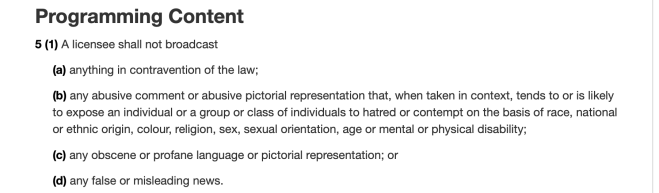
It’s also possible that the Commission will extend its 1987 television and radio codes of conduct limiting “abusive content” and “false or misleading news” to online undertakings. This is what has the free-speech absolutists upset and is worth a longer conversation in this space.
***
Anya Karadeglija of the National Post did some good freedom-of-information digging and came up with an internal Canadian Heritage memo revealing that the federal government may take a wait-and-see approach to the copyright issues raised by the explosive growth of ChatGPT and other AI large language models. Lawsuits in response to the new technology are in their early days.
The copyright issues include the rights of content creators whose material is being scraped, and monetized, by Big Tech platforms. They also raise the question of whether the AI platforms can claim their own copyright over the end-product, despite the fact that copyright is normally the property of a human being, not a machine, that created the work.
***
The Washington Post reports that Amazon’s AI-powered home-assistant Alexa had been telling listeners that the 2020 US election was stolen, citing a source from Rumble. Amazon says it has fixed the problem.
***
There’s lots that could be said about this week’s news items on Bill C-18, the Online News Act. Google observed the expiry of the 30-day public consultation on the federal government’s draft regulation by reissuing its threat to follow Meta and ban Canadian news from its search engine. It’s worth a longer review in a future MediaPolicy post.
For the moment, I will just recommend an interesting and related read. Joshua Benton of Nieman Journalism Lab is probing the question of whether Google’s 90% market dominance of Search could be broken up by a federal court.
***
If you would like regular notifications of future posts from MediaPolicy.ca you can follow this site by signing up under the Follow button in the bottom right corner of the home page;
or e-mail howard.law@bell.net to be added to the weekly update;
Thanks to the richest man in the world, people around the globe have noticed Canada’s mass media legislation, updated for the age of Internet distribution by the Online Streaming Act.
Elon Musk’s impulsive Twitter finger was at it again: “Trudeau is trying to crush free speech in Canada.” That was followed by a tweet promoting Musk’s go-to celebrity contributor on X, Tucker Carlson.
The actual news item was this: the CRTC issued a ruling that streaming platforms (whether they podcast or not) bringing in less than $10 million a year in Canadian revenue are exempt from registration requirements and that only streamers over $10 million need to submit basic identification like a contact person and what broadcast services are provided.
This registration and collection of information was discussed in detail during 54 days of legislative hearings for Bills C-10 and C-11, the most thoroughly debated Canadian legislation in recent memory. Podcasting was never ruled out (nor did the opposition Conservatives suggest it). So it’s not a surprise.
Students of media trivia will recall that in 2014 when CRTC Chair J.P.Blais asked the unregulated Netflix to provide subscriber numbers to the Commission, they defied him, relying upon the immunity of foreign-owned streamers from Canadian regulation. No more, thanks to C-11.
No matter. The usual Canadian suspects joined in with faux outrage at the prospect of the Internet age evolution of talk radio broadcasting, podcasting, was actually going to be regulated in some manner yet to be determined by the CRTC, as if there had ever been any doubt about that.
The allegation was even made that the CRTC had promised not to regulate podcasting: this is nonsense, the Commission website only re-stated what the Heritage Minister and the CRTC had told Canadians several times, that podcasters and all other “social media creators” uploading directly to hosting sites like YouTube would neither themselves nor their “programs” be regulated so long as they stick to sharing platforms.
Even Michael Geist (who defended Netflix’s defiance in 2014) won’t have to register. His owned, operated and self-curated website michaelgeist.ca, includes podcasts but no doubt falls just a nub under $10 million in revenue. Same for TheHub.ca, Canadaland, etc.
***
If you would like regular notifications of future posts from MediaPolicy.ca you can follow this site by signing up under the Follow button in the bottom right corner of the home page;
or e-mail howard.law@bell.net to be added to the weekly update;
Heritage Minister Pascale St-Onge and US Senator Amy Klobuchartalk Facebook news throttles
October 1, 2023
By now you have figured it out, I can’t resist a public opinion poll on media policy.
One must be careful: the quality of sampling and the leading nature of some questions can be a problem. But here’s a good one from the Québec-based CROP published last week on the topic of the Facebook C-18 news throttle. The 1000 respondents skewed a little older (including a lot of retirees) but CROP helpfully broke down the results by age cohort.
Question 1: How frequently do you access your news from these different sources?
Results: (Daily or Multiple times weekly)
Google: 82%
Facebook: 69%
Other Social Media (e.g. TikTok): 51%
News websites: 57%
Instagram: 34%
Twitter: 18%
Not surprisingly, these numbers skew towards younger readers visiting Google, Facebook and TikTok; and older readers to news sites. Only 16% of the 18-34 year old cohort visit news websites daily.
The only shortcoming of the poll is that it didn’t dig down further and ask the extent to which these news sources were the respondent’s exclusive source of news, relevant to the debate over the news throttle. Still, question 2 (how important is Facebook to informing yourself about the news?) tested the intensity of respondents’ loyalty to competing news platforms. Sixty-six percent of the 18-34 cohort described Facebook as very important/important to their news consumption (only 26% of the 55+ age group said that). Forty-five per cent of the younger group reported the Facebook news throttle had disrupted their news consumption habits although only 31% said they had already adjusted by going to other sources (another 21% were considering it).
As for the punch line question, whether Facebook should be compensating news organizations for their content, the results were 48% in favour, 24% against, and the remaining 28% of no opinion. The results were heavily skewed by age group, with 63% of the 55+ crowd in agreement but only 31% of the younger (18-34) group.
The poll was taken solely in Québec, so it’s a good bet you would get different results elsewhere. Here’s a MediaPolicy post on previous polls.
The Facebook news throttle took Heritage Minister Pascale St-Onge to Washington D.C. for a solidarity visit with Senator Amy Klobuchar. The Democratic Senator from Minnesota has been gamely advancing her version of the Online News Act Bill C-18 for two years now but her Bill is stalled. Facebook has also threatened US Congress and the state of California with repeats of their news throttles from Australia and Canada.
St-Onge captured that tersely with the sound byte picked up by Canadian Press: “They [Facebook] don’t want to be regulated, period.”
After doing a photo op with our Heritage Minister, Klobuchar joined her bill’s House co-sponsor Ken Buck (R-Col) for a 25-minute video interview with the Washington Post. MediaPolicy wrote that one up here, finding Buck’s right-wing trust-busting stance of interest.
***
In yet another canary-in-the-coalmine moment for Canadian television, Global TV announced its was discontinuing its long running in-house show Entertainment Tonight. The culprit: the steady downturn in television advertising revenue.
All television shows have a natural life cycle, but we can benchmark the overall trend by looking at CRTC data on ET’s competing channel E Talk! (CTV must report financials for that show because it holds a separate broadcasting licence, unlike Global’s ET where numbers are buried in Global’s network licences).
The bottom line: from 2017 to 2021, CTV’s E-Talk revenues dropped from $30 million to $23 million.
***
There’s a good freelance piece by Alex Cyr in the Toronto Star that begins with a profile of Toronto-born Jeffrey Remedios who is now the head (and chief-talent spotter) of Universal Music Canada. The story then dives into the challenges facing the music streaming business model, in particular the impact of AI. Worth a read.
***
If you would like regular notifications of future posts from MediaPolicy.ca you can follow this site by signing up under the Follow button in the bottom right corner of the home page;
or e-mail howard.law@bell.net to be added to the weekly update;
Today The Washington Post hosted a video interview of Senator Amy Klobuchar (D-Minn) and Congressman Ken Buck (R-Col), co-sponsors of the US version of Canada’s Bill C-18, the Online News Act.
Klobuchar’s proposed Journalism Competition and Preservation Act (JCPA) has been stuck in the Senate for two years now, cleared the Judiciary sub-committee in June, but has not come to a vote on the Senate floor. During today’s interview it became clear that Klobuchar has no idea when it will get a vote in the full Senate, although she says Senate Majority Leader Chuck Schumer (D-NY) is committed to getting it there before the end of 2024. Only then can the JCPA move to the highly dysfunctional House of Representatives.
The House sponsor Buck stole the show during the WAPO interview. The five-term incumbent from Colorado’s rural Fourth District is an interesting cat. He is a member of the conservative House Freedom Caucus but not a Trump acolyte. He has cut himself a profile as a trust-buster and foe of Big Tech market power. His commitment to saving local news outlets is that “news is what binds our community” and its decline “is a threat to the rural way of life.”
Buck’s support for the JCPA is closely aligned with the policy foundation of the Australian News Media Bargaining Code which emphasized above all the correction of Google and Facebook market power over news distribution by overriding anti-trust limitations on news outlets combining to bargain over news value with the larger tech platforms. “This isn’t ‘intervention in the marketplace,'” Buck told WAPO, “we don’t have a market, we have a monopoly.”
Klobuchar chimed in, suggesting that if US Congress can make anti-trust exceptions for farmer co-ops it can do the same for small news outlets.
As for getting a vote on the JCPA, Buck thinks Klobuchar and Schumer could get the required sixty Senators on board for an unfilibustered majority. On the other hand, Buck acknowledged in a massive understatement that getting a Senate Bill passed by the House during this session “is more difficult than in the last Congress.”
***
If you would like regular notifications of future posts from MediaPolicy.ca you can follow this site by signing up under the Follow button in the bottom right corner of the home page;
or e-mail howard.law@bell.net to be added to the weekly update;
The CRTC has tabled an application by Égale Canada to boot Fox News off of Canadian cable for allegedly violating television regulations prohibiting misinformation and abusive comment directed at transgendered people. Instead, the Commission announced its intention to review its overall policy of granting cable access to foreign television channels for unlicensed carriage at the request of Canadian cable companies.
The application arose out of comments by former Fox News host Tucker Carlson in April 2023, described by Egale as follows:
During the segment, Carlson made the inflammatory and false claim that trans people are “targeting” Christians. To position trans people in existential opposition to Christianity is an incitement of violence against trans people that is plain to any viewer. The segment also contained a range of other malicious misinformation about 2STNBGN people, including that trans people are given preferential treatment in employment and other opportunities. This is clearly an attempt to stoke resentment against 2STNBGN people
8(1) No licensee shall distribute a programming service that the licensee originates and that contains
(a) anything that contravenes any law;
(b) any abusive comment or abusive pictorial representation that, when taken in context, tends to or is likely to expose an individual or group or class of individuals to hatred or contempt on the basis of race, national or ethnic origin, colour, religion, sex, sexual orientation, age or mental or physical disability;
(c) any obscene or profane language or pictorial representation; or
(d) any false or misleading news.
The first impression of the CRTC apparently burying Égale’s application is that the Commission is either dodging a hot potato or is so overwhelmed by other telco and broadcasting files that it is content to park this one at the end of a very long queue.
A thoughtful review of the abusive comment regulation is overdue nonetheless. Over a year ago in the weeks following the Russian invasion of Ukraine, the Commission expelled Russia Today from Canadian cable in hasty obeisance to the Heritage Minister’s demand.
The Canadian abusive comment regulation is important and worth defending. Media junkies may recall that in 1987 the Reagan administration in the United States scrapped the “fairness policy” binding FCC-regulated local broadcasters (but not unregulated national cable news operations) that checked the more partisan instincts of some American broadcasters.
Irrespective of the specifics of Carlson’s ugly comments about transsexuals and the fact that he is no longer employed by Fox, the right-wing network spread and legitimized falsehoods and libels about the 2020 US election. That kind of thing might qualify as “false or misleading news” in Canada.
The Commission would be well advised in today’s political environment to think carefully about how to draw the line between political speech and disinformation as well as a measured approach to punishment other than a permanent ban. An instructive example is the CRTC’s 2004 decision to deny a licence renewal to Québec City’s CHOI-FM after its radio hosts defiantly carried on making racist and misogynistic comments.
As anyone might observe, Fox News is free to spread their editorial views, including frequently extreme opinions, over the Internet. But access to Canadian cable, reaching up to 60% of Canadian households, is an economic opportunity and a regulatory privilege, not a right.
Update: A reader reminded me that the “abusive comment” regulations for broadcasters and cable distributors don’t apply directly to non-licensed foreign channels such as Russia Today or Fox News. However the Commission has said in the Russia Today ruling they apply indirectly: “The Commission’s general approach to the addition of English- and French-language non-Canadian services to the List was set out in Public Notice 2000-173 and revised in Broadcasting Public Notice 2008-100. In regard to non-Canadian news services, the Commission determined that an open-entry approach would be consistent with the importance it places on a diversity of editorial points of view. Accordingly, the Commission stated that, “absent clear evidence, as determined by the Commission, that a non-Canadian news service would violate Canadian regulations, such as those regarding abusive comment, the Commission will be predisposed to authorize non-Canadian news services for distribution in Canada.”
***
Still on the free speech theme, former Heritage Minister (and current Environment Minister) Steven Guilbeault avoided his day in court by consenting to remove his Twitter block of the attention-starved provocateur Ezra Levant.
Guilbeault’s block was a response to Levant’s dogged Twitter insults and arguably libellous injury to reputation. The Minister had opted for blocking instead of muting which would have allowed Canadians following Guilbeault’s Twitter handle to continue seeing Levant’s disparagements.
Trolling the Twitter accounts of others is the digital equivalent of grabbing their microphone to speak to an audience the troll hasn’t earned, but federal Ministers will just have to grin and bear it.
***
The National Post has updated the ongoing story of Canada’s Digital Services Tax, set to come into force at the end of the year.
The story hasn’t changed: Canada is one of the few countries that has refused to extend the December 31st deadline for a further twelve months in hopes that the United States Congress will confirm the global tax deal negotiated by the Biden administration. The Biden deal would replace a series of Digital Services Taxes legislated by several countries with a comprehensive international agreement combatting corporate tax avoidance.
The National Post story adds the recent news that both Republicans and Democrats on the House Ways and Means Committee have published a letter decrying Canada sticking to the deadline. The letter repeats unsubstantiated claims that various national DSTs (including those already implemented by Britain and France) violate trade rules and that the US may retaliate against Canada for following the process negotiated by their President. Canada’s reputation is smeared by associating us with the few holdouts against Biden’s request to extend the agreed deadline, those holdouts being Belarus, Pakistan, Russia and Sri Lanka.
Nobody expects Congress will actually pass Biden’s tax deal and the Post story quotes an expert expressing doubt the US Congress will comply. In fact, a cursory glance at the Ways and Means Committee website (curated by majority House Republicans) makes it clear that extending the deadline until the end of 2024 is pointless: in a recent news release targeted at European countries that have already acquiesced to Biden’s deadline extension, the Republicans describe the Biden deal as “a global tax surrender.”
In view of the Republicans’ position, it’s unclear why 138 countries agreed to Biden’s deadline extension. Our federal government is keeping its strategic considerations close to the vest.
***
Today’s recommended read is a video. The Wall Street Journal has an eight-minute explainer of US Federal Trade Commissioner Lina Khan’s aggressive approach to anti-trust enforcement.
***
If you would like regular notifications of future posts from MediaPolicy.ca you can follow this site by signing up under the Follow button in the bottom right corner of the home page;
or e-mail howard.law@bell.net to be added to the weekly update;
Yesterday the federal government satisfied Google’s and Facebook’s number one demand on the Online News Act Bill C-18, limited liability.
The draft regulation establishes 4% of their Canadian revenues as the minimum compensation owed to Canadian news outlets to avoid binding arbitration. Government briefings pegged the total amounts as $172 million for Google and $62 million for Facebook.
The four per cent is a lump sum for Canadian journalism, divided among eligible news businesses. The regulation provides the Big Tech platforms with elbow room on how to distribute it through negotiated settlements with news outlets, either individually or in bargaining coalitions assembled by smaller media outlets.
Platforms are permitted to negotiate non-cash compensation to news outlets, such as technical support and training, although the CRTC will decide if substitutes for real money are authentic. Perhaps more critically, the regulation contemplates a 20% value range of compensation outcomes, meaning the Platforms can negotiate richer deals with some news outlets, thinner with others. That should spark some commentary from advocates for niche news outlets who fear getting the short end of the stick.
The regulation also limits the number of independent news outlets that Google or Facebook can ignore to “any group of 10 independent news businesses operating local news outlets.” An independent news business is defined as having five or fewer news outlets, for example a regional publisher with several community titles, so up to 50 community news websites could be left out.
Facebook flatly rejected the regulation and continues its Canadian news throttle. Google is quiet and keeping its powder dry. As the CRTC has already delayed the beginning of negotiations until early 2025, an election year, the platforms may choose to wait out the government.
Both platforms can still avoid the 4% payment and test the validity of their claims that they owe nothing and that news publishers and broadcasters are in fact the beneficiaries of the value exchange between platforms and journalism. The proposed regulation applies only to the “exemption” of Big Tech from submitting to binding arbitration where their claims can be put to the test.
Two weeks ago, I drew your attention to a story in The Logic that the University of Toronto Law School had secretly accepted a $600,000 gift from Amazon to fund scholarship in competition law.
The university is now returning the unspent balance to Amazon. Law Dean Jutta Brunée explained that her initial decision to keep it all secret was that she didn’t want competition scholars to be influenced by the donation from a major monopolist. The federal government is currently reviewing the Competition Act and considers public submissions from law professors and the general public.
Brunée issued a statement saying she was right to have kept the gift secret but now, the matter having been exposed by The Logic, she is giving the money back because of public perception:
The Faculty of Law upheld the University’s firm commitment to academic freedom, institutional autonomy and integrity. Nonetheless, we acknowledge the important questions raised about the lack of full transparency pertaining to the gift, and the perception of external influence on our academic activities.
It would be interesting to have been a fly on the wall at the most recent meeting of the law faculty (the academics having been kept in the dark about the gift). I feel rather confident there was a rebellion. Prior to the Dean changing her mind, the U of T Faculty Association condemned the gift. UTFA’s principal objection was “most disturbingly, the [Logic] article reveals that Amazon’s donation was not disclosed to the academic community or to the public, and further, that speakers who participated in a seminar funded by the donation were chosen from a list prepared by Amazon.”
No doubt a parallel may be drawn between Amazon funding and trying to influence research on competition law and its Big Tech cousins funding news under Bill C-18. One difference between the two situations is the presence or absence of transparency and regulatory controls on how the money is distributed.
***
Amber Dowling has a well-worth-reading piece in the Globe and Mail marking the gap between what Hollywood streamers said they were already doing for Canadian content and what they are in fact doing.
***
If you would like regular notifications of future posts from MediaPolicy.ca you can follow this site by signing up under the Follow button in the bottom right corner of the home page;
or e-mail howard.law@bell.net to be added to the weekly update;






 MediaPolicy.ca