Spring training for the Senate’s C-18 debate is over, get ready for Opening Day.

February 20, 2023

Senators sitting on the upper chamber’s Transportation and Communications Committee gave us a sneak preview of their opinions on the Online News Bill C-18 at Second Reading on February 7th and 9th.

The sponsor of C-18 in the Senate is Peter Harder of the Progressive Senate group. His lengthy resumé includes stints as chief of staff to Joe Clark as Leader of the Opposition and the Liberal Government Representative in the Senate.

The other dramatis personae of the debate include familiar faces from the Senate’s hearings on Bill C-11: Conservative point-person Leo Housakos, former CTV News host Pamela Wallin, and the two Independent Senators (both former journalists) who co-authored a key C-11 amendment, Paula Simons and Julie Miville-Dechêne. 

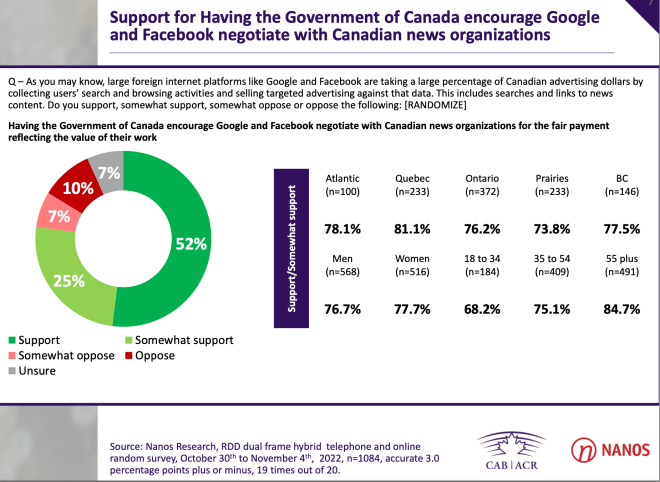
As described in several MediaPolicy.ca posts, the policy idea behind Bill C-18 is that government should intervene in the highly concentrated marketplace of online news distribution and force Google and Facebook to pay license fees to news publishers and broadcasters.

Once the Committee begins deliberations on C-18 in late March, expect the Conservatives to offer tightly scripted messaging carried over from the Commons Heritage Committee: that neither the CBC nor fat cats Bell CTV and Rogers should be compensated by the Big Tech platforms for their news product (but Québecor’s TVA and Postmedia should).

And if the C-11 debate is a guide, get ready for combat by metaphors: Senator Housakos has already suggested that compelling Google and Facebook to make compulsory license payments to news publishers is like Uber drivers demanding a cut of a restaurant bill for connecting diners with restaurant owners. (If you are confused by that metaphor, so am I).

Miville-Dechêne’s Second Reading speech expressed restrained enthusiasm in support of the Bill, her first choice would have been requiring Google and Facebook to finance a single source News Fund (ditto, MediaPolicy.ca). 

Simons on the other hand ran the skull and cross bones up the mast, offering almost every policy objection to C-18 available, beginning with Facebook’s claim that it doesn’t benefit financially from hosting news content (Simons also opposes the federal government’s QCJO subsidies to journalist wages).

The best argument she marshals against C-18 is the possibility of Google or Facebook acquiring undue influence over newsrooms once licensing payments begin to flow (or more precisely ‘flow more,’ as there are already some voluntary licensing agreements in place).

As a rule Simons (and several of the other Senators) bring a refreshing plain-speaking to policy debate. But their credibility as former journalists comes with a special responsibility to support the Bill or else offer a reasonable alternative.

One such alternative is the elimination of any government intervention to save news journalism. In that scenario, government denies all subsidies or regulatory supports, forcing news outlets to ‘adapt or die,’ and hold your breath for whatever kind of news journalism arises from the ashes of creative destruction.

If Senators have the sang froid for that gamble, we will need their plain-speech on the market-based business model they envision.

And what could that look like? No one contests that the advertising model of funding news journalism has been permanently reduced to a supplementary revenue stream. So what then?

Going all-in on subscriber-pay is the most desirable option of course. But after a decade of experience in the unregulated US market, only niche journalism (akin to magazines catering to a narrow demographic of loyal customers) or continentally-scaled newsrooms of three to six million subscribers (the New York Times, Washington Post or Wall Street Journal) have established themselves as sustainable businesses that are independent of the largesse of billionaires. It’s not a solution for the mass market of regional and local audiences who won’t pay for news.

Another model is relying upon the patronage of media barons and philanthropists.

That can work reasonably well, the Thomson-owned Globe and Mail (200,000 paid subscribers) being a case in point.

It also can work reasonably badly where the media baron is a political actor or a political action committee.

Needless to say, civic-minded billionaires willing to lose money are in limited supply and are not a business model.

Even grants from well-intentioned philanthropists (with expectations) are complicated, more of a supplement than a business model for core news coverage.

Without a compelling market solution, Senator Simons appears to advocate for refundable federal tax credits for subscribers and businesses that advertise in Canadian publications. 

It’s an attractive policy prescription. The Liberals introduced a modest subscription subsidy in 2019, worth a $75 refund on $500 of subscription expenditures. Thanks to Revenue Canada’s unhelpful disclosure practices, we still have no data on the program and we have no behavioural evidence as to whether it generates new subscriptions.

As for federal subsidies to advertising buys, our Income Tax legislation already permits full write-offs of those expenses (for print or broadcast but not online news).

The further tax measure mooted by the Senator (she attributes it to Vivek Krishnamurthy of the University of Ottawa) is for government to give money to private businesses so they can patronize the media of their choice.

You see how hard this is.

***

If you would like regular notifications of future posts from MediaPolicy.ca you can follow this site by signing up under the Follow button in the bottom right corner of the home page; 

or e-mail howard.law@bell.net to be added to the weekly update; 

or follow @howardalaw on Twitter.
Catching Up on MediaPolicy.ca – Matt Johnson’s ‘Blackberry’ – KvF’s Bill C-18 amendments – Senator Simons on C-11

From Blackberry. IMDB

February 18, 2023

This week’s round-up of media issues begins with a choice.

One: You can stick your finger in the Pierre Poilievre light socket and watch him tee off on the CBC yet again for asking a question he didn’t like.

Two: You can start your weekend on a different mood channel with Barry Hertz’s positive review of the new Blackberry film written and directed by Matt Johnson and starring Jay Baruchel.

The script is based on the book by Globe reporters Sean Silcoff and Jacquie McNish and will be released internationally by Paramount. (There are no YouTube trailers available yet).

***

Konrad von Finckenstein is a national treasure.

That endorsement may surprise, given contrary policy views expressed on this blog site. But the former trade negotiator, Competition Commissioner, CRTC Chair and federal judge offers an intellectual rigour in his criticism of Bills C-11 and C-18 that isn’t always available elsewhere.

Now that the Online News Act Bill C-18 has passed the House, von Finckenstein has revised his recommendations to the Senate, here.

The Senate’s Transportation and Communications Committee will take up C-18 in late March.

***

On the subject of Bill C-11, I recommend Michael Geist’s podcast interview of Senator Paula Simons, the co-author of the key Senate amendment on user generated content posted to hosting platforms like YouTube.

We are still waiting for Heritage Minister Pablo Rodriguez’s full reply to the Simons/Miville-Dechêne amendment and 25 other changes to C-11 proposed in the Senate. The Minister had implausibly suggested we would hear from him as soon as the week of February 9th.

No word yet, although Liberal House Leader Mark Holland told the Globe and Mail on February 15th that he was in talks about ‘next steps’ with Senate caucus leaders.

***

Last week Heritage officials attended their day of reckoning at the House committee on the hiring of Laith Marouf as an anti-racism consultant despite his many racist (Black, Indigenous and Québecois) and anti-semitic Twitter posts.

Despite intensive questioning by Heritage MPs we are left guessing about the true state of mind of various government officials who must accept responsibility for the baffling omission of a basic Internet search in vetting Marouf’s job application, the inexplicable failure of a 100-person communications team to pick up on Mark Goldberg‘s tweets alerting Heritage to Marouf’s posts in April 2022, and culminating with Heritage’s walking-pace response once the story was broken by journalist Jonathan Kay.

An interesting admission from Heritage officials: the lethargic response wasn’t caused by waiting for legal advice. That seems to leave either indifference or hand-wringing as the most likely explanations.

***

If you would like regular notifications of future posts from MediaPolicy.ca you can follow this site by signing up under the Follow button in the bottom right corner of the home page; 

or e-mail howard.law@bell.net to be added to the weekly update; 

or follow @howardalaw on Twitter.
Catching Up on MediaPolicy.ca – Margaret Atwood on C-11 – Banning Chinese state television – Is TV walking the plank? – Is my YouTube content censored or curated?

February 11, 2023

Bill C-11 continues to be the cultural wedge issue that won’t quit. The MediaPolicy view expressed (incessantly) over the last year is that the Bill is frequently misrepresented and misunderstood.

Those misunderstandings caught up to Margaret Atwood recently when she sympathetically retweeted a Michael Geist post featuring a video of fellow novelist and Canadian Senator David Adams Richards “tearing apart” C-11.

Senator Richards was denouncing the very notion of Canadian content as a state-sponsored assault on artistic expression. (Richards compared the ‘bureaucrat’ controlled funding and promotion of Canadian content to ‘cultural committees’ in Soviet Russia and Joseph Goebbels’ Ministry of Propaganda in Nazi Germany).

An enterprising Globe and Mail reporter got Atwood to elaborate on her endorsement of Richards’ comments.

The MediaPolicy report on the whole affair is here and seeks to clarify what if anything Bill C-11 changes in our decades-long federal policy on funding and promoting “Canadian” creators and their creations.

After that MediaPolicy post was published, Atwood revisited her Globe comments in a lighthearted Substack post and, suffice it to say, she hasn’t done any further reading on the subject matter.

However her post concludes as follows:

I think – I think – that the idea is to enlarge the space available to the creative folk in Canada by helping them profit fairly from their endeavours, insofar as that is possible, and to encourage the availability of platforms via which they may serve up their cheeseburgers. Is that it?

Yes, that’s it.

The facts aside, the Atwood-Richards episode of the C-11 soap opera begat its own epilogue.

The always controversial Guy Fournier wrote a pugnacious column in the Le Journal de Montréal accusing the two English Canadian authors of attacking Québec —see the quotation at the end of this post—- claiming without a shred of evidence that the two writers were insinuating that francophone supporters of the Bill were soft on fascism.

Michael Geist pounced on the column, suggesting Atwood and other critics of C-11 are being victimized by the Bill’s supporters, referencing by hyperlink “columnists” (in fact, only Fournier) and a tweet thread from the Writer’s Guild “respectfully disagreeing” with Atwood.

The victim politics are best left behind. Still, Richards’ cri de coeur on the Senate floor makes interesting reading.

The Senator offers up a straw-man description of Canadian content as a government-approved narrative of national experience that, as a Maritimer, doesn’t speak to his identity let alone what he wants to write about.

Such a narrative, official or otherwise, does not exist except in urban myth. But the enduring riddle of Canadian cultural identity is the subject of a longer MediaPolicy reflection published last year, ‘Telling Canadian Stories in Not a Slogan.’

***

On the subject of free expression and censorship on regulated platforms, Conservative MP Michael Chong wants the CRTC to ban state-supported Chinese TV from Canadian cable services.

Readers will recall that Canadian cable companies voluntarily pulled Russia Today television from distribution shortly after the invasion of Ukraine in February 2022.

The federal government jumped in anyway and more or less commanded the CRTC to officially confirm the expulsion. MediaPolicy covered that story here.

***

While we debate the appropriate regulatory approach to supporting Canadian content in the age of Internet broadcasting, industry leaders are beginning to talk out loud about ‘how much time television has left.’

A worthwhile read is a survey of American TV and streamer executives trying to answer just that question.

A useful Canadian side-bar to the US piece is a Globe report on the state-of-the-industry gathered from CMPA’s annual Prime Time conference.

***

One last dig on the C-11 story.

If you stop and start streaming subscriptions to avoid paying for those fallow months in between seasons of hit shows, you may discover those streamers want you back right away and they are relying on Google’s data-engorged combination of Ad Tech and YouTube to do it.

When I cancelled Paramount Plus this week Ad Tech bombarded me with Paramount ads on every website I visited and —here’s the C-11 hook– a Paramount Plus invasion of my YouTube recommendations.

Yet the prospect of the CRTC asking YouTube to include a few Canadian videos in those top-ranked recommendations —whatever Google chooses in its curatorial wisdom as responsive to your search history— is considered ‘censorship’ by C-11 opponents.

Have a look below. Including the unsolicited Paramount content, five of the eight recommendations do not match my YouTube viewing history.

That means YouTube’s algorithm has downranked and removed the majority of content recommendations responsive to what I have told them I want, in favour of a 62.5% ‘Google content’ quota of what they want me to want.

(If you are trying to figure out the five out of eight, here’s a hint: I don’t golf, I’m stupid for dogs, and I subscribe to Bell Crave.)

***

From Guy Fournier’s column in Journal de Montréal:

Cette hargne contre le projet de loi C-11 ne cacherait-elle pas autre chose ? Comme la conviction secrète qu’ont certaines élites anglophones que les Québécois sont prêts à faire taire tous ceux qui ne pensent comme eux. Les lois 21 et 96 sont pour ces élites le début d’un nouveau fascisme. Comme pourrait bien l’être cette maudite loi sur la radiodiffusion. Le fait qu’elle ait été conçue, rédigée et défendue par trois ministres issus du Québec, Mélanie Joly, Steven Guilbeault et Pablo Rodriguez, ne la rend-elle pas suspecte d’emblée ?

***

If you would like regular notifications of future posts from MediaPolicy.ca you can follow this site by signing up under the Follow button in the bottom right corner of the home page; 

or e-mail howard.law@bell.net to be added to the weekly update; 

or follow @howardalaw on Twitter.

Margaret Atwood and Bill C-11

February 6, 2023

Canada’s most accomplished writer Margaret Atwood recently threw in against the Online Streaming Act Bill C-11 by telling the Globe and Mail that “bureaucrats should not be telling creators what to write.”

Salting those comments, she added “all you have to do is read some biographies of writers writing in the Soviet Union and the degrees of censorship they had to go through—government bureaucrats.”

Atwood echoed sentiments expressed last week during Third Reading of the Bill by her fellow novelist and Canadian Senator David Adams Richards, who for good measure added references to Nazi Germany and Joseph Goebbels.

To this Senator Julie Miville-Dechêne responded the following day, “with all due respect, those who denounce C-11 as an evil act of censorship and infringement of our rights and freedoms are out to lunch.” 

Atwood acknowledged to the Globe that she hadn’t read C-11 “thoroughly yet,” though presumably Senator Richards has.

Here are some thoughts to help them along their way to understanding the Bill better.

We’ve had government intervention to fund and promote Canadian content since the CBC was created in 1936. In the 1980s the CRTC imposed a similar responsibility on other broadcasting networks, the policy idea being to carve out a place for Canadian news, information, sports and entertainment within a continental market dominated by American programming.

Today the CRTC expects CBC and Radio-Canada to dedicate 85% of their programming budget to Canadian shows, while establishing a 30% spending obligation for other broadcasters.

Those spending responsibilities necessarily require a serviceable definition of “Canadian programming,” as opposed to American (or foreign). 

Contrary to what Atwood and Richards believe, the ‘bureaucratic’ definition of ‘Canadianess’ has always been based on the nationality of the creator’s passport, not the cultural specificity of her creation. What makes a broadcast Canadian is the citizenship of its producer and key creative talent.

The same citizenship test applies to many prestigious book awards, of which Atwood and Richards deservedly have many.

Atwood and Richards join more partisan voices in denouncing C-11 as ‘censorship,’ although those comments have been directed not at the definition of Canadian content but rather provisions in the Bill requiring Netflix and YouTube to promote Canadian programming in their personalized recommendations.

Oddly, the same C-11 opponents bemoan the lack of a culturally specific ‘Canadianess’ test for funded programming. The British, for example, have one such test of ‘Britishness.‘ And lo, it requires a ‘bureaucrat’ to apply it.

Double oddly, the proponents of C-11 are mostly defending the citizenship approach founded on the decades-old ‘point system’ that conducts a headcount of key Canadian talent involved in making a video or audio production, as well as Canadian ownership of the resulting product. 

That ‘legacy’ point of view rejects the subjective ‘Canadianess’ test lest it confine artistic expression. Instead, defenders of the ‘point system’ put their trust in the long-term propensity of Canadian artists to produce culturally specific art. Like the aforementioned Atwood and Richards, say.

So far the C-11 debate has (as Senator Miville-Dechêne acknowledged) featured a great deal of partisan hyperventilation about user generated content. The Senator co-authored an amendment, yet to be accepted by Heritage Minister Pablo Rodriguez, putting YouTubers and their uploads outside of a bill that otherwise regulates broadcasting on streaming platforms. 

That won’t leave a great deal in C-11 to quarrel over unless one is hostile to original policy behind funding and promoting Canadian broadcasting. That’s a goal that Ms. Atwood appears to acknowledge in her comment to the Globe about “well-meaning attempts to achieve some sort of fairness in the marketplace.”

Indeed Ms. Atwood’s colourful description of the continental marketplace, and whether Canada can maintain some measure of cultural sovereignty within it, can be found in her legendary remarks to a Parliamentary Committee on the occasion of the 1988 Free Trade Agreement with the United States:

Canada as a separate but dominated country has done about as well under the US as women, worldwide, have done under men; the only position they’ve ever adopted toward us, country to country, has been the missionary position, and we are not on top. I guess that’s why the national wisdom vis-à-vis [the US] has so often taken the form of lying still, keeping your mouth shut, and pretending you like it….Our national animal is the beaver…noted for its industry and its cooperative spirit. In medieval bestiaries it is also noted for its habit, when frightened, of biting off its own testicles and offering them to the pursuer. I hope we are not succumbing to some form of that impulse.”

***

If you would like regular notifications of future posts from MediaPolicy.ca you can follow this site by signing up under the Follow button in the bottom right corner of the home page; 

or e-mail howard.law@bell.net to be added to the weekly update; 

or follow @howardalaw on Twitter.
Catching up on MediaPolicy.ca – Senate sends heavily amended C-11 back to the Minister – What Big Tech Wants – ‘Bias’ at the BBC

CTV’s Vassy Kapelos interviewed Pablo Rodriguez at CMPA Prime Time.

February 5, 2023

The Senate returned a heavily amended Bill C-11 back to the House of Commons last week.

Heritage Minister Pablo Rodriguez was interviewed at the annual CMPA meeting by CTV’s Vassy Kapelos on which amendments he would accept. Our update on what happened and what’s next is here.

***

The Liberals are teeing up their third Internet bill, the yet to be tabled Online Safety legislation. Rodriguez released a report on the cross-country roundtable consultation with various community groups.

Buried at the end is the summary of his meeting with the Big Tech companies and what they want if they are going to play ball with new legislation. Our report is here.

***

The recommended weekend read is Joshua Benton’s review of a report on ‘bias’ at the BBC.

***

If you would like regular notifications of future posts from MediaPolicy.ca you can follow this site by signing up under the Follow button in the bottom right corner of the home page; 

or e-mail howard.law@bell.net to be added to the weekly update; 

or follow @howardalaw on Twitter.

C-11 Update: Senate returns the Online Streaming Act to the House for final rewrite

February 3, 2023

Media coverage and Twitter commentary on Bill C-11 is cresting again after Third Reading in the full Senate approved the Transportation and Communications Committee’s twenty-six amendments.

Here’s a summary of what’s happened and what to expect next on the Bill:

  • The Senate approved all of the committee’s amendments, in particular the elimination of Canadian content regulation of user uploaded content (except content posted on those hosting platforms by conventional broadcasters or music labels).
  • The Conservative Party amendments rejected in the Senate Committee were also voted down in Third Reading. The key amendment would have eliminated any CRTC obligations on Internet streamers or hosting platforms to promote Canadian content.
  • Speaking to delegates to the CMPA’s annual meeting, Heritage Minister Pablo Rodriguez dodged most questions posed by CTV’s Vassy Kapelos but did state (1) he would accept some but not all of the Senate amendments, (2) he hoped to have the government’s tweaked version of C-11 back in the House of Commons next week (!!) and (3) he was confident the Bill was compliant with Canada’s trade treaty obligations. He appeared to discourage any expectation of amendments to section 3(1)(f.1).
  • The Senate is constitutionally permitted to play amendment table tennis with the House for an indeterminate period of time.

On the far side of the world, the Australian government announced its intention to pass a slimmer version of Canada’s C-11 by July 2024. Labour’s Arts Minister Tony Burke described a video streaming bill with the main feature being an Australian programming expenditure requirement akin to the CRTC’s Canadian Programming Expenditure conditions for conventional broadcasters.

Media reports speculated that the expenditure requirements for Netflix and Disney would be similar to those of Australia-owned broadcasters and cable operators, at twenty per cent of programming expenditures.

***

If you would like regular notifications of future posts from MediaPolicy.ca you can follow this site by signing up under the Follow button in the bottom right corner of the home page; 

or e-mail howard.law@bell.net to be added to the weekly update; 

or follow @howardalaw on Twitter

Big Tech dangles self-policing in exchange for no liability in latest Heritage report.

From Canadian Heritage “What We Heard” report on Online Safety

February 2, 2023

The federal Liberals’ march towards tabling Online Safety legislation in the House of Commons got closer to its goal this week with Heritage’s release of results from a series of pro-regulatory roundtables held across Canada. In a recent tweet, Minister Pablo Rodriguez re-committed to tabling a Bill.

The comments from 160 community groups and 13 online platforms were mostly aligned with a series of reports issued in Spring 2022 by the government’s expert panel. That Report recommended government-supervised self policing of online harms and safety, rejecting an interventionist enforcement model that was proposed in the government’s original consultation of Summer 2021.

Buried at the end of this most recent Heritage report is feedback from the Big Tech group including Meta, TikTok, Google, YouTube, Microsoft, and Mind Geek. The comments from the group reflect a constructive engagement with the government’s intention to legislate. Importantly, the summary notes that “several participants flagged the importance of including intermediary liability protection in a legislative framework.”

What the online platforms and tech companies are signalling is their desire for a quid pro quo: they will play ball with legislation enforcing some form of self-policing of harmful online content in exchange for insulating them from lawsuits brought by victims of online harm.

This policy proposal comes at a time that the same Big Tech companies nervously eye the US Supreme Court’s hearing on February 21-22 of lawsuits brought against YouTube and Twitter by victims of ISIS terrorism.

The two lawsuits directly challenge the teflon-like section 230 of the 1996 federal Communications Decency Act. The plaintiffs argue that Twitter and YouTube’s algorithm-driven distribution and monetizing of ISIS recruitment videos glorifying terrorism amounts to promotion of dangerous content (in the case of the YouTube videos, Google split the advertising revenue with ISIS).

That social media curation, say the applicants, is not protected by section 230 enacted by Congress to protect passive hosting of online bulletin boards. Instead, the plaintiffs argue that common law principles of product liability should apply.

As posted previously by MediaPolicy.ca, conflicting views in Congress and US state legislatures over more or less governance of online curation creates a policy vacuum which the US Supreme Court has been invited to fill.

***

If you would like regular notifications of future posts from MediaPolicy.ca you can follow this site by signing up under the Follow button in the bottom right corner of the home page; 

or e-mail howard.law@bell.net to be added to the weekly update; 

or follow @howardalaw on Twitter.

New year, new team. The CRTC has its toes on the starting line.

Meme from Open Media (no endorsement sought or given)

January 31, 2023

Appointments to the CRTC are what we call “Inside Baseball,” of intense interest to those who could do with a few more hobbies.

Just before Christmas the federal government appointed Vicky Eatrides to replace Ian Scott as chair. A former Competition Bureau lawyer and Assistant Deputy Minister at ISED, she had an appropriately low public profile.

Not so Bram Abramson, the newly appointed CRTC regional commissioner for Ontario. A well known telecommunications and technology lawyer who started out as one of Peter Grant‘s juniors at McCarthy’s, Abramson’s varied career includes stints at the CRTC and chief regulatory officer at TekSavvy.

The reaction to Abramson’s appointment has been effusively positive from all quarters. The many critics of the CRTC’s telco rulings on Internet and Mobile regulation are especially pleased.

Abramson is replacing Monique Lafontaine (also a former McCarthy’s lawyer) whose background was stronger in broadcasting.

The next two years at the Commission will be a pressure cooker, given public demand for lower Internet and cell phone prices and, on the broadcasting side, the implementation of Bills C-11 and C-18.

The new chair Eatrides has already signalled she wants to speed up implementation of the Commission’s “MVNO” model that allows upstart telcos to expand outside their current wireless footprints through temporary access to existing networks built by their competitors.

***

There’s another decidedly non-MediaPolicy take on Eatrides’ appointment as chair worth reading from Peter Menzies, here.

***

If you would like regular notifications of future posts from MediaPolicy.ca you can follow this site by signing up under the Follow button in the bottom right corner of the home page; 

or e-mail howard.law@bell.net to be added to the weekly update; 

or follow @howardalaw on Twitter.

Catching up on MediaPolicy.ca – Postmedia layoffs – Rogers Shaw update – Home Depot gave your email to Facebook – US DOJ targets Google’s AdTech – US trade threats, again.

Andrew MacLeod, Postmedia CEO

January 29, 2023

Yet again another bloodletting in print journalism.

This week Postmedia announced an 11% staff cut across its entire news chain. Within the week the redundancy notices will begin and by the end of February we will know who is leaving through buy-outs or layoffs.

The decision came two weeks after a quarterly report highlighting a double digit percentage decrease in advertising and circulation revenues. Asset sales allowed Postmedia to pay down and lower its first-lien debt to $41 million.

***

Last week was an eventful period for the Rogers-Shaw merger, most significantly the Federal Court of Appeal’s rejection of the Competition Commissioner’s appeal.

MediaPolicy.ca’s take is posted here: it’s now time to move past the politics of the merger and put our energy into the federal government’s review of competition legislation.

***

Shopped at Home Depot Canada lately?

Big Orange and Meta have been unmasked by the Canadian Privacy Commissioner for their secret deal to aggregate customer data from e-mailed receipts.

Home Depot used the customer data on products, pricing and personal e-mail addresses with the help of a Facebook tool to verify the effectiveness of Home Depot digital advertisements. It then sold the data to Meta.

As any shopper knows, no customer consent was asked or given. Home Depot told the Privacy Commissioner your consent was implied by shopping there.

As of October, Home Depot stopped misappropriating the data. Still, it reserves the ‘right’ to do so.

The Privacy Commissioner has no sanctions available, but Bill C-27 is intended to change that.

***

Perhaps we have buried this above-the-fold story.

The US Department of Justice announced this week that it is at last filing a complaint under the Sherman Anti-Trust Act against Google for its abuse of market power in digital advertising, specifically its AdTech business.

This targets the core of Google’s enterprise and has very much caught the attention of market analysts.

The Canadian Bureau of Competition walked away from the AdTech file in 2016.

***

MediaPolicy.ca recently posted two chapters in the history of US-Canada trade disputes over cultural goods. Our conclusion was this: the US will always try to bully Canada with allegations of cultural protectionism. Sometimes the complaints have some legal merit, but usually they have none.

Hugh Stephens of the University of Calgary analyzes the latest American threats to “retaliate” against Bills C-11 and C-18.

***

If you would like regular notifications of future posts from MediaPolicy.ca you can follow this site by signing up under the Follow button in the bottom right corner of the home page; 

or e-mail howard.law@bell.net to be added to the weekly update; 

or follow @howardalaw on Twitter.
It’s time to move on from the Rogers-Shaw merger and get on with the review of competition law.

University of Ottawa law professor Jennifer Quaid before the House Committee on Innovation and Technology, January 25, 2023

January 28, 2023

The story of the Rogers-Shaw merger is all but over as we await Innovation Minister François-Philippe Champagne’s final approval.

The Minister’s latest messaging semaphore was that he is in no hurry to put the merger to bed by authorizing the transfer of radio-spectrum licences from Shaw to Rogers and Vidéotron.

But that’s just politics. The likelihood of the Minister vetoing the court-approved merger to seek a new ownership configuration is remote.

For those who didn’t follow last week’s rapid-fire developments, here are the highlights:

  • On January 19th the country’s leading wholesale-based telco TekSavvy filed a CRTC complaint designed to overturn the merger apple cart by targeting the wholesale Internet rates afforded by Rogers to Vidéotron in British Columbia and Alberta. TekSavvy says that arrangement is a sweetheart deal and violates CRTC rules prohibiting telcos like Rogers showing “undue preference” to some but not all wholesale based providers.
  • As expected by all but the faithful, on Tuesday afternoon the Competition Commissioner Matthew Boswell lost his federal court appeal of the Competition Tribunal’s ruling that the merger was not anti-competitive. Indeed the Tribunal had found as a legal fact that the long term commercial arrangements between Rogers and Vidéotron on wholesale rates and network sharing would enhance competition.

The Commissioner’s case was so weak that the Court told lawyers for Rogers, Shaw and Vidéotron that they didn’t have to address the court. Justice David Stratas told the Commissioner his case “wasn’t even close.”

  • On Tuesday evening the Commissioner announced in a press release that he was still right but would not appeal to the Supreme Court of Canada.

It was at this point that the terms of political engagement took shape for the fifth and final Act of the merger drama.

  • On Wednesday morning MPs met in the House of Commons Innovation & Technology (INDU) committee to question representatives from all of the telcos as well as several university academics opposed to the deal.

It was a slag fest of cross-insults between telcos and campaign-style outrage from MPs.

The most effective attack on the deal came from Conservative MP Ryan Williams who wanted to know “why Rogers got to pick its fourth competitor” in Vidéotron.

Liberal MP Nathaniel Erskine-Smith joined in, asking if anyone had a good answer to why Shaw would choose to take a billion dollars less from Vidéotron to sell Freedom Mobile than the $3.75 billion offered by Anthony Lacavera of Globalive.

Lacavera (and others) have called on Champagne to block Shaw’s sale of Freedom to Vidéotron and then conduct a government-supervised auction. The latter option would require an Act of Parliament.

If at any point the inconsolable opponents of the merger are prepared to stand down the populist politics long enough to consider lessons on reforming competition laws, Professor Jennifer Quaid of the University of Ottawa had some advice for INDU MPs.

First, she appeared to suggest that Rogers and Shaw may have gamed the Competition Bureau’s vetting protocol by holding back its best mitigation proposal (the deal with Vidéotron) with all of the detailed information required for the Bureau’s econometric analysis until after the Bureau decided to reject the merger.

If that’s what Rogers did with strategic intent, it’s not possible to put that allegation to the test without a great deal of insider knowledge, some of which is legally confidential.

But Quaid offered an important overall point: we have a public interest in making sure merger applicants don’t play tactical games with the Bureau.

The other point is the obvious gap between the policy assumptions underpinning current competition law and the public skepticism about its outcomes.

Although Quaid (as a critic of the deal) doesn’t say so, part of this gap must surely be attributed to the populist criticism of the merger. Most of that criticism is that the merger is self-evidently terrible, anti-competitive and supported only by vested interests “and the business press.”

Perhaps that deep skepticism is to be expected: the north star of Canada’s competition law resides in the statute’s purpose clause which elevates market-driven efficiency to the exclusion of any other considerations.

That ought to produce a pro-consumer outcome every time, but much of popular opinion doesn’t view consumer interests and corporate consolidation as compatible, ever.

The skepticism may also be explained by a disconnect between a statute administered as it was envisioned and on the other hand popular suspicions that competition law is a pro-business regime designed for and by the Bay Street establishment and then policed by the same elite.

Quaid alluded to this state of affairs in a couple of different ways:

My second of two points is on the Tribunal processI think it’s a heavy process. It’s like a court. Yet it’s packaged as an expert entity. I urge you to look at the kinds of expertise that is generally used in the Tribunal and whether or not you think that captures the full public interest that might bear on competition matters. For the most part, the expertise is business and economics. The question is, are there other perspectives relevant to the competition questions that come up that we should perhaps ensure are better represented in the Tribunal?

I’m one of those people who believes there is a place for regulation and direction. ... If you rely simply on the wealth maximizing incentives of private actors—and they are perfectly entitled to organize their affairs in that way—you may not get the outcomes you want from a public policy perspective

And finally and wisely (forgiving the clunky Google translation):

I think it is the duty of this government and…parliamentarians to listen to citizens, without polish, without labels, without packaging, all beautiful, etc. However, we cannot completely disregard the popular reaction that is happening either because I think that the citizens are not always well equipped to know how to organize their opposition. In this regard, I am lenient because I think there’s a real desire and a real frustration coming out. Rightly or wrongly, I won’t start saying who is right or wrong. However, I think it is clear that there is a gap between the popular understanding of the impacts of this transaction and economic and legal understandings of it. I think it is necessary that there be a communication between the two if we don’t want to have a revolt in relation to the process.

Connecting the dots between those comments, Quaid suggests that if the public thinks there is something badly wrong about competition law outcomes, we had better revisit its overall mission.

Alternatively, it may be that there is nothing fundamentally wrong with our competition law and it only needs stronger enforcement tools. That has been the view of many, including the Competition Commissioner. Some of these changes were made in last summer’s amendments to the Act.

Either way, the federal government’s public consultation window on competition reform remains open until February 27th. The background paper is available here.

***

Also from MediaPolicy.ca: Will Big Tech be cut down to size? What’s next for competition law – February 3, 2022

***

If you would like regular notifications of future posts from MediaPolicy.ca you can follow this site by signing up under the Follow button in the bottom right corner of the home page; 

or e-mail howard.law@bell.net to be added to the weekly update; 

or follow @howardalaw on Twitter.