Bullies aren’t likeable and US trade bullies even less so.
This week MediaPolicy posted in response to an American trade hawk goading the Biden administration to ‘fire-all-phasers’ at Canada and Bill C-11.
***
It was a busy week for news about social media giants and the possibility of government regulation.
McGill University’s Taylor Owen and Facebook-whistleblower Frances Haugen published an op ed opposing government bans on TikTok but also imploring the Liberals to table their Online Safety Act.
In the US there is consternation that Meta is following Twitter in laying off content moderation staff. Meta just got hit with a multi-billion euro fine for ignoring EU laws on data transfers to its North American servers. The data is not just from Europeans’ Facebook activity, but the third party web data it collects from its users.
***
Senate Committee hearings on federal legislation are more thoughtful than comparable proceedings in the House of Commons and this will be proven again this upcoming Tuesday on SenVu when we get another episode in the ongoing study of the Online News Act Bill C-18.
For those of you who, like MediaPolicy, aren’t pinned down by a day job, the Senators kick off at 9 a.m. with a pitch from Newsmedia Canada and also publishers Brian Myles from Le Devoir and Phillip Crawley of the Globe & Mail. As national newspapers, the Globe and Le Devoir may end up as the ‘last man standing’ in mainstream print news so it will be interesting to see how they position themselves in relation to C-18.
They are followed by Canadaland’s Jesse Brown (who will perform Jesse Brown); The Line’s Jen Gerson (who calls the Bill ‘a lie); and then, most intriguingly, Jeff Elgie of Village Media.
Occasionally I drone on about my favourite political columnists who for years have been Chantal Hebert and John Ibbitson. Their disciplined and insightful political analysis is what I admire even though they tamp down the stylism in favour of spare prose.
Paul Wells is the third member of the MediaPolicy political commentary pantheon. He combines political acumen, hard digging, and elegant prose. Judging from his Substack subscription numbers (multiplied by my $5 monthly sub), he’s wildly successful. It’s encouraging that at least for niche journalism the Canadian news market can reward great work.
Today I am adding the Globe’s Shannon Proudfoot to this august group. Like Wells, she offers pith with a rhetorical lilt. Her latest on Laurentian elites had me in tears.
***
If you would like regular notifications of future posts from MediaPolicy.ca you can follow this site by signing up under the Follow button in the bottom right corner of the home page;
or e-mail howard.law@bell.net to be added to the weekly update;
In the week following the CRTC announcement of a public consultation to determine how foreign streamers and Big Tech will contribute to Canadian programming under Bill C-11, a Canadian-educated academic at Georgetown University gave us a flash of the US trade bear’s teeth.
If the CRTC actually implements C-11 in any manner not satisfactory to American media companies, Marc L. Busch recommends the US government file the most aggressive trade complaint possible and “pump up the numbers behind its calculation of ‘equivalent commercial effect.’” Decoded, that means ‘exaggerate damages to US companies so as to justify the most extreme trade retaliations.’
Back to that, later in this post.
Busch is the sort of commentator who combines a free-market outlook with aggressive American trade policy, which is nice work if you can get it. He also tips his policy hand on where he stands on cultural regulation early in his column by offering that “the very premise of [Canadian content] guidelines is absurd in the digital age.”
Born in Wisconsin, Busch was educated at two state-funded Canadian universities and was briefly on the public payroll at Queen’s University. And so he has opinions on things Canadian (including who should win the next federal election).
One of them is about the television series ‘The Handmaid’s Tale.’ He offers this as exhibit A in his case for the absurdity of Canadian content guidelines for funding eligibility.
He’s not alone in pointing to the show based on Canadian author Margaret Atwood’s 1985 novel. The same connection has been made by Canadian IATSE Vice President John Lewis and Conservative Senator Leo Housakos in mocking the rules that certify CanCon shows based on Canadian ownership, cast and crew rather than identifiable Canadian themes.
The debate over a ‘Canadian passport’ versus a ‘theme’ test is a legitimate discussion that will take place before the CRTC in a few months. Heritage Minister Pablo Rodriguez may chime in with a Policy Direction on that point in the coming weeks.
It’s just that using ‘Handmaid’s Tale’ as cannon fodder for attacking the current rules is a dud.
The ongoing TV series and a movie made in 1990 are both true to Atwood’s plot in this respect: the story takes place in an identifiably American dystopia, a theocratic fascist state based in New England. Even in the narratively prolonged TV series, Canada is just a place for escape and refuge (which doesn’t occur until the fourth of five seasons).
Atwood did not write the TV screenplay. The producer, director, writer, and lead actors are not Canadian. The same thing with the 1990 movie except that Atwood co-wrote the script with Harold Pinter.
So in Handmaid example, there are neither Canadian themes nor Canadian ownership or creative leads. The series was shot in Canada, like 645 other US shows, with Canadian crews. By that standard, the X-Files is CanCon.
It’s not that you can’t dig up better examples of American-made movies shot in Canada that are thematically Canadian, starring a Canadian cast, but lacking Canadian ownership of the project. Netflix’s Jusqu’au Déclin (The Decline) is a good example.
It’s all grist for the mill in the argument over whether the current ‘Canadian passport’ system for certifying CanCon needs changing. But despite a handful of examples of uncertified ‘thematically Canadian’ movies, no one has ever conducted academic-standard research as to whether such exceptions are so prevalent as to undermine the policy basis for the current rule.
The MediaPolicy view is, may the best policy argument win.
But back to Professor Busch and his trade bear teeth and claws.
The gravamen of a trade complaint against C-11 is that if the US streamers get only obligations — like writing a cheque to CanCon film funds to make movies that as an American company they can’t buy without forfeiting the opportunity for full copyright—- they will have a credible complaint that C-11 violates the National Treatment ‘non-discrimination’ rule in the CUSMA trade agreement.
Busch’s innovation on this well-known trade argument is to intimidate by larding in every other available allegation, so as to magnify potential damages and therefore maximum retaliation.
On that point he cites the CUSMA chapter 14.10 rule against ‘performance measures.’ Essentially a rule against ‘Buy Canada’ or ‘Buy America’ laws, the chapter has been cited by Michael Geist and the Big Tech lobby association CCIA. Their argument is that Canada is allowed to require Canadian companies to meet local content or purchasing obligations, but not American companies.
Here’s the CUSMA text:
No Party shall, in connection with the establishment, acquisition, expansion, management, conduct, operation, or sale or other disposition of an investment of an investor of a Party or of a non-Party in its territory, impose or enforce any requirement, or enforce any commitment or undertaking:
… (b) to achieve a given level or percentage of domestic content; (c) to purchase, use, or accord a preference to a good produced or a service supplied in its territory, or to purchase a good or a service from a person in its territory.
Taking the chapter to its hypothetical limit in the case of C-11’s cultural regulation, that would mean American companies are exempted from discoverability rules (s.9.1(1)(e) of the legislation) to promote Canadian shows and music, the use of Canadian talent or crews to make Canadian content (s.3(1)(f.1)), or even the requirement to spend an fixed amount on Canadian programming, all of which apply to Canadian broadcasters.
Whether chapter 14.10 applies to those C-11 obligations, and whether it effectively overrides the Chapter 14.5 National Treatment rule to treat domestic and foreign companies in an equitable manner, is difficult to predict.
In that trade fight, the US got its way by cynically over-calculating potential damages suffered by US ‘Canadian edition’ magazines in order to threaten hundreds of millions of dollars in retaliation against Canadian steel, wood and plastics. The threats were duly amplified by the targeted Canadian industries and the Conservatives. Judging from the final peace deal, the threats were quite effective.
What Busch wants in his column is to teach Canada a lesson, so as to “rein in [the] abuses of Bill C-11, and deter other countries from getting carried away with their own cultural protectionism.”
No doubt Hollywood and Big Tech will appreciate Busch’s advocacy. The utility of this kind of well timed threat-by-proxy is to remind the Canadian government, industry, citizens and especially the CRTC that the difference between trade war and peace is whether the regulatory price is right for US companies.
The task of Canadian leaders is to figure out a price that is just short of the US companies’ ability to convince the Biden administration to do their bidding.
***
A footnote.
Despite the comments above on Handmaid’s Tale, all due respect to Margaret Atwood. She is the sort of cultural icon who gives no quarter and asks for none.
As far as I can tell, she has not advanced the case for the TV series based on her book to be eligible for CanCon funding.
And she also has to endure the ignominy of being cast unwillingly as a character in Pierre Poilievre’s campaign videos, the repentant cultural nationalist. Somehow I can’t see her caring.
***
If you would like regular notifications of future posts from MediaPolicy.ca you can follow this site by signing up under the Follow button in the bottom right corner of the home page;
or e-mail howard.law@bell.net to be added to the weekly update;
Ever since the CRTC issued its invitation for public submissions on the implementation of Bill C-11, a cottage industry in opinion pieces has flourished. Expect more of it. MediaPolicy.ca will be selective in posting about them: the full policy submissions that get filed by the public and the industry in June and July will generate more than a few posts.
Having said that, former CRTC Chair Konrad von Finckenstein published a reply in Cartt.ca to Doug Barrett’s piece on the definition of Canadian content and the hot button issue of copyright ownership of Canadian programs by American streamers. Von Finckenstein’s view is that international trade rules mean the Commission cannot deny copyright ownership to the US streamers while at the same time requiring them to spend money on Canadian content.
Barrett’s proposal is essentially a compromise, a King Solomon division of entrepreneurial opportunity. There are others who wouldn’t even go that far, we’ll hear from them soon enough.
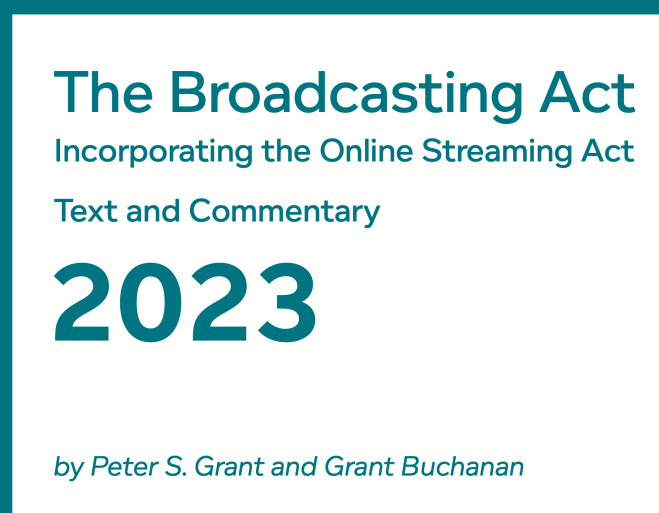
As for information on C-11 that is of indisputable value, McCarthy’s lawyers Peter Grant and Grant Buchanan have generously re-issued their indispensable annotated Broadcasting Act publication as a free pdf file.
It’s about a complaint filed by Égale Canada asking the CRTC to kick Fox News off of cable TV owing to some typically egregious transphobia from the now ex-Fox host Tucker Carlson. As Menzies points out, the CRTC has been here before, most recently when the Heritage Minister demanded the CRTC give Russia Today the heave. There are a few other occasions like the Radio-Canada ‘n-word’ case where the CRTC was dragged into the censorship business and floundered doing so.
Because these kinds of complaints are so infrequent, most Canadians are not aware that CRTC regulations passed in 1987 for television and radio include a content code that prohibits ‘abusive comment’ and ‘misinformation.’
Those legacy regulations do not as yet apply to the ‘online undertakings’ that are now recognized as broadcasters under the Online Streaming Act (although C-11 is drafted so that a private broadcaster distributing its programming through a social media platform cannot be held accountable by the Commission.)
Menzies is right in observing that in an Internet world, where Fox News can do an end-run around Canadian television regulations with ease, the Commission needs to re-establish a coherent policy on awful but lawful content. One new consideration is that C-11 gives the Commission new powers to issue fines instead of choosing between wrist slaps and de-platforming.
***
One of the peculiar features of Bill C-18 the Online News Act is that its central assumption, that Google and Facebook owe compensation to news outlets for making their unlicensed editorial content available to the public, has never been proven empirically. The Line columnist Jen Gerson even called it ‘a lie.’
The idea that the news outlets give Big Tech more value in monetizable news content than they get back in distribution was put forward by the Australian author of the Newsmedia Bargaining Code, the model for Canada’s Bill C-18.
Australia Competition Commissioner Rod Sims wrote in 2019 that Google and Meta’s anti-competitive duopolies in Search and Social made it impossible to accept the current rates of compensation (including no compensation) as a valid market price for news.
You might think that independent research would be available to settle the question, but it’s difficult in the absence of data which is proprietary and resides mostly with the Big Tech platforms.
But for the purposes of fighting this out as an issue in public policy, the contestants are beginning to publish opinions about the contested value exchange through sponsored third party studies.
It will not surprise you that a study sponsored by Meta went its way; another study about Google that was sponsored by news outlets went the other.
***
About a week ago a lot of commentators went over the top in expressing their outrage at a remarkably stupid resolution passed at the federal Liberal Party policy convention.
The resolution aimed at combatting ‘fake news’ —which is what we are still calling hyperpartisan opinion pocked with unverified facts or conspiracy theories— went so far as to demand federal legislation require the ‘disclosure of sources’ as a condition of publication. In other words, the proposal was on its face calling for a police state and the end of independent journalism.
It didn’t take long for Liberal politicians to disavow the resolution. Indeed its sponsor, a rank and file convention delegate, claimed she hadn’t thought it through, which is the most believable if dispiriting explanation.
The real story was that the Liberal Party officials running the convention didn’t spot the problem in advance and apparently did not speak against the resolution or otherwise shove it into the ditch.
Having attended my share of union conventions in the past thirty years I am sympathetic to the hands-off approach to a bad resolution but even so you would have expected much better floor management.
Lost in all of uproar is the legitimate if badly expressed motive behind a truly goofy resolution: we have moved into a new era of public debate in which the symbiotic relationship between trust and truth has been significantly disrupted by bad actors. And it’s legitimate to ask who should be held accountable for that.
***
If you would like regular notifications of future posts from MediaPolicy.ca you can follow this site by signing up under the Follow button in the bottom right corner of the home page;
or e-mail howard.law@bell.net to be added to the weekly update;
Yesterday CRTC Chair Vicky Eatrides published Broadcasting Notice of Consultation (BNOC) 2023-138, the Commission’s roadmap to implementing Bill C-11.
Here are the highlights followed by some MediaPolicy commentary.
The Commission is aiming to having the Bill operational by the Fall of 2024.
Prior to then, there will be a downpayment by foreign online undertakings on making financial contributions to Canadian content; the MediaPolicy guesstimate is April 2024.
Eatrides says she is not touching any regulation of user generated programs, but that commitment is subject to important caveats.
She is spinning off the debate over the definition of a Canadian video program or song to another proceeding for which a timetable is yet to be announced.
Participants (and industry players) have to file their submissions to the CRTC in a lightning quick six weeks, before a June 27th deadline. The first day of public hearings is November 20, 2023. That date might seem unreasonably delayed, but once you digest how many issues the Commission has to prepare for, you might not think so.
Here’s the commentary.
User Generated Programs
Let’s begin with the discoverability of user generated programs on YouTube and TikTok, as this is the issue that attracts us policy moths to the flame.
The vocabulary of BNOC 2023-138 is consistent with Eatrides’ earlier public statements: the Commission has ‘no intention’ of ‘regulating’ YouTube creators or their user-generated content.
Caveat #1. For now. Not in “this proceeding” (i.e. 2023-138):
41. Sections 2.1 and 4.1 of the current Broadcasting Act also provide for a rather complex set of exclusion provisions with respect to social media services and users who upload programs on these services. The Commission does not intend to regulate any aspect of a social media service, nor does it intend to “prescribe” user-uploaded content on social media services for the purpose of regulating such content, as part of this proceeding. The Commission is also cognizant that it should avoid imposing regulatory requirements on broadcasting undertakings if that imposition will not contribute in a material manner to the implementation of the broadcasting policy set out in subsection 3(1) of the current Broadcasting Act.
Caveat #2: ‘Regulating’ programs can mean a lot of things, or not, under the Broadcasting Act.
Caveat #3: When Eatrides says she won’t regulate user generated content she doesn’t mean ‘discoverability’ obligations for Canadian programs. YouTube will have some kind of discoverability obligations, they just might not involve the algorithmic ranking of program recommendations:
As indicated above, the Commission intends to apply an approach that focuses on desired performance standards and measures of success without specifying the means or the method for achieving them. In this regard, the Commission does not intend, at this time, to prescribe or require an undertaking to use a certain method or tool in order to achieve desired promotion and discoverability outcomes.For example, the Commission would not require an undertaking to change marketing strategies or prescribe specific home page or search engine functions. Moreover, the current Broadcasting Act prohibits the Commission from making orders pursuant to paragraph 9.1(1)(e) that that would require the use of a specific algorithm or source code. It would be up to the undertakings to decide which tools are best suited to achieve the identified outcomes regarding promotion and discoverability. However, the Commission will need to understand how those tools are utilized and measured to assess whether the identified outcomes are being achieved.
Eatrides’ view (on many things in this BNOC) is that regulation should be ‘outcomes based,’ which is regulatory code for ‘give us a good result any way you choose.’ This is very similar to how former Chair Ian Scott envisioned the Commission’s approach to discoverability last June when testifying before the Heritage Committee.
You can probably read into these statements emanating from the Commission as the regulator wanting no part of the culture war that has been stirred up over the ranking of content recommendations.
A good guess about the shape of the Chair’s desired ‘outcome’ is that the Commission will leave it to online undertakings to figure out discoverability on their own and then present it to the Commission. How effectively these self-designed outcomes are measured and enforced by the Commission is something we will have to wait for.
***
The Money
There are three issues here.
How much should online undertakings contribute to Canadian content, in what manner, and where does the money go? Which content funds get the money?
How do those obligations, when imposed on a kaleidoscope of foreign media companies, get implemented in a way that is equitable and fair to our existing broadcasters who are licensed to provide a wide spectrum of Canadian content genres (such as unprofitable drama and local news)?
How do we rethink our existing content funds given the elevated expectations in C-11 for programming relevant to diverse communities and Indigenous Peoples? Or do we need to start up new ones governed by the communities themselves? How do we reinvent local news funding given its unravelling business model?
Eatrides wants a downpayment of sorts from the Californian streamers and other online giants.
So she has split up their future financial obligations into two pieces: the first is a basic initial contribution to a content fund (for example the Canada Media Fund or the Independent Local News Fund) as a common denominator shared by all broadcasting undertakings.
Whatever that contribution is, it is supposed to be in place in the first half of 2024.
The second, additional layer of financial contributions to CanCon will be more custom-fit to the nature of the online undertaking. It could just beef up its base contribution to a content fund or alternatively it might be an ‘expenditure’ obligation (for example, Netflix broadcasting Canadian programs it has made or purchased). As part of this additional contribution, there will be ‘intangible’ contributions expected such as the promotion and discoverability of Canadian programs on their platforms.
Another important point Eatrides makes about these additional expenditures beyond base is that they might be custom fit to the broadcasting undertaking’s favoured production fund or programming genre. The rules might even include getting credit for non-programming expenditures like training and internships. That will be catnip for corporate accountants who specialize in that kind of regulatory hokum.
The custom-fitting idea is not new: the Commission mooted it almost five years ago in its report on regulating online undertakings, Harnessing Change.
A Commission official interviewed yesterday by Cartt.ca suggested online undertakings might be regulated in very individualized ways:
“Someone might come and say…we would do it in thirds. We’ve assessed our contribution at a certain level — a third of it would be a contribution to a fund, a third of it would be our support for Canadian programming, a third of it might be what we’re calling the ‘intangibles,” a CRTC official said, adding the regulator would have to further figure out how to value those contributions.
“You can see that mix, and it would be different for each player,” the official said, emphasizing that all players are required to contribute to the base amount.
All of this tells us that this is not your grandma’s regulatory scheme. There will be pricing of apples and oranges among various broadcasting undertakings making different —but equitable– contributions to Canadian content.
Perhaps that is why the Commission vocabulary is so chock full of regulatory zingers like ‘flexible,’ ‘adaptable,’ and ‘outcomes based.’ It’s a matter of pragmatism as much as deregulatory zeal.
***
Canadian content and Ownership of Intellectual Property
This is without a doubt the most difficult issue before the Commission. You will hear plenty about it over the next year.
The current definition of a ‘Canadian’ program eligible for the array of subsidies available in Canada provides that most of the key creative talent on a show, especially the producer who is quarterbacking the venture, must be Canadian. Those subsidies include ‘video production tax credits’ under the Income Tax Act, film and television financing from the Canada Media Fund, and broadcasters getting credit from the CRTC towards their target for ‘Canadian Programming Expenditures’ (CPE) for airing Canadian shows. If a show maxes out on Canadian talent, the show may be 50% subsidized.
Most of the subsidy programs —the Commission-administered CPE being the exception— also require the Canadian producer retain the copyright for the long term commercial exploitation of the show, in effect making it illegal for broadcasting undertakings to force the producer to surrender that copyright as a condition of putting the show on the air.
The most important thing to keep in mind to understand this complex issue is that broadcasting undertakings —soon to include Netflix and the other Hollywood streamers— could potentially be ordered by the CRTC to contribute to the Canada Media Fund (CMF) as the Canadian cable companies must.
Yet unlike our Canadian cable companies, the American-owned streamers would not be allowed to ‘draw upon’ the Canada Media Fund by purchasing CMF-subsidized films from a Canadian filmmaker unless the streamers are okay with the filmmaker denying them the long term copyright.
You have here the makings of a doozy trade complaint from Hollywood against the Canada for potentially violating the ‘National Treatment’ rules under our international trade deals. In a different context, MediaPolicy explained those issues as they arose 25 years ago during the notorious ‘split-run magazine’ dispute between Canada and the US.
This issue has been long anticipated from the very beginning of Parliamentary debate over Bill C-11 and its predecessor C-10. And you can Search ‘Bill C-11 CUSMA trade complaint‘ and come up with plenty of commentary on it. The most recent contribution from Douglas Barrett on Cartt.ca is a good place to start.
One last complexity to keep in mind: the CRTC only has jurisdiction over the definition of Canadian content for ‘CPE.’ The federal government has governance of the production tax credits and, ultimately, the CMF.
***
It seems only fair to sign off this commentary by allowing CRTC Chair Eatrides the last word:
A new and modernized framework should recognize the new perspectives and opportunities that online undertakings bring to the broadcasting system, and ensure flexibility and adaptability in the future. For these reasons, the Commission intends to apply an approach that recognizes that each broadcasting undertaking or group of undertakings is unique, and that focuses on desired performance standards and measures of success. At the same time, it is essential for the approach to ensure that the principles of regulatory fairness and equitability are upheld across all contributors. Further, by considering the possibility of a group-based approach to contributions (where applicable) the Commission aims to provide greater flexibility and a reduced administrative burden.…
…..the Commission recognizes that it continues to be appropriate for different types of broadcasters – whether traditional or online, Canadian or foreign – to support the audio and video elements of the Canadian broadcasting system in different, yet equitable ways.
***
If you would like regular notifications of future posts from MediaPolicy.ca you can follow this site by signing up under the Follow button in the bottom right corner of the home page;
or e-mail howard.law@bell.net to be added to the weekly update;
The Senate Committee considering the government’s Online News Act is mostly a re-run of the House Heritage Committee’s deliberations on Bill C-18. But sometimes you get something new and intriguing.
Cathy Edwards from CACTUS (Canadian Association of Community Television Users and Stations) was on deck Wednesday night and took the opportunity to explain why the House amended the Bill back in November to ensure that CRTC-licensed community news broadcasters automatically qualify as eligible news businesses, which gets them to the table with Google and Facebook.
The explanation, said Edwards, is that community news stations often employ only a single journalist, south of the ‘two-employed journalists’ cut-off for automatic bargaining rights under section 27(1)(a) of the Act. But those stations frequently employ many technical staff for newsgathering as well as volunteer journalists. Hence the logic for making them another exception to the two-journalist rule, pre-qualifying them as eligible news businesses for negotiations under C-18. The Bill also prequalifies online daily newspapers if already vetted by the federal government under the QCJO federal subsidy program.
That was a delightful rebuff to Google spokespersons and Michael Geist (“Money for Nothing”) who were grouching publicly that Parliamentarians had conferred compensation on licensed broadcasters that “may” produce no online news. (That’s incorrect: an eligible news business must produce news in order to obtain compensation for it. But why be a stickler?).
The reason that CACTUS was back in the legislative fray Wednesday night, pitching to the Senate Committee, is that only eight of 67 community stations are licensed by the CRTC —which explicitly commands them to broadcast news— the rest are either license-exempt or online only. That’s why CACTUS is seeking a further amendment to the Bill in section 27(1)(b). Different from the pre-qualifying section 27(1)(a), this clause explicitly requires the production of news to get to the negotiating table with Big Tech.
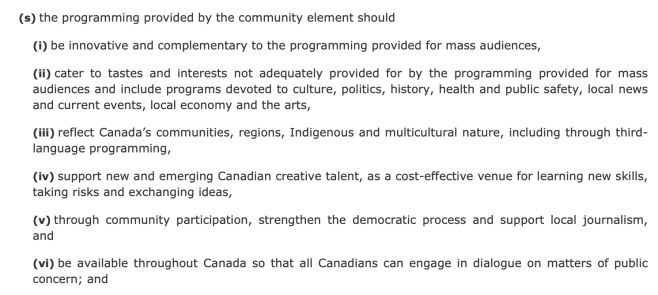
As for the provision of news by community stations, the Broadcasting Act commands community stations to provide community news:
As well, the CACTUS brief states:
Our members produce an average of 6 hours of local content per week, 2 of which would be considered civic local news (of the kind funded by the Local Journalism Initiative) with an additional 2 hours of news coverage of non-civic topics including the cultural sector and sports. As such, we are significant producers of information in small communities across the country, in underserved neighbourhoods surrounding large urban areas, and underserved minorities in large urban areas. We produce local content for ~500 cities and villages and are often the only source of truly local news for them.
***
If you would like regular notifications of future posts from MediaPolicy.ca you can follow this site by signing up under the Follow button in the bottom right corner of the home page;
or e-mail howard.law@bell.net to be added to the weekly update;
A quick and sentimental word on the passing of Gordon Lightfoot. If you are under sixty years of age you may not appreciate how important the great Canadian folksinger was during his prime songwriting years in the 60s and 70s. The world of Canadian music –or just the world in general– was so much smaller then and he was so big. And his lyrics so iconic and his music so powerful. Rest in peace.
***
This week MediaPolicy published two posts.
The first was a watchdog piece. During the Senate hearings on the Online Streaming Act late last year, it came out that YouTube had commissioned a public opinion poll on C-11 but elected not to publish it. I discovered belatedly that the Abacus poll was nonetheless posted on the Senate website because the chair of the Transportation and Communications Committee had asked for it. The post is about the frailties of public opinion polling, especially when the questions are torqued.
The second post is another instalment in the ongoing story of Google and Facebook playing hardball with Canadian Parliamentarians over the Online News Act, Bill C-18, now in the Senate. MediaPolicy makes yet another suggestion of how we might stop playing tee-ball with Big Tech when they are playing hardball with us.
***
On the subject of Big Tech tactics, NBC reported on Facebook’s significant funding of a US lobby group aligned with Mark Zuckerberg’s opposition to anti-trust legislation before US Congress.
Companies fighting regulation through bearded lobby groups is nothing new, anywhere. But given Big Tech’s extraordinary efforts in Canada, it’s worth tracking what they do.
***
Back on C-11. Hugh Stephens has a helpful set-up piece in anticipation of Bill C-11’s journey through the Canada Gazette consultation and CRTC hearings.
Meanwhile, the Canadian Media Producers Association (CMPA) released its annual industry report (year ending August 31, 2022). It was a bumper year for TV production and film making in Canada with some eye-popping results on the ‘foreign location service’ side (i.e. Canadians making shows for American media companies). Results on the CanCon production side were great as well.
The outcomes moved C-11 opponent Michael Geist to conclude that the political narrative in support of the Bill was a hoax. Or as he put it:
There is no Cancon emergency and no risk to film and TV production in Canada. The Bill C-11 panic over the viability of the sector was little more than a fraudulent lobbyist-inspired talking point with little basis in reality.
On the other hand, CMPA’s report pointed out what industry insiders knew was coming:
But that kind of growth also reflects a number of unique variables, each of them contributing to the significant increases in production activity in 2021/22. Coming out of the COVID-19 pandemic, the industry reversed recent trends and experienced a robust rebound in production activity. That increase was further fueled by general inflationary pressures on productions costs, as it was across much of the Canadian economy. Results for Canadian television production were impacted by Canadian broadcasters restoring their levels of licence fee funding in 2021/22 (even catching up for underspends in prior pandemic years), as well as the continued injection of additional government funding resources made available during the pandemic.
The challenge will be to sustain that level of production activity. The general economy is facing significant economic headwinds, with real concerns about lingering inflation and a possible recession. The prospect of such an economic downturn may impact the general level of economic activity in Canada, including film and television production. Canadian content levels from Canadian broadcasters may be readjusted going forward, as shortfalls from prior years may have been fulfilled.
The following chart reveals the 10-year trend (finally exceeding stagnation levels for CanCon), the temporary suppression of production during the pandemic and the spectacular rebound in 2021-22. Long may it continue:
***
Two weekend reads on the recommendation list are:
If you aren’t saturated already with commentary on ChatGPT and AI, the Globe’s Tony Geller wrote an excellent reflection on whether and how governments ought to respond to what’s happening.
Back on C-11, Josh O’Kane interviewed a series of Canadian artists and crew members from the film production and YouTuber industries on their views of C-11. Really well done.
***
If you would like regular notifications of future posts from MediaPolicy.ca you can follow this site by signing up under the Follow button in the bottom right corner of the home page;
or e-mail howard.law@bell.net to be added to the weekly update;
Google and Facebook made their big play at a Senate committee on Wednesday night. That play was hardball, as expected. Facebook says it will block Canadian news if the Online News Act becomes law. Google says it might do the same.
We must acknowledge that Big Tech has ratcheted up the stakes. The government’s winning strategy on C-18 is in disarray.
Google and Facebook tabled a raft of amendments gutting the Bill with a rewrite that would narrow the scope of the legislation to full-text news content, effectively eliminating application of the scheme to 99% of the written, audio and video news currently on their platforms.
Big Tech’s real proposal is to create a voluntary news fund to which Google and Facebook would contribute and let Fund administrators sort out which news outlets get access.
The Fund idea works for Big Tech because the companies harbour dreams of being limited to the minimal contributions that Google is making to news outlets in Taiwan, approximately three per cent of the value they paid under the Australian New Media Bargaining Code, the forerunner of Bill C-18.
In the face of this corporate hubris, Parliamentarians must acknowledge that Big Tech is not offering a face-saving solution. They are offering a humiliating defeat to a sovereign government.
It seems the power game must be played out before a solution can be found.
Last week MediaPolicy suggested the government amend the Bill to strengthen penalties if Google or Facebook throttle news in avoidance of C-18.
On that point, it is interesting that Heritage officials seemed to concede last week that, under the current wording of C-18, Google and Facebook can deindex Canadian news stories or block posts by Canadian news outlets even though those actions might violate section 53 as inconsistent with the purpose of the Act.
Another card the government is holding is the delayed implementation of the Digital Services Tax. Federal Finance Minister Chrystia Freeland has suspended that three per cent tax on the revenue of offshore digital platforms until 2025 as a fallback option to an international agreement on minimum corporate taxes.
When it was introduced, the DST was described by the government as an ‘audience tax’ on Big Tech for monetizing the personal data of Canadian citizens without compensation. All major Canadian political parties endorsed this tax (in fact it was the centrepiece of the Conservative election platform on Bill C-11).
An announcement to implement the DST early would put the current impasse between the government and Big Tech on a different footing.
Then perhaps we will find a solution to this mess. When Google and Facebook began making their news throttling threats last year while C-18 was before the House of Commons, MediaPolicy published a post entitled “Must it be War? A Peace Proposal for C-18.” The post canvassed the different amendments available to House and Big Tech that might cool tempers.
It’s not that Facebook and Google haven’t made reasonable policy arguments.
Heading Big Tech’s list of arguments is that the Bill creates uncertainty about the amount Google and Facebook will have to pay to news outlets.
But there are tools within Bill C-18 to deal with that. Michael Geist put his finger on that during his Senate testimony on Tuesday morning when he suggested the Big Tech companies go into negotiations with Canadian news outlets and propose a single fund for the news industry with fixed contributions from Google and Facebook.
If a deal can be reached including an acceptable amount of funding, and access for all legitimate news organizations willing to accept their fair share of it, the CRTC would likely grant the companies the exemption from further liability contemplated by section 11 of the Bill.
Whatever the solution, it ought to be conceded by Google and Facebook that most capitalists live with uncertainty. It’s known as the free market economy. Possibly the Big Tech monopolists thought they had risen above that inconvenience.
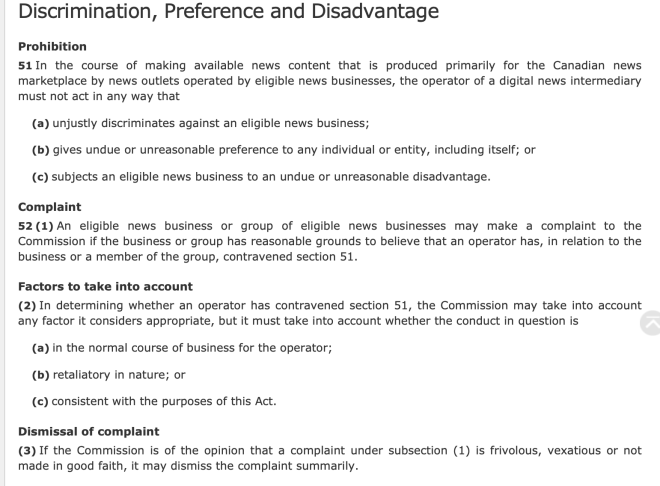
The sleeper issue however is not uncertainty. It’s the Bill’s ‘undue preference’ provisions. That provision in the Act —not included in the Australian legislation— contemplates a CRTC complaint being filed by a Canadian news outlet against Google or Facebook for unreasonably downranking (or blocking) their journalism.
That puts the onus on the digital platforms to defend themselves. That defense necessarily requires them to divulge their deepest commercial secret, their ranking algorithms.
The government acknowledged this concern in November by amending C-18 in the House to narrow the undue preference test to either (a) Google and Facebook preferencing their own news services or (b) punishing news outlets as a bargaining ploy. Importantly, ranking news stories ‘in the normal course of business for the operator’ is a complete defense to undue preference.
If making the ‘normal course of business’ defense even more airtight is the only thing standing in the way of a peaceful resolution of this political scrap over C-18, it seems hopeful that compromise could be reached.
Whatever path we can find to a resolution, one thing Google’s Richard Gingras told Senators remains compelling: the politics around C-18 are setting up an unrealistic expectation that Big Tech can foot the full bill for journalism in this country.
To be fair to the government, they never made this claim but the expectation is out there in the public debate regardless.
We shouldn’t need Google to remind us that as Canadians we have to come to terms with the options available to us.
Those options are either agreeing upon a coherent public policy in which our new outlets’ loss of advertising revenue is mitigated by private and public subsidies or reject those subsidies and let the market take its course.
***
***
If you would like regular notifications of future posts from MediaPolicy.ca you can follow this site by signing up under the Follow button in the bottom right corner of the home page;
or e-mail howard.law@bell.net to be added to the weekly update;
Conservative Senator Leo Housakos asked Abacus Data to disclose a YouTube sponsored public opinion poll
May 2, 2023
It can’t be easy being a public opinion pollster. That’s especially true when it comes to taking soundings on detailed government legislation.
Polls are good at capturing the public mood, our gut instincts if you will. In May 2022 Nanos released a poll showing broad support for the federal government’s intentions to pass three “Internet” bills: the Online Streaming Act C-11, the Online News Act C-18 and an as yet untabled Online Safety Act. But it would be foolish to mistake that broad support for specific endorsements of the Bills as drafted.
Then there is the fraught relationship between pollster and client. The political actor that commissions a poll hopes for a particular outcome while the pollster must maintain its professional standards without alienating its client.
That is why we, the consumers of these polls, need to scrutinize very closely what questions have been asked and contemplate the environment in which answers are given.
On October 14, 2022 while the Online News Act C-18 was before the House of Commons, Google published a poll conducted by Abacus Polling that appeared to replicate its criticisms of the Bill through polling results. In a blog post, MediaPolicy.ca suggested the questions were so leading and torqued that the answers were unreliable.
On October 25th, Abacus Polling CEO David Coletto appeared at the Senate hearings on Bill C-11, the Online Streaming Act.
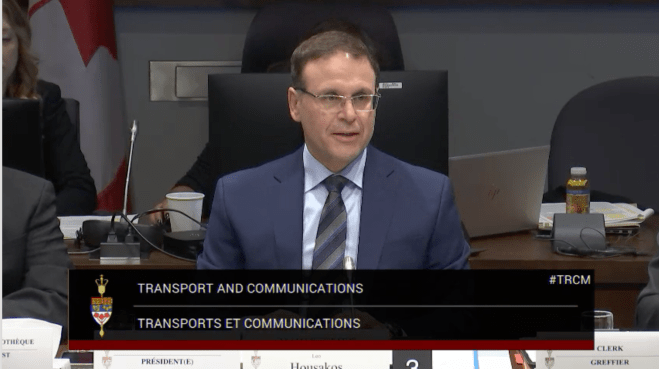
Lead Conservative Party critic Leo Housakos asked Coletto if he had done any polling on the controversial elements of the Bill, in particular the CRTC’s powers to compel social media platforms to recommend more Canadian content. Coletto admitted there was a poll that he had conducted on behalf of Google-owned YouTube but he was not authorized to release it.
In fact, the poll was never publicly released but Housakos asked YouTube to submit a copy to the Senate, now duly posted on the Transportation and Communications Committee’s website.
Here is how Abacus described findings that bolstered YouTube’s case against C-11:
Our research found that video and music have become ubiquitous and essential in the lives of Canadians. Users are overwhelmingly satisfied with the services they use. This positive attitude is driven by several factors, including the content, choice, convenience, and value-for-money offered by today’s streaming services. Access to Canadian content was rated far less important a factor to the experience.
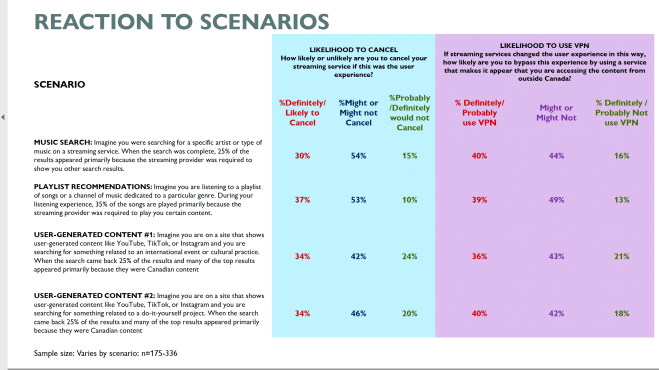
The survey included a section where respondents were asked to react to different scenarios. Each scenario presented a hypothetical change to today’s streaming experience (e.g. Canadian content prioritized in video queries or in content recommendations). Many respondents had negative reactions to the changes. In some cases, their reaction was so strong that users indicated they would cancel the service or go as far as using a VPN to get around the changes.
The study also found that most Canadians are concerned about Bill C-11, the Online Streaming Act. They think it should be up to users to determine what content they see. They feel the Bill’s interventions could negatively impact their access to music and video streaming services.
The poll found that 89% of Canadians stream music or video (not just on social media), compared to 66% consuming content on cable TV, 68% over YouTube itself, and 75% on streaming services other than YouTube. Not surprisingly, 81% of poll respondents described access to streaming as “essential or somewhat essential.”
So far, so expected.
Then the poll jumps straight in to some questionable questions.
First: How willing would you be to provide information about your residency or nationality in order to upload content to platforms like TikTok or YouTube. [Result: 35% willing, 58% hesitant].
Here’s MediaPolicy.ca’s take on that. The question is aimed at measuring public opinion on the wisdom of requiring Canadian YouTuber creators to declare their Canadian nationality for the purpose of recommending Canadian videos or music. That’s not explained by the question. In addition, the question was asked of all respondents, not the one per cent of Canadians who are YouTube ‘creators.’
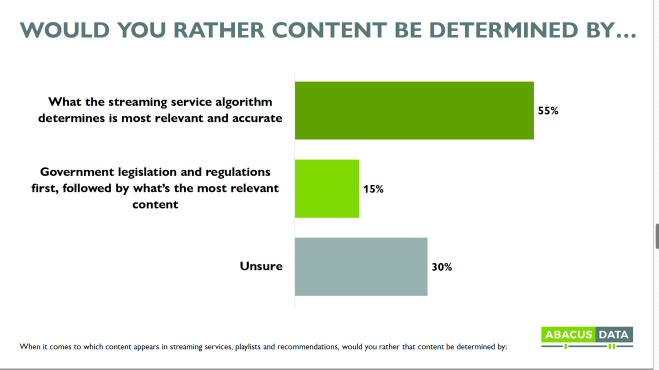
Second: When it comes to which content appears in streaming services, playlists and recommendations, would you rather that content be determined by:
What the streaming service algorithm determines is most relevant and accurate;
or,Government legislation and regulations first, followed by what’s the most relevant content.
Framed this way, the invitation is to choose between YouTube’s unregulated curation versus unspecified government-sponsored content as the top recommendations —relevant or not— before accessing YouTube’s relevant search results. Why anyone, let alone 15% of respondents voted for that Orwellian nightmare is unclear, but to suggest that’s an outcome of Bill C-11 is highly argumentative.
***
Next up in the poll are hypothetical scenarios of how the social media audience might react to YouTube altering their search recommendations as a result of CRTC demands for discoverability of Canadian content.
The question is framed as how likely is it that the respondent would ‘cancel the social media service’ —how does that apply to free service like YouTube and TikTok?— or use a VPN to view unregulated platforms from an American IP address?
Scenario #1: MUSIC SEARCH: Imagine you were searching for a specific artist or type of music on a streaming service. When the search was complete, 25% of the results appeared primarily because the streaming provider was required to show you other search results.
The MediaPolicy.ca comment: a properly framed question should have specified either “….show you other search results relevant to your inquiry from Canadian artists” or “…show you other search results regardless of relevance because they are Canadian?” Many poll respondents may have assumed the latter.
Scenario #2: PLAYLIST RECOMMENDATIONS: Imagine you are listening to a playlist of songs or a channel of music dedicated to a particular genre. During yourlistening experience, 35% of the songs are played primarily because thestreaming provider was required to play you certain content.
MediaPolicy.ca: Again, the question fails to distinguish between relevance or non relevance of search results.
Scenario #3: USER-GENERATED CONTENT #1: Imagine you are on a site that shows user-generated content like YouTube, TikTok, or Instagram and you are searching for something related to an international event or cultural practice.When the search came back 25% of the results and many of the top resultsappeared primarily because they were Canadian content.
MediaPolicy.ca: Again, the question assumes YouTube would include government-mandated irrelevant recommendations to this search inquiry. The question assumes that YouTube, which need only demonstrate to the CRTC an overall compliance with discoverability, would choose to provide exactly the opposite of the search inquiry.
Scenario #4: USER-GENERATED CONTENT #2: Imagine you are on a site that showsuser-generated content like YouTube, TikTok, or Instagram and you aresearching for something related to a do-it-yourself project. When the searchcame back 25% of the results and many of the top results appeared primarilybecause they were Canadian content.
MediaPolicy.ca: Again, the question assumes YouTube will provide Canadian results that lack relevance to the search inquiry. The other issue to consider here is whether ‘DIY’ is a cultural area where CRTC would expect more effort at discoverability.
***
At this point in the poll, the working assumption embedded in the questions has been over-regulation of content through more (how much more is undetermined) and irrelevant recommendations of Canadian videos.
So Abacus’ next question is very interesting:
To what extent do you agree or disagree with the following statements?
It should be up to users to determine whatcontent they want to see (Results: 93% agree or somewhat agree)
I do not think government should decidewhat content aligns with Canadian values (84% agree or somewhat agree)
I am not confident that the government hasthe capacity to determine what content aligns with Canadian values (80% agree or somewhat agree)
Would the results have been different if the question specified “government” was “the arm’s length regulator, the CRTC?” Maybe, maybe not.
But what the second and third questions inadvertently demonstrate is that the many calls to change CanCon certification to a subjective “Canadian” test may provoke a negative public reaction, which is exactly what defenders of the current ‘nationality of creator” point system say, that the current certification system for Canadian content avoids the thorny issue of state-regulated cultural content.
***
And finally the poll’s headliner question, the one calculated to put a stake through the heart of regulating user generated content:
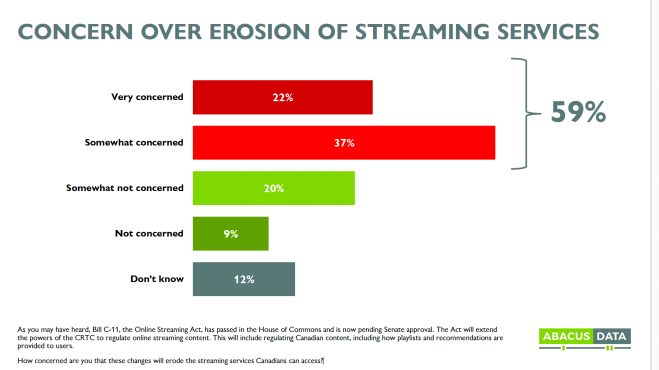
As you may have heard, Bill C-11, the Online Streaming Act, has passed in the House of Commons and is now pending Senate approval. The Act will extendthe powers of the CRTC to regulate online streaming content. This will include regulating Canadian content, including how playlists and recommendations areprovided to users.
How concerned are you that these changes will erode the streaming services Canadians can access?
The question makes no distinction between policing content (out of bounds in C-11) and asking YouTube to promote it, let alone how aggressively Canadian programs would be promoted and what actual interference there would be on recommendations relevant to search inquires.
***
Was this unpublished poll buried by YouTube after commissioning and paying for it? We don’t know why it was kept so quiet.
Still the question lingers: after two years of opponents publicly describing C-11 as the kind of ‘censorship’ bill you might find in North Korea, is it possible to solicit public opinion based on questions that aren’t calibrated to what is actually in the Act, or what is practically likely in its application?
Perhaps it’s all moot. The latest government messaging leans towards exempting YouTuber programs from discoverability regulation (mostly a good thing in the estimation of MediaPolicy.ca). Stay tuned.
***
If you would like regular notifications of future posts from MediaPolicy.ca you can follow this site by signing up under the Follow button in the bottom right corner of the home page;
or e-mail howard.law@bell.net to be added to the weekly update;
The sound and fury over the Bill continues to revolve around whether the CRTC will require algorithm-driven recommendations of Canadian videos and music on social media platforms.
It’s been well established that social media users — ranging from major movie studios to individual YouTubers— won’t be directly regulated as businesses, only YouTube will be. But their programs might be if they are sufficiently ‘commercial,’ a line drawing exercise delegated to the CRTC.
The point of our post is that the uncertainty over the eventual CRTC outcome is driving all the political noise and that more certainty might calm things down.
***
The Australian government’s 2021 News Media Bargaining Fund set the precedent for Canada’s Online News Act, Bill C-18. Now the Australians are following Canada’s lead on Bill C-11 with their own version of a Netflix Bill.
Still in policy development, the Australians are tossing around ideas of how the global streamers should contribute to local Australian content.
One of the settled issues is that global streamers won’t be invited to pay their fair share by purchasing programming rights for sports (Time Warner’s Paramount Plus just acquired rights to Australian football). The same with news.
An unsettled issue is how the streamers should meet Australian-content targets: by making their own dramas, documentaries and children’s programming, or by funding Australian media companies to do it?
The film production community wants the big streamers to commission their own made-in-Australia content, but the broadcasters just want the streamers to write a cheque and have no interest in having to bid against the web giants for broadcast rights to Australian shows.
***
If you would like regular notifications of future posts from MediaPolicy.ca you can follow this site by signing up under the Follow button in the bottom right corner of the home page;
or e-mail howard.law@bell.net to be added to the weekly update;
Last night the Governor-General conferred Royal Assent upon the Online Streaming Act minutes after the Senate approved it and so public commentary on the Bill has crested in mainstream and social media. Mind you, commentary has been cresting for some time now. And given that we are expecting a cabinet Policy Directive to the CRTC to begin implementation hearings, the wave will roll on for some months yet.
Media coverage —including the Globe and Mail‘s excellent summary— has identified the fuel source for the never-ending flame of controversy.
It’s ‘ambiguity,’ ambiguity about the detailed outcome of whatever discoverability measures the CRTC will take with respect to algorithm-driven recommendations of Canadian content on social media platforms, i.e. YouTube and TikTok.
Specifically which Canadian ‘user-generated’ programs will be included or exempted from the scheme to push Canadian programs to Canadian viewers and listeners on those platforms?
It’s the uncertainty that’s making everyone mad, and I don’t mean ‘angry’ mad either.
For two years now, the opponents of Bill C-11 have been filling the void of uncertainty with worst-case scenarios. The Conservatives have injected a conspiracy theory: that the CRTC will impose pro-government ranking priorities on YouTube and flood the zone with Liberal propaganda.
Even journalists get carried away. Veteran (and Canadian) reporter Paul Vieira told his American audience in the Wall Street Journal yesterday that under Bill C-11 ‘if a person in Canada searched on YouTube, the results would display videos mostly from Canadian artists ahead of foreign or U.S.-made content.’
Mostly?
Ahead of foreign or US-made content?
There is no evidence that will be the outcome. The Heritage Minister Pablo Rodriguez has never suggested it.
On the other hand the Minister insists on repeating the nostrum that ‘platforms are in, users are out.’ That means citizen uploaders won’t be regulated as broadcasters and be required to make ‘Canadian’ videos. But the recommendation ranking of a YouTubers’ video might be regulated. We’ll have to see what the arm’s length regulator CRTC decides and whether it impacts Canadian YouTubers. That’s a lot of ambiguity to live with.
We are probably looking at a high and low water mark for CRTC outcomes.
On one hand, former CRTC chair Ian Scott opined to the Heritage Committee last year that social media platforms could satisfy demands for promoting Canadian content without ever touching their recommendation algorithms.
At the other end of the spectrum of outcomes, representatives of the music industry in Québec want a dramatic increase in the rock-bottom consumption of French-language songs on Spotify and YouTube. That seems difficult to achieve without a major tweak to recommendation algorithms for IP addresses in Québec and minority language communities.
Here are some comforting thoughts.
First, the blank canvass of unknown regulatory outcomes will get filled in fairly quickly. The CRTC may set some parameters in its Notice of Consultation for public hearings. Also, when participants in the CRTC’s public hearings file their initial representations, the focus may narrow further.
Second, the legislation gives the CRTC the authority to make YouTube tweak its algorithms in order to get quantifiable results on promoting Canadian programs. But the legislation denies the CRTC the authority to dictate any particular change to algorithms. That leaves the algorithm design in the hands of the platforms.
Third, the CRTC may choose not to pursue a ‘one-size fits all’ policy on discoverability. There may be more intrusive expectations for French language music and none at all for news commentary or home renovation videos.
Expect the CRTC to make generous use of its well-used exemption authority to leave the vast majority of citizen and solo artist videos untouched for the foreseeable future.
***
If you would like regular notifications of future posts from MediaPolicy.ca you can follow this site by signing up under the Follow button in the bottom right corner of the home page;
or e-mail howard.law@bell.net to be added to the weekly update;