Internet Society VP and former CRTC Chair Konrad Von Finckenstein
June 24, 2022
The Senate Committee on Transportation and Communications held two days of hearings this week on the Online Streaming Act, teeing off with former CRTC Chair Konrad Von Finckenstein. Also appearing were Heritage Canada’s lead civil servant on C-11, Thomas Owen Ripley, current CRTC Chair Ian Scott, and Internet activist Michael Geist.
We learned some interesting things:
• Von Finckenstein offered his criticisms of the Bill with matching amendments. His number one issue is the lack of a threshold for annual corporate revenues below which all but the biggest online undertakings would be exempted from regulation (he proposes $100M, or alternatively a minimum of 100,000 subscribers).
He argued that, as a practical matter, without some kind of exemption threshold the CRTC will be swamped with exemption applications.
Another C-11 critic Peter Menzies has also argued that online companies need the business certainty of a bright line between obligations and exemption.
If C-11 isn’t amended as they suggest, the CRTC will certainly set a threshold, much for the reasons cited by these critics, although Heritage representative Ripley suggested there could be small public broadcasters that the CRTC might want to regulate regardless of revenues.
There are actually two possible revenue thresholds have been discussed during House proceedings and now the Senate: the first as cited by Von Finckenstein with respect to the online undertakings that will be regulated.
The second might be a revenue threshold for user programming channels on YouTube when, under section 4(2) of the Bill, the CRTC needs to calculate YouTube’s “five percent of revenue” contribution to Canadian production funds and so the Commission can total up YouTube’s programming revenues aggregated by its “commercial” user channels.
• On a different issue, CRTC chair Scott boldly requested Senators to amend C-11 in three different ways related more to administrative powers than policy issues. One in particular is the current Bill’s surprising omission of the CRTC’s authority to impose binding arbitration in commercial disputes between niche Canadian programmers (for example, APTN) and major online distribution platforms (for example Amazon Prime), the Internet equivalent of cable TV carriers.
Under the existing Broadcasting Act, the CRTC has the power to mediate and arbitrate disputes over the carriage of programming services on cable TV services on terms that are fair to the small programmers.
For some reason (the Minister was cryptic when questioned about this by Heritage MPs), binding arbitration is not carried over in C-11 to the modern version of cable distributors, the Internet content distributors. Scott says Senators should fix this before sending the Bill back to the Commons.
• The partisan opposition to discoverability of Canadian content on YouTube —-and the potential for its recommendation algorithm might be tweaked accordingly— continues unabated. We heard an unexpected intervention from Von Finckenstein —-a Vice President of the Internet Society—- who recommended that discoverability ought to be limited to supplementing YouTube’s recommendations in response to customized viewing preferences with additional links to similar Canadian content.
An eminently sensible solution (for video, if not music streaming).
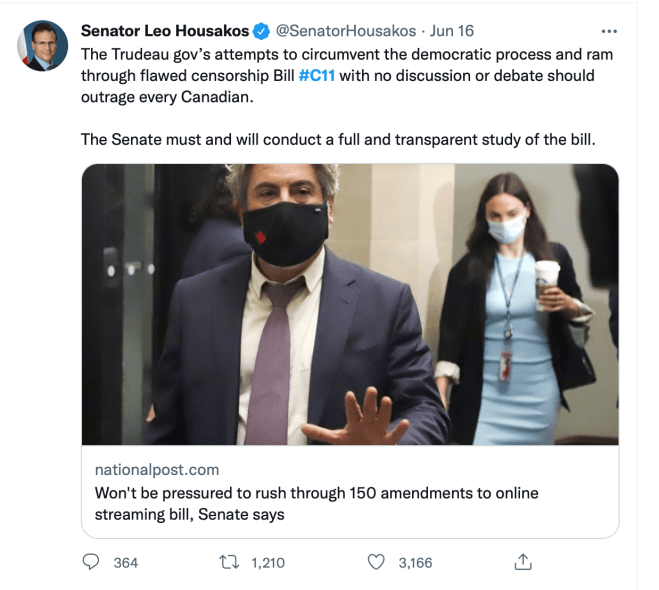
The House of Commons will send the Online Streaming Act to the Senate where Conservative Senate Leader Leo Housakos’tweet (above) heralds one last furious lap around the legislative oval for Bill C-11.
If I had the ear of Canadian Senators, here is what I would tell them.
First, if it was ever in question, maintain that Senatorial chill. It will be an improvement on the debate so far.
This won’t be the first time Senators have been handed a controversial C-Bill filibustered by the Official Opposition to get public attention and then expedited by a Government using closure with majority support.
Bill C-11 was reviewed by Heritage Committee MPs for 20 hours over ten sittings with more than 50 witnesses. And that’s not counting all the Committee time spent on its forerunner C-10 in 2021.
At the end of those meetings, which included four sittings of undisguised filibustering, Conservative Committee vice-chair John Nater said (a) he wanted to schedule another 20 witnesses and (b) he would not agree to amend and return the Bill to House for Third Reading until after the Committee put aside C-11 to conduct an inquiry and complete a report on the incident concerning Hockey Canada.
That put clause-by-clause amendments (of which Mr. Nater would submit more than 120) into the late Fall. On that timetable C-11 would pass —to recall Mr. Nater’s own word— “eventually.”
The Conservatives’ goal was and remains to force the Liberals to walk away from their Bill’s provisions relating to videos and music streaming on hosting platforms, while messaging to voters about freedom of expression and censorship.
Throughout the Committee proceedings there was nary a hint of a side conversation to find a compromise which I suggested in a previous post is well within reach.
In the end the Conservatives gave the Liberals a binary choice: wait out an indefinite filibuster or capitulate to CPC demands. Instead the Liberals joined with the Bloc and NDP to end the filibuster and surrender nothing.
That meant a single day in Committee for amendments, a political farce by any measure. There were at least 150 amendments on the table. Nevertheless in a thirteen-hour sitting on June 14th, forty-two amendments to the Bill were approved. Many were unanimous.
That much Senators already know. What about substance of the Bill?
The majority of the forty-two approved amendments were not contentious, inserted into the Act’s clause on the objectives of national broadcasting policy.
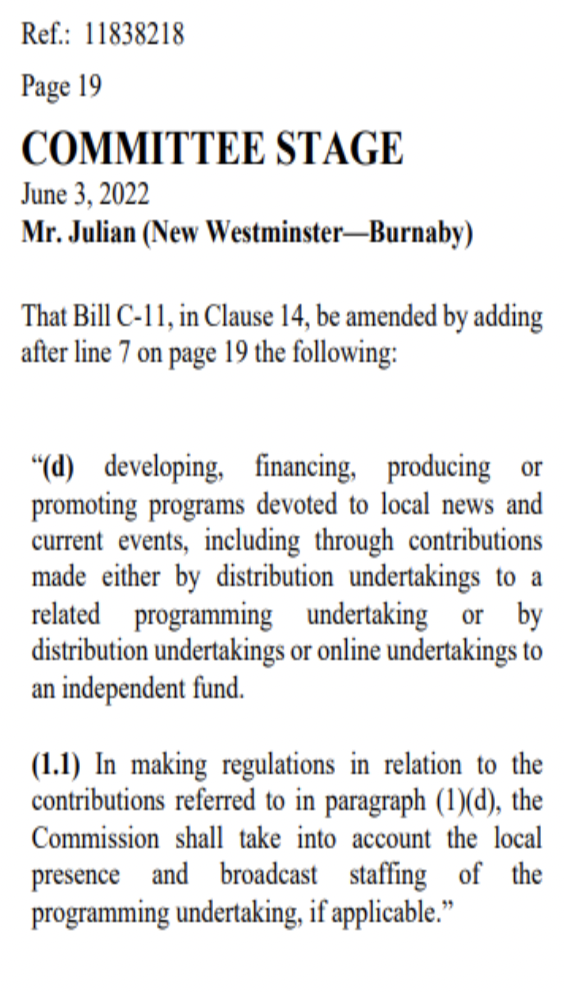
Many amendments tabled by groups supporting the Bill did not make the cut: for example, the local news amendment recommended by the CRTC and the government’s own expert panel was voted down by both Liberals and Conservatives.
The sticking points were the four signature amendments sought by the Conservatives.
They got their first, drawn from their 2021 election platform: the repeal of $120 million in annual Part II fees paid by broadcasters to the Consolidated Revenue Fund.
Their second ought to have fallen like ripe fruit off the policy tree but did not: a minimum revenue threshold below which Internet broadcasters would be exempted from regulation. If Senators don’t fix that, the CRTC will.
Next came the hard part: amendments to delete sections 4.1, 4.2 and 9.1(1)(e). That meant ousting CRTC regulation of any uploads to YouTube, TikTok and Facebook; as well as prohibiting “discovery” orders to promote Canadian music or videos if that would require the platforms to tweak their recommendation algorithms. Those were key sections in the Bill and deleting them was a dealbreaker for the other parties.
In the theatre that the Committee proceedings became, the Conservatives accused Heritage Minister Pablo Rodriguez and outgoing CRTC Chair Ian Scott of contradicting each other and obscuring the meaning of section 4.1. The Minister told Canadians that “platforms are in, users are out” while Scott acknowledged that both the current Broadcasting Act and Bill C-11 would allow the CRTC to “regulate” user programming.
In the interest of clearing that up, here are the facts.
The current legislation is technologically neutral and makes no distinction between conventional and Internet broadcasting platforms. Instead of tabling C-10 or C-11, the federal cabinet could have opted to issue a policy directive to the CRTC reversing the Commission’s 20-year exemption of Internet broadcasting platforms and provide a regulatory road map similar to Bill C-11.
That is what Scott meant when he said the current Act already gives the CRTC free rein over Internet hosting platforms and user programming. The new Bill makes that existing CRTC power explicit but also instructs the Commission in section 4.2 to draw a regulatory boundary between “commercial” and non-commercial programming, and also take into account “direct and indirect revenue.”
YouTube has been the main focus of debate. The hosting platform’s channels are a mix of programming formats: an additional platform for long-form video from linear broadcasters; music streaming services; aggregated channel menus (we used to call that “cable TV”) but mostly niche video content posted by “YouTubers” competing for audiences via the platform’s proprietary recommendation algorithm.
The Liberals (and anyone else in their right minds) have zero interest in micro-regulating 160,000 Canadian YouTubers and their thousands of short-form videos. That is why section 4.2 gives the CRTC the discretion to exempt non-commercial programming while YouTube has the right to appeal to the courts if they get it wrong.
While there is criticism that section 4.2 lacks specifics and leaves too much room for the Commission to define “commercial” and quantify “revenue,” not one of C-11’s opponents have offered a more fulsome version. There has been only one demand: exclude YouTube and all other hosting platforms from regulation forever. Pointe finale.
The policy case for Bill C-11’s regulation of commercial programming on hosting platforms is twofold.
Right now, YouTube’s music uploads and streaming services compete head-on with Canadian radio. This is a policy no-brainer: quite reasonably You Tube has publicly agreed to regulation of its music services.
As for video content, in the long term (if such a thing exists for the Internet) YouTube may evolve into a major distribution platform for commercial video falling into the priority genres of Canadian news, sports, and entertainment we currently see and hear on linear platforms. The policy question is why would an important broadcasting technology of the future be permanently excluded from the Act?
But to cut through the fog of war on section 4.2, it is helpful to turn the spotlight on the word “regulate.”
Up until now the word “regulate” has been used too loosely in the C-11 debate.
In the current Broadcasting Act, “regulating” content includes at least these four major points:
Who makes or pays for Canadian content? The Act empowers the CRTC to determine which media companies write cheques to production funds or make CanCon themselves. For Internet broadcasting, Bill C-11 imposes contributions on platforms and expressly excludes users. That is why section 4.2 refers to user programming on hosting platforms: so the Commission knows what programming revenue to count for the purpose of calculating CanCon contributions from the platforms.
What kind of CanCon programming is supported by regulated funding or spending? The CRTC establishes priority categories of Canadian content, for example News and Drama. But as for YouTube being affected, section 9(6) of Bill C-11 expressly prohibits the CRTC from applying any such genre regulation to hosting platforms. This was pointed out to Heritage MPs by the CRTC’s General Counsel on June 1st but seems to have flown under the radar. There will be no CRTC programming goals or quotas for YouTube.
Oversight of programming content: The CRTC has historically taken a light touch to oversight of programming containing abusive comment, misinformation, discriminatory stereotypes, or age-inappropriate content. Its authority to do so is rooted in the section 3(1)(g) requirement that programming be “of a high standard.” Crucially section 3(1)(g) cannot apply to hosting platforms because Bill C-11 amends it to require “control” of programming and then in section 2.2 deems YouTube not to possess that programming control. That is why claims of Bill C-11 “censorship” are categorically false.
The discovery and promotion of Canadian content: The CRTC has always required radio and TV companies to showcase home grown programming and Canadian artists. Bill C-11 applies this to all Internet broadcasting platforms including YouTube although section 9.1(1)(e) prohibits the Commission from ordering a specific change to recommendation algorithms.
That means the fury over C-11 boils down to discoverability of Canadian video content and the role that hosting platforms’ recommendation algorithms play in that.
Which brings us to the “backfire” argument raised by Google and Canadian YouTubers.
The concern is that Canadian YouTubers’ videos may be ignored or disliked if a CanCon recommendation algorithm pushes their niche content to millions of Canadians who have no interest in that niche. If the existing YouTube algorithm is indeed that badly designed, viewer disinterest could result in YouTubers’ videos being “buried.”
You would have to be empathy-depleted to ignore YouTubers’ fears given that a quarter of them are trying to make a living from their channel. My own view is that it would be surprising if YouTube’s algorithm engineers, who possess reams of data on individual viewing preferences, were unable to figure out a solution to such a massive misfiring of their recommendation tool. At the very least we ought to give the CRTC its opportunity to conduct the expected public consultation on discoverability and recommendation algorithms before any discoverability requirements are imposed or rejected.
But to reach the harbour where Senators might be allowed to coolly appraise C-11, it would be helpful if both the Liberals and Conservatives reconsidered their political messaging.
So far Conservatives are committed to the heat-seeking narrative of “freedom” and “censorship.”It is grist for a summer membership drive, so it’s unlikely to change. But maybe they will have second thoughts.
As for the Liberals, the Minister’s assurance that “platforms are in, users are out” isn’t getting much traction judging from the one-way traffic against C-11 on social media.
Even though a public opinion poll in early May suggested solid support for the government’s approach, the Conservatives are trying to change that. The Liberals appear serenely disengaged on C-11, as if they can get out their message through ParlVu and CPAC. Most Canadians are not going to study the text of the Bill and 900-word news stories are unlikely to zero in on the legal nuances of “regulate.”
The Liberals raised expectations of YouTubers three months ago when they vowed in the House to issue a Ministerial policy directive that would “not include digital first creators” in regulatory contributions or discoverability. The Liberals never revisited that commitment in Committee and the Minister never released a draft CRTC Policy Directive that might have taken the air out of the Conservative ginned up accusations of censorship.
Here’s a proposal for a summer project for the Minister: publish a draft policy directive exempting YouTuber videos from discoverability regulation for the next five years.
La Chambre des communes a transmis la Loi sur la diffusion continue en ligne au Sénat, où le tweet du chef des conservateurs au Sénat Leo Housakos (ci-dessus) annonce un dernier round acharné, au sein de cette assemblée, pour le projet de loi C-11.
Si les sénateurs canadiens voulaient bien m’écouter, voici ce que je leur dirais.
Tout d’abord, si tant est qu’il ait plané un quelconque doute à ce sujet, gardez votre calme très sénatorial. De quoi rehausser le ton du débat tel qu’il a été mené jusqu’à présent.
Ce ne sera pas la première fois que les sénateurs se voient remettre un projet de loi C controversé pour lequel l’opposition officielle fait de l’obstruction afin d’attirer l’attention et qui est ensuite adopté de façon accélérée par un gouvernement qui utilise la clôture par appui majoritaire.
Le projet de loi C-11 a été examiné par les députés du Comité du patrimoine pendant 20 heures réparties sur dix séances, avec plus de 50 témoins. Et c’est sans compter tout le temps passé sur le C-10 par le Comité en 2021.
À la fin de cette période, qui a inclus quatre séances d’obstruction non déguisée, le vice-président du Comité conservateur, John Nater, a déclaré (a) qu’il voulait programmer 20 autres témoins et (b) qu’il n’accepterait pas d’amender et de renvoyer le projet de loi à la Chambre pour la troisième lecture tant que le Comité n’aurait pas mis de côté le C-11 pour mener une enquête et rédiger un rapport sur l’incident concernant Hockey Canada.
De quoi repousser l’examen des amendements article par article (dont M. Nater soumettrait plus de 120) à la fin de l’automne. Selon cet échéancier, le projet de loi C-11 serait adopté, pour reprendre les mots de M. Nater, « éventuellement ».
L’objectif des conservateurs était et demeure de forcer les libéraux à renoncer aux dispositions de leur projet de loi relatives à la diffusion de vidéos et de musique sur les plateformes d’hébergement, tout en adressant aux électeurs des messages sur la liberté d’expression et la censure.
Tout au long des travaux du comité, il n’y a eu aucune allusion à une conversation parallèle pour trouver un compromis qui, comme je l’ai suggéré dans une publication précédente, est tout à fait possible.
En fin de compte, les conservateurs ont placé les libéraux devant un choix binaire : attendre la fin d’une obstruction indéfinie ou capituler face aux exigences du CPC. Au lieu de cela, les libéraux se sont joints au Bloc et au NPD pour mettre fin à l’obstruction parlementaire et ne rien céder.
Ce qui a signifié une seule journée en Comité pour les amendements, une farce politique à tout point de vue. Il y avait au moins 150 amendements sur la table. Néanmoins, au cours d’une séance de treize heures le 14 juin, quarante-deux amendements au projet de loi ont été approuvés. Beaucoup ont suscité l’unanimité.
Cela, les sénateurs le savent déjà. Qu’en est-il de la substance du projet de loi?
La majorité des quarante-deux amendements approuvés n’étaient pas litigieux, insérés qu’ils étaient dans la disposition de la Loi sur les objectifs de la politique nationale de radiodiffusion.
De nombreux amendements déposés par des groupes soutenant le projet de loi n’ont pas été retenus : par exemple, l’amendement relatif aux nouvelles locales recommandé par le CRTC et le groupe d’experts du gouvernement a été rejeté par les libéraux et les conservateurs.
Les points de friction étaient les quatre amendements majeurs demandés par les conservateurs.
Ils ont obtenu leur premier, tiré de leur programme électoral de 2021 : l’abrogation des 120 millions de dollars de droits annuels de la partie II versés par les radiodiffuseurs au Trésor.
Leur deuxième amendement aurait dû tomber comme un fruit mûr de l’arbre politique mais ce n’a pas été le cas :un seuil de revenu minimum en dessous duquel les diffuseurs Internet seraient exemptés de la réglementation. Si les sénateurs ne règlent pas cette question, le CRTC s’en chargera.
Puis est venue la partie difficile : les amendements visant à supprimer les alinéas 4.1, 4.2 et 9.1(1)(e). Ce qui signifiait exclure la réglementation par le CRTC des téléchargements sur YouTube, TikTok et Facebook, ainsi qu’interdire les ordres de « découverte » visant à promouvoir la musique ou les vidéos canadiennes si cela oblige les plateformes à modifier leurs algorithmes de recommandation. Il s’agissait de parties clés du projet de loi et leur suppression a été un facteur de désaccord pour les autres partis.
Dans le théâtre que sont devenus les travaux du Comité, les conservateurs ont accusé le ministre du Patrimoine Pablo Rodriguez et le président sortant du CRTC Ian Scott de se contredire et d’obscurcir le sens de l’article 4.1.Le ministre a déclaré aux Canadiens que « ce sont les plateformes qui sont à l’ordre du jour, pas les utilisateurs », tandis que M. Scott a reconnu que la Loi sur la radiodiffusion actuelle et le projet de loi C-11 permettraient au CRTC de « réglementer » la programmation des utilisateurs.
Afin d’éclaircir ce point, voici les faits.
La législation actuelle est technologiquement neutre et ne fait aucune distinction entre les plateformes de diffusion conventionnelles et Internet. Au lieu de déposer le projet de loi C-10 ou C-11, le Cabinet fédéral avait la possibilité d’émettre une directive de politique à l’attention du CRTC dans le but d’annuler l’exemption des plateformes de diffusion sur Internet accordée par le Conseil pendant 20 ans et, si le Cabinet choisissait de le faire, de fournir une feuille de route semblable aux dispositions du projet de loi C-11.
C’est ce que M. Scott voulait dire lorsqu’il a affirmé que la loi actuelle donnait déjà au CRTC le champ libre pour contrôler les plateformes d’hébergement Internet et la programmation des utilisateurs. Le nouveau projet de loi rend explicite ce pouvoir existant du CRTC, mais demande également au Conseil, à l’article 4.2, de tracer une frontière réglementaire entre la programmation « commerciale » et la programmation non commerciale, et de tenir compte des « revenus directs et indirects ».
Les chaînes YouTube d’aujourd’hui sont un mélange de formats de programmation : des vidéos de longue durée provenant de diffuseurs linéaires; des services de diffusion de musique en continu; des menus de chaînes agrégées (que nous avions coutume d’appeler « télévision par câble »), mais surtout du contenu vidéo de niche publié par des « vidéastes web » qui se disputent les audiences via l’algorithme de recommandation propriétaire de la plateforme.
Les libéraux (et toute autre personne saine d’esprit) n’ont aucun intérêt à micro-réglementer 160 000 vidéastes web canadiens et leurs milliers de vidéos de courte durée. C’est pourquoi l’article 4.2 donne au CRTC le pouvoir discrétionnaire d’exempter la programmation non commerciale, tandis que Google conserve le droit de faire appel aux tribunaux s’il se trompe.
Bien que l’on reproche à l’article 4.2 de manquer de précision et de laisser trop de place au Conseil pour définir le terme « commercial »et quantifier les « revenus », aucun des opposants au projet de loi C-11 n’a proposé une version plus précise ou plus complète de cet article. Il n’y a eu qu’une seule exigence : exclure à jamais toutes les plateformes d’hébergement de la réglementation, pointe finale.
L’argument politique en faveur de la réglementation de la programmation commerciale sur les plateformes d’hébergement par le projet de loi C-11 est double.
À l’heure actuelle, les services de téléchargement et de diffusion en continu de musique de YouTube sont en concurrence directe avec la radio canadienne. Il s’agit là d’une évidence politique : de façon tout à fait raisonnable, YouTube a accepté publiquement la réglementation de ses services musicaux.
Quant au contenu vidéo, à long terme (si tant est qu’une telle notion existe pour l’Internet), YouTube pourrait devenir une plateforme de distribution majeure pour les vidéos commerciales relevant des genres prioritaires des nouvelles, du sport et du divertissement canadiens que nous voyons et entendons actuellement sur les plateformes linéaires. La question politique est de savoir pourquoi une technologie de radiodiffusion importante de l’avenir serait exclue de façon permanente de la loi.
Mais pour dissiper la confusion qui règne, dans le feu de l’action, à propos de l’article 4.2, il est utile de braquer les projecteurs sur le mot « réglementer ».
Jusqu’à présent, le mot « réglementer » a été utilisé de façon trop vague dans le débat sur le projet de loi C-11.
Dans l’actuelle Loi sur la radiodiffusion, « réglementer » le contenu englobe au moins ces quatre points principaux :
Qui fabrique ou paie le contenu canadien? La Loi habilite le CRTC à déterminer quelles compagnies médiatiques font des chèques aux fonds de production ou réalisent elles-mêmes du contenu canadien. Pour la diffusion sur Internet, le projet de loi C-11 impose des contributions aux plateformes et exclut expressément les utilisateurs.C’est pourquoi l’article 4.2 fait référence à la programmation des utilisateurs sur les plateformes d’hébergement :ainsi, le Conseil sait quels revenus de programmation il doit comptabiliser pour calculer les contributions au contenu canadien provenant des plateformes.
Quel type de programmation de contenu canadien est soutenu par un financement ou des dépenses réglementés?Le CRTC établit des catégories prioritaires de contenu canadien, par exemple les nouvelles et les dramatiques.Mais pour ce qui est d’affecter YouTube, l’article 9(6) du projet de loi C-11 interdit expressément au CRTC d’appliquer une telle réglementation des genres aux plateformes d’hébergement. Cette interdiction a été signalée aux députés du Patrimoine par l’avocat général du CRTC le 1er juin, mais il semble qu’elle soit passée inaperçue.Il n’y aura pas d’objectifs ou quotas de programmation du CRTC pour YouTube.
Surveillance du contenu de la programmation : le CRTC a toujours fait preuve de légèreté dans la surveillance des émissions contenant des commentaires abusifs, de la désinformation, des stéréotypes discriminatoires ou du contenu inapproprié pour l’âge. Ce pouvoir lui est conféré par l’article 3(1)g), qui exige que la programmation soit « de haut niveau ». Élément crucial : l’article 3(1)g) ne peut s’appliquer aux plateformes d’hébergement, en effet le projet de loi C-11 le modifie pour exiger le « contrôle » de la programmation, puis, à l’article 2.2, considère que YouTube ne possède pas ce contrôle. C’est pourquoi les allégations de « censure » du projet de loi C-11 sont catégoriquement fausses.
La découverte et la promotion du contenu canadien : le CRTC a toujours exigé des compagnies de radio et de télévision qu’elles mettent en valeur les émissions locales et les artistes canadiens. Le projet de loi C-11 applique cette exigence à toutes les plateformes de diffusion sur Internet, y compris YouTube, bien que l’alinéa 9.1(1)(e) interdise au Conseil d’ordonner une modification spécifique des algorithmes de recommandation.
Cela signifie que la fureur suscitée par le projet de loi C-11 se résume à la possibilité de découvrir du contenu vidéo canadien et au rôle que les algorithmes de recommandation des plateformes d’hébergement jouent à cet égard.
Ce qui nous amène à l’argument du « retour de flamme » soulevé par Google et les vidéastes web canadiens.
Ils craignent que les vidéos des vidéastes web canadiens soient ignorées ou ne fassent pas l’objet de « J’aime » si un algorithme de recommandation de contenu canadien impose leur contenu de niche à des millions de Canadiens qui n’ont aucun intérêt pour cette niche. Si l’algorithme actuel de YouTube est effectivement si mal conçu, le désintérêt des spectateurs pourrait entraîner l’« enterrement » des vidéos des vidéastes web.
Il faudrait être dépourvu d’empathie pour ignorer les craintes des vidéastes web, étant donné qu’un quart d’entre eux essaient de vivre de leur chaîne. Pour ma part, je pense qu’il serait surprenant que les ingénieurs en algorithmes de YouTube, qui possèdent des tonnes de données sur les préférences de visionnage individuelles, ne parviennent pas à trouver une solution à un dysfonctionnement aussi massif de leur outil de recommandation. À tout le moins, nous devrions donner au CRTC l’occasion de mener la consultation publique prévue sur la découvrabilité et les algorithmes de recommandation avant d’imposer ou de rejeter toute exigence de découvrabilité.
Mais pour en arriver au stade où les sénateurs pourraient être autorisés à évaluer froidement le C-11, il serait utile que les libéraux et les conservateurs reconsidèrent leurs messages politiques.
Jusqu’à présent, les conservateurs se sont engagés dans le narratif en quête d’attention de la « liberté » et de la « censure ».Il s’agit d’une source d’inspiration pour une campagne d’adhésion estivale, il est donc peu probable qu’il y ait du changement à ce niveau. Mais peut-être y réfléchiront-ils à deux fois.
Quant aux libéraux, l’assurance du ministre selon lequel « ce sont les plateformes qui sont à l’ordre du jour, pas les utilisateurs », n’a pas beaucoup de poids à en juger par le trafic à sens unique contre le C-11 sur les réseaux sociaux.
Même si un sondage d’opinion réalisé au début du mois de mai laissait entrevoir un soutien solide à l’approche du gouvernement, les conservateurs tentent de changer la donne. Les libéraux semblent désengagés en ce qui concerne le C-11, et ce, en toute sérénité, comme s’ils pouvaient faire passer leur message par ParlVu et la CPAC.La plupart des Canadiens ne vont pas étudier le texte du projet de loi et il est peu probable que des reportages de 900 mots se concentrent sur les nuances juridiques du terme « réglementer ».
Les libéraux ont suscité des attentes chez les vidéastes web il y a trois mois lorsqu’ils ont promis à la Chambre d’émettre une directive ministérielle qui « n’inclurait pas les premiers créateurs numériques » dans les contributions réglementaires ou la découvrabilité. Les libéraux ne sont jamais revenus sur cet engagement en comité et le ministre n’a jamais publié un projet de directive d’orientation du CRTC qui aurait pu faire taire les accusations de censure lancées par les conservateurs.
Voici une proposition de projet d’été pour le ministre : publier un projet de directive politique exemptant les vidéos des vidéastes web de la réglementation sur la découvrabilité pour les cinq prochaines années.
De quoi faciliter quelque peu le travail du Sénat.
Bill C-11 the Online Streaming Act is likely to pass Third Reading in the House of Commons early next week after the Liberals teamed up with the Bloc and the NDP to impose closure on the Conservative filibuster.
The Heritage Committee passed 42 of about 150 amendments submitted by MPs (approximately 120 submitted by the Conservatives) and I offer a brief inventory here.
One amendment that didn’t make the cut was the NDP-submitted proposal for local TV news recommended by both the CRTC and the government’s expert panel, voted down by the Liberals themselves. I wrote about the urgency of that amendment here.
The Online News Act C-18 (the “FaceGoogle pay-for-news” legislation) will return in the fall Parliamentary session. It has passed Second Reading and now moves on to the Heritage Committee. There has been industry muttering about whether Facebook is planning to aggressively shed news content from its Feed and what that means for legislation like C-18. US commentator Joshua Benton is a long time opponent of FaceGoogle legislation and has an interesting take on it all.
Benton’s view might be tempered by the latest industry metrics on news viewership over social networks published by Oxford Reuters. The same study has data about news audience disengagement that left me slightly queasy.
The Competition Bureau has filed its pre-hearing rebuttal to Rogers and Shaw on the Bureau’s application asking the Competition Tribunal to block the $26 Billion merger. The Globe coverage is here.
Bureau Chief Matthew Boswell’s litigation blood is up it seems, as he offered this zinger: “[The deal] will result in a transfer of wealth from low- and moderate-income groups in society to the respondents, whose shareholders include ultra-rich members of the family ownership groups of these companies.”
And here is something that just popped into my Inbox: the CRTC has announced it will release its ruling on the long expired CBC license this coming week.
Updated and Breaking: The Globe is reporting that Rogers has negotiated the sale of the Shaw wireless division Freedom Mobile to Québecor for $2.85 billion, likely removing the last regulatory obstacle to its $26 billion merger.
Heritage Committee MPs pulled a near all-nighter on June 14th voting on more than one hundred amendments to Bill C-11 after the Liberals, Bloc and NDP passed a House motion ending the Conservative filibuster.
The Committee’s report back to the House for Third Reading includes 42 approved amendments.
Here are some significant amendments:
The Canadian ownership clause was redrafted to affirm overall Canadian control of the private broadcasting system: the government’s proposed language was porous and appeared to allow foreign-controlled media to outgrow the Canadian-owned system.
Canadian broadcasters were relieved of their collective burden of $120 million in annual “Part II fees” paid to the consolidated revenue fund, a major demand of the broadcasting companies and a plank in the Conservative election platform. A big win for the Canadian Association of Broadcasters.
Amendments were made to the broad objectives of the Act (the “Broadcasting Policy for Canada”) strengthening the role of independently-owned Canadian film production companies who supply 75% of the CanCon aired by broadcasters, no doubt in anticipation of large American streamers making CanCon here in the future.
Specific amendments were approved directed at the CRTC’s regulatory power to define Canadian content by specifying the importance of Canadian producers retaining copyright and long term exploitation of program rights. The Heritage Minister has promised to give the CRTC directions to review the rules for Canadian content which means the Commission will be looking at whether foreign programmers (e.g. Netflix) are going to control the copyright over their own contributions to CanCon programming.
A series of amendments were passed emphasizing the general importance of community programming; programming for official minority language groups; and also programming, viewing access, and production opportunities for Black, racialized, disabled and other marginalized communities.
Few of the other major amendments touted by the different industry groups and commentators were accepted. Not all were put forward by Heritage MPs of course, but of those that were, here are some notable misses:
No amendment to eliminate or curb the CRTC’s regulatory oversight of user-generated programming on hosting platforms was accepted. The only relevant amendment that went through was NDP MP Peter Julian’s proposal to subject the CRTC’s discretion to regulate or exempt such programming to a freedom of expression standard (which is currently in the general objectives of the Broadcasting Act).
No amendment was accepted to set a revenue-threshold on the size of online broadcasters that will be regulated (although it is likely the CRTC will develop one, relying on its past history of imposing revenue-based regulatory exemptions).
No amendment was adopted on “discoverability” —which raises the issue of recommendation algorithms— of Canadian programming.
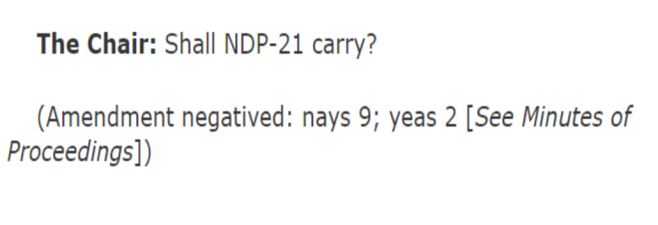
The NDP amendment to strengthen funding of local news was defeated by the Liberals and Conservatives.
The Independent Broadcasters Group —-the industry association representing Specialty channels seeking carriage on cable TV— did not get the amendment it sought extending the Commission’s dispute resolution powers from cable to online undertakings. The IBG did obtain an amendment appearing to confirm the CRTC’s regulatory powers to “order” online undertakings to carry specialty channels on their service in a manner “similar” to the existing Commission rules for Canadian cable companies.
There is a helpful article in the Globe and Mail, here.
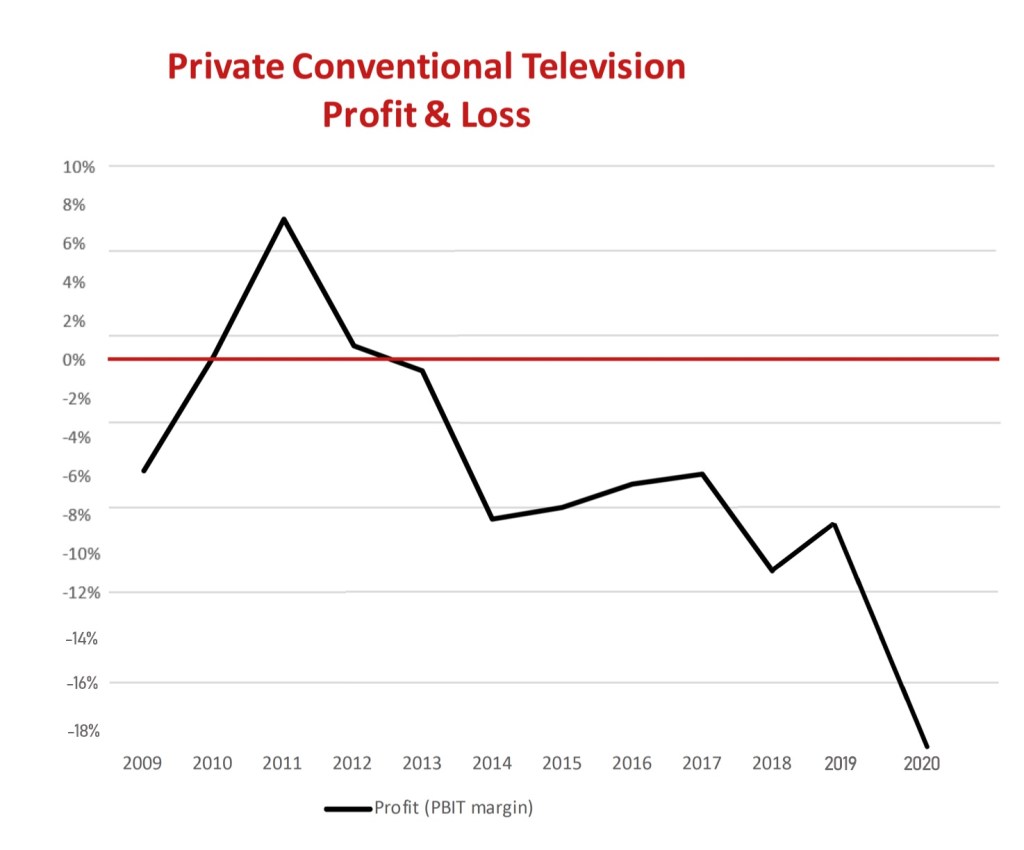
Profit/Loss line for Canadian local TV news from CRTC data
June 13, 2022
CRTC commissioners have asked for a mandate to save local radio and TV news. Parliament must give it to them in C-11.
The stack of amendments waiting for Heritage MPs tomorrow no doubt includes the proposal Unifor submitted on local news [Disclosure: as Unifor’s Media Director from 2013-2021 I submitted a similar amendment to the Committee on Bill C-10].
The Unifor amendment mandates the CRTC to boost funding for local news by realigning existing industry cross payments flowing from broadcasting distributors (BDUs) to broadcasters.
Bill C-11 adds the option of tithing matching cross subsidies from foreign streaming platforms as part of their new obligations to support Canadian news, sports and entertainment, keeping in mind that Heritage Minister Pablo Rodriguez expects a $1 billion injection of cash value into the Canadian broadcasting system as a result of C-11.
Everyone —especially the Canadian public– agrees local news is at the core of our Broadcasting Act. While not indisputably the legislation’s first priority, it ranks at the top with Canadian drama and programming in the languages of our founding and Indigenous nations.
The authors of the 2020 “pre-C11” report of the Broadcasting and Telecommunications Legislative Review (BTLR) were emphatic about local news. Writing two years ago, before the pandemic, they said the financial plight of local news required action:
With the decline in BDU revenues averaging 1.5 per cent per year since 2014, the funding mechanisms currently in place are likely to be less effective over time. Conventional television stations — typically the bedrock of audiovisual spending on news and an important source of local news — have not been profitable since 2012 [see chart above]; they have lost over $600 million in revenues between 2013 and 2018. Revenues for radio have also been declining….
There is little doubt that the current model for supporting news is not sustainable. The traditional news industry in Canada, as in many countries around the world, is facing a crisis, which has serious implications for Canada’s democratic system and social values.
And so BTLR Recommendation #71 says:
We recommend that the CRTC consider that some or all of the levies on media aggregation and media sharing undertakings contribute to the production of news content. These contributions would be directed to an independent, arm’s length CRTC-approved fund for the production of news, including local news on all platforms. We further recommend that the CRTC consider redirecting a greater portion of the levy currently paid by broadcasting distribution undertakings to this same fund for the production of news.
The Report reflected a consensus about the importance of local news. It is the community hall where we see, hear and learn about each other. It’s where professional journalists hold power to account and provide fact-based reporting.
Despite the overwhelming case for saving local news, it’s often the case that significant regulatory change doesn’t attract unanimous support within the industry because some players fear losing funding in a zero sum game while some of the large media companies don’t operate enough local stations to make the BDU-to-broadcaster cross-subsidy worth their while.
Among Canadian media companies, only Bell is prepared to champion the Unifor amendment (CTV is the country’s biggest local TV provider with 36 out of 90 local stations).
Sadly, we almost had the local news funding problem sorted out ten years ago.
In the early ‘00s the cracks in the business model for local news began to show: broadcaster profit margins were dropping. The smaller the market, the more likely its local station was losing money.
The CRTC devised a solution. In 2008 it created the Local Programming Improvement Fund (LPIF) ——a $60 million news fund aiding “non-metropolitan” local stations —transferring cable profits to small and mid sized local TV stations. The fund was underwritten by a new levy of 1% of annual BDU revenues.
The 1% levy was on top of the 5% cable operators were already paying to support Canadian drama and community cable stations. Like those other obligations, LPIF was an industry cross subsidy moving from the more profitable BDUs to the less profitable broadcasters.
Around the same time, the cash-squeezed broadcasters sought to put an end to the cable companies’ free lunch, earning subscriber dollars from station signals taken from local TV towers without compensating the broadcasters, especially in large metropolitan areas left untouched by the LPIF.
After saying no to the broadcasters twice, in 2009 the CRTC agreed to force the BDUs to the table to negotiate “fee for carriage” (FFC) payments to the broadcasters.
But before implementing its FFC order, the CRTC asked the courts to confirm it had the jurisdiction to order compensation in the first place. In December 2012 the Supreme Court of Canada said no and struck down FFC in a 5-4 split decision because of conflicts between the Broadcasting and Copyright statutes. Ironically the broadcasters found themselves cross subsidizing the wealthier BDUs with their free content.
But at least the broadcasters still had LPIF money to sustain their small and mid sized stations?
No such luck. By 2012 the industry had consolidated: the big cable and telco companies had splashed out millions to buy specialty channels and local stations. Bell and CTV. Rogers and City. Shaw and Global. Québecor and TVA. They became “vertically integrated” (VI) media companies with presumably a limitless ability to cross subsidize local news and Canadian drama from their cable and specialty profits.
Somewhere in this time frame the consumer-crusading Harper cabinet turned against the four-year old LPIF levy that cable companies had made a line item on Canadians’ monthly bills.
In July 2012 the Commission killed the LPIF news fund, ruling that vertically integrated media companies would just have to absorb the losses in local news, “innovate” (a signal for job cuts that soon followed) and keep ladling money from one side of the business to the other as a condition of keeping their licenses for overall TV operations.
Asked to reconsider in the Commission’s 2015 “Let’s Talk TV” proceedings, Harper’s new CRTC Chair Jean-Pierre Blais was unmoved so far as the VI local stations were concerned.
Instead Blais made two tweaks to the regulation of local news. He allowed the VIs to defund their community stations and reallocate the money to their local stations; and he abolished the CRTC’s Small Market Local Programming Fund and recreated it as an independents-only news fund available to about 20 stations not owned by VIs.
But as for a dedicated stream of funding or cross subsidy for the vast majority of local news stations —-70 out of 90 are owned by the VIs—- not a penny.
That’s how things stand in 2022: an inexplicable regulatory asymmetry in which there is little relief for money-losing news journalism but a 4% revenue tithe supporting Canadian drama.
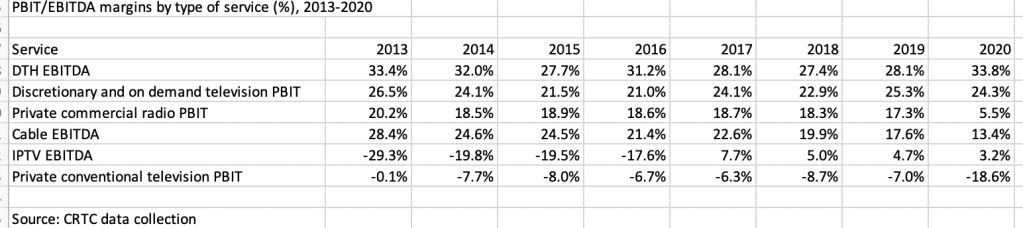
More to the point, our broadcasting economics have only gotten worse for conventional TV, meaning local news, as these 2020 CRTC statistics on PBIT/EBITDA margins demonstrate:
When asked by the Liberal government for advice on a new Broadcasting Act in 2018, the CRTC recommended “supporting television news production through increased access to subscription revenues,” advice that would be repeated by the BTLR Report eighteen months later.
It would be wishful thinking that the CRTC will venture forward on something so bold without an affirmative response to their recommendation.
The Conundrum of Canadian Broadcasting Economics in a graph. Source: CRTC Report “Harnessing Change.” (2020)
June 11, 2022
The Conservative filibuster of the Heritage Committee hearings on C-11 continued throughout the week. CPC committee vice-chair John Nater MP served notice the filibuster would continue into the Fall. I wrote about that here.
Heritage Minister Pablo Rodriguez spoke to the Committee (he was denied the previous week by the filibuster) and revealed some new information about the $1 Billion injection of foreign streamer cash his Department projects.
The Liberal, Bloc and NDP MPs remained tellingly serene throughout the week and on Friday morning the Liberals responded with a closure motion introduced into the House of Commons providing for one nine-hour day of Committee debate (June 14th) on amendments —-Committee meetings normally last two hours—- before C-11 is returned to the Commons for Third Reading.
With C-11 as a springboard, the Conservatives kicked off a summer membership recruitment campaign with a rhapsodic video starring Andrew Scheer MP entitled “I’m not sure how long the government will let this video stay up.”
The tragedy of the filibuster after 10 days of Committee hearings is that the amendments, some of which I profiled in Monday’s post, will receive inadequate debate and be available only to Canadians who tune in to ParlVu.
I also had a volley and response debate with C-11 critic Leonard St. Aubin that began with my proposal to split the difference on regulating user generated programming but ended up being a discussion of the conundrum of Canadian broadcasting economics. Mr. St-Aubin’s first and second replies are here and here.
Enough of C-11 for today and on to the FaceGoogle Bill C-18: you can read a typically incisive article from former CRTC Chair (former Competition Bureau Commissioner, former federal judge, etc.) Konrad von Finckenstein itemizing all the things he think might go wrong with the Bill.
For Rogers-Shaw followers, there is an excellent business feature published this morning in the Globe and Mail covering Québecor CEO Pierre-Karl Péledeau’s bid to buy Freedom Wireless and emerge as a fourth national wireless carrier.
Yesterday’s meeting of Heritage Committee MPs charged with reviewing the Online Streaming Act C-11 was again filibustered by the Conservative party.
Liberal MP Chris Bittle kicked off the two-hour session with a motion to commence clause by clause consideration of amendments on June 13th and, upon finishing C-11, move on to the Conservative motion to investigate whether Hockey Canada used public funds in settling a sexual assault lawsuit.
Conservative MP John Nater —-the Tories’ Committee Vice Chair— opposed the motion and, as a signal of the CPC’s intentions of indefinite filibuster, announced that he had another “twenty witnesses” he wants to call on C-11 in addition to the approximately 30 that have been questioned over the last three weeks.
NDP MP Peter Julian proposed a compromise of assigning the next two Committee days to Hockey Canada and then resuming C-11 and Hockey Canada “simultaneously.”
The Conservatives rejected that and filibustered the remainder of the afternoon without any clear path for the Committee over the remaining two weeks of the Parliamentary session.
Minister Pablo Rodriguez returned to the Heritage Parliamentary Committee this afternoon to answer questions about the Online Streaming Act Bill C-11 after a Conservative filibuster last week left him cooling his heels.
While there was the expected Parliamentary jousting over C-11’s provisions governing hosting platforms like YouTube and TikTok, Heritage MPs and Canadians following the Bill got some other information they had been waiting for.
First, the Minister is not going to unveil a “draft” cabinet policy directive which would give guidelines to the CRTC on the implementation of C-11. He told MPs he would issue the Directive after all amendments are made to the Bill and Royal Assent is granted.
Second, the Minister cited a revised dollar figure for the Canadian content contributions expected under C-11 from foreign online platforms, putting the figure at $1 Billion annually. This is an increase from the $830 million figure cited by the previous Heritage Minister Steven Guilbeault in 2021. Rodriguez explained the increase as a result of additional foreign streamers entering the Canadian market, in particular Disney Plus and Apple TV.
Sitting next to the Minister, Assistant Deputy Minister Thomas Owen Ripley clarified that $900M of the $1 Billion is the expenditure value of the Canadian content the foreign platforms would be obliged to produce. The remaining $100 million would be cash contributions to be distributed through production funds to Canadian-owned media companies.
Bloc MP Martin Champoux raised the profile of one of C-11’s sleeper issues —-so far, user generated programming has sucked most of the oxygen out of Committee debate— which is the ability of Canadian programming services like OutTV or APTN to access carriage on foreign online distribution platforms like Roku, Apple TV or Amazon Prime.
The problem appears to be that C-11 does not completely map over programming access rules binding Canadian cable operators to American online distribution platforms entering the Canadian market. My post from earlier today gives more background: the problem is that C-11 lacks the teeth to deal with foreign platforms that might deny access to Canadian channels.
The Minister’s answer to Champoux was intriguing as he cryptically replied there were problems “with our American counterparts.” A similar question was put to Ripley but his response was cut off in mid-sentence because of time allocation.
The Hill Times published a story this morning in which APTN CEO Monika Ille raised the same access issues and expressed her disappointment that APTN was not given an opportunity to appear before the Committee.
Expect to hear more on that.
Finally and inevitably, not long after the Minister finished answering MPs’ questions, the Liberals renewed their motion from last week to set a deadline for starting the “clause by clause” consideration of C-11 amendments.
The Conservatives reignited their filibuster by moving and speaking to a motion in which C-11 would be put on hold until the Committee conducts hearings and writes a Report in response to the recent House motion requesting an investigation of allegations that Hockey Canada covered up a sexual assault committed by junior hockey players in 2018.
When NDP MP Peter Julian proposed dealing with the Hockey Canada file after C-11 was completed, CPC MP Rachael Thomas told Julian he was “re-victimizing the victim.”
A series of speeches from Conservative MPs used up the final 45 minutes of the two hour committee meeting until adjournment.


 MediaPolicy.ca