Pablo Rodriguez is getting better at this. The Heritage Minister who is trying to shepherd three Internet bills through Parliament in 2022 has filtered out the political noise on two of them and paid attention to important warnings that the public consultation for his proposed Online Harms Bill was going to blow up on him.
On March 30th Rodriguez announced a panel of twelve bone fide experts in Internet law and social policy who will advise Heritage on what to do about the reeking sludge of online speech that social media platforms can’t seem to keep at bay.
One of those experts is Taylor Owen, Director of the Center Media, Technology and Democracy. Owen took the opportunity to tweet that he was pleased that his expert panel was being mandated to “pivot” towards a “systems” approach:
If you are wondering how to interpret Owen’s semaphore, a “systems-based” approach means less emphasis on illegal speech policed by government-established monitoring requirements and more emphasis on getting platforms like Facebook to self-regulate with whatever methods work best under a general legal “duty of care.”
In other words, it means less government regulation and more incentive for Big Tech to develop a better sludge solution so as to avoid liability.
Keeping it real, we should acknowledge that Facebook and other platforms are like private sewage companies being told they must not leak a drop of shit.
On the other hand, they are monetizing shit.
The Heritage Department’s initial consultation paper leaned heavily towards the no-leaks approach by obliging platforms to pre-emptively filter, moderate, and delete posts so harmful they are illegal. And depending on the posts, the stakes are raised by requiring platforms to report the posts and the posters to the authorities.
That kind of regulation has civil libertarians in a lather, though many are prone to absolutist opposition to any regulation of communications.
And where Internet free speech is concerned, expect red-hot politics to follow. Even the most cautious Online Harms legislation will be seized upon by the Conservative Party and some advocacy groups as creeping digital communism. The fundraising opportunities are priceless.
The expert panel is to meet weekly up to 12 times to come up with advice for the Minister on how to design the legislation. It’s encouraging that the Minister will be publishing the panel’s discussion papers and, on a non-attributed basis, the experts’ views.
Where this might end up (or so I am hoping) is the panel advising the Minister to establish hardcore regulation of highly dangerous content —— probably terrorism, child exploitation, revenge porn, Criminal Code hate speech offences, and threats of imminent harm—- which would be regulated as illegal speech with strict enforcement and reporting requirements imposed on the platforms.
Beyond those core concerns lays all manner of harmful but not imminently dangerous content —-think dog-whistling bigotry and racism—— which can be managed in a more ad hoc fashion by the platforms themselves (including banning serial offenders). The platforms will avoid corporate liability so long as their efforts show continuous improvement and meet Canadians’ expectations of corporate responsibility.
By re-booting the consultation process and creating his impressive panel of experts, the Minister should build the necessary political credibility before tabling an inherently controversial piece of legislation.
In addition, the re-boot allows the United Kingdom to forge ahead with their Online Harms legislation, allowing Canada to learn from any mistakes.
Ed Rogers is almost king. Brad Shaw is almost rich. The $26 billion Rogers-Shaw merger cleared its first hurdle last week with CRTC approval of the deal’s $5 billion in broadcasting assets.
Bottom line, the CRTC doesn’t think cable subscribers will be worse off. It accepted Rogers’ argument that it is merely stepping into the shoes of Shaw’s broadcasting operations in regional markets as the second of two major cable companies.
Of less interest to the general public were the competitive issues between cable distributor Rogers and broadcasters wanting a fair shake on the programming they will sell to Canada’s dominant distributor of English language channels at 47% of the TV distribution market (Bell’s cable operation is next at 28%).
In what amounts to refereeing commercial relationships between media companies in a small national market for programming, the CRTC salved legitimate concerns about Rogers’ opportunity to abuse market power with tougher regulations and conditions of merger. Even these tighter rules may not comfort small programmers who can’t survive without Rogers carrying their channels. But it’s all Inside Baseball to the Canadian public.
The ruling predictably ran into a hale of press releases and tweets from big telco and CRTC critics deeply opposed to any merger, several of whom suggested this decision about a cable TV merger was so bad that it demonstrated the CRTC was unfit to carry out its other tasks to regulate wholesale Internet pricing, wireless competition, and any broadcasting responsibilities delegated to it by Bill C-11.
The critics aside, media mergers always generate Canadians’ cynicism about what seems to be rubber-stamping.
Perhaps it’s because no media merger has ever been refused by the CRTC or any other arm of government including the Competition Bureau. (Bell’s initial attempt to buy Astral for $3.4 billion in 2012 was denied by the CRTC but approved on a second proposal after Bell shed assets).
It’s not widely known that the fine print of the Broadcasting Act does not instruct the CRTC to preside over mergers. Nevertheless the CRTC asserts it has that authority “in the public interest” as an extension of its statutory responsibility to foster a diversity of programming.
The definition of the “public interest” under section 3 of the Broadcasting Act is an unranked list of economic and cultural objectives. On the economic side of the menu are consumer priorities of “efficiency” and “affordability” along side of the establishment of “reasonable terms” between media companies that buy and sell the programming that subscribers pay for.
And on the other side of the public interest menu are a list of cultural and linguistic programming objectives.
What you won’t find is a mandate to review mergers or guidance on how to do it.
That distinguishes the Broadcasting Act from the Competition Act which expressly authorizes the Competition Bureau to inspect mergers for market power and their potential to “substantially lessen competition.” The Competition Act has only one test of the public interest on its menu, “efficiency.”
Perhaps because of the Broadcasting Act’s broad definition of the public interest and its application to mergers, the CRTC long ago developed a “Tangible Benefits” policy which says any merger of television assets (e.g. Shaw’s Pay Per View or On Demand channels) reducing the number of media competitors must mitigate the potential harm to the diversity of programming by paying “tangible benefits” in an amount equal to 10% of the transaction price. Those dollars are then distributed by the merged company to content creators that are either non-profit (like the Canada Media Fund) or unprofitable (like independent local news stations).
A sensible cultural policy, Tangible Benefits looks a lot like the purchase price of acquiring greater market power that may affect consumer prices.
But despite reasons to be cynical, it is still good public policy to evaluate any merger on its own merits.
Recall, the CRTC only reviews broadcasting assets, meaning cable, satellite, and TV programming, but not wireless or Internet infrastructure.
The Commission bought Rogers’ argument that by stepping into Shaw’s shoes in regional markets there was no obvious change to the competitive dynamic with other cable companies and so consumers are not worse off. As a consolation prize, the Commission gave a soft order to Rogers (calling it an “expectation,” not a condition of merger) to maintain existing prices and terms of service or to improve them in the long run. The leading consumer advocate, the Public Interest Advocacy Centre, was not consoled, saying such Polyannish assurances had let subscribers down.
For competition between media companies, the Commission met the concerns expressed by small media companies that a nationally-dominant Rogers would cheat them out of a fair price for their channels by adding more teeth to good faith bargaining rules to discourage Rogers from exploiting its enlarged market power.
The Commission also increased the tangible benefits bag of goodies from Rogers’ proposed $5.5 million to $27 million. To do that, the Commission overruled Rogers’ calculation of the transaction value of the deal that excluded Shaw’s On-Demand and Pay-per-View channels which will be shut down by Shaw the day before its paying audiences are passed along to Rogers.
Did the CRTC give Rogers a pass too easily on consumer interests?
Significantly, the Competition Bureau can still review this even though it passed muster at the CRTC. However it’s worth remembering that Canadian competition law has a high tolerance for corporate concentration and makes no assumptions it hurts consumers.
At this point I expect even the deal’s critics are fatalistic about the Competition Bureau coming to the rescue. It’s unlikely the Bureau would diss the CRTC by finding against Rogers on cable TV issues.
On the telco side of the merger, Industry Minister François-Philippe Champagne has more or less forced Rogers to find a buyer to take Shaw’s wireless business, Freedom Mobile, relieving some of the public pressure to block the entire deal.
****
A post-script on local TV news:
A lot of attention during the CRTC merger hearings in November 2021 focused on the fall-out on local news if the deal went through.
That’s because when Rogers acquires Shaw’s cable assets it also inherits the $13 million per year CRTC earmark that enables parent-company cable revenue to be spent on local TV news. That $13 million is 10% of the Shaw-owned Global TV network’s news budget of $130 million. Global will remain outside of the transaction in the hands of the Shaw family through its control of Corus Broadcasting.
Rogers committed to spending the windfall $13 million on more journalists at its western City-TV stations in Vancouver, Calgary, Edmonton and Winnipeg. That will be a major boost to Canada’s fourth TV network, even as it beggars the number three network, Global.
The knock-on effect of this zero-sum game in local news is that Global, now a stand-alone television network of 15 stations, will immediately apply to the CRTC’s special news fund (the Independent Local News Fund, or ILNF) currently distributing $20 million per year to 16 small television stations that also are not affiliated with a major cable company. If Global can draw from the ILNF waterhole, it will run dry.
The CRTC had few tools at its disposal in a merger application to do anything about this miserable situation other than to scupper the entire deal. Sensing an ugly political situation, Rogers suggested the Commission assign a one-time payment of $1.7 million of its proposed $5.4 million tangible benefits package to the ILNF (though it didn’t spare them being skewered by MPs at the Heritage Committee in February).
The Commission instead penciled in the ILNF for a $4.3 million share of a much larger $27 million tangible benefits package and indicated it would be revisiting the ILNF and local news funding in the future.
The next chapter in this story will likely be a pitched battle behind the closed doors of the Canadian Association of Broadcasters —which the CRTC has delegated to administer the ILNF— over whether to welcome Global News to the waterhole.
The CRTC’s British counterpart Ofcom has also banned RT from regulated television in the UK in the wake of Russia’s illegal invasion of Ukraine.
British laws are similar to Canada’s Broadcasting Act in policing broadcasting content: a presumption against censorship or bans, but with an escape clause.
The delightfully phrased British legalism asks whether the licensee continues to be a “fit and proper person.” This prompts an analysis of whether the impugned broadcasts are “duly impartial,” possibly a tougher standard than Canada’s check on “false or misleading news” or “abusive comment on the grounds of national origin.”
As in Canada, RT ultimately elected not to participate in the legal proceedings.
Ofcom justified its 12-page ruling on several points:
That RT is funded by the Russian state, meaning President Vladimir Putin, notwithstanding claims of editorial independence. Both Putin and RT’s editor in chief are under international sanctions.
That Ofcom previously sanctioned RT several times prior to 2018, culminating with a £200,000 fine in 2018.
That while RT had avoided Ofcom sanction since the 2018 fine, the UK regulator has opened 30 investigations of broadcasts since the beginning of Russian invasion in mid February.
That the Russian government’s recent enactment of a “false news” law threatening imprisonment of Russian journalists covering the war in Ukraine (including calling it a “war”) means it is likely impossible that RT can meet the Ofcom standard of “duly impartial” broadcasts.
Yesterday the CRTC did what the federal cabinet wanted it to do: ban the Russian propaganda channels Russia Today and Russia France from Canadian cable TV.
It was all a bit anti-climactic: the cable companies themselves had already dropped the channels. As unlicensed non-Canadian services, channels like RT are broadcast in Canada at the pleasure of the cable companies with the CRTC rubber stamping those business decisions.
That didn’t stop Heritage Minister Pablo Rodriguez from asking the Commission to ban RT anyway.
I’ve never watched RT —you still can on the Internet, which the CRTC doesn’t regulate as yet— because I trust others who tell me it’s propaganda; because I refuse to give RT my clicks or IP address; and because I have a great deal of confidence that viewing their propaganda would make my (partly) Ukrainian blood boil (the surname on my father’s birth certificate is Prilovsky).
What’s strange about this act of censorship —for that is what it is— is how little flak the government and the CRTC have taken over it, something you would expect would rile up the free speech ultras who see censorship under every regulator’s bed.
The tricky legal problem for the CRTC is that the Broadcasting Act was explicitly drafted to protect freedom of expression in its purpose clause. Quite sensibly, a number of long standing regulations under the Act allow censorship of licenced channels, which RT is not, for a limited number of good reasons including “false or misleading news” and “abusive comment that is likely to expose a class of individuals to hatred or contempt on the basis of national or ethnic origin.” The CRTC nimbly skipped around the fact that this censorship mandate doesn’t apply to unlicensed channels by relying on the Commission’s residual responsibility to govern broadcasting “in the public interest,” which it has.
A second thing that is strange about this act of censorship is that no one put any direct evidence of abusive comment by RT directed at the Ukraine or Ukrainians before the Commissioners. RT itself was not made a party to the CRTC proceeding and did not intervene. It’s difficult to tell from the written decision if the Commissioners streamed RT over the web, but if they did they weren’t saying. Details of RT programming put on the record by various interveners either weren’t current or belonged to other Russian state propaganda outlets, not RT.
Reading the ruling, the CRTC uses words like “negative” where you would expect “abusive” and “could expose” where you would expect “does.”
Interesting point: no one including the CRTC argued RT was “false or misleading news.”
More than one intervenor pointed to the federal government’s power —not the CRTC’s authority or responsibility— to get at RT by sanctioning its officials, a wonderful idea that would put the responsibility where it lies, on the federal government. Because it sure didn’t belong to the CRTC.
On the cusp of the federal government’s introduction of an Online News Bill in the House of Commons, the Public Policy Forum of Canada has published its sequel to the 2017 Shattered Mirror report documenting the crisis in Canadian journalism.
The report “The Shattered Mirror – Five Years On” written by Ed Greenspon and Katie Davey arrives at conclusions about funding solutions similar to where I landed in my post two weeks ago, only with far greater insights, details, and ideas.
With any luck, it’s not too late for Heritage Minister Pablo Rodriguez to incorporate them into the Bill.
While the Bill is about refereeing the commercial relationships between the digital distribution platforms Meta and Google and the media organizations that supply news content to their audiences, the government’s role as regulator allows it to put some public interest conditions into the legislation.
Media organizations seeking better compensation for news content under the Bill must deliver original journalism that “better informs our democracy,” rebuilding news coverage of public institutions, especially at the local level.
News outlets that distribute on any media platform —not just mainstream news organizations— should be eligible for this compensation regime so long as they meet the professional standards established in 2019 by federal aid to journalism program, as Qualified Canadian Journalism Organizations (QCJO).
There must be public reporting of the final compensation arrangements and a guarantee of non-discriminatory negotiating practices. Transparency will verify that Meta and Google aren’t playing favourites among news organizations and that audiences are aware of the commercial relationship between the Big Tech and news organizations when reporters are doing beat coverage on them.
As part of their recommendations, the authors of the Report point to the importance of establishing an independent governance body —arm’s length from Big Tech, the media, and the government—- responsible for eligibility and to superintend the overall arrangements.
The constitution of a governance structure provides a useful pivot to the other focus of the Report, the federal government’s Local Journalism Initiative (LJI).
The $10 million per year LJI is the less well known of the federal Liberals’ various aid to journalism programs such as the $100 million per year QCJO subsidy to editorial coverage. Both the LJI and QCJO have a five-year expiry date and the LJI program is coming up for reconsideration first. (I have posted asummary of the various federal programs).
The LJI program has been focussed on funding one-year journalist internships in community newspapers and small cable stations, favouring rural communities that have become news deserts and also in underserviced Indigenous and racialized communities.
The Report says the LJI program has passed its probationary period and it’s time to graduate from an experimental to a permanent program with more money, simpler application procedures, longer funding commitments, and independent governance (it’s currently administered by news industry associationswhose own members apply for its grants).
This independent body might also be confirmed by the Canada Revenue Agency as a “qualified donee” eligible to accept tax-sheltered philanthropic donations for re-distribution to non-profit and, with some flexibility from the federal government, for-profit news organizations as well. (The Report observes that philanthropic support for journalism has been minimal in Canada and, even in the US with its longer tradition of supporting journalism, has hardly made a dent in the overall loss of news coverage.)
As I observed in my previous post, there is a golden opportunity to establish a single and independent governance body to administer both public and private contributions to journalism, whether the funding source is the federal government, Big Tech, other industry levies, or philanthropic donors. That improves the chances of a coherent national program of supporting news journalism on all distribution platforms.
There remains a fly in the ointment, and it’s a big fly. To be blunt, it’s the Postmedia problem.
That $1.1 billion debt (and the workforce) has steadily dwindled since 2009. Still, Postmedia owes $67 million to its first lien Canadian investor Canso and $189 million to second-lien American hedge fund Chatham Assets. The share price is comatose and the company doesn’t pay dividends. The executive compensation has been extravagant, although mostly a rounding error compared to the debt payments.
Although it should be irrelevant to good public policy, there is the slavishly Conservative editorial stance and edgy right-wing opinion writing that fuels popular enmity in at least half the voting population: people who vote for MPs who will vote on the Online News Bill.
The policy problem is this: why should federal legislators help Postmedia if every dollar of aid to journalism, including Big Tech contributions, gives Postmedia a windfall opportunity to pay off another dollar of improvidently acquired debt instead of hiring journalists?
It’s difficult to design a policy solution to this problem, whether it’s the Online News Bill or the LJI and QCJO programs (neither of which address this issue).
The government could impose draconian measures that go against the grain of regulatory traditions, but are not unknown in government-sponsored bailouts: imposing limitations on debt-repayments, dividends and executive compensation in order to be eligible for any of these funding supports.
Another more technical mechanism could be borrowed from the CRTC’s regulation of television local news which sets an 11% baseline of minimum editorial spending as a percentage of overall revenue, even if that revenue is falling. The baseline became useful when the CRTC established a second, supplementary source of funding for news coverage. That additional funding has to be spent on “incremental” news coverage —meaning the opportunity for a public accounting documenting additional reporters covering more stories.
A comparable model might be designed to prevent Postmedia’s bondholders from pocketing new funding earmarked for journalism.
If you think this post deserves a wider audience, please share it.
The merger proposal that never stops feeding the news cycle had a big week.
Federal Innovation Minister François-Philippe Champagne announced he would not approve the “wholesale” transfer of radio spectrum licenses from Shaw’s mobility business in Ontario and western provinces to Rogers. The Parliamentary Industry committee chimed in today with its non-binding opposition to the overall merger, especially the wireless assets.
Champagne’s clipping of Rogers’ wings on the wireless end of the $26 billion deal could impact the anticipated ruling of the Competition Bureau on whether the merging of wireless, ISP, cable and satellite assets “substantially lessen competition.”
The CRTC also holds a veto on the merger of the broadcasting cable and satellite assets (the Global News chain of television stations operated by the Shaw-controlled Corus Broadcasting is not part of the merger). The Commission held hearings in November and Rogers is hoping for a decision before its targeted closing in the second quarter of the year.
The hearings are mostly political theatre. As a Parliamentary committee CHPC has no authority to block the merger that results in the Global stations being cut adrift from Shaw Cable’s $13 million supplementary funding of Global stations that has existed under a CRTC mandate since 2017.
MPs on the Committee mercilessly grilled Rogers Broadcasting VP Colette Watson on the elimination of that $13 million from Global’s $102 million budget.
Watson declined to offer the too candid answer: Rogers would violate its cable license if it didn’t spend the $13 million on its own City-TV stations.
Instead Watson suggested Global stations should absorb the 13% budget cut to their news resources and —in a gob smacking statement— suggested there was “no proof” that Global ever spent the $13 million on local news since 2017. The proof of course is a matter of public record posted on the CRTC website.
More helpfully, Watson’s colleague from Rogers Cable Pam Dinsmore suggested MPs consider bigger solutions to the crisis of local news in Canada’s television networks when deliberating Bill C-11. A good analysis of that crisis was published earlier in the week by the Toronto Star’s Christine Dobby.
Speaking of political theatre, the CHPC has yet to schedule its hearings on the Online Streaming Bill C-11 but early indications are it will be a replay of the C-10 drama from last spring.
In a recent blog post on Senate hearings considering Bill S-210, Internet activist Michael Geist gleefully turned the bombast meter up full blast and claimed that a CRTC official testifying before the Committee had inadvertently disclosed the Commission’s broad ambition to censor Internet content if it gets more regulatory authority under Bill C-11. The CRTC witness in question civil servant Scott Hutton is the Commission’s Research Director, not a Commissioner, and he was referring to the CRTC’s current lack of regulatory authority over “this issue” under discussion in the Senate Bill: age verification requirements to deter minors accessing pornography on the Internet.
The international efforts to regulate online harm took another twist in Germany. Google, Meta and Twitter persuaded a lower court judge that a new law requiring the Big Tech platforms to inform police of posts that reveal threats of criminal activity —and provide supporting persona data— is unconstitutional until a crime is committed. The ruling is being appealed.
My latest blog post digs into the story behind the notorious photo of CRTC Chair Ian Scott having a beer with Bell executive Mirko Bibic in December 2019 and the now iconic status of the picture amid allegations from Internet service re-sellers of regulatory capture.
Mostly I think it’s nonsense as you can probably tell from the blog, but there was another chapter in the ISP saga this week when Bell acquired Quebec’s biggest independent ISP re-seller EBox. Former CRTC Chair and still federal civil servant Jean-Pierre Blais –never one to hide his light under a bushel– publicly criticized the deal as a blow to ISP competition.
from Linked-In
Speaking of acquisitions: the Rogers/Shaw merger needs approvals from the CRTC (for cable and satellite assets), the Competition Bureau, and finally from ISED Minister François-Philippe Champagne for the wireless spectrum. The Globe’s Alexandra Posadzki reported that the MPs on the INDU Parliamentary committee are pushing Champagne to make his approval conditional on Rogers divesting the Shaw mobility operations. Industry analyst Mark Goldberg, ever the deflator of populist dreams, tweeted a previous blog with another perspective: maybe a merger of Rogers and Shaw wireless operations will intensify competition between Telus and Rogers.
Fair-Pay-for-News: Heritage Minister Pablo Rodriguez revealed that the long awaited Online News Bill will be tabled in the Commons soon and covers not only written journalism but also television news posted on Facebook NewsFeed, Google Search, and YouTube.
This “Australian model” of realigning the bargaining power between the Silicon Valley giants and news outlets is picking up traction internationally: the UK government is committing to an even stronger version while there is a weaker version (no binding arbitration) in US Congress.
All of this coincides with the publication of a Press Gazette interview with the architect of the Australian “Media Bargaining Code” Rod Sims on the first anniversary of the legislation. Unfortunately key details of the series of deals struck with Australian news outlets remain shrouded in non-disclosure secrecy. An interesting tid-bit: he refutes the notion that large media organizations have elbowed smaller publications aside at the waterhole.
The New York Times in Canada: Canada’s number two (so it’s said) and least edited newspaper the New York Times has ticked off some Canadian subscribers with controversial coverage of the Convoy Occupations. That drew a rebuttal worth reading from the National Observer’s Max Fawcett.
On December 19, 2019 Bell Canada’s second-ranking executive Mirko Bibic went for a beer at McGee’s pub, two blocks from Parliament Hill. Someone took his picture. His table companion with his back to the camera was CRTC Chair Ian Scott.
A meme was born.
Bell is of course Canada’s biggest communications company. The CRTC regulates telecommunications and broadcasting. The “telco” side of the house includes Internet, wireless, and telephone networks; the broadcast side includes cable and satellite distribution, television and radio. As a vertically integrated (“VI”) communications company along with Rogers and Québecor, Bell has a finger in every pie.
The photo didn’t get much traction in the media. But Bell’s industry adversaries, allied with numerous consumer groups and academics who regard Bell as their foil and nemesis, had better luck recycling the photo into social media with conspiratorial suggestions of clandestine lobbying. It lives online today, reposted at moments of regulatory controversy. The punch-line is that the meeting occurred around the time Bell and other VIs launched appeals against the CRTC’s slashing of the wholesale Internet prices paid by ISP re-sellers like Distributel and TekSavvy to access the VIs’ fibre networks.
Over two years later the CRTC’s rate setting for Wholesale Internet rates is still on the boil: Distributel recently revived the McGee’s photo as smoking gun evidence of Scott’s conflict of interest, demanding he recuse himself from the file.
Earlier this month Scott probably decided he could ignore the photo no longer. He gave an interview to the Toronto Star’s Tony Wong and explained that he and Bibic are old friends (Scott spent years working for Telus in regulatory affairs) and were meeting socially in Ottawa’s best known pub for a beer.
According to Scott, Bibic raised a regulatory issue, of which the many-fingered Bell has plenty. So Bibic had to file the standard report with the federal lobbying registry, coincidentally around the time he ascended to the top of the corporate ladder as Bell’s CEO. Significantly, the registry identifies the subject of the McGee meeting as “broadcasting” (Internet Wholesale is a telco matter, not broadcasting).
Scott told the Star that “no rules were broken” which while true hardly mollified his critics, especially the re-seller representatives (who can also found many times on the lobby registry).
This is no longer breaking news of course. I write about it to get a better understanding of the photo behind the recusal request and the meme’s success in igniting popular opinion about the inside game in Ottawa in general, and the CRTC in particular.
Heated public criticism of the CRTC and its chair —appointed by the ruling government to a five-year term— is a time-honoured Canadian tradition.
The CRTC regulates which itself assures it many enemies.
It regulates big things: Internet and wireless networks, television and radio, and if Bill C-11 is passed it will regulate online streaming.
All that regulation impacts monthly household bills and —depending on your point of view— freedom of speech and Canadian cultural sovereignty. Cue the photo meme, and it’s no wonder that Ian Scott has become another Ottawa piñata.
****
So what’s up with the CRTC’s Wholesale Internet regulation?
Most Canadians have something to say about their monthly ISP bills and the corporate power of VIs like Bell and Rogers usually animates those opinions.
The CRTC knows this and has been working on it a long time.
For the better part of two decades the VIs have ploughed billions (yes, many billions) of dollars into expanding and upgrading wireline networks across the country while ISP re-sellers have entered the market to apply downward pressure on retail prices. The CRTC’s rulings that force the VIs to sell network access to their own competitors at wholesale rates has been described in 2019 by the federal Competition Bureau as a success story for consumers in terms of provider-choice, lower prices, and customer experience.
Still, VIs and re-sellers have fought bitter regulatory battles for the better part of a decade over setting a fair wholesale rate (retail rates for consumers are not regulated).
The master plan designed by the CRTC goes back 15 years including the terms of at least three Commissioners appointed by two different governments. In forcing the VIs to provide re-sellers access to their fibre networks and setting wholesale rates, the CRTC has been searching for the sweet spot between increasing competition to push down retail prices without dampening investment incentives for the VIs to keep up with the exponential growth in consumer demands for more data and higher speeds.
According to the Competition Bureau, as detached and pro-consumer a body as you will find in this heated debate, the CRTC’s wholesale plan has allowed re-seller services grow with retail prices often 10% to 15% lower than those charged by the VIs.
Neither side is satisfied.
The VIs —Facilities Based Carriers (FBC) in CRTC lingo— remain irked at being forced to give a leg up to their competitors. They are particularly irked that the CRTC has slashed wholesale rates to the point that the FBCs say they are not recovering their capital costs; that it’s a drag on further capital investment in a network that increases every year in traffic, consumer expectations of download speeds; and (thorniest of all) that is struggling to connect rural Canadians.
The re-sellers and their consumer allies rail against the FBCs’ foot-dragging in opening up their networks and, most of all, that the CRTC is not cutting wholesale prices far enough.
If this was all a televised drama series, an episode recap would be in order.
Let’s wind it back to 2015.
In a ruling by the previous Chair Jean-Pierre Blais (appointed in 2012 by Prime Minister Stephen Harper), the Commission mapped out a consensus plan for how the Wholesale Code would help the resellers grow without discouraging network investments by the FBCs.
The philosophy behind the plan was explicit: the re-sellers were not going to be wards of the state propped up by the CRTC setting retail rates to ensure their success. Entrepreneurial risk was a given. The CRTC was offering wholesale rate regulation as far as necessary to recognize that while re-sellers could plausibly build their own hardware plants, they could not reasonably be expected to raise billions in capital to build their own “last mile to the home” fibre networks. Access to those last-mile networks would continue on a wholesale basis, but piggy-backing on the FBCs’ “backbone” networks would be phased out.
The Blais plan was to reconfigure the network design from the “aggregated access” of each re-seller hooking into the FBCs’ networks at central “points of interconnection (POI)” and instead linking into those network tentacles closer to the “last mile” at numerous local POIs, a “disaggregated model” of re-seller access.
The disaggregated model —-which the re-sellers supported— meant several knock-on changes in wholesale rates and business risk for the re-sellers.
First, the resellers were going to have to invest in their own “transport” hardware at each POI on the FBCs’ premises, either by renting from the FBCs, buying their own, or forming a cooperative with other re-sellers at the same POI premises.
Next, to give the re-sellers a firm push out the door of the aggregated house, the CRTC sunset the re-sellers’ access to the FBCs’ central POIs and capped the network speeds that they could purchase wholesale in the aggregated set-up.
Lastly, the CRTC announced it would set wholesale rates for both aggregated and disaggregated networks over a three-year transition period. Crucially the Commission deferred the disaggregated rate decision until later and first reviewed the aggregated wholesale rates.
And that’s when the trouble began.
On October 6th, 2016 the CRTC cut the wholesale aggregated rates for what the re-sellers had to pay the FBCs: by 90% on the “usage” rates covering the “backbone” portion of the FCBs’ networks and 40% for the “access” rates covering the last-mile of the network. Blais described them as interim rates, pending a more detailed review of FBC capital costs.
The carriers, including Bell, didn’t take it too well. They said Blais had just killed off the the re-sellers’ incentive to wean themselves off of the aggregated model and start building POI transport in a disaggregated system. The FBCs filed appeals to the federal court, the federal cabinet, and asked the CRTC to reconsider its decision. They lost all of them and the rate cuts stood.
In July 2017 Ian Scott was appointed by the Liberal cabinet to succeed Blais who had not asked for a second term. His appointment was immediately criticized by consumer-group Open Media for being selected from the telco industry instead of the consumer community. Scott had indeed worked for both Telesat and Telus, as well as a short tour of duty in 2007 as senior policy advisor to then-CRTC Chair Konrad Von Finckenstein who was widely seen as a pro-consumer Chair (as was Blais).
Among many regulatory files, the new Chair continued with the laborious study of the FBCs’ capital costs to finalize aggregated wholesale rates, which both sides in the dispute predictably wanted to move up or down.
The Commission released its decision in August 15, 2019 and to the delight of the re-sellers and the horror of the FBCs, the Commission cut the aggregated wholesale rates even further.
And the cuts were retroactive to 2016 so the carriers owed the re-sellers $325 million in rebates. Yes millions, Dr. Evil.
Again, the FBCs launched appeals to federal court and cabinet, as well as requesting the Commission reconsider its decision which they said was riddled with costing errors. In October 2019 they caught a break when a federal judge stayed the CRTC’s order to change rates and make retroactive payments pending appeal proceedings.
And six days before Christmas, Scott and Bibic had that beer.
Tek Savvy and Distributel spokespersons raised hell in press releases and Twitter. The consumer group Open Media, which counts both re-sellers as major financial backers, did the same. Other consumer advocates piled on.
Bell and the other FCBs eventually lost their court challenges. But the wind was shifting in their favour anyway.
Two things happened.
First, in June 2020, the Commission convened another proceeding in the long saga of transition from aggregated to disaggregated rates, this time to design the system of POIs in the disaggregated model which was now informed by Distributel’s request to reverse course from disaggregated and go back to a highly aggregated model.
Distributel, no doubt elated by the double cuts to rates under the aggregated model in 2016 and 2019, told the Commission that the capital costs of building their transport equipment in a disaggregated wholesale regime were astronomical (it might take “centuries”) and the Commission should reverse its 2015 decision.
The FBCs including Bell told the Commission that Distributel’s 180 degree turnabout on the Commissions’ transition plan was a smokescreen for cashing in their winning lottery ticket of deeply reduced aggregated rates. They pointed out that Distributel had originally advocated for the disaggregated system (and neither Distributel nor Bell suggested that transport capital costs had changed in the interim). They also pointed out that the largest reseller Tek Savvy wasn’t complaining about transition to disaggregated and was already building its own hardwired network in southern Ontario.
The winds of change really picked up in August 2020 when the federal cabinet answered Bell’s appeal by stating the Commission’s 2019 rate cuts had missed the sweet spot and showed insufficient consideration to the FBCs’ capital costs and therefore the Commission must review its second rate cut.
So the Commission began its months-long do-over of the aggregated rates review, which resulted in its decision on May 27, 2021. In a unanimous decision by nine commissioners including Scott, the Commission reversed its 2019 rate cut, agreeing with all 14 arguments raised by the FBCs identifying errors the Commission had made in reviewing costing models and its own guidelines. The 2016 interim rates, which had included the initial rate reduction in favour of the re-sellers, were confirmed as final.
Not only that, the Commission said it was carrying on with the transition from aggregated to disaggregated model which meant those reduced aggregated rates would soon be a thing of the past. Distributel and other ISP re-sellers were going to have to build those multiple transport nodes throughout the FBCs’ networks. Their 2019 lottery ticket was in shreds: no second rate cut, no $325 million payment.
At this point raging public controversy was a given. Needless to say the ruling gave new life to the resellers’ public campaign and the juiciest orange in the campaign was the McGee’s photo. (Visits to the Tek Savvy, Open Media or CNOC websites illustrate that, but the most acidic commentary might be Tek Savvy exec Peter Nowak’s twitter account).
Open Media newspaper ad from July 2021
****
Whatever one thinks is the right answer on wholesale internet rates, there’s the matter of lobbying.
Lobbying on matters of public interest under controlled conditions including a federal registry is expressly allowed in all democracies including this one: not only to the CRTC, but to all federal administrative bodies, politicians and their senior staff (and carried on with gusto by representatives of VIs and resellers alike).
There are no rules against one-on-one meetings either. Before I retired, I lobbied federal politicians countless times on media issues, both one-on-one or by committee.
I even lobbied Ian Scott on February 12, 2018 (you can look it up on the registry) although truth be told it was a meet-and-greet in a bar following his appointment the previous July (I am guessing Bell didn’t have to wait that long, but I’m over it).
It was a two-on-two meeting and very pleasant. We filled his ear about the history of the CRTC’s failures on local news and he nodded a lot. At the time, there were no open CRTC files dealing with local news but I hope we educated him for the next time it comes up. I think regulation works better with more information.
Still. Scott —and Bibic— were very naive to think that they could just be regular guys going to a pub that’s located within 100 metres of offices housing the Parliament Hill press corps. Next time maybe they’ll bring chaperones, even if it’s Christmas.
If you think this post deserves a wider audience, please share it.
The Liberals’ Online Streaming Act C-11 passed second reading in the House of Commons on February 16th, setting the stage for the expected political drama of Heritage Committee proceedings in the coming weeks.
Heritage Minister Pablo Rodriguez took to the floor of the House to speak about the importance of cultural sovereignty and kept his messaging on the content of the Bill simple.
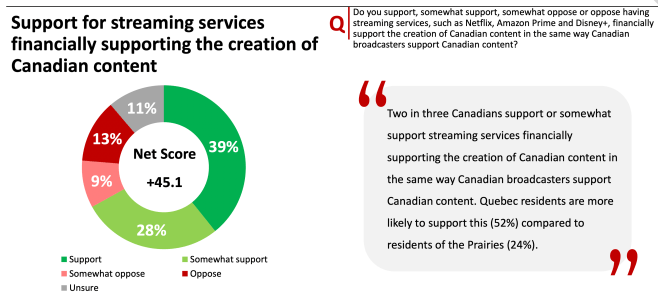
The revisions to the Broadcasting Act, he said, are to compel the mostly American streamers serving the Canadian market to platform their fair share of Canadian programming or else contribute cash to the Canada Media Fund.
As for social media uploads, Rodriguez’s sound byte “platforms are in, users are out” was shorthand for saying that the regulation of upload-based streamers like YouTube would be restricted to professional rather than amateur videos and music.
While the Minister has yet to spell it out, presumably the “regulation” of professional content —-does he mean “significantly monetized”?—- is relevant to the streaming platform’s in-kind or in-cash contribution to Canadian programming and also to its obligation to bring that content to the audience’s attention through “discoverability” functions that do not include algorithms (which are expressly excluded under the section 9(8) of C-11).
No fire-breather, Conservative Heritage critic John Nater struck a moderate pose in reply. He cited the Conservative election platform’s commitment to regulate “large” American streamers “like Netflix, Disney Plus and Amazon Prime” but left the demarcation point between large and not-large unspecified.
As expected most of Nater’s comments were directed at section 4.2 of C-11 which states the general principle of distinguishing professional from amateur social media uploads. He served notice the Conservatives don’t think it’s clear enough and are opposed to leaving the fine print for the CRTC or federal cabinet to fill in after the Bill passes.
Nater also seems to think the Bill contemplates regulating the streaming platforms’ discoverability algorithms, but they are explicitly excluded (leading NDP MP Alexander Boulerice to ask how the discoverability of a platform’s Canadian programming was going to be tracked if not by algorithm design).
Nater also said the Conservatives want the definition of Canadian content changed “to ensure that real Canadian stories are captured within CanCon rules,” a criticism of the long standing “point-system” that measures Canadian content by counting heads of leading creative staff (directors, writers, and actors) rather than a film’s intrinsic Canadian expression (for more on this, have a read of George Carothers’ 2020 study).
When asked by other MPs whether the House could expect a repeat of last year’s filibuster of C-10, Nater responded with a sober “I will work constructively with my colleagues” and “we will table reasonable amendments.”
We’ll soon see.
Conservative MP Pierre Poilievre took the occasion of Second Reading (before his Heritage Critic Nater had a chance to get on this feet) to tell the House that Liberals have “abused the freedoms of Canadians. Why should Canadians now trust that same abusive government with the power to censor what Canadians see and say online?”
There are no scheduled dates for the Heritage Committee but after next week’s short break Parliament is in session for 12 out of 17 weeks to the end of June.