Catching Up: Last week on @MediaPolicy.ca

All powerful US Senator Joe Manchin is said to favour government subsidies to journalism currently part of President Biden’s Build Back Better legislation.

December 19, 2021

Hey Google, Search this: France is vying with Australia for the title of feisty small sovereign nation (desolé) taking on Big Tech, having recently slapped Google with a $725 million fine for failing to negotiate seriously France’s implementation of the 2019 EU Copyright Directive for online platforms and publishers.

Google is still pushing hard around the globe to enforce its cut-rate version of pay-for-news-content. But the French government’s big fine has motivated the Tech giant to offer a negotiating process that includes the binding arbitration end-game legislated last February in Australia.

“American exceptionalism” means a lot of different things including staying at the back of the pack of jurisdictions pursuing Big Tech on pay-for-news-content and other monopoly abuses.

Google is trying to pre-empt Congressional action on pay-for-news-content by making offers to US publishers to sign up for the Google Showcase news portal while insisting on low rates of compensation. The offers have mostly been spurned by American publishers as “insulting” with a peppering of deprecating comments about the Showcase product itself. (A shout-out goes to Press Gazette US Editor William Turvill’s reporting.) However there is no sign of Congress backing up the publishers with Australian-style binding arbitration.

A fascinating step forward in US Congress is a federal salary subsidy for news journalism tagged on to President Biden’s US$1.75 Trillion Build Back Better legislation. BBB rests in the hands of the US Senate for now. The all important view of Democratic Senator Joe Manchin favours the journalism subsidy.

Also newsworthy in the US: the philanthropic journalism project Report for America is thriving and expanding next year to 325 internships in 270 newsrooms across all 50 states. One of many journalism foundations in the US, RFA is funded by the Knight Foundation, Walmart, Facebook, Google and others.

In case you are struggling to categorize the variety of funding projects around the world seeking to aid journalism, here are the major genres:

  • Private negotiations between Google, Facebook and media outlets, largely a pre-emptive move by Big Tech: 15 countries including Canada, Australia, France, Germany, UK and the US.
  • Government backstopping to those private negotiations through legislated binding arbitration: Australia and the EU Directive as implemented in France. A Canadian Bill is on its way early in 2022.
  • Direct government subsidies to news outlets, usually as a per journalist salary subsidy: several European countries for years, Canada, and perhaps the US if the BBB legislation gets through the Senate.
  • Tax laws that incent philanthropic donations to journalism projects: widespread in the US which has a long history of favourable tax regimes and billionaire patronage. The Canadian federal government made this move in 2019 with little effect so far.
  • Limited tax deductions for customer subscriptions: again legislated by Ottawa in 2019 but Canada Revenue Agency isn’t scheduled to report statistics until 2024.

An intriguing (and massive) public funding proposal to save news journalism is being touted by famed American cultural thinker Robert McChesney. I hope to devote a blog to his proposal soon.

Too Big, Too Postmedia: A not-so-feverish review of federal funding of Canadian journalism

December 13, 2021

A recent story in Canadaland “Trudeau’s $10 million top-up fund” is written as an exposé of federal funding of journalism and states that “government approved news organizations are not limited to receiving money from just one fund —many tap several of these initiatives at once, and some of the biggest media brands in Canada have successfully applied for all of them.

The story cites Postmedia (120 daily and weekly newspapers), Black Press (120 Canadian publications) and magazine publisher St. Joseph’s as examples of big media brands tapping federal funding. 

But the story neglects to mention that media companies owning multiple publications can only claim from one fund for any single publication. And there are four federal funds dedicated to four different types of publications.

Here’s how it works:

The Journalism Labour Tax Credit (JLTC) is available to daily newspapers. The $95M annual program made a lot of political noise when it was introduced in 2019. The Fund was administered initially by an independent third-party committee tasked to determine who was a legitimate news organization and not a political action group. Now payments are processed by the Canada Revenue Agency. The program amounts to a $14,000 annual salary subsidy, per journalist. All major dailies in Canada draw from this Fund.

A second fund the “Aid to Publishers” (ATP) program is administered by Heritage Canada. ATP pays annual grants to eligible magazines and free weekly newspapers providing “high quality news content.” Its annual budget is about $70M. About 750 publications qualified last year.

Aid to Publishers has existed since 1867. Originally it was a postal subsidy for the distribution of news to rural areas.  

Due to the Pandemic-induced acceleration of the decline in advertising revenues, the Liberal government introduced an Emergency Support Fund in May 2020 that included a temporary 25% increase in the ATP program worth $15M for fiscal 2020-21. It was extended in July 2021 for the fiscal year ending March 31, 2022 at a cost of $10M. It would not be accurate to characterize the ATP top-up and the ATP as separate funds.

Importantly, publications funded by JLTC are ineligible for ATP funding, and vice versa.

Finally, the Emergency Support Fund also included a new $45M funding envelope for about 800 publications ineligible for either the JLTC or ATP,  but similarly hard hit by the Pandemic’s plunge in advertising revenues. 

Dubbed the “Special Measures for Journalism”(SMJ), the funding goes to Canadian publications such as trade journals, lifestyle publications or other titles that do not publish sufficient news coverage to qualify for the ATP or JLTC. The SMJ was extended for the current fiscal year at a cost of $21.5M. There is no indication from the federal government that this program is here to stay: it is part of the Pandemic “recovery fund.”

Again, the same publication cannot draw from more than one fund.

The only exception to the “one fund per publication” rule is the Local Journalism Initiative (LJI), an annual $10M program begun in 2019 to fund one-year internships or special journalism projects in “news deserts” or “news poverty” areas of coverage in Print, community radio and community TV. The program initially underwrote 342 journalism projects.  

I have not cross compared LJI recipients against other journalism funds, but it’s likely there are some LJI recipient publications drawing from one of the other journalism funds. However it ought to be noted that the LJI’s purpose is to expand news coverage to neglected communities or beats, as opposed to the other funds subsidizing existing coverage.

Like any Canadian business hit by a minimum 30% revenue losses during the Pandemic, media companies have been eligible for the CEWS salary subsidy of up to $847 per weekly salary (the program is now being tapered off). Payments under CEWS offset potential journalism grants dollar for dollar.

The Canadaland story also takes aim at a handful of publishers: the Chinese language newspaper Ming Pao (too pro-China); The Walrus magazine (too close to the Liberals); and of course Postmedia (too everything).

The very big and very right-wing Postmedia is a favourite piñata for mainstream media haters (it vies with Bell for that distinction). One of the darts sent its way in the article deserves some comment because it’s misleading. 

The story cites the significant dollar amounts that Postmedia (the biggest newspaper publisher in the country) has drawn from the journalism funds, how many community newspapers and jobs it has cut, and “a $52.8 million net profit in January [2021].”

I suppose the implication is that Postmedia is lining its profitable pockets with federal cash. The $52.8M figure however is exceptional as an operating income figure: it is cherry-picked from one quarterly report, Q1 2020-2021. I have posted below a spreadsheet of key debt, dividend, cost-cutting, revenue, profit and loss figures from Postmedia’s annual reports over the last four fiscal years ending August 31. You can draw your own conclusions.

Also, the $52.8M figure comes from the fiscal quarter in which Postmedia accrued a one-time $63M non-cash accounting gain on merger of its pension plan negotiated with its major union Unifor which resulted in an inflation-indexed (and more secure) pension for employees and a significant reduction in future unfunded pension liabilities for Postmedia.

This is good place to disclose: before retiring from Unifor after 33-years as a union rep, I assisted union locals in negotiating collective agreements with many large and small Canadian media companies, including staff contracts at the National Post, the Toronto Sun and other Postmedia newspapers.

Catching Up: the Last Week on @MediaPolicy.ca

Source: Roy Morgan Readership Survey

December 11, 2021

A prodigious bunfight over media concentration broke out in Australia this week. A Labor-Green alliance in the Australian Senate, which has legislative powers closer to the American upper chamber than its Canadian counterpart, recommended a judicial inquiry into the influence of Rupert Murdoch’s News Corp media empire on Australian politics. The Senate recommendation is the outcome of a wildly successful online petition launched a year ago by two former Australian Prime Ministers, Labor’s Kevin Rudd and the Liberals’ Malcolm Turnbull. However both the governing Liberal government of Scott Morrison and the Opposition Labor leadership immediately rejected it.

Fascinating political intrigue, to say the least.

Speaking of things Australian, its Media Bargaining Code has inspired news outlets in New Zealand to ask their equivalent of the Competition Bureau to confer a restraint of trade waiver on them so they can combine to negotiate pay-for-content deals with Google and Facebook.

Speaking of persons Australian, Wikileaks founder Julian Assange has been ordered extradited to the US by the British High Court, discounting his mental health defence. The US wants to put Assange on trial for an alleged conspiracy with US Army Intelligence analyst Chelsea Manning to hack military secrets published by Wikileaks, a charge Assange denies. Unless the High Court order is reversed, a trial promises to be a David v. Goliath collision between press freedom and military secrecy and security.

The US philanthropic local journalism initiative Report for America announced a major expansion of its internship program to 325 posts in 270 newsrooms in 50 states. The non-profit group is underwritten by private funders, including the Knight Foundation, the Walton Family Foundation (Walmart), Google and Facebook.

Digging Deeper into the Google Pay-for-Content Deals

December 5, 2021

An under-investigated policy issue is how much money might be delivered by a Media Bargaining Code requiring Google and Facebook to share revenue with Canadian media outlets, otherwise known as pay-for-content.

The Liberal government has promised such a Code early in the new year, inspired by the Australian government’s move last March.

William Turvill of the Press Gazette has dug into a series of confidential deals between the Platforms and Australian publishers and broadcasters in early 2020, agreements that resulted from the Morrison government’s plans to impose binding arbitration on Google and Facebook if they didn’t negotiate fairly for the news content they monetize.

Quoting a “senior industry source” in Canada, Turvill says that in the wake of the Australian deals the Canadian publishers are expecting to get 30% of their newsroom costs covered by deals with Google and Facebook, which they value in the range of $100 million to $150 million annually.

The payoff in a $100-$150 million package to a typical newsroom might be benchmarked against the 25% federal journalist labour tax credit program which provides a $14,000 annual subsidy per journalist in a spending envelope of $95 million annually. These are crude costings.

A year go in October 2020 News Media Canada stated on behalf of publishers that if Canada adopted Australia’s Media Code they expected to recoup $620 million in pay-for-content. But following Newsmedia Canada’s footnoting of the $620M figure to its source it was based on the assertion from two Australian news organizations (including media titan Rupert Murdoch’s Newscorp) in May 2020 —ten months before the confidential Australian deals were struck— that pay-for-content should be 10% of each Platform’s Australian revenues, pegging a range from $CDN 640M to $CDN 960M.

But we still don’t know the final negotiated value of those Australian media deals. The examples cited in Turvill’s article suggest much lower results than Murdoch was hoping for. An Australian industry analyst offered up the figure of $CDN 190M as the aggregated settlements with Google and Facebook, covering both print and broadcast.

Canadian publisher expectations from a legislated Media Code have now been drastically revised from $620M to less than a quarter of that figure at $100M to $150M, according to Turvill. That implies their recent crop of deals with Google and Facebook is worth even less than the revised figure, suggesting the platforms are having their way.

As discussed in a November 15th blog post from MediaPolicy.ca, the last few months Google and Facebook knocked off a series of undisclosed pay-for-content deals in Canada, going publisher by publisher. In fact Press Gazette reports Google has made deals with about 1,000 publishers in 15 countries including the UK, Australia, France, Germany, Italy, India, Argentina, Brazil, Canada, Japan, Czechia, Colombia, Austria, Ireland, and (sparingly) in the US.

What’s going on is Google and Facebook stealing a march on government regulation by negotiating confidential deals, one financially desperate publisher at a time. The strategy must be to establish a low “market price” for aggregated news on their Platforms before any Australian-inspired arbitration process sets it higher.

There is of course no “market price” in a monopoly, other than what the monopolist tells you it is.

As well, the exclusive focus of the Platforms’ negotiations for news articles ignores the indirect value of the ad revenue Google and Facebook earn by attracting news readers to their websites before they even know what they want to read.

The pay-for-content deals also ignore the anti-competitive duopolies over Search and Social advertising that have made Google and Facebook so rich and news media so poor.

If you want to read more about Facebook’s deals with Canadian publishers, check out an excellent feature article by The Logic’s Martin Patriquin, particularly the last few paragraphs.

November 15, 2021 – News Publishers Break Ranks: Have Google and Facebook Won?

Catching up: the Last Week on @MediaPolicy.ca

December 4, 2021

#JournalismIs essential to democracy. The next few months of the legislative agenda in Ottawa promise an intense chapter in the history of Canadian media as three Heritage Bills are scheduled to hit the order table; a revised Broadcasting Act, a Platform pay-for-news-content Bill, and online harms legislation.

There’s a cross connection between the three Bills: both the Broadcasting Act and the Platform Bill respond to the declining financial viability of news journalism. Conversely much of the political fuel for the online harms legislation is about anti-journalism, meaning the misinformation and online intimidation that pollutes social media platforms.

A Nanos poll says almost 80% of Canadians have had enough of online toxicity and want something done about it. That will embolden the Liberals to bring forward what will inevitably be a controversial Bill.

Meanwhile the changing of the CEO guard at Twitter suggests that there is one social media giant that might take its curation responsibility more seriously than a guy named Mark.

Doctor Media, heal thyself. A nice muckraking piece by Jon Horler says that 1 out of 10 television news panelists is a lobbyist with undisclosed conflicts of interest, but presented by the host network as a “strategist” or some other banality.

I have to admit I’m enough of a journalism homey that I mostly see the integrity of the flip side 9-out-of-10. But kudos to Horler for challenging the networks to be transparent.

Kevin. Not a Pearl Jam song. But rather Kevin Chan the face of Facebook in Canada. Martin Patriquin has written a terrific feature that tees off like a typical is-he-really-a-corporate-bad-guy profile but ends with a bang. Great read.

Canada’s “audience tax” on GAFAM companies stands, for now.

December 1, 2021

There’s a helpful article in the National Post regarding Finance Minister Chrystia Freeland’s stick handling of the yet-to-be implemented Digital Services Tax owed by American tech giants Google, Facebook and Amazon for their monetization of personal data harvested from Canadians online.

The three per cent digital services tax —legislated by the Liberals in 2021 and supported by the Conservatives in their election platform— was scheduled to be implemented January 1, 2022. It was expected to raise $700 million annually in government revenue, rising to $900 million when fully implemented.

Despite the original purpose of the tax being described as an instrument to get American Big Tech to pay its “fair share” for cornering the digital advertising market (thus disrupting the financial viability of media companies around the world), most sovereign governments including Canada signalled very early that a Digital Services Tax was less an “audience tax” than a down payment on a minimum corporate tax for foreign tech companies.

Now that OECD nations including the US and Canada have agreed in principle to a minimum corporate tax beginning in 2024, it’s likely the audience tax will be repealed. Other countries like Turkey have already done so in an effort to resolve trade issues with the US. For now, Freeland is pausing the collection of the Canadian Digital Services tax pending the implementation of the corporate tax in 2024.

The Finance Minister might displease the US administration by not cancelling the 3% tax outright, but likely she is keeping her powder dry until 2024. Also perhaps the latest eye gouging from the Biden administration on Buy America and lumber has something to do with it.

How the Platforms Should Pay for Journalism, September 17 2021

Rogers lays out a hiring plan for western City-TV stations; and Proposes a one-time $8.5 Million transfer to Independent Local News Fund.

November 30, 2021

Tasked by the CRTC to provide more detail about hiring journalists with the windfall $13 million local expression funding it would prise from the hands of Global News, yesterday Rogers filed the following with the Commission:

  • The headline is that City-TV stations in Vancouver, Edmonton, Calgary and Winnipeg will double their “journalist” headcount (plus an additional 12 non journalists) to beef up news coverage capacity at those four stations.
  • This is in addition to the commitment Rogers previously made in its merger application to hire 6 Indigenous journalists (one in each major market) to cover First Nations, Métis and Inuit issues and;
  • Hire two western-based journalists to cover Parliament Hill.

Rogers is willing to make these commitments as a condition of merger approval until their station licenses expire in 2023 but wish to keep their powder dry on anything further, pending the CRTC’s upcoming licensing hearings.

The additional reporters will increase news gathering capacity in each coverage area and Rogers has committed to broadcasting 12 news specials in each of the four western City-TV markets, every year.

The precise number of the “doubled” newsroom staffing is unknown thanks to Rogers claiming “competitive confidentiality” which the CRTC has granted in posting a redacted version of Rogers’ submission.

The CRTC’s reflexive shielding of the most mundane “competitive” information has been going on for years and does the regulator no credit.

Without a doubt, all of City-TV’s competitors (including Bell CTV and Global) know exactly how many videographers and reporters are employed by their rivals. It’s hard to keep something like that secret without demanding that journalists appear masked on air.

How all of that stacks up against the 162 television salaries (estimating $80,000 each) you can fit into $13 million is something we will have to keep guessing at. Depending on what Rogers means by “journalist” my wild guess is 95 new hires in total.

However, Rogers has also read the room on the impact of the $13 million de-funding of Global News.

Upon being asked by the CRTC to pitch a revised “tangible benefits” package — a long standing requirement of merger approvals, pegged at 10% of the value of the transferred assets— Rogers proposed an exemption to the standard expectation to target film production funds, in favour of local news:

“Rogers has proposed an exception be made to this allocation [of 40% of the $26 Million package to Certified Independent Film Production Funds] and request that [$8,518,400] be redirected to the Independent Local News Fund (ILNF) as a lump sum payment upon close of the transaction.”

If approved, this transfer would partially mitigate the $13 million switch in local expression funding from Global News to City TV while leaving the shortfall in the hands of the Commission’s review of the ILNF funding envelope.

Rogers/Shaw Wrap Up: What the CRTC Might Do with the Merger

CRTC Commissioner Ian Scott, looking for a little help on the file.

November 29, 2021

The dust has settled after a week-long CRTC hearing reviewing the $5 billion broadcasting distribution end of the $26 Billion Rogers-Shaw merger. 

Don’t be surprised if we wait a long time for the decision, long enough for the Competition Bureau and the federal government to first rule on the other 80% of the deal that isn’t in the CRTC bailiwick, namely the Internet and Wireless assets.

If the merger gets that first green light the next question is what will CRTC Chair Ian Scott and his four commissioners do with Rogers’ proposal to buy Shaw’s cable and satellite broadcasting operations in the western provinces?

The dramatic increase in Rogers’ share of the broadcasting distribution market  —from 20% to 47% of the English language market, with Bell in second place at 28% —  is the hottest of potatoes for the Commission.

Even in an industry as heavily regulated for competitive fairness as Canadian broadcasting, market power is an insidious enabler of economic bullying, especially in the negotiations between the cable companies and scores of programming services making deals for the video content distributed to millions of Canadians.

Every extra dollar that an omnipotent Rogers Cable squeezes out of other Canadian media companies means 30 cents less spent by those programming services on Canadian Programming Expenditures, including local news, drama, documentaries and the like, the very reason for the Broadcasting Act’s existence.

The opponents of the merger tap into something very real: our healthy distrust of concentrated corporate power. Bigger is not better, the wisdom goes, it’s inherently dangerous.

On the other hand, the Rogers pitch to the Commission on market concentration is this: the “market” is global, not Canadian. In the age of Internet TV giants and multi-billion dollar capital spending on broadband infrastructure, Canadian media companies need economies of scale.

In fact the Shaws defend their decision to sell to Rogers as an admission they don’t have the scale or capital to compete in the race to build today’s Internet Protocol TV platform and the fibre-to-the-home and 5G hardware that supports it.

Rogers argued before the Commission that if Canada doesn’t have a national champion capable of delivering Internet video through cable subscriptions, Canadians will cut the cord even faster, the regulated broadcasting system will crumble, and so will a system designed to cross subsidize Canadian news, sports, and entertainment.  We’re not monopolizing the Canadian broadcasting system, says Rogers, we’re saving it.

But like a lot of government regulation, much depends on what we think will happen, because we often don’t know what will happen. It’s the regulator’s comfort (or delusion) that today’s hypothetical problems can always be fixed later.

Here’s another trite but true observation about regulators: they don’t as a rule begin their day blue skying about the ideal model of their industry. They take a look at the market direction of the industry and then mitigate and modify in the public interest.

I would be surprised if the Commission turned Rogers down, but they do have few conditions they could impose:

First, they could require Rogers to divest some broadcasting assets. It’s not easy to imagine which of Shaw’s cable or satellite assets could be sold off and operated as a viable business on its own. More likely by the time the Commission writes up its decision, the federal government will have already forced Rogers to sell off Shaw’s Freedom wireless division.

Second, the Commission could answer the pleas of the many programming services who asked for stronger bargaining rules under the CRTC’s Wholesale Code that regulates negotiations between big and small media companies over the “fair market value” of content distribution. Much of the week long hearing was a deep dive on what that might look like. 

Third, they could do something about the collateral damage to the Global News network resulting from the merger, something I discussed in a previous blog. [Update: Rogers has proposed to make a one-time payment of $8.5 million to the Independent Local News Fund, the $20M annual funding envelope for all independent Canadian TV stations. Post-merger, Global would be expected to apply for ILNF funding].

And there are other caveats and consolation prizes they might think up.

But one thing I will predict (and it isn’t rocket science): if the Commission says it’s okay for Rogers and Shaw to merge into a super media company owning 47% of the English language broadcast distribution market, it is opening the door wide to the remaining media companies to do the same.

Expect Bell and Telus, who already share a wireless network across Canada, to walk right through that doorway.

Catching up: the Last Week on @MediaPolicy.ca

November 28, 2021

While the CRTC Rogers-Shaw hearing was the big show in town, elsewhere lots was going on in Mediaville:

The Platforms on the far side of the world. There were two interesting international developments concerning the issue of Google and Facebook paying for news content.

In Australia a group of small publishers are banging on the door to negotiate revenue sharing with Google and Facebook. Calling themselves the Public Interest Publishers Alliance, 18 niche and ethnic news organizations have applied for “collective bargaining” certification under the Media Bargaining Code that relaxes the usual rules against commercial collusion and allows them to bring Google and Facebook to the table. This follows on the recent developments under Australia’s Platform Bill in which Facebook has refused to bargain with the investigative news site The Conversation and ethnic TV broadcaster SBS.

Meanwhile, the Indonesian government is publicly speculating about following the Australian example by passing a Platform Bill. With a population of nearly 275 million, an Indonesian initiative will grab the attention of Silicon Valley and perhaps set an example for other non G-20 nations.

The Netflix Bill is back. The federal Liberals announced in the Throne Speech that Bill C-10 is back on the menu. Canadian Press published an article restricted to comments from opponents and critics of the last Bill that was ground to dust by Conservative filibusters in the Commons Heritage Committee and the Senate.

C-10 has rock solid support in Quebec and with the Bloc. The NDP supported C-10 last time but was vague in its election platform commitment, while MP Charlie Angus has made some spirited attacks that make the NDP approach to C-10 unclear for now.

#JournalismIs and the RCMP isn’t. The Mounties’ arrest, imprisonment, and release of two Canadian journalists covering the Wet’suwet’en blockade protest near Prince George, British Columbia was yet another leaden touch from a police force that respects neither freedom of the press nor recent judicial precedent making it very clear that journalists are not breaking the law while reporting on those who may be breaking the law.

The police force also appeared to have lied when issuing a statement that the journalists had not identified themselves immediately, contradicted by video evidence posted on Twitter.

Out of jail, photojournalist Amber Bracken made a couple of good points. While she was glad to be out of custody, she was uncomfortable taking the spotlight away from the land claim and Indigenous sovereignty issues she was covering. Secondly, she pointed out that news covered by financially-precarious freelancers is especially vulnerable to the RCMP’s tactics, she was just lucky that the editors of The Narwhal stuck with her.

Trolls Unmasked? In the media regulation Petri dish that is Australia, the Morrison government has announced legislation providing a legal process for anyone who believes they’ve been defamed by anonymous trolls on social media to compel the Platforms to unmask the troll or accept liability as the responsible publisher of the defamation. While this might be hailed as a victory over cowardly trolls, it appears to let the Platforms off the hook after a ruling by the Australian High Court imposing what lawyers call absolute liability on You Tube for defamatory comments posted to its site.

#SaveLocalNews: Aid to News Journalism Passes the US House of Representatives. A journalist subsidy similar to the Canadian program has been passed by the House as part of President Joe Biden’s two-trillion dollar Infrastructure and Climate Change Bill and is headed to the Senate.

The subsidy would apply only to local news and would pay $25,000 per journalist in the first year of a five-year program, then $15,000 subsequently.

The Wall Street Journal, a nationally focussed news site owned by Fox News, said the Bill “calls on the American taxpayer to subsidize Democrats’ media allies.”

The CRTC’s chickens come home to roost on Internet TV and Local News

November 24, 2021

Rogers is going to screw us on sports content, spokespersons for cable distributor Telus warned CRTC Chair Ian Scott on Tuesday. 

If the CRTC sanctions Rogers’ merger with Shaw and becomes the dominant Internet TV platform in English Canada it will be perfectly positioned to withhold must-watch sports events from the cable TV system altogether and broadcast them exclusively on its Internet platform Sportsnet Now, said Telus Regulatory VP Stephen Schmidt. The CRTC’s exemption of Internet broadcasting in the 1999 New Media Exemption Order allows Rogers to end-run the usual CRTC rules requiring broadcasters to sell programming to all cable distributors at a fair price. 

If Schmidt turns out to be right, that’s not the only example of the regulatory chickens coming home to roost.

Take local TV news.


If the merger goes through Rogers will claw back $13 million in annual funding from Shaw’s Global News stations in a dozen communities across the country: Vancouver, Kelowna, Lethbridge, Calgary, Edmonton, Saskatoon, Regina, Winnipeg, Peterborough, Kingston, St.John and Halifax. The $13 million is about 10% of Global’s budget.

Rogers will reinvest that $13 million in Rogers’ chain of four City-TV stations in Vancouver, Edmonton, Calgary and Winnipeg. 

An important explanatory sidebar: in 2016 the CRTC tinkered with some obscure but important rules governing the cable and satellite TV companies’ “Canadian content” obligations. 

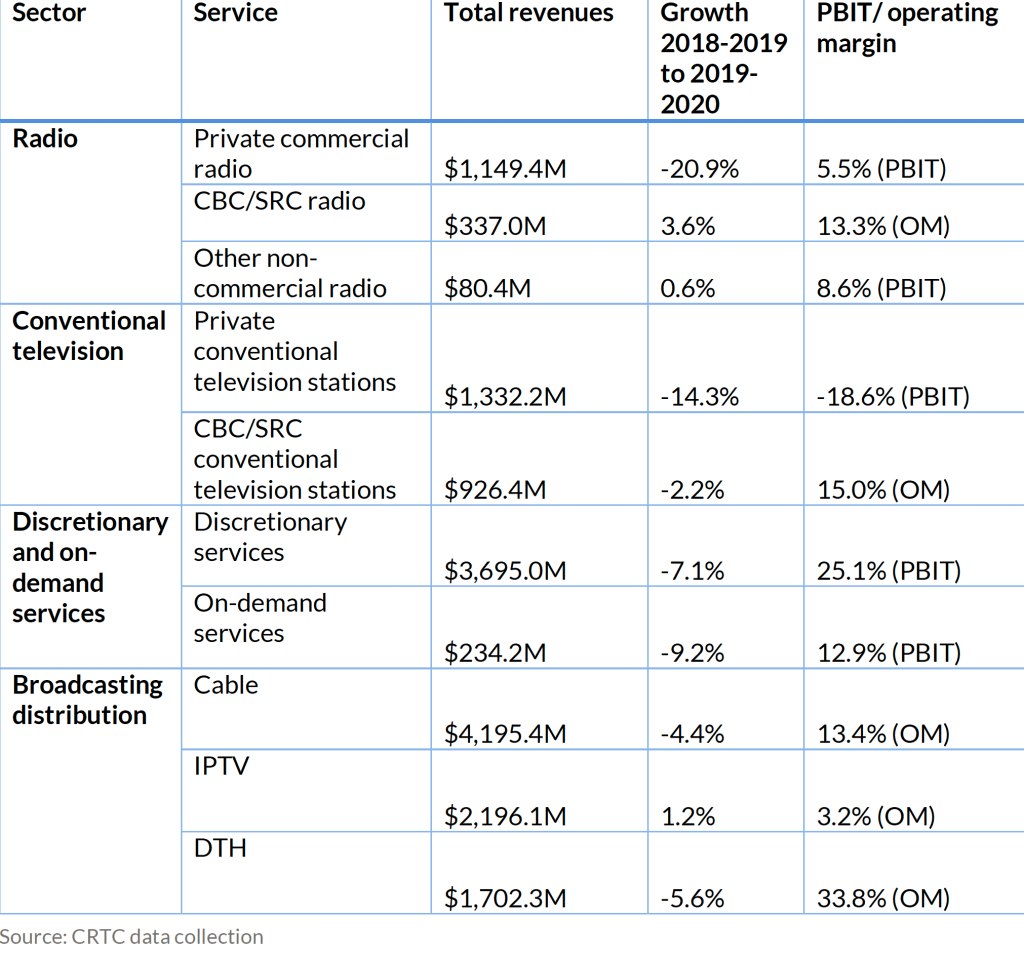
The CRTC mandates a pool of roughly $400 million annually —5% of the revenue earned by regulated cable and satellite companies— to be divided among various content producers. The majority of it goes to the Canada Media Fund and similar “CanCon” funds to make Canadian film and documentaries. The rest goes to “local expression” which until 2016 was each cable company’s own hyperlocal community stations across the country. 

Source: CRTC Financial Summary 2020

The CRTC’s 2016 funding tweak gave major networks like Rogers and Shaw the option to re-direct some or all of their “community” funding to their own “local” stations providing daily news coverage in the same geographical market. That tweak was the Commission’s acknowledgment that the local news industry had been operating in the red for four straight years (today, it’s nine years running).

Rogers and Shaw chose their local news stations over community programming and re-directed those dollars: Shaw’s  boost to their declining revenues at Global News was $13 million. If the merger goes through, it’s gone, the equivalent of about 160 Global News salaries across Canada. It would be naive to think Global is just going to eat that $13 million. There will be less news coverage.

Yet there will be a $13 million windfall for Rogers’ City TV stations in four markets —Vancouver, Calgary, Edmonton, and Winnipeg— which will inherit the “community” funding from the former Shaw cable stations in those markets. 

The City stations are a distant third or fourth in viewership in each of those markets: in Vancouver they are 1/20th the size of the market-leading Global News. Rogers has not given the Commission even a hint of its hiring or programming plans to close that gap in viewership.

Short a cool $13 million, Global News can still apply to the Independent Local News Fund (ILNF) to mitigate that loss. 

The INLF was created by the CRTC in 2016, reallocating a sliver of the existing local expression funding called the Small Market Local Programming Fund, to help local news stations not owned by cable companies and therefore without access to the CRTC’s “community cable” funding. But that $20 million annual funding is already divided up among 20 independent stations such as Hamilton’s CHCH, Victoria’s CHEK, or Newfoundland TV. 

The $20 million pie will be divided into thinner slices for all and certainly won’t replace Global’s $13 million.

This is a perverse result for local news, but once again it’s the regulatory chickens coming home to roost.

In 2008 the Commission took the decline of local news seriously and added a 1% revenue tithe (on top of the existing 5%) on cable companies that flowed to all small and mid market local stations in Canada, almost $100 million annually. During the financial crisis the levy increased to 1.5%. But in 2012 the Commission decided to terminate the funding citing a post-crisis surge in advertising revenues which did not in the end materialize.

It wasn’t long afterwards that it became undeniable to the CRTC that the financial viability of local news was heading relentlessly downwards (See the graph at the top of this post). And so we got the aforementioned 2016 tweaks to local news funding which reallocated rather than increased the Canadian content funding expected from major cable companies.

Corus, which owns Global News along with a strong position in specialty TV channels, has a typical solution to the dilemma of local news: the CRTC should redivide the 5% Canadian content envelope yet again, this time taking money away from films and documentaries funded by the Canada Media Fund and giving it to the ILNF so there is enough money for all of the independent local stations once Global comes looking to replace its $13 million. The beefed up ILNF would have close to $50 million in the kitty.

Corus Submission to CRTC

Does this constant robbing of Peter to pay Paul seem as comical to you as it does to me?

There is a way through however. And that is Bill C-10. 

The Liberals announced in November 23rd’s Throne Speech that they will re-introduce their overhaul of the Broadcasting Act. The raison d’être of C-10 is to get Netflix and the other American Internet TV providers to either make their share of Canadian content or make payments to the “5% fund” we use for Canadian content, including local news.  Bigger pie, bigger slices.

C-10 is an opportunity to provide long term stable funding for local TV news and the government should seize it.

Correction: An earlier version of this blog stated that Rogers only intends to re-invest $7 million of Shaw’s $13 million community cable funds. In fact it intends to re-invest all of the $13 million at the four City-TV stations instead of the twelve Global News stations.