Public broadcasting is about to claim a front row seat in politics…but in the United Kingdom, not Canada. Britain’s Conservative government has served notice to the ad-free BBC —which boasts the most popular news site in the world— that six years hence it will not renew the BBC’s main funding mechanism established in 1946, the “TV tax,” a mandatory licence fee on every TV set. The current annual fee is $270.
None of which has escaped the attention of media commentators here in Canada.
We live in a world in which #defundcbc routinely trends on Twitter and Conservative Opposition Leader Erin O’Toole has promised to do just that (except in Quebec where it would kill him politically).
Loving, hating and reimagining the CBC is the birthright of every Canadian it seems. Globe columnist Andrew Coyne was first off the mark, touting a voluntary subscription fee on ad-free broadcasting with the goal of reducing or eliminating the parliamentary appropriation.
The regulatory future of Big Tech continues as a daily show in US Congress as different bills (none of which directly impact media) make their way through various committees. Microsoft gave it some unexpected immediacy by purchasing the world’s number three video game company, ActivisionBlizzard, (Call of Duty, Candy Crush) for $USD 69 Billion. Microsoft already owns the “pipe” to that gaming content, the ubiquitous Xbox streaming device.
Up until now, Big Tech mergers have been mostly buy-outs of future competitors or the acquisition of media products that fit snuggly into a multi-product ecosystem fed on consumer data. We’ll see what Activision turns out to be for Microsoft.
Big Tech has no hope of keeping itself out of the public eye during an election year in American politics. Democrats attack Facebook for its enabling role in the Stop-the-Steal lie and the Capitol insurrection. Republicans routinely blame Big Tech for almost anything. No less than four Big Tech bills are before Congressional committees.
This week’s most interesting Big Tech news was a federal judge’s ruling that the Federal Trade Commission’s re-filed anti-trust lawsuit against Facebook for its competition-squelching acquisitions of Instagram (back in 2012) and WhatsApp (2014) can proceed. No trial date has been set.
All of this bad publicity for Big Tech will surely colour public opinion on the federal Liberals’ promised legislation against online harms. So far its mostly Facebook and Google’s YouTube getting attention for toxicity on their platforms as befits their market share of online media, however the Globe’s Joe Castaldo spotlighted one of the right-wing up and comers: Toronto-based Rumble competes with YouTube, sans algorithm, and has successfully positioned itself as an alt-right platform.
Her accusation that the CBC is preoccupied with “woke” issues and that journalists are discouraged from pitching hard news stories included the following counterfactual statement:
“It is to endlessly document microaggressions but pay little attention to evictions; to spotlight company’s political platitudes but have little interest in wages or working conditions. It is to allow sweeping societal changes like lockdowns, vaccine mandates, and school closures to roll out — with little debate. To see billionaires amass extraordinary wealth and bureaucrats amass enormous power — with little scrutiny. And to watch the most vulnerable among us die of drug overdoses — with little comment.”
Henley immediately attracted the admiration of “defund the CBC” Erin O’Toole. Henley then agreed to an excoriating interview by Canadaland’s Jesse Brown who demanded she explain her accusations. Worth a read.
Some industry news of importance to local newspapers in both the US and Canada: the New York Times dropped $700 million (CAD) to buy online sports site The Athletic with 400 journalists covering 250 major sports teams in 50 local markets.
But the most memorable scene was the life-imitates-art video starring Succession’s Brian Cox congratulating Ed Rogers on his victory and profanely mocking the departed Natale.
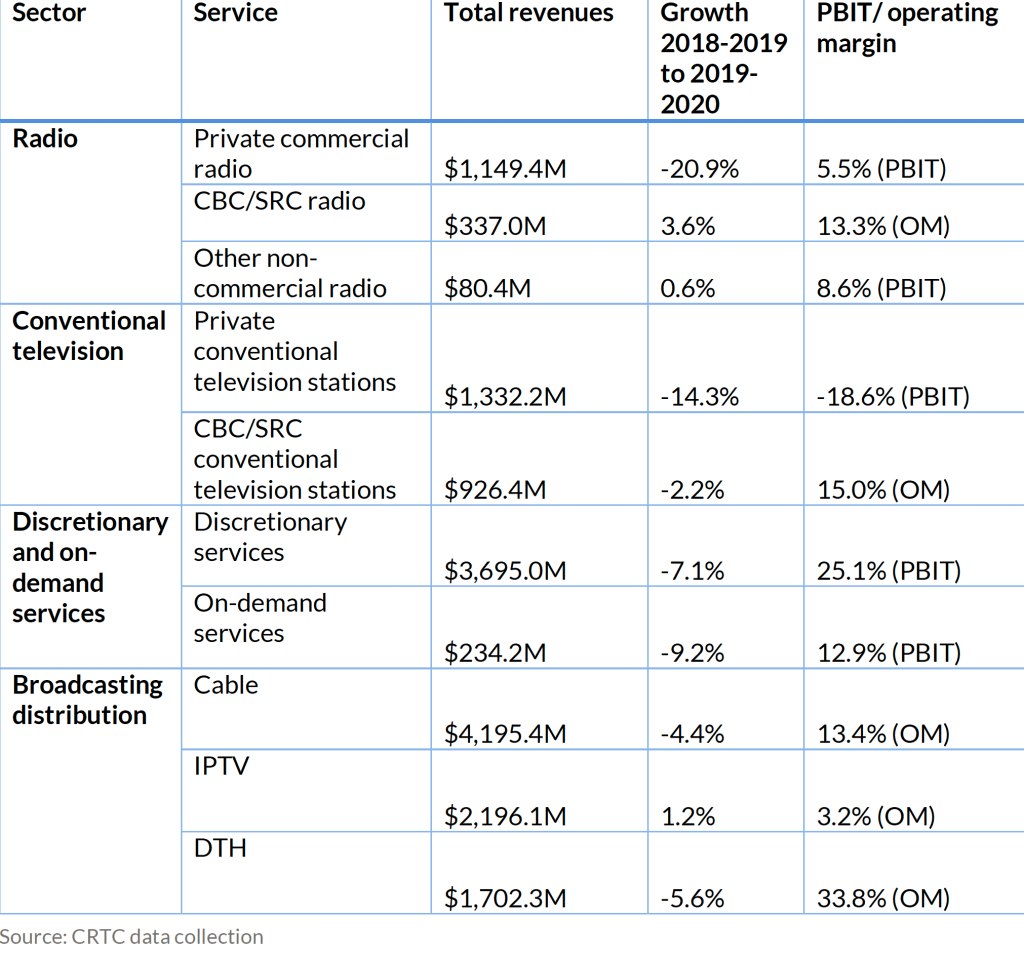
The CRTC’s annual report on broadcasting metrics was released in December for the 2019-2020 year ending August 31st (a 15-month lag). As expected the report revealed the impact of the pandemic’s first six months on media consumption, revenue and profitability.
Key trends from previous years for legacy and Internet TV continued but were accelerated by pandemic conditions for advertising and consumer consumption.
Streaming audio and visual media increased their share of the total market (combining regulated legacy TV and unregulated Internet TV). Lead by Netflix ($1.1 billion in revenue) and YouTube ($900 million), the “over the top” media claimed 25% of media revenue, or a $4.4 Billion slice of a $20 billion pie.
On the flip side, regulated television distributors and broadcasters kept declining. Cable, satellite and IPTV distributors still have 40% of the overall revenue market (at $8 billion) but continued the long term trend of shrinking revenues and profitability.
Meanwhile television broadcasters had a miserable year in 2019-20. Local television continued its eight-year run of losses by plummeting another 14% in revenue and registering a stunning net loss of 18.6% despite the fact that news consumption rose sharply.
The only good news was that normally healthy (and subscription-based) specialty channels were down only 7% in revenue and still showed a 25% profit.
Specialty TV represents 60% of overall broadcasting revenues while advertising-dependent local TV accounts for the rest. However the de facto subsidy of “specialty” to “local” impacts the major broadcasters differently, and does not exist at all for independent local TV stations that do not own specialty channels.
The knock-on effect of the revenue downturn for both distributors and broadcasters is the shrinking budgets for Canadian news, sports and entertainment. As “CanCon” spending is tied to a percentage of earned revenue in the regulated sector, the 2019-2020 year was very bad news.
As for private commercial radio, the sector was down 21% in revenue which hit the local advertising-dependent AM stations the hardest.
Traffic in Twitter posts debating media issues should swell to monumental proportions in 2022. Much will focus on the deeply troubling mayhem of American politics in which the role of Big Tech will feature prominently.
There are several pots boiling on the Big Tech stove in Washington D.C. but Facebook is the biggest. Democrats want Facebook held to account for its enabling of the January 6th Capitol attack. Two former Facebook employees, Frances Haugen and Brandon Silverman, are very publicly making life uncomfortable for CEO Mark Zuckerberg.
On that note you can listen to a great podcast from New York Times Tech columnist Kara Swisher interviewing whistle-blower Haugen who keeps hammering home the message that if Congress would just force Zuckerberg to be more transparent with Facebook’s algorithm and data traffic that would be the straightest line between the political toxicity of today’s Facebook and a healthier platform.
Here in Canada expect a flurry of legislative activity in Ottawa: a reprise of Bill C-10 the Broadcasting Act, legislation to squeeze fair compensation out of Google and Facebook for publishers’ news content, and an Online Harms Bill that will spark a sharp debate over the toxicity of online speech.
Possibly an emerging issue will be whether our federal competition law will prove to be any restraint at all on the rising power and influence of Big Tech or if the Competition Bureau decides to stay out of it. There’s a very good overview in the Toronto Starfrom Amir Barnea.
Although we don’t think of Rogers or Shaw being in the same league as Facebook or the rest of “Big Tech,” if their $26 billion merger is approved by the CRTC and the Competition Bureau that will certainly stir up the big-is-bad conversation. Rogers is pushing for a decision before mid-March.
The Great American News Deserts: from the Washington Post
January 1, 2022
(5 Minute Read)
Hello 2022. New Year’s Day is a good time to reflect upon the state of local news journalism.
For a decade we’ve known that the advertising-dependent business model for local newspapers is broken (local TV and radio news aren’t far behind).
Paid-subscription models —you know, where citizens pay for what we read— are barely making it at the polarities of the market: national audiences reached by the New York Times or the Globe & Mail at one end, and niche followings at the other.
As yet we have no answer for the decline of mass audience news journalism in cities and towns other than the band-aids of government funding or, maybe, cash from Google and Facebook.
Thankfully the collapse of local news has been gradual rather than a dramatic whoosh. But nothing has interrupted the steady decline in revenue, journalists, and news coverage. It’s been charted in both Canada and the US.
So far, Canada’s triage approach to saving local news looks like this:
The federal Liberals’ promise (supported by the Conservatives) of legislation aimed at compelling Google and Facebook to pay publishers fairly for news content, as the Australian government has done.
New tax laws giving non-profit news organizations the opportunity to attract tax-deductible funding from philanthropic foundations and private donors. Montreal’s La Presse is the only major metropolitan newspaper where owners have been willing to dissolve their for-profit corporation and register a non-profit business with Revenue Canada. The Narwhal is the only other major publisher.
A modest readership federal tax credit where taxpayers shell out $500 for news subscriptions to recover $75. Revenue Canada won’t be releasing any data on the success of this program until 2024.
As yet nothing for local TV or news radio. It’s possible the federal Liberals could use the occasion of tabling a revised Bill C-10 Broadcasting Act to inject more industry cross-subsidies into local news.
The US is even further behind than Canada in addressing local journalism’s state of emergency:
For now, no Congressional aid to journalism. Emergency funding failed when President Biden’s Build Back Better omnibus legislation collapsed in December. The more comprehensive approach in a proposed Local Journalism Sustainability Act seems forever stuck in House and Senate committees.
No short-term prospect of Australian-style legislation to compel Google and Facebook to pay for news content.
Public broadcasting is a niche and national news source, with far less funding than the CBC on a per capita basis, and that’s not changing.
American local TV news is in less dire circumstances than Canada because US station owners have something Canadian TV doesn’t have, the intellectual property rights over their on-air broadcasts. This allows US stations to negotiate fees from cable companies picking up their signal.
Enter American media critic Robert McChesney and his frequent collaborator John Nichols with a sweeping, out-of-the-box proposal they call the Local Journalism Initiative, published a month ago (download the 30-minute PDF version below ).
Their starting point is this: the for-profit business model for written news journalism is finished for good at the local level. The only solution is massive public subsidy: a $34 Billion annual federal grant (equivalent to $100 per citizen in a national population of 340 million). Adjusting for population scale, the $34 Billion price tag is about 20 times greater than Canada’s current funding commitments to journalism.
The first thing you need to know about their proposition is they don’t want a dime going to national media organizations or for-profit newspaper chains. They want to sponsor an ecosystem of authentically local, county-by-county, independent newsrooms that adopt a non-profit model.
Here’s how it would work:
Lump sum federal funding would be available every three years for independent, non-profit local newspapers serving only their home county (there are 3000 in the US).
The funding would be up for grabs in a triennial popular vote in each county based on a universal voter franchise. Voters would be able to endorse more than one news source, perhaps up to five in large metropolitan counties.
Based on vote tallies, the term-funding (averaging $11 million annually per county) would be divided proportionately among eligible news organizations that earn at least one per cent of the vote. No news source could receive more than 25% of the funding.
On the thorny issue of defining a legitimate news organization, McChesney and Nichols offer this:
The news organization must be non-profit: as a transitional measure they would allow for-profits if they convert to non-profit within six years;
The news organization must demonstrate legitimacy by publishing regularly for at least six months prior to participating in a funding plebiscite;
The news organization must produce original journalism at least five days per week. Unlike Canadian rules for federal funding, there is no requirement for a minimum amount of news reporting, as opposed to opinion writing;
75% of salaries must be paid to employees in the home county;
The news organization must be completely independent and cannot be a subsidiary of a larger organization, even non-profit; and
The news content must be online and available for free.
Yes it’s a paradigm shifting proposal with a huge price tag.
It helps to understand the perspective that McChesney and Nichols are coming from (they have been writing about the collapse of American journalism for two decades, including their 2010 book “The Death and Life of American Journalism.”).
As they tell it, for-profit chain media companies sucked the lifeblood out of a profitable newspaper industry beginning in the ’90s and ’00s, long before the Internet came along and delivered the coup de grâce.
They are very specific about what is to be saved, describing the core crisis in journalism and democracy as the dramatic loss of local newspapers. Local because the collapse of the business model leaves news deserts where powerful interests act unseen. Local because the every-day stories covered by a small or mid market Press ——stories they describe as “the connective tissue of a community”— “introduce people to their neighbours and encourage them to listen and to empathize with one another.”
That binding community experience is the opposite, they might have added, to the tribalism of social media that is rushing in to fill the void.
You don’t have to buy into all of McChesney and Nichols’ broader analysis (although you may recognize some of your own observations about media and politics in the pages of their books).
Their proposal presents as Utopian in 2021. But the consideration is whether by the end of the decade our local news media will be such a blasted landscape that sooner or later we are going to reach for paradigm-shifting solutions.
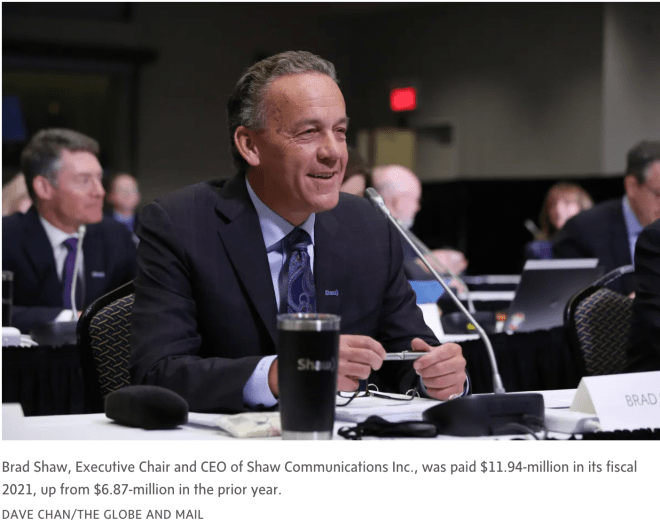
Brad Shaw’s ker-ching moment. The Globeand Mail’s David Milstead reports that Brad Shaw’s CEO pay packet doubled this year to $12 million (the average compensation for CEO of a TSX company is $7.65 million). If the Rogers-Shaw merger is approved, the son of company founder J.R. Shaw will oversee a $26 billion sale to the Rogers family. He also boasts one of Canada’s top corporate pensions at $134 million.
The Conservative Party shadow Minister for Digital Government Rachael Harder Thomas will no doubt have something to say about the federal government’s Online Harms Bill when it is tabled some time in 2022. She made the news last week by spreading misinformation about Covid vaccines, a second occurrence in her case.
The lobby organization Open Media was written up in Le Devoir but not in a good way (an English translation can be downloaded below). Ulysse Bergeron reports that the organization known for its sensationalist fundraising appeals in opposing regulation of the Internet is heavily funded by impacted tech companies Google, Twitter and Canadian ISP provider Tek Savvy. Open Media was harshly critical of the CRTC decision on Internet wholesale rates that retailer Tek Savvy pays . Open Media’s Board of Directors is chaired by Dylan Blanchard, until recently a senior executive at the Toronto-based Internet giant Shopify. The Board includes a second Shopify executive and a former employee at Tek Savvy.
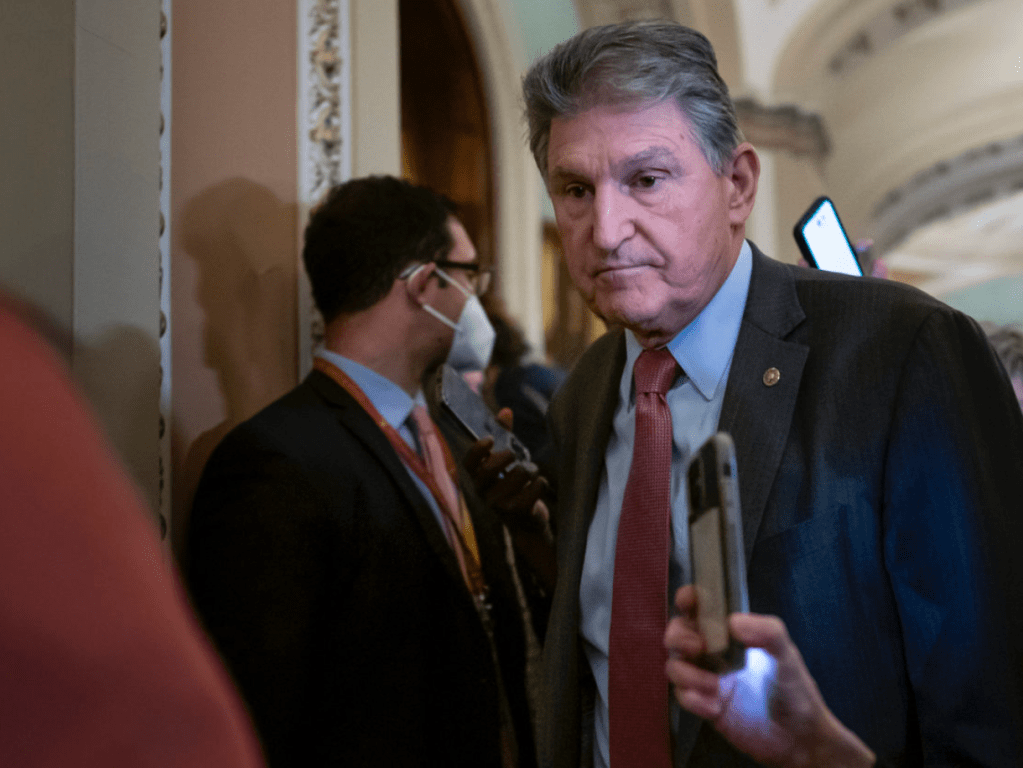
In US Congress federal aid to journalism was on the cusp of success when it fell along with the rest of the Democrats’ $1.75 trillion Build Back Better omnibus legislation. Centrist Democratic Senator Joe Manchen (W.Va.) appeared on Fox News to announce his firmly decided opposition to the Bill, ending lengthy negotiations to pass the legislation.
All good things must come to an end. Even for media policy nerds.
The final legal submissions in the CRTC’s hearing on the proposed $26 Billion Rogers-Shaw merger are filed at last. You can download those authored by the principal antagonists, below.
On paper this merger is poised on a knife-edge. Rogers has the onus —how heavy or light depends on the gut instincts of the Commission— to show that the merger of $5 Billion in broadcasting distribution assets is in the public interest or at the very least isn’t harmful to it.
Rogers has placed all of its casino chips on red: its number one argument by far is that a bigger Rogers will be the corporate champion Canada needs to build out its state-of-the-art video distribution system using its Comcast-licensed “Ignite” television platform that hosts both linear channels and streaming apps.
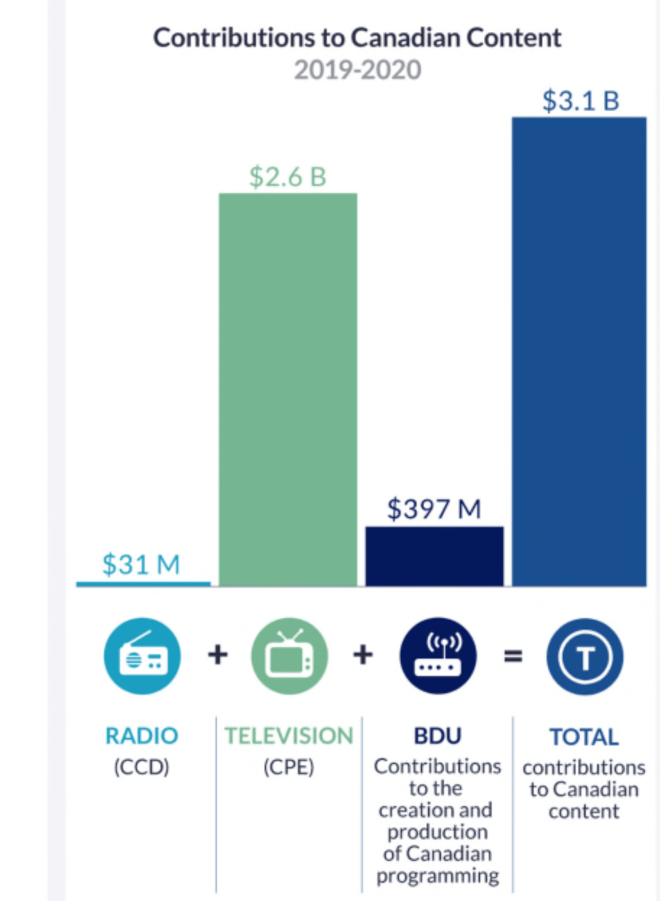
It is this Internet Protocol Television (IPTV) platform, says Rogers, that can fight back against cord-cutting and keep Canadian viewers in the regulated system which generates $3 Billion annually in the funding of Canadian content and local news. If Canadian television platforms are going to compete with streaming boxes, desk-tops, tablets and phones for viewers, their IPTV platforms have to be first-class.
Source: CRTC Report 2019-2020
While Rogers makes an appealing case for the technological pre-conditions of saving Canadian video content, Bell and Telus counter that IPTV platforms are expanding and upgrading all the time. Doing it faster is not a justification to double Rogers’ market share of the English language distribution to 47%, well ahead of Bell’s second place 28%, they say.
Bell piles on this too-big-is-too-dangerous argument, citing the Commission’s 2008 ruling setting general guidelines on how big is too big in media mergers. But Rogers says they are in compliance regardless of an increased national market share because it is only stepping into the shoes of Shaw in provincial markets where Rogers has no presence, so no harm done, especially to consumers.
Bell responds that the Commission policy is broader than just a consideration of market concentration in local markets and the Commission has to recognize that a twice-as-big Rogers will be buying programming from other media companies in national distribution deals, not provincial deals, and 47% is too much market power.
Bell elaborates that Rogers’ doubled size as a purchaser of Canadian programming from rival broadcasters and independent programming services for distribution on Ignite inevitably means more money for Rogers and less for broadcasters and specialty channels: every dollar of revenue lost to those broadcasters means 30 cents less spent on Canadian programming under CRTC rules.
Is Rogers’ “Ignite will save Canadian broadcasting” pitch enough to sway the CRTC?
The remainder of the major objections to the merger probably don’t threaten the application.
Telus argued during the CRTC hearings that a twice-as-big Rogers plans to shut its cable competitors out of platforming a Netflix or Disney Plus channel as well as withholding must-have hockey and baseball games broadcast on Rogers Sportsnet.
Telus believes it has spotted a loophole in the CRTC “undue preference” regulations that normally prohibit a big media company like Rogers from selling their shows (i.e. Sportsnet) on regulated linear channels exclusively to its own cable operation while cutting out rival distribution services but allows it so long as the content is streaming-only.
Telus (with some encouragement from Bell) also says a bigger Rogers could afford to pay Netflix top dollar to be the only Canadian television platform to host the movie app, using the same Sportsnet loophole.
Rogers says all this is tosh: it makes no business sense, Telus is mistaken about a loophole, and in any event they promise (at least so far as Netflix and foreign apps are concerned) not to do it.
Pro tip: don’t expect this to be a deal breaker for the Commission.
There are other important issues volleyed back and forth in the written submissions, but none are likely to sway the Commission’s final ruling.
For now we wait as its likely the Commission will prudently defer its decision until the Competition Bureau and the federal cabinet figure out what to do with the lion’s share of the proposed merger, the wireless and Internet service assets.
All powerful US Senator Joe Manchin is said to favour government subsidies to journalism currently part of President Biden’s Build Back Better legislation.
December 19, 2021
Hey Google, Search this: France is vying with Australia for the title of feisty small sovereign nation (desolé) taking on Big Tech, having recently slapped Google with a $725 million fine for failing to negotiate seriously France’s implementation of the 2019 EU Copyright Directive for online platforms and publishers.
“American exceptionalism” means a lot of different things including staying at the back of the pack of jurisdictions pursuing Big Tech on pay-for-news-content and other monopoly abuses.
Government backstopping to those private negotiations through legislated binding arbitration: Australia and the EU Directive as implemented in France. A Canadian Bill is on its way early in 2022.
Direct government subsidies to news outlets, usually as a per journalist salary subsidy: several European countries for years, Canada, and perhaps the US if the BBB legislation gets through the Senate.
Tax laws that incent philanthropic donations to journalism projects: widespread in the US which has a long history of favourable tax regimes and billionaire patronage. The Canadian federal government made this move in 2019 with little effect so far.
Limited tax deductions for customer subscriptions: again legislated by Ottawa in 2019 but Canada Revenue Agency isn’t scheduled to report statistics until 2024.
A recent story in Canadaland “Trudeau’s $10 million top-up fund” is written as an exposé of federal funding of journalism and states that “government approved news organizations are not limited to receiving money from just one fund —many tap several of these initiatives at once, and some of the biggest media brands in Canada have successfully applied for all of them.”
The story cites Postmedia (120 daily and weekly newspapers), Black Press (120 Canadian publications) and magazine publisher St. Joseph’s as examples of big media brands tapping federal funding.
But the story neglects to mention that media companies owning multiple publications can only claim from one fund for any single publication. And there are four federal funds dedicated to four different types of publications.
Here’s how it works:
The Journalism Labour Tax Credit (JLTC) is available to daily newspapers. The $95M annual program made a lot of political noise when it was introduced in 2019. The Fund was administered initially by an independent third-party committee tasked to determine who was a legitimate news organization and not a political action group. Now payments are processed by the Canada Revenue Agency. The program amounts to a $14,000 annual salary subsidy, per journalist. All major dailies in Canada draw from this Fund.
A second fund the “Aid to Publishers” (ATP) program is administered by Heritage Canada. ATP pays annual grants to eligible magazines and free weekly newspapers providing “high quality news content.” Its annual budget is about $70M. About 750 publications qualified last year.
Aid to Publishers has existed since 1867. Originally it was a postal subsidy for the distribution of news to rural areas.
Due to the Pandemic-induced acceleration of the decline in advertising revenues, the Liberal government introduced an Emergency Support Fund in May 2020 that included a temporary 25% increase in the ATP program worth $15M for fiscal 2020-21. It was extended in July 2021 for the fiscal year ending March 31, 2022 at a cost of $10M. It would not be accurate to characterize the ATP top-up and the ATP as separate funds.
Importantly, publications funded by JLTC are ineligible for ATP funding, and vice versa.
Finally, the Emergency Support Fund also included a new $45M funding envelope for about 800 publications ineligible for either the JLTC or ATP, but similarly hard hit by the Pandemic’s plunge in advertising revenues.
Dubbed the “Special Measures for Journalism”(SMJ), the funding goes to Canadian publications such as trade journals, lifestyle publications or other titles that do not publish sufficient news coverage to qualify for the ATP or JLTC. The SMJ was extended for the current fiscal year at a cost of $21.5M. There is no indication from the federal government that this program is here to stay: it is part of the Pandemic “recovery fund.”
Again, the same publication cannot draw from more than one fund.
I have not cross compared LJI recipients against other journalism funds, but it’s likely there are some LJI recipient publications drawing from one of the other journalism funds. However it ought to be noted that the LJI’s purpose is to expand news coverage to neglected communities or beats, as opposed to the other funds subsidizing existing coverage.
The Canadaland story also takes aim at a handful of publishers: the Chinese language newspaper Ming Pao (too pro-China); The Walrus magazine (too close to the Liberals); and of course Postmedia (too everything).
The very big and very right-wing Postmedia is a favourite piñata for mainstream media haters (it vies with Bell for that distinction). One of the darts sent its way in the article deserves some comment because it’s misleading.
The story cites the significant dollar amounts that Postmedia (the biggest newspaper publisher in the country) has drawn from the journalism funds, how many community newspapers and jobs it has cut, and “a $52.8 million net profit in January [2021].”
I suppose the implication is that Postmedia is lining its profitable pockets with federal cash. The $52.8M figure however is exceptional as an operating income figure: it is cherry-picked from one quarterly report, Q1 2020-2021. I have posted below a spreadsheet of key debt, dividend, cost-cutting, revenue, profit and loss figures from Postmedia’s annual reports over the last four fiscal years ending August 31. You can draw your own conclusions.
Also, the $52.8M figure comes from the fiscal quarter in which Postmedia accrued a one-time $63M non-cash accounting gain on merger of its pension plan negotiated with its major union Unifor which resulted in an inflation-indexed (and more secure) pension for employees and a significant reduction in future unfunded pension liabilities for Postmedia.
This is good place to disclose: before retiring from Unifor after 33-years as a union rep, I assisted union locals in negotiating collective agreements with many large and small Canadian media companies, including staff contracts at the National Post, the Toronto Sun and other Postmedia newspapers.
Speaking of persons Australian, Wikileaks founder Julian Assange has been ordered extradited to the US by the British High Court, discounting his mental health defence. The US wants to put Assange on trial for an alleged conspiracy with US Army Intelligence analyst Chelsea Manning to hack military secrets published by Wikileaks, a charge Assange denies. Unless the High Court order is reversed, a trial promises to be a David v. Goliath collision between press freedom and military secrecy and security.
The US philanthropic local journalism initiative Report for America announced a major expansion of its internship program to 325 posts in 270 newsrooms in 50 states. The non-profit group is underwritten by private funders, including the Knight Foundation, the Walton Family Foundation (Walmart), Google and Facebook.








 MediaPolicy.ca