Corus Entertainment Q3 Report 2022-23
October 29, 2023
Last week MediaPolicy.ca posted twice.
The first was a take on the stand-off between Google and the federal government over the Online News Act Bill C-18 and the pending throttle of Canadian news on Google’s search engine. I had been saving up my thoughts about the Bill for several weeks and have spilled them in this longer article that was originally published by the Institute for Research on Public Policy.
The other post speculated on how Heritage Minister Pascale St.-Onge might edit the government’s policy guidelines to the CRTC on implementing the Online Streaming Act, Bill C-11. Practically speaking, the government can use a Policy Direction to nudge the CRTC towards outcomes such as equitable contributions by US streamers, regulatory relief for Canadian broadcasters, the definition of a Canadian program for the purpose of subsidies and regulatory obligations, and the discoverability of online Canadian content through platform “recommendations.”
Shortly after the latter MediaPolicy post, Heritage Canada published the public comments it received on its draft Policy Direction. The comments mostly reiterate points debated over the last three years, beginning with the tabling of Bill C-10 in November 2020 and continuing through written submissions to the CRTC this July. I counted 991 comments (not 1400 as I reported earlier) submitted by close to 400 organizations and individuals. So if you want to read them, knock yourself out.
This space has tracked most of these issues over the last three years, but there were at least two issues that I hadn’t noticed before.
The first is how the independent Canadian television producers who supply most of the Canadian programs to licensed broadcasters, especially the CBC, are under siege from all sides.
It is old news that Netflix and the other US studios and streamers are asking for radical changes to the current definition of a Canadian program. Their proposed changes would allow them to supplant Canadian creatives with Hollywood talent. They would also strip Canadian producers of the opportunity to retain the long term licensing rights to the shows they make for Canadian broadcasters but also in the future for US streamers commissioning their own Canadian content.
Now Canadian broadcasters Corus Entertainment and Blue Ant are looking for some kind of roll back of regulatory rules obliging them to commission independent producers to make 75% of their dramas and documentaries, instead of allowing the broadcasters to commission their own affiliated production divisions (for example, the Corus-owned Nelvana).
The Commission has yet to announce dates to consider the definition of Canadian programming but when it does it will be a historic debate.
Another issue that I fished out of the public comments was pointed out by ASDIQ (representing French language independent music labels) and the Montréal based Coalition for the Diversity of Cultural Expression (CDEC). They note that the government’s draft Policy Direction appears to ignore Parliament’s explicit mandate to the CRTC regarding streaming platforms making “recommendations” of Canadian content. The Policy Direction currently employs the softer terminology of “discoverability” and “showcasing.” The streamers argue that ought to be restricted to offline promotion and no changes to their current set up of online tabs and search tools. Michael Geist’s submission is that so far no other country has required streamers to use recommendation tools (although the extensive discoverability obligations in France include “programme recommendations.”)
We should see the Minister’s final version of the regulation before the Commission begins Phase One of public hearings on the implementation of C-11 beginning November 20th.
***
Over the next few months (and years) we will hear more about Online Safety and Artificial Intelligence Large Language Models (for example, ChatGPT and its competitors).
The Liberals have promised an Online Safety Bill that will make the heated debates over Bills C-11 and C-18 look mild by comparison. We have the advantage of the British moving first with their own legislation which was recently passed into law and caused quite a stir. Here’s a brief BBC explainer.
The public policy issues for AI are just beginning to be identified and promise to be as endless as the Internet. Aside from the apocalyptic fears for public safety, there are the familiar issues around copyright. That includes the rights of countless content creators whose material is scraped by AI companies for profit. Lawsuits are proliferating.
AI companies themselves will push for copyright protection for their machine-made output, a challenge for copyright laws that only concede the protection of intellectual property to human beings.
***
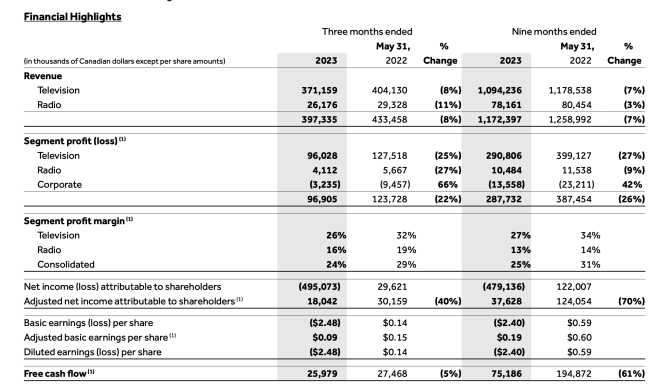
The CRTC announced it is favourably disposed towards granting a request from the financially struggling Corus Entertainment to scale back its licence obligation to commission and broadcast dramas and documentaries.
Subject to public comment, the Commission may allow Corus to reduce its spending on generally unprofitable “Programs of National Interest” from 8.5% to 5% of television revenues. The 3.5% would be spent on more profitable Canadian shows it broadcasts on its family, lifestyle and unscripted drama channels.
CEO Doug Murphy was quoted in Cartt.ca as saying a favourable CRTC ruling would “provide the much-needed flexibility in our content planning and spending for the coming years by letting us focus more on producing the best content that drives our linear and digital businesses.”
Corus has been asking for a regulatory break for some time and is pointing to its steep decline in cash-flow as the justification (allowing the Commission to deflect the inevitable “me too” demands from Bell, Rogers and Québecor).
The context to this latest development is that the CRTC has parked multiple requests from Canadian broadcasters to immediately reduce their Canadian programming obligations. Those demands are going to be taken up by the Commission in its major public proceeding over implementation of Bill C-11. In fact the Commission imposed an “administrative” extension of broadcasting licences (and Canadian programming obligations) until August 2026 to maintain the status quo during that lengthy proceeding. That has Bell marching off to the Federal Court on the grounds that the Commission cannot do so without a public hearing.
***
If you would like regular notifications of future posts from MediaPolicy.ca you can follow this site by signing up under the Follow button in the bottom right corner of the home page;
or e-mail howard.law@bell.net to be added to the weekly update;
or follow @howardalaw on Twitter.

 MediaPolicy.ca
Thank you for this write up. As I prepare for my in person intervention at CRTC2023-138 I find not having staff is supplanted by great writing I find on X.
LikeLike