Catching Up on MediaPolicy – Atlantic newspapers bankrupt – Atwood on the mercenary victims of hate speech – the annoying Jesse Brown
March 16, 2024
The media misery meter spiked again this week as the Atlantic Canada newspaper chain SaltWire announced it was applying for creditor protection. By Wednesday, a court had granted it. SaltWire is the second Canadian newspaper chain to seek creditor protection in six weeks, Black Press did so in January.
SaltWire owns metropolitan dailies in Charlottetown, Sydney, St.John’s and Halifax and a variety of community papers.
There is a backstory of financial miscalculation. SaltWire bought 24 local newspapers in 2017 from Transcontinental, then unsuccessfully launched suit on the grounds that Transcon had withheld damaging information about the state of the business.
The bankruptcy is in response to SaltWire being chased by the financier, Fiera Private Debt, that supplied the cash for the Transcontinental purchase. That’s not the entire story of course. The Fiera debt is at most half of what SaltWire owes to all creditors.
This presents an opportunity for me to plug, one more time, my interview with CEO Jeff Elgie of Village Media, the successful community news network in Ontario. The popularity of the post took me by surprise: it sped past an old post about Margaret Atwood to become the second most read post in MediaPolicy’s short history.
***
You don’t need any help from MediaPolicy to point you to the public debate on the federal hate speech Bill C-63. The generous supply of condemnation from the nation’s free speech ultras is difficult to miss.
The focus of most criticism is not on the “online safety” part of the Bill —where social media platforms are required to step up their content moderation and filtering, particularly where kids are concerned. Rather, the reaction is to the hate speech amendments to the Human Rights Act and the Criminal Code.
Why we need stronger criminal sanctions against hate speech is something the government is going to have to do a better job of communicating. It will have that opportunity when the Bill hits Committee after Second Reading.
The other objective of the Bill is to reinstate section 13 of the Human Rights Act, repealed with much fanfare in 2012. That was the subject of Ms. Atwood’s ire as she was bold enough to ask out loud what others might be thinking: won’t the Commission be flooded with revenge complaints and mercenaries trawling for the (up to) $20,000 compensation that the Commission can order for victims of hate speech spread across the Internet?
Another castigation of the Human Rights amendments came from David Thomas, the former chair of the Human Rights Tribunal (appointed to a seven year term in 2014 by Stephen Harper). His flamboyant guest column in the National Post echoes Atwood on the gates opening wide for mercenary complainants.
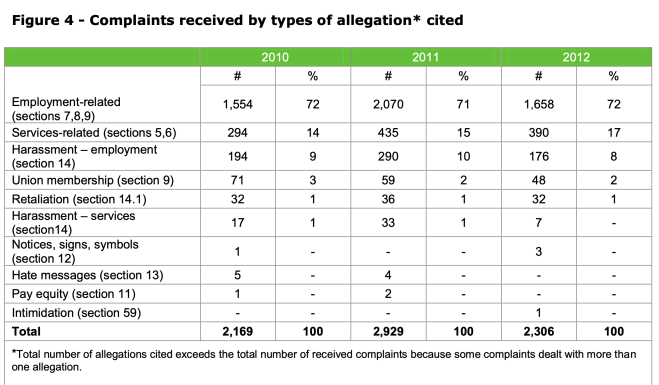
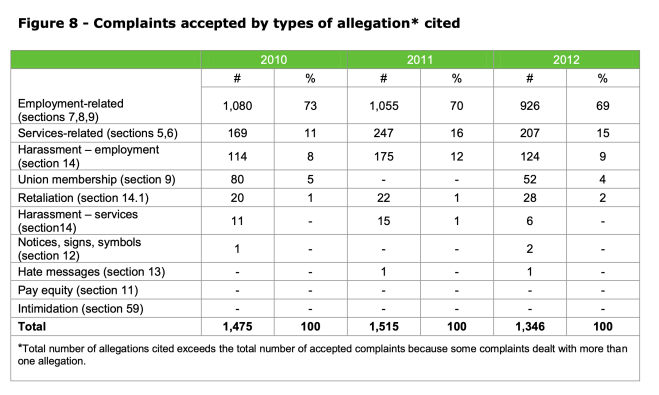
That got me curious about data, so I contacted the librarian at the Commission and asked for numbers on the section 13 caseload before it was repealed. It seems the Commission’s Annual Reports began tracking (or at least reporting) that in 2010 as section 13 became increasingly controversial.
In 2012 for example, the Commission received 1500 complaints overall (not just section 13). Half were weeded out at the complaint stage, 209 were settled, 190 were dismissed and 113 were sent on for adjudication by the Human Rights Tribunal.
As for section 13 complaints here is the data, which may not be what Mr. Thomas or Ms. Atwood would expect.
Complaints received by the Commission:
Complaints “accepted” (i.e. processed for further determination):
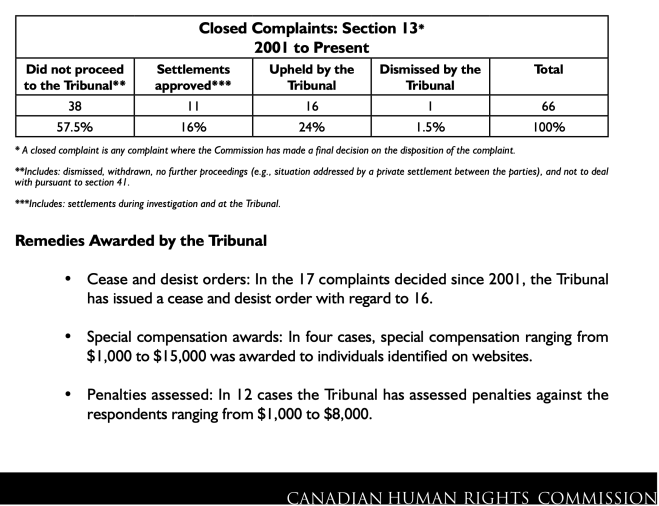
Richard Moon, the hate speech expert who recommended in 2008 that section 13 be abolished in favour of greater enforcement of Criminal Code laws, suggested that the flow of human rights complaints through the federal Commission and Tribunal was modest:
BetweenJanuary 2001 and September 2008 the [Commission] received 73 section 13 complaints (about 2% ofthe total number of complaints received by the CHRC). Of these, 32 were closed or dismissed bythe CHRC and 34 were sent to the [Tribunal] for adjudication... Of the 34 complaints that were sent to the CHRT, 10 wereresolved prior to adjudication. In September 2008, 8 of the complaints forwarded to the CHRTwere awaiting conciliation/adjudication. In the remaining 16 cases the CHRT found thatsection 13 had been breached and imposed a cease and desist order. In several of these cases theTribunal also imposed monetary penalties.
***
The federal government has done the expected and made a five-year funding commitment to the Indigenous Screen Office at $13 million annually in production funds, to be disbursed by the ISO to Indigenous filmmakers.
The ISO has emerged as a parallel institution to the Canada Media Fund that channels production dollars to independent Canadian producers for “CanCon” shows that are broadcast on television and streaming platforms. The CMF receives funding from both the federal government and, upon the direction of the CRTC, Canadian cable companies.
One of the regulatory issues to be determined by the CRTC under Bill C-11 is whether both of the CMF and ISO will be able to supplement their existing funding from a levy on foreign streaming platforms.
***
Dipping into the ocean of political opinion out there, I recommend a Canadaland podcast hosted by the very annoying Jesse Brown with an excellent panel consisting of Jen Gerson, Paul Wells and Stephen Marche.
The subject is blue skying about a Pierre Poilievre government.
You know that aphorism about good journalism “saying one true thing”? You will hear lots of that in this podcast. And plenty of annoying stuff too, so it’s worth your time.
***
And if all this politics gets you down, brighten up your day by enjoying London Ontario’s Ryan Gosling knockin’ ‘em dead at the Oscars.
***
If you would like regular notifications of future posts from MediaPolicy.ca you can follow this site by signing up under the Follow button in the bottom right corner of the home page;
or e-mail howard.law@bell.net to be added to the weekly update;
I am retired staff of Unifor, the union representing 300,000 Canadians in twenty different sectors of the economy, including 10,000 journalists and media workers. As the former Director of the Media Sector and as an unapologetic cultural nationalist, I have an abiding passion for public policy in Canadian media.
View all posts by Howard Law
One thought on “Catching Up on MediaPolicy – Atlantic newspapers bankrupt – Atwood on the mercenary victims of hate speech – the annoying Jesse Brown”



 MediaPolicy.ca
One thought on “Catching Up on MediaPolicy – Atlantic newspapers bankrupt – Atwood on the mercenary victims of hate speech – the annoying Jesse Brown”