March 27, 2026
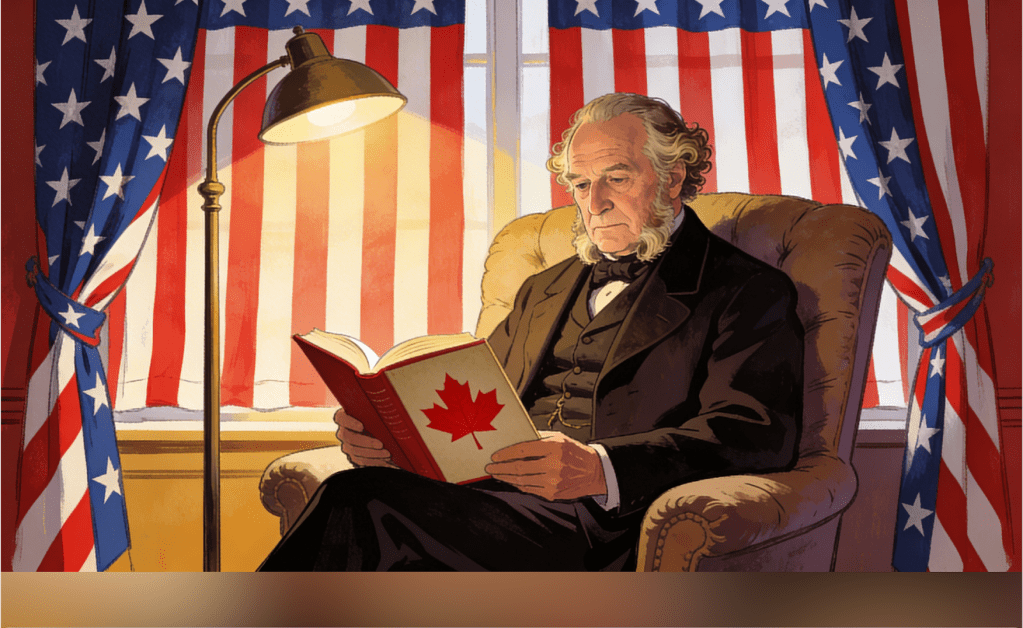
In January, Sutherland Books published Richard Stursberg’s tonic for the anemic domestic market in Canadian authored books, Lament for a Literature.
Now semi-retired, Stursberg served as a senior advisor on cultural policy to the Mulroney government and went on to a string of important jobs in cultural production that culminated with a tour of duty as the VP English services at the CBC. He wrote a memoir of his CBC days, The Tower of Babble, which is a fun read (though not for his skewered adversaries).
Lament for a Literature chronicles the decline of the Canadian book publishing industry and Canadian authored books in a domestic market dominated by foreign book houses. The Canadian book publishing landscape is dominated by a handful of multinational publishers owning 95% of book sales, with small independent Canadian publishers chasing what’s left. And that’s before we consider the chokehold on book distribution that Amazon and Indigo have and the implications of that for publisher profits and author royalties.
MediaPolicy reviewed the 100-page book that is bursting at the seams with major public policy proposals to reverse the decline.
To get a better handle on his proposals, I interviewed him.
***
MediaPolicy: How’s Lament for a Literature doing?
Richard Stursberg: I would say I’ve been very pleased so far. A lot of reactions. There was an excerpt published in the National Post. And they had over 400 reader comments before they cut them off.
MP: You saw my review of your book?
RS: Yes, and John Ibbitson did one in the Globe, and there’s an interview in Canadian Affairs.
MP: About that interview, they asked you a lot about the cultural controversy you stride right into in the book, this contested terrain of decolonizing literature versus telling iconic Canadian stories. The bottom line in your book is that we need to legislate help for Canadian book publishing. But you can’t legislate the cultural zeitgeist, can you?
RS: No you clearly can’t. The difficulty for a curator of cultural funding, like the Canada Council for the Arts, is you end up pursuing an ideological agenda by carving up a fixed budget for book publishing based a policy agenda. And I don’t think that’s what you want to do. I think what you want to do is something different, which is to create a set of arrangements that allow publishers and writers to decide what they are going to write, not bureaucrats.
And the way you do that is simple. You make the book subsidies automatic, like we do in film and television tax credits. And so you get rid of this sort of notion that we’re going to have people sitting around and deeming what’s worthy and what’s not worthy, and what’s politically correct or not. You leave the decisions about what gets published in the hands of authors and publishers.
MP: Right. You talk in Lament about this tax credit, this subsidy program that we already have in film and TV. You are proposing that something like that would replace the federal budget lines for the Canada Book Fund and the book funding program inside the Canada Council?
RS: Yeah. And the way the TV credits work is that typically they’re labour-based. The producer files a cost report and then as a certain proportion of those total costs the government sends you a cheque. Now, there’s two good things that happen with this which don’t happen with any of the book programs.
Right now, the book programs are all zero-sum. So, one publisher gets more, the other has to get less. That doesn’t happen with television tax credits. It would allow you to grow the book industry.
But secondly, what happens is the tax credits are bankable. The publisher can take the tax credit down to the bank and get a loan, more investment [for author advances or marketing].
And they will. You can’t do that with the current book program because you never know how much money is going to come out the other end.
MP: You also write in Lament that we need to re-establish Canadian ownership of publishing houses if we’re going to revive Canadian books. Isn’t the horse out of the barn on Canadian ownership?
RS: The horse is out of the barn and into the meadow. He’s been grazing for a long time. Ninety-five per cent of book sales in Canada go to foreign owned publishers.
MP: So reversing that foreign ownership is not your top priority?
RS: Well I would say this. We should have a federal ownership review process that is transparent. The whole secrecy is bizarre. The entire process over the years has been a complete disaster. The last one was Allan Lau’s Wattpad, it was sold to a Korean company in 2021.
MP: I think the most challenging policy proposal in the book is to create a Canadian rights market where foreign publishers have to make deals with Canadian book publishers to have their foreign-authored books retailed and distributed in
RS: I don’t know if it’s back to the future. No doubt, it would be a little complicated to set it up. But it’s a way of compensating for having allowed the industry to have become completely dominated by multinational publishers. The first right of refusal has to go to Canadian publishers and distributors.
We know that in the early days, whether it was Macmillan or McClelland & Stewart, that’s how they made a lot of their money and financed these extraordinary lists of Canadian artists. With a rights policy, you’re trying to recreate that publisher capacity.
MP: Another proposal you make that also looks complicated to me is your idea to stop Amazon and Indigo from undercutting independent Canadian bookstores on discount pricing. Straight-up price regulation, in other words.
RS: It’s worked in Germany and France for decades. Quebec too. And the reason why it’s a good law is threefold.
One is that, outside of Quebec, our independent bookstores can’t compete. It’s because they’re small and their margins are small, with giants like Amazon or Chapters. But independent bookstores are very important, because one of the fundamental ways to promote books is so-called hand selling at your local bookstore.
You go there. They know you. They know your taste. They say you might be interested in this new title.
So you, you know, instead of saying to yourself, “oh, I think I’ll go to Chapters, because I’ll get 20% off,” it’s the same price everywhere. In France, not only does Amazon have to sell it at the same retail price as everybody else, but they have to charge 10 euros for shipping.
And it’s been very successful. You walk around Paris and there’s a small independent bookstore on every block. And they’re very good.
And you look at the statistics as to the extent to which the French read French authors. Something like, about 55 to 60 percent of all the bestsellers in France are written by French authors.
MP: I think I’m only part way through your list of proposals. It’s a lot and some of it might not even be in federal jurisdiction which means you have to shop the ideas to provincial premiers.
RS: Yes, it’s an ambitious proposal. Any one of them is an ambitious proposal, but altogether it’s an ambitious proposal.
MP: I’m thinking, okay, it makes it a lot easier if the federal government can act alone rather than doing anything that the provinces can object to.
RS: So, in Quebec it’s no big deal. They’ve had their book law, their Loi de Livres, since 1981. Quebec publishers of French language domestic books have 51% of sales in their own market.
It’s because their book law requires schools, libraries and universities to source their books from independent Quebec-based bookstores. They can’t source them from Amazon or from anybody else outside the country. That seems to me to be like almost a silver bullet.
To sell books to those key institutional buyers, you have to be an accredited bookstore.
MP: What does it mean to be an accredited bookstore?
RS: It means that you have to not only be in Quebec, but Canadian owned and operated. It means you have to carry somewhere between 2,000 and 3,000 Quebec titles in your store. So when people walk into the store, there’s lots of books to them, select them, some that are local.
And you can see, this is a big shift because if you went back 30, 40 years, the Quebec book market was in many ways much weaker than the English-Canadian book market.
MP: Do you think you can get the attention of Canadian Heritage with Lament?
RS: The thing that’s so amazing to me is that a lot of these policy models are well-known because they’ve been trialed out elsewhere, whether they’re tax credits or top-ups for distribution or whatever they happen to be. Or, you know, they’ve been tried out for years and years in the TV and film business. And for some reason or another, despite the fact they’re all in the same Department, none of it seems to have penetrated Canadian Heritage’s book people.
MP: Very odd. Well, is it odd?
RS: I think it’s odd.
MP: Well, in the real world of politics and influence, is it any surprise that the television industry has had more success in getting Heritage to implement helpful things than the wee little book industry?
RS: Well, yeah, you’re doubtless right.
***
If you would like regular notifications of future posts from MediaPolicy.ca you can follow this site by signing up under the Follow button in the bottom right corner of the home page;
or sign up for a free subscription to MediaPolicy.ca on Substack;
or follow @howardalaw on X or Howard Law on LinkedIn.
COMMENTS ARE WELCOME. But be advised they are public once I hit the “approve” button, so mark them private if you don’t want them approved.
I can be reached by e-mail at howard.law@bell.net.
This blog post is copyrighted by Howard Law, all rights reserved. 2026.

 MediaPolicy.ca