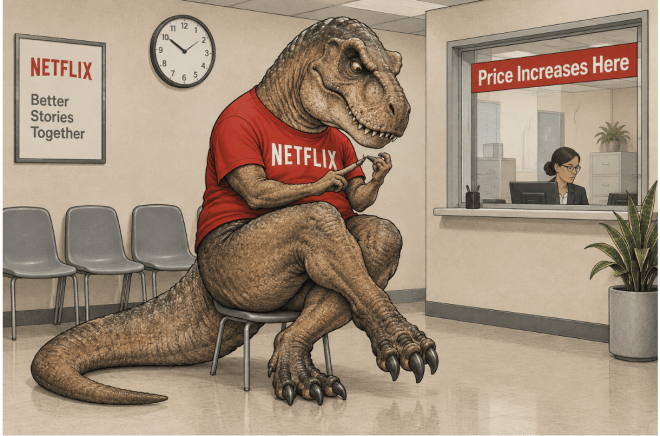
In case of trade war, break glass

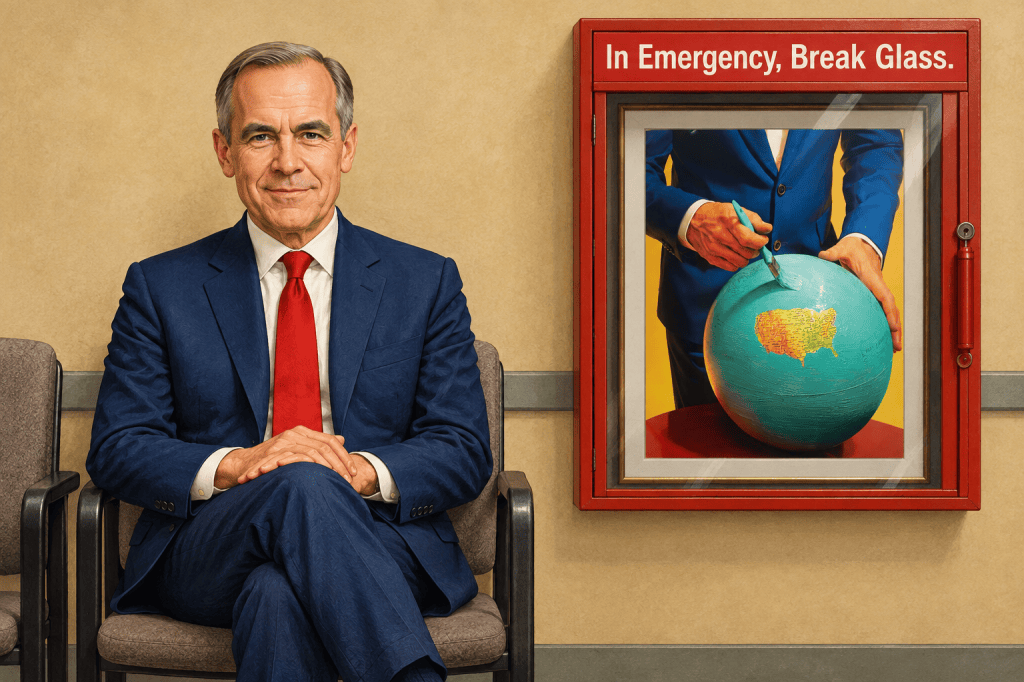
(Satiric AI illustration. The painting in the cabinet is from Toiletpaper by Cattelan and Ferrari)

September 16, 2026

For the moment, the American trade war launched against Canada feels like it’s in a lull.

Trump’s retaliation to Canada’s September 8th retaliation was modest (although that’s no consolation to Brampton’s auto workers).

Of course that could change in a heartbeat. No doubt the Prime Minister’s team has a ready list of “break glass in case of emergency” retaliatory measures, just in case.

It’s an opportunity to seriously consider a media policy proposed many times since Google and Facebook seized most of the Canadian ad market: legislating the extension of our Buy Canada tax deductions of advertising purchases from legacy media to also cover online media.

This idea, which goes by the moniker “close the loophole,” proposes to correct the omission of online advertising in sections 19, 19.01, and 19.1 of the Income Tax code, plugging a $2 billion hole in the corporate tax write-offs that Canadian companies are allowed when buying ads in foreign media like Google, Facebook, the online BBC, and the online New York Times

Under the decades old tax code provisions as they stand, Canadian companies buying ads in legacy media only get the write off —-setting off advertising expenses against taxable revenues— if they buy ads in Canadian legacy media.

Here’s how the Canadian tax code works now:

  • Section 19 says that only ads bought by Canadian companies  in Canadian owned newspapers are eligible to be deducted from taxable income. 
  • Section 19.1 says that ads purchased in a “foreign broadcasting undertaking” aren’t eligible for set off either. In other words, only ad buys in Canadian broadcasting programs are eligible.

What’s not caught by those two provisions is “periodicals,” meaning print magazines. That’s done a little differently:

  • Section 19.01 says that when Canadian companies buy ads in foreign magazines distributed in Canada they can only write off the expense if the magazine has at least 80% Canadian editorial content, i.e. written by a Canadian for the Canadian market only. If the magazine is less than 80% CanCon, the Canadian ad buyer can still deduct 50% of the cost. 

The unique provisions for magazines is an outcome of a famous trade dispute between Canada and the US in the late 1990s. You can read MediaPolicy’s explainer here.

The argument in favour of extending these Buy Canada rules to online media has been made for many years by many advocates (including me when I was spokesperson for Unifor on media issues). 

Forgive me for burying the lede, but the argument is being made again by a large group of Canadian publishers and broadcasters in a federal budget submission. 

It appears to be a grass roots movement. The budget pitch was organized by Jim Barr of Seekers Media and Chuck Lapointe of Narcity. An online petition-style endorsement netted signatures from over 50 big and small news organizations, here.

What’s novel about their approach is the twinning of a close-the-loophole proposal with a federal ad voucher program —-partial cash reimbursement—- for Canadian businesses buying ads in legacy or online Canadian media, including news media. 

The proposal scales the size of the voucher, a refundable tax credit for ad buys, ranging from 75% reimbursement for small Canadian companies to 30% for large. That puts an emphasis on local ad buying by Main Street retailers, less on national buys by big Canadian chains. 

According to the pitch, the estimated $2.2 billion banked by the federal treasury after removing the write off for buying ads in Google and Facebook pays for the unspecified cost of the ad voucher program. “The net cost to the government is zero,” the submission says.

That’s a speculative costing, beyond the means of the media organizations who are advocating the trade-off and perhaps unknowable except to the Department of Finance.

Back in the spring, Senator Andrew Cardozo and I took a look at these issues  in our report, Making News Media Sustainable

On closing the section 19 loophole in favour of a Buy Canada ad purchasing tax policy for online media, we made three different proposals:

  • Do nothing for now. We’re in a trade war and it’s a hand grenade.
  • Do it now but support it with a government plan to grow online Canadian media platforms that can provide Canadian advertisers with a substitute for Google and Facebook.
  • Do it the way it was done in 1998 for print magazines, which means continuing the write off for ad buys in foreign-owned media if their editorial policy is to publish and promote Canadian content.

This last point has policy potential as it plugs in directly to the CRTC’s order to US online undertakings like Netflix and Roku to make Canadian content more discoverable and visible on their platforms. 

As for the ad buying voucher, the Senator and I advocated for what we called market facing support for news journalism. One proposal (only a single paragraph) suggested an ad voucher program. One of the merits cited was that ad purchases can be an effective proxy for public demand and choice of news publications. 

***

If you would like regular notifications of future posts from MediaPolicy.ca you can follow this site by signing up under the Follow button in the bottom right corner of the home page; 

or sign up for a free subscription to MediaPolicy.ca on Substack;

or follow 
@howardalaw on X or Howard Law on LinkedIn.

COMMENTS ARE WELCOME. But be advised they are public once I hit the “approve” button, so mark them private if you don’t want them approved. 

I can be reached by e-mail at howard.law@bell.net.

This post is copyrighted by Howard Law, all rights reserved. 2026.

Catching up on MediaPolicy – Support for the Online Streaming Act is up – the story of Global News – California waits for Governor to sign a QCJO bill

September 12, 2026

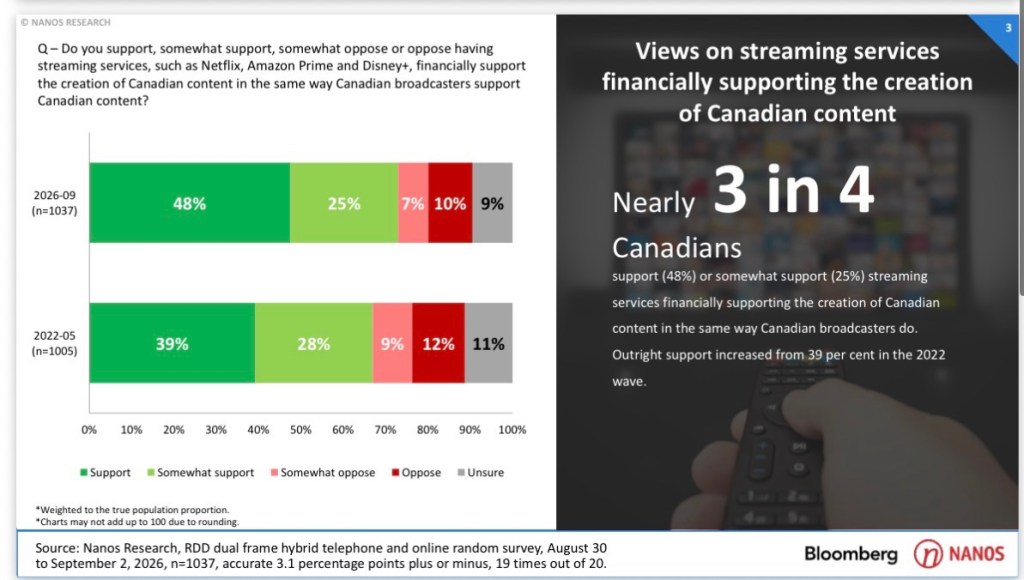
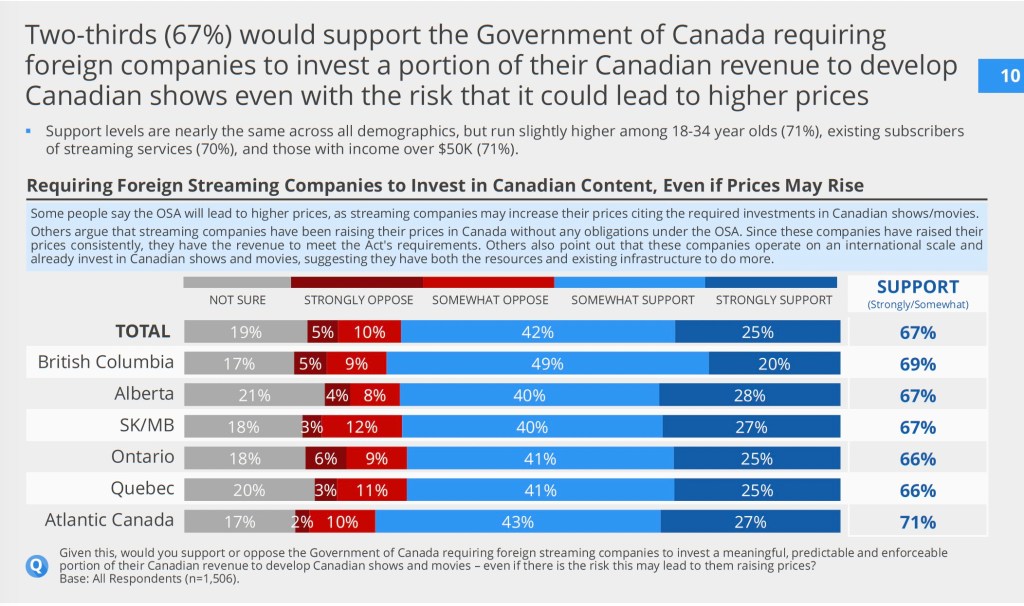
A new Nanos poll commissioned by Bloomberg News finds increased support for public policy requiring US streamers to contribute financially to Canadian content. 

Support rose from 67% to 73% since Nanos last tested the waters four years ago while the Online Streaming Act was being debated in Parliament. 

Detailed results from the new poll have not been released other than Bloomberg reporting them in a news story. Assuming it’s the same question as the May 2022 poll, respondents were asked whether they believe US streamers should contribute financially to the creation of Canadian content “in the same way” as Canadian broadcasters. 

As an indicator of the intensity of that support in 2022, the 67% yes vote was divided between “support” (39%) and “somewhat support” (28%). Eleven per cent were unsure. Until we get a peek at the full Nanos report, it’s unknown how much those numbers have changed. (Update 14/8/26: the full report shows increased intensity of “support” (48%) and “somewhat support” (25%). The “unsures” are down to 9%).

In any event the new 73% number is a jab in the ribs to Prime Minister Mark Carney who allowed US trade pressure to push him in the opposite direction. In June the Prime Minister overturned the CRTC’s order that the streamers contribute 6.5% of revenues in cash to media financing funds and another 8.5% to their own investments in Canadian shows. Domestic broadcasters contribute a total of 25% of revenues to Canadian content. 

The Carney government is now deliberating its guidance to the CRTC on a new framework for streamer contributions. Even prior to Carney’s intervention, the text of the Online Streaming Act and the CRTC’s implementation of it expected less of foreign streamers than Canadian broadcasters. 

At the time of their intervention, Carney and cultural and identity minister Marc Miller claimed that overruling the CRTC wasn’t a response to US trade pressure but rather their sensitivity to subscription pricing. 

On that note, the Hollywood Reporter has published a sassy story about escalating streaming subscription prices in the US where streamers have been steadily raising prices well above the rate of inflation. The content-lean Apple TV has tripled its price since launch in 2019. Netflix Premium is up 125% since 2013 (while inflation was 38% over that period of time).

***

For those that still admit to having ever met Justin Trudeau (I did, he’s tall!), you’ll be interested to know that the drama teacher has become a drama producer.

No wisecracking, ‘kay? The former PM is going into the independent movie making business with his old sidekick and chief of staff, Katie Telford. Nom de guerre of the new enterprise is Hope and Hard Work.

I will let his press release do the explaining.

***

Steve Faguy has written a well informed and balanced account of the gradual demise, possibly fatal, of Corus Entertainment and its Global News television subsidiary.

He sizes up the various culprits: the Shaw family’s restructuring of its various business divisions and debt loads, the CRTC’s astonishing lethargy, the federal government’s inaction, and Rogers’ cutthroat raid on Corus’ profitable US programming. Like the collective assassins of Julius Caesar, it’s hard to pin the crime on one suspect alone.

Now a penny stock loaded with debt, here’s hoping that Global can survive.

One point Faguy doesn’t make, and it could make all of the difference to Global’s survival, is that the federal government’s Online News Act injects $3.9M annually into the television network. If culture and identity minister Marc Miller follows through with his promise to extend “QCJO” journalist labour tax credits to broadcasters, that’s roughly another $8M.  

In 2025, Global spent $119M on television news programming. According to Unifor, Global has laid off 173 union members since early 2024.

If the QCJO money materializes, it should be announced in the Fall budget.

***

It’s intriguing to follow Californian media policy from afar.

As the home turf of Big Tech and Hollywood, you might expect corporate interests to dictate public policy.

Not necessarily.

When five Democratic federal congress representatives from California joined House Republicans in condemning Canada’s Online Streaming Act, the remaining 47 congress representatives did not. Neither did the state’s two Senators.

At the state level, the legislature is Democrat-controlled from top to bottom and elected officials insist on lobbing hot potatoes in the lap of Governor Gavin Newsom. 

Over the course of twenty-four months culminating this August, Newsom endorsed, gutted and then revived the state Assembly’s modest Californian knock-off of Canada’s Online News Act, based on matching $20 million contributions from Google and the state.

Now the legislature has overwhelmingly passed AB2222, the Community News Act. The Canadian policy analogy would be the federal labour tax credit on journalist salaries. Newsom has until the end of the month to sign it, or it dies.

The Community News Act tracks our QCJO labour tax credit for hiring and retaining journalists. The dollar amounts are comparable: $20,000 (USD) per head for the first five journalists and $15,000 thereafter. Any new hires that grow the size of the newsroom are supported at $35,000 per salary.

***

If you would like regular notifications of future posts from MediaPolicy.ca you can follow this site by signing up under the Follow button in the bottom right corner of the home page; 

or sign up for a free subscription to MediaPolicy.ca on Substack;

or follow 
@howardalaw on X or Howard Law on LinkedIn.

COMMENTS ARE WELCOME. But be advised they are public once I hit the “approve” button, so mark them private if you don’t want them approved. 

I can be reached by e-mail at howard.law@bell.net.

This post is copyrighted by Howard Law, all rights reserved. 2026.
Running on contact: Something Else for CanCon financing

AI photo illustration

September 6, 2026

As long as I can remember, Canadian critics of the Online Streaming Act and the last sixty years of regulatory measures supporting Canadian culture have rarely articulated what they would do differently, were it left up to them.

The thinking behind the critique of Canadian cultural policy must be one of two things.

It could be a steadfast belief that Canadians deserve a free and unregulated market where Canadian art and artists compete with American content without assistance.

Maybe in this wide open North American market we would choose lots of Canadian content, maybe not. US Trade Representative Jamieson Greer recently described this as “letting capitalism do its thing and let people choose.”

If not this open borders strategy for culture, the argument that there’s an alternative to the Online Streaming Act remains an unspoken “something else.”

The Carney government is preparing to do something else. In the most Carneyesque way. 

In August, Heritage Canada quietly circulated a series of seven discussion papers to a select list of industry stakeholders in Canada’s audio-visual world. No one claims authorship but the unpublished PDF document was generated by Lisa Gotlieb, Heritage Canada’s Manager of Audio Visual Policy.

The proposal is to build up Canadian film and television production companies that make visibly themed Canadian film and television content, exploit AI technology in both production and distribution, retain their copyright and intellectual property for future growth, and cultivate audiences loyal to the brand that producers nurture.

Reduced to a baseball analogy, the idea is to field a contact hitting offence like last season’s Toronto Blue Jays. A team that steadily generates baserunners and rejects the swing, miss and home run strategy.

The current model of funding Canadian content doesn’t get a warm applause in these documents. In fact it gets politely disparaged as “project by project” funding of CanCon shows that doesn’t adequately incentivize or reward IP-based branding, iconically Canadian content, growth and audience. 

The policy narrative scans strongly binary —old system bad, new system good— and I suggest they be read with a critical eye.  Part one of seven is available here.

In these documents, Heritage expresses dissatisfaction with an ecosystem of modestly capitalized independent Canadian producers running in place on a project-by-project treadmill without a clear path to growth. 

Less fundamentally, shade is thrown on the traditional “headcount” formula that ties government and industry financing to productions hiring mostly Canadian producers, writers, directors, actors and film crews but without a formal commitment to visibly Canadian terrain and screenplays.

In the new world, Canadian film and television producers would become a feisty We-the-North of scaled up studios that would not sell off library rights or global first release to US streamers. That might induce Canadian producers to stop putting quite so much American cream in their CanCon coffee (think of the nationally androgynous Schitt’s Creek). 

Relentlessly throughout the policy papers, the authors tout a growth agenda. That rhymes with Carney’s banker vocabulary of  investment, building, growth, global markets, and a measurable return on public investment.

Once you get past Carney vibe, there are some engaging ideas.

The most fundamental is to restructure the current funding model that combines money and gatekeeping rules from four federal agencies, the CRTC, the Canada Media Fund ($216M in federal spending), Telefilm support for cultural exports ($150M), the National Film Board ($72M) and the federal government’s CAVCO production tax credits ($540M). 

As industry insider Brad Danks explained back in June in a MediaPolicy interview (or see a refreshed version in Broadcast Dialogue), the current funding system places all bets on production financing of shows and none of it on rewarding success. Success is defined as the build out of Canadian platform distribution and audience development. Or the aggressive adoption of AI technology. It’s a strategy for cultural sovereignty that is implicit in encouraging producers to tighten their grip on cradle-to-grave distribution rights instead of cashing out these rights piecemeal to Netflix and other global platforms. 

Somebody has to quarterback this reformed funding model. The authors of the Heritage documents explicitly endorse an expanded National Film Board (perhaps merging the 300 staff of the Heritage CAVCO office, the Canada Media Fund and Telefilm into the much larger NFB).

The policy papers go out of their way to laud the NFB’s unique combination of policy expertise and in-house content production. I’m guessing authors regard Telefilm and the CMF as the guardians of the old system that Heritage wants to disrupt. 

The papers also moot the possibility of the federal government treating the audio-visual industry as a major investment opportunity worthy of a reliable stream of earmarked infrastructure cash from ISED or regional development funds. Although the authors don’t mention the $600 million pot of cultural cash that Carney announced in June, that is also a possible source of recalibrated program spending in the new model.

Most of these policy ideas can be traced back to ex-Deputy Minister Isabelle Mondou’s recommendations to former culture and identity minister Steven Guilbeault who approved them before leaving cabinet in late 2025. The policy momentum within Heritage is in place and the Prime Minister’s “build it” philosophy would seem hospitable to the change. Take note: Mondou now works in the PMO.

The trade war is also an accelerant to change. President Trump has his eye on Canada’s share of global streamer film and television productions. He is supporting Hollywood’s request that US Congress legislate a federal film and television production tax credit to draw more work stateside. 

If Congress acts, film and television producers in Canada, the United Kingdom and European countries could all lose some production volume to Hollywood and other US states.

That would make Heritage’s “build it” agenda for home grown CanCon production a more pressing matter. According to Heritage, foreign film and television production in Canada is ten times the spending on Canadian content although only half of the total hours of industry employment.

It’s no coincidence that Deputy Minister Mondou warned minister Guilbeault that “the balance between Canadian content and Foreign Location and Service Production [in Canada], has shifted in favour of Foreign Location and Service Production which is vulnerable to the current tariff threat and other protectionist measures coming from the United States.”

We will see if the Heritage proposal gels in time for November’s federal budget.

Source: CMPA Profile 2025

***

If you would like regular notifications of future posts from MediaPolicy.ca you can follow this site by signing up under the Follow button in the bottom right corner of the home page; 

or sign up for a free subscription to MediaPolicy.ca on Substack;

or follow 
@howardalaw on X or Howard Law on LinkedIn.

COMMENTS ARE WELCOME. But be advised they are public once I hit the “approve” button, so mark them private if you don’t want them approved. 

I can be reached by e-mail at howard.law@bell.net.

This post is copyrighted by Howard Law, all rights reserved. 2026.
“Knowing those [streamer] players as we do, they were not going to say, ‘Thank you very much. We’re done.’ They were only going to regard that as the appetizer.”

August 29, 2026

The how and why of last Friday’s breakdown in US-Canadian trade talks preoccupied us for most of last week.

The Canadians weighed in on why things went sideways after Trump announced a “deal” several days before the deadline. The Americans spun their narrative in the other direction. Commerce secretary Howard Lutnick’s performance is not to be missed.

It would help to know what was in those negotiating documents that will never become public. Or to start demanding polygraphs that will never be taken.

Without those here is my take, based on what negotiators said and what might have happened.

Carney and Trump talked on the Tuesday night. Clearly they agreed on something. Probably it was some high level numbers on key tariffs. Looking for a public win, Trump couldn’t restrain himself and rushed to announce a deal the next morning. The key thing is that Trump thought he had hooked Carney by giving him enough and that the US would then steamroller the Canadians on the fine print and all of the remaining issues. Saying there was already a deal was part of his strategy.

That is the bargaining dynamic that often occurs when one negotiating party has, or believes it has, the hammer. Trump expected to run the table. If there was any truth to the rumours of the impending demise of the Online News Act, the Canadian team was half expecting the same.

But Trump miscalculated and overreached. On trucks and pickups. On culture. On Canada’s options to make other trade deals without Trump’s permission. This provided an opportunity for Ontario premier Doug Ford to signal Carney that he was about to go offside. Manitoba premier Wab Kinew already was. The Bloc Québécois was making noise about cultural concessions.

When CBC interviewed Trump’s trade envoy Jamieson Greer on Thursday he claimed that the cultural issue embedded in the federal Online Streaming Act —-repeatedly and narrowly confined to “the discoverability of French language content”—- was, shucks, never a big deal for the US. 

“It’s the furthest thing from a red line,” Greer told CBC host Rosemary Barton. “We highlighted [it at the end] yes, but our view is you should let capitalism do its thing and let people pick. We know it’s important to people in Quebec….We would not have let it get in the way of a good deal.” (Roll the video from the nine minute mark).

Slick and slippery, yes. But more likely a sign that Trump thought the Canadians were already hooked and would swallow anything to get a deal across the line.

Greer still found time to have another moan to CBC’s Barton about streamer cash payments to Canadian media funds: “What we don’t like is a situation where Canada forces American tech companies to take their earnings to give a percentage to their competitors.”

Putting aside that mischaracterization of how cash payments to media funds get recycled to all contributors, Carney had already taken them off the table three months ago by overruling the CRTC.

Yet here Greer was still fixated on them, raising them on both Canadian and US television networks, even after the breakdown of talks and in the same breath in which he claimed that “the French language” issue raised by the federal Online Streaming Act and Québec’s counterpart Bill 109 was no big deal.

Canada’s trade envoy Dominic Leblanc responded to Greer’s claims tactically. He publicly thanked the Americans for taking the streamer issue off the table. 

While Leblanc was thanking Greer, the Canadian cultural community was effusively and publicly thanking Carney for fending off the Americans. 

Every iota of that effusiveness was proportional to a residual mistrust that the Online Streaming Act and the Online News Act are off the table for good, or that a Prime Minister who would give away the digital services tax for nothing, humiliate the CRTC by overruling their implementation of cash payments, and for Pete’s sake would even submit to a shameless Trump shakedown on a bridge we paid for, might yet fold again on culture.

Reynolds Mastin of the Canadian producers’ union CMPA, which has emerged as the de facto spokesperson for the English-language cultural community, described the near-death of the Online Streaming Act as “an inflection point” for Canadian culture and trade talks.

Mastin also politely chided the Carney government if it had indeed assumed that its climb down on the streamer payments in June had sated the US streamers’ hunger to get rid of the OSA altogether. “Knowing those players as we do, they were not going to say, ‘Thank you very much. We’re done.’ They were only going to regard that as the appetizer.”

This weekend Mastin’s CMPA and another 40 cultural organizations took the time and expense to express their gratitude to Carney “for standing up for Canada’s cultural sovereignty” in full-page newspaper ads. Newsmedia Canada’s Paul Deegan did much the same on the Online News Act

In Québec, the Coalition for the Diversity of Cultural Expression went a step further, calling for Carney to throw it into reverse gear and reinstate the $200 million in audio-visual and audio streamer payments. 

Carney is now in a pickle of his own making. 

The Americans may or may not have let go of the cultural concessions. All it would take to revive them is an American reporter asking Trump the question.

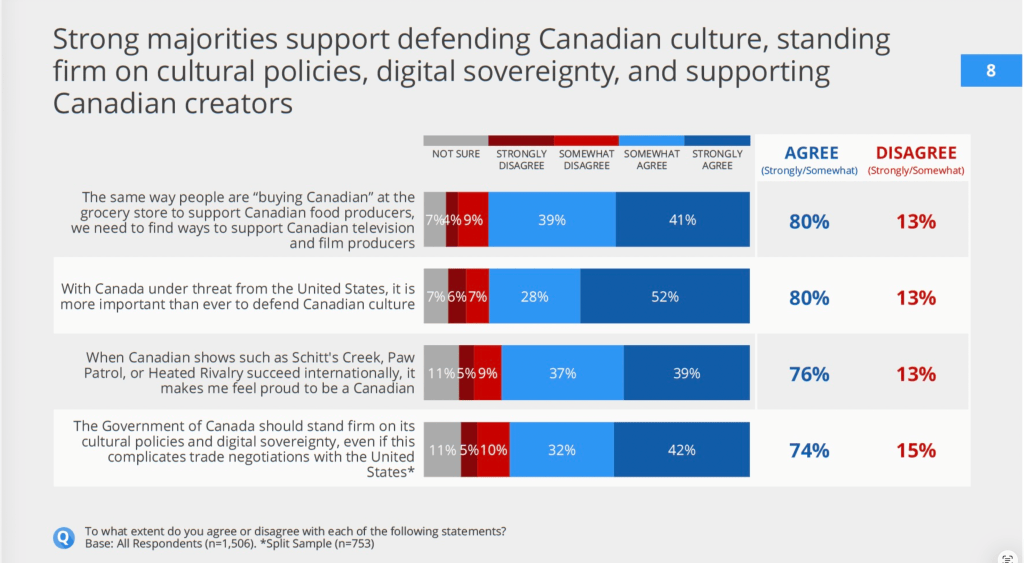
Canadians have increasingly seen cultural issues as a defining issue of our dignity and resistance to Trump humiliation, at high levels of support that were already elevated according to year-old public polling

Meanwhile Carney has his $600 million pot of cultural spending that, contrary to MediaPolicy’s initial skepticism, might actually be doing something more than taking the sting out of his climb down on cultural issues. 

A leaked page grab from an internal Canadian Heritage document suggests that the $600 million will cover the $134 million in foregone streamer payments to Canadian audiovisual media funds for broadcast news and Canadian content. But the document also suggests that the remaining “unallocated” $467M is earmarked for “additional audiovisual stabilization funding” and the “audio sector.”

The vagueness of this $467 million commitment may sustain skeptics like myself. But other internal documents from Heritage suggest an earnest and far reaching rethink of how to spend not only the $467M but all of the $850 million in various federal programs for audio visual production on a growth and export strategy for Canadian content.

I’ve buried the lede here. More to come on that. 

***

If you would like regular notifications of future posts from MediaPolicy.ca you can follow this site by signing up under the Follow button in the bottom right corner of the home page; 

or sign up for a free subscription to MediaPolicy.ca on Substack;

or follow 
@howardalaw on X or Howard Law on LinkedIn.

COMMENTS ARE WELCOME. But be advised they are public once I hit the “approve” button, so mark them private if you don’t want them approved. 

I can be reached by e-mail at howard.law@bell.net.

This post is copyrighted by Howard Law, all rights reserved. 2026.
Catching up on MediaPolicy – Zuckerberg settles kids’ lawsuit for $18B – doxxing liability for “networked harassment” – Cineplex’s Goliath flexes

(AI illustration)

August 28, 2026

Meta’s big trial settled after only five days of testimony and before CEO Mark Zuckerberg was scheduled to take the stand.

The social media giant just paid off 47 US states with $18 billion (USD) to resolve lawsuits seeking reparations and safety features as a result of online harms allegedly inflicted on American children by its Facebook and Instagram products. 

With more lawsuits pending, Meta continues to deny liability.

The big dollar figure equates to four months of Meta’s annual profit but the money will be paid out over 10 years. As well, thirty per cent of the amount is tied to YouTube and TikTok agreeing to a similar settlement.

Regardless, the state Attorneys General crowed victory. 

“For years, Meta intentionally deceived the public about the addictive and harmful design features that have wreaked havoc on youth mental health,” according to Virginia Attorney-General Jay Jones. The deal “will put an end to these dangerous practices and deliver meaningful relief that will protect children from online harm.”

The settlement funds will mostly flow to children’s mental health services.

Front-loading meaningful policy action with lawsuits may be anarchic, but it moves the US closer to comprehensive federal regulation of online harms against children and provides a first draft of regulatory digital safety plans.  Meta and the Attorneys General would be well aware of that.

Whatever that US regulation ends up looking like —there’s currently head butting between the House of Representatives and the US Senate over the content of digital safety plans— it will be an obvious benchmark for other countries seeking to do the same thing, as Canada is doing with the Liberals’ Bill C-34, The Safe Social Media Act. Given speculation about the apparent agreement at abortive US-Canada trade talks over “digital alignment,” the regulatory footprint in the US becomes even more relevant. 

Under the terms of the settlement, there will be a hard two-hour cap for under-18s daily screen time, limits on continuous scrolling time, and no access after midnight.

There will be limits on addictive features such as Likes and other emojis. Push notifications will be prohibited during school hours.

Meta will also disable extreme make-up and cosmetic surgery image filters, a nod to concerns about the harmful role of social media in body image. There is no outright ban on so called body image postings.

There are also no limitations on Meta’s algorithmic personalized recommendations. Instead, teens will have an option to adopt a non-personalized feed.

Importantly, most of the hard controls are in the apps’ default settings that can be undone with parental consent. Meta has promised to provide simpler settings and tools for parents. 

Of note to policy makers: the age verification protocols that underpin the entire regulatory regime are not concretely sketched out in the settlement. The important details are set as a deliverable from Meta in a year’s time.

That’s no small matter: Meta and YouTube’s Google ownership are looking to foist age verification on each other as legislatures choose between imposing that responsibility on either app stores like Google Play or individual social media apps such as Instagram.

Going forward, the settlement may or may not grease the skids leading to US federal regulation of online harms to children. It depends on YouTube, TikTok and Snapchat responding positively as well as Congressional leaders sorting out their differences over the strength of regulatory standards requiring digital safety plans from social media companies.

The Canadian C-34 makes it clear that a Canadian digital regulator will have the power to set its own standards if the safety features offered by Meta and the other social media companies in their digital safety plans are found wanting. As the ultimate hammer, the regulator can ban youth accounts. 

Meta says it is not implementing the terms of settlement in Canada. We will see if that sticks, but Meta might be tempted to retain its leverage to settle the lawsuits filed by Canadian school boards or haggling over the draft of Bill C-34.

***

Michael Geist has a new blog post reporting on a Canadian judge granting an injunction against a social media influencer who triggered a digital mobbing against a Toronto lawyer that included anti-semitic dog whistling and threats to children. 

Geist suggests that the injunction could lead to a new “tort” —the basis of civil liability for damages — of “networked harassment.”

***

Barry Hertz has a story in the Globe & Mail providing circumstantial evidence that the dominant Canadian film theatre chain Cineplex squeezes film distributors into exclusive exhibition deals that result in independent theatres losing important films. 

The issue came to light when the independent Carlton multiplex theatre in downtown Toronto abruptly lost exhibition rights to Matt Johnson’s new release “Tony,” a biopic of the belated writer and chef Tony Bourdain, just prior to the scheduled opening and after tickets had been pre-sold.

The Carlton is wedged geographically between neighbouring Cineplex theatres. The Toronto-headquartered Cineplex controls 70% of film theatres in Canada.

In the Globe story, the Carlton refers to “the hegemonic theatrical exhibition market share that exists in this country” and invites disgruntled patrons to complain to the Canadian Competition Bureau.

***

If you would like regular notifications of future posts from MediaPolicy.ca you can follow this site by signing up under the Follow button in the bottom right corner of the home page; 

or sign up for a free subscription to MediaPolicy.ca on Substack;

or follow 
@howardalaw on X or Howard Law on LinkedIn.

COMMENTS ARE WELCOME. But be advised they are public once I hit the “approve” button, so mark them private if you don’t want them approved. 

I can be reached by e-mail at howard.law@bell.net.

This post is copyrighted by Howard Law, all rights reserved. 2026.

The public got there first. Carney got there later.

August 23, 2026

On Friday night Mark Carney said no to the “shit deal” that Canadian journalist Jen Gerson warned us might be coming.

In the absence of a lot more information than we’ve already been given, the post-mortem on the breakdown of negotiations will continue to be spun by whomever’s talking, be it Mark Carney or Donald Trump. 

Canadian journalist Terry Glavin reminded us this weekend that “there’s also a good reason to be at least somewhat skeptical about the way Prime Minister Carney has explained the impasse, and by all means, be skeptical about the spin put about by sources close to the talks and various Liberal-friendly sock puppets. Peter Menzies, who has spent a lifetime in journalism and media policy, has noticed the ubiquity of “strategic leakers” informing reporters assigned to the trade talks. Menzies advises vigilance.”

Times two, I say (except for the sock puppet comment). 

There might have been one such strategic leak last week about where the Online News Act stood in the midst of last week’s negotiations. The answer was: it’s awaiting a formal death announcement.

On Thursday, Toronto Star investigative reporter Justin Ling reported that “sources” (note the plural) were telling him that Carney had already thrown the Online News Act under the bus as part of a projected settlement and that “publishers” had been advised to be “ready for the death” of the bill.

Ling also reported  “another source briefed by Canadian officials confirmed that the Online News Act would be a likely concession, but stressed that things could change before Friday’s new deadline.”

Note “likely.”

Unless someone in the source-chain is lying, “likely” and “briefed by Canadian officials” is intended to be reliable information.

I did ask Newsmedia Canada CEO Paul Deegan if indeed publishers were warned by “Canadian officials” about dropping the legislation that pays out $100 million annually to Canadian news outlets.

 “I am not aware of any conversation, officially or otherwise, between publishers and government about the future of the Online News Act one way or the other, nor am I aware of any such conversations with any publisher or group of publishers,” he told me.

“Ministers and staff were extremely tight-lipped, which was entirely expected and appropriate, given the sensitivity of the final negotiations which were underway in Washington.”

On Friday morning the reaction in the Québec media to Ling’s tip off was of mushroom cloud dimensions. Among the Québécois opinion-movers pushing the red button were the respected University of Montréal law professor Pierre Trudel and Bloc MP Martin Champoux. The Bloc’s press release was punctuated by the words “appeasement” and “capitulation.” 

If the Québec branch of the federal Liberal Party has one job it is, at the very least, not to severely aggravate nationalist sentiments on matters of media and culture. The toss-up federal by-election in Chicoutimi is next Monday, a separatist party leads the polls going into a provincial election at the beginning of October, and there will be three more federal by-elections in Québec later this fall. 

No doubt all of this circulated back to the Prime Minister’s Office and was likely just one more thing to remind Carney that public opinion polling was making it clear he had misread the room of Canadian opinion on taking significant tariffs and making cultural concessions.

In the aftermath of the breakdown on Friday night, Ontario Premier Doug Ford went on television to make it clear that he’d been uncomfortable all of last week about the projected landing spot on auto, steel and aluminium tariffs. The landing spot was 15% for auto and 25% for steel and aluminum, effectively the global benchmark for Trump tariffs. Don’t bother with the nuances to those heart-stopping numbers.

On culture, Carney told reporters following his Saturday morning press conference that the sticking points included “the French language” and “culture.” He offered no specifics (although in one of his answers he referred to the American hostility to bilingual product labelling).

Whatever cultural concessions were in the works, the deal is off for now.

As trade lawyer Barry Appleton wrote this weekend, “the public got there first.” Carney got there later.

“Polling in the week of the negotiation put support for making concessions at thirty-nine per cent,” noted Appleton. “Six in ten Canadians were against conceding further before the deadline arrived. A government facing that number was discovering the edge of what it could sign more than it was choosing refusal.”

This disconnect with public opinion, and the popular appetite to stand up to Trump’s aggression, has been Carney’s weakness going back to his 2025 election. It’s responsible for both the surrender of the digital services tax and overruling the CRTC on streamer contributions to Canadian content.

Léger poll, October 2025

I can offer from my own career experience as a trade union negotiator: ninety per cent of the job is to get the right read on your membership. It’s not only that you are accountable to the rank and file, as Carney is to Canadians, but more importantly their willingness to fight and take pain is your bargaining power. Overestimate or underestimate that fighting spirit at your peril. 

Carney’s “I’m the adult in the room” persona is what got him elected. But it’s clear now he underestimated the Canadian people and was on the verge of presenting us with a bad deal as a fait accompli without giving us the opportunity to stand up to an American government brazenly determined to turn us into a vassal state, a Belarus to their Russia, when we’d rather be Ukraine.

I’m not convinced the Prime Minister has got the message yet.

He set September 8th as the date for imposing Canadian retaliatory tariffs. That gives him time to get past the three federal by elections next Monday. More importantly, the extra two weeks seem like an invitation to the Americans to reconsider and get back to the table with a better offer.

A fresh American offer with radically lower tariffs and no Canadian concessions seems unlikely. Let’s hope the Prime Minister is reading the right room, the Canadian room. 

***

If you would like regular notifications of future posts from MediaPolicy.ca you can follow this site by signing up under the Follow button in the bottom right corner of the home page; 

or sign up for a free subscription to MediaPolicy.ca on Substack;

or follow 
@howardalaw on X or Howard Law on LinkedIn.

COMMENTS ARE WELCOME. But be advised they are public once I hit the “approve” button, so mark them private if you don’t want them approved. 

I can be reached by e-mail at howard.law@bell.net.

This post is copyrighted by Howard Law, all rights reserved. 2026.
Catching up on MediaPolicy – The $600M waterhole – Australia’s new C-18 – Paramount merger drama continues

August 22, 2026

I was pleased with myself this week to be quoted in a news story that described the Carney government’s promise of $600 million annually for cultural spending, in replacement of the CRTC’s $200M levy on foreign streamers, as “the world’s biggest lollipop.” 

So clever, but ultimately the wrong metaphor even though the soporific effect of a big wad of federal cash was meant to take the edge off of the angry reaction among Canadian producers, broadcasters and the public at large after Carney overruled the CRTC.

No, the right metaphor is “the $600 million watering hole.”

I say that only because the Prime Minister and cabinet minister Marc Miller have been so coy about where the money is headed. After all, $600M is three times the overruled $200M. It’s not just a Netflix bailout. 

But we’re still in the dark about the destination of those federal dollars. Members of the minister’s newly appointed advisory committee on audiovisual production have been sworn to secrecy, according to the Wire Report’s story about signing NDAs. The Wire Report story quotes one member of the committee as saying we will not see the product of their deliberations “for a few months.”

I would expect that the producers (CMPA), the broadcasters (CAB), and news publishers (Newsmedia Canada) are engaged in an all-hands-on-deck lobbying effort to influence where that $600M gets spent. If the government is telling them anything useful, no one is talking.

Ergo, let’s give uninformed speculation a try. Some of the additional $400M might be new spending. Some of it might relabel existing federal cultural dollars.

Government Priority 1?: Media Funds

Presumably the first $200M of the $600M is to do what minister Miller promised: replace the CRTC’s 5% cash levy on audiovisual (Netflix et al) and audio (Spotify et al) streamers. 

The $200M figure came from the CRTC’s 2024 estimate and is now two years out of date. Of the total, the CRTC earmarked $140M for additional CanCon contributions to the Canada Media Fund for entertainment and children’s programming, the Independent Local TV News fund, the Indigenous Screen Office and a variety of smaller production funds that finance shows by and for diverse communities and official minority language communities. 

Another $60M of music streamer cash was intended for artist development funds (Factor, MusicAction, Starmaker, and RadioStar). It was also to support Community Radio Fund and the newly established Indigenous Music Office.

There was also money for news reporting in small and mid-sized radio markets. 

The audio streamers weren’t part of Carney’s June 3rd quash of the CRTC ruling on video streamers, but a subsequent communication by the federal Attorney-General to the judges hearing Spotify’s appeal to the Federal Court means that $60 million is gone too.

Based on the minister’s public statements, expect these media funds to be the first to drink from the $600M watering hole.

Priority 2?: Reversal of the fake cuts

The next speculative tranche of the $600M is a relabelling exercise: the restoration of 2026 federal budget cuts to cultural funding. 

That would reverse the $192M cut to the CBC, the $68M cut to the Canada Media Fund, $13M cut from the Canadian Periodical Fund for magazines and community news publishers, and $2M from French-language TV5 News. Perhaps the Liberals will pick the moment to restore their cuts to the Canada Book Fund ($3.4M) and the Canada Music Fund ($16M). Final tally: nearly $300M.

Ever since the minister tabled these cuts in the “Main Estimates” federal budget back in February, the word on the street was that the CBC and Canada Media Fund cuts would be restored or mitigated in a Supplementary estimate. 

Priority 3?: Double counting of budget dollars already announced for broadcaster access to the QCJO journalism labour tax credit

In March 2026 the Liberals announced (by my estimate) a $115M expansion of the QCJO journalism labour tax credit to television and radio broadcasters. The public pressure for policy action hasn’t let up: since then, Rogers and Global News announced layoffs in television and radio as well as closures of several AM radio station. Quebecor has threatened a fresh round of layoffs “if nothing changes.”

If Carney counts this as a piece of the $600M, this is also a relabelling of previously committed federal dollars.

Priority 4?: Replace the CRTC’s recent 1.55% cash levy on streamers and Canadian broadcasters, quashed by Carney’s announcement

The 1.55% would have relieved Canadian cable companies from the obligation to subsidize public service television channels mandated for basic cable TV by the CRTC (e.g. APTN, TV5, CPAC).

When the CRTC announced this cash levy in May I estimated the cost at $42M for foreign streamers and $93M for Canadian broadcasters.

If taken out of the $600M, that’s another $135M draw from the waterhole. 

Priority 5?: More money to replace the lower than expected streamer investments in CanCon productions

The CRTC ruling that Carney overruled would have compelled foreign streamers to invest directly in Canadian shows at 8.5% of revenues (the cash levies of 5% and 1.55% made up the remainder of the overall 15%). 

We won’t know until minister Miller unveils his new policy direction to the CRTC, but these “Canadian Programming Expenditure” investments could be metered at the same 8.5%, or more or even less. I say with a straight face: it all depends on what Carney promised Netflix CEO Ted Sarandos in that New York hotel room meeting in late May.  

If Carney agreed to reduce that 8.5%, I figure it will cost about $28M in federal money to replace each percentage point of the 8.5%. 

Priority 6?: the Online News Act

I hate saying this out loud, but others have as a matter of wish fulfillment. Between American trade bullying and Carney’s propensity to cave on cultural legislation, is the Online News Act on the chopping block? 

If it doesn’t get thrown under the bus in trade negotiations, should we expect another hotel room meeting where the Prime Minister promises to sunset Google’s $100M news licensing payments to Canadian news organizations which are up for renewal in 2029? (A note here: Apple got an in-person meeting with the Prime Minister on June 11th to talk about the Safe Social Media Act, recorded in the lobby registry).

And if so, is Carney planning to replace Google’s $100M out of the $600M? 

Priority 7?: Anything

There is the chance that the $600M includes money for some good public policy, independent of the expediency of the moment.

Not that I am stumping for it, but it would not surprise me at all if the Liberals committed more money to the export of Canadian shows through Telefilm, or special funding for international co-productions with France or other trading partners. It would rhyme with their overall approach to big investments with, um, non-hegemonic trading nations.

If you’ve done the math, that’s a $850M draw down from a $600M waterhole.

If Canadian producers, artists and broadcasters have also done the math, that would explain the flurry of lobbying activity since Miller announced the $600M. 

***

While we Canadians speculate on the future of the Online News Act, this week the Albanese government in Australia legislated version 2.0 of its 2021 news licensing scheme, rechristened as the News Bargaining Incentive.

The NBI expands the scope of its 2021 legislation to add TikTok and Microsoft’s LinkedIn to the previous law that required Google and Meta to make licensing deals with most Australian news outlets. Meta refused to renew its deals that expired in 2024. The NBI is the government’s response. 

The new legislation sets a price on compliance: the four tech companies must pay 2.5% of their Australian advertising revenues into a news fund.

However, each of the digital platforms can substantially reduce their cost by making licensing agreements directly with at least eight news organizations. The tech platforms get 150% credit toward their 2.5% target by making deals with large news organizations, and 200% credit for agreements made with small and medium sized news outlets. 

If there’s any shortfall on meeting the 2.5% target, the government will levy the remainder in cash from the platforms with proceeds banked in a national news fund. That pool of money will be presumptively distributed to news organizations based on a journalist headcount, as in Canada. Unlike Canada, the Australian news fund can tweak the headcount formula to be more generous to smaller news outlets. 

I have not seen estimates of news licensing payments the NBI will generate, but the 2.5% figure looks substantially less than the value of the 2021 deals which totalled $190M annually. And if deals get made to offset the 2.5%, it would be worth something closer to 1.5% of ad revenues. 

There’s no word yet on when the NBI legislation will be proclaimed by the Albanese government. Not surprisingly, the Trump administration is opposed to the NBI and a spokesperson told the Australian Financial Review back in April that the White House regarded the NBI, which it did not differentiate from a digital services tax, as “foreign extortion.”

***

The Paramount/Warner Brothers merger drama refuses to take a week off.

As you recall, twelve US state attorneys general led by California’s Rob Bonta are contesting the $111B merger under the federal antitrust Clayton Act. A trial date is set for March 2027.

After threatening to move all of its studios out of Los Angeles, Paramount owner David Ellison’s new tactic is to ask the federal judge who granted an interim injunction against the merger to impose a $1.9 billion surety bond on the states. The purpose of the bond is to cover the $210 million per month “ticking fee” that Ellison will begin paying on October 1st to Warner Brothers Discovery shareholders who voted “yes” to the merger. 

The judge previously declined to require the bond finding that the states’ lawsuit raises important matters of public policy. As for Bonta, he says Ellison made a grown up’s decision to agree to the ticking fees in the first place. 

Meanwhile, the mayor of Los Angeles Karen Bass appears to have been swayed by Ellison’s threat of a capital strike and is urging Bonta to make a deal now instead of pursuing the lawsuit. Her challenger in the upcoming municipal election supports going to trial instead.

The Trump administration looms large on the sideline. The White House is close to David Ellison’s father, the world’s second-richest man Larry, who is bankrolling the merger. Ellison Pater’s wealth comes from his Oracle Corporation. Oracle is carrying a lot of debt and is badly exposed in the event of financial instability in the AI industry. 

Whether Bonta and the other attorneys-general want a court-ordered restructuring of the merger or just more financial commitments, delay is clearly their leverage. 

One gets the feeling that with so much money and so many jobs at stake, a deal will get made long before trial. Late yesterday, California Governor Gavin Newsom expressed interest in an early deal and the Democratic nominee to replace the termed-out governor is also a proponent of settlement.

***

If you would like regular notifications of future posts from MediaPolicy.ca you can follow this site by signing up under the Follow button in the bottom right corner of the home page; 

or sign up for a free subscription to MediaPolicy.ca on Substack;

or follow 
@howardalaw on X or Howard Law on LinkedIn.

COMMENTS ARE WELCOME. But be advised they are public once I hit the “approve” button, so mark them private if you don’t want them approved. 

I can be reached by e-mail at howard.law@bell.net.

This post is copyrighted by Howard Law, all rights reserved. 2026.
Catching up on MediaPolicy – Film industry throws down on Carney – ambitions for Canadian media tech – Paramount’s runaway shop

August 15, 2026

Canadians, it seems, are not looking for a national moment of humiliation in the face of US trade aggression. Public polling tell us so and hats off to The Line’s Jen Gerson for spelling it out.

“Canada is working to secure some kind of interim deal, and if the leaks are to be believed, we’re going to give the Americans essentially everything they want while they maintain most tariffs on us. It appears to be a shit deal for us, and one that puts us directly in the glide path toward vassal state.

Visceral, yes. True, also yes.

The film and television production community thinks so too and said so this week, more politely, in an Open Letter to Prime Minister Mark Carney’s federal government.

The Open Letter published by the Canada Media Producers Association, and signed by 50 industry organizations, restates the industry’s dismay at the federal government’s decision to overrule the CRTC’s cash and investment obligations for US streamers. 

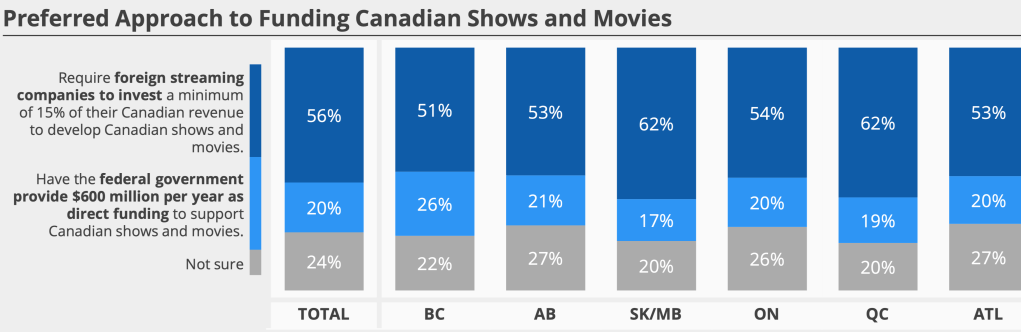
The government’s current position is that later this year it will formally instruct the CRTC to strike down media fund cash levies on Hollywood streamers while the federal cabinet dictates a new figure for the direct streamer investments in Canadian programming that will be required. The government says it will dip into federal coffers to make up the difference. 

“The government’s $600 million per year pledge, though appreciated and welcome, is not a substitute for durable, legally enforceable contribution obligations,” CMPA President Reynolds Mastin is quoted in the press release. “Discretionary funding is subject to budget and external political pressures; a regulated contribution framework is not.”

The CMPA and the broad spectrum of industry signatories to the Open Letter appear to be a content to stick with the CRTC’s overall 15%-of-revenues benchmark for streamer investments in Canadian content, even if it is missing the cash contributions to Canadian media funds that recycle the money into Canadian-produced programming that becomes available to the streamers through licensing agreements. 

The signatories to the Open Letter also appear comfortable with the CRTC’s new investment obligations for Canadian broadcasters, reduced from 30% to 25% of revenues in May. No broadcasters signed the letter. 

Notable absentees from the otherwise exhaustive list of signatories include the Los Angeles-headquartered film crew union IATSE Canada and the Toronto International Film Festival. TIFF chair Cameron Bailey was recently appointed by the federal government to represent the media industry on the federal government’s advisory committee on US-Canada trade talks.

***

Flying below the radar, the Canada Media Fund just announced that it has signed an Expression of Interest agreement with the Los Angeles-based Interlink Investment Group. A consortium of Canadian cultural groups signed on to the EOI, including the Vancouver Asian Film Festival, Racial Equity Screen Office, and Muslims in Media.

The CMF exists to allocate production funding, contributed by the federal government and Canadian cable companies, to independent Canadian producers creating and licensing Canadian content for television and streaming broadcast.

The project that CMF CEO Valerie Creighton has in mind is to create a public-private investment fund to support “a new model for international collaboration in the media and technology sectors that would complement Canada’s screen-sector ecosystem, creating new pathways for investment, co-production, technology development, content creation, and international distribution across a range of sectors, including film, television, digital media, gaming, creator economy ventures, artificial intelligence, virtual production, and emerging content technologies.”

Apparently, funding for a Canadian media tech stack.

The text of the EOI agreement has not been made public. 

There are a million questions that arise out of the Fund’s surprise announcement. The first is whether this is a freewheeling Creighton floating a trial balloon or, on the other hand, a subtle move by an unseen hand on the federal government’s chessboard of media policy

Heritage Canada has yet to comment on the proposal and no money has been committed by either public or private investors. 

The semi-autonomous CMF is majority-funded by the federal government, seats two government appointees on its board, and reports on its programming activity through the Department of Canadian Heritage. 

The Canadian-educated Interlink chairman, Shezad Rokerya, is a member of the World Economic Forum and chairman of the Canada–UAE Sovereign Wealth Fund Council. The Council appears to be an investment platform with personal endorsements from Canadian diplomats but not a formal status within government.  

The policy idea of a Canadian owned media technology stack suggested by the CMF press release is consistent with at least two ideas much in general discussion of late: exports of Canadian audiovisual content and Canadian sovereign control over the distribution network for that content.

***

Is Paramount chair David Ellison planning a runaway shop to punish California for challenging its merger with Warner Brothers Discovery ?

After a federal judge sided with 12 plaintiff state governments to delay a trial date for their anti-trust lawsuit until March 2027, Ellison has threatened to move his entire studio operation out of Hollywood to another state if California does not negotiate an out of court settlement with him now.

Paramount begins paying $7 million per day to Warner Brothers Discovery shareholders on October 1st while the merger remains unconfirmed. 

***

If you would like regular notifications of future posts from MediaPolicy.ca you can follow this site by signing up under the Follow button in the bottom right corner of the home page; 

or sign up for a free subscription to MediaPolicy.ca on Substack;

or follow 
@howardalaw on X or Howard Law on LinkedIn.

COMMENTS ARE WELCOME. But be advised they are public once I hit the “approve” button, so mark them private if you don’t want them approved. 

I can be reached by e-mail at howard.law@bell.net.

This post is copyrighted by Howard Law, all rights reserved. 2026.
Catching up on MediaPolicy – Will Carney’s Netflix tax play in Chicoutimi? – is the Liberal kids safety bill safe from Trump? – Paramount Warner Bros trial date

(satiric AI photo illustration)

August 9, 2026

It’s likely that the standout moments of the Mark Carney chapter in Canadian history books will include the Gordie Howe Bridge and his repeal of the digital services tax. 

I’m not 100% sure how the Prime Minister will be remembered in English speaking Canada for his duck-and-cover on the Online Streaming Act, Bill C-11. But I’m a lot more certain how he will be remembered in Québec. 

At the end of July, days after Carney announced three federal by-elections that include the swing-riding of Chicoutimi-Le Fjord, local Bloc Québécois candidate Caroline Dubé held a press conference to denounce Carney’s plan to eliminate the CRTC’s imposition of Canadian content contributions by Netflix and other US streaming giants.

Along with sitting Bloc MPs Mario Simard and Alexis Brunelle-Duceppe, Dubé teed off on Carney for ten minutes. The lead talking point was that Carney was letting global streamers off the hook for $200 million annually and turning to taxpayers to fill the funding gap: Canada’s first “Netflix tax.”

Another Bloc talking point was more visceral: the Bloc MPs were grinding their teeth over a Liberal double cross on a bill that the Justin Trudeau cabinet had managed to steer through the “psychodrama” of a minority Parliament in 2022 thanks to the Bloc. The Québec nationalist party’s lead on the file, MP Martin Champoux, had successfully negotiated several Bloc-sponsored amendments to the bill with Liberal MPs but Trudeau’s successor as Prime Minister appears to be taking steps to gut it in appeasement of Donald Trump’s trade aggression. 

Last week Le Devoir published an opinion editorial co-written by leading Québec legal scholar Pierre Trudel (also one of the authors of the 2020 federal report that set the table for Bill C-11) hitting the same talking point on the risk of replacing regulatory contributions by streamers with federal budget dollars.

“Canadian cultural industries are condemned to a chronic dependence on public funds,” wrote Trudel and Jean-François Gaudreault-Desbiens in French. “That means creative activities are at the mercy of budgetary mood swings. At the same time, foreign companies that derive juicy income from the cultural consumption of Canadians get a pass….

“[Policies in implementation of Bill C-11] are at the heart of what allows Canada to be considered a different country from the United States.”

The op ed was endorsed by the signatures of an impressive list of Québec scholars. Open letters don’t always constitute a news worthy event, but this one will discomfit the Québec branch of the federal Liberal Party which, between the surrender of the digital services tax in June 2025 and this climb down on the Online Streaming Act, has lost the room in Québec on the cultural file.

The Chicoutimi by-election is August 31 and there are more to follow: two Montreal federal by-elections that the Prime Minister must call to fill the departures of Steven Guilbeault and the NDP’s Alexander Boulerice as well as the provincial election on October 5th. 

***

If the Carney government continues down this path of gelding its own cultural legislation it may soon have to consider the fate of its online safety bill, The Safe Social Media Act Bill C-34, tabled in the House of Commons on June 10th.

At the time, the culture and identity minister Marc Miller publicly stated that C-34 would be shielded by the Liberals from US trade pressure because it involved the protection of children. “Kids just aren’t on the bargaining table, hard stop,” he added.

The Safe Social Media Act would regulate harmful content available from AI chatbots, social media, and porn sites. While there are specific safety features required by the bill, the centrepiece is a newly created legal “duty of care” requiring digital platforms to create safety plans, subject to approval of a new federal regulator, that minimize harmful content and feature safer digital design. 

On the theory that Carney government has no appetite to stray further from what the Trump administration will tolerate in the regulation of US-headquartered digital platforms, it is worth noting that two years of stalemate in US Congress over online safety might be coming to a head.

Tennessee Republican Marsha Blackburn’s “KOSA” (Kids Online Safety Act) has passed the Senate a second time and was referred to the Republican-controlled House of Representatives.

House Republicans, however, still do not like KOSA’s “duty of care” strategy because they fear digital platforms will comply by “censoring” conservative-friendly content. As White House executive order on AI phrases it: “Congress should prevent the United States government from coercing technology providers, including AI providers, to ban, compel, or alter content based on partisan or ideological agendas.”

The House watered down the KOSA duty of care in the first version of the Senate bill. However it appears that Blackburn and a bipartisan Senate have drawn a line in the sand on the their version.

The White House has yet to pick a side, perhaps reluctant to make unpopular policy choices between protecting children and conservative speech on gay and transgender kids in the run-up to November’s mid-term elections.

Politico reported another wild card on this file; where Meta stands in all of this.

Meta lobbied against the earlier Senate version of KOSA two years ago because it didn’t support the Meta position that age gating or parental consent check-offs for minors accessing social media should be imposed on the Apple and Google app stores, not on Meta and other digital apps and platforms. 

Meta is advancing the same position on age-gating in Canada, having pitched its case to the public on CBC. Meta has also been lobbying the Carney government on this issue. 

It’s reasonable speculation that Meta might be prepared to both reinstate Canadian news on its platforms and pay publishers for it if it got something in return on the Safe Social Media Act.

***

A quick update on the Paramount-Warner Brothers merger that MediaPolicy has been tracking.

A federal court judge sided with the plaintiff state governments, who oppose the merger on anti-trust grounds, who asked for more time to prepare their case. A twelve-day trial will begin March 27, 2027.

***

If you would like regular notifications of future posts from MediaPolicy.ca you can follow this site by signing up under the Follow button in the bottom right corner of the home page; 

or sign up for a free subscription to MediaPolicy.ca on Substack;

or follow 
@howardalaw on X or Howard Law on LinkedIn.

COMMENTS ARE WELCOME. But be advised they are public once I hit the “approve” button, so mark them private if you don’t want them approved. 

I can be reached by e-mail at howard.law@bell.net.

This post is copyrighted by Howard Law, all rights reserved. 2026.
Letter from a Canadian: On the meaning of trade ‘discrimination’

August 7, 2026

“I don’t know what you mean by ‘glory,’” Alice said.

Humpty Dumpty smiled contemptuously. “Of course you don’t—till I tell you. I meant ‘there’s a nice knock-down argument for you!‘”

“But ‘glory’ doesn’t mean ‘a nice knock-down argument,’” Alice objected.

“When I use a word,” Humpty Dumpty said in rather a scornful tone, “it means just what I choose it to mean — neither more nor less.”

“The question is,” said Alice, “whether you can make words mean so many different things.”

“The question is,” said Humpty Dumpty, “which is to be master — that’s all.”

― Lewis CarrollThrough the Looking Glass

***

It’s a post-modern cliché, but there is something to the idea that to name a thing is an expression of power.

Last November, 15 Republicans and 12 Democrats sitting on the House Ways and Means committee wrote to Canada’s trade minister Dominic Leblanc. They thanked Canada for rescinding its digital services tax. Then they called for the repeal of our Online Streaming Act (the “OSA”) because it’s “discrimination.”

Today, news reports in the Canadian press habitually list the OSA as laying square in the US trade cross-hairs.

Now that stop-and-start trade talks are heating up again it’s a good time to separate fact and fiction on the OSA.

Despite our long border and our differing origin stories, Canada and the United States have many things in common. We are democracies and we are neighbours. And we are global traders.

What we also have in common, although it seems to be slipping lately, is that in matters of cross border trade in goods and services, we respect each other’s sovereign decision-making provided they respect principles of fair treatment.

Of US companies operating on Canadian soil, or vice versa.

We wrote it all up in a trade treaty ratified by Canadian Parliament and the US Congress, the 2018 CUSMA deal (“USMCA” to Americans) and the two earlier versions signed in 1988 and 1992.

November’s congressional letter invited Canada to rescind the OSA because, according to its signatories, the OSA is “discriminatory” against US streamers and in violation of USCMA.

The TL:DR version of this post is to say the OSA is neither of those things.

…Continue reading at Cartt.ca

***

If you would like regular notifications of future posts from MediaPolicy.ca you can follow this site by signing up under the Follow button in the bottom right corner of the home page; 

or sign up for a free subscription to MediaPolicy.ca on Substack;

or follow 
@howardalaw on X or Howard Law on LinkedIn.

COMMENTS ARE WELCOME. But be advised they are public once I hit the “approve” button, so mark them private if you don’t want them approved. 

I can be reached by e-mail at howard.law@bell.net.

This post is copyrighted by Howard Law, all rights reserved. 2026.