
October 30, 2025
The Senate’s justice committee will soon be voting on Senator Julie Miville-Dechêne’s Bill S-209, an age verification bill for pornography that was launched in the upper house and will eventually make its way to the House of Commons.
The committee was scheduled to stop hearing witnesses and consider amendments on November 5th but hit a snag on October 29th when a representative of the German online regulator told Senators that the Canadian-owned PornHub had not complied with German law, something that appeared to contradict PornHub lawyer Solomon Friedman‘s testimony on October 8th that PornHub would obey a Canadian law as it had elsewhere, specifically mentioning Louisiana and the United Kingdom. The Senate committee is now considering its options which could mean recalling the fiery PornHub lawyer to answer questions again.
Regardless, the bill will likely get to a committee vote in November and then move on to the full Senate where an earlier version was previously endorsed in 2024 as Bill S-210.
The committee debaters, including Senators, seem to be divided into two groups, one for those that are single-minded in their concern about the privacy risks to porn consumers and another for those fed up with the lack of a policy response to the scourge of violent pornography miseducating children about sex.
UBC law professor Janine Benedet, in the bluntest possible language, described porn as a harmful cultural product sold by companies hiding behind an expansive view of the right to privacy:
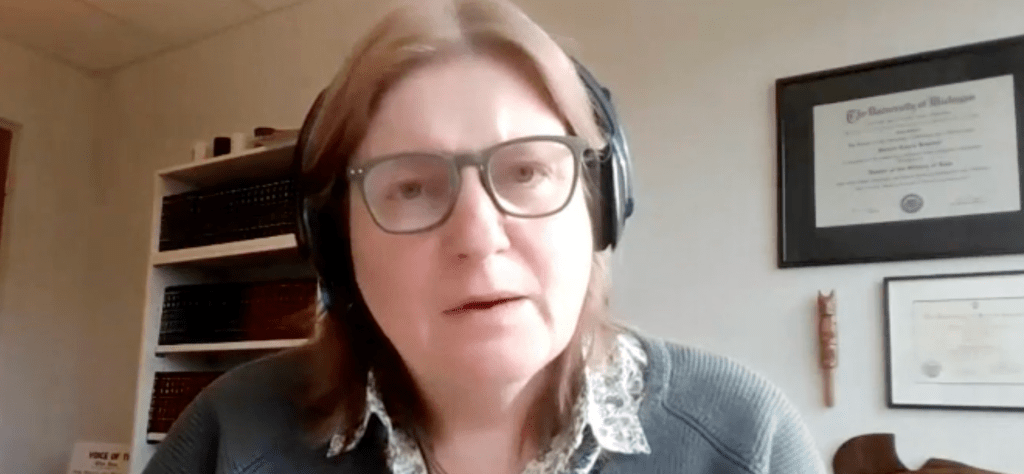
UBC professor Janine Benedet – 4 minute video
So far the Senate debate has been preoccupied with adult porn subscribers being outed in a data hack. The policy challenge for the bill is how to avoid, minimize or secure the risk of personal data stolen through hacks, a risk that goes up when Photo ID is required.
That’s why the bill is designed to exploit age estimation as far as possible to dramatically drive down the number of Internet users who would ever have to verify age by submitting ID proof of majority.
Age estimation technology is driven by AI-fueled online surveillance and web scraping: the age-estimating company searches the web or commercially available data for the Internet footprint associated with the viewer’s e-mail address, suggesting either an adult or a child. To the extent that estimation misfires and wrongly concludes the viewer is ineligible as a minor to access porn, the viewer can then submit ID to the age estimator.
The fear of data leaks is an anxiety that can’t be medicated by amending the bill, but likely amendments will be tabled anyway.
Right now, S-209 says that porn sites (which could include social media platforms that allow porn) have to contract with a commercial age verification service that meets federal government standards, including a critical requirement that personal data is digitally expunged as soon as age is verified.
In this regulatory model, thousands of websites or content applications become the age-gaters for porn in partnership with age verification companies. This is how the UK is doing it.
Some US states, like Utah and Texas, have moved the responsibility for age verification further up the chain of online distribution and are hanging the age gating role on apps and content applications (like Meta, X, Google etc.) by making them contract with age verification companies. If age estimation generates false positives and denies age verification to an adult, ID would likely be required.
California has gone one step further up the tech chain. The California bill puts the onus on companies selling device operating systems to require device users to volunteer their age. Perhaps the reason that the state’s Silicon Valley giants endorsed the bill: there’s no ID required at any point.
(An interesting aside, Google’s corporate policy is to use age estimation first, requiring ID if necessary, but only for their own products available in the GooglePlay app store).
The thinking seems to be: the bigger the tech company managing the age estimation task, the better their access to data, and therefore the better their age estimation results.
The downside to moving age verification up the Internet chain is that all adult users of a major online product, like Google Search or Facebook, might be caught in the age verification net, even if they’ve never sought out porn or never will.
Google’s approach to S-209 is generally supportive: it applauds sticking the porn providers with age verification responsibility and opposes PornHub’s view that it’s simpler and less risky to make a few Big Tech companies responsible.
The S-209 amendment that Google is proposing to the Senate is to narrow the scope of porn regulation to online entities that are porn sites by nature, as opposed to most websites, apps and platforms whose overall content is not “primarily intended” for porn. That might let Elon Musk’s X off the hook even though X officially permits porn. (Google’s YouTube does not allow porn, but age-verified adults can find it on Google Search if you disable the SafeSearch default settings. On the other hand, X allows under age children to view pornography if they opt-in).
As drafted, the Bill delegates to a future government regulatory body the line drawing exercise of which online entities with porn content are going to be in or out of the age verification scheme. Age verification could be restricted to conventional porn sites or expanded to a site like X which reputedly is the source of 41% of porn consumption by children.
Critic and law professor Michael Geist told the Senate committee that such an impactful decision on requiring age verification for social media apps or search engines ought to be written right into the legislation, not deferred to a regulator.
Geist does not offer an alternative to S-209 however, other than suggesting the bill be scrapped entirely and the problem of underage consumption of violent pornography punted to a broader Online Harms bill that the government has yet to table.
***
Letter to the Editor: there’s an alternative to S-209 choice of age verification
***
If you would like regular notifications of future posts from MediaPolicy.ca you can follow this site by signing up under the Follow button in the bottom right corner of the home page;
or sign up for a free subscription to MediaPolicy.ca on Substack;
or follow @howardalaw on X or Howard Law on LinkedIn.
I can be reached by e-mail at howard.law@bell.net.
This blog post is copyrighted by Howard Law, all rights reserved. 2025.
 MediaPolicy.ca