
June 14, 2025
The latest CRTC ruling (2025-133) on local television news has delivered a predictable outcome, but also the beginnings of an adult conversation about a broader CRTC strategy.
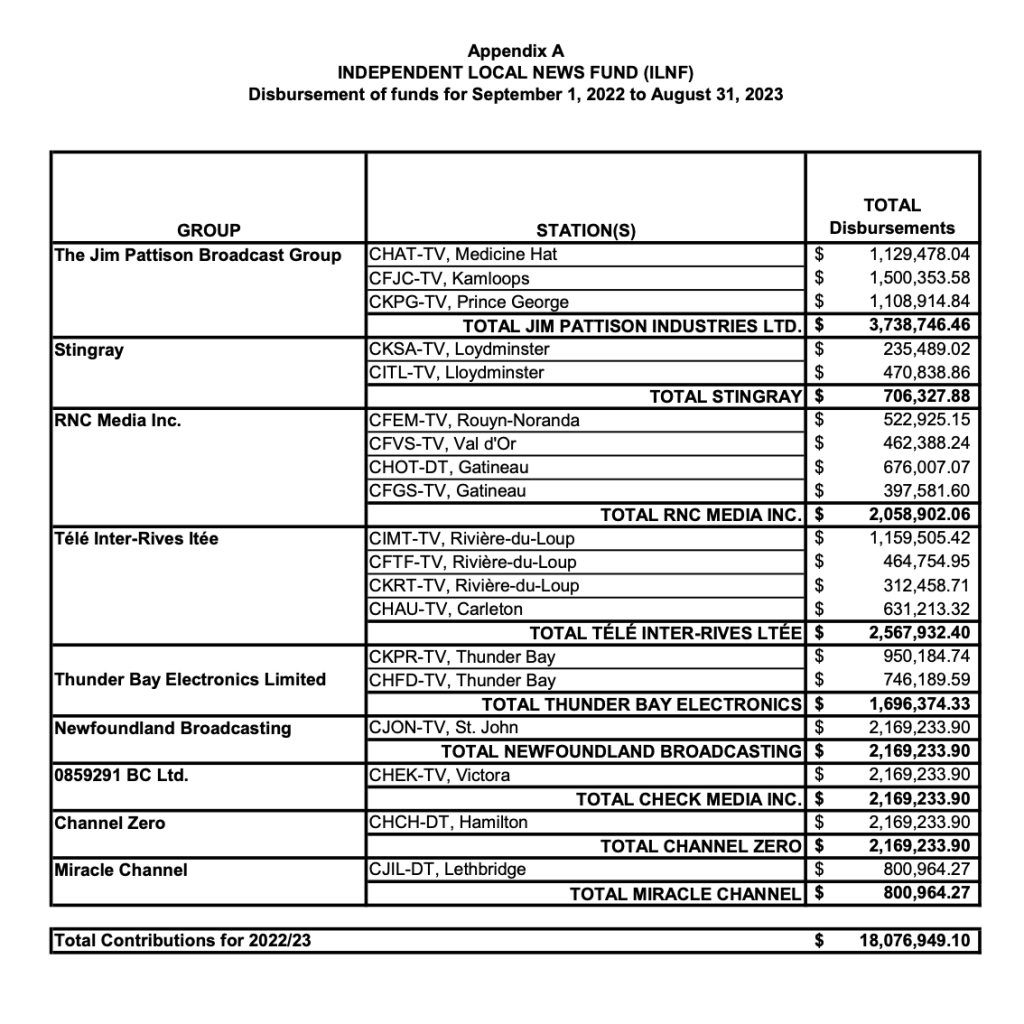
The Commission’s bottom line was that the CRTC-created Independent Local News Fund that subsidizes unprofitable local news production at sixteen stations not owned by Canada’s three major broadcasting groups will be extended to fifteen Global News stations. The ILNF’s $18 million annual kitty that is courtesy of a tithe on major cable companies is scheduled to be swollen by another $40 million from the Commission’s cash levy on online streamers.
The Commission was bound to reclassify the Corus-owned Global stations as “independent” once they were cut loose from Shaw Cable in the CRTC-approved Rogers-Shaw merger. Denying them admission to the ILNF would have been difficult to explain and now the streamer money makes the numbers work.
The level of ILNF subsidy works out to approximately 70% of news production costs, a dramatic figure, although it varies from station to station depending on how much they spend on news and how many hours they produce.
A CRTC rule caps any station owner in a single regional market from drawing more than 12% of the $18 million (now $58 million) fund.
In this recent ruling, the CRTC added an “entity” cap which restricts the 15-station Global News network to 45% of the available money, somewhat less than the majority share they would be paid without a national cap.
Those are the headline numbers.
There’s some unfinished business.
The Commission says its going to develop an incentive —details to come later— to reward local news stations for increasing their news coverage of underserved communities (read Indigenous, minority French and Anglo communities and equity-seeking groups).
As part of that ruling, the Commission has imposed a quid pro quo for receipt of ILNF cash: stations must post all of their television news content on their websites; whether its available for free or subject to paywalls isn’t clear from the ruling. Many stations already distribute their video content digitally for free.
So far, so predictable.
But three —three!— Commissioner dissents from the ruling suggest that a more wholistic vision of broadcast news funding is coming. And in fact a general rethink of news funding is one of the issues the Commission is reviewing in its current consultation on audio-visual broadcasting by television and streaming operators.
Ontario Commissioner Bram Abramson decided to speak his mind in a way you rarely find in Commission rulings, suggesting the tweaking of the ILNF to satisfy Global’s admission to the subsidy club is only an “interim” (read, “timid”) step with more to talk about.
Abramson makes the taboo suggestion that the Commission consider access to the ILNF subsidy by local stations owned by the three major networks, the 45 stations operated by the “vertically integrated” (“VI”) Québecor (5), Rogers (5) and BCE (35) that own both cable services and local stations.
Abramson’s view is that what’s more important than ownership of stations is the market they operate in, in particular the extent of local “news poverty,” meaning the availability of news from other local news outlets.
Québec commissioner Stéphanie Paquette weighed in on this as well, arguing that because the French language markets are dominated by Québecor’s TVA network, which is ineligible for ILNF money, that means the production of French language news gets shortchanged by the only-for-independents ILNF.
Going back to the establishment of the ILNF by the Commission in 2016, the “VIs’” local stations aren’t eligible for that Fund. But they are eligible for a different CRTC cross-subsidy that redirects cable company patronage of their own hyperlocal community stations to their own network TV stations. But depending upon how you do the calculations, that VI news subsidy is worth half or three-quarters of an ILNF dollar.
The CRTC’s standing justification for two sets of subsidy rules for VIs and independents is that the big three networks have greater access to pooled news resources as well as deeper pockets for capital investment.
There’s compelling policy logic to the Commission’s traditional approach, however the bright red line between the financial capacity of VI and non-VI television stations can get muddied in practice, particularly where some of the ILNF-eligible stations are owned by big media companies that don’t happen to run cable operations.
Stingray and Pattison come to mind. Each company closed television stations last month in the rural Prairies, Stingray in Lloydminster (population 31,000) and Pattison in Medicine Hat (population 63,000). The closure of the Pattison station was influenced by the capital cost of renovating the television studio that had sustained major flood damage.
The Jim Pattison Group is a multi-billion dollar, multi-industry conglomerate.
The other notable thoughts from the Abramson dissent were directed at free content. The Commissioner was of the opinion that the availability of industry cross subsidies ought to be subject to a public policy favouring the free distribution of news programming under the conditions of a “Creative Commons”: in other words, a general policy of favouring free news content.
The implications of that thinking are far reaching. Certainly Google and Meta have been making the same claim: that the public interest in accessing news content overrides the desirability of mandatory news licensing payments through legislation like the federal Online News Act, Bill C-18.
***
The Republican defunding of “biased” public broadcasting by PBS and NPR in the United States is on track after the House budget bill narrowly passed and was sent on to the Senate.
Judging from this New York Times report, Republican House Speaker Mike Johnson was able to mollify Republican holdouts with promises of reinstating some federal funding in the near future.
***
I attended a journalism conference recently where a focus on “essential standards of news reporting” inevitably turned into discussion about who is a journalist.
I’ll spare you my soapbox thoughts on the matter but I recommend an entertaining article in The Hub about online influencers straddling the line between partisan activist and journalist.
***
If you would like regular notifications of future posts from MediaPolicy.ca you can follow this site by signing up under the Follow button in the bottom right corner of the home page;
or sign up for a free subscription to MediaPolicy.ca on Substack;
or follow @howardalaw on X or Howard Law on LinkedIn.
I can be reached by e-mail at howard.law@bell.net.
This blog post is copyrighted by Howard Law, all rights reserved. 2025.
 MediaPolicy.ca