
March 27, 2025
Earlier this week MediaPolicy published an interview with the chief spokesperson for Canadian broadcasters, Kevin Desjardins. The President of the CAB pitches his case for a new regulatory bargain between Canadians and the 68 private sector media businesses that form his Association.
However the CRTC’s hearings on said regulatory bargain are now on hold. As expected the Commission has paused three key Online Streaming Act files for the duration of the federal election period: video content policy, audio content policy and gatekeeping in media distribution.
The media policy scene now switches from the pageantry of CRTC hearings to the battlefield of electoral politics. The contestants in the run up to the April 28th election will no doubt spark debate over media policy. We’ll have to wait for their official election platforms.
But a reasonable prediction is that media policy won’t get much traction beyond the political class —with the exception of CBC funding, which will be consequential— while the leaders and voters will be focussed on whatever Donald Trump wants us to be, for example 25% auto tariffs and more coming next week.
In the coming weeks I will try to address both the trade war (if it affects Canadian media and cultural sovereignty) and media policy.
As for the trade issues, I was unsuccessful in provoking the CAB’s Desjardins on what Trump means for Canadian broadcasting. He only speculated that a tariff-induced recession would affect advertising revenues for everyone, including broadcasting.
That’s a bit like refusing to say “Voldemort.”
The main lobby groups for Hollywood and Big Tech have been demanding the White House begin a scorched earth trade war against Canada ever since Parliament enacted the Online Streaming Act and the Online News Act in 2023, followed by the much delayed Digital Services tax in 2024.
Those expected industry demands were dutifully transcribed into formal warnings delivered to Canada from the US Trade Representative (a member of the Biden cabinet) that the US considered Canadian legislation might violate our CUSMA free trade deal. But you will note that the Biden White House did not act on those threats.
Long before Donald Trump got the idea of launching illegal tariffs in defiance of the CUSMA agreement, US trade strategy included a Break-Glass option of just ignoring the cross border trade agreement and launching tariffs against Canada under section 301 of the US Trade Act.
The last time occurred in 1999 in response to Canadian legislation impeding split-run magazines like “Sports Illustrated Canada” that were trade dumping into our domestic market. At least in that case, the US had won the trade litigation at the World Trade Organization before it set a deadline for section 301 sanctions against Canadian steel, plastics, and wood products.
This time around, Hollywood and Big Tech definitely have their “Break-Glass” man in the White House.
The official spokesperson for Big Tech, the Computer & Communications Industry Association (CCIA), has been filing briefs on Capitol Hill and with Trump’s Trade Representative demanding retribution for Canadian legislation.
Note to file, Canada’s Shopify belongs to the CCIA.
CCIA briefs are always packed full of allegations that foreign countries are violating this or that chapter of trade agreements. The better to load up the bargaining table. For the benefit of US legislators, CICA’s rhetoric is salted with bewildered outrage that foreign legislatures are regulating global American enterprises.
The trade allegations should not be dismissed out of hand just because they are inflammatory. But the CCIA sometimes loses touch with reality. In 2023 a CCIA brief informed US legislators and the US Trade Representative that Canada had once agreed that in exchange for the US not retaliating against Canadian regulation of US television access to our domestic market we would never regulate broadcasting over the Internet. It was a brazen fabrication. And the Biden White House no doubt ignored it.
The CCIA’s opening salvo in the anticipated Trump trade war was delivered this past December in a 238-page aggregation of Big Tech’s trade allegations against 53 countries and the 27-state European Union.
Although trade deficits and surpluses are irrelevant to whether trade agreement have been breached, the CCIA got right to the politics by pointing out that “digital services and goods represent a key driver of US export power, with the technology industry delivering a hefty digital trade surplus of $266.8 billion for the United States in 2023.”
Put plainly, Big Tech does some heavy lifting in keeping the overall US trade deficit lower.
In a new filing in January, Big Tech put its emphasis upon America’s interests in intellectual property that, says the CCIA, is impacted by “discriminatory non-tariff barriers” (i.e. regulation) in Canada, Australia, New Zealand and the European Union.
The point of course is not whether such “non-tariff barriers” exist, it’s whether they are truly discriminatory against US companies competing in foreign markets and violate the trade agreements that the US negotiated, signed and ratified with these countries. “Non-tariff barriers” may be the pretext for Trump tariffs next week.
In February, the CCIA got down to brass tacks, providing the US Trade Representative with its list of priorities for trade action.
Top target: the Digital Services taxes imposed by 14 countries, including Canada.
Next: news licensing payments to journalism outlets (Google money) in Australia, Canada, and the EU.
Next: for US video and music streamers, domestic content requirements and cultural cash levies in Canada, France, and other EU countries. In other words, eliminating the Online Streaming Act root and branch.
And so on. The CCIA is also targeting potential Canadian regulation of high-impact AI systems contained in our Bill C-27 (proposed legislation that died in January when Parliament was prorogued).
Whether any of that fits into He-Who-Must-Not-Be-Named’s plan to hit Canada and the rest of the world with “reciprocal tariffs,” we may see that on April 2nd.
***
Canadian legislators aren’t the only politicians with a taste for staging show trials of public broadcasters.
Yesterday MAGA ultra Marjorie Taylor Greene convened US Congress’ new Subcommittee on Delivering on Government Efficiency with subpoenas issued to PBS and National Public Radio.
The committee session was officially dubbed “Anti-American Airwaves.” No hidden agendas for Greene: “I think the important thing for Americans to ask is: Is this where our taxpayer money needs to go? To extremely left-leaning broadcasting and political bias that doesn’t represent all of America?
“[PBS and NPR are] radical left-wing echo chambers for a narrow audience of mostly wealthy, white, urban liberals and progressives who generally look down on and judge rural America.”
Greene did score a couple of points on the PBS refusal to cover the Hunter Biden laptop story (apology made) and the NPR chief’s pre-employment tweets calling Donald Trump a “racist and a sociopath” (also apology made).
It wasn’t all one way traffic as the Democrats on the committee had their turn. Theatre-goers were treated to political satire from Californian Congressman Robert Garcia.
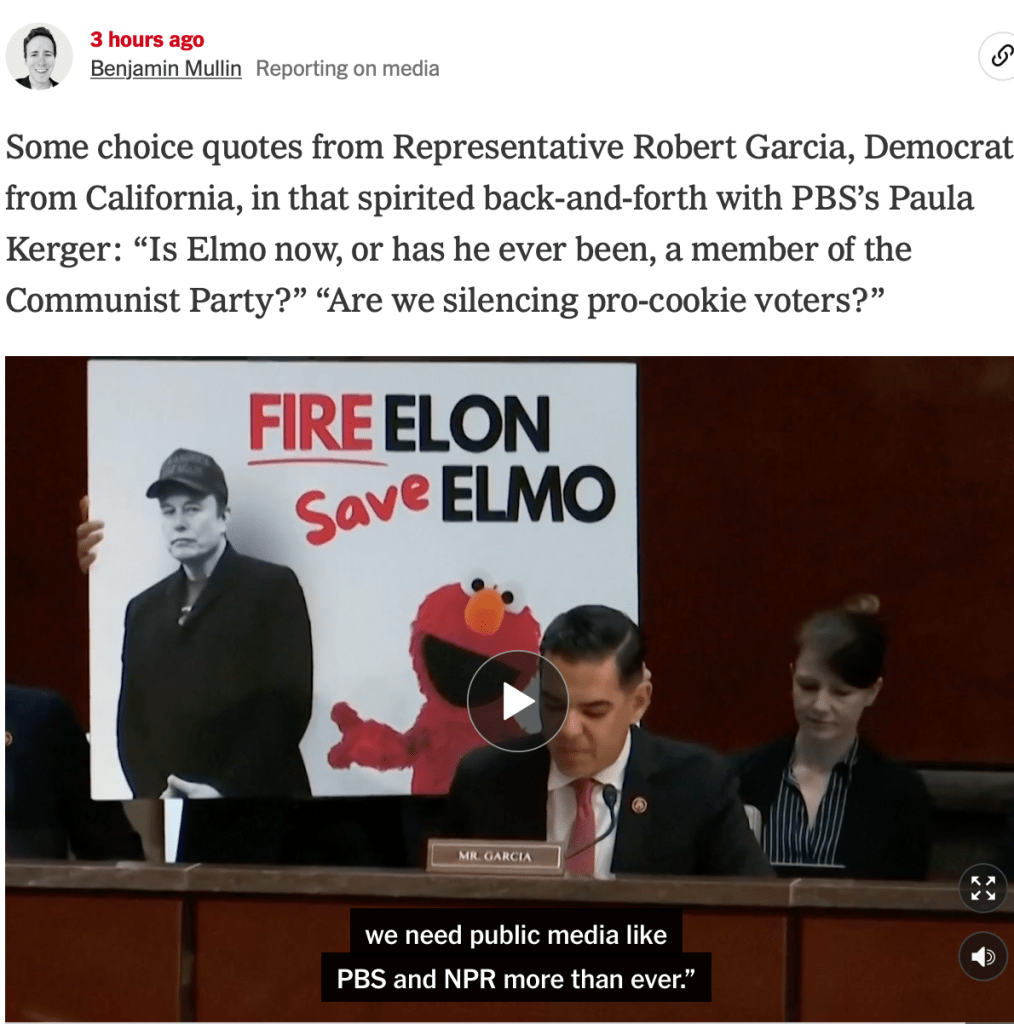
Another Democrat, Jasmine Crockett of Texas, accused Republicans of the right-wing version of Cancel Culture.
“Free speech is not about whatever it is that you all want somebody to say,” she said. “And the idea that you want to shut down everybody that is not Fox News is bullshit. We need to stop playing because that’s what y’all are doing in here. You don’t want to hear the opinions of anybody else.”
The speculation is that Republicans in control of both chambers of US Congress will finally make good on threats to eliminate federal support for public broadcasting, currently budgeted at $535 million USD annually. That’s about 1% of NPR’s combined private-public financing and 15% of the total PBS budget.
The influential non-MAGA conservative opinion columnist George Will recently advocated defunding, saying that government contributions to PBS and NPR funding are a subsidy for affluent audiences.
***
If you would like regular notifications of future posts from MediaPolicy.ca you can follow this site by signing up under the Follow button in the bottom right corner of the home page;
or sign up for a free subscription to MediaPolicy.ca on Substack;
or follow @howardalaw on X or Howard Law on LinkedIn.
I can be reached by e-mail at howard.law@bell.net.
This blog post is copyrighted by Howard Law, all rights reserved. 2025.

 MediaPolicy.ca
One thought on “Catching Up on MediaPolicy – Say his name – Shopify’s Tech Bros have their sights on Canada – MAGA puts PBS and NPR on trial”