Miller’s answer: there will be no surrender by the Liberals on his new bill. Protecting kids is not on the table, he said, “hard stop.” The minister thinks that similar legislative efforts being passed or proposed in Washington and various US state houses to protect children from online harms bodes well for Canada pursuing the same strategy.
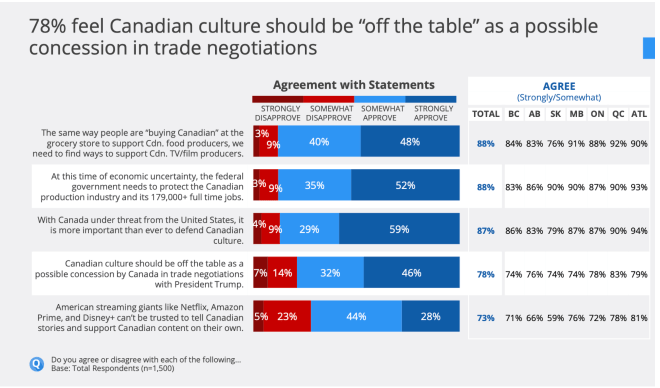
Also, he said protecting children is more important than “redistributing money within an industry,” a reference to the CRTC ruling. (Public polling on conceding ground on the Online Streaming Act under US trade pressure is here.)
As for overruling the CRTC on streamer contributions, Miller said he wouldn’t comment publicly. That lasted about ten seconds once Kapelos went after him for “capitulation” to US trade pressure and American companies.
Kapelos asked Miller what Canada got, or might get, in CUSMA trade talks for coughing up the Digital Services Tax and the CRTC ruling.
“I’m not going to tell you,” replied the minister.
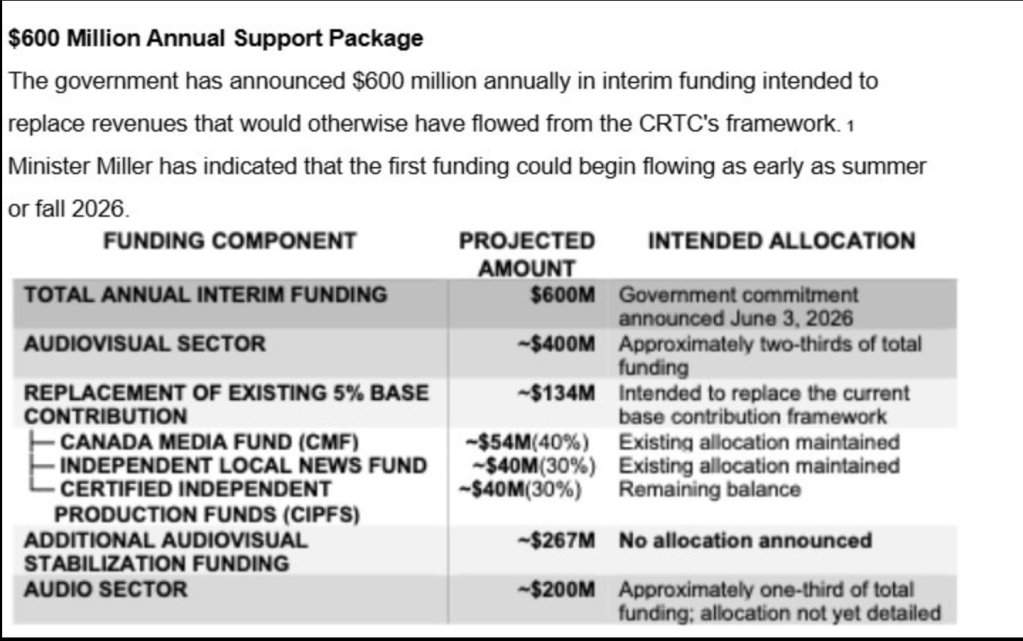
The minister then gave up some fresh talking points on the CRTC ruling and the $600M in federal funds that includes replacement of the streamer contributions:
The CRTC “is not the final arbiter” on implementing the Online Streaming Act, the government is.
The Prime Minister may have overruled the CRTC’s 15%-of-revenues assessment on foreign streamers but it is only because the 15% number wasn’t the right one. When the minister formally instructs the CRTC “in a few months” on the make-over of the overturned decision, there will be “a number.”
The annual $600M in federal funds announced on June 3rd will compensate for giving away the $200M in annual streamer contributions ordered two years ago by the CRTC in part because that streamer money is “tied up in court.” (The escrowed streamer funds from 2025-26 will have to be refunded to the streamers).
The federal $600M will include money for “independent journalism.”
***
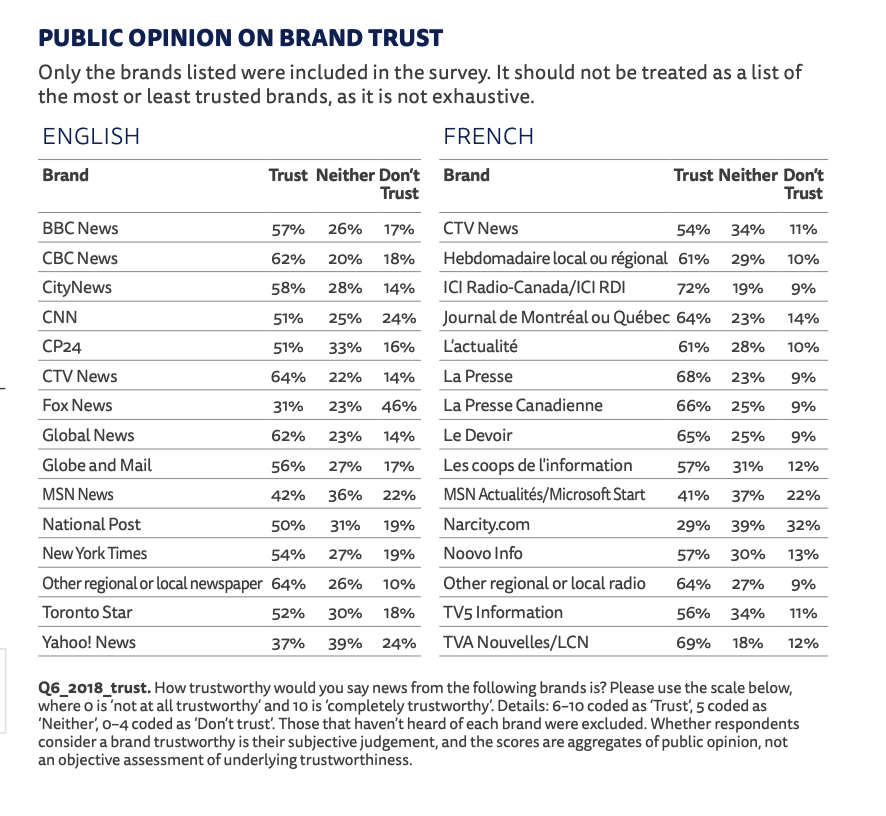
There was an unexpected media policy post from Narcity publisher Chuck Lapointe last week that is worth reading.
Narcity is a Canadian news outlet with a heavy bent towards travel content. But it also publishes conventional news content and on a daily basis it re-posts Canadian Press news stories on Facebook in order to draw traffic to Narcity’s websites.
Speaking of Meta, Lapointe’s policy post points out how foreign platforms now completely dominate the Canadian market in digital advertising with the well known impact on the ability of Canadian media to monetize their content.
A good policy move, he says, would be for Ottawa to put new federal dollars in the hands of Canadian advertisers on the condition they spend it on Canadian digital platforms. That kind of voucher system might spur innovation by Canadian digital outlets competing for that ad spend.
It’s a smart idea that’s been circulating in various US states for some time now. In Canada, Senator Andrew Cardozo and I included the recommendation of an advertising voucher in our recent report, Making News Media Sustainable.
As often happens in government reviews of big mergers, the field of competition is configured to offer a rationale for the thumbs up or down. In this case, the FCC is saying it’s “pro-competitive” for Hollywood studios and streamers to consolidate in order to compete more effectively with Silicon Valley tech/media companies.
The merger story isn’t over. Some US state attorney generals, including California, are banding together to litigate an anti-trust action against it.
The merger also hasn’t been approved by the Canadian Competition Bureau. The European Union and the United Kingdom are also reviewing it: an early approval or the launch of further EU investigations might be announced in July.
***
Back to the Online News Act for a moment and attention all journalists.
An independent researcher from Simon Fraser University is running a survey on newsroom opinions on the consequences of the Online News Act. (She confirmed to me that she isn’t getting funding from foreign platforms. Her research appears to be supported by a federal grants).
If you would like regular notifications of future posts from MediaPolicy.ca you can follow this site by signing up under the Follow button in the bottom right corner of the home page;
or sign up for a free subscription to MediaPolicy.ca on Substack;
Uncles describes the editorial mission as solutions-based and innovation-focussed news coverage: the branding is Canada’s potential to “Be Giant.”
The long-form journalism feels best suited to weekend readers and magazine lovers.
You can sign up for their weekend e-mail distribution: the business model is ad-free and subscription-free. In short, it’s 100% billionaire backed.
At first glance, Be Giant’s news genres put it in competition with the Globe & Mail and The Logic, but the solutions based mission means that smaller outlets like The Tyee, The Discourse and The Narwhal are going to face more competition for the best in Canadian freelance journalism.
With more than 20% (i.e. 100%) of its philanthropic funding coming from the Loblaw-owning Westons, the non-profit Be Giant will not be able to issue tax receipts should it start accepting donations from readers or foundations.
One thing seems likely: Be Giant will not lack for investment capital.
***
Public financing of news journalism, public or private, does not exist at the federal level in the United States.
Perhaps not for long. Governor Gavin Newsom’s final budget proposal for 2026-27 (he terms out in December) eliminates the state’s $10M support to local news. The state contribution is the condition of Google’s matching $10M support.
On the other hand, Newsom isn’t backing off the state’s recent doubling of the state’s 35% subsidies for film and television production, expanded from an annual $330M USD to $750M.
According to the Hollywood Reporter, the grinding down of the Californian film and television industry continues as Hollywood sheds jobs, labour hours and its share of both US and global production.
With the next, and pre-midterm, federal budget cycle approaching, Hollywood is agitating for a federal production subsidy to match its own state subsidy. Unlike Canada, the US does not offer federal subsidies. (Canada’s combined federal-Ontario labour subsidy is about 35% for US productions, higher for Canadian content).
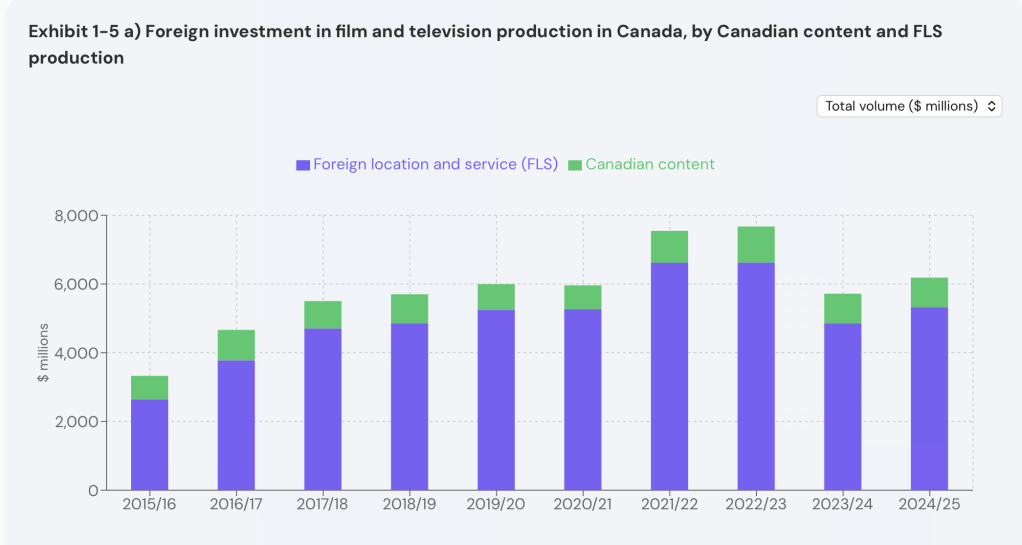
Over the last decade, the US has lost market share of video production and the main winners have been Canada and the United Kingdom that offer competitive subsidies and a supply chain of world-class production clusters that Hollywood producers have integrated into their business models.
graphic from the Hollywood Reporter
Months ago, President Trump touted slapping tariffs on movies shot abroad for the US market, paid for by Hollywood studios. This is not what Hollywood studios want: they want federal subsidies. The analogy to continental auto manufacturing seems apt.
The story in the Hollywood Reporter notes that David Ellison’s Paramount, the winner of the Warner Brothers merger sweepstakes, has committed to producing at least 30 movies annually to fend off anti-trust objections. That opens up a scenario in which the Trump FCC ties the location of shooting to the merger approval, a move that would impact the UK more than Canada.
***
Two weeks ago MediaPolicy pointed out some big Liberal cuts to cultural funding in the Parliamentary budget process, the “Main Estimates” for 2026-27.
Impacting News:
CBC: elimination of $192M from the $1.454 billion parliamentary grant;
(The latter two media funds are co-funded by government, broadcasters and streamers).
My sources suggested that the cuts to the CBC and the Canada Media Fund might not end up being so dire. Possibly, some of the funding might be resurrected in a later, Supplementary Estimate, at a time of the government’s choosing.
Well, I wanted to know more before I cast my ballot at the advance poll this weekend in Toronto’s University-Rosedale by-election.
I e-mailed Canadian Heritage and asked what the story was. I found the answer less than 100% clear, but here is the information I got:
The Heritage spokesperson described the absence in the Main Estimates of the Liberals’ much touted $150M increase to the CBC in the last budget as a consequence of the new money being part of last year’s Supplementary Estimate (which just got Senate approval two weeks ago) and therefore not rolled into the 26-27 Main Estimate.
Moreover, the spokesperson said categorically the missing $150M is not part of the budget cutting under the government’s three-year Comprehensive Budget Review.
Bottom line: without promising the $150M is coming back, it seems likely it will.
But that leaves the fate of the remaining $42M cut to the CBC grant unclear. That $42M figure reflects the extra funding that the Trudeau government pumped into the CBC in 2024 as a response to falling revenues and mass layoffs announced by the CBC. Nothing in Heritage’s answer to my email clarified whether that money is coming back.
Heritage didn’t respond to my question about cuts to the other media funds, including whether the budget reductions were impacting civil servants or program subsidies.
The Canada Media Fund, which pumps extra subsidy cash into Canadian TV dramas, documentaries, and children’s programming, has been limping along on the same $135M base funding from the federal government since 2011.
In 2017, Heritage minister Melanie Joly committed to an annual supplement of $42M to neutralize the falling contributions to the Fund from the declining cable TV companies. Last year, the government publicly committed to extending that supplement for three more years.
The $42M supplement has never been part of the CMF’s base funding that shows up in the Main Estimates. So probably it’s coming back and/or the government is going to claw it back once the streamer contributions to the Fund begin.
On the other hand, about $20M in time-limited DEI funding for CMF-supported programming just expired and by the end of this budget year the remaining $5M will stop.
Final CMF budget cut: unknown.
The rest of the Heritage cuts are part of the comprehensive expenditure review and they are real. According to Heritage: “Reflected in the 2026-27 Main Estimates are planned spending reductions. Incremental reductions in 2027-28 and in 2028-29 will be reflected in future Main Estimates for those respective years.”
***
If you would like regular notifications of future posts from MediaPolicy.ca you can follow this site by signing up under the Follow button in the bottom right corner of the home page;
or sign up for a free subscription to MediaPolicy.ca on Substack;
There was a brief political buzz this week when US Congressman Lloyd Smucker (R-PA) introduced a bill in the House Ways and Means Committee to ask the Trump administration to pronounce Canada’s Online Streaming Act Bill C-11 an unfair trade practice.
The technical term for the congressional request is a “section 301” investigation under the US federal Trade Act that can lead to retaliatory tariffs against other nations, Canada in this case, or it can fizzle out.
On the eve of CUSMA trade negotiations, Smucker’s congressional action is the expected statement of American intent. He and other Congressional representatives have sporadically demanded White House intervention since Parliament passed Bill C-11 in April 2023. In Canada, Smucker’s move was met with a smattering of told-you-sos from the foes of the Online Streaming Act, as was the case when Joe Biden’s White House expressed the same opposition to C-11.
The allegation of “unfair trade practice,” taken seriously, requires the Trump administration to recant its endorsement of CUSMA in 2018, a treaty that Smucker enthusiastically supported.
That’s because the Online Streaming Act, and the CRTC’s implementation of it that includes a 5% cash levy on US streamers to replenish Canadian media funds, almost certainly does not violate CUSMA, which may be why neither the Biden administration nor the Trump White House ever filed a complaint against C-11 that would have gone to a trade arbitrator for final resolution.
It’s not a violation of the CUSMA trade deal to impose financial or regulatory obligations on foreign companies that hurt their bottom line so long as Canadian companies are subject to broadly equivalent regulatory requirements that hurt their’s. That’s clearly the case in the Online Streaming Act and the CRTC levy.
None of that matters a whit, of course.
After plenty of lobbying, the US streamers believe they have the tariff-mad Donald Trump in their corner and they may well be right. With Paramount Plus having swallowed Warner Brothers Discovery under the new ownership of friend-of-Trump Larry Ellison, the streamers are even tighter with the White House than before. So who cares that Canadians obeyed the trade deal that Trump signed?
Netflix is all in for trade action too. This is mostly a case of smash and grab: they will take what they can get from the White House. In Europe, Netflix plays ball with regulators because they have no better option. In Israel, Netflix succeeded in getting streaming regulations scrapped at Trump’s request. As for Canada, Netflix told the CRTC two years ago it could live with a 2% cash levy (Disney seemed to be okay with something closer to 3%) —so quaintly pre-Trump, yes?—but if the new White House administration is willing to go to the mats for Hollywood, why not go for broke?
Meanwhile, the Carney government is sending some mixed messages to the US on how highly we value our culture.
Of course there was last summer’s Carney-cave on the digital services tax, but strictly speaking that was a corporate tax dispute rather than cultural legislation.
Most recently, our federal government’s projection of its own budgetary spending in the next three years suggests that Canadians love culture so much that the Prime Minister is prepared to make the deepest cuts to the CBC, the Canadian Media Fund (CanCon), the Canadian Periodical Fund (news journalism), the Canada Book Fund (Canadian books), and the Canada Music Fund (CanCon) since Stephen Harper took a cleaver to them.
The MainEstimates tabled in the House of Commons by Carney’s treasury board look something like this for 2026-2027:
CBC: eliminate $192M from the $1.5B parliamentary grant (13% cut);
Canada Media Fund: eliminate $68M from the $203M budget (33%);
Canadian Periodical Fund: eliminate $13M from the $86M budget (15%) with a further $14M cut in 2028/29;
Canada Book Fund: eliminate $3.4M from the $40M budget (8%);
Canada Music Fund: eliminate $16M from the $40M budget (40%);
TV5: eliminate $2M from the $13M budget (15%).
Funding for the Canada Council for the Arts, the Indigenous Screen Office, and the Local Journalism Initiative is frozen.
All of this violates the Liberal government’s election platform that left no wiggle room in promising to increase CBC funding by “an initial $150M” —implemented in 2025-26 budget —before moving on to future increases. At least the government hasn’t resorted to blaming Donald Trump’s tariff squeeze, well known to all when these election promises were made.
These cuts require a budget to make them final. But they aren’t a trial balloon. The Main Estimates were approved by cabinet’s treasury board and tabled in the House of Commons on February 26th, citing them as the government’s promised “comprehensive expenditure review.” Two weeks earlier, Heritage minister Marc Miller appeared before the Commons Heritage committee to praise the government’s increased cultural spending in the 2025-26 budget.
If there’s been any public outcry about Carney’s deep cuts to cultural spending, it’s been lost in the din. Somewhere, Stephen Harper is turning purple with indignation at the double standard.
As trade talks loom, it appears that Canada will defend its culture down to the last budget cut.
***
If you would like regular notifications of future posts from MediaPolicy.ca you can follow this site by signing up under the Follow button in the bottom right corner of the home page;
or sign up for a free subscription to MediaPolicy.ca on Substack;
It seems that Meta and Ottawa are talking about something that touches upon licensing of news content for Meta’s AI tools, age verification for social media accounts, the Online News Act, and Meta’s news ban on Facebook and Instagram.
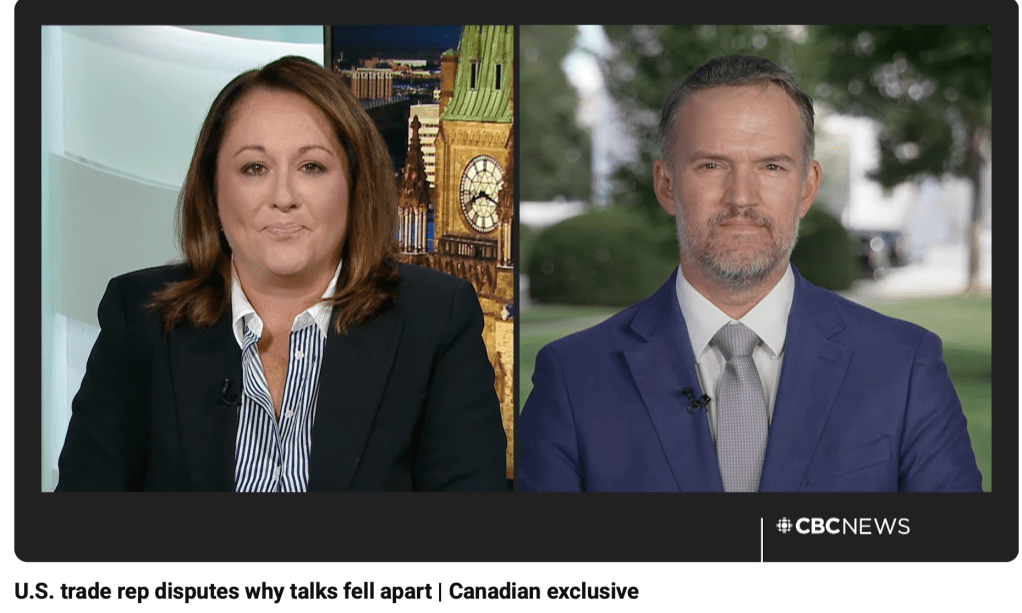
Earlier this month, Meta spokesperson Rachel Curran was invited to a ten-minute spot on David Cochrane’s CBC news hour to discuss Meta’s pitch to have the federal government impose age verification responsibilities on app stores (Google and Apple) rather than apps (Meta).
At the eight minute mark they pivot to the news ban and Meta’s recent chats with the Liberal government.
“We would love to have news back,” said Curran, which doesn’t exactly square with her adamant position that as an advertising-driven business they get no commercial value from news content.
Her read-out of Meta’s talks with the Liberals was that the government agreed with Meta’s view.
That’s an astonishing claim —not denied by the government as yet— given that the Online News Act was built on precisely the opposite foundation, the government’s policy conclusion that Facebook monetizes news content and exploits its commanding market position in social media to shortchange news publishers in what would otherwise be a fair market in licensing payments for news snippets and hyperlinks.
A more nuanced answer from Curran might have been that Meta is willing to pay for news content from some news publishers, but not from most others, and therefore a mandatory licensing regime doesn’t make sense.
The idea that some news content generates ad revenue for Meta, but some content does not, is a value proposition that could be true but it has never been proven one way or another and Meta has no intention of putting it to the test.
The Online News Act gave Meta a chance to prove such a claim by negotiating different price points for different news outlets. But prevented by the Online News Act from cherry picking news outlets, Meta instead chose the nuclear option of a news ban.
Now we’re back to “Go” on the Monopoly board and Meta wants to cherry pick deals with chosen news outlets for the ingestion of news content into the training of its AI tools.
Curran tried to obscure the cherry picking by making the shamelessly false statement that the Online News Act is preventing Meta and news outlets from engaging in negotiations over AI content (the Online News Act only regulates “making news available” to the public and would require amendments to apply to content licensing for the training of AI tools).
Alternatively, Meta wants news content in order to offer AI products that mimic search engines and embed news links in its chat replies. Yes, that might well be covered by the Online News Act and so Curran would be right, the Online News Act is an obstacle to implementing Meta’s evolving global model of monetizing third party content without licensing it.
But the important take-away here is that Meta is pitching a deal to Ottawa: repeal the Online News Act, let Meta cherry pick a few Canadian news outlets for licensing deals, and in return Meta will allow news publishers and their content back onto Facebook and Instagram.
The President of the Canadian Association of Journalists Brent Jolly dubbed this “a Faustian bargain,” but a more descriptive characterization would be “total capitulation by Ottawa.”
Removing the news ban would certainly help some news publishers, especially start-ups, who are still willing to put their business faith in Meta-controlled distribution. But the political value of the Liberals of taking such a lop sided deal seems minimal.
***
The battle to buy Warner Brothers Discovery is over.
You could spend the rest of your weekend reading analyses of the dramatic bidding war. For something short and punchy, here is Aakash Gupta’s X post.
The deal is supposed to catapult Paramount into a far better competitive position with the streaming thoroughbreds Netflix, Disney, YouTube and Amazon, improving upon its current also-ran position. With a mountain of debt financing sitting on Paramount’s post-merger balance sheet, major layoffs and studio production cost controls are a good bet.
Prior to the improved share bid, Paramount tried to satisfy the WBD board and its major shareholders with a key promise to buy its laggard cable assets (including CNN) and other guarantees around break-up fees and the reliability of its debt financing. In the end, it had to pay more.
Netflix didn’t want to pay more and may have been listening to the chorus of critics who thought they were overpaying, even with a lower per share price and Netflix stock swaps for WBD shareholders.
One interesting view was that Netflix might get more bang for its buck buying Spotify instead of a bigger share of the video streaming market through WBD’s prestige HBO content, WBD’s other IP brands and its massive movie archive.
Paramount is ultimately owned by Larry Ellison, third richest man on the planet and tight-with-Trump. The New York Times has a useful overview of Ellison’s budding media empire in technology, movies, cable news, and TikTok USA.
There will be at least two story lines for MediaPolicy readers to follow once the deal is closed.
The first is what happens to CNN News. In less than a year, Ellison has acquired control of CBS News and now CNN.
CBS News is already being repositioned towards a more conservative audience.
CNN —disparaged for years by Republicans as the “Clinton News Network”— seems a good candidate for being starved for cash, stripped for parts or transformed into Fox News 3 unless Ellison is shrewd enough to hang on to a centre-left audience for advertisers. Certainly his friend in the White House expects a conservative CNN.
On the latter point, Ellison may have jotted down notes on Jeff Bezos’ business misjudgment in humbling the Washington Post to appease Trump.
The other story is Canadian: will Ellison renew or let the HBO licensing deal with Bell Media expire and offer HBO as a stand-alone streaming service in Canada (in a bundle with Paramount Plus, or separately). (Update 2/3/26 – Paramount has announced that HBO and Paramount Plus will be merged into one streaming service.)
If Bell loses the profitable HBO content stream, its entire broadcast enterprise becomes very weak, possibly an intolerable drag on its bottom line.
The Attorney-General of California Rob Bonta is talking out loud about challenging the deal. But anti-trust is notoriously a long shot both in timeline and chances of success.
Regardless, the deal may not close for a year, an election year, and the Congressional Democrats are not going to let this merger go gently into the night.
***
In December I wrote about the book Elbows Up, an anthology of centre-left English Canadian and Indigenous voices responding to Donald Trump’s annexation threats.
I wasn’t deeply impressed by the book and said so. But I recommend an entertaining follow up: The Hub’s Harrison Lowman video interview of the book’s editor, CBC Radio host Elamin Abdelmahmoud.
Lowman had the same problem with the book that I did: no conservative voices and more than a generous dose of settler-state vocabulary that seems at odds with forging the ecumenical political bonds and links required for resisting US hegemony.
His guest had no good answer for the parochial exclusion of conservative perspectives on a common Canadian challenge, the threat of annexation: he weakly implied a lack of interest from conservatives to meet his time sensitive call-out for contributions.
But Abdelmahmoud is quick-witted to say the least, and he did a good job of explaining the importance of Canada and Canadians integrating the Indigenous perspective of dispossession, domination and death into our national consciousness of who we are, what we want to be, and, as pointed out in the book, why Trump’s threats provide a perfect opportunity to advance our reconciliation project.
Lowman and Abdelmahmoud, conservative and progressive bookends, are good friends in their private lives and listening to the interview is like sitting back and appreciating a robust argument over beers. That makes it an almost perfect metaphor for the national conversation we might have.
***
If you would like regular notifications of future posts from MediaPolicy.ca you can follow this site by signing up under the Follow button in the bottom right corner of the home page;
or sign up for a free subscription to MediaPolicy.ca on Substack;
The European Commission has fired a shot across the bow of TikTok, and by implication other social media, by finding the social media giant culpable of addictive algorithm design and inadequate safety measures.
The Commission explained its preliminary ruling, which TikTok can either appeal or fix, as follows:
TikTok seems to fail to implement reasonable, proportionate and effective measures to mitigate risks stemming from its addictive design.
For example, the current measures on TikTok, particularly the screentime management tools and parental control tools, do not seem to effectively reduce the risks stemming from TikTok’s addictive design. The time management tools do not seem to be effective in enabling users to reduce and control their use of TikTok because they are easy to dismiss and introduce limited friction. Similarly, parental controls may not be effective because they require additional time and skills from parents to introduce the controls.
At this stage, the Commission considers that TikTok needs to change the basic design of its service. For instance, by disabling key addictive features such as ‘infinite scroll’ over time, implementing effective ‘screen time breaks’, including during the night, and adapting its recommender system.
The EU finding is made against the Chinese-owned app in the European market, not the American-owned TikTok across the Atlantic. But it will heat up the tension between the US and the EU over the regulation of online harms impacting US-owned apps operating in Europe.
The momentum of regulatory intervention around the globe picked up more steam when Spain indicated its intention to follow Australia and France in banning underage social media accounts.
As for Canada, Heritage Minister Marc Miller isn’t saying yet if a ban on underage access is part of the online harms bill he is preparing.
Last Monday, the influential Taylor Owen and his McGill colleague Helen Hayes called for a moratorium on underage access to social media while online harms legislation gets tabled, works its way through Parliament, and gets implemented.
Judging from Canada’s last two pieces of media legislation, the Online Streaming Act and the Online News Act, the length of the entire process might be measured in years.
Last week Senatrice Julie Miville-Dechêne, the bill’s sponsor, obtained committee approval for a series of technical amendments as well as a change that defined porn more narrowly to get at “X-rated” content and scope out the nudity and implied sexual activity common in mainstream drama. The new definition requires the exhibition of explicit sexual activity and exposed genitalia for the purpose of sexual excitement.
As drafted, S-209 still leaves the decision on whether to scope in porn-permissive social media apps to the federal government, either in a House vote on the bill or afterwards.
***
Last weekend MediaPolicy noted the diverging fortunes of the New York Times and the Washington Post with the Times getting the Trump-bump in digital views and the Post sagging in the other direction.
Then American anti-monopoly advocate Matt Stoller published a long Substack post where he suggested that Bezos bought the Post in 2013 as political insurance against the Obama administration taking anti-trust action against his Amazon e-commerce business. The insurance policy, Stoller suggested, has become unnecessary or overpriced as Bezos literally put his money on Trump.
One piece of context is that while the Post’s declining audience numbers may be attributable to anti-Trump readers voting with their feet, the conservative and pro-Trump Wall Street Journal is experiencing the same decline, although not as steep as the Post.
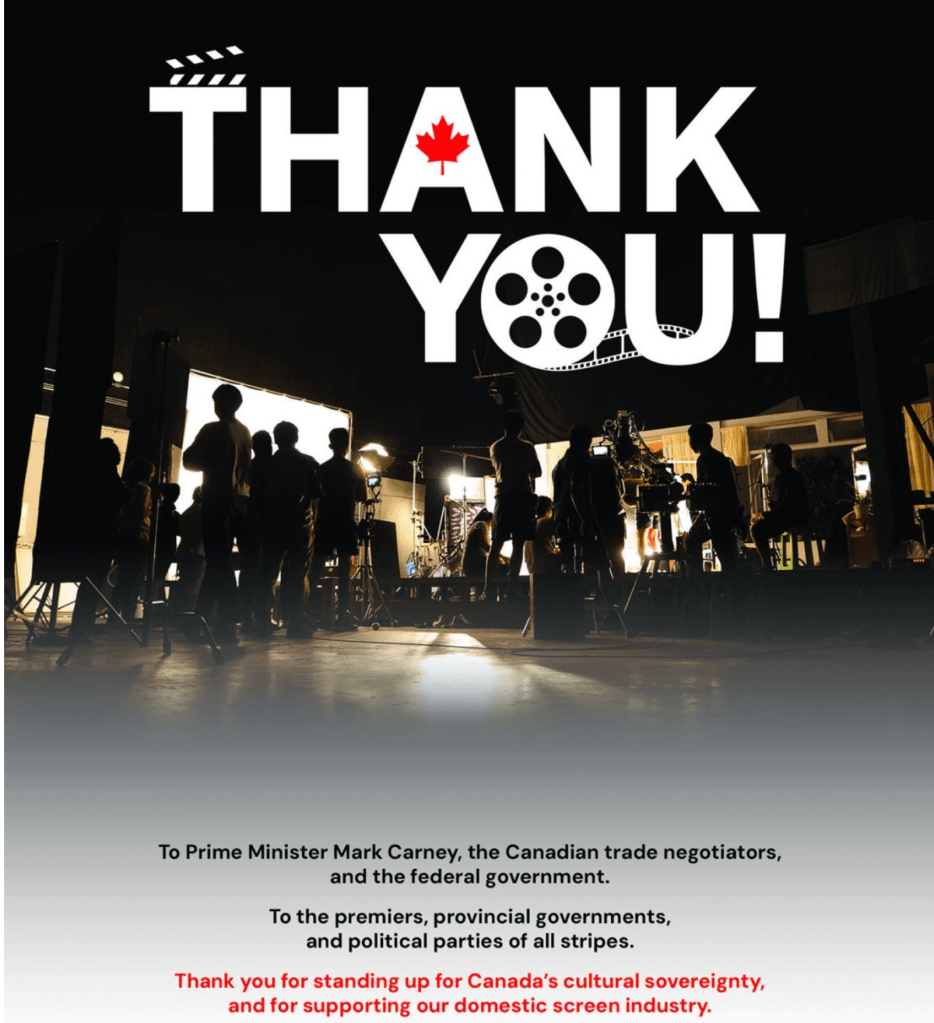
The gong show otherwise known as the right-wing frenzy over mainstream media went viral last week when a video clip surfaced of Reynolds Mastin publicly thanking Prime Minister Mark Carney for “having our backs” and gushing that “we have your back too.”
There it was, proof of the blood pact between the federal Liberal Party and the mainstream news media.
But who the heck is Reynolds Mastin?
Mastin is the President of the Canadian Media Producers Association (CMPA), the industry group representing independent Canadian production companies that make entertainment programming. He was chairing the CMPA’s annual Prime Time conference in Ottawa when he made the remarks.
Readers may know, Mastin is not a journalist and he (and the CMPA) has nothing to do with news journalism. He was encouraging Carney to resist American trade pressure on the Online Streaming Act which requires US streamers to contribute to the Canada Media Fund.
Independent movie and television producers draw CanCon subsidies from the Canada Media Fund to make dramas and comedies. The CMF doesn’t spend a dime on news, although some make the mistake of thinking it does.
Nevertheless, the timing was was perfect for frenzy: the Conservative Party was in the midst of its annual convention in Calgary.
Here is Conservative Heritage critic Rachael Thomas MP describing “the Canadian media summit” as a news journalism event:
Thomas’ falsehoods then found their way into Conservative fund raising e-mails.
At that point, some conservative pundits urged Conservatives to do a fact check. The managing editor of The Hub, Harrison Lowman, was as brave as he was blunt:
Now speaking of Mr. Lowman and The Hub, I can recommend an excellent podcast he did in January with ex-New York Times editorial page editor James Bennet.
In June 2020, Bennet (whose brother is a Democratic Senator) cleared for publication an opinion column from Republican Senator Tom Cotton arguing that Donald Trump ought to deploy the military if necessary to deal with rioting and looting that flared in the aftermath of the police murder of George Floyd.
Bennet’s employment did not survive the newsroom uprising that followed.
A similar newsroom conflagration occurred the same month at Canada’s National Post when columnist Rex Murphy opined that Canada “is not a racist country.”
In any event, I found myself gripped by the full 35 minutes of Lowman’s interview of Bennet and you may find it worth the time as well.
***
If you would like regular notifications of future posts from MediaPolicy.ca you can follow this site by signing up under the Follow button in the bottom right corner of the home page;
or sign up for a free subscription to MediaPolicy.ca on Substack;
Last week Heritage Minister Marc Miller walked back the tough talk of his predecessor Steven Guilbeault: cultural issues are no longer “off the table” in the upcoming trade talks with the US and Mexico.
In an interview with The Logic, Miller said Canada would have to be “flexible” in dealing with the US demands that Canada repeal the Online Streaming Act and the Online News Act although there are “lines that can’t be crossed.”
There will be no Davos speeches for Canadian culture. At least not in English. It probably escaped nobody’s notice that Guilbeault’s ultimatum was never repeated by the Prime Minister.
Miller also suggested that Canada needs to design its online harms bill with a clear eyed acknowledgement of Big Tech’s influence in the Trump administration. Miller said “we’re not oblivious to the fact that large American companies do have access to the administration, and colour a lot of the views coming out of the White House when it comes to the way they’re behaving.”
Despite an earlier news story that Miller was considering Australian and French bans on social media accounts for minors, he was quoted by The Logic as undecided about a Canadian ban.
“A simple ban, with doing nothing else, would be overly simplistic and probably wouldn’t achieve the goal that we’re trying to achieve, which is to make sure kids are safe, physically, emotionally and mentally,” he said. In a separate interview with the Globe & Mail, Miller said he was considering online harms legislation that would govern how AI chatbots impacted children.
That sounds very much in line with a new LinkedIn post from McGill University’s Taylor Owen, the most influential voice on online harms in Canada:
The core problem is that tech companies have failed to build safe products, and governments have failed to hold them accountable. Parents and teachers are rightly frustrated and so the impulse toward radical action is understandable.
But a ban treats exclusion as the end goal. It punishes users rather than the products causing harm. It restricts children’s rights rather than enhancing their safety. And when a kid turns 15, they enter an online ecosystem with no protections whatsoever.
Every jurisdiction that has studied this seriously—Australia, the UK, the EU—arrives at the same place: an enforcement body that can hold platforms accountable through risk assessments, mitigation plans, and transparency requirements. Age-appropriate design standards that eliminate targeted ads, auto-scrolling, data harvesting, and stranger contact for minors.
Canada had a bill [C-63] that did much of this. It should be retabled—and updated to include AI chatbots, which are now one of the main sources of consumer safety risk for young people.
(Update 2/2/26: The Globe & Mailpublished an op-ed by Owen and his colleague Helen Hayes recommending Ottawa proceed with an online harms bill based on a duty to protect children that obliges social media apps and AI chatbots to implement safety procedures. They recommend a moratorium, a temporary ban on underage access until such time that the bill is passed and tech companies have complied).
However, the challenges in legislating an online harms bill in a minority Parliament are considerable.
The Conservatives have a different vision of legislating online safety, preferring to criminalize online harms so the law is enforced by judges and not government regulators.
Unlike the last minority Parliament, the Liberals can’t just make a deal with the NDP to form a House majority to pass an online harms bill. The NDP’s loss of official party status in the 2025 election means they aren’t on Parliamentary committees and can’t team up with the Liberals to break filibusters that bottle up legislation in committee hearings.
The Liberals would need the Bloc Québécois to get them out of that jam.
***
I said there would be no Davos speeches for Canadian culture.
There almost was: Prime Minister Carney’s seven-minute hit at this week’s Prime Time conference sponsored by the Canadian Media Producers Association was funny and spontaneous and, by pointedly celebrating great home grown shows like Heated Rivalry “at this moment,” comes close enough to a bold statement of cultural sovereignty.
***
It would be easy to write a blog about the pyrotechnics going off inside American media so long as one was prepared to post, oh, about every fifteen minutes.
What I am finding interesting is Bari Weiss’ ascendancy at CBS News as the new CEO appointed by Paramount owners David and Larry Ellison (after bagging $150M US for her news website The Free Press).
Unsurprisingly, Weiss is moving CBS news coverage to the right. How far to the right, and how deep into Donald Trump’s embrace, we shall see. There’s a fair amount of moral panic that CBS will just be a Fox News Two, as if the centre and left is not adequately populated by ABC, NBC, CNN and MSNBC. There’s an illuminating NPR story on Weiss’ shake up at CBS, here.
Speaking of NPR, the New York Timespublished a story noting that the Congressional revocation of federal funding of the now-dissolved Corporation for Public Broadcasting (which provided 15% of NPR and PBS funding) has not resulted in station closings, at least not immediately. For now, donations are filling the gap.
And speaking of the New York Times (and The Washington Post too), data-cruncher extraordinaireNate Silver posted the following graph on his Substack that measures the news cycle buzz of political coverage:
It seems that the Jeff Bezos-owned WAPO did not get an attention-boosting “Trump bump” after the 2024 US Election but rather is experiencing something more like a “Trump sunk” effect.
Possibly that’s because Bezos alienated some readers by nixing a newsroom editorial endorsement of Kamala Harris and then, after Trump won, cuddled up to the White House. The eyeballs appear to be marching off to the Times.
All of it a damn shame: WAPO is replete with good watchdog journalism.
***
In November, the CRTC issued a major decision about on-screen Canadian content. Two biggies began with a revised point system to define the “Canadian” in Canadian programs under the Online Streaming Act, C-11.
The other opened the door for the first time to foreign streamers owning majority copyright rights in Canadian programs.
The Commission’s November ruling was the first of a two-part decision on video streaming: the crucial issue of streamer expenditures on Canadian programs remains outstanding.
Well, don’t hold your breath.
In a speech to the Canadian Media Producers Association on January 29th, the CRTC’s Broadcasting Vice-Chair said the Commission was not ready to issue new rulings.
“There is still more work to be done, and I cannot tell you exactly what to expect as we continue deliberating,” Nathalie Théberge told the crowd, who might have noted that the Commissioners are still deliberating seven months after hearings concluded.
“What I can tell you, however, is that there will be follow-up decisions in the coming months. This includes decisions to address spending on Canadian programs, distribution rules for services, measures to ensure discoverability of Canadian content, dispute resolution and audio policy.”
The coming months catches the attention. The Commission owes Canadians and the industry the aforementioned Part Two (“spending on Canadian programs”) as well as two separate files on the other topics Théberge mentioned.
All of this after the Commission was ordered, not asked, by federal cabinet in November 2023 to get the job done of implementing a new regulatory framework under Bill C-11 in two years.
And on Wednesday February 11th the Coalition for the Diversity of Cultural Expressions is holding a one day event in Ottawa to discuss the impact of AI on cultural production, a lead in to the federal government’s invitation-only policy summit, March 16th-17th in Banff.
***
If you would like regular notifications of future posts from MediaPolicy.ca you can follow this site by signing up under the Follow button in the bottom right corner of the home page;
or sign up for a free subscription to MediaPolicy.ca on Substack;
Hola from the centre of the universe, Toronto, where the biggest snowfall since 1999 (50 cm) has everyone on the watch for the army to be deployed, shovels in hand.
Here are a few things happening in Canadian media policy:
Canadian culture and the 2026 CUSMA trade talks
I’m going to be giving a ten-minute explainer on this topic at the Digital Media at the Crossroads annual conference on February 6-7 in snow-bound Toronto. The program and registration link is here.
No foolish predictions from me other than taking note that the US trade agenda goes far, far beyond Canadian cultural legislation such as the Online Streaming Act, the Online News Act or a potential online harms bill.
US chief negotiator Jamison Greer is floating the idea of a North American customs union which sounds a lot like double-digit Trump tariffs in exchange for Washington blocking Canadian trade diversification.
Regarding the Canadian streaming legislation that Netflix wants Greer to kill, last week MediaPolicy published a guest column from Peter Grant on how the CRTC might extend an olive branch to Netflix by allowing foreign streamers (and Canadian broadcasters) a CanCon credit for licensing and distributing Canadian shows abroad.
MediaPolicy also posted a book review of Richard Stursberg’s Lament for a Literature, a call to revive the nearly dead Canadian-owned book publishing industry. The Globe’s John Ibbitson also reviewed it. Stursberg’s “what is to be done” menu of policy action requires CUSMA’s “cultural exemption” of CanCon to survive the trade talks.
The context of this is the retrenchment of streamer spending on new productions since 2022. The Hollywood Reporter has fresh data about where US shows are being made and the only thing that is indisputable is that California is hurting and in an incremental way non-US foreign location shooting is taking a bigger share of a reduced production market . Canada’s volume is steady over time; UK and Irish shooting has gone up.
Within the United States, a game of musical chairs has resulted in New Jersey and New York gaining business, while Georgia and California have lost work.
The Trudeau government’s 2024 ban on the TikTok’s business activity in Canada (but not the app itself) followed a bipartisan Congressional ban in the United States on the grounds of national security.
Now that the Trump administration has completed the transition of the Chinese-owned TikTok into a separate US company, controlled by American interests with a minority Chinese ownership stake, the national security concern has evaporated in both the US and Canada.
Our federal government has agreed to a judicial consent order that reinstates TikTok’s right to carry on business in Canada (and presumably jump starts its investments in Canadian creators).
The odd thing: it’s the Chinese TikTok company, not the American-Chinese joint venture, that will operate in Canada. But the national security concern, which was never revealed by the federal government, has disappeared.
***
If you would like regular notifications of future posts from MediaPolicy.ca you can follow this site by signing up under the Follow button in the bottom right corner of the home page;
or sign up for a free subscription to MediaPolicy.ca on Substack;
You like to think you’ll never fall for a digital fishing scam. You like to think you’ll never fall for a deep fake news video.
Ahem, I fell for a deep fake news video.
YouTube, in its algorithmic omniscience, pushed to me as its top daily recommendation a video of the famous Washington Post political corro George Will. As the NeverTrump Reaganite we know him to be, Will delivered a withering critique of US tariffs by pointing to Toyota’s investment of $40 billion in Canada. Later, after I searched for a news announcement and found none, I wised up. (My friend in the auto industry kindly reminded me that $40 billion equals eight new car plants).
But for a good ten minutes, I was all in. The AI-video had George Will on the screen, live and in the flesh, saying exactly what George Will would say and how he would say it, but strangely looking twenty years younger than his 85 years. Then checking the meta-data, the video creators claimed to be a George Will fan site. I very much doubt they were licensed to impersonate George. A week later, YouTube had taken it down.
A few days later YouTube pushed me a similar fake, this time tech journalist Kara Swisher. Fool me once, etc.
Digital deception is now a daily event, according to a Canadian poll. Fifty-two per cent of us are “very concerned” about it; a full 88% are concerned.
Canadians generally want action against digital deception and hold a mix of views on who ought to do the acting:
Meanwhile, news publishers are soaking their heads in an icy bucket of water.
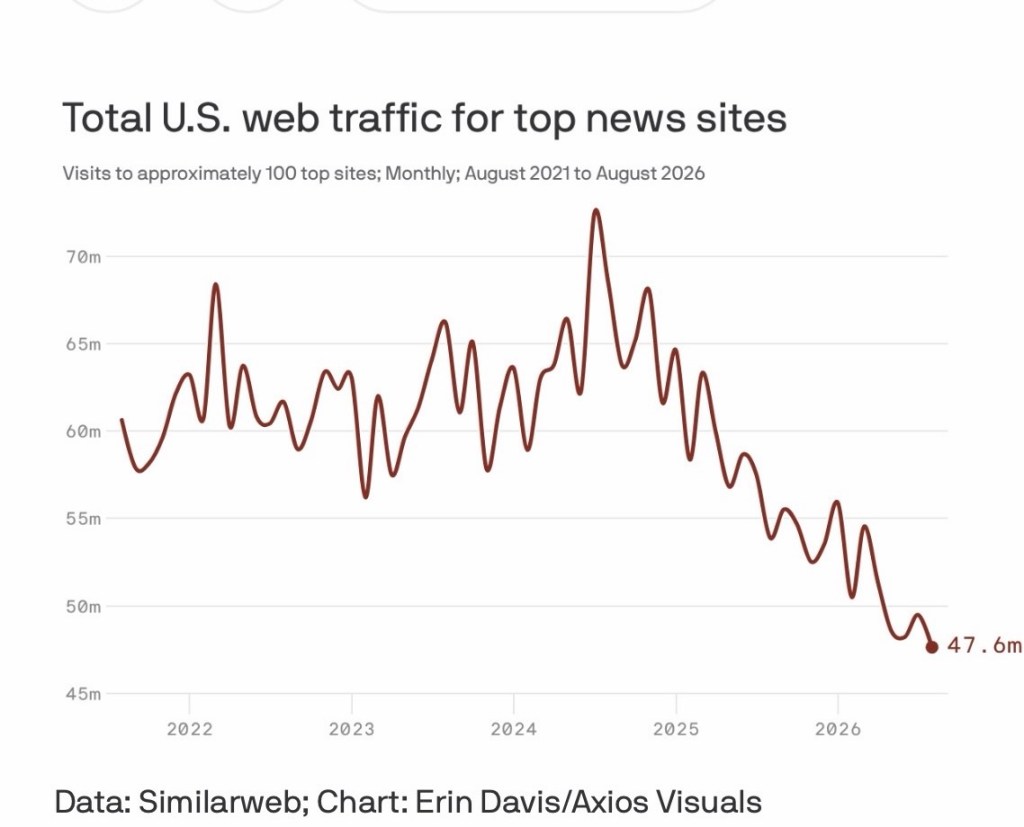
The collective wisdom was that news journalism is getting squeezed for audience attention (and ultimately revenue) on either side by AI and social media influencers. Thanks to AI-generated videos and Chat summaries, the latter published with or without links to digital news sites, publishers are expecting referral traffic to keep declining and more or less crash and burn.
If there’s a silver lining, twenty per cent of publishers believe they will make deals for significant licensing revenues, another 49% see a minor stream of revenue, and another 20% expect none. The latter group are concentrated in local media, public broadcasting and smaller countries.
A cause for optimism is that a lot of publishers are innovating by hiring digital creators to work with their journalists to compete in the influencer /video/ social media world.
Watch that space: I am waiting for someone to come up with a licensed AI-generated celebrity journalist/influencer who gets content up on the ‘net tout de suite in the news cycle. Someone like George Will.
***
As I’ve been griping about for some time now, the CBC has been slow out of the blocks to put its five year plan into action and earn that $150M raise in the Parliamentary grant.
We may be getting somewhere.
Editor in chief Brodie Fenlon just announced that CBC “will add 33 local journalists and create 11 new bureaus, increasing [our] Canadian footprint from 66 to 77 locations. This “boots-on-the-ground” investment is in addition to last year’s local service expansion of 30 journalists hired in 22 communities across Canada. Many of the new positions are based in Central and Western Canada.”
Now for context, CBC has about 3600 news journalists in television, radio and online. It’s long been underweighted in western Canada, likely because of where the television and radio stations were located decades ago when our demography was a lot more central Canadian. In British Columbia, for example, the private television broadcasters collectively outspend CBC television 7:1.
The CBC has also hired a new head of English language services to replace the retiring Barb Williams. The new EVP is Doug Smith. He’s arriving from Paramount Canada and his CV stretches back to ViacomCBS, Rogers, and Alliance Atlantis.
A streaming guy. Let’s give him a couple of years and see what he can conjure up at CBC Gem.
Maybe we’ll see a shift to buzzy blockbusters that emulate the recent success of Crave’s Heated Rivalry in Canada and abroad.
Making hit Canadiana television that is validated by successful export is not new: Canadian broadcasters have done it repeatedly with Transplant, Flashpoint, DaVinci’s Inquest, Degrassi, etc.
At home, Bell Media can take credit for a hitting streak of popular and authentic Canadian shows, smacking doubles like Shorsey, LetterKenny and Late Bloomer, and now Heated Rivalry, a centre-field blast worthy of Bo Bichette (sorry, too soon?).
There’s no reason CBC can’t do the same. It can and has (Sort Of was genius). But as a paid subscriber to Gem (how many of us is a secret), my personal request is to pour money into the functionality of the high friction, algorithmically anemic streaming site.
(Correction: An earlier version of this post identified the number of CBC newsroom employees at 3400.)
***
This year’s annual coven of Media Policy conspirators is scheduled in Toronto in the first weekend of February.
Digital Media at the Crossroads will be held at the Faculty of Music building, University of Toronto, on Friday 6th- Saturday 7th. Here’s the program. See you there.
***
If you would like regular notifications of future posts from MediaPolicy.ca you can follow this site by signing up under the Follow button in the bottom right corner of the home page;
or sign up for a free subscription to MediaPolicy.ca on Substack;
This US President wants high tariff walls to keep Canadian goods out of America and to grab Canadian jobs. Going the other way he wants open borders and unregulated markets for US exports such as streaming services and social media apps.
Given the thousands of Canadian manufacturing jobs and family farms at stake in the trade talks, and the inevitable reprise of 51st state threats —-“we just have to have Greenland Canada”— it may seem parochial at first to focus on media policy. But with 660,000 jobs in our media and cultural sectors, focus I shall.
Here are some of the upcoming headlines.
The CUSMA trade talks
An internet meme recently popped up in my X feed that put two contemporaneous statements from Google spokespersons next to each other.
In the first, Google addressed the digital regulators of a foreign government —-in this case the European Union—- with the utmost respect. In the second statement to a much different forum, Google demanded US Congress stomp all over the EU.
So no surprise, when CUSMA talks begin the US is going to come loud and hard against Canada regulating media in our own country, whether it’s the Online Streaming Act C-11 or the Online News Act C-18. I don’t have a high degree of confidence that PM Mark Carney won’t flush them like he did the carbon tax, the digital services tax, the emissions cap, etc.
It’s not that we shouldn’t reconsider Canadian media policy any time we want, but it would be better to do so because Canadians wish it. The polls say we don’t: at least not during the trade talks.
What’s at stake here is not only those two pieces of legislation, C-11 and C-18, but our right to take future action on any media policy that might cost the tech bros money or convenience. Think AI. Or online harms.
I make no prediction. On the one hand, as a banker and a corporate lifer I think Carney would happily throw cultural regulation under the bus.
On the other, if he does that he can kiss his Québec caucus goodbye. Or, the NDP might find its gag-point and bring down the Liberal minority government.
The Commission has three big decisions to release in the new year, arising out of the Online Streaming Act (having missed the December 2025 deadline set by cabinet).
The most consequential is the second instalment of the aforementioned CanCon video streaming ruling which will deal with issues that could carve out regulatory conditions for a generation:
How much money will Netflix and the California streamers have to spend on Canadian shows?
Will the Commission reduce CanCon spending for Canadian broadcasters (it will) and by how much?
Will the Commission swap out obligations for Canadian broadcasters to make CanCon dramas in favour of underwriting their unprofitable news operations?
The Federal Court heard the streamers’ appeal against the $200 million levy in June and judgment is overdue.
The legalities of appeal are narrow and amount to whether the Commission dotted the i’s and crossed the t’s. They don’t allow the streamers to easily challenge the CRTC’s wisdom on the size of the levies, nor what they are spent on (i.e. CanCon dramas and broadcast news).
Still, if the Court strikes down the levies on technical grounds just before the CUSMA talks begin it will significantly assist American negotiators or, if our Prime Minister’s climb down on the digital services tax is any guide, assist him in dumping trade ballast.
Another wild card is Québec’s new streaming law, Bill 109. It’s the CAQ’s claim to regulate streamers in case the federal CRTC disappoints on French language content on screens and AirPods.
When CUSMA talks begin, Québec’s bill will be sited in the same American crosshairs as the federal C-11. With a Parti Québécois election victory in the offing, and possibly another referendum on separation we could hear a lot more about this provincial law.
Next, we can speculate on whether Global TV News makes it to 2027 in one piece. Its parent company Corus refinanced its debt this year and managed to land some new television programming to replace the profitable Disney and Discovery content that Rogers poached from them.
But Corus still lives hand to mouth, and the news division loses a lot of money. The Shaw family ownership can’t find a Canadian buyer. Even Mark Carney wouldn’t dare exempt the 15-city Global News network from Canadian ownership rules and watch Fox or one of the other US television chains march in and set up shop in every major Canadian city.
The last question mark is a boutique policy issue but carries huge consequences for the survival of the Canadian film and television industry. The CRTC’s ruling that allows US streamers to own majority copyright in their new Canadian dramas turned four decades of Canadian cultural policy on its head.
The domino that might fall is whether the Liberal government would harmonize the CRTC’s new rules about the ownership of intellectual property in Canadian dramas with its own rules that govern federal subsidies to Canadian programs. The CRTC ruling invites American trade negotiators to demand it.
Online Harms
If Justice Minister Sean Fraser tables an online harms bill in Parliament, it will be time for some soul searching by all of us.
How seriously do we take the online harms of race-baiting and anti-semitic hate, humiliation of women and girls, and harm to our adolescent and teenage children? Are we virtue signalling our concern or do we really want to do something about it?
You can see this debate play out in its beta-version with Bill S-209, tabled by an independent Senator. That bill is legislation that would require porn sites and social media apps to exclude minors from accessing hardcore porn by using third party age verification services.
Again, the harm is obviously serious, but how seriously do we take the harm? Even though the risks are remote, how much are we willing to gamble the privacy of porn site visitors and social media followers whose identities might be hacked and exposed?
All eyes will be on Australia which has grabbed global attention by banning teen access to social media, a move that requires age verification of adult social media accounts.
AI
It would be guesswork to predict what happens next with the amazing explosion of AI technology, its impact on economic growth and social harm, and government efforts to regulate it.
The most pressing policy questions are in the hands of AI Minister Evan Solomon who has frequently telegraphed his reluctance to impede the development of Canada’s fledgling AI industry by “over indexed” regulations.
But neither has Solomon warmed to the Big Tech campaign to create an American-style “text mining” exception in Canadian copyright law. If he did, he would be sinking any chances that Canadian news organizations and cultural creators have to force AI giants into paying license fees for scraping online content to feed their products. Hugh Stephens has an excellent summary of the current state of affairs, here.
The worst case scenario for content creators is very bad but grimly not a lot worse than the best case scenario.
Even if AI companies submit to paying license fees —-and there have already been a few licensing agreements struck between AI companies and a select group of big news publishers and content creators—– it’s entirely possible that in the next five years AI will so disrupt the direct interface between news organizations and news consumers that news outlets will pine for the days when Google and Meta were taking their hyperlinks for free but at least sending audience traffic their way.
Either the US or Canada may raise AI commerce or the mitigation of its harms at the CUSMA bargaining table. The Trump administration appears to be all in for making American AI into the global masters of the Internet.
But as many have pointed out there is a back eddy at state-level where MAGA politicians are as concerned about AI harms as anyone.
If the Prime Minister gives away the media policy store to the Americans, what the CBC does becomes even more important.
Bandwidth
Whatever the government wants to do on media and cultural policy in 2026, bandwidth could be a problem.
I don’t mean download speeds. I mean the administrative bandwidth in the federal Heritage Department. Bureaucrats will be on call 24/7 during trade talks; the department is already charged with developing legislation to overhaul the governance of the CBC; and there are any number of quiet policy reviews and projects going on.
This could be the busiest year ever for media and cultural policy and the unhappy timing of Steven Guilbeault’s exit from cabinet means that we have a rookie Heritage minister, Marc Miller (who may or may not be as invested in C-11 or C-18 as Guilbeault).
Compounding that lack of experience is Carney’s decision to shuffle the deputy ministers who do the grinding work of getting things done in government. Long time Heritage deputy Isabelle Mondou just got shuffled to the Privy Council Office. Good luck to the new guy, Francis Bilodeau.
***
If you would like regular notifications of future posts from MediaPolicy.ca you can follow this site by signing up under the Follow button in the bottom right corner of the home page;
or sign up for a free subscription to MediaPolicy.ca on Substack;
I am ever grateful for my library card. After waiting just a few weeks for 100+ Torontonians to read this book before me, I got my turn with this new anthology of thirty Canadian artists and writers reacting to Donald Trump’s threats to crush our economy so he can annex our country.
Elbows Up! (subtitled “Canadian Voices of Resilience and Resistance”) is of course a riff on the Prime Minister’s election slogan that helped to put him where he is now. Whether in fact we are conducting ourselves that way is, I think it’s best to say, a work in progress.
The editor of this book, CBC host Elamin Abdelmahmoud, pitches the relevance of this collection as a cultural reboot of a similar publication in the turbulent year of 1968: The New Romans: Candid Canadian Opinions of the US.
The 2025 remake has less to say about the annexationist threat to the south than it does about being and feeling Canadian in dangerous times.
A few contributions stood out for me. Tom Power (the host of CBC’s radio show Q) offers a guileless and heart warming account of his journey from not-a-clue teenager to Newfoundlander patriot to passionate Canadian. The secret of his self discovery: sharing music, half-finished beers and sunrises with other dissolute musicians touring Canada. It’s a metaphor for community that anyone ought to find relatable, even if they find it in less dingy environments.
Author Iain Reid has a stunner of a short story (“The Appointment”) that is curiously de-contextualized from history and nationality. I’m not sure what it’s doing in this book, but it’s terrific.
Actor Jay Baruchel goes on a rant about how the American media juggernaut has smothered (English language) Canadian content. It’s hard for me to judge how good this piece is because that’s what I sound like all of the time, but I certainly nodded my head in agreement throughout. It should not be lost on readers that this book was published by a foreign book publisher because after years of foreign acquisitions the Canadian-owned press has been reduced to fighting for scraps.
But the disappointment I felt reading this book was its insularity. There’s not a single conservative voice. There’s one Québec writer. Presumably these missing voices, our fellow Canadians, have something to say in our moment of national peril.
Yet there are several contributions from writers who come from the cultural left perspective that Canada is not morally legitimate and, as a polity, is the perpetrator of a colonial and Euro-Caucasian supremacist domination of the powerless. Some of these pieces are well written and carry intellectual weight. But you can’t get to the end of this anthology without feeling that the project was put together for an audience demographic of about 20% of Canadians. That’s not the path to national resilience and resistance against annexation.
My last comment is that I want to point out the short, inspiring piece written by Dr. Jillian Horton who spoke to my innermost convictions and fears, and maybe your’s too:
It is our Canada.
We are a nation like almost every other —-built on violence, cruelty, oppression, as well as ingenuity, hard work, tenacity, community, faith, hope, and the sacrifices of those who came before us. But that is only one truth about us…a puzzle piece, not the whole story. That story has taken a turn at just the right moment. Sometimes saying what you will never become —-whether that is a fascist state or the 51st—- is the thing that brings the most clarity.
***
If you would like regular notifications of future posts from MediaPolicy.ca you can follow this site by signing up under the Follow button in the bottom right corner of the home page;
or sign up for a free subscription to MediaPolicy.ca on Substack;