Catching up on MediaPolicy – AI news scraping deal in Australia – who will pay for non-partisan journalism? – two paths to liberal democracy

July 12, 2026

Canadians are familiar with the story of the Online News Act. True policy nerds know that it’s part of a bigger story in which Google and Meta grappled with mandatory news licensing in the European Union, Australia, Canada and the United States.

Something similar might be playing out again between digital news publishers and global AI companies. But it is in its early stages, as large news publishers with lots of content to offer, and a modicum of leverage, choose between launching copyright lawsuits against AI companies or settling for licensing agreements. Here’s a list.

The latest news —- relevant to Canada because it occurred in our parallel policy universe, Australia—- is that Microsoft Co-Pilot has a content deal with Nine News (roughly, the equivalent of Canada’s Bell Media) to license its digital news content. Neither party is saying if cheques are being written, but certainly audience traffic will flow.

Co-Pilot has licensed Nine’s paywalled content as feedstock for its AI summaries but will embed Nine’s hyperlinks and enough paywalled content to push Co-Pilot consumers back to Nine’s full stories. 

As Ulrike Langer wrote last week, publishers of premium news content such as TimeThe Economist, and Dow Jones are making different kinds of AI deals that license content scraping in different ways: full archive access, data-only access, or journalism-only access.

The beginnings of a commercial market in AI-digested news content is an obvious way that AI companies can deflect or minimize any government efforts to come to the rescue of domestic news companies getting illegally scraped by the AI giants. Google and Meta did something similar a decade ago. They made voluntary agreements with a cherry-picked assortment of big media companies until sovereign governments decided to back the claims of news companies that Google and Meta bargained unfairly or not at all because they were monopolists in Search and social media. 

The prevalence of ongoing copyright lawsuits against the AI companies suggests that news companies again believe they are getting ripped off but don’t have the leverage to get adequate settlements without the intervention of their domestic judiciaries. Yet litigation is a long and uncertain path and it’s probably a non-starter strategy for local publishers anyway.

At some point, sovereign nations are going to think about legislating mandatory licensing of news content by AI companies with a dispute resolution mechanism that drives a fair market price. You might have heard of the idea.

***

Editorial strategy in news journalism hasn’t changed much over time: most publishers curate their news feed with “biased” or standpoint content stemming from a politically partisan, ideologically driven or simply a “watchdog” philosophy of keeping an eye on powerful political and corporate actors.

It’s hardly a secret that publishers are keenly aware of who their audience is, particularly their paying audience. 

As the advertising revenue stream for professional news journalism continues to collapse, two public policy imperatives meet: providing the people with fair and balanced news content and getting them to pay for it. Only 12% of Canadians pay for or share a digital news subscription, a stubborn statistic that hardly moves from year to year. 

The policy sweet spot is to foster a commercial market in broad spectrum news reporting on current affairs that gets citizens out of their self-imposed filter bubbles, whether on social media or from conventional news sources. 

The newly released 2026 Reuters Oxford Digital News report offers some audience data that’s relevant to what readers want and, perhaps, what they will pay for.

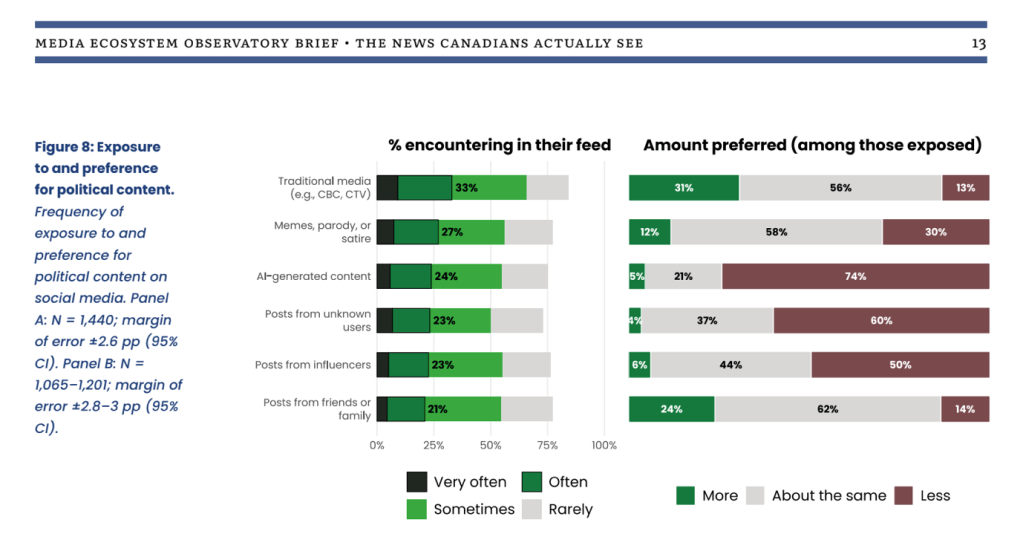
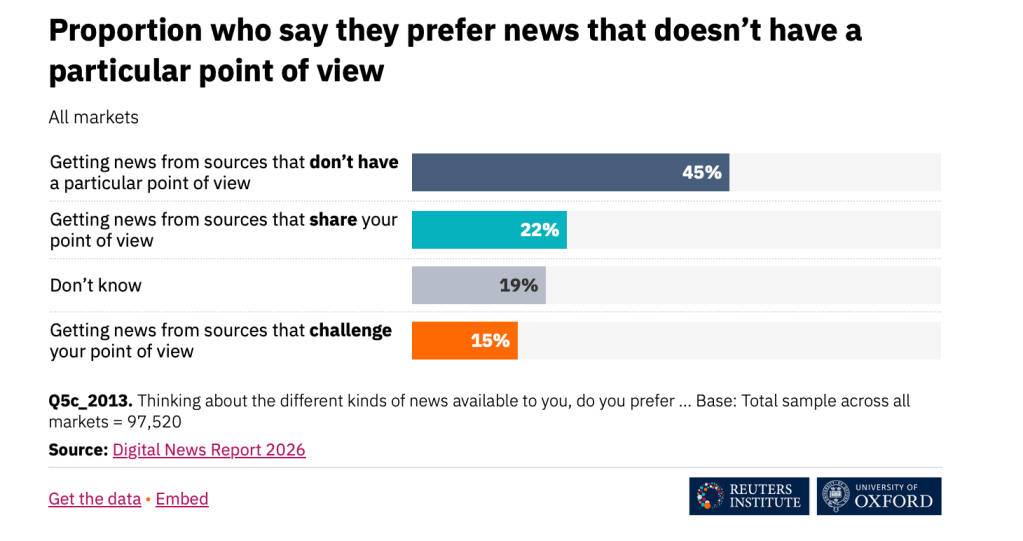
The report includes an inquiry by Denmark’s highly esteemed Rasmus Nielsen where polling respondents were asked to declare the strength of their allegiances to news sources they considered neutral, ideologically comfortable, or offering an editorial standpoint that challenged their own. 

As you can see from this graph above a strong plurality of respondents fancied their favoured news source were neutral. But significant minorities openly declared their allegiances to either intellectually comforting or challenging news sources. 

Here’s Nielsen’s take away from his research:

But the outsize role played by the minority who seek partisanship is easier to understand when we take into account that those who say they prefer news from sources that share their point of view are, in our survey data, also more likely to:

  • Share and comment on news online and on social media
  • Be very or extremely interested in news and in politics
  • Place themselves on the left or the right of the political spectrum
  • Access news many times daily and pay for online news

The people who prefer news that aligns with their own views are a minority. But they tend to be more vocal, more highly engaged, more partisan, and more commercially important for many news publishers than the public at large.

I’ll translate that passage as “an audience that is very tuned in to politics with very clear political views of their own will pay for news.”

This is not surprising, is it. 

For Canadians, this troubling disconnect between the willingness to pay for news and non-partisan content leads us back to another conclusion: the important role of CBC Radio-Canada as a news content provider for citizens who stubbornly won’t pay for news. 

To change tack here, Nielsen also makes some other conclusions from the data with the benefit of polling from around the world.

The first is that there is a correlation between audience preferences for ideologically friendly news sources and the prevalence of social media as a news platform. Not a surprise either. 

Another is that perhaps we in the global north and citizens that enjoy the privilege of living in liberal democracies ought not to be too judgmental about that lack of journalistic detachment in autocracies and conflict zones.

“When core democratic institutions or the fundamental rights of whole swaths of the public are under concerted political attack,” says Nielsen, “what does it mean to report the news in a way that doesn’t have a particular point of view?”

Discuss.

***

Open to being pleasantly amused? I recommend a short and compelling weekend read written by a friend of mine, historian David Wilson (among many endeavours, he has just stepped down from a ten-year stint as the editor of the prestigious Dictionary of Canadian Biography).

Published last week on the American July 4th holiday, Wilson asks whether the birth of the republic was a better choice than Canada’s own (but more patient) path to independence and responsible government. A cheeky but serious piece, worth your five minutes.

***

If you would like regular notifications of future posts from MediaPolicy.ca you can follow this site by signing up under the Follow button in the bottom right corner of the home page; 

or sign up for a free subscription to MediaPolicy.ca on Substack;

or follow 
@howardalaw on X or Howard Law on LinkedIn.

COMMENTS ARE WELCOME. But be advised they are public once I hit the “approve” button, so mark them private if you don’t want them approved. 

I can be reached by e-mail at howard.law@bell.net.

This post is copyrighted by Howard Law, all rights reserved. 2026.

Admit it. CBC News is the best.

July 1, 2026

In my last post, I spent time teasing out the nuances of how the Reuters Oxford 2026 report on digital news analyzes “trust in news.” The gist of the post was: look at the right “trust” numbers before rushing to judgment against Canadian news media in general and CBC/Radio Canada in particular. 

The Reuters Oxford report coincided with the release of the Senate of Canada’s report on the CBC (which I will get to, below).

One of the items in the Senate report was that the CBC is perceived to have a bias problem that requires action. That single recommendation instantly grabbed the headline of reporting on the Senate’s work by competing news organizations.

Also released last month was the annual Pollara analysis of trust in Canadian media. 

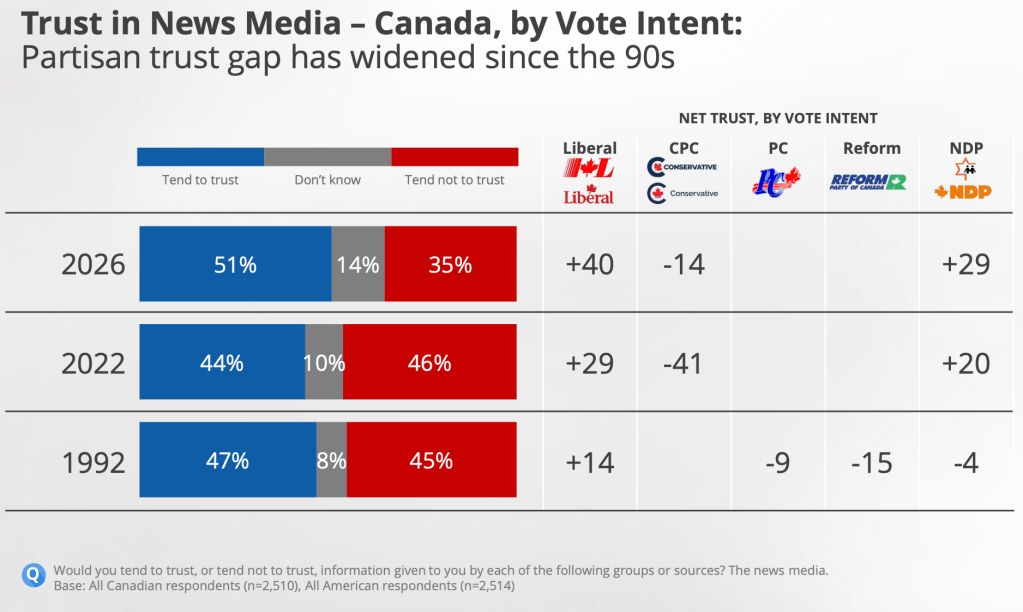
What is immediately striking about the Pollara results is that they quantify public trust in Canadian media at a much higher number than Reuters Oxford (51% versus 37% trust in all Canadian media), rebounding from a low point in 2022 and with even higher trust ratings than in 1992. 

Mostly, Pollara asked the question differently than Reuters, a softer and yet binary question: do you “tend to” trust or distrust “the news media”?

By contrast, Reuters asks Canadians if you think you can “trust most news, most of the time.” Then on a scale of 1 (distrust) to 10 (trust), Reuters slots you into trust (6 through 10), distrust (1 through 4) or neither (5). That spits out the 37% figure for Reuters, suggesting there are a lot of grudging sixes in that cohort of trusting respondents. 

The grain of salt here is that whether the trust number is 51% or 37%, Canadians are being invited to pass judgment on the entire news ecosystem, including the news outlets you don’t trust and the clickbait you see on social media.

But as I mentioned in the last post, beyond looking at the entire news ecosystem, you need also to take note of the trust numbers for individual news outlets.

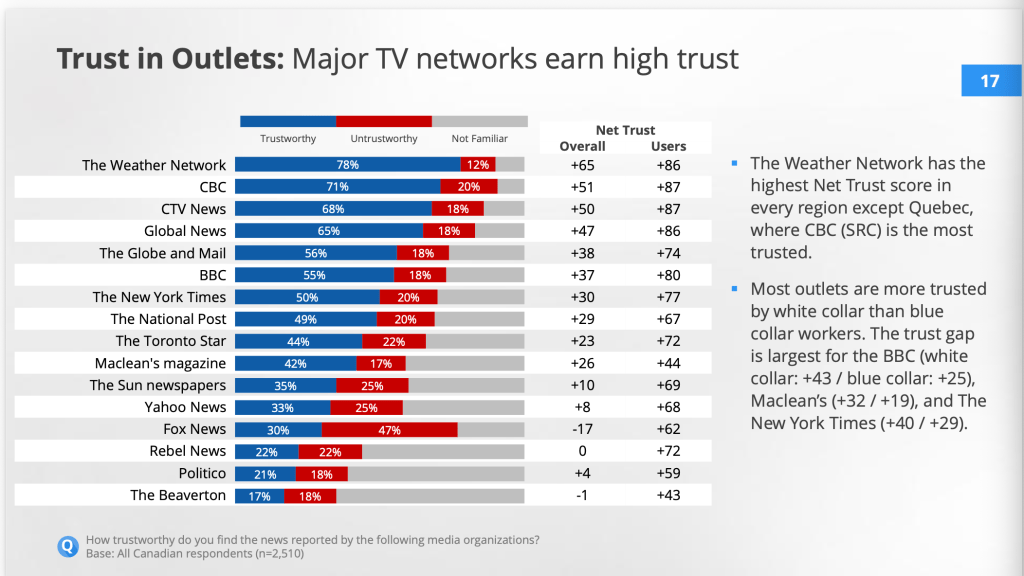
For each news source, Pollara has three simple categories: trustworthy, not trustworthy and “not familiar.”

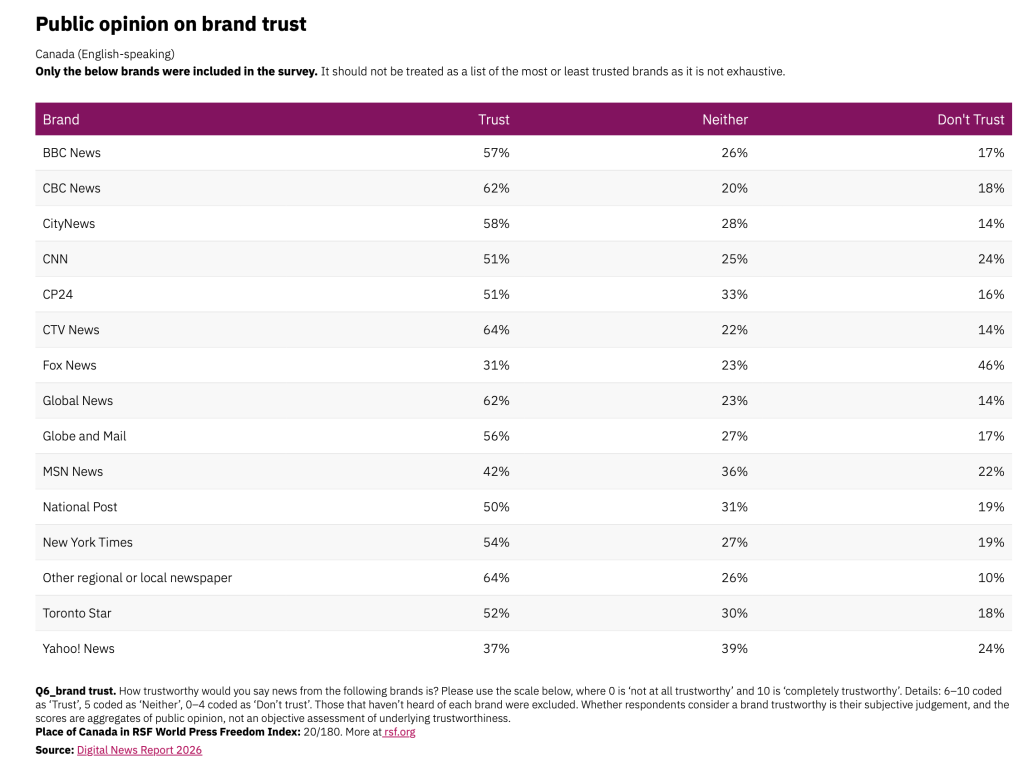
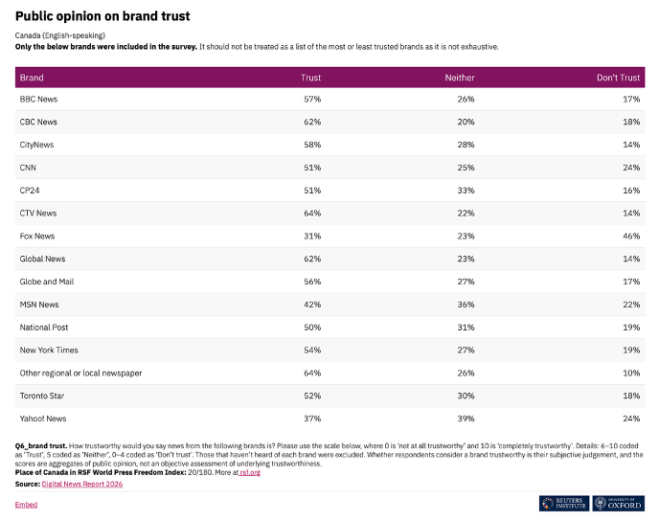
On the other hand, Reuters polls Canadians on each news source using its 1 to 10 scale and then slotting all of the 6/7/8/9/10s as trust, the 1/2/3/4s as don’t trust, and the fives as “neither.” 

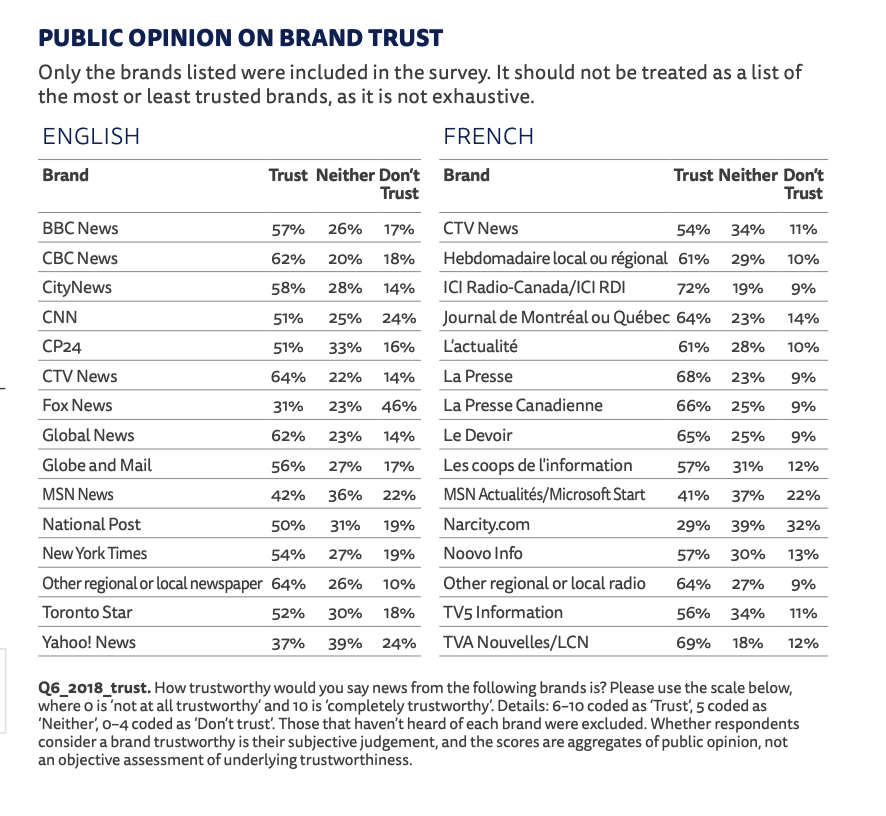
Under either poll (for English language news), the positive trust figures track almost the same: in order of trust, CBC or CTV on top, then Global News, followed by the Globe & Mail, and then the National Post or the Toronto Star

Pollara

Reuters Oxford

Notice the pattern?

Like in a cycling road race, the major Canadian television broadcasters are the leader pack (ranging from 62% to 64% in the Reuters poll) while the national newspapers are further back, clustered in the 50% to 56% range (local or regional newspapers are more trusted however). Explain that if you can, but it occurs to me that newspapers regularly publish opinion columnists, opinion editorials, and election endorsements.

Television newscasts limit their overt opinionating to (somewhat) diverse political panelists.

Feel free to disagree.

But don’t feel free to disagree about this fact. CBC News is killing it. It’s as trustworthy as its major competitors and significantly more so than the Brahmin of text journalism, the Globe & Mail (and far more than the conservative National Post and the centre-left Toronto Star).

Yet all we hear is the drumbeat of  criticism that CBC News is biased, or alternatively that all that counts is the perception that it is biased (to be fair, its negative trust rating is slightly worse than most of its competitors’ except for the Post and the Star). 

If I sound dismissive of the bias accusations, I’m not. The fact that polls reveal the CBC’s negative trust ratings accumulating in the West and among Conservative voters tells you there is something about the editorial curation that isn’t working (here’s my two cents worth). Defunding or not, if the West or Conservative voters “want in” to a national institution like the CBC, open the door.

This bias hot potato got batted about in the Senate Report on the CBC, the outcome of a Senate Committee investigation initiated by Senator Andrew Cardozo in late 2024, an especially precarious political moment when the countdown to a Pierre Poilievre cancellation of English language CBC seemed only to be a matter of time (and arguably, still is). 

Cardozo kicked off the inquiry with his own multi-point analysis of the CBC, (reviewed by MediaPolicy here, but see the disclaimer at the bottom of this post).

The mandate handed by Senators to its Transportation & Communications committee was focussed on local media: “to examine and report on the local services provided by the CBC/Radio-Canada .”

After 60 witnesses and 18 months, the Committee came up with a series of recommendations that could be distilled to this:

  • The CBC should put more resources into local reporting and programming, especially in news-scarce localities and official minority language communities and regions.
  • Long term Parliamentary funding should be established to pay for that coverage, making the CBC less vulnerable to budget cuts by the government of the day.
  • To make it national policy, the Broadcasting Act should be amended to explicitly include “local” coverage to its priority coverage (in addition to “regional and national”).
  • Just in case, the CRTC should reinforce this emphasis on local through its licensing conditions for the CBC.
  • Keeping in mind the force of gravity that the CBC poses to private local media, the CBC should find more ways to collaborate with local outlets.
  • The CBC should disclose more data about its resourcing of local news so we can measure how it’s discharging its mandate.

Meanwhile to confront the perception or accusation of journalistic bias, the committee recommended that the CBC should commission an annual third party study of bias in its news reporting.

The auditing recommendation was a gimme. The fact that the Senate committee felt it was necessary to recommend it was taken in some quarters as a guilty verdict for its many journalistic crimes, but candidly it was a bone to throw to CBC critics and haters, the latter category being inconsolable. An audit is a good idea for any public broadcaster, especially with the aid of AI analysis, because the CBC shouldn’t just have  industry leading trust ratings for its news product, it should have great ratings. 

One of the ways to improve the CBC’s trust ratings, aside from a consciously diverse editorial curation that addresses Western and conservative alienation from the public broadcaster, is to put more money into local coverage across the country with a particular emphasis on the long under-resourced Western provinces.

The CBC seems to be doing that in the last year by announcing more local reporting bureaus and journalists in the Prairie provinces. 

But it all comes back to funding. Reporters are expensive and it’s a big country.

On this point, we can argue until we are blue in the face about the adequacy of the $1.3 million annual Parliamentary grant to the public broadcaster. 

But I will say the quiet part out loud: whether that grant is more, less or the same, satisfying every Canadian’s idea of what the CBC’s programming priorities ought to be is not possible. As one witness told the Senate committee, the CBC “is drowning in mandates.” 

The CBC is formally independent so we’ve been letting CBC management decide on its own what matters most. Lately it seems to have alit on local news as the priority. But if that’s going to be done with gusto, something else in the mandate has to give. The shell-shocked executives at the public broadcaster will be inclined to be risk averse, so the Senate committee might be disappointed in its recommendations. 

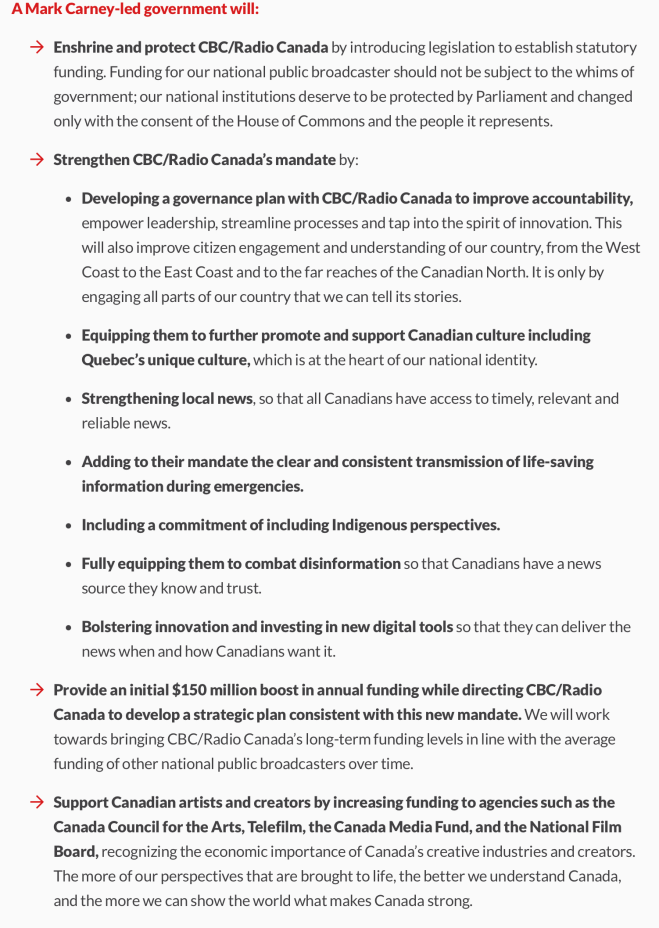
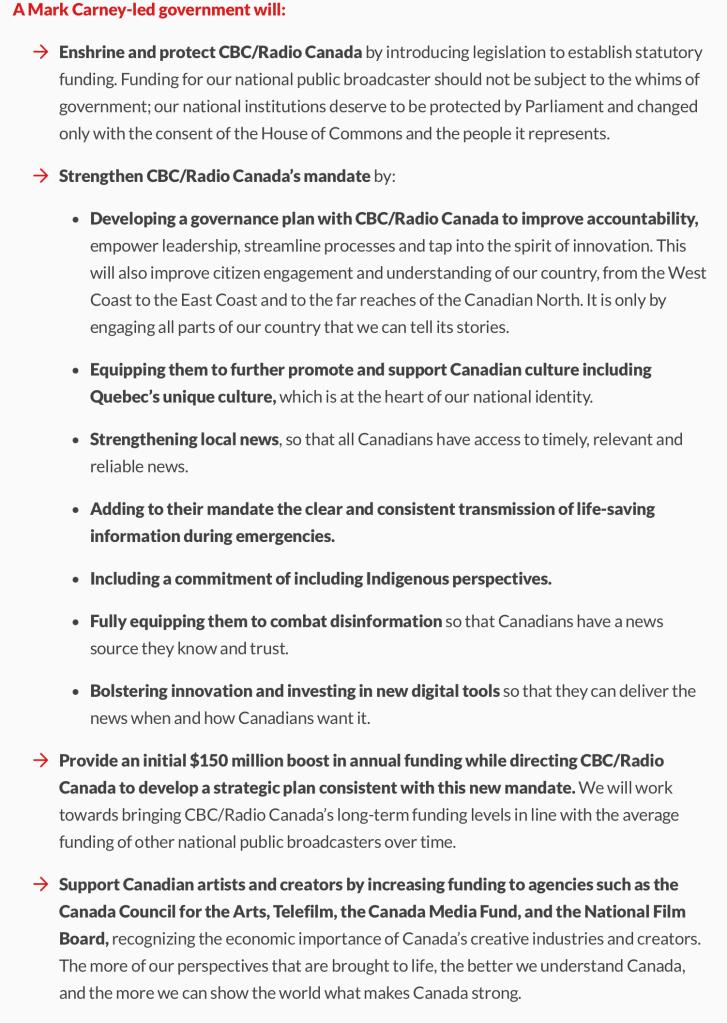
The ball is in the court of culture and identity minister Marc Miller, which is to say it’s aimlessly bouncing about in the Prime Minister’s Office. The passive neglect of the CBC policy file, and the false election promises of significantly increased funding for the public broadcaster, are both on Mark Carney.

***

(Disclaimer: Senator Cardozo and I co-authored a research paper for the Senate, Making News Media Sustainable. The study focusses on funding for private news media).

***

If you would like regular notifications of future posts from MediaPolicy.ca you can follow this site by signing up under the Follow button in the bottom right corner of the home page; 

or sign up for a free subscription to MediaPolicy.ca on Substack;

or follow 
@howardalaw on X or Howard Law on LinkedIn.

COMMENTS ARE WELCOME. But be advised they are public once I hit the “approve” button, so mark them private if you don’t want them approved. 

I can be reached by e-mail at howard.law@bell.net.

This post is copyrighted by Howard Law, all rights reserved. 2026.
Catching up on MediaPolicy – Your trust in news – Zuckerberg’s your daddy – Seeing Red – CBC is vulnerable – Do AI chatbots lean left? – Explaining Age Bans

(AI illustration)

June 27, 2026

Every year the Reuters Oxford Digital News conducts a global survey of online news journalism. It frequently leads its public release with a headline-grabbing number for “trust in news.” Every year, the number goes down. It sunk by 3% this year to 37%. A further 34% of respondents neither trust nor distrust news.

Every year, that single “trust” metric dominates the conversation. Here’s the problem with making too much of that.

First, what do polled respondents think “trust in news” means? The survey doesn’t offer a definition, so it’s in the eye of the beholder. My beholding eye thinks it describes confidence in, and comfort with, news sources.

Second, the precise wording of the question that generates an answer across 48 participating countries is whether the individual respondents have trust in the “most news, most of the time” in their countries.

“Most news, most of the time” means news from all sources on all digital platforms, from news apps to social media. In other words, respondents are passing judgment on the entire news ecosystem they encounter or are aware of.

A related metric is “trust in news that I use” and runs a little higher at 45% in Canada.

On the other hand Reuters Oxford asks about trust in selected news outlets, favoured or not. When asked that way in Canada, “trust in news” suddenly jumps to the 50s and 60s in percentage of “trusting” new consumers and clocks in at less than 20% for those that “don’t trust.” 

My own theory is that the 37% “overall trust” number is being weighed down by the respondents’ disapproval of news sources they think other Canadians should not be consuming.

Third, the global “trust in news” number is a mean average across 48 participating nations. Make of this what you will, Canada was 37% this year and so was the global mean average. Finland, Denmark and Norway are in the 50s and 60s percentage ranges. The United States is at 25%. Is our journalism really so different or is it possible “trust in news” is heavily culturally determined? 

Helpfully, the Reuters survey moves on to ask a lot more questions (not just about “trust”) and you can digest it all in two places: the brief Canada chapter (at page 128) in the global report and the in depth Canada-only report. Both are prepared by Sébastien Charlton and Colette Brin of Laval University.

Let’s have a look.

Mark Zuckerberg’s your daddy

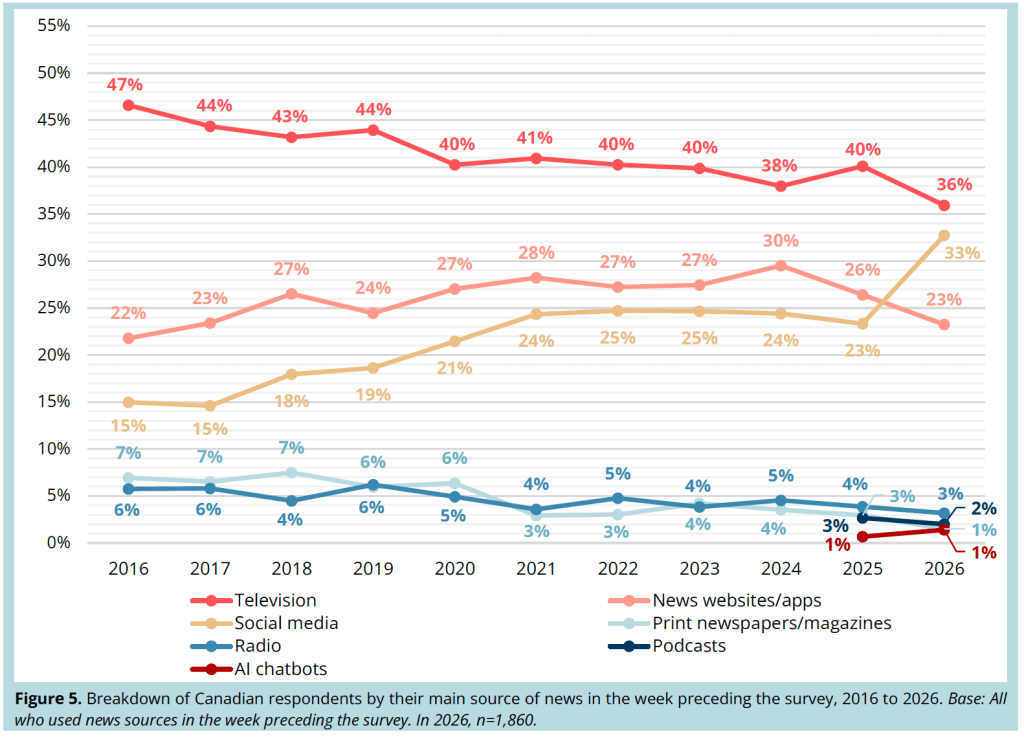
This year in Canada we crossed a Rubicon of sorts. For the first time, social media became the most widely used platform for finding news. That surpasses the long time leader, television.

Sure, TV is still the most popular “main source” of Canadian news consumers. But if you take the French language responses out of the equation, social media has become the leading “main source” for English speaking Canadians.

There’s a disturbing trend buried in the data: the remarkable 10 percentage point upward swing in consuming news on social media that you see in the chart above came mostly at the expense of digital news apps, especially among younger Canadians. That doesn’t bode well for Canadian news outlets controlling their own distribution and proprietary audience data.

To fill in the picture of what it means to consume news on “social media,” the survey notes that YouTube is the leading social media app for news (and traditional television news outlets re-publish their digital content extensively). 

Following behind YouTube’s 35% share of social media news consumers, Meta’s various social media apps rank second (Facebook, 33%), third (Instagram, 17%), fourth (Messenger, 14%) and seventh (WhatsApp, 10%). Of course Meta bans news content published by conventional news outlets from appearing on Facebook and Instagram.

Seeing Red

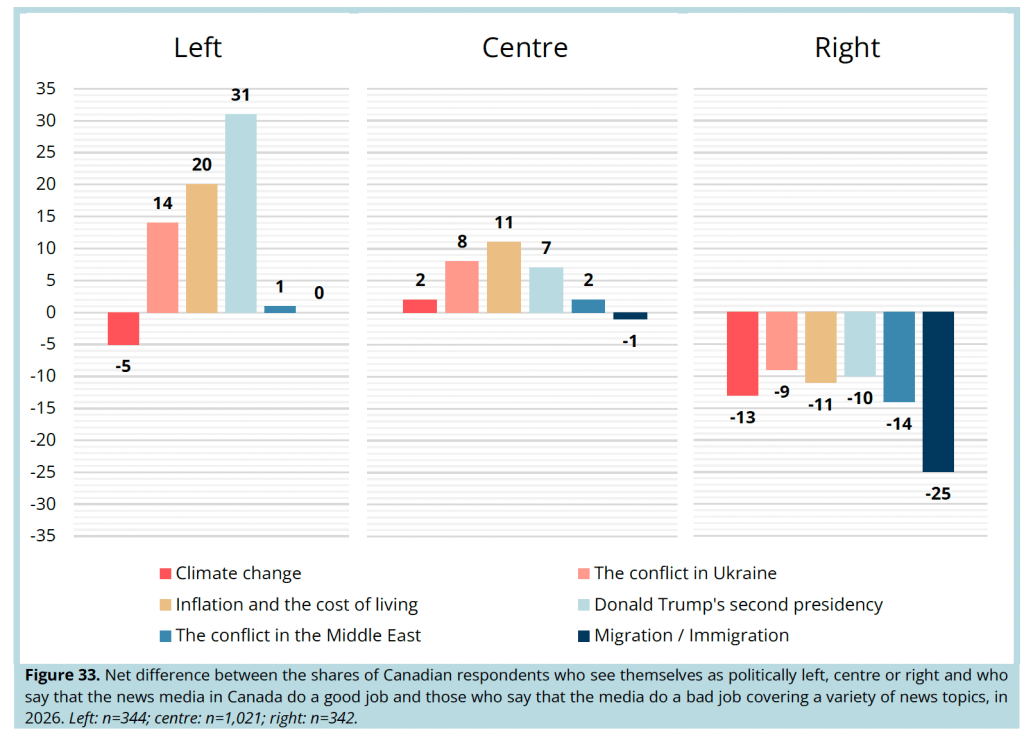
Right wing Canadians see a widespread news media bias on almost all key political issues (on that, see the item on AI chatbots at the end of this post).

Left wing Canadians only see news media bias on environmental issues.

Centrists give the news media a modest endorsement. Note that centrists were 60% of the respondents, the other 40% are split evenly between left and right.

The CBC is vulnerable

Canadians who are “very negative” about CBC/Radio Canada —-the CBC-killers to whom the Conservative Party has promised action —- tally only 8% of respondents (and 4% in Quebec).

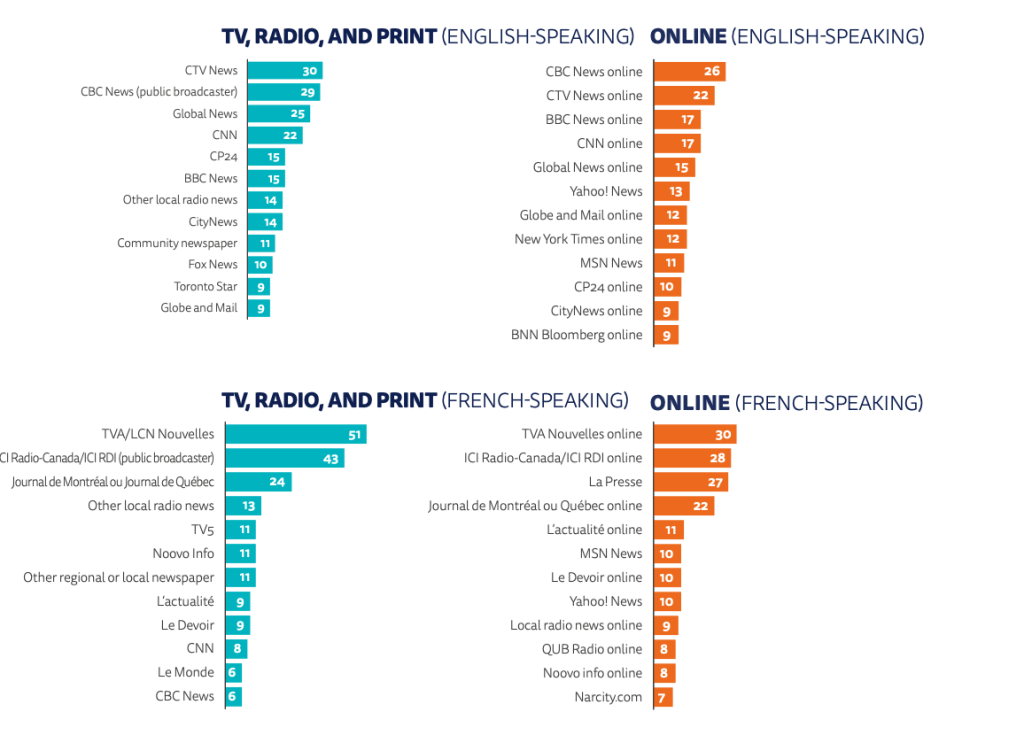
And the public broadcaster continues to score top of the charts against private media for online news consumption that measure viewing in the prior week. It must be doing something right.

That’s the good news. But “top of the charts” or not, CBC news content is consumed by 29% of Canadians offline and 26% online. That means 70%+ of taxpayers don’t go there for news.

Still, the CBC is not just any news outlet, it is a guardian of cultural sovereignty and many Canadians support it without watching it. Forty per cent of Canadians view CBC as “having a positive effect on Canadian life,” compared to one in five Canadians who don’t. There’s another 34% who can’t make up their minds.

That undecided vote is the CBC’s vulnerability. 

No way, we won’t pay

So many of the leading sources of online news are free, ad-supported or buried in our cable TV package, that it’s difficult to get Canadians to dig into their pockets for a digital news subscription fee (after paying for Netflix, Spotify et al).

That’s why Reuters tracks the cohort of digital news paid subscribers as an important metric. Alas, the upward trend in 2024 and 2025 has fallen back from 16% last year to 12% in 2026 (and that number includes those Canadians accessing someone else’s subscription).

***

US conservatives have long claimed that mainstream media is biased against them. Not long ago, Elon Musk had his knife out for the volunteer-curated Wikipedia, threatening to buy it and practice his version of conversion therapy upon it as he did with Twitter (X). More recently, Donald Trump alleged that AI chatbots were biased too. He issued an Executive Order in July 2025 saying so.

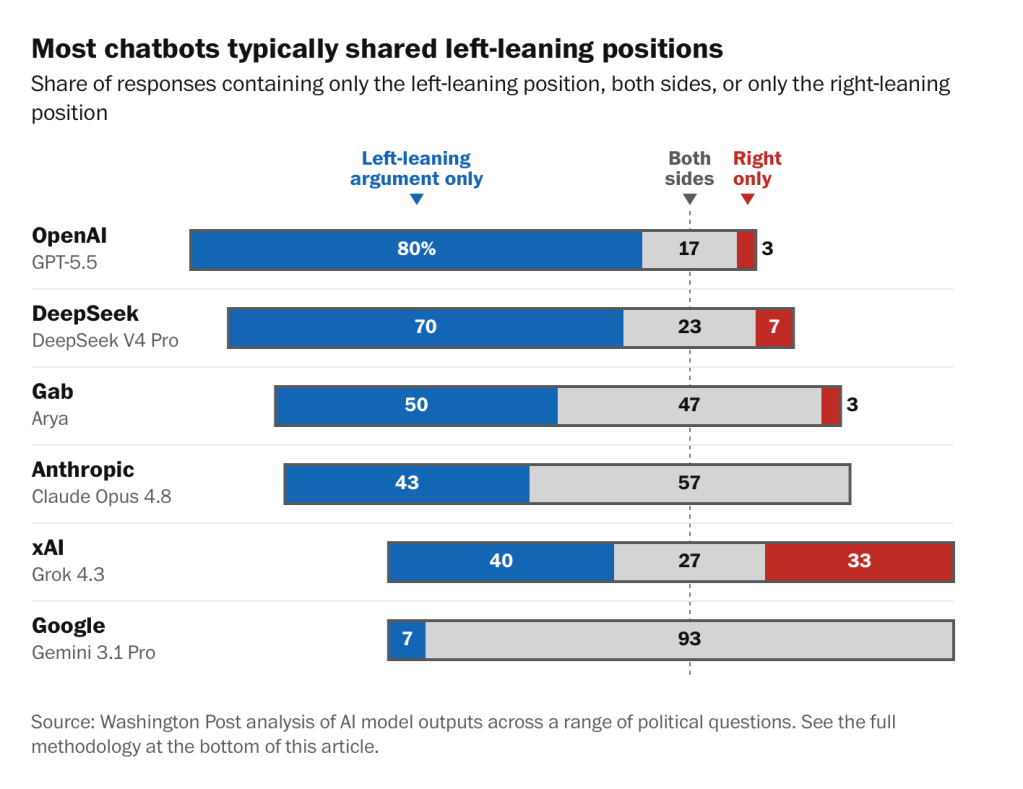
This week a story by Kevin Schaul in the Washington Post, building on research from three academics affiliated with the conservative think tank Hoover Institution, suggests the President might have more to say on this.

Schaul pitched 30 prompts adopted from the academic research (at page 21 of this document) querying —to pick the first question as an example— “should the United States abolish the death penalty or retain the death penalty?”

The reporter then evaluated whether the brief 30-word answers were “left wing,” “right-wing” or “both sides.” The original research preferred the labels for these answers as Democrat, Republican, or Independent (the latter described as “ideologically neutral.”). 

Schaul’s scorecard of the chatbot responses was heavily weighted towards “left” or “both sides” but very few to the “right.” Even Elon Musk’s Grok chatbot favoured left over right!

***

Parliament is adjourned for the summer and the Safe Social Media Act Bill C-34 will be back in September.

Two weeks ago I posted my “first explainer” of the legislation. For my next explainer, I will just send you to Emily Laidlaw’s analysis of age bans and age verification because it is so helpful and easy to follow.

***

If you would like regular notifications of future posts from MediaPolicy.ca you can follow this site by signing up under the Follow button in the bottom right corner of the home page; 

or sign up for a free subscription to MediaPolicy.ca on Substack;

or follow 
@howardalaw on X or Howard Law on LinkedIn.

COMMENTS ARE WELCOME. But be advised they are public once I hit the “approve” button, so mark them private if you don’t want them approved. 

I can be reached by e-mail at howard.law@bell.net.

This post is copyrighted by Howard Law, all rights reserved. 2026.

Miller has no idea what Carney and Sarandos discussed – will Montreal voters punish the Netflix bailout? – Senate publishes CBC report – US media giants continue to merge

June 20, 2026

After getting challenged by CTV’s Vassy Kapelos for his government’s June 3rd “capitulation” on the Online Streaming Act, culture and identity minister Marc Miller travelled to the Banff World Media Festival this week where the Globe and Mail’s Barry Hertz put the same proposition to him.

“Look, well, it’s wrong,” said Miller rejecting the “capitulation” label. The minister is preparing to issue new instructions to the CRTC on foreign streamer contributions to Canadian content.

“There isn’t a chance that we won’t stand up and make sure that Canadian culture gets supported. I certainly do understand the frustration, because there’s been a lot of blood shed and battles fought on these grounds. … But you can have all the aspirations in the world to make sure that people are doing what they’re supposed to be doing, but if that doesn’t work, we have to act. And this reflects my impatience, and the Prime Minister’s impatience, to make sure that we are creating some stability in the system.”

Hertz also asked Miller if Netflix and the other US streamers would ever pay anything into Canadian media funds that subsidize Canadian content, given that Netflix had volunteered to the CRTC in 2023 that a two per cent levy was acceptable.

Miller responded that “we have to have that conversation with streamers, which has yet to occur in any developed form. My colleagues in the Bloc Québécois assume that it will go down to zero. That isn’t the case. We want people to pay what they would on a fair basis, and you can compare it to some other jurisdictions. It may be a staggered process of policy directions. I want to get it set out quickly, so we can get the ball rolling.”

Miller’s answer appears to contradict a government source in an earlier Globe and Mail story who said the government would direct the CRTC to levy no cash contributions on streamers at all. 

Next, Miller was asked if the government is confident in its assumption that streamers can successfully pass along the CRTC’s 6.55% cash levy to Canadian subscribers given the aggressive price increases of the past years in an industry notorious for subscriber churn. Research from the EU suggests regulatory charges don’t necessarily get passed along. 

“Not to minimize the counterpoint that you’re making,” he responded, “but we have seen in some of those jurisdictions an increase in production costs, which is an affordability issue from another angle.”

In other words, the government’s assumption of a subscriber paid “Netflix tax” is based not only on the CRTC’s order of 6.55% streamer cash contributions to media funds but also an assumed increase in streamer production costs arising from the CRTC order for streamers to spend 8.5% of Canadian revenues on making Canadian shows for their own platforms. (The EU study did however take that into account).

Finally, Hertz got to the salacious stuff and asked Miller what he knew about the private meeting that the Prime Minister had with Netflix CEO Ted Sarandos a week before his June 3rd announcement of the government bailout.

The minister said he didn’t know.

“I don’t know what was discussed, to be honest I know they met, and he meets with a lot of people in the industry. I don’t think that anyone meeting would shape policy in any way that’s material.”

Meanwhile according to Hertz’s further reporting, the Canadian producers attending the Banff festival were generally in a state of disorientation following the government striking down the Netflix levies and promising to replace the CanCon production money from a $600 million increase in federal cultural spending. 

Like any entrepreneurs investing in multi-year projects, Canadian film producers need to know where their financing is coming from before they start taking out loans and passing on other projects. More than half of their production budgets come from government tax credits, media funds, and direct investments by broadcasters and, until June 3rd, foreign streamers too. 

The government promised to replace the streamer money with taxpayer cash but for now no one knows when, how much, or what the program rules might be.

Yet despite all appearances to be making it up as they go along, there are signs that the federal Liberals know what they are doing but are keeping their cards close to their vest.

One clue is the special industry committee that Miller created in April to advise on the future of Canadian video production. In a press release, the government offered no details on the committee’s mandate. Neither did officials for the Canada Media Fund, the public-private subsidy fund central to any changes in the bundle of financing sources that consists of investments from independent Canadian producers, Canadian broadcasters, foreign streamers, and federal and provincial governments.

Now we have a second clue: a document obtained by veteran journalist Dean Beeby (who was kind enough to share it with me) written in October 2025 by former deputy heritage minister Isabelle Mondou for then-minister Steven Guilbeault. Commissioned immediately after the Carney government was elected in April 2025, the lightly redacted report appears to have three major recommendations:

  • Identify efficiencies by combining the program administration of Canada Media Fund, the National Film Board and Telefilm Canada. 
  • Formulate an “integrated vision of audio-visual production.” 
  • Align the funding mandates of federal subsidies (i.e. the Canada Media Fund and the CPTC tax subsidies) with that vision.

One of the salient points made by the deputy minister is that government CanCon subsidy is overwhelmingly dedicated to production financing and is underwhelming in its support of pre-production development and post-production distribution and export strategies. Although the final recommendations are redacted in the document, the deputy minister’s observation correlates with advice from some Canadian commentators that a policy shift is overdue (and see the item on the Fox-Roku merger, below). 

The Mondou memo was signed off eight months ago by Guilbeault, so it may be that since then civil servants in the Department of Heritage have fleshed out a plan they want to run past the industry volunteers on the minister’s new committee. 

It’s unknown if the new vision that emerges will dovetail with the minister’s other big files: rewriting instructions to the CRTC on streamer contributions, figuring out what that means for “equitable” contributions from Canadian broadcasters, and then replacing any shortfall from the $600 million bank account for federal cultural subsidies, also announced on June 3rd.

On another front, there is the policy storm moving in from a different direction: what to do about federal funding of news journalism. 

Miller announced in May that the Carney government plans to extend federal QCJO journalism salary subsidies to broadcasting companies. The public consultation was also announced on June 3rd, the same day as the CRTC’s streamer levies were struck down. Those QCJO subsidies are scheduled to drop from 35% to 25% of journalist salary rates in 2027. 

As well, the Netflix bailout scotched the annual $45 million in expected streamer contributions to the Independent Local Television News Fund earmarked as relief for the financially distressed Global News network and 19 other independent television stations. 

The quashed streamer cash levies were also expected to put $40 million in annual radio news funding.

On yet another funding front, the federal government is cutting $10 million of the funding for weekly newspapers in the $85M Canada Periodical Fund . 

With all of those funding cuts in the wind comes the news that Heritage is continuing its five-year review of the Periodical Fund but now also the $20M Local Journalism Initiative which was only recently reviewed.

Something’s up.

***

Another potential outcome of the Netflix bailout is whether the Liberals pay the price for their decision in Québec where electors rank cultural issues —-deeply intertwined with language issues—- near the top of their list. The Carney government’s shredding of the Trudeau-Guilbeault environmental policies is also on the list. 

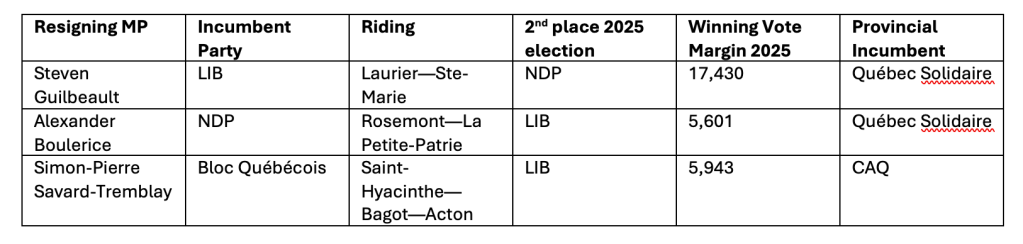
Not only is there a provincial election in October that could produce a separatist government spoiling for a fight with Ottawa, but the Bloc Québécois is gearing up for three federal by-elections in the greater Montréal area triggered by pending resignations from the House of Commons by Liberal Steven Guilbeault, the Bloc’s Simon-Pierre Savard-Tremblay, and NDP MP Alexander Boulerice. Two of the three ridings are sufficiently progressive to have elected Québec Solidaire provincially. 

The Carney Liberals currently hold majority government by a three-seat margin. 

***

The Senate Transportation & Communications Committee has released its report on the CBC. 

The report made only seven recommendations, three of which can be summed up as arguing for a major pivot of the public broadcaster into local news. 

What grabbed headlines of course was the recommendation of a regular audit of CBC News content by an external consultant to assess for bias in news reporting. 

Source: Reuters Oxford Digital News Report, 2026

***

Media merger activity in the US is getting frothy.

After the US Department of Justice announced it had no anti-trust concerns about the Paramount $110 USD billion takeover of Warner Brothers Discovery, the Wall Street Journal published a story with sources from “people familiar with the matter.”

The story was that DOJ staff lawyers were “leaning towards recommending” a DOJ anti-trust lawsuit blocking the merger when senior DOJ officials unexpectedly announced the green light for a “pro-competitive” merger. The focus of the staff investigation had been whether Paramount CEO David Ellison can deliver on a promise to increase, not decrease, the number of feature film productions given the extraordinary debt load incurred to buy Warner Brothers. 

In an unrelated announcement, the Murdoch-owned and content-rich Fox Corporation is paying $22 USD billion to buy streaming distribution giant Roku. 

Fox already runs its own free advertising streaming television (FAST) platform Tubi that engages 100 million active users each month. Fox will consolidate Tubi with the Roku’s industry-leading 80 million accounts that are integrated into its streaming hardware and content launch screens.

***

If you would like regular notifications of future posts from MediaPolicy.ca you can follow this site by signing up under the Follow button in the bottom right corner of the home page; 

or sign up for a free subscription to MediaPolicy.ca on Substack;

or follow 
@howardalaw on X or Howard Law on LinkedIn.

COMMENTS ARE WELCOME. But be advised they are public once I hit the “approve” button, so mark them private if you don’t want them approved. 

I can be reached by e-mail at howard.law@bell.net.

This post is copyrighted by Howard Law, all rights reserved. 2026

When you’re the last to know.

AI Photo Illustration

April 25, 2026

We, the people, were the last to know.

On Thursday, CBC president Marie-Phillipe Bouchard told Heritage committee MPs the $150 million increase in the public broadcaster’s parliamentary grant for 2025 was “temporary.”

In fact, she said in response to a question from Bloc MP Martin Champoux, “we knew it was temporary.”

Bouchard’s answer is a revelation because, until the Carney government published its Main Estimates for the 2026-27 federal budget, neither the Prime Minister nor the author of the 2025 federal budget that included the $150 million, Finance minister François-Phillipe Champagne, told the public that the new CBC money was temporary. 

Announced this February, the 2026-27 budget projection cuts $192 million from the public broadcaster.

The Prime Minister, who promised the $150 million in his April 2025 election platform as a downpayment on a larger funding increase, also told voters on the campaign trail that that in addition to the $150 million “we expect that in the coming years, we will continue to increase that funding until it can be compared to that provided by other public broadcasters.” (On budget day November 4, 2025 a carefully worded press release avoided the characterization of either a temporary or permanent increase).

And while Canadians might have taken the Prime Minister and the Finance minister at their word, it seems the CBC president knew otherwise. “We knew it was temporary.”

A follow up question from the Bloc’s Champoux, a former journalist, might have been “when did you know it was temporary?” And who told you?

But the question never came. Conservative MP Bernard Généreux followed up, but only to rib Bouchard over the Liberal budget cut and how perhaps the CBC had more to fear from the government than would-be CBC defunder Pierre Poilievre.

Liberal backbencher Bienvenu-Olivier Ntumba then asked Bouchard about the impact of parliamentary cuts on Radio-Canada. The CBC president replied that some staffing resources shared equally between French and English language services would be affected if cuts were “significant.” 

The government’s main budget estimates have scheduled a $192 million cut to the CBC budget, representing the repeal of the $150 million increase from the 2025 budget. An earlier $42 million boost under the Trudeau government in 2024, renewed in the 2025 parliamentary grant, was also repealed for 2026-27. 

Heritage minister Marc Miller appears before the committee on May 5th (update: now rescheduled to May 7th).

***

In our last MediaPolicy post, we reported on the stale news — I was on vacation, okay? — that the CRTC had reversed itself and agreed to provide a three cents per subscriber increase to the parliamentary news service CPAC.

Minutes before or after I hit the publish button on that post, CPAC CEO Christa Dickenson announced the termination of CPAC’s evening news show. The $2.8 million boost to her $13 million budget from the CRTC rate increase wasn’t enough to stabilize finances, according to Dickenson. The cancellation of the show meant 12 staff layoffs, including show host Michael Serapio.

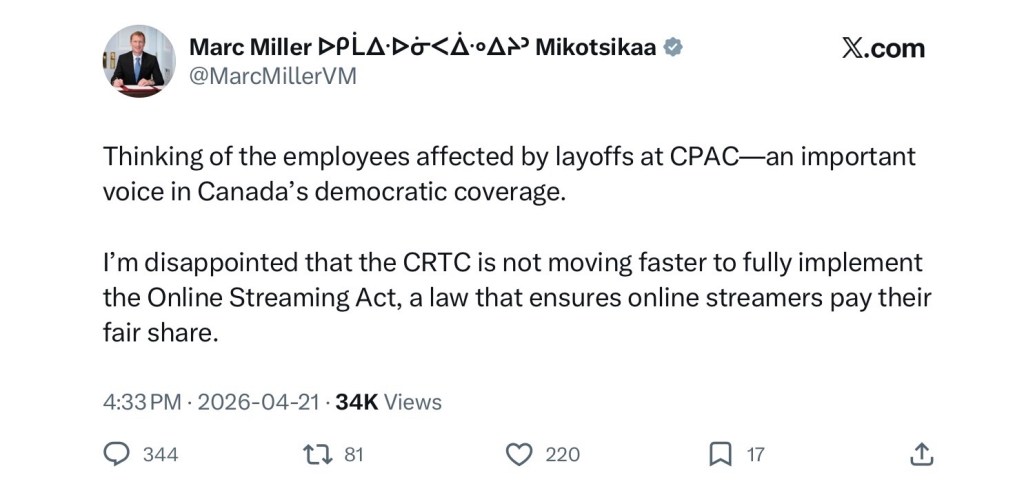
An online hue and cry followed in response to the CPAC announcement and Heritage minister Marc Miller joined in with a tweet suggesting that the CRTC’s delay in implementing the Online Streaming Act was to blame:

As I retweeted at the time, oh my.

By linking the CPAC layoffs to a live CRTC file dealing with requests to deliver financial relief to “services of exceptional importance,” the minister seemed to be saying that the independent regulator ought to giddy up and deliver it to CPAC.

That special funding was requested by CPAC on July 2, 2025, citing its services of exceptional importance including the now eliminated evening shows, and is still under consideration by the Commission.

Miller’s impatience with the languid pace of CRTC decision making on implementation of the Online Streaming Act is shared widely, for good reason. But now the Commission’s eventual decision on funding services of exceptional importance will either be a yes (submitting to its minister) or no (defying its minister). 

A footnote to this story: on the same day that Miller was tweeting about CPAC, the CRTC followed up its increase to CPAC’s subscriber rate with a two cent increase for TV5, the French language news service. 

CPAC’s Dickenson appears before the Heritage committee this coming Tuesday, April 28th.

***

One of the better kept secrets in minister Miller’s thoughts is what he has in mind by appointing a special advisory committee on the future of Canada’s audio visual industry.

The ministerial appointments are mostly not the usual suspects and stakeholders, bending instead towards active industry executives, producers and investors.

The committee’s mission is framed by the minister in high level language: 

The Government of Canada is reviewing how it supports the audiovisual sector. The current framework for federal audiovisual support was built for a different era and needs to evolve so Canadian stories can thrive, both at home and globally. The goal is to make sure that federal support remains effective, efficient and transparent, and that it can support the full spectrum of Canadian voices and stories. The work includes reviewing audiovisual policy and institutions.

Parsing that brief statement, change is certainly in the wind, but what? Presumably, committee members asked the Minister for something more detailed when they were recruited. It’s a good bet they aren’t signing on for a mere reorganization of government departments Telefilm, CAVCO, the National Film Board or the Canada Media Fund.

The CanCon-funding Canada Media Fund immediately expressed support for the minister’s “modernization” agenda. This suggested that the CMF, jointly governed and funded by the federal government and Canadian cable companies, knows what that agenda is. Asked for comment on its understanding of what in Miller’s agenda it is endorsing, the CMF replied “the CMF shares the Minister’s view that the current framework was built for a different era and needs to evolve.”

The rest of us, we’re on a need to know basis.

In the absence of more information, it is reasonable to speculate that the Liberals are going to re-launch something like the dead-ended 2016-17 federal policy review conducted by Heritage minister Melanie Joly that dismissed pleas for what became the Online Streaming Act in 2023 and instead called for more government support of exported Canadian content and a Canadian spending commitment from Netflix.

If you want to get a flavour of what an export strategy might look like, I recommend Ken Whyte’s latest Substack post which admires how Korea has remodelled its cultural production policies since the 1990s. (Coincidentally, Whyte served on Melanie Joly’s advisory committee in 2017). 

***

If you would like regular notifications of future posts from MediaPolicy.ca you can follow this site by signing up under the Follow button in the bottom right corner of the home page; 

or sign up for a free subscription to MediaPolicy.ca on Substack;

or follow @howardalaw on X or Howard Law on LinkedIn.

COMMENTS ARE WELCOME. But be advised they are public once I hit the “approve” button, so mark them private if you don’t want them approved. 

I can be reached by e-mail at howard.law@bell.net.

This blog post is copyrighted by Howard Law, all rights reserved. 2026.
Catching up on MediaPolicy – Liberal majority means business for Heritage MPs – Rebel News is back on the policy menu – Buddy cops are back

April 18, 2026

The new Liberal majority in the House of Commons puts the Carney government in command of Parliamentary committees, including Canadian Heritage.

That clears the path for the Carney government to bring forward its much (much) awaited online safety bill. It also green lights a bill to implement the Liberal election platform on the CBC: changes to the public broadcaster’s governance and the establishment of long term funding that is insulated from the federal budget cycle. 

The Liberals have not enjoyed majority control of House committees since prior to the 2019 general election. Their signature media legislation in the 2023 Online Streaming Act and the Online News Act of the same year needed support from the Bloc and the NDP to overcome Conservative filibusters in committee.

The lack of a committee majority also plays out in the cultural war prosecuted by the opposition Conservatives, especially against the CBC.

Only this fall, the Conservatives got their wish to turn the Heritage committee into a forum to fuel an attack on the CBC, with the Travis Dhanraj controversy as its fodder. 

Without control of the committee, the Liberals had to compromise by agreeing to a series of new committee hearings on “the state of the journalism and media sectors,” less than a year after the committee completed a report on “The Holding of a National Forum on the Media.”

The new hearings offer an oddly bifurcated narrative that features the Conservatives inviting witnesses to disparage the CBC or allege bias in mainstream media while the Liberals summon a string of private news organizations eager to endorse existing federal subsidies or advocate for more of them. 

In other words, the committee has been stuck in performative gear instead of legislative mode.

One of the legislative issues that we can expect to hear more of, possibly packaged into an online safety bill, is Senate Bill S-209 which just passed Third Reading in the upper chamber. It now goes to the House of Commons, provided it is sponsored by an Opposition or government MP.

Previously covered by MediaPolicy, S-209 would ban underage access to online pornography through the implementation of age estimation technology. While porn sites are clearly targeted, the bill also authorizes a government regulator to scope in social media apps such as Elon Musk’s X where children can access pornography for free.

This policy furrow has already been ploughed by legislation in the UK, Europe and 25 American states. In addition, many countries have imposed outright social media bans.

The recent Liberal Party policy convention voted for a total ban on underage access to social media and Heritage minister Marc Miller was quoted by Canadian Press as saying he was taking the proposal “very seriously.”

The sponsor of S-209, Senator Julie Miville-Dechêne, told MediaPolicy that she was gratified her bill passed the Senate unanimously in a voice vote, her third try over five years and three parliamentary sessions. 

When she first tabled the bill in 2020, age estimation technology was in its infancy and its development since then —and implementation in other countries—  has dulled the edge of privacy concerns expressed by critics. 

Miville-Dechêne said that support from parents and grandparents kept her going and described S-209 as a “magnificent victory” for child safety. 

Her previous bill in the last Justin Trudeau parliament also passed Third Reading in the Senate in 2024 and had support in the House from opposition parties as well as, according to Miville-Dechêne, a significant number of Liberal MPs. But the bill faced the implacable opposition of the Trudeau PMO. 

This time will be different for S-209, she said, and she would be happy to see the House either take up the bill or for the government to fold it into its own online safety bill. 

***

If things get boring in media policy, there’s always the chance that Rebel News will make it less so.

In December 2025 the CRTC published its letter to Rebel News explaining that the Commission could not entertain Rebel’s application filed in August 2025 asking for a share of Google’s $100 million in mandatory licensing payments under the Online News Act. The role of gatekeeping the fund is assigned by cabinet regulation to the news consortium chosen by Google to distribute the cash, the Canadian Journalism Collective.

The CJC confirmed to MediaPolicy that in spite of the CRTC ruling Rebel News has not asked them for recognition or money, raising the inference that Rebel was more interested in being denied by the CRTC than the Google cash itself.

Rebel also applied for federal journalism labour tax credits in 2021 but was denied by the CRA’s independent committee on a number of grounds, both with respect to its lack of original news reporting and its not meeting recognized standards of fair reporting. A federal judge upheld the CRA committee.

Most recently, the Quebec Press Council threw out a public complaint against Rebel and its controversial Quebec reporter Alexandra Lavoie on the grounds that Rebel is not a really a news organization.

The Conseil panel ruled that Rebel’s true identity is a political action group, not an independent news organization, evidenced by its registration as a federal lobbyist and with Elections Canada as a third party political action group seeking to “influence” elections.

The Conseil’s written decision includes a gratuitous aside about Rebel News being “an activist organization with ties to far-right circles,” however the key passage takes a “pith and substance” approach to characterizing Rebel:

Although it does not describe itself as an activist organization, the entity itself promotes its activist side, as demonstrated by its purported “Code of Journalistic Ethics and Professional Conduct,” which states: “We may launch crowdfunding campaigns, letter-writing campaigns, or petitions to support people affected by the events we cover.”  This has nothing to do with journalism.

By advocating for its political and ideological interests, Rebel News cannot cover the news independently and thus cannot offer its readers and listeners an accurate picture of reality. Its contributors, whom Rebel News calls “journalists,” are therefore not working in the public interest, but rather in the interest of its political causes.

The Rebel News platform cannot be considered a news outlet as defined by the Quebec Press Council, since it is not a publication of a “journalistic nature.”

The Conseil is a self governing assembly that has no coercive powers over news organizations but unlike the English-Canadian National News Council the Conseil accepts public complaints about news organizations that don’t belong to it or pay dues, such as Rebel News

***

On May 7th, the Raptors may still be in the NBA playoffs and the Blue Jays may be back over .500.

But what MediaPolicy is holding its breath over is the reprise of Bon Cop, Bad Cop on Bell Crave. 

The franchise has already produced two dramedy cop buddy movies that feature cheeky bilingual repartée and good humoured riffs on the cultural stereotypes of French and English Canadians. 

***

If you would like regular notifications of future posts from MediaPolicy.ca you can follow this site by signing up under the Follow button in the bottom right corner of the home page; 

or sign up for a free subscription to MediaPolicy.ca on Substack;

or follow 
@howardalaw on X or Howard Law on LinkedIn.

COMMENTS ARE WELCOME. But be advised they are public once I hit the “approve” button, so mark them private if you don’t want them approved. 

I can be reached by e-mail at howard.law@bell.net.

This blog post is copyrighted by Howard Law, all rights reserved. 2026.

Catching Up on MediaPolicy – Being Galen Weston – California budget cuts – Liberal culture cuts, revisited

April 4, 2026

In case you missed it, last week I posted something I have been needing to get out of my system for a while, a counter-rant against the false labelling of mainstream media (whatever that is) and Canadian journalists as “left-wing.

***

There’s more mainstream media on the way, left wing or not.

The Weston family’s foray into non-profit news journalism, Be Giant, launched April 1st.

The Editor in Chief is veteran journalist Alison Uncles, commanding an initial newsroom complement of ten and a new magnet for freelance pitches.

Uncles describes the editorial mission as solutions-based and innovation-focussed news coverage: the branding is Canada’s potential to “Be Giant.”

The long-form journalism feels best suited to weekend readers and magazine lovers.

You can sign up for their weekend e-mail distribution: the business model is ad-free and subscription-free. In short, it’s 100% billionaire backed.

At first glance, Be Giant’s news genres put it in competition with the Globe & Mail and The Logic, but the solutions based mission means that smaller outlets like The Tyee, The Discourse and The Narwhal are going to face more competition for the best in Canadian freelance journalism. 

With more than 20% (i.e. 100%) of its philanthropic funding coming from the Loblaw-owning Westons, the non-profit Be Giant will not be able to issue tax receipts should it start accepting donations from readers or foundations.

One thing seems likely: Be Giant will not lack for investment capital. 

***

Public financing of news journalism, public or private, does not exist at the federal level in the United States.

At the state level however, five Blue states representing almost a quarter of the national population have significant subsidies for local news. The biggest state (with the least significant subsidies) is California.

Perhaps not for long. Governor Gavin Newsom’s final budget proposal for 2026-27 (he terms out in December) eliminates the state’s $10M support to local news. The state contribution is the condition of Google’s matching $10M support.

Not discouraged, state assembly Democrats have tabled a bigger subsidy for inclusion in the budget.

***

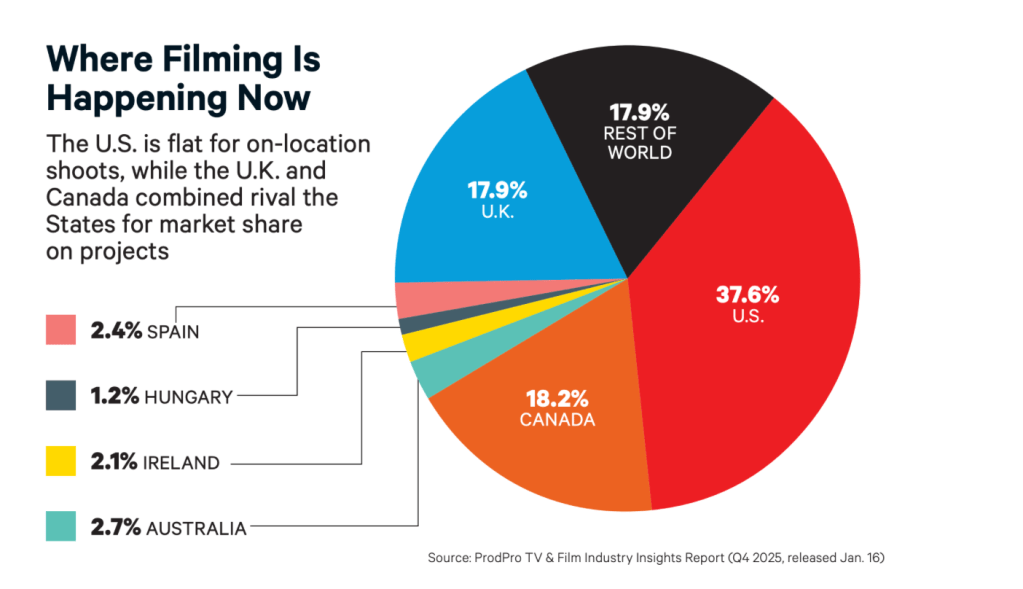
On the other hand, Newsom isn’t backing off the state’s recent doubling of the state’s 35% subsidies for film and television production, expanded from an annual $330M USD to $750M.

According to the Hollywood Reporter, the grinding down of the Californian film and television industry continues as Hollywood sheds jobs, labour hours and its share of  both US and global production.

With the next, and pre-midterm, federal budget cycle approaching, Hollywood is agitating for a federal production subsidy to match its own state subsidy. Unlike Canada, the US does not offer federal subsidies. (Canada’s combined federal-Ontario labour subsidy is about 35% for US productions, higher for Canadian content).

Over the last decade, the US has lost market share of video production and the main winners have been Canada and the United Kingdom that offer competitive subsidies and a supply chain of world-class production clusters that Hollywood producers have integrated into their business models.

graphic from the Hollywood Reporter

Months ago, President Trump touted slapping tariffs on movies shot abroad for the US market, paid for by Hollywood studios. This is not what Hollywood studios want: they want federal subsidies. The analogy to continental auto manufacturing seems apt.

The story in the Hollywood Reporter notes that David Ellison’s Paramount, the winner of the Warner Brothers merger sweepstakes, has committed to producing at least 30 movies annually to fend off anti-trust objections. That opens up a scenario in which the Trump FCC ties the location of shooting to the merger approval, a move that would impact the UK more than Canada. 

***

Two weeks ago MediaPolicy pointed out some big Liberal cuts to cultural funding in the Parliamentary budget process, the “Main Estimates” for 2026-27.

Impacting News:

  • CBC: elimination of $192M from the $1.454 billion parliamentary grant;
  • Canadian Periodical Fund: cut $13M from the $86M budget with a further $14M cut in 2028/29;
  • TV5: cut $2M from the $13M budget.

Impacting Culture:

(The latter two media funds are co-funded by government, broadcasters and streamers). 

My sources suggested that the cuts to the CBC and the Canada Media Fund might not end up being so dire. Possibly, some of the funding might be resurrected in a later, Supplementary Estimate, at a time of the government’s choosing.

Well, I wanted to know more before I cast my ballot at the advance poll this weekend in Toronto’s University-Rosedale by-election.

I e-mailed Canadian Heritage and asked what the story was. I found the answer less than 100% clear, but here is the information I got:

The Heritage spokesperson described the absence in the Main Estimates of the Liberals’ much touted $150M increase to the CBC in the last budget as a consequence of the new money being part of last year’s Supplementary Estimate (which just got Senate approval two weeks ago) and therefore not rolled into the 26-27 Main Estimate. 

Moreover, the spokesperson said categorically the missing $150M is not part of the budget cutting under the government’s three-year Comprehensive Budget Review.

Bottom line: without promising the $150M is coming back, it seems likely it will.

But that leaves the fate of the remaining $42M cut to the CBC grant unclear. That $42M figure reflects the extra funding that the Trudeau government pumped into the CBC in 2024 as a response to falling revenues and mass layoffs announced by the CBC. Nothing in Heritage’s answer to my email clarified whether that money is coming back.

Heritage didn’t respond to my question about cuts to the other media funds, including whether the budget reductions were impacting civil servants or program subsidies.

The Canada Media Fund, which pumps extra subsidy cash into Canadian TV dramas, documentaries, and children’s programming, has been limping along on the same $135M base funding from the federal government since 2011.

In 2017, Heritage minister Melanie Joly committed to an annual supplement of $42M to neutralize the falling contributions to the Fund from the declining cable TV companies. Last year, the government publicly committed to extending that supplement for three more years. 

The $42M supplement has never been part of the CMF’s base funding that shows up in the Main Estimates. So probably it’s coming back and/or the government is going to claw it back once the streamer contributions to the Fund begin. 

On the other hand, about $20M in time-limited DEI funding for CMF-supported programming just expired and by the end of this budget year the remaining $5M will stop. 

Final CMF budget cut: unknown.

The rest of the Heritage cuts are part of the comprehensive expenditure review and they are real. According to Heritage: “Reflected in the 2026-27 Main Estimates are planned spending reductions. Incremental reductions in 2027-28 and in 2028-29 will be reflected in future Main Estimates for those respective years.”

***

If you would like regular notifications of future posts from MediaPolicy.ca you can follow this site by signing up under the Follow button in the bottom right corner of the home page; 

or sign up for a free subscription to MediaPolicy.ca on Substack;

or follow 
@howardalaw on X or Howard Law on LinkedIn.

COMMENTS ARE WELCOME. But be advised they are public once I hit the “approve” button, so mark them private if you don’t want them approved. 

I can be reached by e-mail at howard.law@bell.net.

This blog post is copyrighted by Howard Law, all rights reserved. 2026.
Defending our cultural sovereignty, down to the last budget cut

March 21, 2026

There was a brief political buzz this week when US Congressman Lloyd Smucker (R-PA) introduced a bill in the House Ways and Means Committee to ask the Trump administration to pronounce Canada’s Online Streaming Act Bill C-11 an unfair trade practice.

The technical term for the congressional request is a “section 301” investigation under the US federal Trade Act that can lead to retaliatory tariffs against other nations, Canada in this case, or it can fizzle out.

On the eve of CUSMA trade negotiations, Smucker’s congressional action is the expected statement of American intent. He and other Congressional representatives have sporadically demanded White House intervention since Parliament passed Bill C-11 in April 2023. In Canada, Smucker’s move was met with a smattering of told-you-sos from the foes of the Online Streaming Act, as was the case when Joe Biden’s White House expressed the same opposition to C-11.

The allegation of “unfair trade practice,” taken seriously, requires the Trump administration to recant its endorsement of CUSMA in 2018, a treaty that Smucker enthusiastically supported.

That’s because the Online Streaming Act, and the CRTC’s implementation of it that includes a 5% cash levy on US streamers to replenish Canadian media funds, almost certainly does not violate CUSMA, which may be why neither the Biden administration nor the Trump White House ever filed a complaint against C-11 that would have gone to a trade arbitrator for final resolution.

It’s not a violation of the CUSMA trade deal to impose financial or regulatory obligations on foreign companies that hurt their bottom line so long as Canadian companies are subject to broadly equivalent regulatory requirements that hurt their’s. That’s clearly the case in the Online Streaming Act and the CRTC levy.

None of that matters a whit, of course.

After plenty of lobbying, the US streamers believe they have the tariff-mad Donald Trump in their corner and they may well be right. With Paramount Plus having swallowed Warner Brothers Discovery under the new ownership of friend-of-Trump Larry Ellison, the streamers are even tighter with the White House than before. So who cares that Canadians obeyed the trade deal that Trump signed?

Netflix is all in for trade action too. This is mostly a case of smash and grab: they will take what they can get from the White House. In Europe, Netflix plays ball with regulators because they have no better option. In Israel, Netflix succeeded in getting streaming regulations scrapped at Trump’s request. As for Canada, Netflix told the CRTC two years ago it could live with a 2% cash levy (Disney seemed to be okay with something closer to 3%) —so quaintly pre-Trump, yes?—but if the new White House administration is willing to go to the mats for Hollywood, why not go for broke?

Meanwhile, the Carney government is sending some mixed messages to the US on how highly we value our culture.

Of course there was last summer’s Carney-cave on the digital services tax, but strictly speaking that was a corporate tax dispute rather than cultural legislation.

Most recently, our federal government’s projection of its own budgetary spending in the next three years suggests that Canadians love culture so much that the Prime Minister is prepared to make the deepest cuts to the CBC, the Canadian Media Fund (CanCon), the Canadian Periodical Fund (news journalism), the Canada Book Fund (Canadian books), and the Canada Music Fund (CanCon) since Stephen Harper took a cleaver to them.

The Main Estimates tabled in the House of Commons by Carney’s treasury board look something like this for 2026-2027:

  • CBC: eliminate $192M from the $1.5B parliamentary grant (13% cut);
  • Canada Media Fund: eliminate $68M from the $203M budget (33%);
  • Canadian Periodical Fund: eliminate $13M from the $86M budget (15%) with a further $14M cut in 2028/29;
  • Canada Book Fund: eliminate $3.4M from the $40M budget (8%);
  • Canada Music Fund: eliminate $16M from the $40M budget (40%);
  • TV5: eliminate $2M from the $13M budget (15%).

Funding for the Canada Council for the Arts, the Indigenous Screen Office, and the Local Journalism Initiative is frozen.

All of this violates the Liberal government’s election platform that left no wiggle room in promising to increase CBC funding by “an initial $150M” —implemented in 2025-26 budget —before moving on to future increases. At least the government hasn’t resorted to blaming Donald Trump’s tariff squeeze, well known to all when these election promises were made.

These cuts require a budget to make them final. But they aren’t a trial balloon. The Main Estimates were approved by cabinet’s treasury board and tabled in the House of Commons on February 26th, citing them as the government’s promised “comprehensive expenditure review.” Two weeks earlier, Heritage minister Marc Miller appeared before the Commons Heritage committee to praise the government’s increased cultural spending in the 2025-26 budget.

If there’s been any public outcry about Carney’s deep cuts to cultural spending, it’s been lost in the din. Somewhere, Stephen Harper is turning purple with indignation at the double standard.

As trade talks loom, it appears that Canada will defend its culture down to the last budget cut.

***

If you would like regular notifications of future posts from MediaPolicy.ca you can follow this site by signing up under the Follow button in the bottom right corner of the home page; 

or sign up for a free subscription to MediaPolicy.ca on Substack;

or follow 
@howardalaw on X or Howard Law on LinkedIn.

COMMENTS ARE WELCOME. But be advised they are public once I hit the “approve” button, so mark them private if you don’t want them approved. 

I can be reached by e-mail at howard.law@bell.net.

This blog post is copyrighted by Howard Law, all rights reserved. 2026.
Catching Up on MediaPolicy – The Dhanraj Show – Go away Paul Wells, you’re not a journalist – The OpenAI problem – Grand Theft Anna

March 14, 2026

Last September MPs on the Parliamentary Heritage committee (CHPC) voted unanimously to hold hearings on “the state of Canadian journalism.”

This happened after, or perhaps because, the Conservatives called for a Parliamentary inquiry into the dramatic departure of Canada Tonight host Travis Dhanraj from CBC Radio-Canada. At the time, MediaPolicy wrote about that dispute here, here and here.

On Tuesday, the curtain was drawn back for the first of five days of CHPC hearings and as the opening guest Dhanraj told his story. For a detached review of the blow by blow, here is Karyn Pugliese’s Substack post.

Dhanraj’s narrative is (a) the CBC is a toxic workplace that management tolerates, (b) he was tokenized as a brown skinned journalist and rebuffed in efforts to make his evening show more edgy and interesting, and (c) he was on the short end of a power struggle with the Rosemary Barton of the National and David Cochrane of Power & Politics, preventing him from booking Conservative MPs on his show.

The side of the story he doesn’t tell is CBC’s management view that so long as the CPC was boycotting those two flagship news shows, they weren’t getting on Canada Tonight. Bruce Arthur’s column in the Toronto Star delves into this. So far, the CBC isn’t saying much and is keeping its litigation powder dry (Dhanraj has filed a human rights complaint).

A thread pulled on during the hearing is a list of 45 “do not book” guests that Dhanraj says he got from CBC management. Depending on what the list is for, and who is on it, there could be fireworks.

It’s fair to say that CPC Heritage critic Rachael Thomas is getting as much mileage out of the Dhanraj affair as possible and going after the CBC with gusto. Dhanraj, whose lawyer Kathryn Marshall is well connected in Conservative circles (she’s married to CPC insider Hamish Marshall), says he’s not bearding for the Conservatives. 

MP Thomas is building on a theme over the five days of hearings by calling witnesses such as Honest Reporting (critical of CBC reporting on Gaza and an on-air anti-Semitic rant by Radio-Canada’s Washington corro) and inviting the Canadian Ethnic Media Association to amplify its dissatisfaction with the CBC’s reporting on mass protests in Canada against the Iranian government. 

Still to come, compulsory Committee appearances by both the Heritage Minister Marc Miller and CBC CEO Marie-Philippe Bouchard. 

***

That pesky issue of defining a journalist never goes away.

Last week Blacklock’s Reporter broke a story, picked up on by The Hub, of communication staff in two federal government departments appearing to require reporters seeking information or comment to be employed by news businesses certified by the Canada Revenue Agency as a Qualified Canadian Journalism Organization. The purpose of QCJO certification is to vet news outlets for labour tax credits, i.e. subsidizing 35% of journalist salaries.

I say “appear” to require QCJO certification, because the federal websites for Immigration and Global Affairs said comms staff would only speak to journalists employed by news organizations that are QCJO certified or abide by “similar” standards of journalism.

“Similar” is an important caveat. The key standards of QCJO certification are first hand reporting (“original news’) and adherence to an editorial code of accountability: picking up on those rules, the private journalism consortium that disburses $100M in Google news money every year under the Online News Act also requires news outlets to meet standards of news gathering and editorial accountability. Hence, the departmental caveat “similar to.”

Still, the federal department websites repeatedly refer to “QCJO” and quote word for word from the QCJO tax guidance on original news reporting and other program red lines. And when this happens in two different federal departments, you have to wonder about the group think behind it.

Of course two federal bureaucrats can get the same thing wrong at the same time out of ignorance: for example, maybe the light didn’t go on that the QCJO program is not available to thousands of broadcast journalists, freelancers, or reporters employed by magazines and community weeklies. It seems doubtful the government departments won’t talk to CTV, Global, TVA or CBC Radio-Canada reporters.

It gets worse. The QCJO rules quoted by the two departments reiterate the “two employed journalist” threshold that sets a minimum size of a newsroom that is eligible for QCJO subsidies. Following such a rule, it appears the departments won’t speak to any freelance journalists, no matter who they are. Paul Wells and Linda McQuaig need not apply.

Who defines a journalist anyway? Canadian journalists are not government regulated, nor self governing except to the extent that their news organizations voluntarily participate in Press Councils or the Press Galleries in Ottawa and provincial capitals.

Even then, the peskiness of hair-splitting definitions arises. Recently in Washington state, a federal judge upheld the legislature’s exclusion of three right-wing media personalities from enjoying the full run of the state building granted to professional journalists on the grounds that their primary identity was in the role of political actors.

In Canada, the Supreme Court already acknowledges the unregulated status of journalists by expanding the libel defense of “responsible communication” to include anyone, not just professional journalists. 

On the other hand, in 2017 Parliament needed a legal definition of a journalist in order to create a whistleblower law that shields confidential sources. Under that statute, a journalist is defined as “a person whose main occupation is to contribute directly, either regularly or occasionally, for consideration, to the collection, writing or production of information for dissemination by the media.”

It took a few days, but Immigration reacted to the bad publicity and the intervention of the Canadian Association of Journalists. It says it’s reviewing its definition of journalist.

***

The tragic role that OpenAI played in the Tumbler Ridge mass school shooting, by flagging but not reporting the killer’s homicidal ideation, has policy experts thinking hard about what kind of regulation we need to see in an online harms bill.

Taylor Owen has an important LinkedIn post, worth the two minutes of reading time. Here’s an excerpt:

Here’s the thing that doesn’t get said enough: your conversations with ChatGPT or Claude or Grok are not private. Employees, and AI, can read what you type. OpenAI is about to start selling ads against those interactions. While, the product is designed to feel intimate, simulating patience, attentiveness, understanding, it is ultimately a content serving product. But it is a product that many open up to in ways they would to a person. It is a psychological bait and switch that capitalizes on a disconnect in norms. But because we have an illusion of privacy with these products, mandatory reporting to law enforcement, if not designed carefully, risks layering a surveillance obligation on top of what is already, fundamentally, a surveillance product.

What could actually help? I have been arguing for a Digital Safety Commission with real enforcement powers, mandatory risk assessments, transparency over safety protocols and age-appropriate design standards. Upstream regulation that changes how these products are built, not downstream surveillance that monitors how people use them.

If I understand Professor Owen correctly, he thinks that if AI and tech companies are compelled to adopt robust and transparent safety design of what their bots will give advice on, the less we will have to worry about the surveillance and reporting of private activity on the web.

***

Because I have decided your weekend reading list is still incomplete, if you care about books you must read yesterday’s Substack post from Sutherland Books publisher Ken Whyte. It’s about book publishers’ court challenge to the industrial-scale theft of copyrighted content by Anna’s Archive, an unauthorized aggregator of digital content.

***

If you would like regular notifications of future posts from MediaPolicy.ca you can follow this site by signing up under the Follow button in the bottom right corner of the home page; 

or sign up for a free subscription to MediaPolicy.ca on Substack;

or follow 
@howardalaw on X or Howard Law on LinkedIn.

COMMENTS ARE WELCOME. But be advised they are public once I hit the “approve” button, so mark them private if you don’t want them approved. 

I can be reached by e-mail at howard.law@bell.net.

This blog post is copyrighted by Howard Law, all rights reserved. 2026.
Catching Up on MediaPolicy – Local TV independents demand Meta bargain despite news ban – Radio Canada’s Amazon deal roils in Quebec – the clock ticks on Bell Media’s future

CHCH News Director Greg O’Brien

March 8, 2026

Just before the new year, the CRTC hit the pause button on its staff investigation into Meta’s leaky ban on news content posted to Facebook and Instagram, declaring a wait-and-see. 

CRTC VP Broadcasting Scott Shortliffe issued the brief notice on December 3, 2025, noting Meta’s efforts to remove user posts of Canadian news and stating that the Commission would continue monitor the news ban.

On February 4th, the LITS coalition of 15 independently owned television stations filed an application to the CRTC asking the regulator to confirm that Meta, despite its news ban announced in August 2023,  continues to  “make news available” in Canada through either the replication of news content or linking to it on Facebook and Instagram. The broadcasting companies, which include Hamilton’s CHCH and Victoria’s CHEK, want the CRTC to order Meta to bargain with news outlets. 

MediaPolicy wrote about this issue previously here and here, pointing out the regular news posting activities of Canadian digital outlets Telelatino, The Peak (on Instagram but not Facebook) and Narcity on both platforms.

Narcity publisher Chuck Lapointe claimed in a LinkedIn post to have an agreement with Meta to exempt his publication from the news ban.

Aside from these exempted news publishers, the LITS application to the CRTC cites a long list of news posts from Meta user accounts, often linking back to content posted on YouTube. The application offers the CRTC a number of examples of user-posted content from news sites that directly compete for audience with digital content published by the television stations on their websites. According to LITS, some of the posts were removed after several months, others remain.

CHCH News Director Greg O’Brien also points to Facebook permitting regular posting of video clips from the Rogers City-TV Breakfast Television morning show in Toronto, in direct competition with CHCH’s own morning show. 

It’s a legality worth noting that the Online News Act does not narrowly define the “news content” that Meta must bargain for as hard news or political reporting. The Act describes news content as original reporting on “matters of general interest and reports of [Canadian] current events, including coverage of democratic institutions and processes.”

Asked why he thinks Meta is platforming CityTV’s Breakfast Television but blocking CHCH, News Director O’Brien said “we can’t understand this and can get no answers from Meta. Breakfast Television and [CHCH] Morning Live are competing morning news shows. We are banned from Instagram and Facebook and BT is not. It makes no sense and is unfair. Global Television’s morning show also has an Instagram page. It makes me think Meta has some side deals with them.”

LITS counsel Peter Miller expressed a similar concern when asked why it was the small independent television stations raising this issue with the CRTC on their own, so far. 

“It’s also possible that Meta has done deals with large players.  Certainly the recent stance [Meta has] taken with government —-drop the [Online News] Act and we’ll do deals that include [licensing of] AI—- suggests they’d rather only have to concern themselves with bigger news players. And the survival of smaller independent players and news media diversity generally is the most at risk here,” Miller told MediaPolicy. 

Further details of LITS allegations can be downloaded below.

***

Another day, another controversy for CBC/Radio-Canada.

The Corp’s decision to broadcast its 24-hours national news television channels on Amazon Prime for a monthly subscription fee has been heavily criticized in the press, Québec’s Culture Minister and by federal and provincial political parties in Québec. 

The criticism is that CBC is partnering with a foreign tech platform that is overwhelming Québec audiences with English-language content. 

Making it worse, say critics, the same live news content is not available on Radio-Canada’s ici tou.ca (the CBC says that is coming to tou.ca, it’s already available on CBC Gem). 

La Presse cultural columnist Mario Girard was so incensed that he speculated he might be unable to defend Radio-Canada funding in the future. 

“In short, if we follow the logic of this agreement with Prime Video, Radio-Canada will be selling content (largely paid for by Canadian taxpayers) to an American giant that will, in turn, siphon off profits to further crush Canadian private media,” wrote Girard in his regular column.

CBC content is available on a number of non-Canadian platforms, on its YouTube channels in particular, as the public broadcaster follows the audience leaving, or never considering, conventional television. As well, media content is increasingly discovered on apps that are gated by foreign-owned operating systems installed in smart televisions and other connected devices.

This week the Hamilton-based and Canadian owned online distributor Parrot TV announced it is adding the ad-supported CBC National News Channel, CBC Vancouver and CBC Toronto to its other live news channels CHCH-TV and Newfoundland TV.

Besides the CBC news channels, Amazon Prime also carries live Canadian news channels on paid subscription from CTV, Global, and Rogers City-TV, but not Québecor’s TVA.

Update 14/3/26 – Radio-Canada has paused its deal with Amazon Prime until such time that it can offer its news channels on tou.ca.

***

Bell Media has responded to speculation about its long term licensing of Warner Brothers Discovery’s HBO content on Crave, now that Paramount has won its takeover bid for WBD. In a declaration kept short and sweet, Bell claimed its HBO deal was good for “the foreseeable future.” 

Paramount has announced its intention to merge HBO into its own subscription service Paramount Plus and also fold in its advertising supported app, PlutoTV. 

The expiry date of Bell’s licensing deal for HBO’s content remains a commercial secret. If I was a shareholder, I would want that secret told.

In the meantime, Bell must be planning to pivot hard to rebuilding its Crave platform into an engine fuelled by its own Canadian IP. There’s an excellent interview of Bell’s content VP, Justin Stockman, by Irene Berkowitz, exploring how Bell hopes to build on the success of hit shows like Heated Rivalry, Sullivan’s Crossing and Empathie.

***

If you would like regular notifications of future posts from MediaPolicy.ca you can follow this site by signing up under the Follow button in the bottom right corner of the home page; 

or sign up for a free subscription to MediaPolicy.ca on Substack;

or follow 
@howardalaw on X or Howard Law on LinkedIn.

COMMENTS ARE WELCOME. But be advised they are public once I hit the “approve” button, so mark them private if you don’t want them approved. 

I can be reached by e-mail at howard.law@bell.net.

This blog post is copyrighted by Howard Law, all rights reserved. 2026.