
April 26, 2025
Something I didn’t see coming in the Conservative platform on media, but should have, was Pierre Poilievre repudiating three years of trashing-talking government subsidies to news journalism.
Just released, the Poilievre platform proposes to more than double the funding of the federal Local Journalism Initiative (LJI), from $20 million per year to $45 million. That potentially adds a further 400 journalist jobs in local print media markets across Canada. The locations of those markets line up nicely with Conservative Party ridings in rural areas and outside major metropolitan areas.
The reaction in some conservative circles to Poilievre’s announcement could be described as vein-bulging disbelief. They had half expected a federal news voucher policy, like the Liberals’ now expired reader tax credit. But this?
In The Hub, a conservative publication that rarely allows daylight to show between itself and the Party, Sean Speer fumed the LJI funding was “a massive concession to the Trudeau agenda and a fundamental failure of conservative politics.” The remarks were made on a podcast, so I am not sure whether the word “conservative” was supposed to be capitalized.
The Hub Publisher Rudyard Griffiths chimed in that the federal government controls news content through the LJI, a serious accusation but without a basis in fact.
The Hub’s dismay with Poilievre’s position on subsidies should be put in context.
If elected Prime Minister, Poilievre will defund the English language services of the CBC with its 2,000 journalists.
Oddly in consideration of his repeated castigations, Poilievre’s platform is silent on the federal $65 million QCJO subsidies to about 3,000 print media journalists, dispensed at 35% of salary.
He has promised immunity to Meta for liability under the Online News Act, which puts at risk Google’s compliance with their commitment to pay $100 million per year compensation to news outlets employing 9,000 journalists (at about 15% of salary).
He has also promised $20 million to fund “Indigenous journalism” without providing specifics.
The Hub’s feeling of betrayal by Poilievre runs deep. In the past few months the publication has gone out of its way to celebrate its refusal to take federal subsidies or compensation from Google, proclaiming its disdain for this financial support as part of its marketing campaign for more paid subscriptions.
What’s not well advertised is that two years ago The Hub publisher Griffiths sought and obtained official designation from the Canada Revenue Agency as a “QCJO” news publisher and, more recently, the seal of approval from the Canada Journalism Collective that is administering the Google money.
I asked him about this apparent contradiction and he confirmed that The Hub has the designations, but spurned the money. A month ago The Hub very publicly donated its $22,000 in Google cash to a charity.
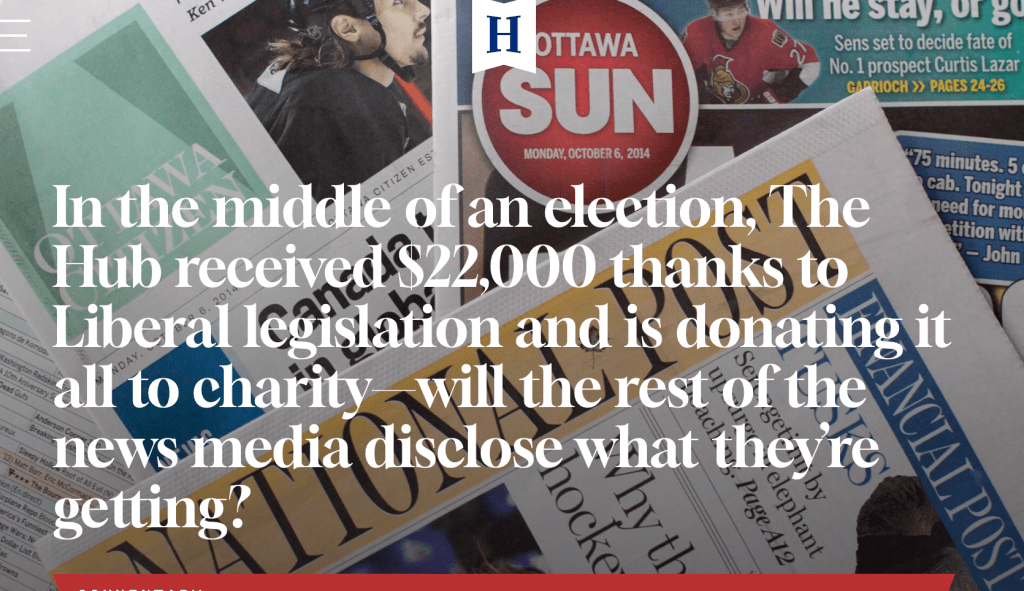
As for the QCJO designation, he says The Hub wanted it for the purpose of Press credentials and never applied for the salary subsidy or reader tax credit program. As for seeking and then giving away the Google money, he said The Hub wanted to follow its application through the CJC process so it could verify the integrity of the distribution.
The Hub’s argument with subsidies is about the independence of the press from government, a non trivial concern of course, but the relevant discussion is “independence” from the many vectors of power in our liberal democracy, not only government but big corporations, sponsors, political parties, billionaires, readers demanding ideological conformity and powerful local families.
The Hub‘s success in winning official status raises the concern of how best to administer QCJO designation when it results in the certification of a news outlet so utterly committed to a northstar political party, one that may be governing Canada come Tuesday morning.
That concern is usually shrugged off by those who point to the historic practice of print media mixing its news reporting with politics through opinion journalism and explicit party endorsements. It got us where we are today, so why worry about the close ties between some media and their political champions?
One way to stop worrying about those political allegiances is found in program design for the subsidies. One of the best ways for a news outlet to prove its bona fides of good journalism is through its committment to original and accurate news gathering as the main course in the journalism meal, with opinion as the dessert.
The QCJO criteria for designation has always required that news outlets engage in original news gathering with a fairly high bar for professional standards. The weakness of those rules is that lack of a high bar for volume of news gathering, requiring only that news gathering be carried out on “ongoing basis.” The “ongoing” is left to eyeballing by a certification committee after a news organization has submitted details of its self selected “best three weeks” of news reporting.
If an outlet like The Hub with its acres of opinion writing and occasional news story can get QCJO designation, the bar for frequency of news reporting can’t be very high.
In fact Griffiths told me that as a non-profit he nevertheless decided against seeking the charitable status that would allow him to issue tax receipts to donors because the rules of the government’s less known “RJO” program for non-profits sets the news gathering bar at 51% of published content, a test he says he could not meet.
And then there is accuracy in news reporting, another thing that demonstrates good journalism and, when not done well, undermines public trust.
Recently, The Hub has repeatedly described federal subsidies to news journalism as totalling “$425 million per year.”
Included in that figure is the $100 million Google money as an “indirect” federal subsidy, a highly editorialized way of describing government-enforced news licensing payments between private parties.
More seriously, its “$425 million” figure includes $154 million from the Canada Media Fund, a media fund that spends all of its money on Canadian television dramas, documentaries and children’s programming and exactly zero dollars on news journalism. That’s a hugely misleading reporting error.
There is yet another way to demonstrate good journalism: keeping a safe distance from corporate influence. News organizations of all stripes have a chequered history on this, frequently allowing advertisers and sponsors to pay for content in one way or another. Nevertheless “advertorial” that is written and paid for by a sponsor, clearly marked as non-journalist content, is generally accepted and long tolerated.
But the arms length independence from corporate money can get squishy.
The Hub published an article in October that opposed the federal government’s Online Streaming Act, also contested in a “Scrap the Streaming Tax” public campaign launched the previous month by the American Digital Media Association (DiMA) against the CRTC’s ruling that music streamers pay five per cent of revenue to Canadian media funds.
DiMA’s member organizations Spotify, Apple, Youtube and Amazon are notorious news subjects in their opposition to the CRTC’s implementation of the bill and DiMA’s campaign art was used by The Hub to illustrate the content of the article.
DiMA even paid for the article, a fact that was acknowledged at the bottom of the article but still, in my opinion, constituting a repudiation of independent journalism.
***
While I’m on about The Hub, they posted a terrific podcast in their Full Press series hosted by Harrison Lowman and starring independent journalists Tara Henley and Peter Menzies. The topic was the notorious “shit show” of Rebel News turning the election debate press conferences on their end on consecutive nights.
It got going on the first night when a Rebel News reporter chose to ask the only non-Christian leader why he wasn’t speaking out against “ongoing attacks against Christians” and Church burnings, a provocatively staged but nonetheless legitimate question.
But the second night was when it all went to hell and the press conference became so unruly that the election commission cancelled it.
The Full Press podcast has some very intelligent commentary on the whole mess, very relevant to the Internet-induced era of wide open journalism.
***
If you would like regular notifications of future posts from MediaPolicy.ca you can follow this site by signing up under the Follow button in the bottom right corner of the home page;
or sign up for a free subscription to MediaPolicy.ca on Substack;
or follow @howardalaw on X or Howard Law on LinkedIn.
I can be reached by e-mail at howard.law@bell.net.
This blog post is copyrighted by Howard Law, all rights reserved. 2025.

 MediaPolicy.ca
Ha. Nice column today my friend!Sent from my iPhone
LikeLiked by 1 person
Good columnSent from my iPhone
LikeLike