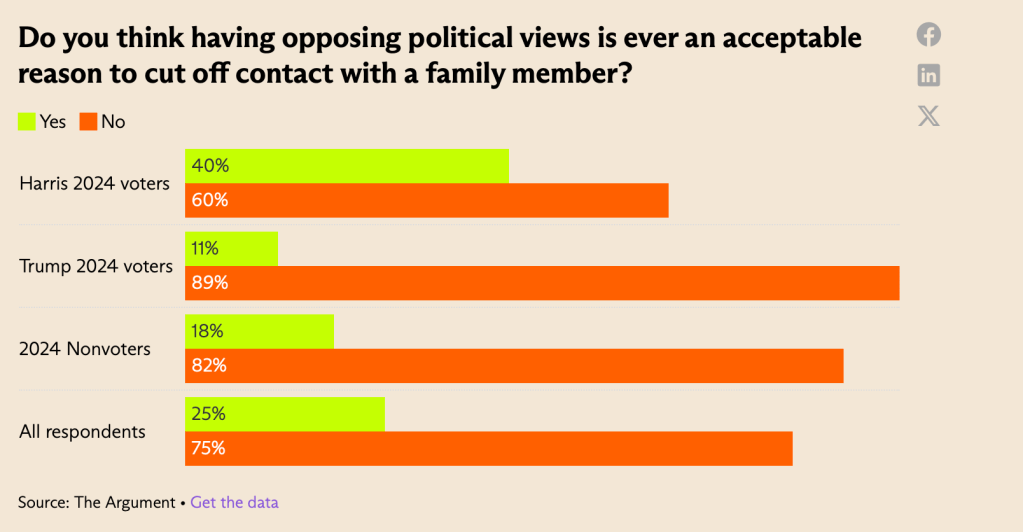
Polling graphic from The Argument
September 6, 2025
French journalist unions have won a share of the licensing fees negotiated by publishers with AI companies whom are paying for the news content they scrape off the Internet, according to a report in Nieman Lab.
If not for the French: always the first to fight for content creators. Several years ago, journalist unions got their members a share of the “Google money” paid out in Europe under its news licensing framework in the last few years. Le Monde reporters earn an additional 275 euros per year.
Now that there is a new content licensing deal between Le Monde and OpenAI reporters get 25% of the cash. No reports on how much that is.
***
Speaking of our friends at Google, the US trial judge who ruled that Google holds an illegal and anti-competitive monopoly in Search has, by many accounts, let Google off the hook by rejecting most of the Justice Department’s remedies.
By his own description, the judge exercised occupational “humility” by going easy on Google. The most significant thing he had to say, much cheered by Google, was that whatever skullduggery allowed Google to solidify its dominant market position over Search, the competition for the AI market is a horse race.
The judge handed out consolation prizes by requiring some limited data sharing with Google’s search competitors, a remedy disparaged by the CEO of Duck Duck Go as “a nothing burger.”
Also, the judge ruled that Google’s multi-billion dollar agreements with Samsung and Apple for making Google the default search app on their phones can continue. Those commercial agreements were significant in the judge’s earlier finding that Google’s monopoly was illegal.
On the other hand, Google is looking a gift horse in the mouth and will appeal both the limited remedy and the original finding of monopoly.
There is plenty of good analysis to read on the ruling.
The Big Tech giant may have escaped the worst consequences of the Search monopoly-ruling but it has other concerns. A US Justice Department anti-trust lawsuit against its domination of digital advertising is well underway and yesterday European Union regulators fined Google nearly three billion euros for the same market domination. The regulator’s fine was immediately entangled by US-EU trade tensions and could be delayed.
Meanwhile Google’s share price bumped 8%, so at least someone is happy.
***
When Mark Carney scrubbed Canada’s digital services tax in June, a new coalition Canadians for Digital Sovereignty published an Open Letter calling on the Prime Minister to defend Canadian regulation of the Internet and Big Tech.
On the eve of the federal Liberals’ cabinet retreat this week, the coalition published a well-timed and lengthier piece, more like a manifesto.
It’s an elaboration on what it means to defend “digital sovereignty,” a new catchphrase describing a public policy gamut stretching from communications infrastructure to software and the regulation of online content. Or as one Comment column in the Globe and Mail put it recently, more Canadian autonomy over “data, code and compute.”
The basic idea is to recognize the new geopolitical environment in which digital technology is increasingly controlled by states, namely the United States, and becomes more than just a regulatory issue but a matter of economic self sufficiency and political security.
An executive summary of the new Open Letter is here:
***
I made a needed correction to last week’s MediaPolicy’s report that independent Canadian broadcaster Wildbrain had abandoned its CRTC licenses and pulled its suite of family channels from cable TV.
I reported that Wildbrain is selling out to American interests, which its spokesperson says it isn’t, rather it is taking advantage of its new status as a digital-only broadcaster by removing Canadian ownership requirements from its public share structure.
***
I am enjoying a left-wing American Substack I just discovered, The Argument.
It published a poll on political attitudes that was interesting but I am not inclined to just map its findings over to the Canadian experience.
But still, I was left agape by the poll finding that 40% of Kamala Harris voters would consider cutting off contact with a family member “for opposing political views.” Only 11% of Trump voters would do that.
***
If you would like regular notifications of future posts from MediaPolicy.ca you can follow this site by signing up under the Follow button in the bottom right corner of the home page;
or sign up for a free subscription to MediaPolicy.ca on Substack;
or follow @howardalaw on X or Howard Law on LinkedIn.
I can be reached by e-mail at howard.law@bell.net.
This blog post is copyrighted by Howard Law, all rights reserved. 2025.

 MediaPolicy.ca