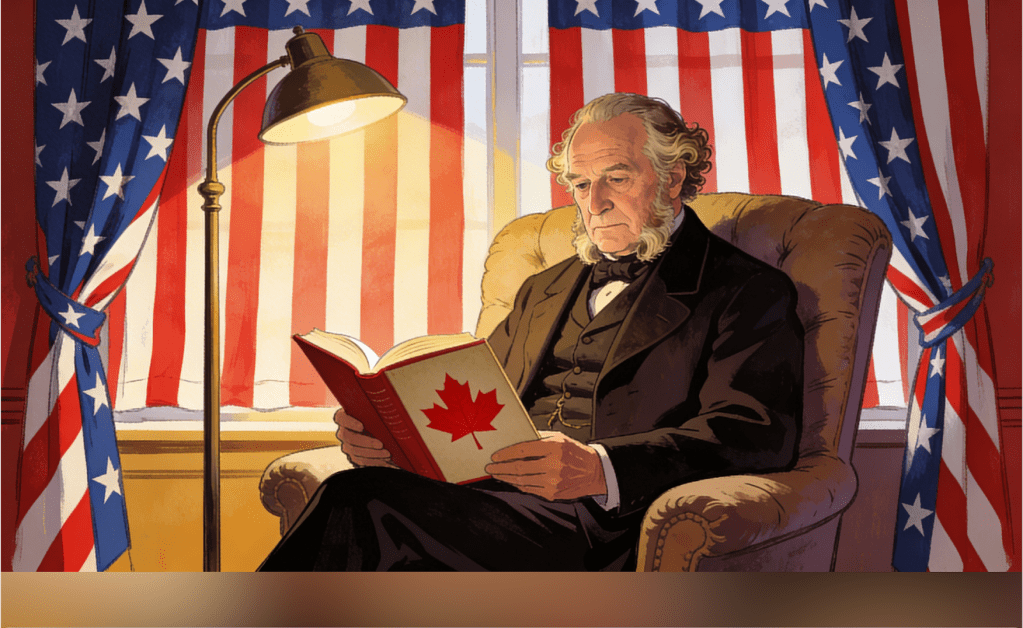
Richard Stursberg drills down on policy proposals for Canadian books he says can be winners (if only Ottawa would listen)

March 27, 2026

In January, Sutherland Books published Richard Stursberg’s tonic for the anemic domestic market in Canadian authored books, Lament for a Literature.

Now semi-retired, Stursberg served as a senior advisor on cultural policy to the Mulroney government and went on to a string of important jobs in cultural production that culminated with a tour of duty as the VP English services at the CBC. He wrote a memoir of his CBC days, The Tower of Babble, which is a fun read (though not for his skewered adversaries).

Lament for a Literature chronicles the decline of the Canadian book publishing industry and Canadian authored books in a domestic market dominated by foreign book houses. The Canadian book publishing landscape is dominated by a handful of multinational publishers owning 95% of book sales, with small independent Canadian publishers chasing what’s left. And that’s before we consider the chokehold on book distribution that Amazon and Indigo have and the implications of that for publisher profits and author royalties.

MediaPolicy reviewed the 100-page book that is bursting at the seams with major public policy proposals to reverse the decline.

To get a better handle on his proposals, I interviewed him.

***

MediaPolicy: How’s Lament for a Literature doing?

Richard Stursberg: I would say I’ve been very pleased so far. A lot of reactions. There was an excerpt published in the National Post. And they had over 400 reader comments before they cut them off.

MP: You saw my review of your book?

RS: Yes, and John Ibbitson did one in the Globe, and there’s an interview in Canadian Affairs.

MP: About that interview, they asked you a lot about the cultural controversy you stride right into in the book, this contested terrain of decolonizing literature versus telling iconic Canadian stories. The bottom line in your book is that we need to legislate help for Canadian book publishing. But you can’t legislate the cultural zeitgeist, can you?

RS: No you clearly can’t. The difficulty for a curator of cultural funding, like the Canada Council for the Arts, is you end up pursuing an ideological agenda by carving up a fixed budget for book publishing based a policy agenda. And I don’t think that’s what you want to do. I think what you want to do is something different, which is to create a set of arrangements that allow publishers and writers to decide what they are going to write, not bureaucrats.

And the way you do that is simple. You make the book subsidies automatic, like we do in film and television tax credits. And so you get rid of this sort of notion that we’re going to have people sitting around and deeming what’s worthy and what’s not worthy, and what’s politically correct or not. You leave the decisions about what gets published in the hands of authors and publishers.

MP: Right. You talk in Lament about this tax credit, this subsidy program that we already have in film and TV. You are proposing that something like that would replace the federal budget lines for the Canada Book Fund and the book funding program inside the Canada Council?

RS: Yeah. And the way the TV credits work is that typically they’re labour-based. The producer files a cost report and then as a certain proportion of those total costs the government sends you a cheque. Now, there’s two good things that happen with this which don’t happen with any of the book programs.

Right now, the book programs are all zero-sum. So, one publisher gets more, the other has to get less. That doesn’t happen with television tax credits. It would allow you to grow the book industry. 

But secondly, what happens is the tax credits are bankable. The publisher can take the tax credit down to the bank and get a loan, more investment [for author advances or marketing].

And they will. You can’t do that with the current book program because you never know how much money is going to come out the other end.

MP: You also write in Lament that we need to re-establish Canadian ownership of publishing houses if we’re going to revive Canadian books. Isn’t the horse out of the barn on Canadian ownership?

RS: The horse is out of the barn and into the meadow. He’s been grazing for a long time. Ninety-five per cent of book sales in Canada go to foreign owned publishers.

MP: So reversing that foreign ownership is not your top priority?

RS: Well I would say this. We should have a federal ownership review process that is transparent. The whole secrecy is bizarre. The entire process over the years has been a complete disaster. The last one was Allan Lau’s Wattpad, it was sold to a Korean company in 2021.

MP: I think the most challenging policy proposal in the book is to create a Canadian rights market where foreign publishers have to make deals with Canadian book publishers to have their foreign-authored books retailed and distributed in 

RS: I don’t know if it’s back to the future. No doubt, it would be a little complicated to set it up. But it’s a way of compensating for having allowed the industry to have become completely dominated by multinational publishers. The first right of refusal has to go to Canadian publishers and distributors. 

 We know that in the early days, whether it was Macmillan or McClelland & Stewart, that’s how they made a lot of their money and financed these extraordinary lists of Canadian artists. With a rights policy, you’re trying to recreate that publisher capacity.

MP: Another proposal you make that also looks complicated to me is your idea to stop Amazon and Indigo from undercutting independent Canadian bookstores on discount pricing. Straight-up price regulation, in other words.

RS: It’s worked in Germany and France for decades. Quebec too. And the reason why it’s a good law is threefold. 

One is that, outside of Quebec, our independent bookstores can’t compete. It’s because they’re small and their margins are small, with giants like Amazon or Chapters. But independent bookstores are very important, because one of the fundamental ways to promote books is so-called hand selling at your local bookstore.

You go there. They know you. They know your taste. They say you might be interested in this new title. 

So you, you know, instead of saying to yourself, “oh, I think I’ll go to Chapters, because I’ll get 20% off,” it’s the same price everywhere. In France, not only does Amazon have to sell it at the same retail price as everybody else, but they have to charge 10 euros for shipping.

And it’s been very successful. You walk around Paris and there’s a small independent bookstore on every block. And they’re very good.

And you look at the statistics as to the extent to which the French read French authors. Something like, about 55 to 60 percent of all the bestsellers in France are written by French authors.

MP: I think I’m only part way through your list of proposals. It’s a lot and some of it might not even be in federal jurisdiction which means you have to shop the ideas to provincial premiers. 

RS: Yes, it’s an ambitious proposal. Any one of them is an ambitious proposal, but altogether it’s an ambitious proposal.

MP: I’m thinking, okay, it makes it a lot easier if the federal government can act alone rather than doing anything that the provinces can object to.

RS: So, in Quebec it’s no big deal. They’ve had their book law, their Loi de Livres, since 1981. Quebec publishers of French language domestic books have 51% of sales in their own market.

It’s because their book law requires schools, libraries and universities to source their books from independent Quebec-based bookstores. They can’t source them from Amazon or from anybody else outside the country. That seems to me to be like almost a silver bullet.

To sell books to those key institutional buyers, you have to be an accredited bookstore.

MP: What does it mean to be an accredited bookstore? 

RS: It means that you have to not only be in Quebec, but Canadian owned and operated. It means you have to carry somewhere between 2,000 and 3,000 Quebec titles in your store. So when people walk into the store, there’s lots of books to them, select them, some that are local. 

And you can see, this is a big shift because if you went back 30, 40 years, the Quebec book market was in many ways much weaker than the English-Canadian book market.

MP: Do you think you can get the attention of Canadian Heritage with Lament?

RS: The thing that’s so amazing to me is that a lot of these policy models are well-known because they’ve been trialed out elsewhere, whether they’re tax credits or top-ups for distribution or whatever they happen to be. Or, you know, they’ve been tried out for years and years in the TV and film business. And for some reason or another, despite the fact they’re all in the same Department, none of it seems to have penetrated Canadian Heritage’s book people.

MP: Very odd. Well, is it odd? 

RS: I think it’s odd. 

MP: Well, in the real world of politics and influence, is it any surprise that the television industry has had more success in getting Heritage to implement helpful things than the wee little book industry? 

RS: Well, yeah, you’re doubtless right.

***

If you would like regular notifications of future posts from MediaPolicy.ca you can follow this site by signing up under the Follow button in the bottom right corner of the home page; 

or sign up for a free subscription to MediaPolicy.ca on Substack;

or follow 
@howardalaw on X or Howard Law on LinkedIn.

COMMENTS ARE WELCOME. But be advised they are public once I hit the “approve” button, so mark them private if you don’t want them approved. 

I can be reached by e-mail at howard.law@bell.net.

This blog post is copyrighted by Howard Law, all rights reserved. 2026.
Catching Up on MediaPolicy – The Dhanraj Show – Go away Paul Wells, you’re not a journalist – The OpenAI problem – Grand Theft Anna

March 14, 2026

Last September MPs on the Parliamentary Heritage committee (CHPC) voted unanimously to hold hearings on “the state of Canadian journalism.”

This happened after, or perhaps because, the Conservatives called for a Parliamentary inquiry into the dramatic departure of Canada Tonight host Travis Dhanraj from CBC Radio-Canada. At the time, MediaPolicy wrote about that dispute here, here and here.

On Tuesday, the curtain was drawn back for the first of five days of CHPC hearings and as the opening guest Dhanraj told his story. For a detached review of the blow by blow, here is Karyn Pugliese’s Substack post.

Dhanraj’s narrative is (a) the CBC is a toxic workplace that management tolerates, (b) he was tokenized as a brown skinned journalist and rebuffed in efforts to make his evening show more edgy and interesting, and (c) he was on the short end of a power struggle with the Rosemary Barton of the National and David Cochrane of Power & Politics, preventing him from booking Conservative MPs on his show.

The side of the story he doesn’t tell is CBC’s management view that so long as the CPC was boycotting those two flagship news shows, they weren’t getting on Canada Tonight. Bruce Arthur’s column in the Toronto Star delves into this. So far, the CBC isn’t saying much and is keeping its litigation powder dry (Dhanraj has filed a human rights complaint).

A thread pulled on during the hearing is a list of 45 “do not book” guests that Dhanraj says he got from CBC management. Depending on what the list is for, and who is on it, there could be fireworks.

It’s fair to say that CPC Heritage critic Rachael Thomas is getting as much mileage out of the Dhanraj affair as possible and going after the CBC with gusto. Dhanraj, whose lawyer Kathryn Marshall is well connected in Conservative circles (she’s married to CPC insider Hamish Marshall), says he’s not bearding for the Conservatives. 

MP Thomas is building on a theme over the five days of hearings by calling witnesses such as Honest Reporting (critical of CBC reporting on Gaza and an on-air anti-Semitic rant by Radio-Canada’s Washington corro) and inviting the Canadian Ethnic Media Association to amplify its dissatisfaction with the CBC’s reporting on mass protests in Canada against the Iranian government. 

Still to come, compulsory Committee appearances by both the Heritage Minister Marc Miller and CBC CEO Marie-Philippe Bouchard. 

***

That pesky issue of defining a journalist never goes away.

Last week Blacklock’s Reporter broke a story, picked up on by The Hub, of communication staff in two federal government departments appearing to require reporters seeking information or comment to be employed by news businesses certified by the Canada Revenue Agency as a Qualified Canadian Journalism Organization. The purpose of QCJO certification is to vet news outlets for labour tax credits, i.e. subsidizing 35% of journalist salaries.

I say “appear” to require QCJO certification, because the federal websites for Immigration and Global Affairs said comms staff would only speak to journalists employed by news organizations that are QCJO certified or abide by “similar” standards of journalism.

“Similar” is an important caveat. The key standards of QCJO certification are first hand reporting (“original news’) and adherence to an editorial code of accountability: picking up on those rules, the private journalism consortium that disburses $100M in Google news money every year under the Online News Act also requires news outlets to meet standards of news gathering and editorial accountability. Hence, the departmental caveat “similar to.”

Still, the federal department websites repeatedly refer to “QCJO” and quote word for word from the QCJO tax guidance on original news reporting and other program red lines. And when this happens in two different federal departments, you have to wonder about the group think behind it.

Of course two federal bureaucrats can get the same thing wrong at the same time out of ignorance: for example, maybe the light didn’t go on that the QCJO program is not available to thousands of broadcast journalists, freelancers, or reporters employed by magazines and community weeklies. It seems doubtful the government departments won’t talk to CTV, Global, TVA or CBC Radio-Canada reporters.

It gets worse. The QCJO rules quoted by the two departments reiterate the “two employed journalist” threshold that sets a minimum size of a newsroom that is eligible for QCJO subsidies. Following such a rule, it appears the departments won’t speak to any freelance journalists, no matter who they are. Paul Wells and Linda McQuaig need not apply.

Who defines a journalist anyway? Canadian journalists are not government regulated, nor self governing except to the extent that their news organizations voluntarily participate in Press Councils or the Press Galleries in Ottawa and provincial capitals.

Even then, the peskiness of hair-splitting definitions arises. Recently in Washington state, a federal judge upheld the legislature’s exclusion of three right-wing media personalities from enjoying the full run of the state building granted to professional journalists on the grounds that their primary identity was in the role of political actors.

In Canada, the Supreme Court already acknowledges the unregulated status of journalists by expanding the libel defense of “responsible communication” to include anyone, not just professional journalists. 

On the other hand, in 2017 Parliament needed a legal definition of a journalist in order to create a whistleblower law that shields confidential sources. Under that statute, a journalist is defined as “a person whose main occupation is to contribute directly, either regularly or occasionally, for consideration, to the collection, writing or production of information for dissemination by the media.”

It took a few days, but Immigration reacted to the bad publicity and the intervention of the Canadian Association of Journalists. It says it’s reviewing its definition of journalist.

***

The tragic role that OpenAI played in the Tumbler Ridge mass school shooting, by flagging but not reporting the killer’s homicidal ideation, has policy experts thinking hard about what kind of regulation we need to see in an online harms bill.

Taylor Owen has an important LinkedIn post, worth the two minutes of reading time. Here’s an excerpt:

Here’s the thing that doesn’t get said enough: your conversations with ChatGPT or Claude or Grok are not private. Employees, and AI, can read what you type. OpenAI is about to start selling ads against those interactions. While, the product is designed to feel intimate, simulating patience, attentiveness, understanding, it is ultimately a content serving product. But it is a product that many open up to in ways they would to a person. It is a psychological bait and switch that capitalizes on a disconnect in norms. But because we have an illusion of privacy with these products, mandatory reporting to law enforcement, if not designed carefully, risks layering a surveillance obligation on top of what is already, fundamentally, a surveillance product.

What could actually help? I have been arguing for a Digital Safety Commission with real enforcement powers, mandatory risk assessments, transparency over safety protocols and age-appropriate design standards. Upstream regulation that changes how these products are built, not downstream surveillance that monitors how people use them.

If I understand Professor Owen correctly, he thinks that if AI and tech companies are compelled to adopt robust and transparent safety design of what their bots will give advice on, the less we will have to worry about the surveillance and reporting of private activity on the web.

***

Because I have decided your weekend reading list is still incomplete, if you care about books you must read yesterday’s Substack post from Sutherland Books publisher Ken Whyte. It’s about book publishers’ court challenge to the industrial-scale theft of copyrighted content by Anna’s Archive, an unauthorized aggregator of digital content.

***

If you would like regular notifications of future posts from MediaPolicy.ca you can follow this site by signing up under the Follow button in the bottom right corner of the home page; 

or sign up for a free subscription to MediaPolicy.ca on Substack;

or follow 
@howardalaw on X or Howard Law on LinkedIn.

COMMENTS ARE WELCOME. But be advised they are public once I hit the “approve” button, so mark them private if you don’t want them approved. 

I can be reached by e-mail at howard.law@bell.net.

This blog post is copyrighted by Howard Law, all rights reserved. 2026.
Of books, sovereignty and morons. A review of Stursberg’s ‘Lament for a Literature’

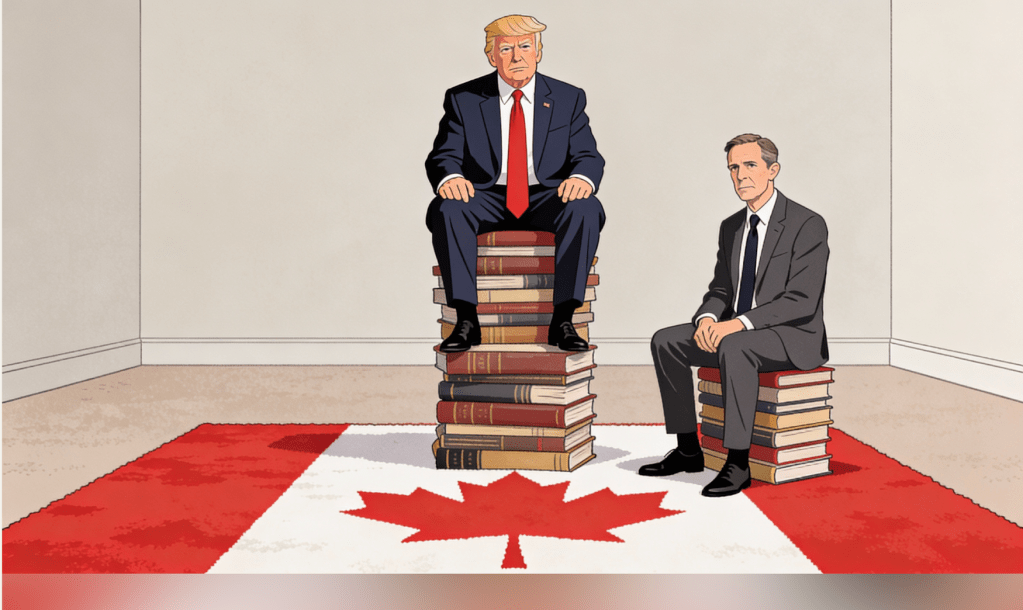
AI illustration by Perplexity

January 24, 2026

Richard Stursberg, Lament for a Literature: The Collapse of Canadian Book Publishing (Sutherland House).

If we ever were, Canadians are no longer happy to be cultural North Americans. 

The current US administration’s plan is to reduce Canada to a vassal state, like Russia’s Belarus.

Canadians have responded with fear, anger and pride. We are, the vast majority of us, resolved to defend our cultural sovereignty by any means necessary or available.

Enter stage right, Richard Stursberg’s history and policy statement on Canadian book publishing, Lament for a Literature. It’s more of an essay than a book at 96 pages with no footnotes to slow you down and, somewhat irritatingly, no index. It’s published by Sutherland House, one of the small and feisty Canadian publishing houses that are the objects of the author’s cultural affection. 

The melodramatic book title is a riff on George Grant’s 1965 classic Lament for a Nation. Long before Canada bet big on North American integration, Grant meditated upon the death of Canadian sovereignty. He described a withering away of the Canadian identity and questioned our resolve to resist the black-holed gravity of the United States. 

Stursberg articulates the essence of the matter in his first paragraph (inviting Kim Mitchell’s great compliment: “damn, I wish I wrote that”):

A country’s identity is forged from its political, military, and social history as interpreted and communicated through its arts. The stories that emerge define how a country thinks about itself, what it values, and how it perceives others. The stories can come in the form of epic poems, TV shows, magazine articles or oral traditions. The Ur medium is books. They provide the most thorough and immersive explorations of identity and often underpin all the other media.

You can pick a bone with any of that if you like, including the claim that books are our cultural supercode, or as Margaret Atwood once described that literary universe, “the geography of our Canadian mind.” (Alas, Atwood’s acerbic wit got the better of her when she playfully designated those uninterested in Canadian books as “cultural morons.”)

Despite long form narrative having to compete for attention with the Internet, we are still a nation of book readers with the time and patience for that immersive wonder.

The trouble is, Stursberg writes, the Canadian book business has largely collapsed over the last 20 years. We have the weakest domestically-owned publishing sector in the industrialized world (a measly five per cent of book revenues in its own market); we prefer celebrity memoirs and self improvement books to Canadian biography and politics; we’re mostly reading American fiction and non fiction distributed by the foreign publishing houses and their Canadian subsidiaries that have the other 95% of sales in the Canadian market; and our tight cohort of prominent Canadian novelists are increasingly setting their narratives outside of Canada, whether out of artistic vision or with an eye on foreign distribution.

For all of this, Stursberg puts the blame on public policy failure, going back decades.

The public policy for supporting the arts and media in our small Canadian market is always a variation on a theme: government subsidies underwrite the cost of Canadian culture so that art which is truly local and authentic will earn enough money that the Canadian media companies making a business of selling and distributing Canadiana can make a go of it. 

For books, the largesse is not lavish: the federal funding of the Canada Book Fund ($50M/yr) and the Canada Council book program (another $40M/yr) are rounding errors of a federal budget rounding error.

But the key  thing is that unless we’re going to cut subsidy cheques to foreign book publishers (we don’t), we need a regulatory framework that keeps Canadian media companies strong.

The thinking goes, the foreign book houses are in Canada to make money. But their diminutive Canadian-owned counterparts are in it for both the love and the money. However the small scale of the Canadian-owned houses makes them vulnerable to economic rip tides and the occasional financial crisis. That is why regulatory and government support to grow their business scale, and to build a backlist of great titles and a stable of bestselling authors, can be the key for Canadian publishers to survive the day and live to publish more Canadiana. 

Stursberg recounts the narrative of how peculiar (and fatal) it was that federal policy on Canadian book publishing failed to follow the more successful regulatory model supporting broadcasting. 

Where Pierre Trudeau’s 1968 broadcasting legislation demanded Canadian ownership of all television and radio broadcasting, his corresponding book policy in 1974 grandfathered American publishing houses already here while impeding further foreign takeovers of Canadian publishers. 

When Brian Mulroney’s heritage minister Marcel Masse tried to strengthen the takeover rules in his “Baie Comeau” book policy (named for the location of the cabinet retreat where it was approved), he later ran into the headwinds of the Mulroney cabinet’s natural instincts and eagerness to make a free trade deal with Ronald Reagan. 

At the first real test of Baie Comeau, Mulroney green lit the Gulf & Western conglomerate’s takeover of the Canadian-owned Prentice Hall. Over the next two decades, under Conservatives and Liberals alike, the Baie Comeau policy supporting small Canadian book publishers was enforced poorly and then not at all. Today it is effectively a dead letter. 

Stursberg reminds us of the bestselling and buzzworthy fiction and non-fiction that Canadian owned publishing houses once brought to market: Peter Newman’s Renegade in Power and The Canadian Establishment, Grant’s Lament for a Nation, Pierre Berton’s The National Dream and the Last Spike, Mordecai Richler’s St.Urbain’s Horsemen, Leonard Cohen’s Beautiful Losers, Alice Munro’s Bear, and Atwood’s Surfacing and Survival to name a few; many of them prize winners in Canada and internationally.

Stursberg writes of the tragedy of the Canadian publishing powerhouse McClelland & Stewart, with its dream team backlist of iconic books, falling into financial crisis and, after some serious skullduggery, emerging eleven years later as foreign-owned but not before new owners feasted on $77 million in Canadian subsidies. Plenty of villains in the piece, and not all foreigners

Today the Canadian subsidiaries of foreign publishing houses can cherry pick the best Canadian authors and books, while the smaller Canadian-owned houses embrace the commercially challenged mission of mapping the geography of the Canadian mind. As for the authors that Canadian publishers bring to success, they can hardly resist the lure of foreign book houses for their next title, what with their global distribution and Canadian marketing budgets. 

But Lament is a policy treatise and, like Stursberg’s 2019 manifesto on broadcasting The Tangled Garden, he is not shy about providing an answer to the question “what is to be done?”

His answer is a multi-point program of more generous federal book subsidies and regulatory support for Canadian publishers that he would put in the hands of a Canadian crown corporation. As a kind of CBC for book publishing, federal BookCo would be backed by a tougher policy on Canadian ownership (to protect the last five per cent of our market) and supported by a nationalist policy to grow that five per cent through book distribution and publishing rights, as well as leveraging federal money to persuade provincial governments to imitate Québec’s policies supporting French language authors and books. It’s a bold menu that would see powerful enemies queueing up and US trade negotiators at the front of the line.

As we head into the ugly confrontation with the US in upcoming trade talks, it’s an opportunity for Canadians to stake our claim to cultural sovereignty. Better to fight on our feet than become vassals on our knees. 

***

If you would like regular notifications of future posts from MediaPolicy.ca you can follow this site by signing up under the Follow button in the bottom right corner of the home page; 

or sign up for a free subscription to MediaPolicy.ca on Substack;

or follow @howardalaw on X
or Howard Law on LinkedIn.

COMMENTS ARE WELCOME. But be advised they are public once I hit the “approve” button, so mark them private if you don’t want them approved. 

I can be reached by e-mail at howard.law@bell.net.

This blog post is copyrighted by Howard Law, all rights reserved. 2026.