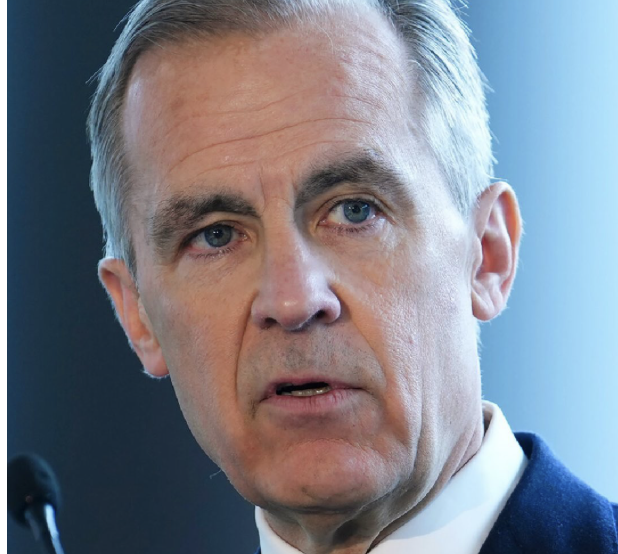
After years of calling the shots as a business CEO and bank governor, the Prime Minister is discovering how tough it is to play the weaker hand when negotiating —-well, trying to negotiate—- with a bully like the United States.
Trump not only wanted the DST to be cancelled, he demanded on Sunday morning it be repealed as a condition of further negotiations over tariffs, trade and continental security. On Sunday evening Canada folded.
Carney cancelled the DST literally hours before the Silicon Valley titans were obliged to send us about a couple of billion dollars in corporate tax remittances, after years of Canada delaying the tax in the hope of coming up with an alternative measure to address the problem of US tech giants reducing their global tax bill by offshoring revenues earned in Canada and countless other jurisdictions. A deal with former President Joe Biden fell through because US Congress would not ratify it.
The rapid chain of events on Sunday had a whiff of Kabuki theatre: it’s plausible that weeks ago Carney made the decision to clear ballast from his trade agenda, much as he did with a carbon tax he once endorsed, but he needed Trump’s threat of walking away from the trade talks to do so. Whether Carney and Canada got anything from Trump in exchange for this unilateral concession we may never know.
It’s an understatement to say there is a disturbing pattern taking hold. Canada spent $1.3 billion on border security to rebuff Trump’s first round of trade tariffs triggered on the phony pretext of fentanyl smuggling.
We enacted and then suspended most of our retaliatory tariffs in hopes of expedited trade negotiations.
We joined hands with NATO allies to click our heels at Trump’s demand that NATO countries more than double their defence spending to 5% of GDP.
And as a ten out of ten on the cringe scale, who can forget Ontario Premier Doug Ford’s bumbling bluff to cut electrical power exports to the United States.
Carney is gambling that Trump won’t see the DST climb-down as weakness and be emboldened. If Canada was the European Union of 400 million souls, an ocean away from the US, the Prime Minister might have chosen a different strategy.
What’s the right way for Carney to play this in the next few weeks?
I spent my trade union career negotiating against powerful companies, usually playing the weaker hand unless the rank and file were angry enough, for a long enough period of time, to face down their employers. One of the key responsibilities of the negotiator is to figure out your own strength.
This is Carney’s challenge. How resilient are Canadians in our collective commitment to economic defence against the Trump onslaught? We get riled up by Trump’s “51st state” threats. But are we tough enough for a grinding trade war of attrition that lasts until Trump’s economy tanks and he has to face mid-term voters next year?
This is a question that the Prime Minister must ask himself every day. It is a question we must ask ourselves.
Our first test of bargaining solidarity is for our politicians, especially our provincial premiers. I suppose we could ask them to just shut up and let the winner of the federal election speak for Canada and certainly not head south to cut their own deal with the US President at Mar-a-Lago.
But voters expect their elected officials to speak up for their constituencies —-Alberta Premier Danielle Smith has every right to remind us that the oil patch is as important as the auto industry— or else they will no longer be elected officials. But there is a line to be drawn and respected.
The same test of solidarity can be expected of non-elected political agents. The chorus of domestic critics of the tax on Uber, Google, and the other digital titans has mischaracterized the tax as just another cynical cash-grab from Big Tech companies that are better left unregulated.
Canadian journalists have tried to correct that misimpression, reporting on the DST as a story of global tax policy. The story is that Canada was a relative latecomer to the international consensus among OECD nations that US Big Tech was offshoring revenues earned in other countries to tax havens like Ireland and that national digital taxes were the best way to combat it until the cheating stopped.
Most European Union nations have already implemented their digital services taxes. While the US President still has those levies in his trade crosshairs, any changes will come at the negotiating table where the EU can pursue a solution to the offshoring problem. In a recent announcement, US Treasury Secretary Scott Bessent said that the US was prepared to mirror OECD/G20 nations’ tax policies on a minimum corporate tax even though the US will not ratify a tax treaty on the matter.
The details of this recent understanding between the OECD and the US are still hazy.
The EU is keeping its DSTs, for now, because it has some things that Canada doesn’t. Like, the EU nations’ DSTs were already implemented and they had not delayed them out of good will as Canada did. Like the trade of EU nations is less exposed to the United States than Canada’s is. Like, the EU can fall back on an internal trading bloc of 400 million.
The EU will discover, as Canada is, that a solid front at the bargaining table is the only way to defend economic opportunity and political sovereignty against Trump’s trade war.
If it’s all over quickly because we can’t keep a grip on our internal solidarity, we will have lost the trade war. And losing the trade war could mean losing our country.
***
If you would like regular notifications of future posts from MediaPolicy.ca you can follow this site by signing up under the Follow button in the bottom right corner of the home page;
or sign up for a free subscription to MediaPolicy.ca on Substack;
The future of the Canadian Broadcasting Corporation hangs in the balance, waiting for the verdict of thumbs up or down. Live. Or die.
We know where the two major political parties stand on this.
If Pierre Poilievre wins a majority in the April 28th federal election he will move quickly to “defund” English-language CBC services. An omnibus bill will remove legal impediments in the Broadcasting Act and his budget will eliminate up to $1 billion in federal spending. If he has that Parliamentary majority don’t be surprised if he also breaks his campaign promise and slashes the Radio-Canada budget, to fend off a caucus revolt over sparing Québec.
Meanwhile the Carney Liberals will be for “saving” a “new” CBC. Voters in Québec expect no less. And in English Canada there are NDP supporters to be poached.
We’ll see if it gets any more complicated than that, but I doubt it. “Defund” or “save.” That’s the choice.
Naive souls like myself would have preferred to have framed this choice within a thorough public debate, even a royal commission, to investigate what it means to defund, save or reinvent the CBC.
There’s a public appetite for this thoughtfulness. It’s worth remembering that an October 2024 poll put the hard core “defund” forces at only 11% of Canadians. An earlier poll found that 76% of Canadians want to keep the CBC but half of that support wants to see “changes.” Heavens knows what “changes” means. That’s where a more considered public policy debate might have helped.
The stale polls on public satisfaction with the CBC may no longer matter. Donald Trump moves the opinions of Canadian voters in a tweet. Fighting off his annexation plan without a CBC: what a scenario that is.
My hat is off to the grass roots campaigns to save the CBC; not just the Friends of Canadian Media‘s cheeky campaign to “FU__ the CBC,” but also the chat groups popping up on Facebook and Reddit.
But now having the benefit of the views of others, I have something to say that’s a little different.
The Senator (“don’t call me Senator,” he likes to say) ticks a lot of boxes for me. He’s a Canadian cultural sovereigntist. He asks more questions than he makes speeches. He’s unfailingly civil. Like most of the Independent Caucus senators appointed by Justin Trudeau, he carries on Senate business in a collegial and non-partisan manner despite his Liberal connections.
Having said that, I don’t agree with everything he recommends. But he got the big stuff right.
***
Cardozo’s big idea is this: cultural sovereignty is essential to Canada. And the CBC is at the heart of a news and media ecosystem that delivers this sovereignty to Canadians. The CBC employs a third of the country’s journalists and is by far the biggest spender on televised Canadian dramas and comedies set in locales across the country.
To agree with Cardozo’s view, you have to let go of the notion that a free market in news and cultural content — a free North American market– is sufficient to nourish and defend our cultural independence. It also means giving up on the argument that the existence of the CBC is only justified where there is a demonstrated “market failure” of Canadian media, like our far north. That’s a journey into the black hole of “which market?” and “how much failure?” from which I suggest no light will escape.
Cultural minorities in Canada have always understood in the pits of their stomachs what cultural sovereignty means to them. It means survival. It means to breathe. Francophones in Québec and the rest of Canada get it. Indigenous peoples get it. Anglophones in Québec, too.
Us garden variety English-Canadians, not so much. American culture is everywhere and tasty too. Until recently, the Americans kept their crazy politics on the other side of the border, so why worry? Vancouver’s sassy libertarian YouTuber J.J.McCullough liked to say we are cultural “North Americans” and “I’m fine with that.” It’s not an uncommon opinion.
Then Donald Trump announced his plans to reduce our economy to rubble and annex us. Or just turn us (and Greenland) into a vassal state.
The crazy politics have now swept across the border. As Senator Cardozo says in his report, the times demand an independent Canadian media ecosystem. It’s unlikely any Canadian disagrees. The CBC is the key institution in that ecosystem, he says, and the polls suggest Canadians agree with that too.
Cardozo recalls that the 1928 report of the Aird royal commission proposed a cross-country network of publicly owned Canadian radio stations —later christened the CBC— as essential to defending our popular culture and democratic spaces from being dominated by American voices. If anything, the situation a century later is far more urgent.
***
Here’s the Cardozo plan.
First, forget more money for the CBC, at least for now in this moment of national crisis. That means putting off the widely applauded proposal that the CBC relinquish it’s $270 million cut of the advertising market, which would be a 14% reduction of its finances when we need the CBC the most.
I admire the Senator’s pragmatism but would prefer to rephrase his idea as “let’s get the CBC house in order before we ask Canadian taxpayers for more money.”
Second, make a big bet on local news. No more thoughts and prayers about the growing pockets of news poverty and news deserts in rural and small town Canada, but action lead by the public broadcaster shifting resources away from national news coverage and “radically reducing the budget of national headquarters (Toronto, Montréal and Ottawa).”
In advocating for local programming, Cardozo has picked up on the points made in this country by the Michener Foundation and the Friends of Canadian Media and in the US by Rebuild Local News. Our democracy is fraying because of political polarization fuelled by national politics, while Canadians’ less polarized engagement with local democracy and community events is threatened by the financial precarity of local news outlets.
Public opinion polls repeatedly say that Canadians “trust” local news above all media sources. There’s a craving there to be satisfied.
Cardozo’s proposal for the CBC to double down on local news is compelling. But there are many devils in the details. One is whether this is a good time to cannibalize the CBC national news budget at a time of national emergency. Another is how to divert the CBC’s journalism resources into local markets without elbowing private media outlets in the face. That might have been what the CBC just did by expanding its local coverage into local markets with its $7 million in “Google money.”
The senator’s report does have a practical idea that could be put to good use: “sharing content.”
There have long been proposals for the CBC to share its editorial content with private news outlets, waiving copyright. That could go much deeper with a bigger CBC commitment to joint investigations with private news outlets in local markets. Or the CBC could take a page out of the BBC’s book: the 165-journalist Local Democracy Reporting Service that assigns BBC-paid journalists to work for local news outlets.
Next, the third Cardozo idea is really several issues rolled into one: how to drain the political venom about the CBC out of the public sphere. That means confronting issues of public trust, alleged bias, and accountability.
It must be said first that the griping about “CBC bias” doesn’t measure up to the facts.
Repeat after me: CBC News is the country’s most trusted news source. The slightly overweight negative trust ratings suggest the “defunder” hostility is taken into account.
from Pollara Poll, July 2024
But citing this impressive verdict on the CBC’s trustworthiness is not a get-out-of-jail-free card for its journalism. When you report in the opinion minefields of Gaza, pipelines, and (insert controversial issue here), mistakes are going to loom large. Doing better, more disciplined news reporting is an ongoing project for any news organization. Being publicly owned, the CBC has a higher bar to meet.
Cardozo has some good suggestions.
He’d like the CBC to regularly commission and publish external audits of its news coverage. It won’t convince the CBC haters, but it’s useful if it’s something that CBC managers would go to bed worrying about. I imagine they already do. But Cardozo would make this an important tool in public accountability and transparency.
He’d also like to see more debating of public issues on CBC platforms to foster a stronger Canadian culture of intellectual curiosity and tolerance of different opinions. Amen to that.
Another of his proposals is to eliminate the CBC’s in-house editorial Ombud as the arbiter of public complaints, rerouting critics to the industry-administered Canadian Broadcast Standards Council instead.
I’m not thrilled by this idea. There’s too big a volume of complaints to dump them on someone else’s desk. The Ombud reports are quite fair, if you read them. And you can always appeal to the CRTC. Cardozo acknowledges this an optics issue.
But the elephant in the room is that too many Canadians view the CBC as —how shall we say—- insufficiently representative of what makes them feel Canadian.
Too urban. Too central Canadian. Too insulated from those that pay the tax bill.
You can dismiss these dyspeptic public attitudes if you want. After all, the polling supports a far higher degree of satisfaction than dissatisfaction. For sure, some of CBC hating is a culture war cynically fomented by political foes who want to diminish mainstream media, the better to fill that void with right-wing opinion.
But we have a historic opportunity to make popular satisfaction with the CBC deeper and wider if we face the dyspepsia head on.
Cardozo’s big idea (and others including the government’s expert committee have proposed it too) is to implement a version of the British practice of a social contract between the public broadcaster and the people’s elected representatives.
That negotiated BBC charter secures multi-year funding for an eleven-year term, freed from the gyrations of annual government budgets, in return for specific performance expectations. At the expiry of the charter term, it’s judgment day for the public broadcaster.
A CBC charter would be about more than long-term planning and financial stability. It could be a new and different way to make the CBC accountable to the people and for it to feel real in doing so.
Contrast the charter idea to the accountability we have today. Currently the Broadcasting Act provides apple-pie policy objectives for the CBC, but few specifics. The Prime Minister handpicks the President of the corporation to manage the place for five years. The CRTC weighs in with five-year licensing conditions for the CBC to earmark spending for different programming genres. The last time around the CRTC botched it and was directed by cabinet to try again.
This type of governance of the CBC might hit the right balance of accountability versus keeping the ruling party’s mitts off of programming decisions and the day-to-day management of the corporation. But it does nothing to make Canadians feel that it’s “our” CBC.
A CBC charter would be better. Going in that new direction still retains a threat to the CBC’s independence from government: which political party will be in power when the charter expires and is up for renewal? The BBC just dodged that bullet when an election expelled “defunder” Conservatives and welcomed a Labour government. But Cardozo would argue it’s still better than our current approach. It is.
MediaPolicy has two other ideas to institutionalize more public confidence in the CBC.
First, move CBC headquarters from Toronto to Winnipeg. Sounds crazy, I know, but hear me out.
Much of the disaffection with the CBC is articulated as the public broadcaster being a central Canadian hyper-urban “woke” institution. Fairly or not.
So “leafy downtown Toronto”.” So “île des génies.”
The gloss on that critique is that the CBC’s programming content gets torqued towards audiences and advertising dollars in the Toronto and Montréal television markets.
And one can only add this respectfully: a staff of journalists and content creators living in big cities are naturally inclined to be culturally simpatico with the urban neighbourhoods where they reside. That’s a problem for a national institution.
Moving headquarters and staff anywhere is a big, hugely expensive deal. It’s a lot to ask in the name of moving the needle on staff culture and assuaging hinterland hostility to the Toronto and Montréal metropoli. And if it’s done, it should be gradually and without hemorrhaging experience and talent.
The second MediaPolicy idea is even more out of the box, but bear with me.
We should legislate a constituent assembly of randomly chosen CBC listeners, readers and viewers ——200 from one end of the country to the other—- to convene every two years and publish its assessment of the CBC’s performance and direction. This would be especially helpful in shining a light on what Cardozo describes as the CBC’s “blind spots.”
In the corporate world, they call these shareholder meetings. In the public world, they call them town halls. A constituent assembly would give CBC managers and elected politicians better feedback than high-level polling results. It would offer cogent (or not) thoughts about the CBC from Main Street Canada.
***
The idea of a robust CBC anchoring an independent (of the US) Canadian media is of the moment. “To let it go,” says Cardozo of defunding, “would allow for the complete domination by America of our communications system.”
It’s commonplace to observe that American-owned social media platforms are the perfect conduit for misinformation to flood into Canada in a prolonged Trump campaign to destabilize and annex us. It’s also hard to ignore that the Republican blueprint to move the US much further to the right, the Heritage Foundation’s Project 2025,advocates the elimination of government funding to public broadcasting on the explicit basis that it’s “left-wing.”
But there are still those that would argue that a strong Canadian media can and should do without the CBC except in localities where audiences are so sparse that the private news enterprises can’t succeed.
That’s tied in to yet a longer discussion of the financial viability of Canadian news reporting (as opposed to news opinionating) and whether to continue federal subsidies to news journalism.
The same policy conundrum applies to non-news programming. With Canadian private broadcasters so pinched that they are demanding relief from CRTC mandates to produce local news and Canadian entertainment content, how big a cultural hole might there be to fill if the CBC isn’t there to do it?
***
If the CBC survives and isn’t defunded by the next government, there’s an opportunity to make profound changes, as outlined in this post.
But even without big changes, the new President of the CBC Marie-Philippe Bouchard has an inbox full of strategic and programming decisions to make right away.
Forty million Canadians have forty million opinions on how to do that, some of them based on nothing more than our idiosyncratic cultural tastes and technological preferences.
Bouchard must manage unreasonable and unmeetable expectations with tough management decisions on complex questions.
Should the CBC stay on every major media platform, treating each as equally important? Or should it make bigger bets on fewer digital channels?
Would we be better off with one CBC Radio network instead of two, despite the strong ratings?
Should the CBC invest more of its television drama budget in high-budget iconic Canadian shows or keep faith with charming serials in authentic local settings?
Should the CBC find its way back into sports, avoiding the unaffordable price tags of big league programming rights?
If the CBC puts more into local news, what programming is going to get less?
These are management decisions that almost none of the forty million have an educated opinion, informed by a detailed knowledge of audience data and budget dollars.
As Richard Stursberg signed off on his advice to the new president Bouchard, “good luck.”
***
That’s the MediaPolicy view.
Let me close by recalling that one of the experts MediaPolicy interviewed in December, Peter Menzies, may have nailed it when he said the CBC’s “biggest problem is not that – at least for the English part – so many Conservatives want to kill it, it’s that a large number of people just don’t care if it lives or dies.”
I doubt that’s true any more, thanks to Donald Trump’s plan for Canada. But if the next election keeps the CBC alive, instead of killing it, a rebirth of the public broadcaster is an historic opportunity not to be squandered.
***
If you would like regular notifications of future posts from MediaPolicy.ca you can follow this site by signing up under the Follow button in the bottom right corner of the home page;
or sign up for a free subscription to MediaPolicy.ca on Substack;


 MediaPolicy.ca